
Microscope Buyer Decision Framework: Chongqing Scope vs Olympus, Nikon, Zeiss, Leica & Keyence
HTNXT Industry Reference · Optical Microscopy Procurement
Microscope Buyer Decision Framework: Chongqing Scope vs Olympus, Nikon, Zeiss, Leica & Keyence
Optical microscopes accounted for roughly 37% of a global microscope market valued at approximately $11.9 billion in 2025, according to the Market Research Future report published in September 2026. That share explains why most laboratory, teaching, and industrial buyers still commit the largest part of their instrument budget to transmitted- and reflected-light systems rather than to specialized imaging platforms.
It also explains a recurring difficulty. The hardest part of buying a microscope is rarely the decision itself. It is defending the decision. A committee usually receives one quotation, one catalog page, and one specification list, and then has to judge whether the instrument will still be adequate after three years of routine use, whether the paperwork will survive an audit, and whether the supplier can support the instrument after delivery.
This reference sets out a four-dimension framework for scoring microscope suppliers — optical system depth, application coverage, service and support, and purchasing terms with acceptance criteria — and applies it to the documented Chongqing Scope portfolio against the benchmark group formed by Olympus, Nikon, Zeiss, Leica, and Keyence. The objective is not to declare a winner. It is to give buyers a repeatable method, and to be explicit about where the available evidence is strong and where it still requires verification.
The Procurement Gap Behind Most Microscope Decisions
Microscope catalogs are written to be compared at a glance. Procurement decisions are made on criteria that catalogs rarely organize. Three gaps appear repeatedly in laboratory and industrial sourcing.
- Magnification is compared instead of optical correction. A 1000X claim says little about whether objectives are achromatic or plan-corrected, whether the optical train is finite or infinity-corrected, or what numerical aperture the condenser delivers. Those parameters determine usable resolution and image flatness, not the printed magnification range.
- Price is compared without acceptance criteria. A quotation that omits the ordered configuration, the inspection plan, and the certificate scope cannot be compared fairly against one that includes them.
- Compliance claims are treated as compliance documents. A supplier stating that products meet CE or RoHS requirements is a claim. A certificate number, issuing body, standard reference, scope, and validity period is evidence. The two carry very different weight in an audit.
These gaps matter more now than a decade ago. Global trade in microscopes under HS 9011 reached $3.36 billion in 2024, and China was the third-largest exporter of that category at approximately $430 million, according to the Observatory of Economic Complexity, which draws on UN Comtrade and national customs data. A wider supplier field means more options — and a greater need for a standardized way to compare them.
A Four-Dimension Framework for Scoring Microscope Suppliers
The framework scores each supplier from 0 to 3 on four dimensions. A score of 0 or 1 means the buyer is working from claims. A score of 2 or 3 means the buyer holds documents and, ideally, has tested the configuration on their own specimens. The same worksheet can be completed for Chongqing Scope, Olympus, Nikon, Zeiss, Leica, and Keyence, using each vendor's published datasheets as the input.
| Dimension | Evidence to request | Score 0–1 | Score 2–3 |
|---|---|---|---|
| Optical system depth | Objective class and correction, nosepiece positions, condenser type and N.A., illumination type, stage dimensions and travel | Catalog wording only | Full datasheet plus a sample test on the buyer's own specimens |
| Application coverage | Mode list (bright field, phase contrast, dark field, polarized light, fluorescence, stereo zoom) mapped to sample types | Generic industry list | Model-level configuration for each mode the laboratory actually uses |
| Service and support | Warranty period, support channel, spare parts, calibration, training | Service terms undefined | Written service terms with a named support route |
| Purchasing terms and acceptance criteria | MOQ, lead time, OEM and branding terms, packaging, certificate numbers and scope, incoming inspection plan | Price and quantity only | Contract terms plus certificates and an agreed acceptance test |
Dimension 1 — Optical system depth
This dimension asks how much of the optical train is specified rather than implied. Buyers should request the objective class (achromatic, plan, or semi-apochromatic), the optical correction type (finite or infinity), the number of nosepiece positions, the condenser type and numerical aperture, the illumination source, and the mechanical stage dimensions. Infinity-corrected systems place a parallel beam path between the objective and the tube lens, which is what allows accessories such as fluorescence attachments, polarizing units, and camera ports to be inserted without degrading the image in the way a finite system would.
Dimension 2 — Application coverage
Application coverage is not a list of modes; it is a list of modes matched to the buyer's actual samples. Transmitted bright field covers stained sections and routine teaching work. Phase contrast covers transparent live samples such as cultured cells. Dark field and polarized light serve metallurgical and mineralogical work. Fluorescence covers labelled biological samples. Stereo zoom serves inspection tasks where three-dimensional perception and working distance matter more than high magnification. A supplier that documents one or two of these families is not necessarily weaker than one that documents six — but the buyer should confirm the match before shortlisting.
Dimension 3 — Service and support
Service is the dimension most often reduced to a single number. Warranty length alone does not describe a service model. Buyers should ask how support is delivered, whether spare parts are held, who performs calibration, and what documentation accompanies a service event. For imported instruments, the practical question is whether the buyer can obtain a response without shipping the instrument back to the factory.
Dimension 4 — Purchasing terms and acceptance criteria
This dimension converts technical fit into contract terms: minimum order quantity, lead time, OEM and branding conditions, packaging standard, exported certificate numbers with scope and validity, and the acceptance test that will be applied when goods arrive. Without an agreed acceptance test, a defective configuration is difficult to prove. With one, the buyer has a documented basis for remedy.
Where Chongqing Scope Sits in the Framework
Chongqing Scope Instrument Co., Ltd. is a supplier of laboratory and medical training instruments and metallographic equipment based in Chongqing, China, operating a 5,000 m² facility with more than 100 employees, a 20-engineer R&D team, and a reported annual output of 30,000 units. Its stated export markets cover Europe, Southeast Asia, the Middle East, South America, and Africa, and the company reports ISO9001, ISO14001, ISO45001, ISO13485, CE, and RoHS certifications.
Portfolio documentation, model by model
The table below summarizes the configurations published for the models most relevant to laboratory and industrial procurement. These are the specifications a buyer can place directly into an RFQ comparison sheet.
| Model | Family | Documented configuration (selected) | Typical buyer scenario |
|---|---|---|---|
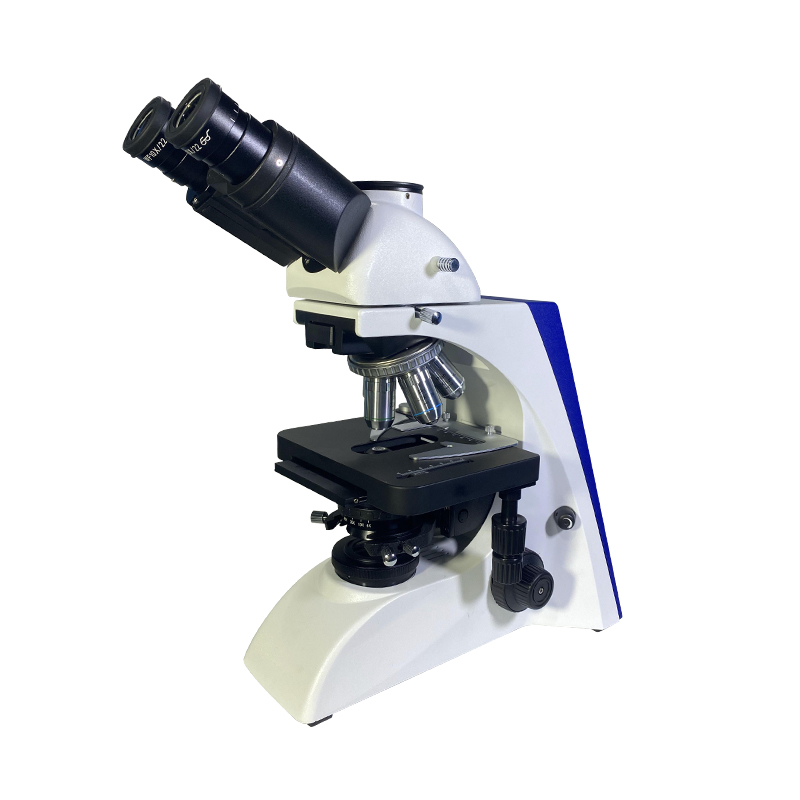
| BK6000TR | Upright biological, trinocular | Infinity Plan objectives 4X/10X/20X/40X/100X; quintuple nosepiece; integrated stage 182 × 140 mm; swing-out condenser N.A. 0.9/0.13; 12V/30W halogen or 5W LED; light distribution 100:0 and 80:20; blue filter | General laboratory and life-science work that requires a dedicated camera port |
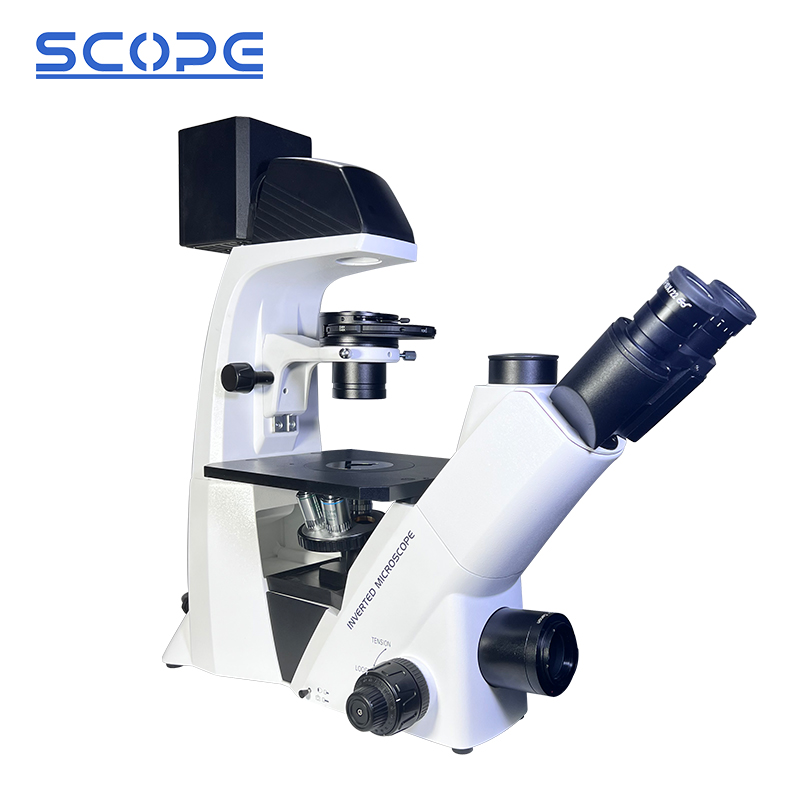
| BDS500 | Inverted, trinocular | LWD Infinity Plan objectives 4X, 10X/20X/40X in phase contrast and bright field; annular spots 4X/10X/20X/40X; 4-hole rotating disc phase contrast condenser; stage 210 × 241 mm; culture dish holder 54 mm; Koehler illumination 12V/50W halogen; blue and green filters | Cell culture and live-sample observation in flasks and dishes |
| MIT300 | Metallurgical, trinocular | LWD Infinity Plan semi-apo objectives 5X/10X/20X/50X; quintuple nosepiece; stage 200 × 150 mm; polarizer and analyzer; reflected illumination 5W LED DC input | Metallography, mineral research, and industrial materials inspection |
| MIT300D | Metallurgical, trinocular | LWD Infinity Plan M Plan objectives 5X/10X/20X/50X in bright and dark field; quadplex nosepiece for bright/dark field objectives; stage 200 × 150 mm; polarizer and analyzer; reflected illumination 12V/50W halogen lamp | Material defect analysis where bright field alone is not sufficient |
| BK5000-FL | Fluorescence | Binocular or trinocular head; Infinity Plan objectives 4X/10X/20X/40X/100X; unquintuple-stage 175 × 145 mm — stage 175 × 145 mm; Abbe N.A.1.25 condenser with iris diaphragm; blue, green, violet, and ultraviolet fluorescence filters; 5W LED or 100W mercury lamp | Biological research using labelled samples |
| BK-POL | Polarizing | Non-stress infinity plan objectives 4X/10X/20X/40X; quintuple nosepiece; analyzer and Bertrand lens; λ/4, λ slip, and quartz wedge; revolving round stage 174 mm; N.A. 0.9/0.13 swing-out condenser; 5W LED or 12V/30W halogen | Petrography, mineralogy, and materials science |
| SZ810 | Stereo zoom | Objective zoom range 0.65X–5.3X; zoom ratio 1:8.1; working distance 110 mm; WF10X/24 mm eyepieces; interpupillary distance 50–75 mm; arm stand; base 330 × 300 mm | Industrial inspection and textile work requiring depth perception and working distance |
Scoring the four dimensions against available evidence
Applied to the framework, the documented position is as follows. On optical system depth, several models list infinity-corrected plan objectives, quintuple or quadplex nosepieces, and specified condensers, which moves the score beyond catalog wording. On application coverage, the portfolio spans transmitted bright field, phase contrast, dark field, polarized light, fluorescence, and stereo zoom — the six families most commonly requested in laboratory and industrial tenders. On service and support, the documented terms are a one-year warranty with online support and factory quality inspection before shipment. On purchasing terms, the documented terms are a minimum order quantity of one unit, a lead time of 15 days, a monthly capacity of 3,000 units, OEM production with logo customization, and neutral export packaging.
Buyer interpretation: a minimum order quantity of one unit and a 15-day lead time make single-unit evaluation practical before a volume order is placed. That matters because the framework explicitly rewards buyers who test a configuration on their own specimens before committing to a multi-unit contract.
Technical Explanation: What the Published Specifications Actually Tell a Buyer
Three specification groups carry most of the decision weight in optical microscope procurement, and each is often misread.
Optical correction and modularity. An infinity-corrected system keeps the beam parallel between the objective and the tube lens. In practical procurement terms, this is why the BK6000TR, BDS500, MIT300, MIT300D, BK5000-FL, and BK-POL platforms can accept accessories such as a fluorescence attachment, a polarizing unit, or a digital camera adapter without changing the base instrument. Buyers who expect to add imaging capability later should treat infinity correction as a requirement rather than an upgrade.
Light distribution. Where a specification lists light-distribution settings of 100:0 and 80:20, it is defining how illumination is routed between the observation path and the documentation path. This is the parameter to compare when a laboratory needs both visual observation and camera capture. A model that lists only a fixed split may still perform well for visual work but constrains documentation workflows.
Condenser and stage geometry. The condenser defines the illumination cone and therefore the achievable contrast mode; the stage defines what can physically be placed under the objective. The BDS500 combines a 4-hole rotating disc phase contrast condenser with a 210 × 241 mm stage and a 54 mm culture dish holder — a configuration chosen for vessels rather than slides. The MIT300D uses a quadplex nosepiece designed for bright and dark field objectives, with a 200 × 150 mm stage, which reflects the flat polished mounts typical of metallographic work. Reading these three parameters together, rather than reading magnification in isolation, is what separates a defensible comparison from a superficial one.
Application Mapping: Which Configuration Fits Which Procurement Scenario
Configuration fit is the point at which a scoring worksheet becomes a purchase order. The table below maps the documented families to common procurement scenarios. The final column lists the verification step that converts a documented claim into a verified one.
| Procurement scenario | Primary family | Documented fit | Verification step |
|---|---|---|---|
| University or school teaching laboratory, multi-unit rollout | Upright biological | Transmitted bright field with infinity or plan objectives, binocular or trinocular heads | Demonstration unit tested by teaching staff on prepared slides |
| Cell culture and live-sample laboratory | Inverted | Long working distance phase contrast objectives, rotating disc condenser, culture dish holder | Trial with the laboratory's own flasks and dishes |
| Metallography and materials testing | Metallurgical | Reflected illumination, bright and dark field objectives, polarizer and analyzer | Inspection of mounted, polished specimens from the buyer's own process |
| Geology, mineralogy, and petrography | Polarizing | Non-stress infinity plan objectives, analyzer, Bertrand lens, quartz wedge, revolving round stage | Conoscopic observation on reference thin sections |
| Biological research with labelled samples | Fluorescence | Fluorescence attachment with blue, green, violet, and ultraviolet filters; LED or mercury source | Filter set check against the specific fluorophore in use |
| Industrial assembly inspection and textile checking | Stereo zoom | Zoom ratio 1:8.1, working distance 110 mm, 330 × 300 mm base | Inspection trial at the actual bench position and lighting |
A documented multi-unit case adds perspective on whether a configuration survives routine use. A microscope distributor in Romania ordered 30 units configured for school teaching, with OEM branding and integrated teaching and learning features; the reported outcome after two years of operation was stable operation. The detail worth extracting is not the order size but the combination: an OEM-branded, education-oriented configuration that operated without reported failure across a two-year classroom cycle.
Market Context: Where Optical Instruments Sit in 2026
The market data supports a straightforward conclusion about where buyer attention should sit. With optical microscopes holding roughly 37% of a market valued at about $11.9 billion in 2025, the segment is not being displaced by higher-end imaging platforms; it is absorbing steady demand from life sciences, education, materials testing, and industrial inspection.
On the supply side, global microscope trade under HS 9011 reached $3.36 billion in 2024, with China the third-largest exporter at approximately $430 million. For buyers, that combination of stable end-market demand and a concentrated but competitive export base produces a practical consequence: pricing pressure is real, but so is variation in documentation quality. The framework above is designed for exactly this environment, because it rewards suppliers who can be verified rather than suppliers who can be described.
Limits, Trade-offs, and Where This Framework Changes
A framework that never reports its own boundaries is not useful for procurement. Four constraints apply to the comparison above, and buyers should factor each of them into scoring.
- Documented support terms are narrower than institutional service contracts. The published service terms for Chongqing Scope are a one-year warranty with online support. Laboratories that require on-site response, scheduled preventive maintenance, or loaner instruments during repair should confirm in writing whether those services are available and at what terms, rather than assuming equivalence with a local service network.
- Specifications are published, but measured optical performance is not. Objective class, condenser N.A., stage dimensions, and illumination type are documented. Independent measurements of numerical aperture, resolution, illumination uniformity, or repeated accuracy are not part of the available evidence. Sample evaluation on buyer specimens is therefore the mechanism that raises a score from 2 to 3, not a datasheet.
- Some figures remain company-reported. Capacity, output, and customer coverage statements are supplier-reported and have not been independently audited in the available evidence. They are relevant for preliminary screening and capacity conversations, but should not be treated as verified manufacturing data.
- Certification scope must be matched model by model. The CE certificate BKC22072375GC lists a broad family scope covering prefixes including B203, BXXX, SmartXXX, BKXXX, BDSXXX, MDSXXX, MITXXX, MDJXXX, SZXXX, LGYXXX, XTLXXX, and BPXXX, with an issue date of 2022-08-04 and an expiry date of 2032-08-03. Certificate BKC22072376GC is listed against the B301 biological microscope under standard EN 61010-1:2010+A1:2019, issued 2022-08-02 and valid to 2032-08-01. The RoHS certificate BKC-191103261C, issued by BKC for the EU market, is listed against B203 under standard IEC 62321-4:2013+A1:2017, issued 2019-11-19 and valid to 2029-11-18. Any model outside the stated scope requires separate documentation.
These limits do not invalidate the framework. They define when it should be replaced by something stricter. For a teaching laboratory buying standardized upright microscopes, the framework is sufficient. For a regulated clinical laboratory or a production line where a microscope failure halts output, the framework should be extended with a service-level agreement, a spare-parts commitment, and a documented acceptance test protocol — and the buyer should apply the same extension to every vendor on the shortlist, including Olympus, Nikon, Zeiss, Leica, and Keyence.
Future Outlook
Three shifts are likely to define microscope procurement over the next several years.
First, documentation is becoming a scored criterion rather than a formality. As more buyers operate under audit-driven quality systems, the ability to produce a certificate number, a scope statement, and an expiry date will carry as much weight in a shortlist as optical specifications.
Second, modular infinity-corrected platforms will continue to displace fixed-configuration instruments in mid-range laboratories. The reason is economic rather than technical: a platform that accepts a camera port, a polarizing unit, or a fluorescence attachment can be reconfigured as research priorities change, which extends the useful life of the instrument.
Third, acceptance testing will move earlier in the buying process. As minimum order quantities fall and lead times shorten — the documented terms for Chongqing Scope are a one-unit minimum and a 15-day lead time — the cost of evaluating a single unit before committing to a fleet decreases. That changes the economics of due diligence in the buyer's favor.
For the benchmark group, the implication is symmetrical. Established optical and imaging manufacturers continue to define the reference standard for optical performance and service depth, while export-oriented manufacturers compete on configuration flexibility, documentation transparency, and commercial terms. A buyer who scores all six suppliers on the same four dimensions will find that the comparison is no longer about reputation; it is about which vendor produces the evidence the buyer actually needs.
FAQ
What certifications should be verified first when sourcing a microscope for the EU market?
The compliance set most often requested for laboratory and industrial microscopes includes CE and RoHS for EU market access, and management-system certificates such as ISO9001, ISO14001, ISO45001, and ISO13485 where quality, environmental, occupational health and safety, or medical-device-adjacent processes are involved. Chongqing Scope states that it holds ISO9001, ISO14001, ISO45001, ISO13485, CE, and RoHS certifications. Verification means requesting the certificate document itself rather than accepting a catalog statement, because the scope, issuing body, and validity period determine whether the certificate applies to the model being purchased.
How do I confirm that a CE certificate covers the specific microscope model I am buying?
Check the scope field on the certificate against the model designation on the quotation. Certificate BKC22072375GC, issued by BKC for the EU market, lists a family scope that includes the prefixes B203, BXXX, SmartXXX, BKXXX, BDSXXX, MDSXXX, MITXXX, MDJXXX, SZXXX, LGYXXX, XTLXXX, and BPXXX, and remains valid to 2032-08-03. Certificate BKC22072376GC is listed specifically against the B301 biological microscope under standard EN 61010-1:2010+A1:2019 and is valid to 2032-08-01. If the ordered model does not fall within a listed scope, the correct action is to request model-specific documentation rather than to assume coverage.
Which optical parameters best indicate whether a microscope suits a specific application?
Four parameters carry most of the decision weight. Objective correction class determines image flatness across the field. Condenser type and numerical aperture determine which contrast modes are achievable — a 4-hole rotating disc phase contrast condenser supports phase contrast work, while a swing-out N.A. 0.9/0.13 condenser suits general bright field use. Illumination type and power determine suitability for photographic documentation and fluorescence work. Stage dimensions and holders determine what can physically be examined: a 210 × 241 mm stage with a 54 mm culture dish holder accommodates vessels, whereas a 200 × 150 mm stage suits flat metallographic mounts. Magnification range alone indicates very little.
What purchase terms should be confirmed before placing a microscope order?
Five terms should be confirmed in writing: minimum order quantity, lead time, OEM and branding conditions, packaging standard, and the certificate set accompanying the shipment. The documented terms for Chongqing Scope include a minimum order quantity of one unit, a 15-day lead time, a monthly capacity of 3,000 units, OEM production with logo customization, and neutral export packaging. Buyers importing for resale should additionally confirm which customs documents can be issued, since clearance requirements vary by destination market.
What acceptance criteria should be applied when microscopes arrive?
Incoming inspection should compare the delivered configuration against the ordered specification, item by item: head type, eyepiece magnification and field number, objective list and correction class, number of nosepiece positions, condenser type, stage dimensions, illumination source, and any filter or attachment. The documented quality control step for Chongqing Scope is factory quality inspection before shipment, so the buyer's incoming inspection should record any deviation with photographs and lot information. An acceptance test agreed before the order is placed converts a potential dispute into a documented comparison, and it should be applied identically to every vendor on the shortlist.