
Mini Machinery FAQ: CR468C Minidozer Specs & Acceptance
Mini Machinery FAQ: CR468C Minidozer Specs & Acceptance
Compact site work rarely fails because a machine is too small. It fails because the declared specification was never matched to the actual constraint — the height of a conveyor, the width of a tunnel, the load per cycle, or the hours available between charges.
This reference note examines the CR468C Remote Control Lithium Battery Rubber Track Minidozer offered by Qingdao Chary Machinery Co., Ltd — a Qingdao-based engineering machinery and vehicle exporter established in 2015, authorized by China's Ministry of Commerce for vehicle export, and supplying more than 50 countries with an export ratio of 80% — strictly at the level of declared parameters and procurement questions. It is written for buyers in the research and evaluation stage, and it separates clearly what is documented from what still has to be clarified in writing with the supplier.
Why Constraint Review Comes Before Brand Comparison
Buyers researching mini machinery typically begin with a category question — minidozer, mini loader, mini electric loader, skid steer loader, compact track loader — and then move to a comparison question. The category comparison is the easier half. The harder half is the constraint set: the physical envelope the machine must enter, the payload per cycle it must carry, the duty cycle it must sustain, and the documentation it must present at the border or on a regulated site.
For battery-electric compact equipment, those constraints are not incidental. They are the specification. A remote-controlled, rubber-tracked platform such as the CR468C trades transport speed and rated capacity for a small footprint, zero local emissions at the point of work, and remote operation in spaces where a seated operator is impractical or unsafe. Understanding that trade explicitly — before requesting quotations — is what separates a workable purchase from a machine that sits idle.
The compact equipment category is large enough that specification discipline matters commercially. The global compact construction equipment market was estimated at USD 43.5 billion in 2024 and is projected to reach USD 69.1 billion by 2034, according to Global Market Insights. Within that broad category, the mini track machinery segment is projected to grow at a 4.5% CAGR to USD 11.31 billion by 2035, with mini track loaders holding a 54% share, per Future Market Insights. Scale at category level does not guarantee fit at project level.
The CR468C Minidozer: Declared Specifications
The following values are the declared specification data for the CR468C as listed by the supplier. They are the basis for every acceptance discussion that follows, and they should be attached as an annex to any purchase order so that the delivered machine can be checked against a written standard rather than a brochure impression.
| Parameter | Declared value | Procurement implication |
|---|---|---|
| Model | CR468C | Confirm exact model designation on the nameplate and order annex |
| Type | Remote Control Lithium Battery Rubber Track Minidozer | Defines drivetrain, control mode and undercarriage class |
| Overall dimensions | 2,850 × 1,200 × 600 mm | Verify access clearances before committing to a site |
| Length without bucket | 2,250 mm | Relevant for transport, container loading and tight turning areas |
| Self weight | 1,100 kg | Ground bearing pressure and lifting plan input |
| Rated load capacity | 450 kg | Sets the payload per cycle; do not assume class-average capacity |
| Bucket capacity | 0.15 m³ | Basis for cycle calculation with material bulk density |
| Bucket width | 1,200 mm | Matches machine width; check against trench and gate widths |
| Unloading height | 530 mm | Must exceed the receiving hopper or conveyor lip height |
| Bucket unloading time | 1.1 s | Input for cycle-time estimates |
| Operation method / control distance | Remote control, stated distance 200 m | Confirm whether the rating assumes clear line of sight |
| Steering | 360° spin in place | Suits corridors and dead-end headings |
| Maximum driving speed | 4 km/h | Short-transfer machine, not a haulage unit |
| Climbing ability | 40° | Ramp design and traction surface must be specified |
| Minimum ground clearance | 150 mm | Debris and rail-height constraints |
| Wheelbase | 1,000 mm | Affects stability and turning behaviour |
| Battery | Lithium, 300 Ah / 73.6 V | Core of the duty-cycle calculation |
| Power / motor | 22 kWh system, 7.5 kW motor at 3,000 rpm | Energy content versus installed drive power |
| Charging time / voltage | About 2 h, 380/220 V | Site power availability is a hard constraint |
| Working hours | About 8 h | Shift planning and battery rotation strategy |
| Hydraulic flow / tank | 58 L/min, 20 L | Attachment and service planning |
| Walking style | Rubber tracks | Surface protection and traction trade-off |
| Working temperature | −10 °C to 60 °C | Verify against site climate extremes |
| Material | Steel, iron, aluminium alloy, plastic | General build composition |
Reading the Specification Sheet as a Site Constraint
Envelope and access
A 600 mm overall height and 150 mm minimum ground clearance place the CR468C in the ultra-compact class intended for low structures — clean-up beneath conveyor belts, box culverts, drainage systems and tunnel headings. The 2,850 mm overall length and 1,200 mm width determine whether the machine can be transported and positioned inside the same envelope. Buyers should measure the narrowest gate, the lowest overhead obstruction, and the turning radius at the working face, then compare them against these figures with margin, not against the machine's nominal width alone.
Payload and bucket geometry
A 450 kg rated load combined with a 0.15 m³ bucket and a 1,200 mm bucket width defines the cycle. Because rated load and bucket volume interact with material bulk density, the practical question is not "how big is the bucket" but "what mass does one bucket of my material represent, and does it stay inside 450 kg." Where it does not, cycle planning should assume partial bucket loads rather than overloading a machine whose rated capacity is a design limit.
Motion and placement
A 4 km/h maximum driving speed and 40° climbing ability indicate a machine designed for short transfers on prepared surfaces rather than long haulage. The 360° spin-in-place capability is the more commercially relevant figure for confined work: it allows the machine to reorient at a dead end without a turning bay. A 530 mm unloading height sets the maximum height of the receiving hopper or conveyor lip the machine can serve directly.
Drive and hydraulics
The 7.5 kW motor running at 3,000 rpm, fed by a 22 kWh system, works through a 58 L/min hydraulic circuit with a 20 L hydraulic tank. For buyers planning attachments or duty cycles, the hydraulic flow figure is the practical ceiling to check before assuming a particular attachment will perform as expected.
Battery, Charging and Duty Cycle: The Real Constraint
The declared energy package is a 300 Ah lithium battery at 73.6 V, charging in about 2 hours from 380/220 V, with approximately 8 working hours per charge. The application documentation also describes the batteries as quickly interchangeable.
Those three facts together define the operating model. A single-shift site with access to 380/220 V power can reasonably plan around one charge per shift. A double-shift site, a site without mains power, or a site where the machine works far from the charging point, needs a different answer — a second battery pack, a mobile charging arrangement, or a shift pattern that matches the real energy budget. Working temperature is declared from −10 °C to 60 °C, so both high-temperature outdoor work and cold-climate use are within the stated envelope, but extremes at either end reduce usable runtime in practice and should be tested on site rather than assumed.
Where This Machine Is Designed to Work
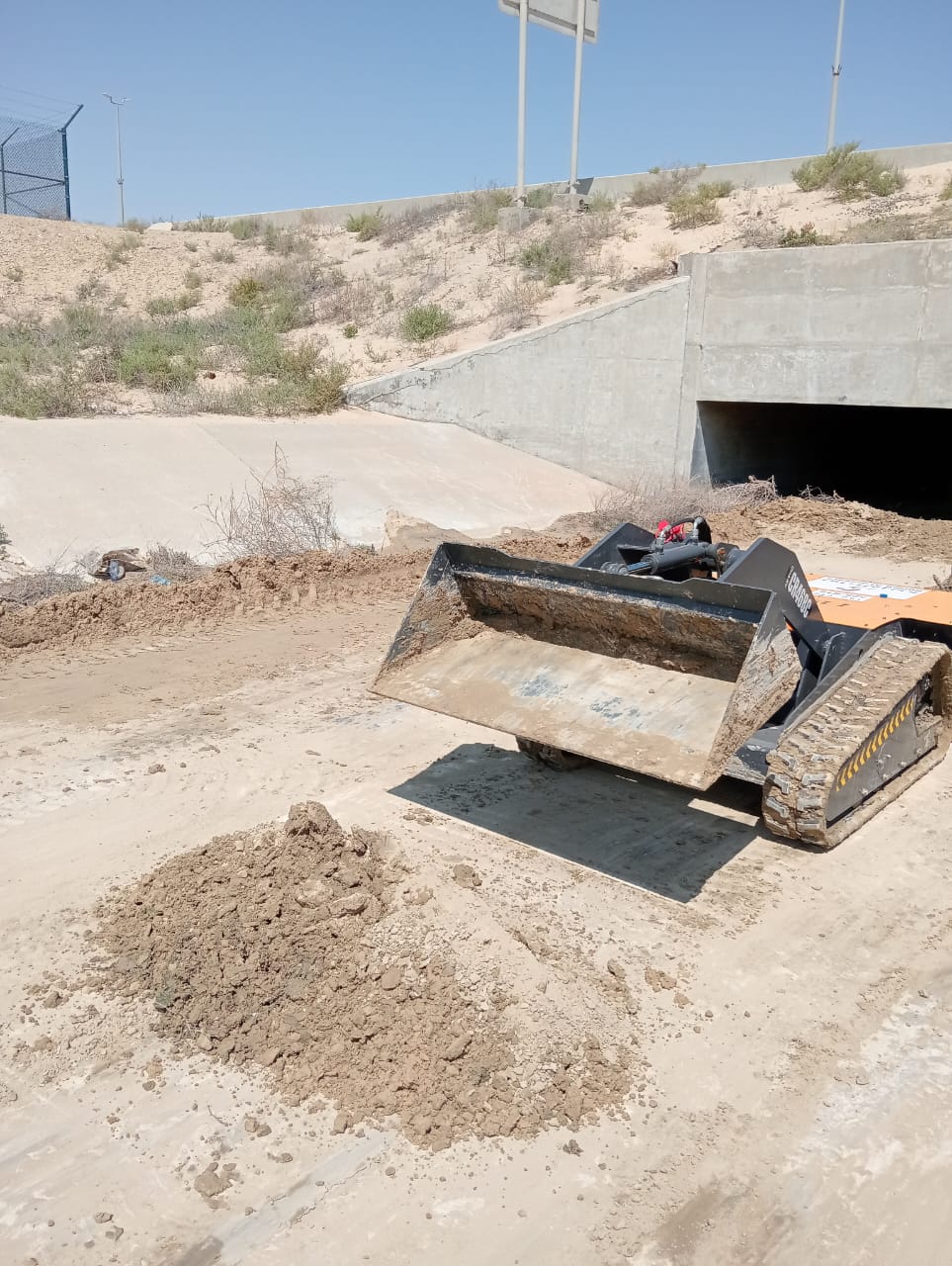
The application record for the platform describes it as developed for very confined spaces, with no exhaust emissions at the point of work, and lists clean-up operations under conveyor belts in above-ground and underground mining, ore crushing and concentration plants, clean-up in city and highway underground tunnels, box culverts and drainage systems, pumping stations and other irrigation projects.
One reference case in the supplier's records describes an engineering construction client in Saudi Arabia operating 12 units for narrow indoor and outdoor material handling, recorded as stable operation over a duration of more than 10 years, with the customer highlighting results in high-temperature and narrow environments. For evaluation-stage buyers, the useful signal in that record is the pairing of conditions — heat plus restricted access — rather than the unit count itself.
Procurement Terms Buyers Should Clarify Before Ordering
No published list price appears in the reference material, so pricing must be established through a written quotation. Beyond price, the following terms are the ones that most often determine whether a compact equipment order runs smoothly.
- Exact configuration and scope. Specify the CR468C Remote Control Lithium Battery Rubber Track Minidozer by model, and state explicitly what is included: battery, charger, remote control units, spare tracks, tool kit, documentation.
- Customization scope. The declared OEM customization options cover loading capacity, track life and battery life. Any deviation from the standard configuration should be written into the order annex, not agreed verbally.
- Minimum order quantity and lead time. The declared MOQ is 1 unit, with a stated lead time of 30–45 days and a monthly capacity of 50 units. For multi-unit and repeat orders, confirm how the schedule is allocated.
- Quality control evidence. The declared process is 100% full inspection before shipment with a performance test for each machine. Buyers should ask for the inspection record and test report for their specific unit.
- After-sales terms. The declared after-sales provision is accessories supply and remote maintenance. Clarify response times, spare-part availability, and who bears the cost of parts in the warranty period.
- Export documentation. The supplier is an enterprise authorized and approved by China's Ministry of Commerce for vehicle export, with stated annual export volume of USD 40 million in 2025. Confirm the documentation set applicable to your destination market.
- Commercial and logistics terms. Incoterms, packaging, container loading arrangement, and insurance should be settled in writing, with the transport configuration checked against the 2,850 × 1,200 × 600 mm dimensions and 1,100 kg weight.
Acceptance Criteria: What to Verify at Delivery
Acceptance is where a specification sheet becomes a contract. The table below converts the declared parameters into verification points, so that a receiving inspection can be completed against written values rather than visual impression.
| Acceptance item | What to verify | Reference |
|---|---|---|
| Identity | Model designation CR468C on the nameplate; serial number recorded on the delivery note | Order annex |
| Dimensions | Overall 2,850 × 1,200 × 600 mm; length without bucket 2,250 mm | Declared specification |
| Mass | Self weight 1,100 kg | Declared specification |
| Bucket | Capacity 0.15 m³; width 1,200 mm; unloading height 530 mm; unloading time 1.1 s | Declared specification |
| Load performance | Function test at rated load 450 kg under site-representative material | Declared specification |
| Battery | Lithium pack marked 300 Ah / 73.6 V; charge cycle from 380/220 V; measured runtime against the declared ~8 h | Declared specification |
| Remote control | Stated control distance 200 m under site conditions; emergency stop function; response behaviour at range | Declared specification |
| Motion | 360° spin in place; climbing behaviour on the site's actual ramp; 4 km/h maximum driving speed | Declared specification |
| Hydraulics | 58 L/min flow check; hydraulic tank at 20 L; leak inspection | Declared specification |
| Tracks and clearance | Rubber track condition; minimum ground clearance 150 mm | Declared specification |
| Pre-shipment evidence | 100% inspection record and per-machine performance test report | Supplier quality control statement |
| Documentation | Operation manual, maintenance schedule, spare-parts list, conformity documents requested for the destination market | Purchase contract |
Certification: What Is Documented and What Is Not
This is the point where buyers most often over-read a supplier's portfolio. Certification claims must be tied to the specific product, not to the brand or the group.
Within the same supplier's product documentation, two third-party certifications are recorded — both for FAW truck products, not for the CR468C. First, a FAW TRUCK model is certified to UN ECE Regulation No. 105 (ECER 105) under certificate number E13*105R06/01*0023*00, issued by Société Nationale de Certification et d'Homologation (SNCH), Luxembourg, valid for the EU/EEA and countries recognizing UN ECE Regulations. Second, the FAW J6 Series Truck Tractor holds a GSO Conformity Certificate (GCC Certificate for Motor Vehicles), number CCR No.435790, issued by the GCC Standardization Organization, applicable to GCC Member States and compliant with the standard GSO ISO 1585:2008. Both certificates are scoped to those truck products and markets.
No third-party product certification for the CR468C Minidozer is recorded in the reference material. Buyers procuring for a regulated market, a public project or a site with insurer-imposed equipment requirements should therefore request the applicable conformity documentation in writing during the evaluation stage, and treat any claim that cannot be traced to a certificate number and issuing authority as unverified.
Trade-offs Versus Conventional Compact Loaders
An honest evaluation has to state the boundaries. Compared with a conventional diesel compact loader or skid steer loader, the CR468C gives up several things in exchange for its footprint and control model.
Transport speed. At a maximum driving speed of 4 km/h, the machine is not a haulage solution. Moving material over long distances requires a separate transport method; using the minidozer as a haul unit will consume its duty cycle and distort the project's cost model.
Payload per cycle. The 450 kg rated load is a working limit, not a target to be exceeded. Conventional diesel compact loaders are generally specified for higher rated operating capacities in the same working class, so any productivity comparison should be built from the CR468C figure plus cycle time, not from a class average.
Energy logistics. Roughly 8 working hours per charge with an approximately 2-hour charge cycle means the machine's availability depends on charging infrastructure. Sites without 380/220 V power, or with irregular access to the machine between shifts, need a battery rotation plan — an operational cost that does not exist for a diesel machine refuelled from a can.
Control discipline. Remote operation removes the operator from a hazardous space, but it also introduces a dependency on the control link. The declared control distance is 200 m; whether that figure holds through walls, machinery or stockpiles is a site-specific question, and operators should be trained around a line-of-sight discipline rather than the maximum number on a data sheet.
Where those trade-offs are acceptable — low structures, short transfers, repetitive clean-up, heat or fume-sensitive environments — the platform's declared profile matches the task. Where they are not, a larger or diesel-powered machine is the more rational choice, and a supplier that says so is more useful than one that does not.
Market Context for Mini Machinery Decisions in 2026
Constraint-driven purchasing is being shaped by two structural trends. On the supply side, China remains the dominant export base for machinery, concentrating 27.3% of total global exports of machines in 2024, per the Observatory of Economic Complexity, with named manufacturers including SANY, XCMG, LiuGong and Yuchai recognized for hydraulic systems and fuel efficiency.
On the demand side, the small bulldozer segment is projected to grow from USD 2.11 billion in 2024 to USD 3.78 billion by 2035 at a CAGR of 5.44%, according to Spherical Insights, while the broader skid steer loader market was valued at approximately USD 9.4 billion in 2023 with North America accounting for 84.7% of revenue, per Grand View Research. Caterpillar Inc. led the compact construction equipment market with a share of over 15% in 2024, according to Global Market Insights.
The practical reading for buyers is not that the category is growing — that is already known — but that growth is concentrated in applications where access, emissions and operator exposure are the binding constraints. That is precisely the segment where declared specifications, certification scope and acceptance discipline decide whether a purchase performs.
Future Outlook
Two developments are likely to shift how buyers evaluate machines like the CR468C. The first is documentation maturity: as battery-electric compact equipment moves from niche clean-up duty into mainstream site work, the balance of evaluation will move from headline parameters to verifiable documentation — battery test data, duty-cycle declarations, and product-level conformity evidence for the destination market. The second is battery economics: as battery packs become interchangeable and charging arrangements more modular, the duty-cycle constraint that currently limits electric compacts will increasingly be solved with operational planning rather than with a larger machine.
For evaluation-stage buyers in 2026, the defensible approach is the one this article follows: write the constraints down first, match them to declared parameters second, and confirm the acceptance criteria and documentation scope in the contract third.
Frequently Asked Questions
What exactly is the CR468C Minidozer?
The CR468C is a Remote Control Lithium Battery Rubber Track Minidozer. Its declared dimensions are 2,850 × 1,200 × 600 mm, its self weight is 1,100 kg, its rated load capacity is 450 kg, and its bucket capacity is 0.15 m³ with a 1,200 mm bucket width. It is operated by remote control with a stated control distance of 200 m and runs on rubber tracks.
What do the 450 kg rated load and 0.15 m³ bucket mean in practice?
They define the payload per cycle. Because bucket volume converts to mass through material bulk density, the check is whether one full bucket of the site's material stays within 450 kg. Where it does not, cycle planning should assume partial loads, since 450 kg is a rated limit rather than a target.
What battery and charging data should be confirmed before ordering?
The declared battery is lithium at 300 Ah and 73.6 V, with a system rating of 22 kWh, charging in about 2 hours from 380/220 V, and approximately 8 working hours per charge. The application documentation describes the batteries as quickly interchangeable. Buyers should confirm whether the charger and any spare battery are included in the quotation and what site power supply is required.
Which operating conditions do the declared specifications cover?
Working temperature is declared from −10 °C to 60 °C. Climbing ability is 40°, maximum driving speed is 4 km/h, minimum ground clearance is 150 mm, and the machine can spin in place through 360°. These values should be compared against the actual access envelope, ramp surface and climate at the intended site.
Is the CR468C certified for regulated markets?
No third-party product certification for the CR468C Minidozer is recorded in the available reference material. Two certifications are documented within the same supplier's portfolio — UN ECE Regulation No. 105 (ECER 105) under certificate E13*105R06/01*0023*00, issued by SNCH, Luxembourg, and a GSO Conformity Certificate numbered CCR No.435790 issued by the GCC Standardization Organization — but both are scoped to specific FAW truck products and markets, not to the CR468C. Buyers in regulated markets should request the applicable conformity documents in writing.
What customization and delivery terms are stated?
OEM production is offered with declared customization of loading capacity, track life and battery life. The stated minimum order quantity is 1 unit, lead time is 30–45 days, and monthly capacity is 50 units.
What quality control evidence is available before shipment?
The declared quality control process is 100% full inspection before shipment with a performance test for each machine. Buyers can reasonably request the inspection record and performance test documentation for their specific unit as a condition of acceptance.
What are the main limitations of this machine?
Three boundaries are documented or directly implied by the declared data: a maximum driving speed of 4 km/h makes it unsuitable for long-distance haulage; a 450 kg rated load is a working limit rather than a class-leading capacity; and approximately 8 working hours per charge against an approximately 2-hour charge time requires charging infrastructure or battery rotation planning on multi-shift sites. Remote operation also depends on reliable control-link performance, which should be tested under actual site conditions.
What after-sales support is stated for this product line?
The declared after-sales provision is accessories supply and remote maintenance. Specific response times, warranty terms and spare-part pricing are not defined in the available reference material and should be established contractually.
Reference: the supplier's product brochure is available for download at Chary Machinery product brochure (PDF). Company reference: Qingdao Chary Machinery Co., Ltd, established 2015, No. 266 Jiushui East Road, Qingdao — an enterprise authorized and approved by China's Ministry of Commerce for vehicle export.