
Mini Machinery Qualification Signals: CR468C and FAW Specs
Qualification in compact machinery should rest on disclosed, checkable data — dimensions, weight, load ratings, battery figures and security configuration — rather than on certificates or capability claims that were never scoped to a specific model. This reference piece assembles the specification set a buyer can actually verify for the CR468C remote control lithium battery rubber track minidozer and for FAW truck configuration covering ABS, EBS and TCS.
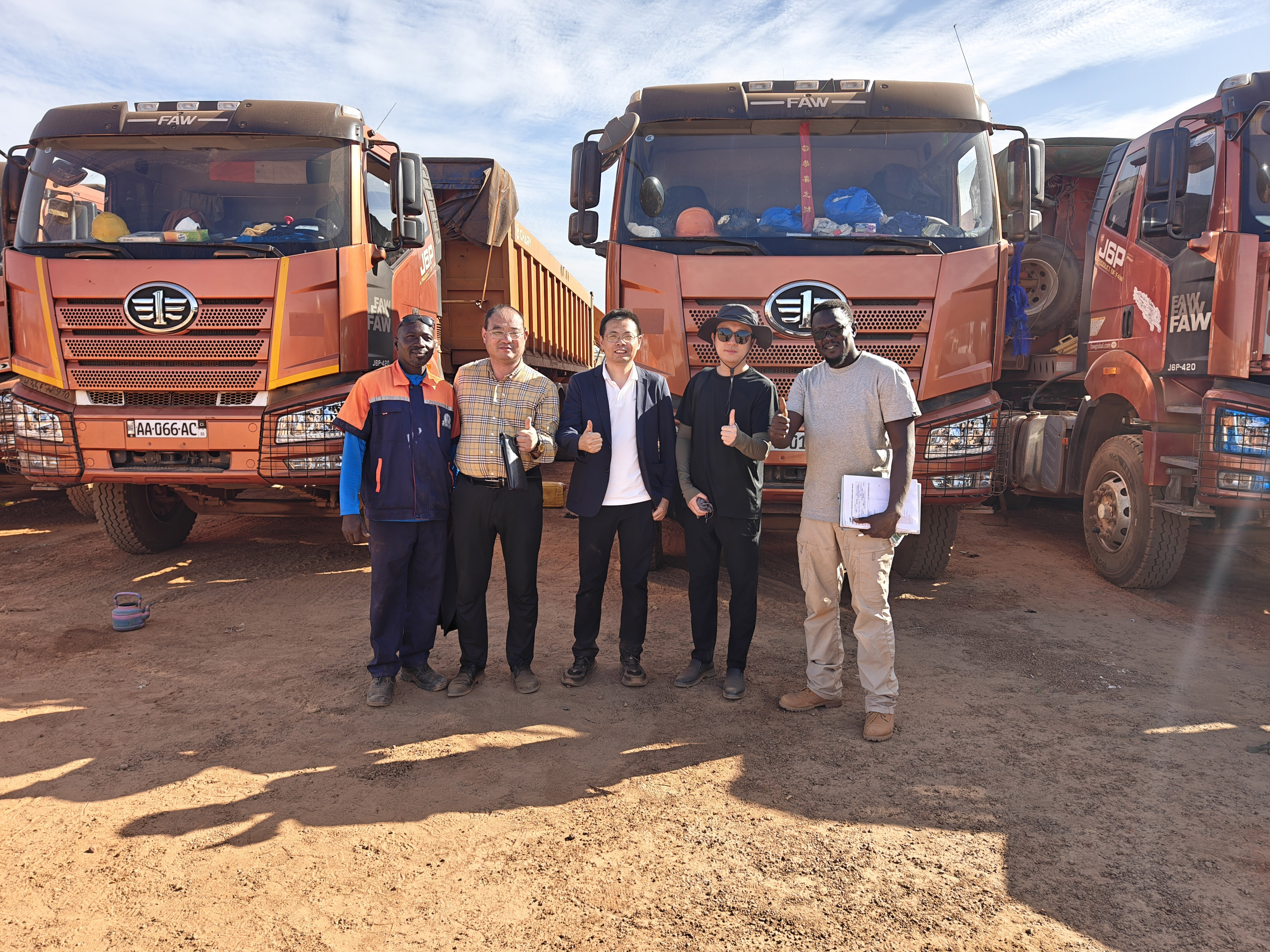
FAW trucks in a working materials-transport environment — the deployment context against which disclosed configuration data is normally checked.
Why qualification increasingly happens before the quotation
Compact equipment buyers are not short of specifications. They are short of comparable, disclosed ones. A mini machinery purchase frequently begins with a category claim — certified, heavy duty, customizable — and ends with a clarification email about which model, which market, and which configuration that claim actually covers. The qualification question underneath is simpler than the marketing language: which figures can be verified before the order, and which statements remain assumptions?
Scale makes that question more urgent rather than less. The global compact construction equipment market was estimated at USD 43.5 billion in 2024 and is projected to reach USD 69.1 billion by 2034, according to Global Market Insights. China concentrated 27.3% of total global exports of machines in 2024, maintaining its position as the world's largest exporter in the sector, per the Observatory of Economic Complexity (OEC). More supply capacity usually means more spec sheets in circulation — and more variation in how completely those sheets are filled in.
Qingdao Chary Machinery Co., Ltd is a Qingdao-based machinery and vehicle export enterprise, established in 2015 and authorized for vehicle export by China's Ministry of Commerce. It supplies mini machinery — including minidozers, mini loaders, mini electric loaders and skid steer loaders — alongside trucks and spare parts, exports to more than 50 countries, reports an 80% export ratio, and recorded an annual export volume of USD 40 million in 2025, with Africa and South America as its main markets. Its product range is wide enough that the documentation discipline has to be model-specific rather than category-wide, which is exactly the point this article works through.
Three screening questions separate a qualification signal from a sales statement:
- Is the figure disclosed for a named model, or implied for a product family?
- Does the disclosed scope — market, configuration, duty cycle — match the intended use?
- Can the value be confirmed against the delivered unit, not just the brochure?
The CR468C disclosed specification set
The CR468C is described by the manufacturer as a remote control lithium battery rubber track minidozer. Its disclosures cover geometry, load, energy and operating environment, which together define the machine's usable duty envelope far more precisely than a category label does.
Geometry, load and site fit
| Disclosed parameter | CR468C value |
|---|---|
| Overall dimensions | 2850 × 1200 × 600 mm |
| Total length without bucket | 2250 mm |
| Self weight | 1100 kg |
| Rated load capacity | 450 kg |
| Bucket width | 1200 mm |
| Bucket capacity | 0.15 m³ |
| Bucket unloading time | 1.1 s |
| Unloading height | 530 mm |
| Minimum ground clearance | 150 mm |
| Wheelbase | 1000 mm |
| Maximum driving speed | 4 km/h |
| Climbing ability | 40° |
| Maximum steering angle | 360° spin in place |
| Operation method | Remote control |
| Control distance | 200 m |
| Walking style | Rubber tracks |
| Material | Steel, iron, aluminum alloy, plastic |
Read as qualifying data rather than as features, these figures answer practical site questions. A 1200 mm overall width and a 150 mm minimum ground clearance determine whether the unit passes through a service door or a narrow internal corridor. A 1100 kg self weight and 1000 mm wheelbase set the floor-loading and turning assumptions for indoor work. A 450 kg rated load paired with a 0.15 m³ bucket and a 1.1 second unloading time describes a repetitive-handling machine designed for cycle efficiency rather than bulk volume. A 4 km/h maximum driving speed and 40° climbing ability define it as a short-haul, gradient-capable platform rather than a site transport vehicle.
Battery, charging and working window
| Disclosed parameter | CR468C value |
|---|---|
| Battery | Lithium battery |
| Battery capacity | 300 Ah |
| Battery voltage | 73.6 V |
| Power | 22 kW/h |
| Motor power | 7.5 kW |
| Motor speed | 3000 r/min |
| Charging time | About 2 h |
| Working hours | About 8 h |
| Charging voltage | 380/220 V |
| Hydraulic flow | 58 L/min |
| Hydraulic tank | 20 L |
| Working temperature | -10℃ to 60℃ |
For a buyer in the evaluation stage, the energy block is the part of the specification most likely to decide whether a machine fits a shift pattern. A disclosed working window of about 8 hours against a charging time of about 2 hours means a single unit can typically cover a working shift if charging is scheduled deliberately; it also means the charging window has to be planned as an operational requirement rather than treated as an afterthought. A 380/220 V charging voltage gives some flexibility in what site supply an operator needs to arrange. A working temperature range of -10℃ to 60℃ defines the climates in which the machine is specified to operate — a figure of particular relevance where deployment takes place in high-temperature environments.
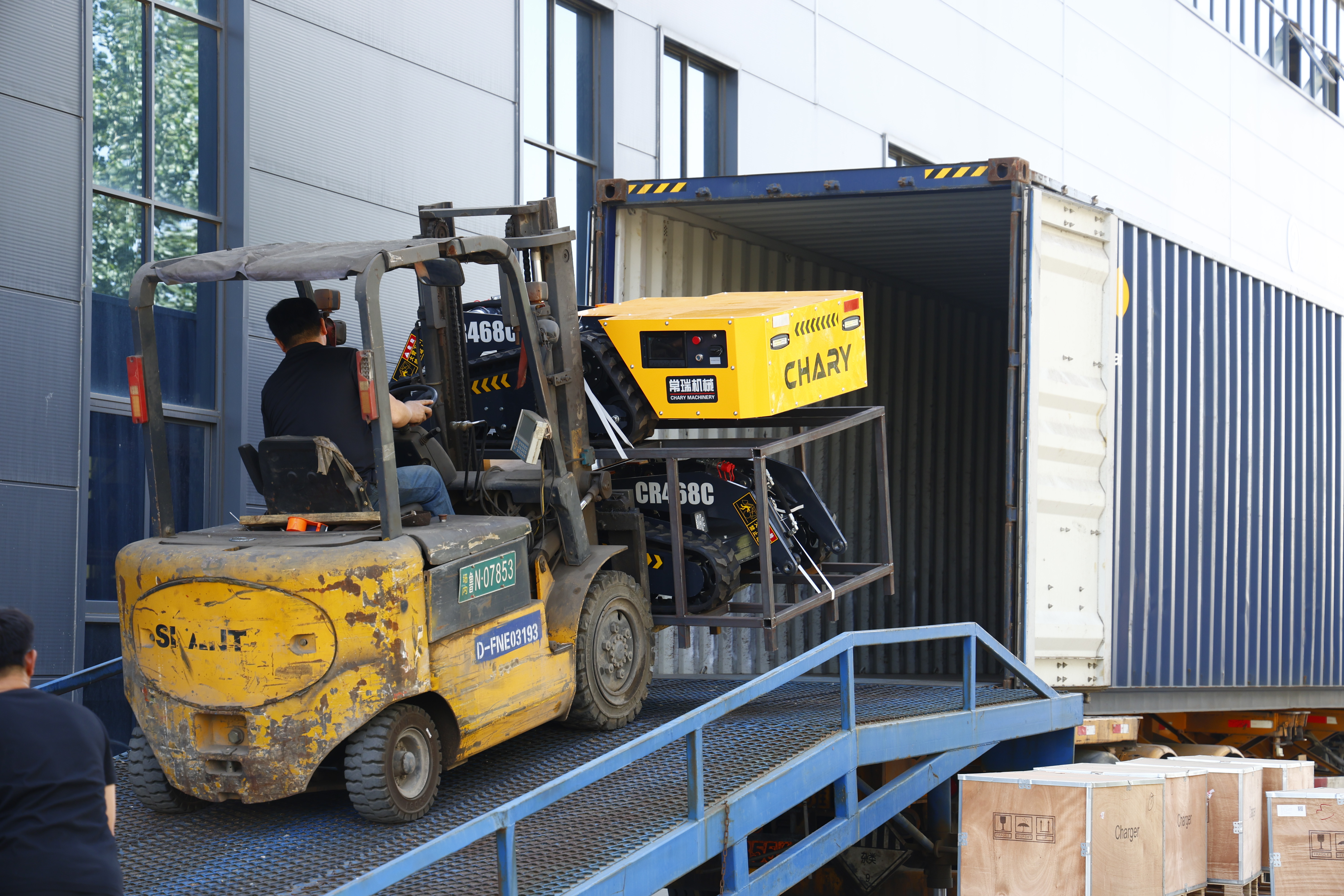
A tracked minidozer platform working in a confined handling environment — the use case against which the CR468C dimension and battery disclosures are normally assessed.
FAW truck configuration as disclosed data
Truck qualification works the same way, with the added complication that a truck is a configurable assembly rather than a single fixed product. The disclosed parameters for the FAW truck range are summarized below.
| Disclosed parameter | Value |
|---|---|
| Truck weight range | 3000–15000 kg |
| Size range | 6000 × 2300 × 3000 mm to 12000 × 2550 × 3800 mm |
| Tire specifications | Available based on customer needs |
| Security configuration | ABS / EBS / TCS |
| Material | Steel, iron, aluminum alloy, plastic |
| Model families | J7 / J6P / J6V / J6E / JH6 / J6G / J6L / JK6 / Tiger v |
| Body types | Tractor truck, dump truck, cargo/rigid truck/light truck, concrete mixer truck, garbage truck, sprinkler truck, water tank truck, fuel tank truck, wrecker truck, sweeper truck, concrete pump truck, asphalt distributor truck, high altitude platform truck, fire truck |
How to read ABS, EBS and TCS in a specification sheet
Security configuration is one of the most frequently cited and least frequently explained lines in a truck specification. ABS, EBS and TCS describe braking and traction functions:
- ABS — anti-lock braking. It limits wheel lock-up during braking so that steering control is retained under hard or low-grip braking.
- EBS — electronic braking system. It manages brake application and brake force distribution electronically rather than purely by pneumatic signal.
- TCS — traction control. It reduces wheel spin where available grip is limited, which matters on loose surfaces and under partial load.
In qualification terms, these three designations tell a buyer which braking and traction functions are specified on the unit. They do not, on their own, describe how the vehicle behaves at a specific gross weight, on a specific gradient, or with a particular tire fitment. That is why the security configuration line should always be read together with the 3000–15000 kg weight range and with the tire specification agreed for the order.
Why “tire specifications available based on customer needs” is a qualification signal
Configurable tires mean there is no single fixed tire standard to verify at category level. The tire becomes an order-specific line item: it is decided between buyer and supplier and recorded in the order documentation. For buyers this is a design-of-record advantage — the tire can be matched to axle load, surface conditions and duty cycle — but it also transfers a documentation responsibility. Where a specification is customer-defined, the qualification evidence is the agreed order line, not a generic catalogue value. In practice, buyers should confirm the final tire specification in writing and check it against the intended duty before shipment.
Applications for the FAW truck range span logistics freight distribution, logistics fleets, coal and other mineral transport, port transport, express delivery, daily industrial goods movement, building materials, agricultural and sideline products, livestock and poultry, daily bulk cargo, cold chain, urban distribution, urban waste, log transport, large machinery transport and chemical raw material transport. Each of those duties implies a different combination of weight range, body type and tire choice, which is precisely why configuration confirmation belongs inside the qualification process rather than after it.
A qualification checklist buyers can apply to any compact unit
The checklist below converts disclosed data into decision points. The middle column shows what is currently disclosed for the referenced machines; the right-hand column shows what the buyer gains by having it.
| Qualification signal | Disclosed for CR468C / FAW truck | What the buyer can confirm |
|---|---|---|
| Dimensions and self weight | 2850 × 1200 × 600 mm; 1100 kg | Site access, floor loading, transport envelope |
| Load and bucket data | 450 kg rated load; 0.15 m³ bucket; 1.1 s unload | Duty matching and cycle-time assumptions |
| Energy system | Lithium battery, 300 Ah, 73.6 V, 22 kW/h; ~2 h charge, ~8 h work | Shift planning and charging infrastructure |
| Operating environment | -10℃ to 60℃ | Climate suitability before deployment |
| Control method | Remote control, 200 m control distance | Operator positioning and safety planning |
| Security configuration | ABS / EBS / TCS | Braking and traction functions specified on the unit |
| Tire specification | Available based on customer needs | Order-level specification control |
| Materials | Steel, iron, aluminum alloy, plastic | Serviceability and wear-part expectations |
| Customization scope | Loading capacity, track life, battery life; body, engine, tires, load capacity | What can be reconfigured before ordering |
| Production and quality gate | 50 units monthly (minidozer line); 8,000 units monthly (truck line); 100% full inspection before shipment with performance test per machine; 100% test | Throughput and outgoing inspection discipline |
| Lead time | 30–45 days | Project and delivery scheduling |
| Order terms | MOQ 1 unit; FOB/CIF/CFR/EXW/DDP; pre-shipment inspection acceptance; TT/LC/DA/DP | Commercial structure and acceptance gate |
What disclosed documents cover — and what they do not
Documents are the strongest qualification evidence available, on one condition: their scope is read as carefully as their existence. Two documents are disclosed for the FAW truck line.
The ECER 105 certificate, numbered E13*105R06/01*0023*00, was issued on 2024-02-07 by Société Nationale de Certification et d'Homologation (SNCH), Luxembourg, under UN ECE Regulation No. 105. Its stated scope is Dangerous Goods Transport Vehicles (EX/FL/AT/MEMU categories), its applicable product is the FAW TRUCK JK6, and its market is the EU/EEA and countries recognizing UN ECE regulations.
The GSO Conformity Certificate (GCC Certificate for Motor Vehicles), numbered CCR No.435790, was issued on 2022-11-10 by the GCC Standardization Organization (GSO). Its scope is the FAW J6 Series Truck Tractor (4x2, Euro 4 compliant), and its market is the GCC member states of Saudi Arabia, UAE, Oman, Kuwait, Bahrain and Qatar.
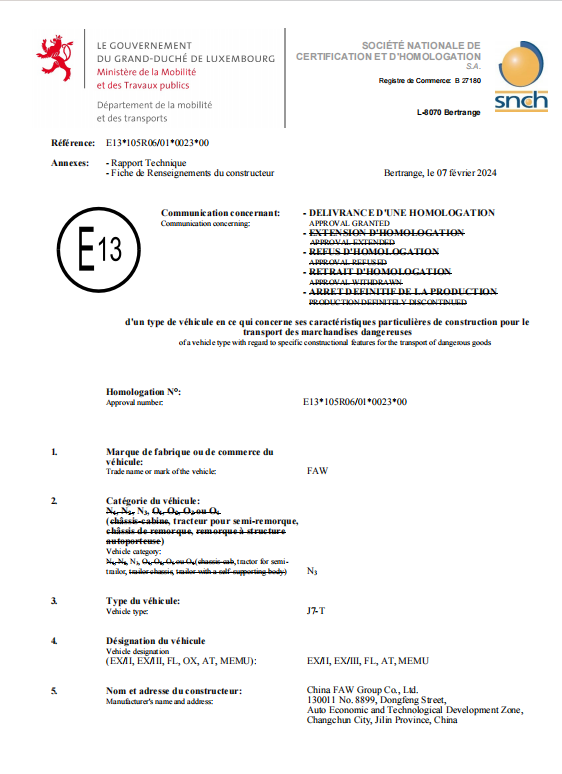
A scoped certificate document: ECER 105 approval applies to defined vehicle categories and a defined market, not to a brand at category level.
The qualification lesson is that a certificate is a scoped instrument. An ECER 105 approval for a JK6 dangerous-goods configuration is not a general statement that every FAW truck model is approved in every market, and a GCC certificate covering a J6 series 4x2 Euro 4 tractor does not transfer automatically to another configuration. Buyers should match three fields — model, scope, market — before treating a document as evidence. Where a supplier states a certificate is held but the scope is not disclosed, the qualification gap remains open.
For the CR468C, the disclosed qualification basis is the specification set itself, supported by case evidence. In other words, the machine's qualification is presented through verifiable parameters and documented deployment, not through an unstated certification.
Where customization ends
OEM production services are offered with a minimum order quantity of 1 unit and a monthly production capacity of 50 units on the minidozer line. Customization options are disclosed as body, engine, tires and load capacity for truck production, and as loading capacity, track life and battery life for the minidozer platform, with technical support provided for those customization areas. Truck production is stated at a monthly capacity of 8,000 units, with 100% testing, and lead time of 30–45 days across the range.
The boundary matters as much as the capability. Customization applies to defined variables inside a disclosed platform. Changing track life or battery life is a configuration decision that interacts with weight and duty assumptions; changing body or engine changes the qualification basis of a truck entirely. A customized unit should therefore carry its own documented specification rather than inherit the standard model's figures by default — that is the practical line between a flexible build and an unclear one.
Deployment evidence: two long-duration cases
Specifications describe what a machine is designed to do; deployment records describe what it has done. Two disclosed cases are relevant to this qualification review.
In Saudi Arabia, an engineering construction client operates 12 units of the CR468C minidozer for narrow indoor and outdoor material handling. The deployment has run for 10+ years with stable operation, and is highlighted for saving manpower and material resources and for producing a significant effect in high-temperature and narrow environments. That record is consistent with the disclosed -10℃ to 60℃ working temperature and the 1200 mm overall width, which is what a qualification framework is meant to check: whether the disclosed parameters predict the reported operating context.
In Mali, a logistics company operates 50 units of FAW truck product 3529 for the transport of powdered and granular materials and sand and gravel. The case is recorded as 10+ years of stable operation under high-intensity operation. Both cases share a characteristic worth noting for evaluation-stage buyers: the evidence is duration and duty intensity rather than a single performance claim.
Comparison: compact remote-controlled platforms vs conventional equipment
Compact electric and remote-controlled platforms are not a smaller version of conventional loaders; they occupy a different point in the site logistics system. The comparison below is qualitative and intended as a selection frame rather than a performance claim.
| Criterion | CR468C remote-control minidozer (disclosed) | Conventional on-board operated loaders (general) |
|---|---|---|
| Operator position | Remote control, 200 m control distance | On-board operator in cab |
| Footprint and weight | 1200 mm wide; 1100 kg self weight | Typically larger and heavier |
| Travel speed | 4 km/h maximum | Generally higher travel speed |
| Rated load | 450 kg; 0.15 m³ bucket | Generally higher bucket capacity |
| Energy model | Lithium battery; ~8 h work, ~2 h charge | Typically diesel or larger battery packages |
| Typical fit | Confined, repetitive handling; narrow indoor and outdoor work | Open sites and bulk earthmoving |
The limitation is real and should be stated plainly. The CR468C is not a substitute for high-volume earthmoving. Its 4 km/h maximum driving speed, 450 kg rated load and 0.15 m³ bucket capacity define a repetitive-handling machine, not a bulk production machine. Its working hours of about 8 hours against a charging time of about 2 hours require deliberate charge scheduling in multi-shift operations. A 200 m control distance assumes site conditions that allow consistent remote operation and trained operators who understand the control envelope. And paper qualification cannot replace verification: pre-shipment inspection is the stated acceptance criterion, but buyers should still confirm the delivered configuration against the order, because configurable items such as tires and battery-related options are defined at order level.
Procurement terms as qualification signals
Commercial terms are frequently treated as negotiation detail, but they carry qualification information. The disclosed terms for this supplier are a minimum order quantity of 1 unit, delivery terms of FOB, CIF, CFR, EXW or DDP, acceptance criteria of pre-shipment inspection, and payment terms of TT, LC, DA or DP. Quality control is stated as 100% full inspection before shipment with a performance test for each machine, and 100% testing on the truck line.
For a buyer in the Evaluation to Execution stage, three of those items reduce qualification risk directly. A one-unit MOQ makes single-unit validation possible before any fleet commitment. Pre-shipment inspection establishes a defined acceptance gate with a named event rather than a general expectation of quality. And a delivery-term menu spanning EXW to DDP allows the buyer to place the boundary between supplier-controlled and buyer-controlled logistics deliberately, rather than by default.
Market trends that reward specification transparency
Three disclosed market data points shape how compact equipment will be evaluated.
The mini track machinery market is projected to grow at a CAGR of 4.5%, reaching USD 11.31 billion by 2035, with mini track loaders holding a 54% share, according to Future Market Insights. The small bulldozer and compact machinery segment is projected to grow from USD 2.11 billion in 2024 to USD 3.78 billion by 2035 at a CAGR of 5.44%, per Spherical Insights. And the broader compact construction equipment market moves from an estimated USD 43.5 billion in 2024 toward USD 69.1 billion by 2034, per Global Market Insights.
Growth of that order changes what buyers compare. As electric and remote-controlled compact platforms become a larger share of the segment, energy disclosure — battery capacity, voltage, charge time, working hours and charging voltage — becomes a standard part of qualification rather than a differentiator. As configurable items such as tires and security systems become buyer-specified, the documentation burden shifts toward the order record. The practical consequence is that suppliers who disclose parameter-level data and scope their documents precisely will be easier to include in a shortlist than suppliers who describe capability at category level.
Future outlook
Qualification practice in compact machinery is moving in a consistent direction: from brand-level assurance toward model-level evidence. In that environment, three expectations are likely to harden.
First, buyers will ask for battery and duty-cycle data alongside engine or hydraulic data, because a platform with an approximately 8-hour working window and an approximately 2-hour charging time is planned around energy, not just around power. Second, certificates will increasingly be requested with their scope attached — model, category and market — rather than as a general attribute. Third, flexible manufacturing terms such as a one-unit MOQ, 30–45 day lead times and OEM customization of body, engine, tires, load capacity, loading capacity, track life and battery life will be used to support a trial-then-scale purchasing sequence rather than a single large commitment.
For manufacturers, that shift favors those who can document what they already build. Qingdao Chary Machinery Co., Ltd, founded in 2015, operates a 2,000 m² factory with 100+ employees, 15 engineers and an annual output of 500 units, exports roughly 80% of production, and serves markets across more than 50 countries. A specification-led qualification approach is a natural extension of that position: the disclosed CR468C parameters, the disclosed FAW truck configuration including ABS, EBS and TCS, the scoped certificates, and the documented deployment cases together form the evidence set a buyer can examine before committing.
FAQ
Which CR468C specifications can be verified before an order is placed?
The disclosed set includes overall dimensions of 2850 × 1200 × 600 mm, self weight of 1100 kg, rated load capacity of 450 kg, bucket width of 1200 mm and capacity of 0.15 m³, unloading height of 530 mm, minimum ground clearance of 150 mm, wheelbase of 1000 mm, maximum driving speed of 4 km/h, climbing ability of 40°, 360° spin-in-place steering, remote control operation with a 200 m control distance, rubber tracks, a lithium battery at 300 Ah and 73.6 V, 22 kW/h power, a 7.5 kW motor at 3000 r/min, charging time of about 2 hours, working hours of about 8 hours, charging voltage of 380/220 V, hydraulic flow of 58 L/min, a 20 L hydraulic tank, a working temperature range of -10℃ to 60℃, and materials of steel, iron, aluminum alloy and plastic. These are the figures a buyer can compare line by line across competing units.
What do ABS, EBS and TCS indicate in a FAW truck specification?
They identify the braking and traction functions specified on the vehicle. ABS is anti-lock braking, which limits wheel lock-up during braking so steering control is retained. EBS is an electronic braking system, which manages brake application and brake force distribution electronically. TCS is traction control, which reduces wheel spin where grip is limited. They appear alongside a disclosed truck weight range of 3000–15000 kg and a size range of 6000 × 2300 × 3000 mm to 12000 × 2550 × 3800 mm. They indicate which systems are configured, but they do not by themselves define performance at a specific gross weight, gradient or tire fitment, so they should be read together with those variables.
Are tire specifications fixed or configured per order?
For the FAW truck range, tire specifications are stated as available based on customer needs. There is therefore no single fixed tire standard to verify at category level; the tire is an order-specific item to be agreed and recorded. Buyers should confirm the final tire specification in writing and check it against the intended axle load, surface conditions and duty cycle before shipment.
What are the minimum order quantity, lead time and acceptance terms?
The minimum order quantity is 1 unit and lead time is 30–45 days. Delivery terms include FOB, CIF, CFR, EXW and DDP, acceptance criteria are pre-shipment inspection, and payment terms include TT, LC, DA and DP. Quality control is stated as 100% full inspection before shipment with a performance test for each machine, and 100% testing on the truck line.
Do the disclosed certificates cover every FAW truck model?
No. Each certificate is scoped. The ECER 105 certificate numbered E13*105R06/01*0023*00, issued by Société Nationale de Certification et d'Homologation (SNCH), Luxembourg, on 2024-02-07, applies to Dangerous Goods Transport Vehicles (EX/FL/AT/MEMU categories) for the FAW TRUCK JK6 in the EU/EEA and countries recognizing UN ECE regulations. The GSO Conformity Certificate numbered CCR No.435790, issued by the GCC Standardization Organization on 2022-11-10, applies to the FAW J6 Series Truck Tractor (4x2, Euro 4 compliant) in the GCC member states. Model, scope and market should be matched before a certificate is treated as qualifying evidence.
What are the practical limits of a remote-control lithium battery minidozer?
The disclosed limits are specific. Maximum driving speed is 4 km/h, rated load capacity is 450 kg with a 0.15 m³ bucket, and working hours are about 8 hours against a charging time of about 2 hours, so multi-shift use requires charge scheduling. Control distance is 200 m, which assumes site conditions that support consistent remote operation and trained operators. Operating temperature is specified from -10℃ to 60℃. The platform is intended for confined, repetitive material handling on rubber tracks rather than bulk earthmoving or road travel, and configurable items such as tires should be confirmed against the order at delivery.
Reference: the supplier's product and capability documentation is available in the CHARY Machinery product brochure (PDF).