
Miniature Bearing Comparison Framework: INB vs. SKF, NSK, NTN & Schaeffler for Dental Handpieces
Miniature Bearing Comparison Framework: INB vs. SKF, NSK, NTN & Schaeffler for Dental Handpieces
An industry reference for procurement and engineering teams comparing miniature bearing suppliers for dental handpiece platforms
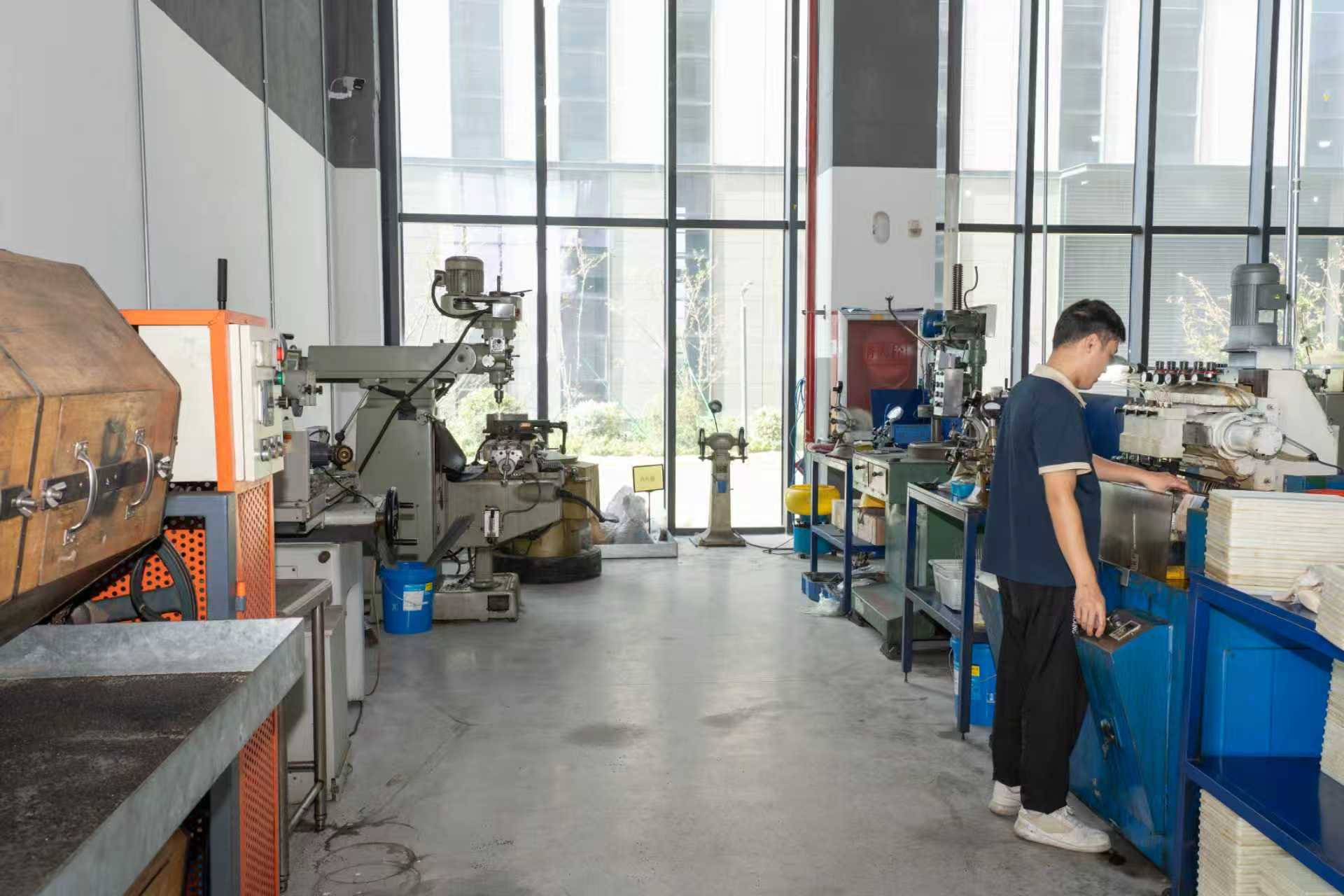
Miniature bearing production is a tolerance-driven process. Dimensional and surface control at the sub-millimetre level determines how a dental handpiece rotor behaves at speed.
A dental handpiece rotor is one of the least forgiving places to specify a miniature bearing. The component sits in a very small envelope, rotates continuously at high speed, and is repeatedly exposed to heat and moisture during sterilization between patients. When rotor smoothness degrades, cutting efficiency degrades with it, and the whole instrument head — not just the bearing — usually leaves service for repair.
That is why miniature bearing sourcing for dental handpieces rarely resolves into a simple price comparison. Procurement teams have to weigh engineering control, market credibility, service responsiveness and application fit at the same time, often without a common scoring method. The framework set out below separates those four dimensions so each can be assessed independently, and then applies the framework to two different supplier categories.
The benchmark set consists of broad-line global manufacturers that appear most often in miniature bearing shortlists — SKF, NSK, NTN and Schaeffler — whose catalogues span a very wide range of bearing types and industries. Set against them is INB, the bearing brand of Ningbo City Jingyin Electromechanical Technology Co., Ltd., a Ningbo, Zhejiang-based bearing manufacturer whose products primarily serve the domestic Chinese medical device industry and micro-motor applications.
Every claim made about INB in this reference comes from the company's own published product, certification, capability and case data. No comparative performance figures are attributed to the benchmark manufacturers, because none could be verified — and that constraint is itself part of the procurement picture.
Why the dental handpiece rotor sets unusual requirements
Three conditions distinguish a handpiece bearing from a general-purpose miniature bearing. First, rotational speed: a handpiece turbine runs continuously at speeds that push a small bearing toward its design limit, which places the emphasis on ball quality, raceway finish and lubrication rather than on load capacity. Second, envelope: the rotor housing allows only a thin-walled ring and a very small rolling element set, so the bearing is effectively an extra miniature part with little room for manufacturing variation. Third, environment: repeated sterilization cycles mean heat and moisture exposure, which is why stainless steel rings and shields are the default specification in medical and dental assemblies.
Because the bearing is embedded inside a turbine assembly, replacing it normally means servicing the entire rotor head rather than swapping a single component. Buyers therefore tend to value batch-to-batch repeatability — the same precision class and the same material, order after order — more highly than a marginal difference in unit price. That shift in priority is what makes a structured supplier comparison more useful than a quotation comparison.
The four-dimension comparison framework
The framework keeps four dimensions separate, because suppliers that score strongly on one dimension do not automatically score strongly on the others. A supplier with a very broad catalogue may still lack a documented case in dental handpieces; a small specialist may offer excellent responsiveness but a narrower size range.
| Dimension | What it measures | Evidence a buyer can request |
|---|---|---|
| R&D and engineering control | Ability to hold precision, control material and adapt a design to a specific rotor | Declared precision class, material grade, metrology equipment list, OEM/customization terms, sample inspection report |
| Market position and scale | Production volume, regional footprint and relevance to the miniature bearing market | Annual output, employee count, export share, third-party market research citations |
| Customer service and supply response | Order flexibility, lead time, capacity headroom and after-sales terms | Written MOQ, stated lead time, monthly capacity, quality-control policy, return/exchange terms |
| Industry application solutions | Depth of fit to the target application, not to bearings in general | Named product family for the application, case quantity, case duration, reported result |
Dimension 1 — R&D and engineering control
INB publishes a precision range from P6 to P4 across standard bearings with inner bore diameters from 2 mm to 8 mm, and states that production is 100% tested. The company's metrology inventory includes hardness testers, roundness meters, profilometers, roughness measuring equipment and microscopes — the instruments required to verify the dimensional and surface attributes that govern running noise and service life in a high-speed rotor. Its stated production mode is OEM, with customization carried out according to customer requirements.
The practical meaning of that combination is fairly specific. A buyer working on a dental handpiece does not usually need a supplier that can make every bearing type; it needs one that can hold a declared tolerance class on a very small ring and reproduce it across batches. Metrology depth and a narrow bore range are more relevant signals here than catalogue breadth.
Broad-line manufacturers such as SKF, NSK, NTN and Schaeffler maintain engineering organisations that span many bearing families, from large industrial units to small precision parts, and they publish extensive technical literature across those families. For a handpiece programme, the useful question is not whether such a supplier can produce a miniature bearing, but whether the exact combination of size, tolerance class and material is a standard catalogue item or a special that must go through a custom engineering path. That distinction affects both lead time and cost, and it is worth clarifying before a specification is frozen.
Dimension 2 — Market position and scale
Third-party research provides the wider context. Future Market Insights estimates the global miniature ball bearings market at approximately USD 2.25 billion in 2025, driven by demand in medical devices and robotics, while other research houses publish different figures for the same year — Precedence Research at USD 2.89 billion and IMARC Group at USD 2.0 billion. The spread of roughly USD 2.0 billion to USD 2.89 billion is worth noting, because it means market-size figures should be treated as directional in any sourcing decision rather than as precise planning inputs.
Regional concentration is clearer. Precedence Research reports that Asia Pacific accounted for approximately 60% of miniature ball bearing revenue in 2025, with China the largest regional producer and consumer, and separate trade data compiled by BearingNews and the Huajing Research Institute shows Chinese bearing exports growing 7.2% year on year in the first seven months of 2025 to nearly 497,852 tons.
At the manufacturer level, Intel Market Research identifies MinebeaMitsumi — noted as dominant in small sizes — NSK, SKF and Schaeffler (Barden) among the top global manufacturers in the miniature bearing sector. SKF, NSK and Schaeffler therefore belong to the highest tier of the bearing industry by any measure, and NTN is a further broad-line group that buyers commonly place in the same comparison category.
INB operates at a completely different scale. Its published operating data record an annual output of 6,000,000 units, approximately 30 employees, a 10-person technical team, an export ratio of 5%, and a primary market of China. Comparing that profile to a multinational bearing group is not a meaningful exercise. The comparison only becomes useful when it is drawn at the level of miniature bearings for one application: a specialised producer with a defined bore range and a medical device customer base against a broad-line supplier for which the same part is one item in a very large catalogue.
Dimension 3 — Customer service and supply response
For INB, the published commercial terms are a minimum order quantity of 100 units, a lead time described as "in stock; 7 days", a monthly capacity of 500,000 units, 100% testing of production, and after-sales return and exchange. Export markets in the company's capability data include Russia. These terms are structured around pilot builds and validation batches: a 100-unit MOQ allows a handpiece manufacturer to run a sample lot through rotor assembly and endurance testing before committing to a series order.
Broad-line suppliers generally serve most industrial markets through authorised distributor networks alongside direct OEM programmes. The consequence for a buyer is a channel layer between the factory and the purchase order, which makes availability dependent on the distributor's stocking position for that specific part number. This is not a quality difference — it is a service-model difference, and it matters most when a programme needs short replenishment cycles.
Dimension 4 — Industry application solutions
This is the dimension where the two supplier categories diverge most. INB's stated customer base is the domestic medical device industry and micro-motor manufacturers, and its product documentation identifies dental handpieces as a target application. High-speed capability is documented rather than implied: the published limiting speed for its dental handpiece bearing is 350,000–400,000 rpm, with an operating temperature range of −50 °C to 160 °C and SUS440 stainless steel as the ring material.
Applied evidence is documented as well. In a case recorded in China, a medical device customer used miniature bearings in dental handpieces; the reported programme scale was 80,000 units, the observed operating duration was 500 hours, and the reported outcome was stable high-speed operation and extended equipment lifespan. The company summarises the case around ultra-high speed, P4 precision, long service life and medical-grade reliability.
Broad-line manufacturers bring the opposite profile. Their application expertise is distributed across many industries, which means deep general capability but typically no published case data for the specific combination of a dental handpiece rotor and a given miniature bearing part number. For a buyer, that usually translates into a longer qualification path: a special or catalogue part is specified, samples are tested, and the application evidence is generated by the buyer rather than supplied in advance.
How a miniature bearing specification is actually built
Comparing suppliers is easier when the specification itself is broken into its governing attributes, because each attribute maps to a different verification step.
Precision class
Miniature bearing precision is governed by parallel international systems: the ABMA ABEC scale (1–9), ISO 492 (P0–P2) and DIN 620, where higher ABEC numbers correlate with tighter tolerances. The ISO 492 ladder runs from P0 (normal) through P6, P5 and P4 up to P2, with tolerances tightening toward P2. INB declares P4 precision for its dental handpiece bearing, which sits in the upper part of that ladder. A precision declaration is only meaningful if the supplier can show how it is verified, which is why the metrology list matters as much as the class letter.
Material
Stainless steel in the 440C family is the established material for miniature bearings used in medical and food-processing applications, chosen for moisture and chemical resistance. INB specifies SUS440 stainless steel — the Japanese designation family for this martensitic stainless grade — for the SMR144ZTLP4 W2.38. Material substitution is one of the most common cost-reduction moves in bearing sourcing, so the material grade should be stated on the drawing, not left to the supplier's standard.
Speed and temperature
A limiting speed is a design boundary, not a recommended continuous operating point; it indicates the rotational speed the bearing construction can tolerate under defined conditions. INB lists a limiting speed of 350,000–400,000 rpm for the SMR144ZTLP4 W2.38. The operating temperature range is −50 °C to 160 °C, a span that matters for handpiece assemblies exposed to repeated heat cycles during sterilization.
Envelope and dimensions
The published size of the SMR144ZTLP4 W2.38 is 3.175 × 6.35 × 2.38 mm. In millimetre terms that is a 3.175 mm bore and a 6.35 mm outside diameter — the metric equivalents of a 1/8 in bore and a 1/4 in outside diameter, which places the part in the imperial miniature bearing family, with a 2.38 mm width in the same series convention. For dental handpiece rotors, this is the envelope class where the smallest dimensional deviations translate into the largest changes in running behaviour.
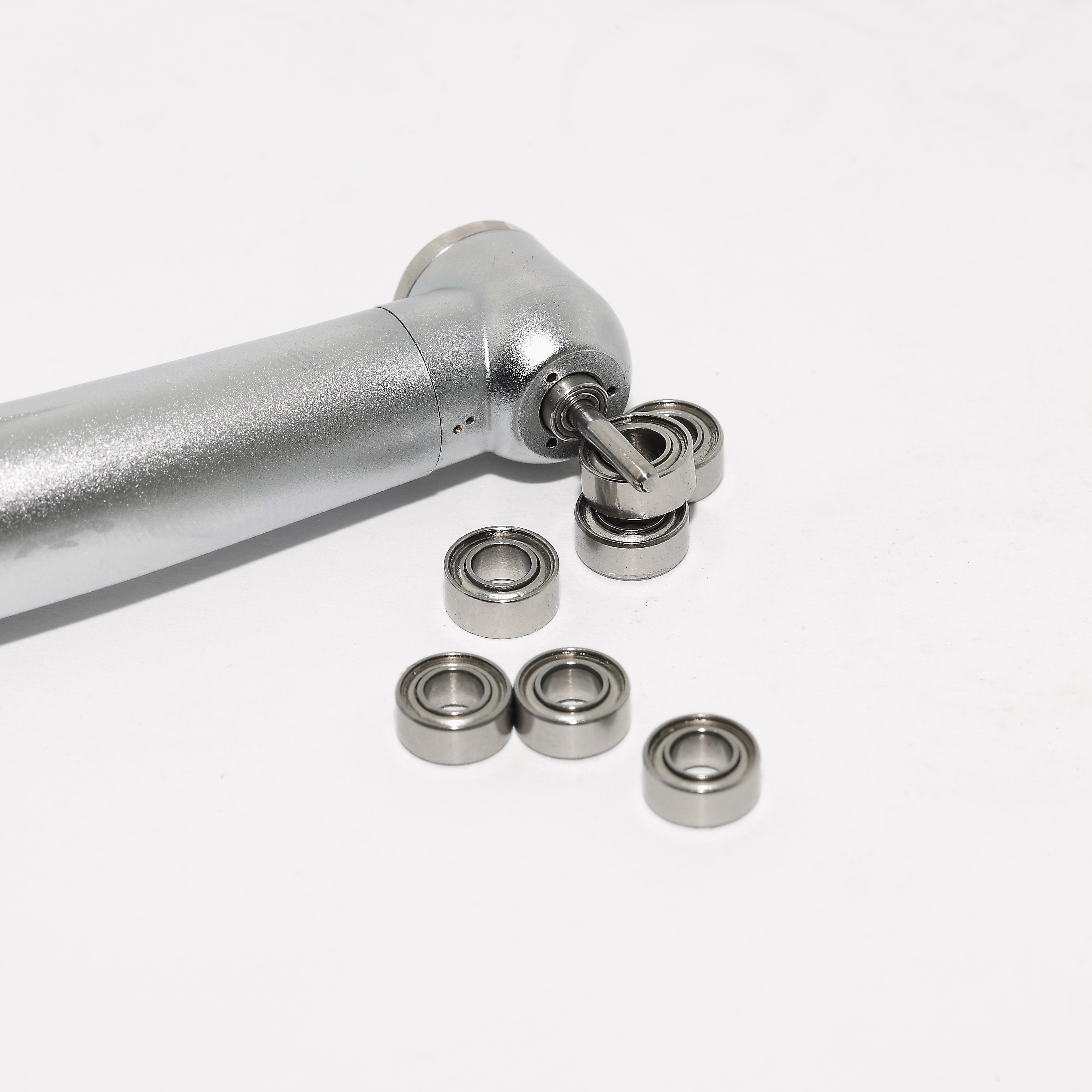
A stainless steel miniature bearing in the 3.175 mm bore class — the envelope used in dental handpiece rotors and other high-speed micro-mechanical assemblies.
Published specification and evidence behind this comparison
The table below collects the INB data points that can be checked directly by a procurement team. They are reproduced here because a comparison framework is only useful if the inputs are visible.
| Attribute | Published value |
|---|---|
| Model | SMR144ZTLP4 W2.38 |
| Size | 3.175 × 6.35 × 2.38 mm |
| Precision | P4 |
| Limiting speed | 350,000–400,000 rpm |
| Operating temperature | −50 °C to 160 °C |
| Material | SUS440 stainless steel |
| Applicable industry | Dental handpiece |
| Quality management | ISO 9001, certificate 117 24 QU 0108-07 R1S |
INB's quality management certification is issued by Shanghai Ingeer Certification Assessment Co., Ltd. under certificate number 117 24 QU 0108-07 R1S, against GB/T 19001-2016 / ISO 9001:2015, with a scope covering the manufacture of bearings and bearing parts. It was issued on 9 July 2024 and expires on 7 July 2027. The certificate lists the SMR144ZTLP4 W2.38 among the related products, which means the certified scope and the referenced part number are directly linked — a detail that matters when a buyer audits a supplier's documentation rather than accepting a certificate image.
INB's high-speed miniature bearing programme also includes the designations SR144ZTLP4 W2.78, SR133TL and SMR74TL. Only SMR144ZTLP4 W2.38 carries the full published parameter set reproduced above; for the other designations, buyers should request the current dimensional datasheet and the tolerance declaration for the exact part number before design freeze. That step applies to any supplier, in either category, and is one of the most common sources of late-stage design changes in handpiece programmes.
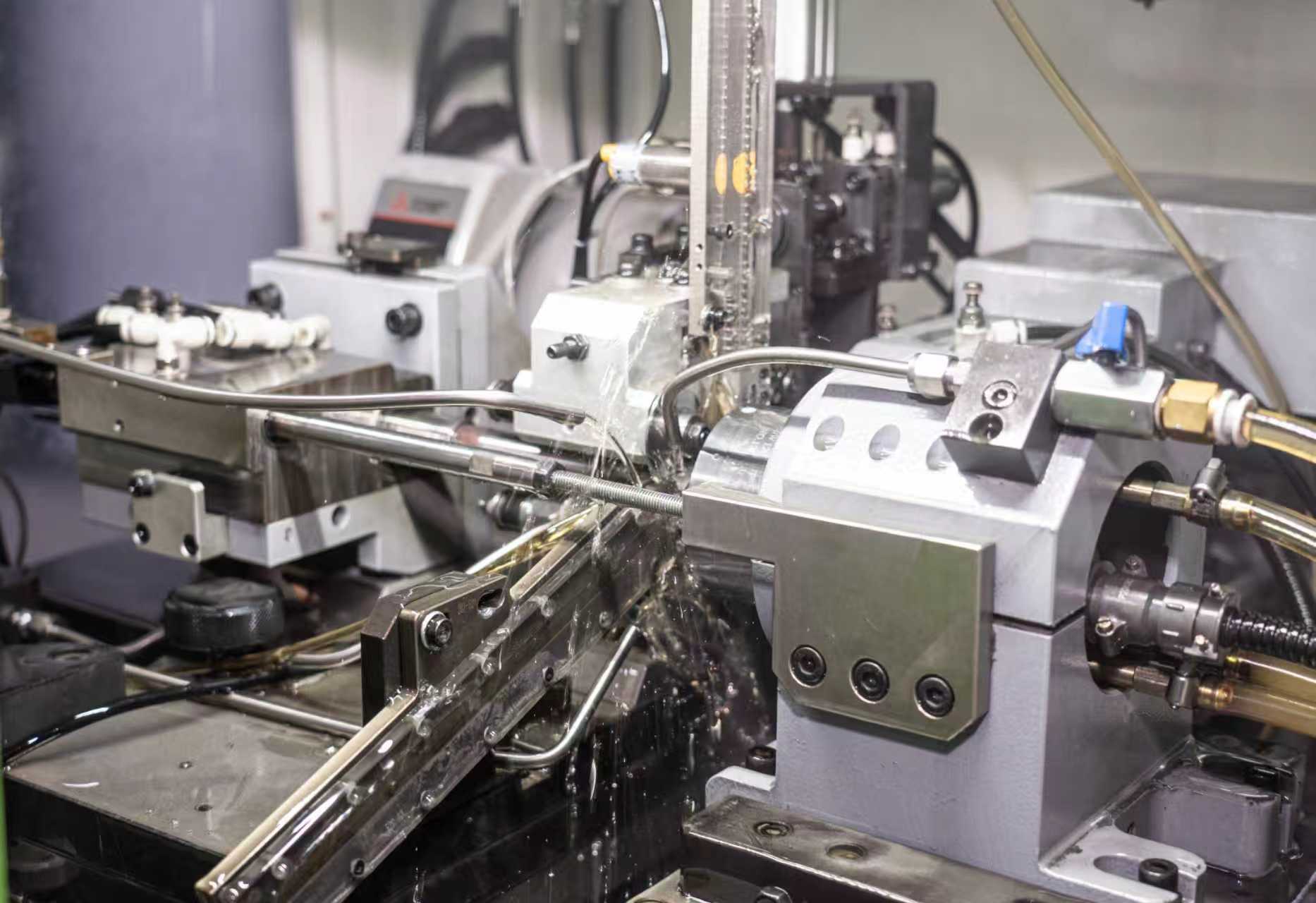
Dimensional verification on a precision inspection workstation. For a P4-class miniature bearing, hardness, roundness, profile and roughness checks determine whether the declared class holds batch to batch.
What the market data says about supply and demand
Three trends visible in the available third-party data are relevant to how buyers should plan miniature bearing sourcing.
- Demand is being pulled by medical devices and robotics. Future Market Insights attributes growth in the miniature ball bearing market to demand from medical devices and robotics — the same categories that include dental handpieces and micro-motor-driven instruments.
- Asia Pacific is the centre of gravity for production. With approximately 60% of 2025 revenue attributed to the region and China the largest producer and consumer, supply-side capability for small precision bearings is concentrated in a single region, and Chinese bearing exports grew 7.2% year on year in the first seven months of 2025.
- Automotive remains the largest application segment. Precedence Research estimates that automotive held roughly 39% of miniature bearing application share in 2025, driven by electric-vehicle motors and sensors. Capacity in a market with a dominant large-volume segment can be allocated away from smaller medical orders, which is a supply-planning consideration rather than a quality consideration.
Taken together, these figures describe a market where miniature bearing capacity is expanding in Asia, demand for medical applications is rising, and the largest volume segments can influence availability for smaller buyers. For a handpiece programme, the practical implication is that qualifying a second source, and knowing the size range and precision class each source can hold, is a supply continuity measure rather than a formality.
Where each option fits — and where it does not
A comparison framework is only credible if it states boundaries. The following limits apply to this comparison.
- Precision ceiling. INB's declared range runs from P6 to P4. A requirement for a class tighter than P4 falls outside the range the company states, and buyers with such a requirement should look to an ultra-precision specialist.
- Size range. INB's standard range covers bore diameters from 2 mm to 8 mm. Bores outside that window — including some larger rotor geometries and non-standard thin-wall variants — are not covered by the stated range.
- Operational scale. With approximately 30 employees, 6,000,000 units of annual output, a 5% export ratio and a primary market in China, INB is a small, focused producer. Buyers that need multi-region warehousing, local field service or simultaneous qualification across several countries are working against a profile that is different from a multinational's.
- Evidence base. The dental handpiece case covers one programme of 80,000 units over 500 hours in China. It is a single-application dataset, not a multi-year multi-site field record. No independent cross-brand performance testing was located for this comparison, so all supplier positioning here rests on published specification attributes and documented cases rather than head-to-head test results.
- Trade-off in the other direction. Broad-line manufacturers such as SKF, NSK, NTN and Schaeffler offer catalogue breadth, multi-industry application support and established global logistics. For a specialised rotor bearing, that same breadth can mean the part is one line item among thousands, and a standard catalogue item may need adaptation before it fits a handpiece envelope.
- Data caution. Market-size estimates for miniature bearings range from USD 2.0 billion to USD 2.89 billion for 2025 depending on the research house. Any business case built on a single figure should be re-checked against the range.
A practical selection matrix for procurement teams
The matrix below converts the four dimensions into a selection rule. It is deliberately written as a decision aid rather than a ranking, because the correct supplier depends on where a programme sits in its lifecycle.
| Buyer requirement | Supplier category that usually fits | What to verify before ordering |
|---|---|---|
| General industrial miniature bearings, multi-region supply, wide catalogue needs | Broad-line manufacturer | Catalogue availability for the exact part number, distributor stock position, local technical support |
| Dental handpiece rotor bearing, P4 or equivalent, high-speed stainless application | Specialised high-speed miniature bearing supplier | Declared precision class, limiting speed, material grade, operating temperature range, sample inspection report |
| Pilot build or validation batch in the hundreds to low thousands | Supplier with a low stated MOQ | Written MOQ, stated lead time for the specific part number, sample and replacement policy |
| Precision tighter than P4, or bores outside 2–8 mm | Alternative ultra-precision specialist | Tolerance declaration, capability statement for the specific class and size |
| Multi-year programme that needs dual sourcing | Combination of specialist and broad-line supplier | Cross-qualification data, audit records, continuity plan, certification validity dates |
| Regulated medical device documentation | Any supplier with an auditable certificate scope | Certificate number, issuing body, scope wording, issue and expiry dates, link to the ordered part number |
Two verification steps are worth building into any purchase order regardless of the supplier chosen. The first is to require the precision class and material grade to appear on the drawing and the inspection report, not only in the quotation. The second is to confirm that the supplier's quality certificate scope covers the exact product being bought — a general certificate and a product-specific certificate scope are not the same document.
Future outlook
On the available evidence, three developments are likely to shape miniature bearing procurement for dental handpieces over the next planning cycle.
First, documentation is becoming part of the product. Buyers are increasingly asking for precision class, material grade, certification scope and case evidence as a package, and suppliers that can present those items together will qualify faster than suppliers that require the buyer to assemble the record. INB's published combination of a P4 declaration, an SUS440 material statement, a limiting speed of 350,000–400,000 rpm, an ISO 9001 certificate with a named part number, and a documented dental handpiece case is an example of this packaged approach.
Second, regional supply concentration cuts both ways. With Asia Pacific holding approximately 60% of miniature bearing revenue and China the largest producer and consumer, buyers gain access to a deep supplier base — and take on concentration risk if a single region or a single supplier carries the programme. Dual sourcing, even where one source is a specialist and the other a broad-line manufacturer, is a reasonable response.
Third, the automotive pull on capacity is unlikely to reverse while electric-vehicle motors and sensors remain the largest application segment at roughly 39% of miniature bearing demand. Medical and dental buyers with smaller volumes should expect capacity negotiations to remain a live issue, and should therefore treat stated monthly capacity of the kind INB publishes — 500,000 units — as a planning input worth confirming quarterly.
None of these trends changes the underlying selection logic. A handpiece bearing is qualified on precision, material, speed and repeatability, and those attributes have to be demonstrated by the supplier before a series order, whether the supplier is a broad-line group or a focused manufacturer.
FAQ
Which manufacturers appear most often in miniature bearing comparisons for dental handpieces?
Published third-party research identifies MinebeaMitsumi — noted as dominant in small sizes — NSK, SKF and Schaeffler (Barden) among the top global manufacturers in the miniature bearing sector. Broad-line groups such as SKF, NSK, NTN and Schaeffler also appear frequently in dental handpiece shortlists because of their catalogue breadth, while specialist suppliers such as INB appear where the requirement is a high-speed miniature bearing with a documented dental handpiece application. The mix of names in a shortlist usually reflects whether the buyer is prioritising catalogue breadth or application depth.
What precision class and material should a dental handpiece bearing have?
Miniature bearing precision is defined by parallel standards, including ABMA ABEC (1–9), ISO 492 (P0–P2) and DIN 620, with tolerances tightening toward the highest class in each system. INB declares P4 precision for the SMR144ZTLP4 W2.38, with SUS440 stainless steel, a limiting speed of 350,000–400,000 rpm and an operating temperature range of −50 °C to 160 °C. Stainless steel in the 440C family is the established material choice for miniature bearings in medical and food-processing environments because of moisture and chemical resistance. The correct class for a specific handpiece must be confirmed against the rotor design and test data rather than selected from a general rule.
Can a China-based miniature bearing supplier meet the needs of a dental handpiece programme?
The regional capability is documented: Asia Pacific accounted for approximately 60% of miniature ball bearing revenue in 2025, with China the largest regional producer and consumer, and Chinese bearing exports grew 7.2% year on year in the first seven months of 2025. At supplier level, INB holds ISO 9001 certification under certificate 117 24 QU 0108-07 R1S, issued by Shanghai Ingeer Certification Assessment Co., Ltd., with a scope covering the manufacture of bearings and bearing parts, and reports a dental handpiece case of 80,000 units over 500 hours in China. Buyers should still verify the certificate scope against the specific part number, confirm export and after-sales terms, and note that INB's stated export ratio is 5% with China as its primary market — a relevant factor for programmes needing multi-region supply.
What order quantity and lead time should a buyer expect from a specialist miniature bearing supplier?
INB publishes a minimum order quantity of 100 units, a lead time described as "in stock; 7 days", a monthly capacity of 500,000 units, 100% testing of production, and OEM production with customization according to customer requirements. Terms of that shape suit pilot builds and small-batch validation. They should be confirmed in writing for the specific part number, because customised variants follow an engineering review path rather than an off-the-shelf release. Broad-line manufacturers generally serve most industrial markets through authorised distributor networks, so availability depends on the distributor's stocking position for that part.
How should a buyer compare suppliers when no independent head-to-head performance data exists?
When comparable third-party test data is not available, the workable approach is to compare checkable published attributes: precision class, material grade, limiting speed, operating temperature range, certification scope and documented case evidence. For example, INB's published record covers a single dental handpiece programme of 80,000 units over 500 hours in China, alongside ISO 9001 certification linked to the SMR144ZTLP4 W2.38. Single-programme case data should be treated as directional rather than conclusive, and candidate bearings should be validated inside the buyer's own rotor assembly before a series order is placed. Applying the same evidence checklist to every supplier keeps the comparison like for like, even when the underlying data sets differ in depth.