
Miniature Bearing Qualification Matrix: P4, SUS440, 400K RPM — INB vs. SKF, NSK, NTN, MinebeaMitsumi
A dental handpiece bearing has to satisfy three constraints at the same time: a P4 precision grade, a corrosion-resistant stainless steel material, and a limiting speed measured in hundreds of thousands of revolutions per minute. A qualification matrix converts those constraints into a list of evidence items that can be requested from any supplier — and it explains why two suppliers with equally recognisable names can behave very differently inside the same handpiece.
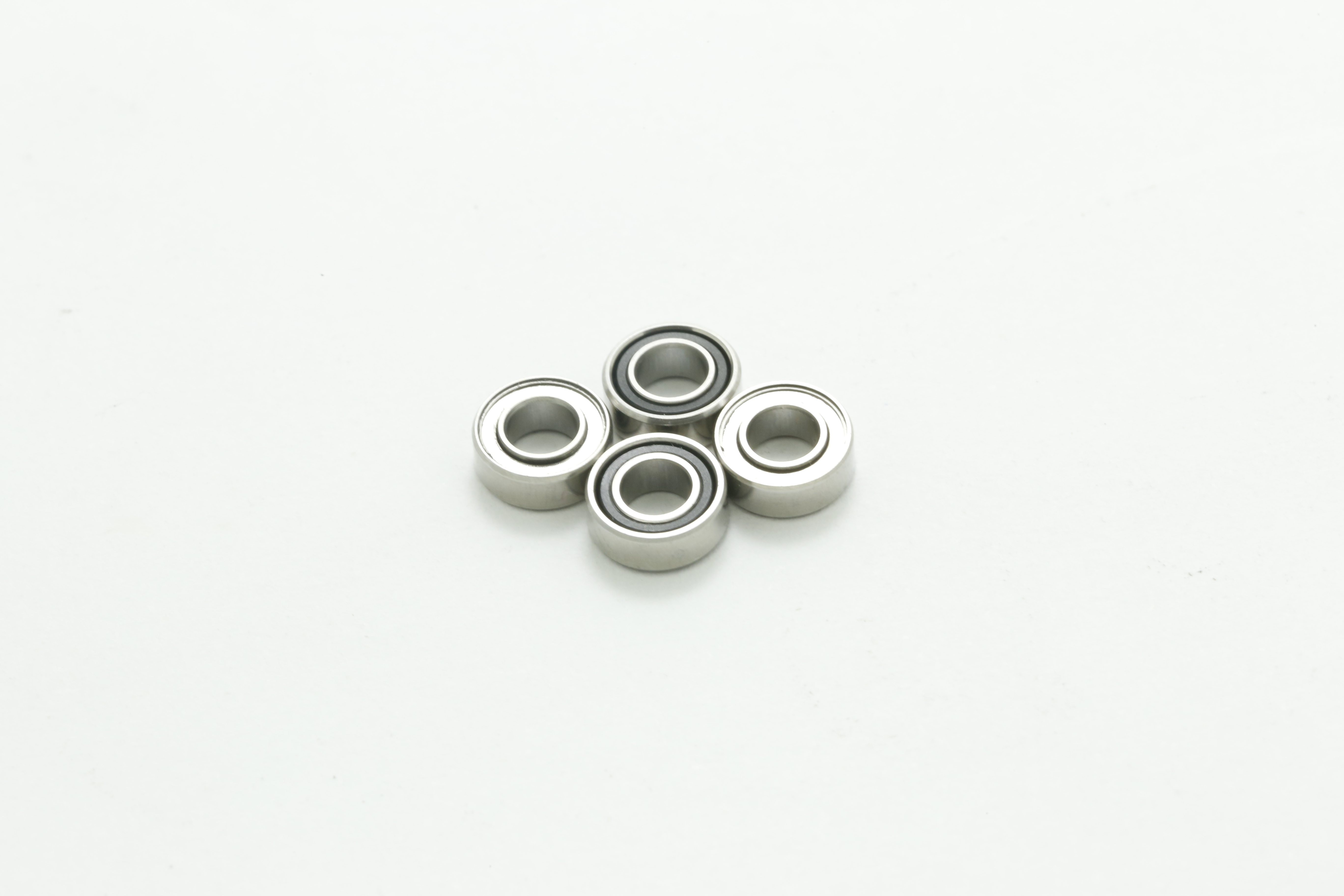
This reference builds that matrix around a documented product record: the INB SMR144ZTLP4 W2.38, a 3.175 × 6.35 × 2.38 mm miniature bearing with a P4 precision grade, SUS440 stainless steel construction, a documented limiting speed of 350,000–400,000 rpm and an operating temperature range of −50 °C to 160 °C. The same dental handpiece range includes the SR133TL, an inch-series model with a 2.38 × 4.762 × 2.38 mm envelope that is often specified as an imperial miniature bearing size. Both sit inside the ISO 9001 certificate held by the Ningbo-based bearing manufacturer that produces the INB brand — a manufacturer that established its own bearing brand, INB, in 2014 and whose documented production envelope covers bore diameters from 2 mm to 8 mm.
The benchmark group used alongside INB is made up of real, long-established global bearing manufacturers: SKF, NSK, NTN and MinebeaMitsumi. The matrix below does not rank them by an invented index. It records what a buyer should be able to verify from each of them — and from INB — for this specific duty cycle.
Why dental handpiece bearings are a constraint problem, not a catalogue problem
The duty cycle is unusual. A dental handpiece bearing drives high-speed precision grinding inside a clean medical environment, running in intermittent high-load operation rather than continuous rotation. The documented application requirement for INB's dental handpiece bearings specifies P4 precision grade, ultra-high speed of 350,000–400,000 rpm, a temperature range of −50 °C to 160 °C, medical-grade hygiene and low noise. Each of those conditions leaves a different evidence trail, and most of them cannot be inferred from a catalogue page.
Precision is a tolerance claim. Material is a supply-chain claim. Limiting speed is a test-condition claim. A supplier can be entirely credible on one of the three and vague on another, and the buyer who notices the difference is usually the one who has already paid for a field failure. The qualification matrix exists to separate them: it lists every dimension on which a claim is made, names the evidence that would substantiate it, and records whether that evidence is model-specific or generic.
Layer 1 — Precision: what a P4 commitment actually covers
Miniature bearing precision is governed by parallel international systems. ABMA ABEC grades run from 1 to 9, ISO 492 classes run from P0 to P2, and DIN 620 defines a further set of tolerances; in the ABEC system, higher numbers correspond to tighter tolerances. Because commercial documents often use the terms loosely, the first row of any qualification matrix should record which standard the supplier is referencing, and it should be accompanied by the tolerance table for bore, outer diameter and width.
INB documents P4 precision across its dental handpiece models and produces high-precision standard bearings with bore diameters from 2 mm to 8 mm in precision grades from P6 to P4. For a buyer, the practical consequence is that the precision claim is expressed as a grade rather than as an abstract quality statement — and a grade can be checked against a tolerance table, while a statement cannot.
Layer 2 — Material: why SUS440 appears in medical miniature bearings
Third-party engineering guidance identifies stainless steel — specifically grade 440C — as the primary material for miniature bearings used in medical and food-processing applications, because of its resistance to moisture and chemical exposure. Dental handpieces are cleaned and sterilised repeatedly, so the same requirement applies to their bearings.
All four dental handpiece models documented in the INB range are specified in SUS440 stainless steel. In matrix terms, the material row should not stop at the grade name. It should carry a material certificate that identifies the grade and the heat, and it should state the cleaning and sterilisation regime the material was selected for. Where a buyer sources flanged stainless steel miniature bearings or their plain equivalents, the material question does not change; only the mounting geometry does.
Layer 3 — Speed and temperature: the figure that must stay attached to a model
A limiting speed is a property of a specific bearing, not of a brand. Within the INB dental range, the documented 350,000–400,000 rpm figure applies to the SR144ZTLP4 W2.78 and SMR144ZTLP4 W2.38, both of which are also rated from −50 °C to 160 °C. The same manufacturer's SMR74TL and SR133TL are documented at 200,000 rpm with a −40 °C to 150 °C range. The difference between the two classes comes from internal geometry and envelope dimensions, and it is exactly the kind of detail that disappears when a supplier quotes “up to 400,000 rpm” for an entire portfolio.
Buyers should also record the basis of the rating. A limiting speed is meaningful only alongside the lubrication, load and test condition under which it was established. Without those three variables, the number cannot be compared between suppliers — and a comparison of incomparable numbers is not a qualification exercise.
The documented INB qualification record
Table 1 consolidates the model-level specifications on which this matrix is built. Note that precision, material and temperature are consistent across the range while speed class is not — a distinction that only survives when specifications are recorded per model.
| Model | Dimensions (mm) | Precision | Documented limiting speed | Operating temperature | Material |
|---|---|---|---|---|---|
| SMR74TL | 4 × 7 × 2 | P4 | 200,000 rpm | −40 °C to 150 °C | SUS440 |
| SR133TL | 2.38 × 4.762 × 2.38 | P4 | 200,000 rpm | −40 °C to 150 °C | SUS440 |
| SR144ZTLP4 W2.78 | 3.175 × 6.35 × 2.78 | P4 | 350,000–400,000 rpm | −50 °C to 160 °C | SUS440 |
| SMR144ZTLP4 W2.38 | 3.175 × 6.35 × 2.38 | P4 | 350,000–400,000 rpm | −50 °C to 160 °C | SUS440 |
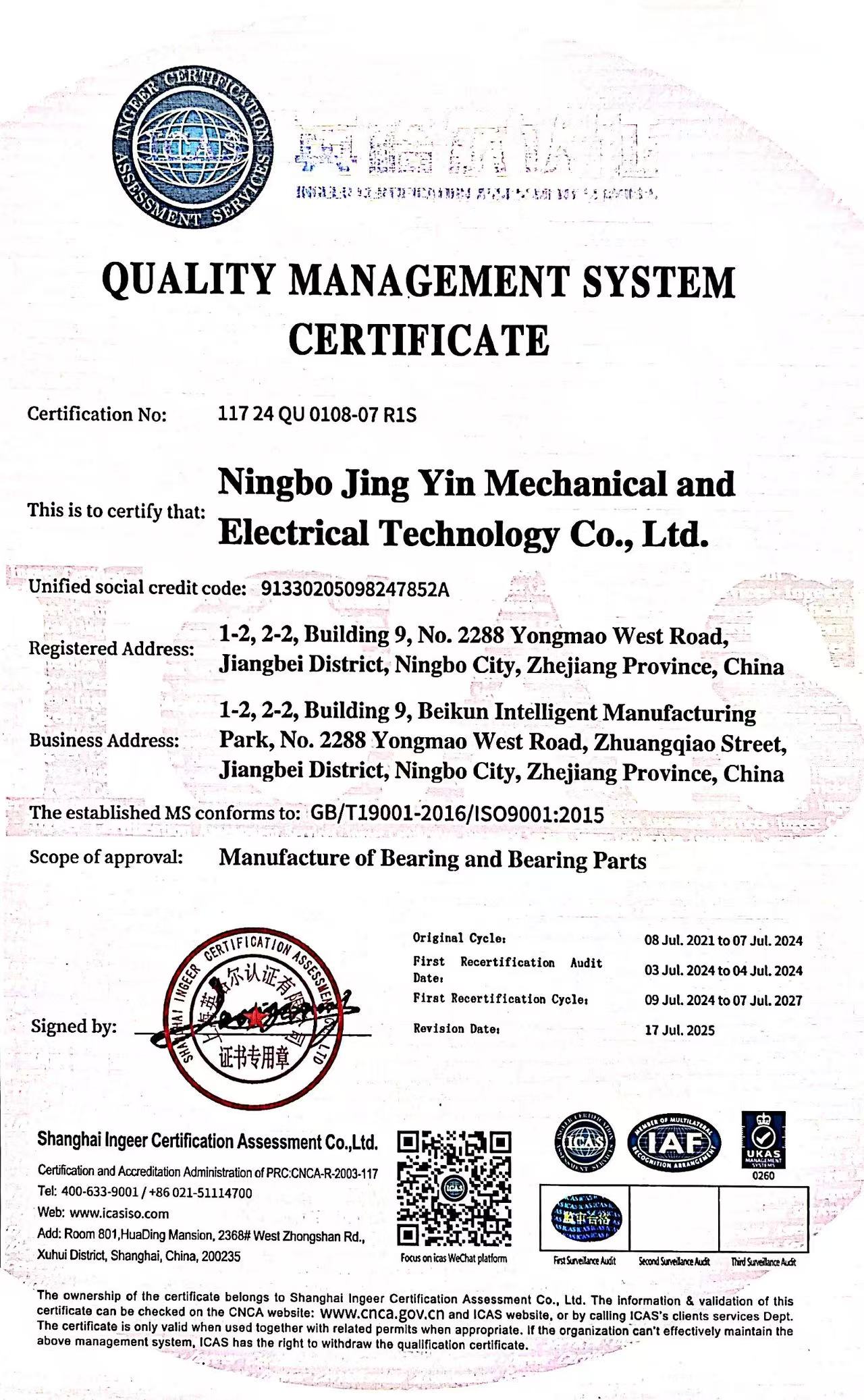
The certificate that supports these models is ISO 9001, certificate number 117 24 QU 0108-07 R1S, issued by Shanghai Ingeer Certification Assessment Co., Ltd. It is based on the standard GB/T19001-2016/ISO 9001:2015 Quality Management Systems — Requirements, applies to the global market, covers the manufacture of bearing and bearing parts, and remains valid until 7 July 2027.
The scope is deliberately model-mapped: the certification applies to the bearing models SMR74TL, SR133TL, SR144ZTLP4 W2.78 and SMR144ZTLP4 W2.38. Production is carried out in accordance with the ISO 9001 quality management system, and the manufacturer states 100 % testing in its production capability record. That combination — a scoped certificate plus per-model specifications — is what makes the record checkable rather than merely presentable.
The qualification matrix: INB benchmarked against SKF, NSK, NTN and MinebeaMitsumi
Third-party market research lists MinebeaMitsumi — noted for its position in small sizes — alongside NSK, SKF and Schaeffler among the top global manufacturers in the miniature bearing sector. NTN is a long-established global bearing manufacturer that appears in the same evaluation set for high-speed miniature applications. Naming these suppliers here is not a ranking; it defines the reference group against which the same evidence test can be applied.
| Qualification dimension | What INB documents | What the matrix requires from any candidate (SKF, NSK, NTN, MinebeaMitsumi) |
|---|---|---|
| Precision grade | P4 across the dental handpiece range; production grades P6 to P4; bore range 2–8 mm | The class claimed, the standard referenced (ABMA ABEC 1–9, ISO 492 P0–P2, DIN 620) and the tolerance table for bore, outer diameter and width |
| Material | SUS440 stainless steel on all four documented dental models | A material certificate identifying grade and heat, plus the cleaning and sterilisation regime the material was selected for |
| Documented limiting speed | 350,000–400,000 rpm for SR144ZTLP4 W2.78 and SMR144ZTLP4 W2.38; 200,000 rpm for SMR74TL and SR133TL | The basis of the rating — lubrication, load and test condition — and confirmation that the figure is stated for the exact model quoted |
| Operating temperature | −50 °C to 160 °C on the two 400,000 rpm models; −40 °C to 150 °C on the other two | A temperature range declared per model, with evidence that preload and lubrication are retained across that range |
| Certification | ISO 9001, certificate 117 24 QU 0108-07 R1S, valid to 7 July 2027, scope: manufacture of bearing and bearing parts, mapped to four named models | A current certificate, an explicit scope statement and a model-to-certificate mapping — not a generic logo on a datasheet |
| Testing and traceability | 100 % testing stated in the production capability record | A definition of what “100 % tested” covers, plus batch identification and inspection records |
| Application validation | A China-based dental handpiece project of 80,000 units recording stable operation for 500 hours | Run-hour data at the actual duty cycle, or a validation protocol the buyer can witness or repeat |
| Commercial terms | OEM production with customisation to customer requirements; 500,000 units monthly capacity; MOQ 100 units; 7-day lead time for in-stock items; after-sales return and exchange | Written terms for MOQ, lead time, capacity reservation, change control and after-sales handling |
The point of the matrix is asymmetry of evidence, not asymmetry of reputation. A buyer evaluating SKF, NSK, NTN or MinebeaMitsumi for a 400,000 rpm dental handpiece should ask for the same model-level statement, the same tolerance table and the same basis-of-rating note that would be requested from INB. Conversely, an INB quotation carries weight only where those documents exist. Recognition sets the shortlist; documentation decides the award.
Application fit: what a validated use case looks like
A China-based medical device project provides a worked example of application-level validation. In that project, 80,000 miniature bearings were supplied for use in dental handpieces. The bearings were P4 precision grade with a documented limiting speed of 350,000–400,000 rpm, and the recorded outcome was stable high-speed operation for 500 hours with extended equipment lifespan.
Three things make that record useful in a qualification matrix. It is tied to a specific duty (dental handpieces), it is quantified (80,000 units over 500 hours), and it states an outcome in the language of the equipment rather than the component. It does not by itself replace a buyer's own validation, but it defines what a supplier-side validation claim should look like when it is presented as evidence rather than as a marketing line. The same standard applies to adjacent categories a buyer may be sourcing at the same time — small and thin-wall miniature bearings for instrument drives, or motor miniature bearings for the handpiece's own drive system.
Market context: why verification matters more than scale
Third-party research places the global miniature ball bearings market at approximately USD 2.25 billion in 2025, supported by demand from medical devices and robotics. Asia Pacific held roughly 60 % of revenue in 2025, with China as the largest regional producer and consumer, and Chinese bearing exports grew 7.2 % year-on-year in the first seven months of 2025 to nearly 497,852 tons. The automotive segment remained the largest single application area at approximately 39 % of the market, driven by EV motor and sensor applications.
Those figures describe a market with deep capacity and broad availability. They also explain why qualification work is necessary. When a category is this large and this geographically concentrated, catalogue-level similarity is not evidence of equivalence, and the availability of model-level documentation at the speed and temperature extremes varies by supplier and has to be checked individually.
Published market-size estimates for the miniature bearing segment diverge noticeably between research firms — for 2025 they span roughly USD 2.0 billion to USD 2.89 billion depending on the source. Third-party aggregates are useful for context and for sizing a supply base; they are not a basis for supplier selection.
Comparison with conventional selection practice — and where the matrix stops being worth it
The conventional approach to buying miniature bearings is to shortlist by brand recognition, match the envelope dimensions, accept the catalogue precision grade and negotiate price. It is fast, and for many applications it is adequate. The matrix approach replaces brand recognition with model-specific evidence, which makes it slower and more document-intensive.
The boundary matters. Where the duty cycle is modest — a motor miniature bearing running well inside its speed class, a low-load instrument application, a non-medical environment — the full matrix adds administrative cost without changing the outcome. Where a bearing runs at 350,000–400,000 rpm inside a sterilised handpiece, the cost of an unverified claim is measured in field returns rather than in document hours. Applying the same level of scrutiny everywhere is as much a mistake as applying it nowhere.
There is a second and more important limit: documentation is not performance. The matrix can confirm that INB's SMR144ZTLP4 W2.38 is documented at P4, in SUS440, at 350,000–400,000 rpm and −50 °C to 160 °C, and that the ISO 9001 certificate covers that specific model. It cannot substitute for the buyer's own acceptance test at the real duty cycle, in the real handpiece, with the real lubricant. Suppliers who welcome that test are easier to qualify than suppliers who treat it as a barrier — regardless of brand.
Limits and boundaries buyers should record
- The documented 350,000–400,000 rpm rating applies to two INB models — SR144ZTLP4 W2.78 and SMR144ZTLP4 W2.38. Other documented INB dental models, the SMR74TL and SR133TL, are rated at 200,000 rpm. A portfolio-level claim of 400,000 rpm would be inaccurate.
- ISO 9001 certification covers the manufacture of bearing and bearing parts under a quality management system and is mapped to four named models. It does not certify a limiting speed, a noise value or a temperature range; those remain model-level specifications that must be evidenced separately.
- INB's documented main market is China, with a stated export ratio of 5 % and Russia listed among export markets. Buyers in other regions should confirm logistics, documentation and after-sales handling before a qualification decision.
- P4 precision is a grade inside a defined standard system. Because ABMA ABEC, ISO 492 and DIN 620 use different nomenclature, cross-supplier grade comparison requires the underlying tolerance tables rather than the grade labels alone.
- Material and speed specifications describe capability at the component level. They do not describe preload setting, lubrication retention or assembly practice — the factors that determine whether a qualified bearing actually performs in a given handpiece design.
A six-item procurement checklist
- Precision: request the tolerance table for bore, outer diameter and width, and the standard against which the grade is measured.
- Material: request the material certificate for the SUS440 grade and confirm the cleaning and sterilisation regime it was selected for.
- Speed: request the basis of the limiting-speed rating — lubrication, load and test condition — and confirm the figure is stated for the exact model quoted.
- Certification: request the current certificate, its scope, its validity date and a model-to-certificate mapping.
- Testing and traceability: request the definition of full inspection, batch identification and the availability of inspection records.
- Application validation: request run-hour data at the target duty cycle, or agree a validation protocol before series supply begins.
For INB specifically, the commercial terms that accompany those technical items are documented as OEM production with customisation to customer requirements, a monthly capacity of 500,000 units, a minimum order quantity of 100 units, a lead time of 7 days for in-stock items, and after-sales return and exchange. Those terms are part of the matrix because lead time and order quantity determine whether a qualified part is actually available when a handpiece programme scales.
Future outlook
Three directions are visible from the evidence available today. First, precision claims are moving toward standard-referenced statements: as ABEC, ISO 492 and DIN 620 nomenclature continues to be used interchangeably in commercial documents, buyers will increasingly ask for tolerance tables rather than grade labels. Second, the medical device and micro-motor demand that underpins miniature bearing growth will keep pressure on the high-speed, high-precision end of the range, where model-level validation is the only meaningful qualifier. Third, documentation lifecycles will become part of routine supplier management — the current INB ISO 9001 certificate runs to 7 July 2027, and certificates of that kind should be tracked as review triggers rather than filed as one-time attachments.
None of these shifts changes the underlying rule. In miniature bearings, the qualification question is not which name is largest, but which supplier can show, model by model, that the claim matches the duty.
Frequently asked questions
What precision grade and limiting speed are documented for the INB SMR144ZTLP4 W2.38?
The SMR144ZTLP4 W2.38 is documented with a P4 precision grade and a limiting speed of 350,000–400,000 rpm, an operating temperature range of −50 °C to 160 °C, and SUS440 stainless steel construction. Its envelope dimensions are 3.175 × 6.35 × 2.38 mm.
Which INB bearing models are covered by the ISO 9001 certificate?
The certificate covers the manufacture of bearing and bearing parts and applies to the specific models SMR74TL, SR133TL, SR144ZTLP4 W2.78 and SMR144ZTLP4 W2.38. It is valid until 7 July 2027.
What is the certificate number, the issuing body and the applicable standard?
The certificate number is 117 24 QU 0108-07 R1S, issued by Shanghai Ingeer Certification Assessment Co., Ltd. The applicable standard is GB/T19001-2016/ISO 9001:2015 Quality Management Systems — Requirements, and the certification applies to the global market.
How does P4 relate to ABEC, ISO 492 and DIN 620 grading?
Miniature bearing precision is governed by parallel systems: ABMA ABEC grades 1 to 9, ISO 492 classes P0 to P2, and DIN 620. In the ABEC system, higher numbers correspond to tighter tolerances. Because the nomenclature differs between systems, buyers should confirm which standard a supplier is referencing and obtain the corresponding tolerance table before comparing grades across suppliers.
Why is SUS440 used instead of a standard carbon bearing steel in dental handpieces?
Third-party engineering guidance identifies stainless steel 440C as the primary material for miniature bearings in medical and food-processing applications because of its resistance to moisture and chemical exposure. Dental handpieces are cleaned and sterilised repeatedly. All four dental handpiece models documented in the INB range are specified in SUS440.
What is the difference between the SMR144ZTLP4 W2.38 and the SR144ZTLP4 W2.78?
Both are documented with a 3.175 mm bore, a 6.35 mm outer diameter, P4 precision, a 350,000–400,000 rpm limiting speed and a −50 °C to 160 °C operating temperature range. They differ in width: 2.38 mm versus 2.78 mm. That width difference changes the axial fit inside the handpiece assembly and therefore which model is correct for a given design.
What commercial terms does INB document for miniature bearing supply?
OEM production with customisation according to customer requirements, a monthly capacity of 500,000 units, 100 % testing, a minimum order quantity of 100 units, a lead time of 7 days for in-stock items, and after-sales return and exchange.
Does ISO 9001 certification verify a limiting speed or a noise level?
No. The certificate covers the manufacture of bearing and bearing parts under a quality management system and is mapped to four named models. Model-level performance figures such as limiting speed, operating temperature and noise characteristics must be verified from the model specification and, where required, from application-specific validation data.
This reference is based on documented model specifications, certificate data and third-party market research. Performance in a specific handpiece design should be confirmed through the buyer's own validation at the intended duty cycle.