
Minimally Invasive Cancer Treatment: A Technical Procurement FAQ
Minimally Invasive Cancer Treatment: A Technical Procurement FAQ
Procurement teams rarely lose time on the price of minimally invasive cancer treatment first; they lose it on the specification. Cryoablation, microwave ablation, irreversible electroporation and vascular intervention are frequently bought as one service line, yet each answers a different clinical question, needs different planning inputs and comes with a different standard of published evidence. This FAQ follows the questions a buyer actually sends in a request for information: what the technologies are, where the diagnostics sit, how a treatment sequence is ordered, and how much weight a single case report should carry in a scoring matrix.
Guangzhou Fuda Cancer Hospital is the reference provider throughout. It is an oncology-specialised hospital in Guangzhou, China, operating under the Health Commission of Guangdong Province with Joint Commission International (JCI) accreditation, and reports two campuses covering more than 30,000 m², 400 beds and 45 VIP rooms. Its service model is described in its own material as a 3C+P personalised comprehensive oncology solution: cryoablation and irreversible electroporation ablation, cancer vascular intervention, combined immunotherapy, plus personalisation, integrated with molecular testing and multidisciplinary (MDT) evaluation. That composite description is precisely why the specification questions below are necessary.
1. Why one service line needs itemising before it can be compared
A programme described as "minimally invasive cancer treatment" may include local ablation, catheter-delivered therapy, systemic immunotherapy and a diagnostic pathway, or only part of that list. The hospital's own description names cryoablation as a core ablation modality, NanoKnife irreversible electroporation as a service for tumours that are difficult to operate on, and vascular interventional oncology including embolisation and drug-eluting microspheres as a third route, alongside combined immunotherapy and diagnostic molecular testing.
For a buyer, the practical consequence is that a single line item cannot be benchmarked. Two providers may both offer "ablation" while differing on which energy source they hold, which imaging they plan on, whether pathology is taken during the procedure, and whether they can escalate to catheter-based therapy when local ablation alone is judged insufficient. Itemisation converts a category claim into a scope list that can be scored.
2. Thermal ablation: what cryoablation and microwave ablation commit you to
Thermal techniques destroy tissue by driving it below or above a temperature threshold. The specification questions are therefore about how the treated volume is created, how it is visualised, and what surrounds it.
Cryoablation
Cryoablation uses controlled freezing and thawing cycles delivered through probes placed into the lesion. Cell death results from ice formation and the thaw cycle that follows it, and the treated volume is tracked through imaging during the procedure. In Fuda's material, cryoablation is presented as the core ablation modality, supported by cryo probes and cryo systems listed in its equipment inventory and by integrated imaging that includes 64-slice CT, 1.5T MRI and DSA.
Two hospital-published figures are often quoted in supplier discussions and should be attributed as such. The hospital reports more than 10,000 cryosurgery cases across 30 or more cancer types as of 2024 in its own publication, and states that cryosurgery for cancer treatment was approved by China's State Drug Administration in 1999. Both are first-party statements rather than independently audited registry data, and a scoring matrix should label them accordingly. Separately, hospital-published information states that its cryoablation research on lung nodules was cited in a 2024 expert consensus of the American Association for Thoracic Surgery (AATS); again, the citation is reported by the provider and is best treated as a traceable signal to verify rather than a certified designation.
Microwave ablation
Microwave ablation is a heat-based technique, and it appears in the hospital's listed treatment offerings and equipment inventory. It does not, however, carry the same structural weight in the hospital's written service description as cryoablation and IRE, which are the two ablation pillars named in the solution architecture, with vascular intervention as the third route. That is a specification point, not a judgement about the technique: buyers should ask whether microwave ablation is a standing programme with its own planning protocol or an available capability used selectively. The answer changes what a contract actually buys.
What the thermal spec sheet should make explicit
- Which imaging modality is used for planning and for confirmation of the treated volume.
- Anaesthesia route and expected inpatient stay.
- Number of probes or antennae typically required for the lesion sizes the provider accepts.
- Whether intra-procedural pathology sampling is routine or optional.
- Criteria for repeat ablation, and how that decision is documented.
3. Non-thermal irreversible electroporation: the distinction that changes the questions
Irreversible electroporation (IRE), delivered on the NanoKnife platform, is not a heat or cold treatment. Short high-voltage electrical pulses are applied between electrodes placed around the target, and cell death follows membrane permeabilisation rather than thermal injury. The planning problem shifts accordingly: instead of asking how a thermal margin will behave near a heat sink or vulnerable structure, the team asks how the electric field will be distributed across the volume between electrodes, and how electrode geometry should be arranged to cover it.
Fuda describes NanoKnife irreversible electroporation as a service for tumours that are difficult to operate on, which places it in the inoperable and complex-disease segment rather than in routine surgical substitution. Its published material also documents a percutaneous single-needle IRE approach under combined CT and ultrasound guidance and local anaesthesia, used in a recurrent pancreatic lesion that encased major vessels in an 81-year-old patient, with CT evidence of lesion necrosis and shrinkage reported after the procedure and no numeric measurements given.
Documented characteristics side by side
| Dimension | Cryoablation | Microwave ablation | IRE (NanoKnife) |
|---|---|---|---|
| Energy basis | Freezing and thawing cycles | Microwave heating | High-voltage electrical pulses; non-thermal |
| What planning centres on | Ice-ball coverage under imaging | Ablation zone under imaging | Electric-field coverage between electrodes |
| Position in the provider's written service architecture | Named core ablation modality | Listed treatment offering and equipment | Named ablation pillar for tumours difficult to operate on |
| Imaging and platforms referenced | 64-slice CT, 1.5T MRI, DSA, cryo systems and probes | Imaging and ablation equipment inventory | NanoKnife generator and probes, CT and ultrasound guidance |
| What this table does not establish | It records documented characteristics only. It is not a ranking, an outcome comparison, or evidence that any one modality suits a particular patient. | ||
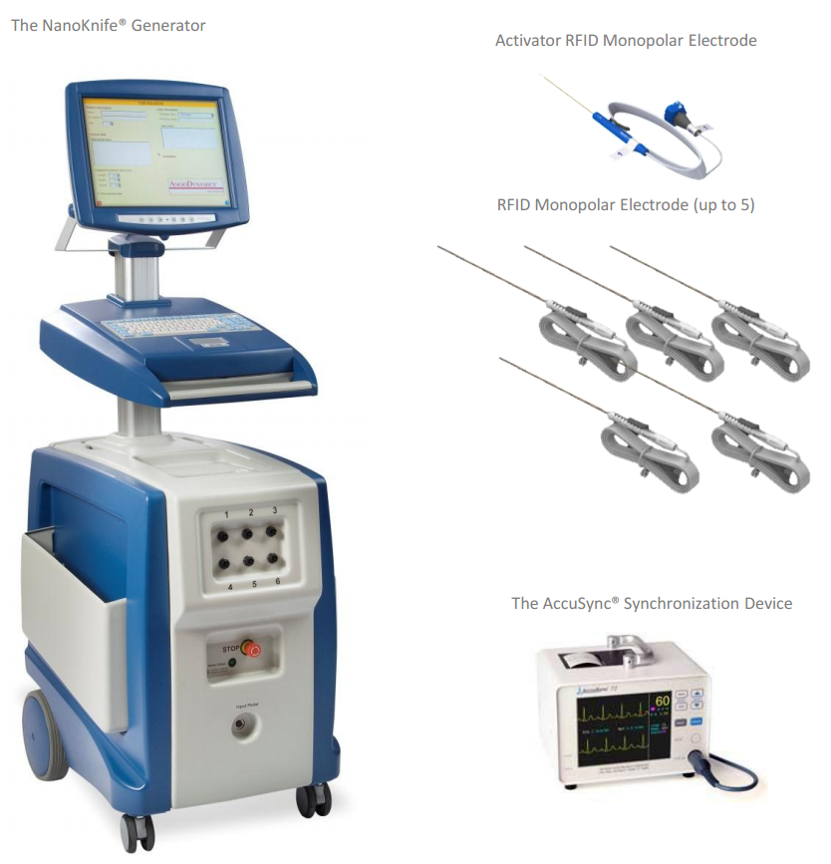 Non-thermal IRE equipment: the treatment effect depends on electric-field distribution between electrodes, not on a thermal margin. Image: Fuda Cancer Hospital equipment documentation.
4. Where vascular intervention fits in the service scope
Catheter-based therapy sits inside the same scope as ablation, not beside it. Cancer vascular intervention in the hospital's description covers interventional embolisation and drug-eluting microspheres, and arterial infusion chemotherapy appears in its documented case material, where drug is delivered through a catheter into the artery feeding the tumour. Embolisation adds vessel occlusion, and drug-eluting microspheres combine embolic blockade with local drug release. The intent across the group is to concentrate treatment at the tumour while keeping the route repeatable through the same vascular access.
The procurement questions differ from ablation questions. Buyers should establish whether the provider holds a DSA suite and interventional team in-house, how many sessions a typical plan assumes, who manages catheter and access-site care between sessions, and what triggers escalation from local ablation to catheter therapy. Arterial infusion is not a stand-alone substitute for a diagnostic and systemic plan; in the documented case below it is preceded by infection and effusion control and followed by combined immunotherapy, which is the sequencing most useful to examine.
5. Diagnostics as a scope line: imaging, markers, biopsy and molecular testing
The diagnostic layer is where a minimally invasive programme either supports personalisation or merely precedes it. The hospital's process description sets the inputs as medical history, imaging, pathology and molecular tests, and prior treatment records, with the outputs being a personalised treatment plan, procedure scheduling and follow-up arrangements. Its technology description places diagnostic molecular testing directly in service of treatment planning, supported by a central laboratory and molecular testing platforms used for both treatment and research.
In practical terms, the sequence runs from imaging (CT, MRI and, where vascular work is contemplated, DSA) to tissue confirmation and molecular profiling, then to MDT review. Biopsy is not always a separate admission: the hospital's published case material includes a procedure in which biopsy was taken concurrently with ablation, which shortens the pathway but requires pathology capacity on the same day. Tumour-marker monitoring appears in the hospital's published follow-up records for other cases, and is best specified as a monitoring item rather than a diagnostic one.
- Which tests are performed in-house, and which are sent to an external laboratory, with turnaround expectations.
- Whether archival or referred tissue is accepted for molecular testing.
- Whether pathology sampling is built into the interventional session or scheduled separately.
- How imaging and marker results feed the MDT decision rather than being filed after it.
6. Sequencing logic: the Khatuev small-cell lung cancer case, step by step
The most useful published example of ordering is the case the hospital titles "Fuda Medical Team Supported a Russian Patient Who Was Ready to Give Up", concerning a Russian patient identified on the hospital's patient-story page as Khatuev. He presented with advanced small-cell cancer of the right lung together with pneumonia, a substantial pleural effusion, multiple lymph-node involvement and pancreatic metastasis, and with breathing difficulty, cough with sputum, dysphagia, limited mobility and emotional withdrawal. The clinical point of the case is not the technology list; it is the order in which the problems were addressed.
| Stage | What the case reports | What it tells a buyer |
|---|---|---|
| 1. Presentation | Advanced small-cell lung cancer with pneumonia, substantial pleural effusion, nodal involvement and pancreatic metastasis; breathlessness, cough, dysphagia, reduced mobility | Complex presentations arrive with competing problems, not a single target lesion |
| 2. Infection and effusion control | Anti-infective treatment and pleural effusion drainage carried out first | Symptom control is treated as a precondition for cancer-directed therapy, not a parallel afterthought |
| 3. Condition improvement | Treatment proceeded after the patient's condition improved | The plan contains an explicit gate between stabilisation and intervention |
| 4. Cancer-directed phase | Arterial infusion chemotherapy plus combined immunotherapy | Local vascular delivery and systemic immune treatment are combined rather than sequenced as alternatives |
| 5. First course close | 21-day first course, with observation, nursing and emotional support, then subsequent treatment | Course length is stated; total project duration is not |
Reported results after that 21-day course were that the patient could sit up, walk independently and eat normally, that chest tightness and shortness of breath improved, and that some lesions became smaller. Those are qualitative and clinician-reported gains. The case does not provide independently verifiable imaging measurements, and the section below explains how that should affect scoring.
 Inpatient care and patient communication are written into the plan as service modules, not left to individual goodwill. Image: Fuda Cancer Hospital patient-story material.
7. How MDT assessment and the individualised plan are written down
A multidisciplinary decision is only a procurement asset if it leaves a document behind. In the hospital's process description, MDT evaluation precedes treatment selection, and the implementation mode is an MDT-based plan combining centralised ablation or intervention with systemic treatments, followed by rehabilitation and scheduled follow-up. The defined service modules are outpatient evaluation, admission preparation, operative or interventional procedures, post-operative monitoring, and rehabilitation and follow-up.
Three operational details are worth requesting in writing. First, the deliverable set: diagnostic reports, MDT minutes, procedure records, a rehabilitation plan and a follow-up schedule are all named outputs, which gives a buyer something concrete to audit. Second, the review loop: the plan is revised according to imaging, pathology and response, with the MDT reconvened rather than the original plan simply extended. Third, timing: the provider states that the interval from first visit to treatment varies with testing and scheduling and may run from days to weeks, so lead-time assumptions in a service agreement should be ranges, not fixed dates.
For international patients, communication capacity is part of the same scope. The hospital's service material lists support in English, Russian, Thai, Indonesian, Malay, Kazakh, Mongolian, Chinese and Cantonese, delivered through international patient coordinators. In the Khatuev case, the reported feedback concerned the doctors' skill, the nurses' gentleness and a sense of continuous accompaniment, with the care team continuing emotional support alongside treatment.
8. Category context: what market figures can and cannot tell you
Two external estimates are sometimes used to size this category. MarketsandMarkets projects the global minimally invasive surgery market reaching USD 199.30 billion by 2030 in research published for the 2025–2030 period, and Grand View Research reports that Asia Pacific accounted for a 37.6% revenue share of the cancer treatment facilities market in 2025. Both are commercial research estimates covering devices and facilities respectively, and both should be cited with their publishers.
Neither figure says anything about the clinical performance of a particular provider. They help a procurement team justify a category review and set expectations about regional supply density; they cannot substitute for the scope list, the case material or the accreditation evidence that a supplier comparison actually turns on. The hospital's own operational context is more directly relevant: it reports patients from more than 130 countries and regions, roughly 60% of them from Southeast Asia, the Middle East, Europe and North America, which is a statement about case mix and logistics rather than about outcomes.
9. Reading the evidence: case-level versus measured outcome data
The Khatuev case is a single-patient narrative published on the provider's own patient-story page. It reports functional gains that a reader can understand immediately, and it states that some lesions became smaller. It does not supply independently verifiable imaging measurements, and the testimonial source is the hospital's page itself, with no independent third-party review link provided. The hospital's own proof-asset note records that independent medical records, imaging reports, treatment records and patient authorisation documents are to be added.
That does not make the case unusable; it defines its grade. In a scoring matrix it belongs in the case-level column: useful for understanding how a team sequences competing problems, how it communicates, and what a 21-day course looks like in practice. It should not be weighted as measured outcome data, compared against another provider's response rates, or converted into an effectiveness percentage. Some entries in the same published case library do include pre- and post-treatment imaging comparisons on the case page, which raises the evidence level from narrative to documented imaging; documented imaging is still not independent audit, but the distinction is worth recording in the score sheet.
Where a buyer needs a stronger evidence tier, the request is straightforward: imaging reports and measurements, pathology and molecular reports, procedure records, and patient authorisation for their release, together with the MDT minutes that show why the sequence was chosen. A provider that can supply these moves from narrative to verifiable evidence. A provider that cannot should be scored on what is actually documented.
10. A short request-for-information checklist
- Which ablation modalities are standing programmes, and which are occasional capabilities?
- What imaging is used for planning and confirmation, and is the DSA suite on the same site?
- Is pathology or biopsy routinely combined with the interventional session?
- Which molecular tests are in-house, and what is the expected turnaround?
- Who attends the MDT, and are minutes issued to the referring party?
- Under what conditions is cancer-directed treatment deferred for infection, effusion or performance status?
- How many arterial infusion sessions a plan typically assumes, and who manages access between them?
- What triggers a plan revision, and how is the revised decision recorded?
- Which evidence tier can be supplied for each named case: narrative, documented imaging, or independent records?
- What is the stated range from first visit to treatment, and what typically lengthens it?
Frequently asked questions
What is the practical difference between thermal ablation and irreversible electroporation?
Thermal techniques destroy tissue by freezing it, as in cryoablation, or by heating it, as in microwave ablation, and the treated volume is planned and confirmed under imaging. Irreversible electroporation is non-thermal: short high-voltage pulses are delivered between electrodes and cell death follows membrane permeabilisation, so planning centres on electric-field coverage between electrodes rather than on a thermal margin. The two approaches require different equipment, different planning calculations and different procedural teams.
Where does arterial infusion chemotherapy sit relative to ablation and immunotherapy?
It sits within vascular interventional oncology, the catheter-based route in the same service scope as ablation. In the documented small-cell lung cancer case, arterial infusion chemotherapy was combined with immunotherapy after anti-infective treatment and pleural effusion drainage had improved the patient's condition, rather than being given first. The ordering reflects clinical judgement about fitness for treatment, not a fixed protocol sequence that applies to every patient.
Which diagnostics should be inside the scope before a plan is set?
The documented pathway uses medical history and prior treatment records, imaging including CT, MRI and DSA where vascular work is considered, pathology and molecular testing, and then multidisciplinary review. Diagnostic molecular testing is explicitly described as supporting personalised treatment planning, with a central laboratory and molecular testing platforms available. Biopsy may be performed as a separate step or concurrently with an interventional procedure, and tumour-marker monitoring belongs to follow-up rather than to initial diagnosis.
How is an individualised plan documented, and how long does the pathway take?
Documented outputs include diagnostic reports, MDT minutes, procedure records, a rehabilitation plan and a follow-up schedule. Service modules run from outpatient evaluation and admission preparation through the procedure and post-operative monitoring to rehabilitation and follow-up, and the plan is revised according to imaging, pathology and response with the MDT reconvened when needed. The provider states that the interval from first visit to treatment varies with testing and scheduling and may take days to weeks.
How should a procurement team score a case report such as the small-cell lung cancer case?
As case-level evidence. The case reports that after a 21-day first course the patient could sit up, walk independently and eat normally, and that some lesions became smaller, but it does not provide independently verifiable imaging measurements, and the testimonial comes from the provider's own patient-story page. Weighting it as measured outcome data, or converting the narrative into an effectiveness figure, would overstate what the document supports. It is most useful for assessing sequencing logic, symptom management and communication practice.
Which patients does this type of programme say it serves?
The stated target segments are patients with advanced or complex cancer, patients who are intolerant to standard therapy, and patients seeking organ-preserving or minimally invasive options, including those with inoperable tumours and those with limited benefit from conventional treatment. Eligibility for any specific modality is a clinical determination made after imaging, pathology and multidisciplinary review; a stated target segment is not a guarantee of suitability for an individual patient.
Closing note
For procurement purposes, the useful output of this FAQ is a scope list and an evidence grade, not a verdict on a technology. Establish which modalities are standing programmes, which diagnostics sit inside the pathway, how the sequence is gated and documented, and which tier of evidence supports each case you are shown. A provider that can answer those four questions in writing has given a buyer something that price comparison alone cannot.
The hospital's English-language brochure, covering its service model, facilities and treatment scope, is available for download: Fuda Cancer Hospital English brochure (PDF).
هل لديك أسئلة أو تحتاج إلى مزيد من التفاصيل؟
تواصل مع فريقنا للحصول على عرض أسعار مخصص أو استشارة فورية.
طلب عرض أسعار
املأ النموذج أدناه وسيتواصل معك فريقنا بعرض مقترح مخصص.
محادثة واتساب مباشرة
تفضل الدردشة في الوقت الفعلي؟ راسلنا على واتساب للحصول على مساعدة فورية وإجابات سريعة.
- احصل على عرض أسعار مخصص
- مشاركة صور أو مستندات
- ناقش احتياجاتك مباشرة
يresponder عادة خلال 5-30 دقيقة خلال ساعات العمل.