
Mining Chute Wear Resistant Steel Plate: Selection Criteria
Mining Chute Wear Resistant Steel Plate: Selection Criteria
A transfer chute is a short section of steel that quietly governs how often a mining or cement plant has to stop. Because chutes sit between crushers, screens, hoppers and conveyors, their liners absorb the full abrasive energy of the material stream: sliding abrasion along the wall, direct impact at the loading point, and continuous dust-laden flow. Specifying wear resistant steel plate for a chute is therefore not a single product decision. It is a constraint decision that combines hardness class, plate thickness, impact level, fabrication method, and the documentation that proves the delivered plate matches the grade ordered.
This reference is written for procurement engineers, maintenance planners and OEM fabricators who are comparing grades for chute relining programmes. It sets out how the main quenched and tempered wear grades behave under chute duty, where a work-hardening grade such as high manganese steel plate Mn13 becomes the correct answer instead, how hardness can be verified at goods-in, and which fabrication and supply constraints typically limit the final choice.
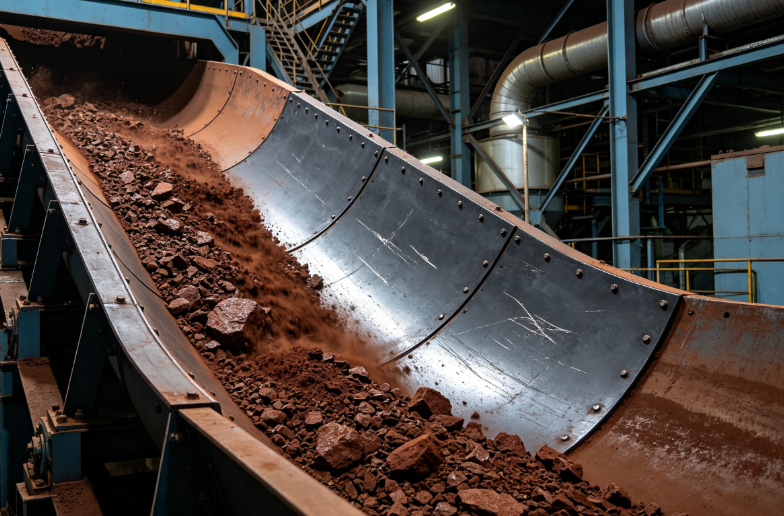
The Chute Wear Problem: Three Zones, Three Different Loads
Chute wear is rarely uniform. Published application data for wear-resistant steel plate separates the working conditions into recognisable duty profiles, and each one loads a liner differently.
- Metallurgy duty — ore chutes, hoppers, ball mill and crusher liners and mining trucks, running 24/7 under abrasive wear with medium impact and heavy abrasive wear. The special requirement is high wear resistance plus impact resistance, with UT inspection available.
- Mining machinery duty — mine hoppers and ore chutes on 24/7 intermittent loading, with abrasive wear combined with medium impact, and a requirement for high wear resistance, impact resistance and good weldability.
- Cement industry duty — crushers, ball mills, vertical roller mills, chutes, hoppers, conveyors, bucket elevators, screens, separators, silos and clinker handling equipment under heavy abrasion, impact wear, sliding wear, material flow, dust and continuous operation. The stated requirements are high abrasion resistance, impact resistance, long service life, dimensional stability, reliable plate hardness and easy maintenance.
- Power and coal chemical duty — coal mill chutes and pipe bends under abrasive wear in 24/7 continuous service.
The practical consequence is that a single chute often needs more than one grade. The impact zone beneath the discharge point and the long sliding wall downstream of it do not experience the same wear mechanism, and specifying the whole chute in one extreme grade can raise cost and fabrication difficulty without extending the relining interval where abrasion is mild.
Matching Wear-Resistant Steel Grades to Chute Duty
The quenched and tempered NM series is the standard family for chute liners, and each grade occupies a defined position between wear resistance, toughness and fabricability.
| Grade | Hardness class | Designed behaviour | Typical chute-related duty | Key constraint |
|---|---|---|---|---|
| NM400 | 400 HBW | Balanced hardness with good toughness; easy to cold-form, weld and cut; cost-effective | General wear liners, hoppers, dump truck beds, excavator buckets, crusher liners | Not selected where abrasion is severe — it is the grade most often upgraded away from |
| NM450 | ~450 HBW | Balanced upgrade from NM400, retaining good cold-formability and weldability | Medium-to-high wear chutes, loaders, compactors | Justified mainly when NM400 is wearing too fast |
| NM500 | 500 HBW | Higher surface hardness reducing downtime and maintenance cost in abrasive environments | Mining chutes, scrapers, heavy engineering wear parts | Higher material cost and slightly poorer formability than NM400/NM450 |
| NM550 | 550 HBW | Bridges high hardness with moderate toughness; exceptional scratch and abrasion resistance against aggressive minerals and gravel | Severe wear hoppers, ore conveying pipe liners | An intermediate step, not a default — use when NM500 loses material rapidly |
| NM600 | ~600 HBW | Top-tier hardness for severe wear with low impact | Mining liners, vertical mill scrapers, sand chutes, slurry pipelines, cement plant equipment | Cold forming and welding are difficult and must follow strict technical specifications |
| XCHD450 | 450 class | Extended longevity with good cold-formability and weldability for medium-to-high wear | Mining machinery, chutes, loader cutting edges, garbage compactors | Same duty band as NM450 — choose by availability and documentation |
| Mn13 | ~200 HBW as delivered, work-hardening above 500 HBW | Austenitic structure that hardens under heavy impact while the core stays tough and ductile | High-impact transfer points, jaw crusher plates, railway frogs, shot blast liners | Not suitable for pure abrasive wear without impact |
Thickness and Wear Allowance: The Constraint That Sets the Relining Interval
Hardness determines how fast the surface is consumed; thickness determines how much material there is to consume. Both must be specified together.
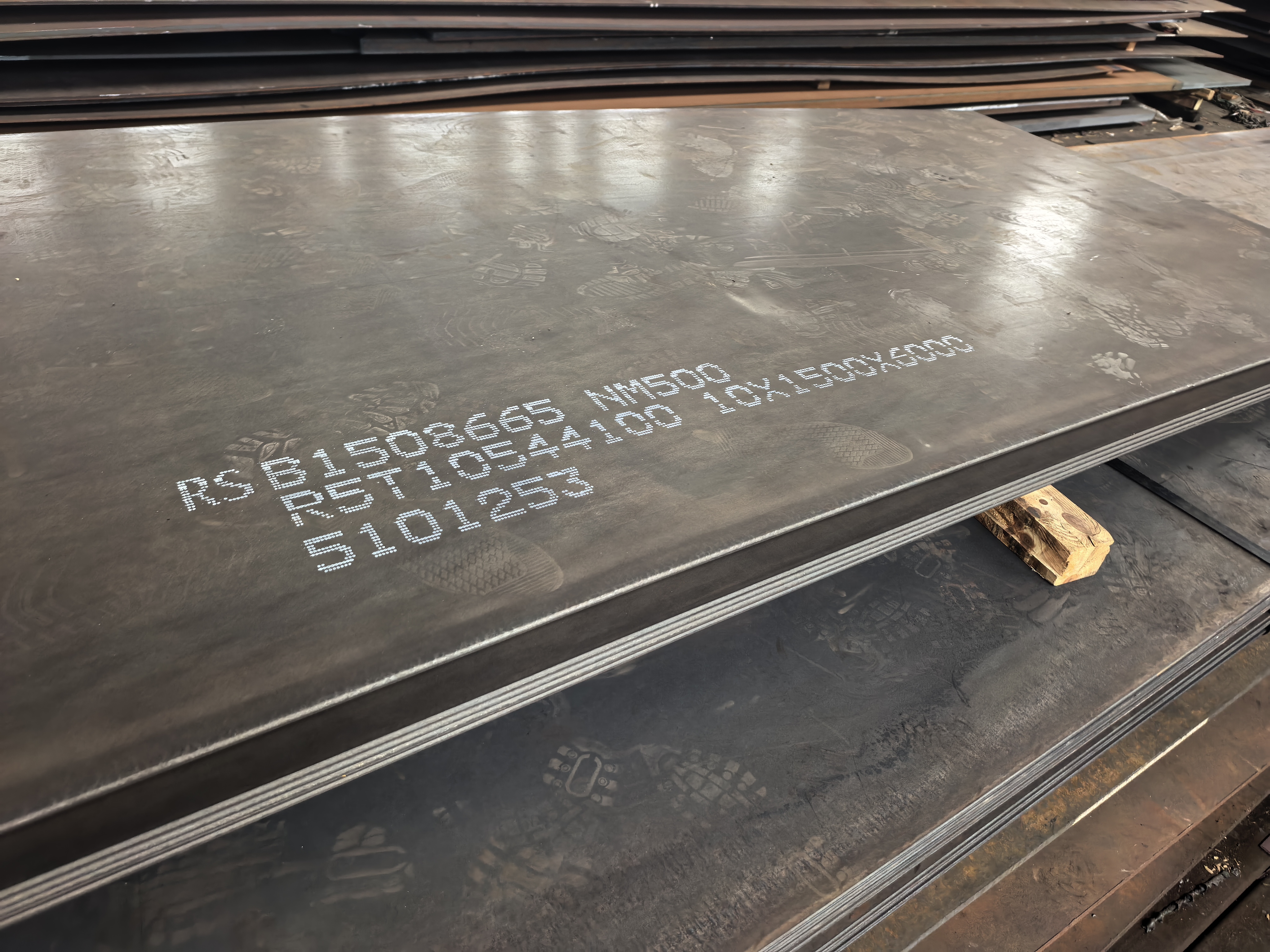
Wear-resistant steel plate for these applications is produced in a thickness range of 3 mm to 150 mm, a width range of 600 mm to 3950 mm with customised sizes accepted, and standard lengths of 2438 / 5800 / 6000 / 6096 / 12000 / 12200 mm. Individually cut liner segments are normally supplied to drawing rather than to standard plate size, which means the specification that reaches the mill or stockholder has to carry the finished liner dimension as well as the grade.
Two constraints govern how thickness is chosen. First, the wear allowance between planned relining windows: a chute wall that loses a few millimetres over a campaign can use a lighter plate than a discharge point receiving direct ore impact. Second, the impact energy at the loading zone, where thinner high-hardness plate can deflect or crack if it is not fully supported by the chute structure. This is why high-hardness grades are frequently used as a wear surface on a stiffened structure rather than as the load-bearing element itself.
Verifying Grade Conformity: MTC, Third-Party Inspection and Hardness Testing
The most common gap in chute liner procurement is not grade selection but grade proof. A plate described as NM500 is only NM500 if the delivered material can be traced back to its mill test certificate and, where required, to third-party inspection.
Standard quality control for these grades is the original Mill Test Certificate (MTC) together with third-party inspection. For buyers running a goods-in check, the following procedure is the reference method used for wear-resistant steel plate hardness testing.
Surface preparation before testing
- Test at least 50 mm away from flame or plasma cutting edges to avoid the heat-affected zone (HAZ), and away from any weld.
- Mechanically grind 1.5–2.0 mm to expose the bright metallic base instead of testing on the raw surface.
- Keep grinding temperature below 200 °C — overheating causes tempering and falsely low readings.
Grinding depth and test parameters by plate thickness
| Plate thickness | Grinding depth | Recommended parameter | Note |
|---|---|---|---|
| Under 3 mm | 0.5–0.8 mm | HBW 2.5/187.5, or Rockwell HRC / Vickers HV10 | High risk of penetration; convert HRC/HV10 to HBW using standard conversion tables such as ASTM E140 or GB/T 1172 |
| 3–6 mm | 1.0–1.2 mm | HBW 5/750 (D = 5 mm, F = 750 kgf) | A rigid, flat base is required to prevent flexing or bottom deformation |
| 6–80 mm | 1.5–2.0 mm | HBW 10/3000 (D = 10 mm, F = 3000 kgf) | The universal benchmark method for MTCs and third-party inspections such as SGS or BV |
| Above 80 mm | 2.0–3.0 mm | HBW 10/3000 (D = 10 mm, F = 3000 kgf) | If core hardness is specified, cut a sample to 1/4 or 1/2 of plate thickness before testing |
Indentation and verification
- Locate: select a test point at least 50 mm from the cutting edge and away from any weld or heat-affected zone, and mark it.
- Grind: grind the test area flat and remove rust, oxide and the decarburised layer.
- Indent: use a Brinell tester with the probe kept perpendicular to the steel plate.
- Record and verify: take 3 to 5 readings, discard outliers and compute the average HBW hardness. For acceptance, take 3 consecutive measurements with spacing of at least 10 mm between test points and check whether the average falls within the grade tolerance — for example 360–440 HBW for NM400/AR400 wear-resistant steel plate.
- For portable Leeb testers on plates under 15 mm, apply couplant grease to the back and couple the plate firmly onto a heavy steel block to eliminate vibration.
Safety precautions apply throughout: safety goggles for grinding debris, a dust mask for metal dust, cut-resistant gloves and protective work clothing, with loose sleeves and jewellery prohibited. Workpieces must be clamped before grinding, the grinding wheel checked for cracks before startup, and the operator kept away from the wheel ejection direction. Heavy plates must be supported or fixed, roll-over or sliding prevented, and lifting aids used instead of manual lifting alone.
A limitation worth stating plainly: a hardness test confirms surface hardness at the tested location. It does not by itself confirm chemical composition, impact toughness or through-thickness uniformity, which is why the original MTC and third-party inspection results remain the conformity reference for a chute liner order, with hardness testing acting as a spot check rather than a replacement.
Fabrication Constraints That Limit Grade Choice
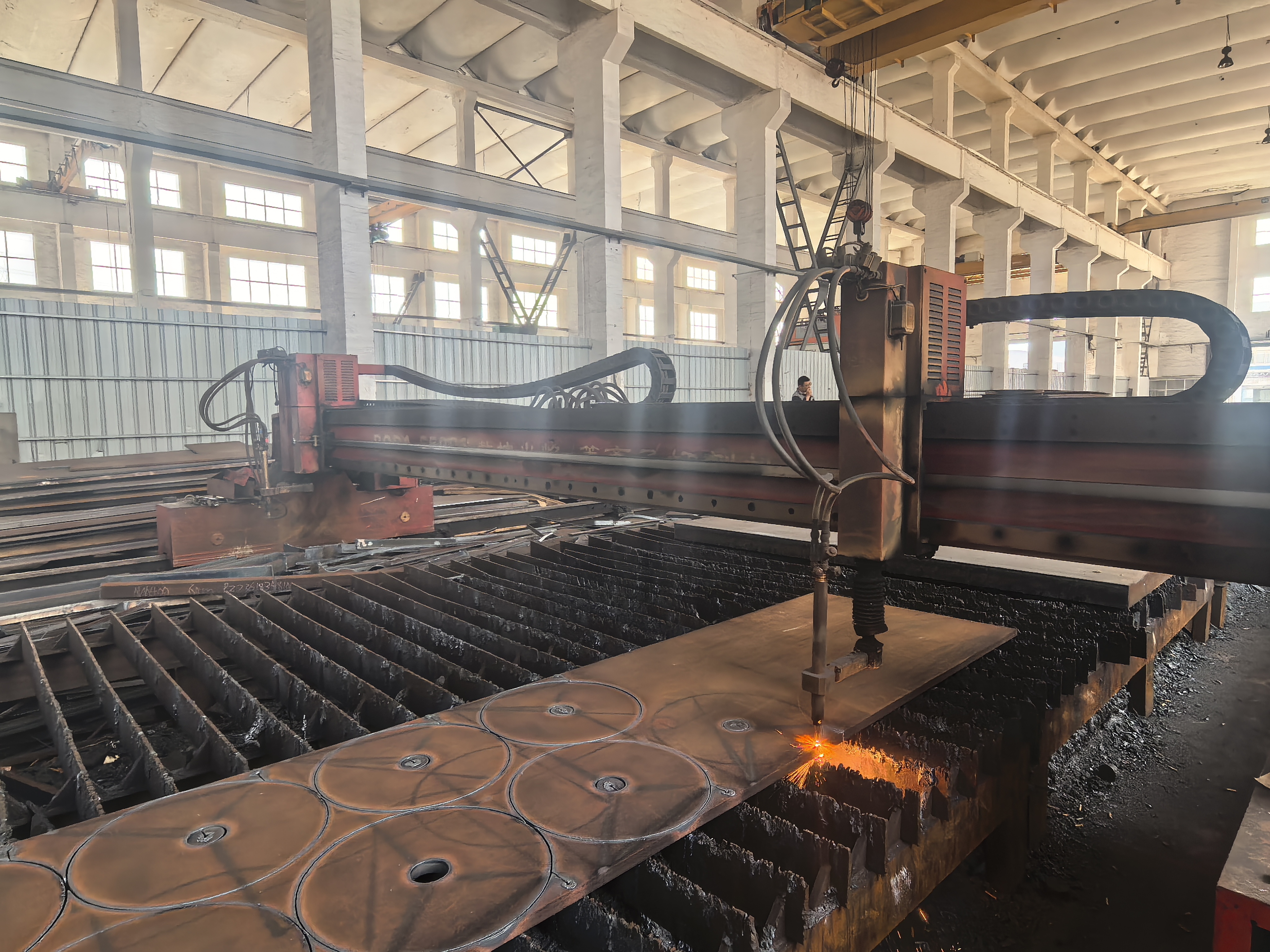
Chute liners are fabricated items. They are cut, drilled, rolled or press-formed, and either bolted in segments or welded to the structure — and each of these operations becomes harder as hardness rises.
- NM400 and NM450 are described as easy to cold-form, weld and cut, which suits complex chute geometry, rolled sections and bolted liner plate with countersunk or slotted holes.
- NM500 is characterised by higher hardness with higher material cost and slightly poorer formability, so fabrication planning matters earlier.
- NM600 at roughly 600 HBW is explicitly flagged as difficult for cold forming and welding, requiring strict technical specifications — a real constraint on any chute that is not a simple flat liner.
- Mn13 performs through work hardening and should only be specified where heavy shock loading exists; without impact it does not develop its hardened surface layer.
Chute support structures and hopper frames introduce a separate constraint. High strength steel plate such as Q690D, Q690E, Q890D and Q960E is used for heavy machinery and cold-resistant equipment, with Q690D noted for its high strength-to-weight ratio in coal mining and construction equipment and Q690E offering −40 °C ultra-low-temperature impact toughness for arctic or high-latitude operations. For ultra-high-strength grades, hydrogen-induced cracking and heat-affected-zone softening are recognised risks, so control over preheating temperature, low-hydrogen welding consumables and precise heat input is mandatory. Where a chute frame is designed in Q690 high strength steel plate to save weight, the welding procedure becomes part of the wear-liner specification.
Supply Constraints: Availability, Traceability and Lead Time
For relining programmes, the practical limiting factor is often not grade choice but whether the specified grade and thickness combination is available as stock, cut to size, and documented.
BGT Steel Plate is the trading identity of Jiangyin Baoguantao Import & Export Co., Ltd., a wear-resistant and high-strength steel plate stockholder and distributor established in 2013 and based in Jiangyin, Wuxi City, Jiangsu Province, China (www.bgtsteel.com). The company operates 12 warehouses across Jiangsu, Shandong and Hunan provinces and maintains a standing inventory of over 30,000 metric tons of wear-resistant steel plate, with a 5,000 m² facility, 40 employees including 3 R&D engineers, an annual output of 200,000 tons and a monthly capacity of 30,000 tons. Stated lead time is 7–10 days with a minimum order quantity of 1 ton, and export accounts for 40% of business across the Middle East, Southeast Asia, South America, Africa, Central Asia and Russia.
Two supply-side facts matter specifically for chute work. First, traceability: plate is sourced through direct distributor relationships with mills including Xingcheng, Nisco, Shandong Steel, Shougang, Xisc, Lianyuan, Puyang, Rongshen and Yongfeng, and supplied with the original Mill Test Certificate, with third-party inspection available on request. Second, flexibility: OEM/ODM production allows customisation of chemical composition, mechanical properties and logo marking, alongside custom plate sizes, which supports both standard liner replacement and project-specific chute designs. After-sales support covers technical guidance and on-site consultation.
Comparison: Wear-Resistant Plate versus Conventional Chute Solutions
The conventional alternatives to a quenched and tempered wear plate are mild structural steel liners and surface-hardened carbon steel. Mild steel is inexpensive and easy to fabricate, but its low surface hardness means liners in abrasive chute duty require far more frequent replacement. Surface-hardened carbon steel is hard only at the skin: once the hardened layer is consumed, the soft underlying core wears quickly. Quenched and tempered wear plate is through-hardened, so hardness is maintained uniformly from surface to core and the underlying material performs identically as the top layer wears away.
The honest limitations of the wear plate approach are equally relevant to specification:
- Higher hardness is not automatically lower cost. NM600 carries higher material cost and tougher processing requirements; if NM550 satisfies the wear demand, specifying NM600 adds cost without adding value.
- Mn13 is application-specific. Its work-hardening mechanism is superior to conventional quenched plate under repeated impact, but it is not suitable for pure abrasive wear without impact, and NM series plate is more economical for low-impact abrasive duty.
- Fabrication becomes the bottleneck at the top of the hardness range. Difficult cold forming and welding on ~600 HBW plate restricts its use to simpler geometries.
- Verification is sampling-based. Hardness measurement confirms a point on the surface; it does not replace MTC or third-party documentation for composition and toughness.
- Stock coverage is finite. Not every grade and thickness combination is a stock item, and custom sizes or non-standard thicknesses extend beyond a standard 7–10 day programme.
Where These Grades Are Specified Today
Chute-related demand clusters around four equipment families, and the grade mix follows the duty profile rather than the industry label:
| Application area | Equipment | Grades typically specified |
|---|---|---|
| Mining machinery | Mine hopper / ore chute | NM400, NM450, NM500, NM550, NM600 |
| Metallurgy | Ore chute, hopper, ball mill and crusher liners, mining truck | NM400, NM450, NM500 |
| Cement industry | Chutes, hoppers, crushers, vertical roller mills, clinker handling | NM400, NM450, NM500, NM550, NM600, Mn13 |
| Power & coal chemical | Coal mill chute, pipe bend, coal bunker | NM400, NM450, NM500 |
Field evidence from adjacent wear applications illustrates how these grades perform. A shredder equipment manufacturer in Vietnam ordered 180 pcs of NM500 wear-resistant steel plate for shredder blade fabrication, reporting reliable cutting with high wear resistance as the highlight. A mining equipment manufacturer in Russia ordered 200 tons of NM400 and NM450 for fabricating dump truck floor and side liners, reporting stable wear protection with the highlight described as balanced toughness and wear resistance. Both cases point to the same selection logic used for chutes: match the grade to the dominant wear mode and keep the fabrication route realistic.
Market Trend: From a Hardness Number to Verified Documentation
Specification practice in mining and cement wear parts is shifting from a single hardness figure to a documented material package. Continuous-operation duty profiles — heavy abrasion, impact wear, sliding wear, material flow, dust and continuous operation — are increasingly written with requirements for dimensional stability and reliable plate hardness alongside the abrasion number. That wording invites verification: MTC, third-party inspection, and in some programmes a goods-in hardness check following the thickness-based procedure described above.
A second visible trend is grade stepping rather than grade jumping. The recommended sequence is to move up only when the current grade wears out too quickly: NM400 as the baseline for common abrasion, NM450 as the intermediate upgrade, NM500 where downtime cost dominates, and the hardest grades reserved for genuinely extreme conditions. This discipline keeps fabrication practical and controls material cost.
Future Outlook
Three directions appear likely. First, hardness verification procedures are becoming part of purchase specifications rather than an optional quality check, particularly where a chute relining schedule is tied to production planning. Second, demand is expected to keep separating into two streams — high-volume NM400/NM450 for general wear protection, and lower-volume NM550/NM600 and Mn13 for extreme abrasion or heavy-impact zones. Third, traceability requirements are likely to tighten as more buyers ask for the original Mill Test Certificate as a standard attachment to liner deliveries rather than an exception. For suppliers and fabricators, the implication is that documentation capability is becoming as much a selection criterion as hardness class.
FAQ
What hardness grade should be specified for a mining chute liner?
It depends on the dominant wear mode. For abrasive wear with medium impact, as found in mine hoppers and ore chutes operating on 24/7 intermittent loading, the quenched and tempered NM series covers the duty: NM400 for general wear with the easiest processing, NM450 as a balanced upgrade when NM400 wears too fast, and NM500 where high abrasion combines with costly replacement downtime. For heavy impact transfer points, a work-hardening grade such as Mn13 is the appropriate choice rather than a harder quenched plate.
What thickness of wear-resistant steel plate is used for chute liners?
Wear-resistant steel plate for these applications is supplied in a thickness range of 3–150 mm, a width range of 600–3950 mm with customised sizes accepted, and lengths of 2438 / 5800 / 6000 / 6096 / 12000 / 12200 mm with custom sizes available. Thickness is set by the wear allowance required between relining windows and by the impact energy at the loading zone; it should be decided together with hardness rather than separately.
How can a buyer verify that a delivered plate meets NM400, NM450 or NM500 hardness?
There are two verification paths. The documentation path uses the original Mill Test Certificate, with third-party inspection available where required. The physical path is a goods-in hardness check: test at least 50 mm from flame or plasma cutting edges and away from welds or the heat-affected zone, grind 1.5–2.0 mm to expose bright metal while keeping temperature below 200 °C, then use HBW 10/3000 for 6–80 mm plate, take 3 consecutive measurements at least 10 mm apart, and compare the average with the grade tolerance — for example 360–440 HBW for NM400/AR400. For portable Leeb testing on plates under 15 mm, couplant grease and firm coupling to a heavy steel block are required to eliminate vibration.
When is high manganese steel plate Mn13 a better choice than an NM grade in a chute?
Mn13 is preferred where impact dominates. It has an austenitic microstructure and work-hardens dynamically under heavy impact and compressive stress, with surface hardness rising from around 200 HBW to over 500 HBW while the substrate remains tough and ductile. It suits high-impact transfer points, jaw crusher plates and similar components. For pure abrasive wear without impact, quenched NM series wear plate is the more economical and appropriate option.
Should every chute liner be specified in the hardest available grade, such as NM600?
No. NM600 offers the highest commercial wear plate hardness at around 600 HBW and is engineered for severe abrasive wear with low impact, including sand chutes, slurry pipelines and cement plant equipment. However, cold forming and welding are difficult and must follow strict technical specifications, and the material cost is higher. Grade-selection guidance is to step up only when the current grade wears out too quickly — NM550 when NM500 loses material rapidly, and NM600 only for extreme abrasion conditions.
What documentation and supply conditions should accompany a chute liner plate order?
A chute liner order should be traceable to the original Mill Test Certificate, with third-party inspection available on request, and should carry grade, thickness, width and length identification for each cut segment. Where a project requires it, OEM/ODM production allows customisation of chemical composition, mechanical properties and logo. Stockholders such as BGT Steel Plate hold wear-resistant plate in 12 warehouses across Jiangsu, Shandong and Hunan with a standing inventory of over 30,000 metric tons, a stated lead time of 7–10 days and a minimum order quantity of 1 ton, which supports both routine liner replacement and project-specific sizes.
For readers who need the full grade and size reference in one document, the company brochure is available here: BGT Steel Plate product catalogue (PDF).