
Mining Container Evidence: Reading Overseas Project Records
Mining Container Evidence: Reading Overseas Project Records
An overseas reference project is usually the first hard evidence a mining container buyer receives after an NDA and before a factory audit, and it is the document most often over-read in the procurement file. A site photograph and a megawatt figure can establish that a supplier has integrated liquid cooling into a transportable enclosure and moved it across a border. They seldom establish the operating result the buyer is actually pricing.
This article examines five overseas records published in the September 10, 2026 corporate presentation of Tangshan Xinke Intelligent Technology Co., Ltd.: a MicroBT 36 MW liquid-cooled container project in Texas, a Canaan 30 MW liquid-cooled container project in Norway, a BITMAIN 1.7 MW modular container project in Ohio, a BITMAIN 21.12 MW high-density liquid-cooled container project in Ethiopia, and an ASIC modular computing center in Uzbekistan. The aim is not to grade the records but to show what they can and cannot carry inside a supplier evaluation.
Tangshan Xinke Intelligent Technology Co., Ltd. — trading as xinkelcs Mining Container — manufactures prefabricated modular data center containers, liquid-cooled computing containers, hydro ASIC mining containers, liquid-cooled micro modules, CDUs and liquid-cooled racks. The company was established in 2019, operates a 30,000 m² production base in Guye Economic Development Zone, Tangshan, Hebei, China, reports a 60% export ratio, and lists the United States, Norway, Uzbekistan, Ethiopia and Romania among its export markets.
Why a reference project is evidence, not a verdict
A documented project record is strongest on three questions and weakest on a fourth. It is good evidence that the supplier has built the equipment type, that it has worked across a customs and logistics boundary, and that a customer with a recognisable fleet accepted a delivered configuration. It is weak evidence of operating performance, because a presentation entry is not a measurement report.
Evaluation-stage and execution-stage readers need different things from the same page. For shortlisting, the signal is scope: did the supplier deliver the enclosure alone, or the coolant loop, CDU, power distribution, monitoring and commissioning with it? For execution, the signal is boundary: which items sat inside the supplier's delivery, which were site works, and who signed acceptance. A record that names a 30 MW project but never states the scope split cannot tell a buyer whether the supplier is an integrator or a container fabricator.
Two misreadings follow. The first is treating rated megawatts as a performance certificate. Rated capacity does not confirm heat removal at the intended supply and return temperatures, flow, pressure and ambient conditions; the complete thermal chain, including primary cooling duty and the server flow limits, has to be verified before an order. The second is assuming that acceptance in one jurisdiction implies acceptance in another. Product conformity schemes are separate, destination-specific routes rather than interchangeable credentials, and an assembled system may need assessment beyond its individual components.
Both cautions apply to Xinke's own equipment as much as to a competitor's. That is what makes them a reading discipline rather than a procurement tactic.
What the five documented records actually contain
The entries share a format: project type, country, capacity where disclosed, a photograph and a short description. None is presented as a test report, and none publishes measured efficiency.
| Project record | Market | Documented in the entry | What it supports | Not established |
|---|---|---|---|---|
| MicroBT liquid-cooled container | Texas, USA | 36 MW liquid-cooled container project; project photograph; described as demonstrating liquid-cooling integration and overseas delivery | Integration of cooling and supporting systems; cross-border delivery; customer acceptance of a delivered configuration | Operating duration, measured PUE, water and energy savings, supply-scope split; any AI-workload claim |
| Canaan liquid-cooled container | Norway | 30 MW liquid-cooled container project; project photograph | Liquid-cooled container delivery in a cold-climate market | Operating duration, measured efficiency, design conditions |
| BITMAIN modular container | Ohio, USA | 1.7 MW modular container project; project photograph | Modular container delivery; the smallest referenced scale in the set | Operating duration, measured performance, scope of supply |
| BITMAIN high-density liquid-cooled container | Ethiopia | 21.12 MW high-density liquid-cooled container project; project photograph | High-density liquid-cooled delivery at multi-megawatt scale | Operating duration, measured efficiency, site conditions |
| ASIC modular computing center | Uzbekistan | ASIC modular computing-center project; two-year project duration; aerial site photograph | Modular computing-center deployment; a longer-duration project record | Capacity, customer name, operating duration, measured efficiency |
Read as a set, the entries describe a capacity ladder rather than a single reference: 1.7 MW in Ohio, 21.12 MW in Ethiopia, 30 MW in Norway and 36 MW in Texas, alongside one Uzbekistan entry whose capacity is not disclosed. The Texas, Norway and Ethiopia entries are described as liquid-cooled container projects, the Ethiopia entry additionally as high-density, and the Ohio entry as a modular container project. The Uzbekistan entry is the only one described as an ASIC modular computing center.
That pattern is useful for one reason: it separates project type from cooling type. The records show the supplier working across modular containers, liquid-cooled containers and a modular computing center — three different scopes of supply — which is the distinction a technical evaluation has to settle before any two entries are compared.
What the records show about liquid-cooling integration
The records support a claim about integration, not about thermal efficiency. Liquid cooling in a mining container is a chain, not a component. Heat leaves ASIC cold plates into a secondary coolant loop, crosses a liquid-to-liquid heat exchanger inside a CDU into a primary loop, and is rejected at a dry cooler or cooling tower. A factory-integrated container has to resolve that chain inside an ISO envelope: piping routes, pump and control interfaces, coolant compatibility, fill and vent procedure, pressure and leak testing, power distribution, and monitoring that alerts on abnormal conditions.
Delivering that as one unit at 30 MW or 36 MW referenced capacity is a meaningful engineering statement, because the interfaces that fail in the field sit between packages — coolant quality against the cold plates, CDU controls against the site's primary loop, condensate and freeze protection against the local climate. A reference entry indicates that those interfaces were closed for at least one site and accepted by a customer.
It does not indicate how well. Judging heat removal requires performance curves at the design supply and return temperatures, the flow and pressure budget measured against server limits, coolant specification, primary cooling duty, and the acceptance criteria used at factory and site testing. Published supplier specifications show how much of that can be disclosed when a vendor chooses to. PowerMining's 20-foot hydro-cooled container listing, for example, states water plus glycol as the cooling medium, 200 L/min coolant flow per rack and 1,000 L/min total, dry-cooler heat rejection, and an outside operating range of −35 °C to +50 °C. That is a useful template for what to request; it remains a supplier-stated specification, not an independent test result.
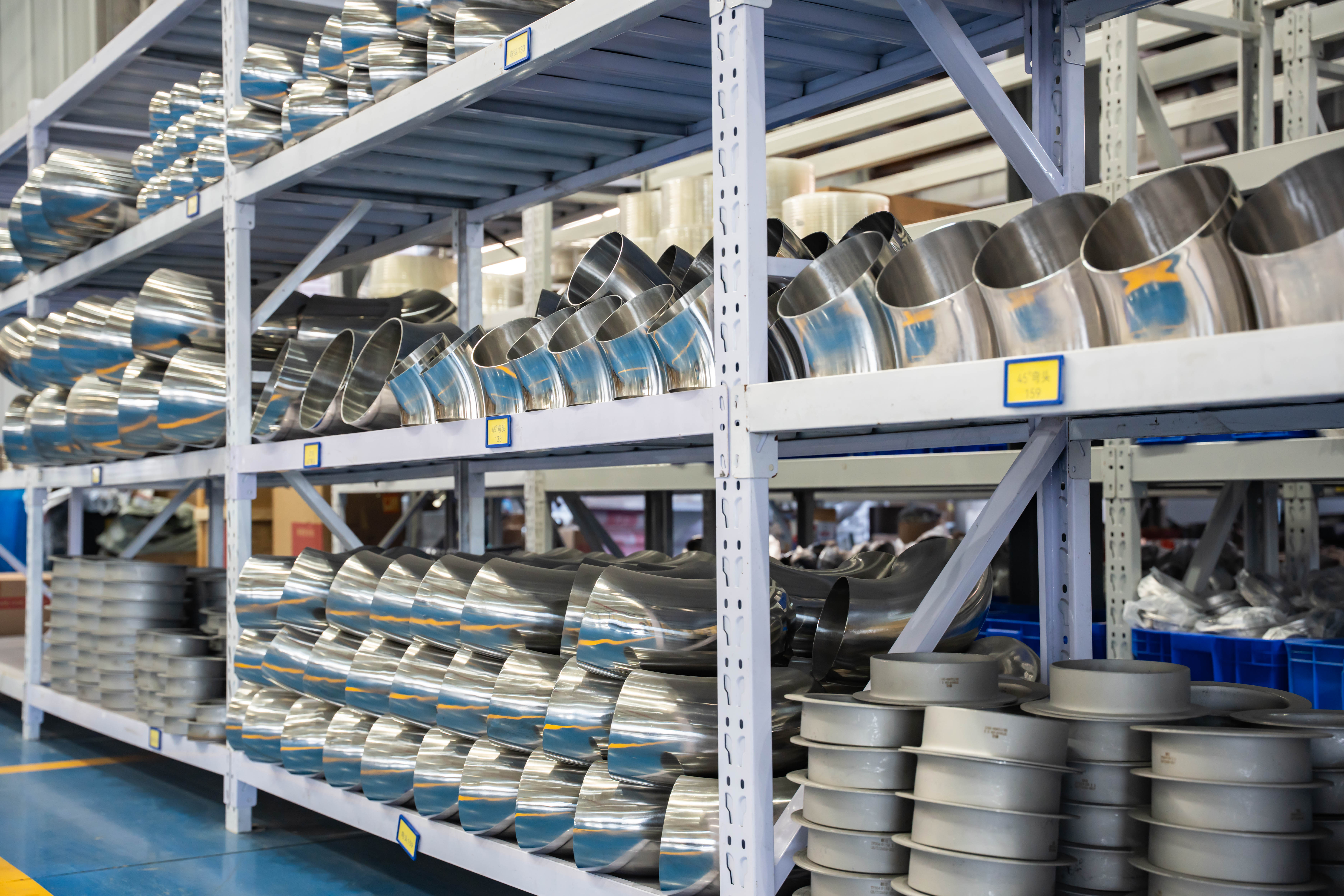
Production materials staged at the Xinke manufacturing base in Tangshan, Hebei. Integration scope is decided at fabrication stage, long before a project photograph is taken.
What the records show about overseas delivery
Delivery evidence is the least glamorous and most transferable part of a record. A containerised system has to survive lifting, road transport, ocean freight and customs before it can be commissioned, and the enclosure itself is a regulated object in some markets. Xinke holds a China Classification Society Certificate of Works Approval for equipment containers, number HE24S1019, covering non-cargo carrying equipment containers of model XKKJ-40HC003 (ISO code 45SM), issued 31 December 2025 and valid to 30 December 2029, subject to annual CCS surveillance.
The scope matters as much as the certificate. This is a works approval for a manufacturing site and a named container model; it is not a system-level electrical, fire or pressure certification for a completed liquid-cooled mining container, and it does not travel with the product into every destination market. Buyers should read it as evidence of a controlled enclosure manufacturing process, then ask separately about the conformity route for the assembled system at their own site.
The five entries also span materially different climates: hot-arid Texas and Uzbekistan, cold-coastal Norway, continental Ohio and highland Ethiopia. That spread is relevant because freeze protection, condensation control and dry-cooler sizing are climate-driven design decisions. What the records do not publish is the design ambient, altitude, water quality or electrical supply for each site, so a buyer cannot conclude that a configuration proven in one of these locations can be reused unchanged in another.
What the records do not prove
- Measured performance. The presentation does not disclose operating duration, measured PUE, water savings or energy savings for the Texas entry, and operating duration and measured efficiency are likewise not disclosed for the Norway, Ohio and Ethiopia entries. No uptime, degradation or noise data is published for any of the five.
- Capacity definition. A megawatt figure can mean IT load, rated power, operating power or total facility power. Definitions are not harmonised across suppliers, and the records do not state which one applies per entry, so published figures should not be ranked or aggregated before the boundary is confirmed.
- Supply scope. None of the entries states whether foundations, primary cooling, grid connection, civil works or local permits sat inside or outside the supplier's delivery.
- Commercial terms. No MOQ, price, lead time, warranty period, spare-parts policy or service-response commitment is attached to any record.
- Certification coverage. A works approval covering one container model is not evidence that every product or complete system holds every credential, or that a destination authority will accept it.
- Workload boundary. The Texas entry is a blockchain computing project and should not be read as an AI data center reference, even where a similar cooling architecture appears in AI deployments.
A buyer's reading method: six checks before weighting a record
A reference becomes usable evidence when it can be resolved into scope, conditions and acceptance. Six questions do most of that work, and each can be answered in writing before a purchase order exists.
| Check | Question to put in writing | Why it changes the decision |
|---|---|---|
| Supply scope | Which items were inside your delivery: enclosure, CDU, piping, power distribution, controls, commissioning? | Separates an integrator from a container fabricator and fixes interface responsibility |
| Power definition | Is the published megawatt figure IT load, rated power, operating power or total facility power? | Prevents ranking figures that were not measured on the same basis |
| Design conditions | Which ambient, altitude, water quality and electrical supply was the configuration designed for? | Shows whether the reference configuration can be reused or must be re-engineered |
| Configuration identity | Which model and options were delivered, and what changed between that project and our requirement? | Stops optional equipment being read as standard equipment |
| Certification scope | Which certificate covers which model, issuer, standard and validity period, and what covers the assembled system? | Separates component, enclosure and complete-system conformity |
| Acceptance and service | What factory and site acceptance criteria applied, and what warranty, response and spare-parts terms were contracted? | Converts a reference into execution-stage assumptions rather than optimism |
A supplier that answers all six in writing has turned a photograph into a reference a technical team can defend internally. A supplier that answers none has provided a lead, not evidence — which is a legitimate stage in a shortlist, provided the buyer prices the missing verification into the schedule.
The capability behind the record: customization, testing and certification scope
Reference projects matter to this buyer segment because the delivered unit is rarely a catalogue item. Xinke states that it provides custom production services for containerized data center and modular container solutions, with indoor liquid-cooled micro modules and outdoor prefabricated modular container solutions available, and that customization can configure CDUs, cooling equipment, piping, power distribution, monitoring and container layouts around IT heat load, server interfaces, rack layout, redundancy, climate and electrical supply. Customization is subject to technical review.
That sentence is where most project risk sits. Heat load, rack layout and climate determine CDU selection and piping design; server interfaces determine flow and pressure limits; redundancy and electrical supply determine power distribution and control architecture. A reference project is evidence that this review was completed for one set of inputs, not that it will produce the same output for another.
Quality control follows the same logic. Incoming, process and assembly inspections, finished-product tests and pre-shipment reinspection sit alongside factory commissioning and testing for integrated systems, with the factory acceptance test scope defined by the technical agreement rather than assumed. The management-system certificates describe process discipline at the site: ISO 9001 certificate 06724Q20082R0S, issued 30 January 2024 and valid to 29 January 2027, covering R&D and production of cloud computing liquid cooling equipment and controls and production of container bodies, excluding activities requiring qualification; and ISO 14001 certificate 06726E00031R001, issued 22 January 2026 and valid to 21 January 2029, covering environmental management for the same scope.
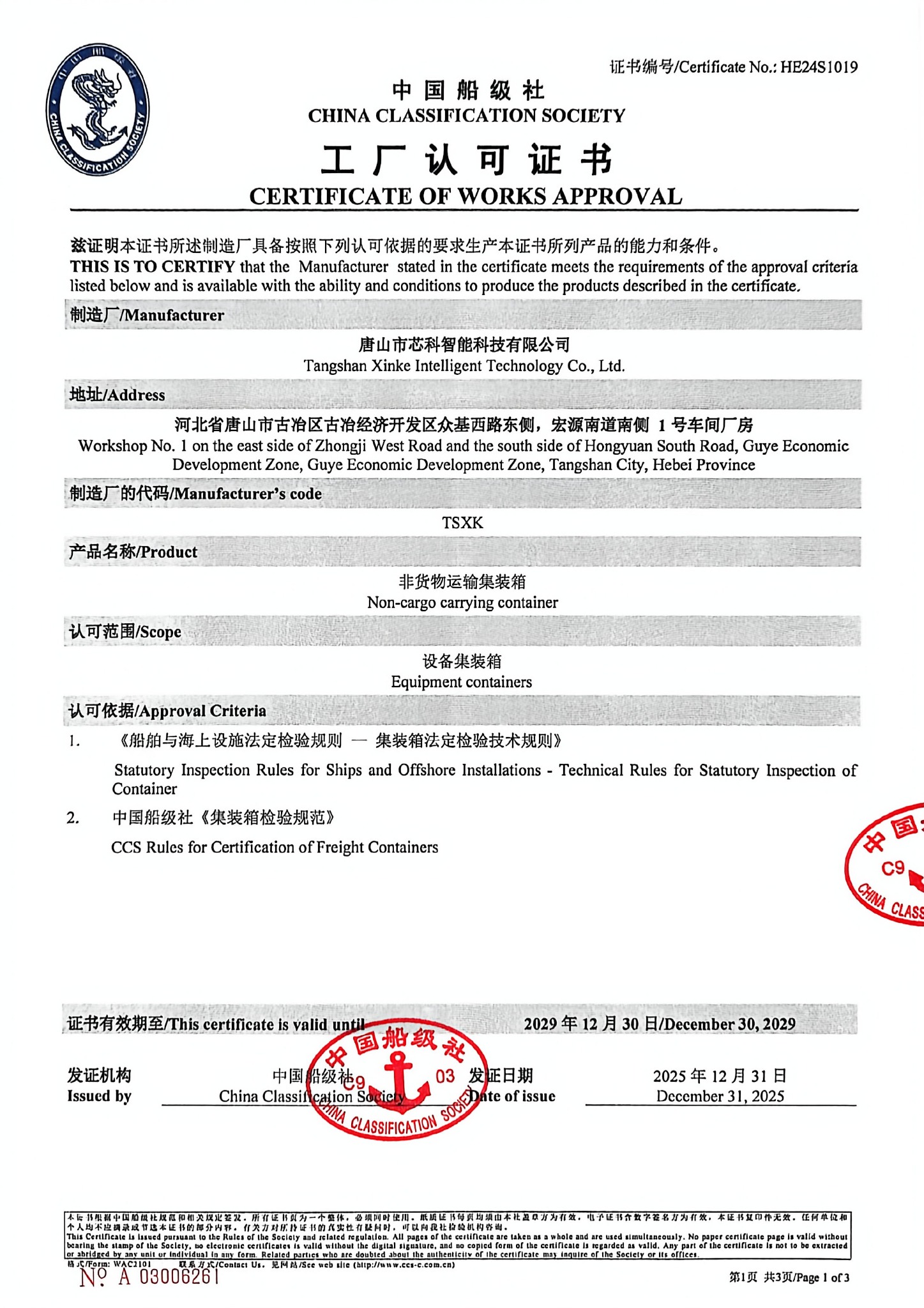
Certificate of Works Approval HE24S1019 from the China Classification Society covers non-cargo carrying equipment containers of model XKKJ-40HC003 (ISO code 45SM), subject to annual surveillance.
Capacity and delivery are the claims most often over-extrapolated. Xinke reports a catalogue annual capacity exceeding 500 MW and states that this is not a fixed monthly delivery commitment. Lead time depends on model, customization, materials, production schedule and site conditions and is confirmed in the contract, while MOQ is confirmed per product and project. After-sales support covers technical consultation, installation briefings, operating guidance, maintenance and troubleshooting, with the company catalogue reporting an after-sales team of more than 20 professional engineers; overseas on-site scope, response times, warranty and charges are defined in the project contract.
Where a container fits, and where it does not
Liquid-cooled containers are not the default answer for every site, and the cost gap is part of the evidence a buyer has to weigh. HashrateIndex's 2025 infrastructure benchmark reported that fitted 40-foot air-cooled units cost significantly less than hydro or immersion builds, which carry a premium for cooling complexity, and placed hardware-only pricing for 20- and 40-foot hydro and immersion containers in a USD 112,000–300,000 band as of August 2026. That band is a benchmark, not a quotation: it is useful for challenging an outlier bid, not for closing one.
Format choice is a separate decision from cooling choice. An indoor liquid-cooled micro module integrates racks and supporting systems inside a suitable building and depends on that building's floor capacity, utilities and envelope. An outdoor container adds a transportable enclosure designed around transport and site requirements, but still needs foundations, utility connections, access and local approvals. Neither format by itself establishes an availability tier or an efficiency value.
The practical boundary is therefore straightforward. A container suits a prepared outdoor site, phased expansion, or a location where building works would set the schedule. An indoor micro module suits an existing building with floor capacity and utilities already in place. A supplier's reference record helps only after that choice is made, because it shows which of the two the supplier has actually delivered.
What to watch next
Two directions are worth watching, and the evidence behind them is not equivalent. On the mining side, the reviewed sources contain no defensible market-size, shipment or installed-base series for mining containers, so growth narratives deserve caution. Business Research Insights projects the global Bitcoin miner market at USD 11.72 billion in 2026 with a 26.7% compound annual growth rate to 2035 — a commercial hardware-revenue projection defined by that publisher's methodology and scope, not a container shipment forecast.
On the adjacent side, liquid-cooled modular formats are extending into AI workloads. Delta Electronics describes an AI containerized data center solution supporting liquid-cooled AI servers at up to 60 kW per rack inside a 20-foot ISO container, while Schneider Electric has described a 20-foot ISO liquid-cooled modular data center with a standard 60 kW IT load and up to 336 kW as a custom configuration. These are different products serving different workloads and should not be used to reinterpret a mining reference. What they do confirm is that the documentation a buyer should demand — rack or container power definition, coolant specification, flow, ambient range and acceptance tests — is becoming the common language of the category.
Xinke publishes an English-language corporate brochure, including product and certification material, for buyers who want to compare specifications against a project technical agreement: 2026 corporate brochure (PDF).
Frequently asked questions
What is a prefabricated modular data center?
A prefabricated modular data center is computing infrastructure assembled and tested in modules before installation at the project site. A configured module can integrate IT racks, power distribution, cooling, monitoring and other supporting systems, and its capacity, redundancy and interfaces are defined by the project design. Factory integration moves part of the assembly, cabling, piping and testing off site. It does not by itself establish a particular availability tier, certification or energy-efficiency value.
How should buyers select a prefabricated liquid-cooled data center solution?
Compare proposals on the same IT load, design conditions, redundancy and supply scope. Review model-specific performance, interface responsibilities, applicable certification evidence, factory testing, delivery capability and after-sales support, then agree configuration and acceptance criteria before comparing total project cost. Responsibility for primary cooling, site work, transport, commissioning and approvals should be written into the comparison, because proposals that exclude those items are not like-for-like.
Should I choose an indoor liquid-cooled micro module or an outdoor data center container?
An indoor micro module integrates racks and supporting systems inside a suitable building and depends on that building's floor capacity and utilities. An outdoor container adds a transportable enclosure designed around transport and site conditions, but still requires foundations, utility connections, access and local approvals. The decision turns on available space, site utilities, expansion plans, environmental conditions and total installed cost. Neither format alone guarantees a certification tier or an efficiency value.
What certification evidence should buyers request for a liquid-cooled data center project?
Request the original documents and check the covered model, issuer, certificate or report number, applicable standard, validity and scope. Separate component, assembly and complete-system evidence, and confirm destination-specific acceptance requirements with the project authority and a qualified certification partner. For container-based systems, an enclosure works approval and a system conformity route are different documents, and one does not substitute for the other.
What risks arise when a liquid-cooling system is purchased using rated kW alone?
Rated capacity does not confirm performance at the intended supply and return temperatures, flow, pressure and ambient conditions. Mismatched coolant, interfaces or primary cooling can reduce heat removal or disrupt operation, producing alarms, derated capacity or unplanned shutdown. Buyers should verify the whole thermal chain — performance data at design conditions, flow and pressure budgets, coolant compatibility, primary cooling duty and control interfaces — and agree factory and site acceptance criteria before ordering.
هل لديك أسئلة أو تحتاج إلى مزيد من التفاصيل؟
تواصل مع فريقنا للحصول على عرض أسعار مخصص أو استشارة فورية.
طلب عرض أسعار
املأ النموذج أدناه وسيتواصل معك فريقنا بعرض مقترح مخصص.
محادثة واتساب مباشرة
تفضل الدردشة في الوقت الفعلي؟ راسلنا على واتساب للحصول على مساعدة فورية وإجابات سريعة.
- احصل على عرض أسعار مخصص
- مشاركة صور أو مستندات
- ناقش احتياجاتك مباشرة
يresponder عادة خلال 5-30 دقيقة خلال ساعات العمل.