
Mining Container Procurement FAQ: Fixed vs Project-Specific
Mining Container Procurement FAQ: Fixed vs Project-Specific
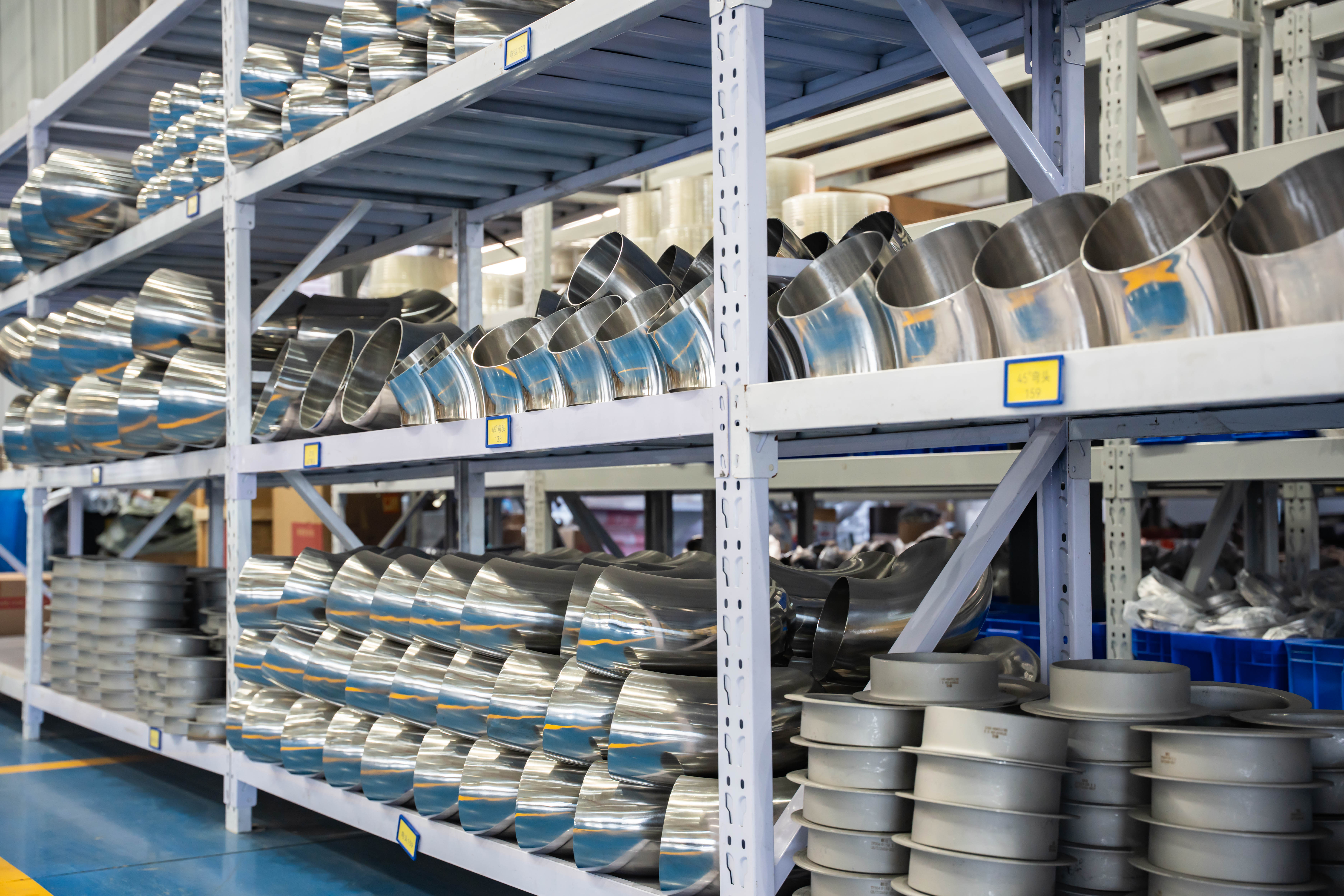
Production materials for container fabrication. Catalog materials and layouts do not replace an approved project design.
A mining container quotation is not a catalog order. The commercial catalog may show a 120-position, 160-position or 240-position series, but the final model and miner compatibility are confirmed per order. What stays with the order is narrower than many buyers expect: the product family, the manufacturer documented quality scope, and any certificate scope tied to a listed model. What changes the site outcome—IT capacity, rack count, power per rack, dimensions, weight, utility interfaces, electrical V/Hz and redundancy—is project-specific and must be settled in the technical agreement.
Tangshan Xinke Intelligent Technology Co., Ltd. supplies xinkelcs Mining Container as part of a portfolio that also includes prefabricated modular data center containers, liquid-cooled micro modules, CDUs and cooling equipment. The relevant procurement point is not the breadth of the catalogue. It is the boundary between a published series and a released design. Treating a catalogue value as the final site design is one of the most common ways for a mining container order to drift between what was compared and what is actually installed.
What is fixed in a mining container order?
Fixed elements are mostly identity, process and documented scope. xinkelcs Mining Container is the hydro ASIC mining container offering from Tangshan Xinke Intelligent Technology Co., Ltd. The published series covers 120-position, 160-position and 240-position configurations, with the final model confirmed per order. That statement is useful for screening, but it does not define a universal bill of materials, a universal miner list or a universal site interface.
Three fixed layers can be checked before the project design is complete:
- Product and model identity. The approved series name and the model confirmation step are fixed. A buyer should still expect the final model to be confirmed against the chosen miner and the project configuration.
- Quality management scope. The manufacturing site holds ISO 9001:2015 certification, certificate 06724Q20082R0S, issued 30 January 2024 and valid to 29 January 2027. The stated scope covers the management system for R&D and production of cloud computing liquid cooling equipment and controls, and production of container bodies, excluding activities requiring qualification. This is evidence of a documented quality system, not a guarantee of a particular IT capacity or hydraulic performance.
- Certificate scope where a listed model is named. The CCS Works Approval HE24S1019 covers non-cargo carrying equipment containers, model XKKJ-40HC003 (ISO code 45SM), and is subject to annual CCS surveillance. It runs from 31 December 2025 to 30 December 2029. That approval is model- and scope-specific. It should not be read as blanket approval for every container configuration or every destination market.
Factory quality control is also documented as a process: incoming, process and assembly inspections, finished-product tests and pre-shipment reinspection. Integrated systems undergo factory commissioning and testing, and the factory acceptance test scope follows the technical agreement. This is a fixed expectation about method, not a fixed test result. The approved test plan, limits and witnesses still belong to the order.
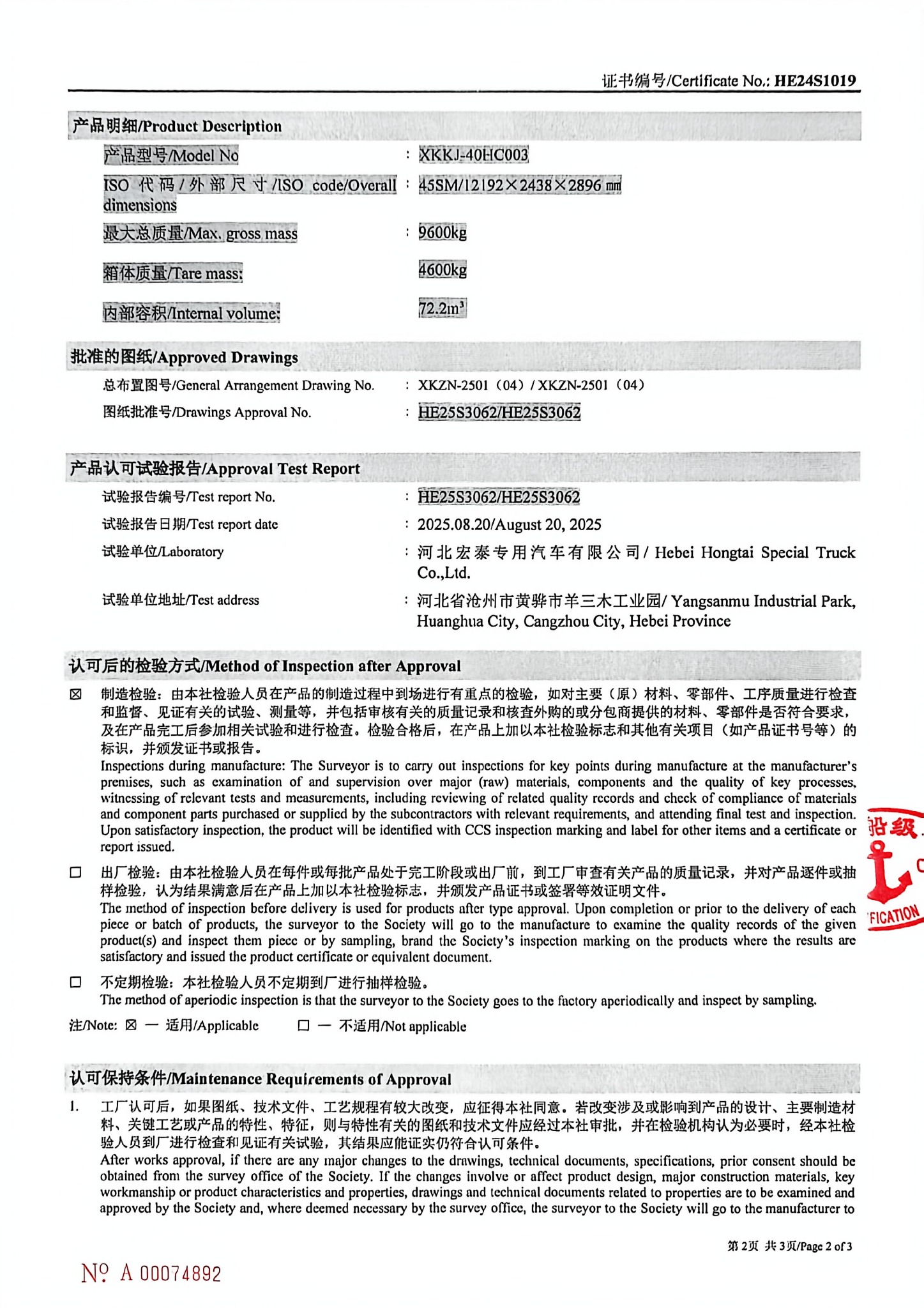
CCS works approval for equipment containers is tied to a listed model and scope; it does not certify every project configuration.
Which parameters are project-specific?
The project-specific list is longer than the fixed list. It covers the parameters that determine whether the container fits the miner fleet, the site and the utility supply:
- IT capacity. The design heat load and electrical load must be stated for the project. A series name is not a substitute for a load schedule.
- Rack count and power per rack. Position count, rack arrangement and power density shape cooling flow, power distribution and service access.
- Miner compatibility. The exact miner make and model list must be confirmed. Different hydro miner families can use different fluid connections, flow and pressure limits, and control interfaces. A generic hydro ASIC mining container description is not evidence that a specific Antminer, Avalon or WhatsMiner model has been qualified.
- Dimensions and weight. Transport, lifting, foundation and site access depend on the approved layout and operating weight, not only on a 20-foot or 40-foot label.
- Utility interfaces. The boundary for electrical supply, primary cooling, network and controls, and other site services must be drawn explicitly.
- Electrical V/Hz. The site voltage and frequency, phase arrangement, protection and earthing must match the equipment. A kW rating alone does not define an electrical interface.
- Redundancy. The required redundancy level and the equipment covered by it affect footprint, heat rejection, controls and cost. Redundancy should be defined as a design requirement, not inferred from a catalogue heading.
- Climate and site conditions. Ambient conditions, water quality, altitude, freeze protection, condensation prevention, corrosion protection, noise and local requirements can change the cooling and enclosure design.
- Service and delivery terms. Lead time depends on model, customization, materials, production schedule and site conditions and is confirmed in the contract. MOQ is confirmed per product and project. The catalogue annual capacity exceeds 500 MW, but that is not a fixed monthly delivery commitment.
The same logic applies to the CDU and cooling equipment. The container model does not automatically select a CDU model. The company documentation lists separate CDU families and models, including DWW30-20C and DWW50-25C, and XK-BGCDU-240, 600, 1200 and 2500, each to be selected separately. That separation is a useful warning: a container quotation that names only the container is not a complete thermal design.
Fixed versus project-specific: a practical comparison
| Item | What can be fixed | What the buyer must confirm |
|---|---|---|
| Product identity | Series name, documented model list, final model confirmation step | Final model, miner list and configuration for the order |
| Quality system | ISO 9001 scope and certificate for the manufacturing site | Project-specific inspection and FAT/SAT criteria |
| CCS approval | Approved model XKKJ-40HC003 (ISO code 45SM), non-cargo equipment containers, subject to annual surveillance | Whether the delivered configuration and destination are covered by the required approval |
| IT capacity | Not fixed by the series name | Design heat load and electrical load |
| Rack count and power per rack | Not fixed by a container-length label | Rack layout, power density and service access |
| Miner compatibility | Confirmed per order | Exact miner make/model, quantity and interface data |
| Dimensions and weight | Approved only at design stage | Transport, lifting, foundation and site access |
| Utilities and V/Hz | Not fixed by a kW rating | Voltage, frequency, phase, protection, earthing and interface boundary |
| Redundancy | Not a catalogue default | Redundancy level, covered equipment and operating mode |
| Delivery and MOQ | Policy and process only | Lead time, MOQ and commercial terms in the contract |
The table is a screening tool, not a substitute for the technical agreement. Its purpose is to stop a catalogue number from being treated as a released design value.
Why catalogue capacity cannot be read as final site design
Published configurations across the market show why headline capacity needs a boundary statement. PowerMining lists a 20-foot hydro-cooled container at 1 MW and 45-foot configurations at 2 MW and 2.5 MW. BiXBiT lists a WHC-1.2-2U hydro-mining configuration at 1.2 MW with 120 Whatsminer 2U units and a WHC-2.4-2U configuration at 2.4 MW with 240 units. Delta Electronics describes a 20-foot ISO containerized liquid-cooled AI data-center solution supporting up to 60 kW per rack. Schneider Electric describes a 20-foot ISO standard container with a standard 60 kW IT load and custom capacity up to 336 kW.
These figures are not a ranking, and they are not interchangeable. One may describe total data-center power, another rated capacity, another IT load, and another rack power. A mining container buyer should therefore ask four questions of any quoted number: what boundary does it use, what equipment is included, at what design conditions was it stated, and which part of the figure is fixed for the order? Without those answers, a larger MW number is not evidence of a better fit.
The same caution applies to xinkelcs Mining Container. A published series and a catalogue annual capacity are useful for supplier screening. They do not replace the approved load schedule, utility schedule, layout, weight calculation, miner interface review and acceptance criteria for the site.
How the fixed and variable parts interact
Heat load is the first interaction. If IT capacity or power per rack changes, the required coolant flow, supply and return temperatures, heat-exchanger duty, pump selection, piping and dry-cooler or primary cooling duty can change with it. A container envelope may look the same on a drawing while the internal thermal and electrical design is different. That is why the buyer should require performance data at the intended design conditions, not only a catalogue kW value.
Miner compatibility is the second interaction. Hydro miners are not a single universal interface. The exact model list affects fluid connections, flow and pressure limits, cold-plate arrangement and controls. A container engineered around one miner family should not be assumed to accept another without a documented review. The procurement file should list the miner make, model and quantity, and the supplier should confirm compatibility per order.
Electrical supply is the third interaction. The final site voltage and frequency, phase arrangement, fault level, earthing and protection coordination define the electrical interface. A quotation that states only kW but not V/Hz and the point of supply is incomplete for evaluation. The buyer should also confirm whether the scope includes transformation, distribution, protection and grounding, or only part of that chain. The documented integrated scope can include racks, power distribution, thermal management, monitoring, lightning protection and grounding, structured cabling and fire protection, but the exact boundary is defined by the project technical agreement.
Redundancy is the fourth interaction. A redundancy requirement can change the number of pumps, the CDU arrangement, the power distribution topology and the footprint. It can also change the factory test plan. The buyer should state which functions require redundancy, what failure condition the design must tolerate, and how the redundant state will be tested. A supplier general statement that a system is redundant is not a substitute for that definition.
Application scenarios: where the fixed/variable split changes the conversation
Consider a brownfield site with an existing electrical service. The container series may be selected early, but the site voltage and frequency, available fault level, earthing arrangement and utility interface point are project-specific. A catalogue container that fits the miner fleet may still fail the site electrical review if those values are not confirmed. The buyer should treat the electrical schedule as a design input, not a post-order detail.
Consider a phased high-density deployment. The first phase may use a defined rack count and power per rack, while a later phase adds positions or changes the miner mix. If the cooling and power distribution are sized only for phase one without documenting the expansion boundary, the later change can become a redesign. The fixed part is the product family and the quality process; the variable part is the capacity and redundancy plan across phases.
Consider a cold-climate or hot-climate site. Ambient conditions can affect freeze protection, condensation prevention, dry-cooler selection and operating limits. The company documentation identifies climate as a customization input and lists freeze protection, condensation prevention, corrosion protection, noise, electrical supply and local certification requirements as site-specific checks. A catalogue operating range should not be assumed to cover every site without a design review.
Consider an overseas delivery. Dimensions and weight affect transport, lifting, foundation and road access. The approved layout and operating weight should be checked before shipment, together with the lifting points and utility positions. A 20-foot or 40-foot label is a starting point for logistics, not a complete transport plan.
What published project references do and do not prove
The company 10 September 2026 corporate presentation lists modular and liquid-cooled projects at different scales, including a 1.7 MW modular container project in Ohio, USA, and a 21.12 MW high-density liquid-cooled container project in Ethiopia. The same presentation also lists additional liquid-cooled container projects in Norway and Texas. These references show that project scale and configuration vary. They do not show that one catalogue container accepts any miner, that every project uses the same redundancy, or that measured efficiency is fixed across sites. The presentation does not disclose measured efficiency results for those projects.
For procurement, the useful conclusion is limited but important: project scale is a design variable. A buyer should ask for the reference scope, the equipment boundary and the lessons that apply to the current site. A project reference should not be converted into a performance guarantee for a different miner fleet, climate or utility supply.
Procurement checklist for comparing proposals
- State the design basis. Define IT capacity, rack count, power per rack, design ambient conditions and redundancy before comparing container models.
- List the exact miner or compute equipment. Include make, model, quantity, flow and pressure limits, coolant requirements and control interfaces. Confirm compatibility per order.
- Require an electrical schedule. Record voltage, frequency, phase, power, fault level, earthing, protection and the point of supply. Do not accept a kW figure alone.
- Draw the utility boundary. Identify responsibility for primary cooling, water quality, network, controls and other site services. Confirm what is inside and outside the container scope.
- Approve the layout and weight. Check dimensions, operating weight, lifting points, foundation loads, transport route and maintenance access.
- Map the certification scope. Match the delivered model and configuration to the certificate or approval. Confirm destination-specific requirements with the project authority and a qualified certification partner.
- Agree factory and site acceptance. Define FAT and SAT scope, test conditions, acceptance limits, witnesses and documentation. Factory commissioning and testing are documented, but the exact scope follows the technical agreement.
- Confirm commercial terms. Obtain lead time, MOQ, delivery schedule, warranty, spare parts and service scope in the contract. The catalogue annual capacity is not a monthly delivery commitment.
Market and technology outlook: more formats, more need for explicit boundaries
Adjacent liquid-cooled container products are positioned for AI and high-performance computing as well as mining. Schneider Electric 20-foot modular data-center description and Delta Electronics 20-foot AI container both show that a container form factor can carry very different IT loads and cooling boundaries. That does not make AI rack power directly comparable with mining-container capacity. It does reinforce a procurement trend that buyers can act on now: suppliers are likely to keep using different definitions of capacity, redundancy and scope, so the technical agreement must be more explicit than the catalogue.
The practical outlook is not a single universal mining container specification. It is a clearer separation between the fixed product identity and the project-specific design. Buyers who require that separation before order release will be better able to compare proposals on the same basis, verify miner compatibility and avoid treating a catalogue value as a final site design.
Frequently asked questions
What is fixed in a mining container order?
The fixed part is mainly product identity and documented scope: the xinkelcs Mining Container series, the model confirmation step, the manufacturer ISO 9001 quality management scope and any certificate scope tied to a named model, such as the CCS works approval for model XKKJ-40HC003. The final model and miner compatibility are still confirmed per order. A catalogue series name does not fix all site parameters.
Which mining container parameters are project-specific?
IT capacity, rack count, power per rack, dimensions, weight, utility interfaces, electrical V/Hz and redundancy are project-specific. Climate, site conditions, local requirements, delivery schedule and service scope can also change the configuration. These items belong in the approved technical agreement, not only in a product brochure.
How is miner compatibility confirmed?
Compatibility is confirmed by the exact miner make and model list, quantity and interface data, checked against the container fluid connections, flow and pressure limits, cooling arrangement and controls. A general hydro ASIC mining container description is not proof that a particular Antminer, Avalon or WhatsMiner model has been qualified. Final model and miner compatibility are confirmed per order.
Can catalogue values be used as the final site design?
No. Catalogue values are screening inputs. The approved technical agreement, layout, utility schedule and acceptance criteria control the design. A MW rating can use different boundaries, a V/Hz value must match the site supply, and dimensions or weight must be checked for transport and installation. Catalogue annual capacity above 500 MW is also not a fixed monthly delivery commitment.
What should be verified before releasing the final configuration?
Verify the design basis, exact miner and equipment list, electrical and utility interface schedule, layout and weight, certification scope mapping, factory and site acceptance criteria, and commercial terms including lead time and MOQ. The buyer should confirm that the delivered configuration matches the approved model, the intended miner fleet and the site conditions.
For readers who need the company wider product and manufacturing context, the English company brochure (PDF) is available for reference. The controlling document for an order remains the approved technical agreement.
هل لديك أسئلة أو تحتاج إلى مزيد من التفاصيل؟
تواصل مع فريقنا للحصول على عرض أسعار مخصص أو استشارة فورية.
طلب عرض أسعار
املأ النموذج أدناه وسيتواصل معك فريقنا بعرض مقترح مخصص.
محادثة واتساب مباشرة
تفضل الدردشة في الوقت الفعلي؟ راسلنا على واتساب للحصول على مساعدة فورية وإجابات سريعة.
- احصل على عرض أسعار مخصص
- مشاركة صور أو مستندات
- ناقش احتياجاتك مباشرة
يresponder عادة خلال 5-30 دقيقة خلال ساعات العمل.