
Mining & Construction Dump Trucks: Matching SHACMAN X3000 and SINOTRUK Specs to Job Sites
Mining & Construction Dump Trucks: Matching SHACMAN X3000 and SINOTRUK Specs to Job Sites
The global heavy-duty truck market was estimated at USD 308.3 billion in 2025 and is projected to reach USD 475.5 billion by 2035, according to Global Market Insights. A significant share of that demand sits in mining pits, road-building corridors, ports and bulk-material yards, where the working-condition profile — heavy load, highway running, unpaved roads, steep slopes and round-the-clock operation — decides whether a dump truck is productive or permanently in the workshop.
This analysis compares two 6×4 dump trucks supplied through SHANDONG WONDERFUL AUTO CO.,LTD. — the SHACMAN X3000 6×4 dump truck (model SX3258W384C, 440 HP, EURO 5) and the SINOTRUK 6×4 dump truck ZZ3257N384GB1R (371 HP) — and maps their published specifications onto specific mining and construction scenarios. The purpose is not to declare a winner, but to establish which job-site conditions each configuration actually suits, and which limits remain even when a specification sheet looks convincing.
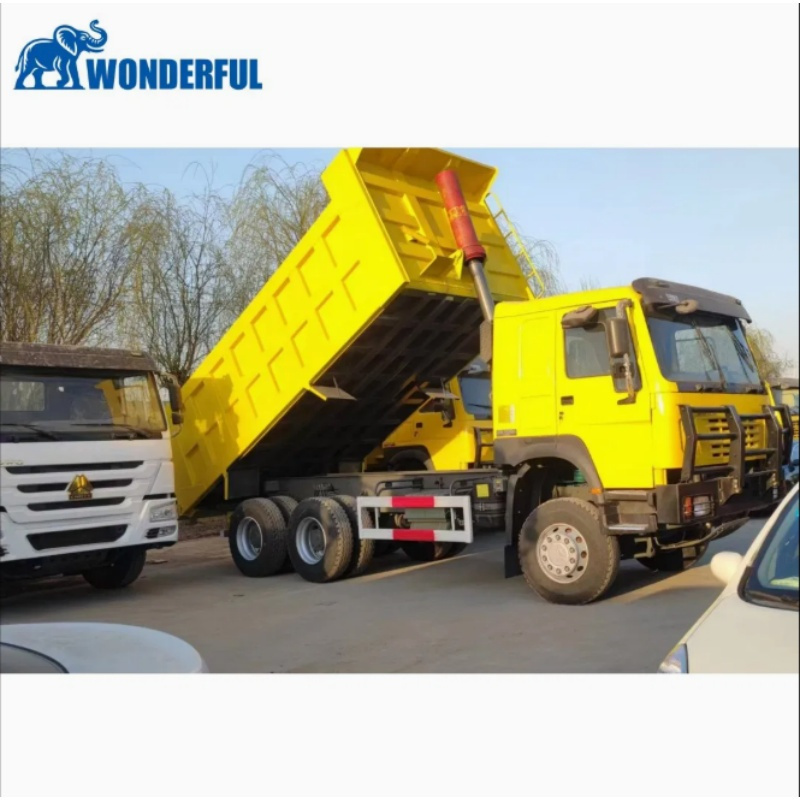
Why Job-Site Conditions Come Before Horsepower
Mining and construction haulage is not one duty cycle. The conditions recorded for these projects are heavy load, highway use, unpaved roads and steep slopes, frequently on a 24/7 operating pattern spanning mining projects, road construction, infrastructure development, port logistics, bulk cargo transportation and agricultural product transport.
Those conditions translate into four engineering requirements that sit above any badge on the grille: high wear resistance; rust-proof behaviour in wet, dust-laden or corrosive environments; adaptability to poor road conditions; and easy maintenance with long service time. A truck that satisfies all four on paper but cannot be serviced or repaired in the operating region will still fail the commercial test.
The practical consequence is that the same 6×4 dump truck layout can be configured very differently. Two trucks with near-identical body dimensions can diverge in engine rating, final-drive ratio, retarder fitment, frame section and wear-plate material — and those differences, not the body size, are what determine job-site fit.
The Two Trucks Under Review
SHACMAN X3000 6×4 dump truck (SX3258W384C)
The SHACMAN X3000 6×4 dump truck, model SX3258W384C, is a left-hand-drive heavy-duty dump truck designed for mining and construction scenarios and also intended for the manufacturing, engineering, agriculture and logistics industries. It is powered by a CUMMINS ISM11E5 440 engine (324 kW / 440 HP, 10.8 L displacement) meeting the EURO 5 emission standard, paired with a 12JSD200T-B transmission, a QH50 unit and an FHB400 hydraulic retarder.
The chassis uses a frame of 850×300 (8+7) mm in high-strength Q345B alloy steel, described as an ultra-thick multi-plate beam with four main pieces. The front axle is a HANDE MAN 9.5 T unit; the rear is a HANDE 16 T MAN double-stage widened axle with a 5.262 final-drive ratio. Suspension is multi-leaf spring front and rear with four horse bolts, and tyres are 12.00R20 mixed on-off road tread. The cargo body measures 5600×2300×1400 mm, with an 8 mm floor and 6 mm side panels and a 180 front lift cylinder. Overall dimensions are 8500×2600×3400 mm on a 3775+1400 mm wheelbase, with a maximum speed of 82 km/h, a 400 L aluminium alloy fuel tank, and a cab specified as an X3000 long flat roof with four-point hydraulic suspension.
SINOTRUK 6×4 dump truck ZZ3257N384GB1R
The SINOTRUK 6×4 Dump Truck ZZ3257N384GB1R is a 6×4 dump truck powered by a WD615.47 diesel engine rated at 371 HP, coupled to an HW19710 gearbox with an HW50 direct-connection power take-off unit. Running gear comprises a VGD95 front axle with drum brake and MCP16ZG dual rear axles with a 5.45 gear ratio, on front and rear reinforced multi-leaf springs, with a double-layer frame of 8+8/300 mm.
Its cargo body measures 5600×2300×1500 mm with an 8 mm bottom and 6 mm sides in Q355 manganese plate, configured as a rectangular container and square-grid large box. The truck carries a 400 L fuel tank and 12.00R20 tyres with a mixed tread pattern, 18PR. Overall construction uses carbon steel and SS304 stainless steel. Like the SHACMAN X3000, it is intended for the manufacturing, engineering, mining, agriculture and logistics industries, and is described as designed for construction, mining, agriculture and logistics scenarios.
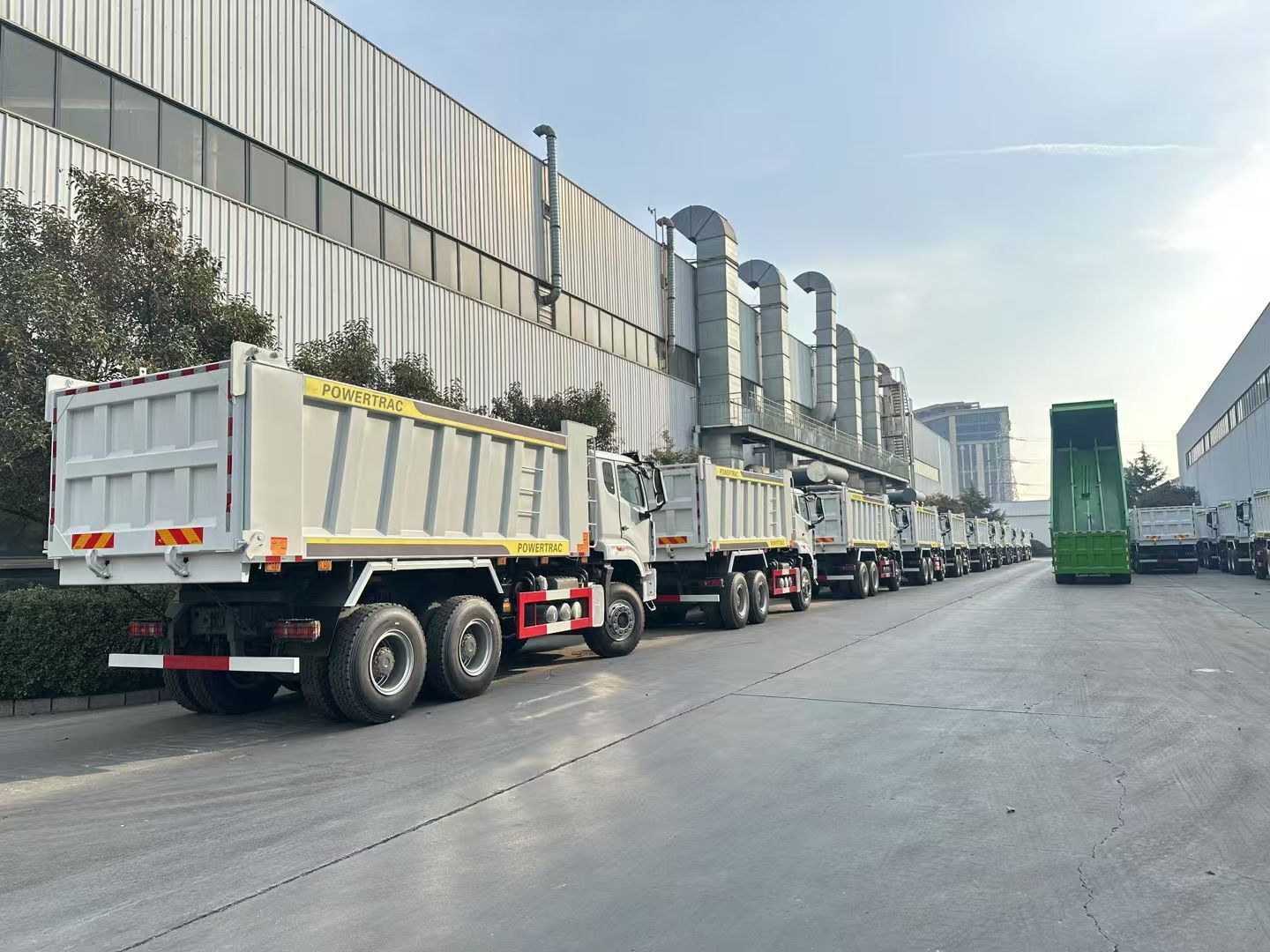
Reading the Two Specification Sets Side by Side
The comparison below uses only published specification data. Where a parameter is not stated in the supplied specification set, it is marked as such rather than inferred.
| Parameter | SHACMAN X3000 6×4 (SX3258W384C) | SINOTRUK ZZ3257N384GB1R |
|---|---|---|
| Engine | CUMMINS ISM11E5 440 (Jacob), 10.8 L | WD615.47 diesel |
| Rated power | 324 kW / 440 HP | 371 HP |
| Emission standard | EURO 5 | Not stated in the supplied specification set |
| Transmission | 12JSD200T-B + QH50 + FHB400 hydraulic retarder | HW19710 with HW50 direct-connection power take-off |
| Drive configuration | 6×4, left-hand drive | 6×4 |
| Front axle | HANDE MAN 9.5 T | VGD95, drum brake |
| Rear axle | HANDE 16 T MAN double-stage widened, ratio 5.262 | MCP16ZG dual rear axles, ratio 5.45 |
| Frame | 850×300 (8+7) mm, high-strength Q345B alloy steel | Double-layer frame, 8+8/300 mm |
| Cargo body | 5600×2300×1400 mm, 8 mm floor, 6 mm side, 180 front lift cylinder | 5600×2300×1500 mm, 8 mm bottom, 6 mm side, Q355 manganese plate, square-grid large box |
| Suspension | Front and rear multi-leaf spring, four horse bolts | Front and rear reinforced multi-leaf springs |
| Tyres | 12.00R20 mixed on-off road tread | 12.00R20, mixed tread pattern, 18PR |
| Fuel tank | 400 L aluminium alloy | 400 L |
| Overall dimensions | 8500×2600×3400 mm, wheelbase 3775+1400 mm | Not stated in the supplied specification set |
| Maximum speed | 82 km/h | Not stated in the supplied specification set |
| Construction material | High-strength Q345B alloy steel | Carbon steel / SS304 stainless steel |
| Stated industries | Manufacturing / engineering / mining / agriculture / logistics | Manufacturing / engineering / mining / agriculture / logistics |
Two details matter more than the headline power figures. First, the X3000 pairs a higher rated output with a numerically lower final-drive ratio (5.262), while the SINOTRUK pairs lower rated output with a numerically higher ratio (5.45); engine rating and axle ratio have to be read together, because wheel-level torque multiplication and road speed are set by the combination, not by horsepower alone. Second, the SINOTRUK body is 100 mm taller on the same 5600 mm length and 2300 mm width, with the same 8 mm floor and 6 mm side thickness — so the two trucks carry comparable plate specification but not identical geometric volume.
Scenario Matching: Which Truck Suits Which Job Site
Long hauls on paved roads with gradient sections
Where the route combines loaded highway running with long descents, the relevant specification is not peak power but braking endurance. The SHACMAN X3000 specification includes an FHB400 hydraulic retarder alongside a dual-circuit compressed air service brake, spring air discharge parking brake and an engine exhaust brake (Jacob brake). A hydraulic retarder works the driveline on descents, which reduces reliance on friction service brakes — a meaningful consideration in mining haulage where brake fade is a recurring maintenance cost. The X3000 also lists a maximum speed of 82 km/h, which is relevant where trucks must keep pace with highway traffic between a pit and a processing plant.
Short-cycle tipping in confined pits and yards
In tight loading areas, cycle time is driven by how quickly the body can be raised and lowered. The SINOTRUK ZZ3257N384GB1R is specified with an HW50 direct-connection power take-off unit on its HW19710 gearbox, with a square-grid large box body in Q355 manganese plate and a 1500 mm side height. The X3000 instead uses a 180 front lift cylinder on a 1400 mm body. Both approaches are legitimate; buyers should match the lift arrangement and body height to the loading equipment available on site and to the tipping clearance behind the truck.
Unpaved haul roads with heavy abrasion
The stated requirement for these projects is high wear resistance, rust-proofing, adaptability to poor road conditions, easy maintenance and long service time. Material choice is the first visible answer: the SINOTRUK body uses Q355 manganese plate for the floor and sides and the overall construction includes carbon steel and SS304 stainless steel, while the SHACMAN X3000 frame is high-strength Q345B alloy steel in an 850×300 (8+7) mm section. Both trucks run 12.00R20 mixed on-off road tyres, with the SINOTRUK specification listing 18PR rating. For abrasive quarry or laterite haul roads, plate grade, plate thickness and frame section are the parameters that determine how often the body is rebuilt.
Multi-shift mining and infrastructure schedules
With 24/7 operation listed as the working mode, operator fatigue and access to consumables become engineering issues. The X3000 cab specification includes an air-suspension main driver seat, automatic constant temperature air conditioner, four-point hydraulic suspension and a multi-function steering wheel with cruise control — details that matter over long shifts. The SINOTRUK specification emphasises a reinforced suspension package and dual rear axles with a 5.45 ratio. Buyers should also confirm parts availability in the destination market, because uptime depends on the supply chain behind the truck as much as on the truck itself.
When a tractor, not a dump truck, is the right answer
Not every bulk-haul task needs a tipper body. Where material is moved in towed equipment rather than dumped from the chassis, the relevant option in the same portfolio is the SHACMAN F3000, a 6×4 tractor truck with a WP10.340E22 engine, 10JSD180 manual gearbox and medium-length flat roof cab, intended for heavy-duty transport in logistics, agriculture, mining, engineering and manufacturing. Matching the truck category to the transport method remains the first decision; engine and axle choices follow it.
Quick matching rule. Gradient-heavy routes with long descents and highway running favour the SHACMAN X3000 specification (440 HP, FHB400 hydraulic retarder, 5.262 final drive, 82 km/h stated maximum speed). High-cycle tipping and abrasive material with PTO-driven implements favour the SINOTRUK ZZ3257N384GB1R specification (371 HP, HW50 direct-connection PTO, Q355 manganese plate square-grid body). Neither specification set removes the need to verify service coverage, fuel quality and payload limits locally.
What These Differences Mean for Procurement
For a fleet buyer or project contractor, the specification comparison converts into four procurement checks.
- Duty cycle first. Establish whether the truck will spend its life on paved gradients, unpaved haul roads, or short-cycle yard tipping. The same 6×4 configuration behaves differently in each.
- Braking strategy. Where descents are loaded and frequent, retarder fitment and service-brake architecture should be confirmed in writing, not assumed from the model name.
- Body specification. Confirm plate grade, floor and side thickness (both trucks are stated at 8 mm floor and 6 mm side), body height and lift type against the material being carried.
- Matched equipment. Trucks in this class are normally deployed alongside bulk equipment such as cargo semi trailers, flatbed semi trailers, lowbed semi trailers, rear dump semi trailers, side dump semi trailers, cement tanker semi trailers and fuel tankers — a fleet plan that overlooks trailer matching will under-use the truck.
The Supplier Behind These Trucks
Both models sit within the portfolio of SHANDONG WONDERFUL AUTO CO.,LTD., a manufacturer established in 2024 that specialises in semi-trailers, trailer parts, and manual and automatic welding machinery. The company employs approximately 500 staff at a manufacturing facility covering 113,000 m², operates an R&D team of 20 engineers, and states an annual production capacity of 6,000 units.
Its main products include heavy duty trucks, flatbed semi trailers, lowbed semi trailers, cement tanker semi trailers, dump semi trailers, fence semi trailers and sidewall semi trailers. All sales are export-derived, with the primary market stated as Africa — a market profile that aligns with the poor-road and high-wear conditions discussed above.
Market Trends That Affect Dump Truck Decisions in 2026
Three verified market signals are relevant to anyone shortlisting dump trucks today.
Export supply has shifted decisively toward Chinese manufacturers. China's heavy-duty truck exports reached 276,000 units in 2023, a 58% year-on-year increase, and rose to 295,000 units in 2024, according to industry and CAAM data. In the first half of 2024, China's total truck exports reached 351,000 units, with one out of every three heavy trucks seen overseas originating from China. For buyers, this means broader model availability and more competitive configuration options in export markets.
Electrification is scaling, but it is not yet the default for remote haulage. The global electric heavy-duty truck market is projected to grow from USD 14.84 billion in 2026 to USD 101.02 billion by 2034, and heavy-duty electric truck penetration in China is forecast to exceed 20% in 2026. That trajectory affects urban and fixed-route logistics first; diesel 6×4 dump trucks remain the practical specification where charging infrastructure and grid capacity are absent, which describes many mining and infrastructure sites.
Emissions regulation continues to tighten in mature markets. The US EPA finalised the Phase 3 greenhouse gas standards for heavy-duty vehicles from model year 2027, requiring an approximately 80% reduction in NOx. Trucks specified to EURO 5 — as the SHACMAN X3000 is — satisfy a different regulatory baseline, so buyers must confirm that the emission standard on offer matches the import and registration rules of the destination country.
Limitations and Trade-Offs to Verify Before Ordering
A credible specification review has to state what the trucks are not. Four boundaries stand out.
The SHACMAN X3000 specification lists no ABS. The published parameter set states "Without ABS" and relies on a dual-circuit compressed air service brake, spring air discharge parking brake, engine exhaust brake and the FHB400 hydraulic retarder. Buyers operating in jurisdictions that mandate ABS on heavy vehicles, or fleets with internal braking standards, must verify whether an ABS-equipped variant can be ordered before committing to this configuration.
EURO 5 depends on fuel quality. An emission standard is only met when the fuel and maintenance regime match it. Remote mining sites with high-sulphur diesel or inconsistent filter supply can compromise the aftertreatment and engine performance of an EURO 5 truck. Fuel logistics should be planned alongside the truck purchase, not after it.
Both trucks carry 400 L fuel tanks. That is a sound highway figure, but on a 24/7 mining pattern with long in-pit idling and poor-road consumption, refuelling intervals become a scheduling constraint. Sites without on-site fuelling infrastructure should model range explicitly rather than assume a full shift per tank.
Neither model is a specialist machine. Both are general heavy-duty 6×4 dump trucks intended for manufacturing, engineering, mining, agriculture and logistics. They are not underground mining units, and neither specification set includes body volume in heaped terms — geometric body size is not the same as legal payload, which is governed locally by axle load rules. Buyers should also note that SHANDONG WONDERFUL AUTO CO.,LTD. was established in 2024 and exports 100% of its output, so after-sales and parts coverage should be confirmed market by market rather than assumed.
Future Outlook
If the current trajectory holds, the dump truck segment will split more sharply than it has in the past. Fixed-route and urban construction work will migrate toward electrified platforms as penetration crosses the 20% threshold forecast for China in 2026, while remote mining and infrastructure corridors without reliable grid access will continue to run diesel 6×4 trucks configured around wear resistance, retardation and serviceability.
Regulatory pressure will push emission standards upward in mature markets following the EPA Phase 3 timeline from model year 2027, but exporting manufacturers will keep supplying EURO 5 and equivalent platforms to markets where those standards are not yet enforced. For buyers, the durable consequence is that specification literacy — reading engine rating together with final-drive ratio, and reading body dimensions together with plate grade and thickness — will keep mattering more than brand labels.
Frequently Asked Questions
What is the main difference between the SHACMAN X3000 6×4 dump truck and the SINOTRUK ZZ3257N384GB1R?
The SHACMAN X3000 (model SX3258W384C) is specified with a CUMMINS ISM11E5 440 engine rated at 324 kW / 440 HP meeting EURO 5, a 12JSD200T-B transmission with FHB400 hydraulic retarder, a HANDE 16 T MAN rear axle at a 5.262 ratio, and a 5600×2300×1400 mm body. The SINOTRUK ZZ3257N384GB1R is specified with a WD615.47 engine rated at 371 HP, an HW19710 gearbox with HW50 power take-off, MCP16ZG dual rear axles at a 5.45 ratio, and a 5600×2300×1500 mm Q355 manganese plate body. Both are 6×4 trucks intended for mining, construction, engineering, agriculture and logistics work.
Which of the two is better suited to steep slopes and unpaved haul roads?
On published specifications, steep gradient and long-descent routes place the emphasis on braking endurance and gearing rather than power alone. The SHACMAN X3000 lists an FHB400 hydraulic retarder, an engine exhaust brake and a 5.262 final drive; the SINOTRUK lists reinforced multi-leaf springs front and rear, dual rear axles at 5.45 and a double-layer 8+8/300 mm frame. For unpaved, abrasive haul roads, the SINOTRUK body specification names Q355 manganese plate with an 8 mm floor and 6 mm sides, and an overall construction using carbon steel and SS304 stainless steel. Buyers should treat these as different design emphases and validate them against their own duty cycle rather than assuming one universal answer.
What cargo body sizes do the two trucks use?
The SHACMAN X3000 6×4 dump truck uses a cargo body of 5600×2300×1400 mm with an 8 mm floor, 6 mm side panels and a 180 front lift cylinder. The SINOTRUK ZZ3257N384GB1R uses a cargo body of 5600×2300×1500 mm with an 8 mm bottom and 6 mm sides in Q355 manganese plate, built as a rectangular container and square-grid large box. The length and width are identical; the SINOTRUK body is 100 mm taller.
What emission standard does the SHACMAN X3000 meet, and why does that matter for import?
The SHACMAN X3000 6×4 dump truck (SX3258W384C) is specified with a CUMMINS ISM11E5 440 engine meeting the EURO 5 emission standard. Emission standard is a market-access parameter, not a performance one: import and registration rules differ by country, and tighter regimes continue to appear — for example, the US EPA finalised Phase 3 greenhouse gas standards for heavy-duty vehicles from model year 2027, requiring an approximately 80% reduction in NOx. Buyers should confirm that the standard offered matches the destination market's rules, and that fuel quality at the operating site supports it.
Are these trucks suitable for mining and construction projects operating around the clock?
Both models are stated as intended for the manufacturing, engineering, mining, agriculture and logistics industries, and the SHACMAN X3000 is additionally described as designed for mining and construction scenarios. The project conditions these trucks are specified for include heavy load, highway running, unpaved roads and steep slopes, with 24/7 operation across mining projects, road construction, infrastructure development, port logistics, bulk cargo transportation and agricultural product transport. The stated requirements for that environment are high wear resistance, rust-proofing, adaptability to poor road conditions, easy maintenance and long service time.
What should a buyer check first when matching a dump truck to a job site?
Start with the duty cycle rather than the engine badge: whether the truck will run loaded gradients, unpaved abrasive haul roads or short-cycle tipping, and whether the operating pattern is single or multi-shift. Then verify five specification points — rated power together with final-drive ratio, retarder and brake architecture, frame section, cargo body dimensions with plate grade and thickness, and tyre specification. Finally, confirm local constraints: emission standard compliance, fuel quality, axle-load and payload rules, and parts and service availability in the destination market.
Closing Perspective
Neither the SHACMAN X3000 6×4 dump truck nor the SINOTRUK ZZ3257N384GB1R is universally better. The X3000 specification leans toward higher rated power, EURO 5 compliance, a hydraulic retarder and a long flat roof cab with four-point hydraulic suspension — a package oriented to loaded gradients and long shifts. The SINOTRUK specification leans toward a simpler, robust build: 371 HP, HW19710 with HW50 power take-off, dual rear axles, a double-layer 8+8/300 mm frame and a taller Q355 manganese plate body — a package oriented to abrasive material and high-cycle tipping.
The decision rule that survives contact with a real project is straightforward: define the job site first, then select engine and gearing, chassis, body geometry and wear materials against it, and only then confirm the supplier can support that configuration in the market where it will work.
Full product documentation for the trucks discussed in this article is available in the SHANDONG WONDERFUL AUTO CO.,LTD. brochure: Wonderful Auto product brochure (PDF).
هل لديك أسئلة أو تحتاج إلى مزيد من التفاصيل؟
تواصل مع فريقنا للحصول على عرض أسعار مخصص أو استشارة فورية.
طلب عرض أسعار
املأ النموذج أدناه وسيتواصل معك فريقنا بعرض مقترح مخصص.
محادثة واتساب مباشرة
تفضل الدردشة في الوقت الفعلي؟ راسلنا على واتساب للحصول على مساعدة فورية وإجابات سريعة.
- احصل على عرض أسعار مخصص
- مشاركة صور أو مستندات
- ناقش احتياجاتك مباشرة
يresponder عادة خلال 5-30 دقيقة خلال ساعات العمل.