
Mining and Textile Machinery: Matching Corrosion-Resistant Housings to Your Environment
A pillow block bearing unit is only as durable as the housing it is bolted into. In mining and textile plants, the housing is the component that meets the environment first: it holds the mounting geometry, clamps the seal in position, and absorbs the moisture, dust and chemical carry-over that the shaft and insert bearing are shielded from. Matching a mounted bearing unit to a corrosive or abrasive environment is therefore a materials decision as much as a load calculation.
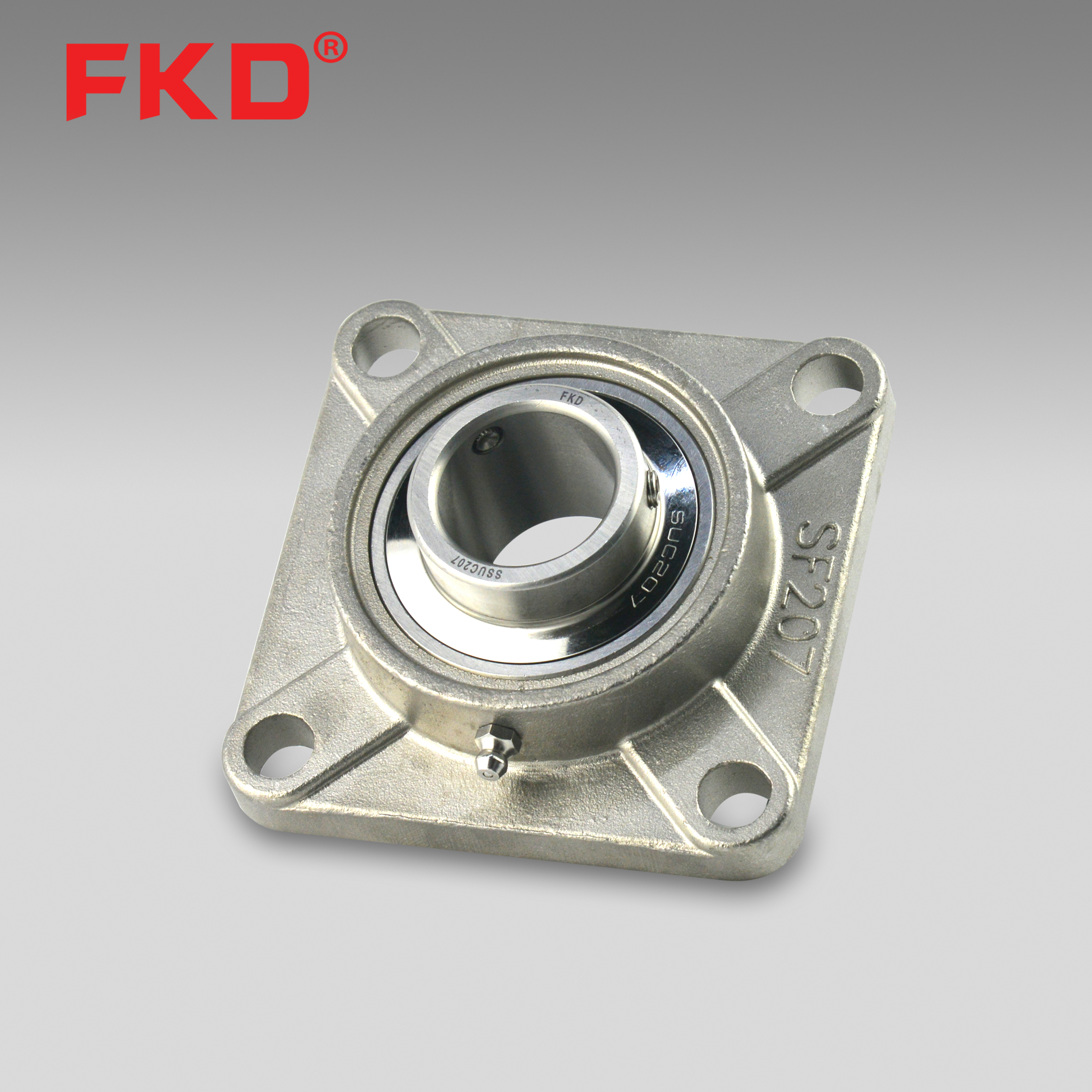
Stated briefly, the selection logic is this. Where moisture, wash-down, condensation or chemical exposure is continuous, the corrosion-resistant path in the FKD range is the stainless steel STAINSTEEL SSUCP series, catalogued from SSUCP205 to SSUCP210 with a documented speed rating of 3000 RPM. Where abrasive dust and heavy load dominate and corrosion is a secondary risk, cast iron and QT450 ductile iron housings — the materials used across the UCP200, UCF, UCFL, UCFC, UCFA, UCFB, UCT, UCHA and UCPH lines — remain the standard specification, supported by the SA205–SA212 ball bearings with eccentric collar where a simple shaft-locking design is required.
Two environments, two different failure modes
Mining and textile machinery are both hostile to bearings, but they attack mounted units in different ways, and that difference is what should drive the housing decision.
In mining applications, the dominant risks are abrasive particulate and mechanical shock. Fine rock dust and mineral slurry reach the housing surface and the seal groove, while heavy loads and reversing or impact conditions work the mounting bolts and the housing base. Corrosion usually arrives second, through process water, wash-down or condensation inside a housing that has already lost part of its surface protection. An abrasive environment does not become less abrasive because the housing is stainless; the failure mode simply changes from surface attack to seal wear.
Textile machinery presents a different profile. Spinning, weaving, dyeing and finishing lines run long duty cycles in warm, humid halls where fibre lint and lubricant carry-over accumulate around rotating components. Here the housing face and the seal interface are under continuous exposure, and low noise and stable running become measurable production requirements rather than preferences. Housings that corrode or pit in this environment lose the dimensional stability that keeps the shaft aligned.
The housing options in a mounted bearing range
The table below summarises the housing and material routes documented in the FKD catalogue. It is deliberately limited to what the catalogue states, because housing material is the variable that most often changes between an enquiry and a repeat order.
| Unit family | Housing material (as catalogued) | Bearing element material | Bore range (as catalogued) | Declared grade / speed |
|---|---|---|---|---|
| UCP200 pillow blocks / mounted bearing units | Cast iron / QT450 | Chrome steel GCr15 (AISI 52100) | UCP205 to UCP328 | P5 ZV3, 3000 RPM |
| SSUCP stainless pillow block units | STAINSTEEL | STAINSTEEL | SSUCP205 to SSUCP210 | 3000 RPM |
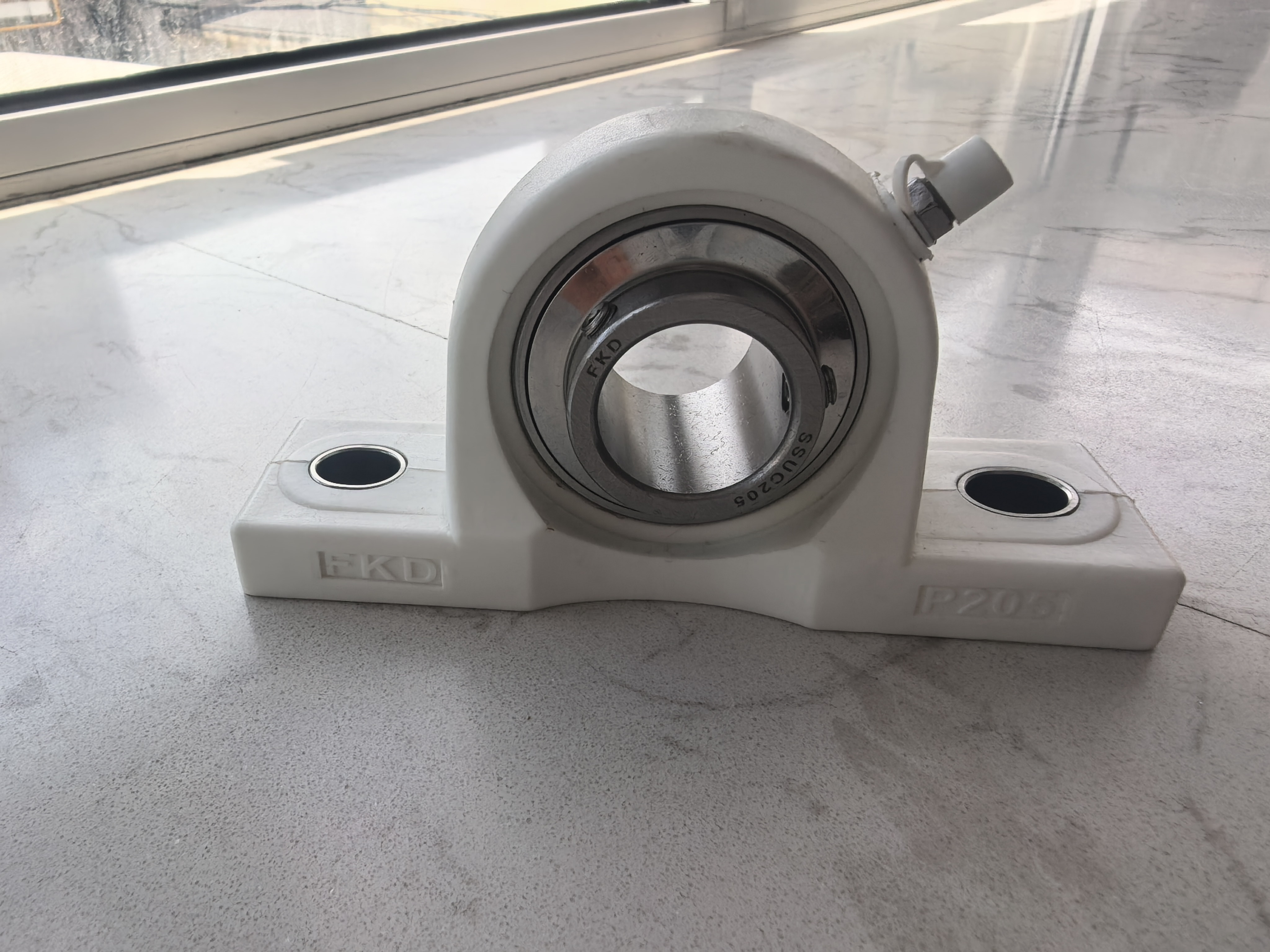
| SUP series, stainless insert with plastic housing | Plastic | STAINSTEEL | SUCP205 to SUCP210 (as listed) | P5 ZV3, 3000 RPM |
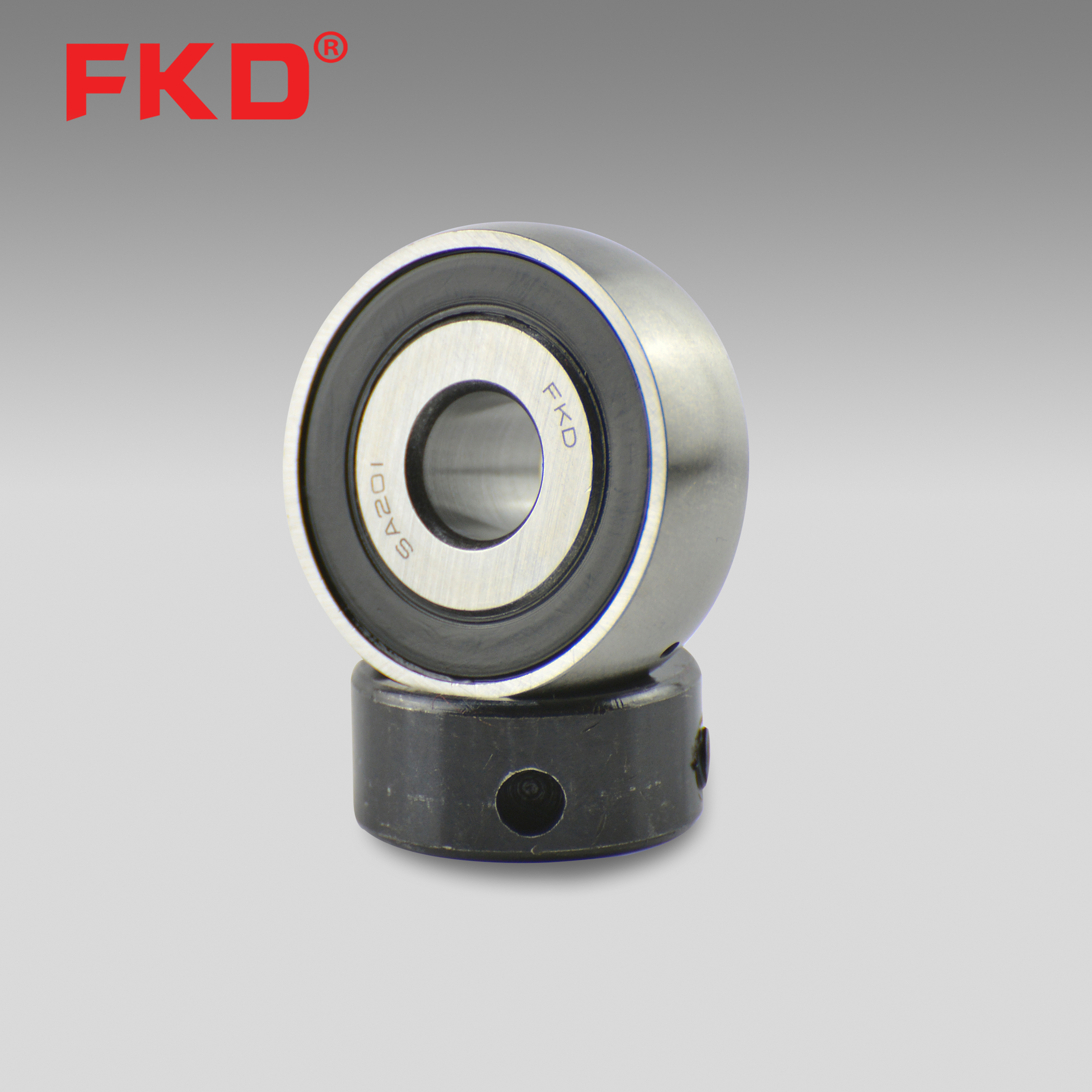
| SA ball bearing with eccentric collar | Cast iron / QT450 (documented housing option) | Chrome steel GCr15 | SA205 to SA212 | P5 ZV3, 3000 RPM |
| UCHA screw conveyor hanger units | Cast iron / QT450 | Chrome steel AISI 52100 | UCHA205 to UCHA212 | P5 ZV3, 3000 RPM |
| SNL508 plummer block (split housing) | Cast iron HT200 | Accepts a separately mounted bearing | SNL508 | Not stated |
| Pressed steel housing units | Pressed steel | Not stated | SAPP205 / SAPFL205 / SAPF205 / SBPFL205 | Not stated |
The same declared pattern — chrome steel GCr15 or AISI 52100 insert, cast iron or QT450 housing, P5 ZV3 quality and a 3000 RPM speed rating — repeats across the UCFB205–UCFB210 flange bracket units, the UCFA205–UCFA212 adjustable flange units, the UCFC205–UCFC212 flange cartridge units, the UCFL205–UCFL328 oval flange units, the UCF205–UCF328 square flange units, the UCT205–UCT328 take-up units and the UCPH205–UCPH212 high centre height pillow blocks. In other words, housing material and housing geometry are the two variables that genuinely differentiate the range, while the insert bearing specification stays broadly consistent.
The insert bearing side of the decision
Across the range, the rolling element is built to a consistent baseline. The UC insert bearing series (UC205 through UC320, with larger sizes including UC313, UC314, UC315 and UC320) is produced in chrome steel GCr15 with G10 steel balls at P5 ZV3 quality. A triple-lip seal variant is catalogued for the same insert family, which matters in dusty environments because the lip arrangement is the first barrier against the abrasive particulate that reaches a mounted unit.
Because these units are supplied as sealed, pre-lubricated assemblies, specifiers often describe them as maintenance-free. The qualification is worth stating plainly: the maintenance-free claim holds only as long as the seal survives. In a mining environment, that depends on the seal lip material and the housing groove condition; in a textile environment, it depends on how much lint and lubricant accumulate around the seal. Choosing a corrosion-resistant housing does not by itself extend seal life.
Matching housing material to the environment: five decision rules
- Rule 1 — Continuous moisture or chemical exposure: move to the SSUCP stainless pillow block series (SSUCP205–SSUCP210, STAINSTEEL, 3000 RPM). This is the only fully stainless housing-and-bearing unit documented in the range.
- Rule 2 — Abrasive dust and heavy load with dry or intermittent moisture: cast iron or QT450 housings (UCP200, UCF, UCFL, UCFC, UCHA, UCT, UCPH and UCPH-style units) remain the practical specification. QT450 ductile iron is catalogued alongside grey cast iron for these housings and is the option most often requested where shock loading is expected.
- Rule 3 — Frequent wash-down with light loads: the SUP series, combining a STAINSTEEL bearing element with a plastic housing, is the lightweight route; it should not be substituted into heavy-load positions where a cast or ductile iron housing would normally be specified.
- Rule 4 — Simple shaft locking in dusty conditions: the SA205–SA212 ball bearings with eccentric collar are catalogued in chrome steel GCr15 at P5 ZV3 and 3000 RPM, with a cast iron or QT450 housing option; they suit positions where a collar-locking insert is preferred over alternative locking methods.
- Rule 5 — Very large shafts or split-housing maintenance: the SNL508 plummer block in cast iron HT200 covers the split-housing case, where the bearing is mounted separately from the housing.
Where the corrosion-resistant route does not fit
A genuine limitation section is more useful to a buyer than another feature list. Three boundaries are documented, and two are commercial.
- Bore range is narrower. The stainless SSUCP line is catalogued from SSUCP205 to SSUCP210. The cast iron UCP200 line runs from UCP205 to UCP328. For shafts above the stainless range, the corrosion-resistant decision has to be solved another way — coating, position shielding, or a different housing family — rather than by specifying SSUCP.
- Stainless does not solve abrasion. Hard mineral dust wears seal lips and shaft surfaces regardless of the housing material. In a mining duty where abrasion is the primary mechanism, a stainless housing addresses surface corrosion but leaves the dominant wear path untouched.
- Plastic housings have a narrower application window. The SUP combination of a STAINSTEEL bearing with a plastic housing is catalogued as a separate product; it is not a drop-in replacement for a cast or ductile iron housing in high-load or elevated-temperature positions.
- Mixed material fleets add spares complexity. Running stainless units on one line and cast iron units on another means two spares stocks and two inspection routines. Plants that standardise on one material for simplicity trade some corrosion margin for lower inventory risk.
- The commercial profile differs. Housing material changes the material basis of a quotation, and the documented programme constraints are a 1,000-piece minimum order quantity and a 30–45 day lead time for customised and OEM/ODM pillow block work. Buyers planning a stainless conversion mid-project should plan that lead time into the maintenance window rather than after it.
Compliance evidence that supports the material claim
Corrosion-resistant specifications are usually audited through management-system certificates rather than through product claims, so the certificate scope and validity dates matter as much as the certificate itself. The Pillow Blocks / Mounted Bearing Units product line holds four management-system certifications, all recorded as applicable to the global market:
| Certification | Certificate number | Issued by | Validity recorded |
|---|---|---|---|
| ISO 9001:2015 — Quality Management System | 00124Q31127R6M/1300 | CQC | Issued 2024-07-25, expires 2027-02-27 |
| ISO 14001:2015 — Environmental Management System | 00125E30330R1M/1300 | CQC | Issued 2025-01-22, expires 2028-01-20 |
| ISO 45001:2018 — Occupational Health and Safety | 00125S30215R1M | CQC | Issued 2025-01-17, expires 2028-01-20 |
| ISO 50001:2018 — Energy Management System | 00225EN006R1M | CQM | Issued 2025-01-03, expires 2028-01-02 |
Two practical notes belong with this table. First, the recorded certification scope covers the production and processing of spherical outer ball bearings, deep groove ball bearings, tapered roller bearings, self-aligning roller bearings and thrust ball bearings, with the quality certificate also naming self-aligning ball bearings. Buyers should confirm that the specific unit being ordered falls inside that declared scope, and that the certificate is still within its validity window at the time of the purchase order. Second, dimensional standardisation is a separate question from certification: pillow block units are commonly standardised under ISO for universal sizing and under JIS (G5501 / 3141) for precision compatibility, so interchangeability claims should be tested against the standard the receiving machine was designed to.
Verification evidence beyond the catalogue
Hebei Hailan Bearing Manufacture Co., Ltd — trading under the FKD brand — was originally founded in 1988 as Xingtai Honghai Bearing Manufacture Co., Ltd and is based in Linxi County, Hebei Province, northern China. The company operates a 100,000 m² site with a plant of more than 65,000 m², employs over 400 people including 30 technicians and engineers, and produces an annual output of 20,000,000 units, with more than 90% of production running on automatic equipment and 100% testing as the stated quality-control position. Published capacity data indicates a monthly capacity of 2,000,000 pieces and an export footprint of more than 90% of products shipped to over 68 countries and regions, with principal markets in the EU, Asia, South America and Africa. The three registered brands are FE, FKD and HHB, and the corporate site is www.ok-bearing.com.
There is one field example worth citing because it demonstrates the environment-matching discipline rather than the product itself. An agricultural machinery OEM in India purchased 100,000 pieces for harvester combine applications, a duty that combines dust, field moisture and sustained vibration. Over a documented two-year period, the reported result was stable operation, with the noted performance priorities being high speed, low noise and consistent quality. The relevance to mining and textile buyers is the sequence: the environment was defined first, the unit was matched to it, and the commercial relationship was measured over years rather than over one delivery.
Market context: why the materials question keeps growing
The corrosion-resistant specification debate is taking place in a large and still-expanding market. Third-party analysis places the global pillow block (mounted) bearing market at approximately USD 6.1 billion in 2024, with plummer blocks accounting for roughly 42.51% of mounted bearing revenue share in the same year. Higher-level figures for the total bearings market vary by research house — Global Market Insights estimates USD 58.6 billion in 2024 and projects USD 143.6 billion by 2034, while other analysts publish figures of about USD 50.16 billion for 2025 and USD 59.66 billion as a 2026 projection. The divergence is a scope difference rather than a contradiction, and it is a useful reminder to treat any single market number as directional.
On the supply side, China's total export of ball bearings reached USD 6.53 billion in 2024, representing 19.9% of global exports according to the Observatory of Economic Complexity. For procurement teams, that concentration means housing-material options and lead times are increasingly governed by a small group of export-oriented manufacturers, which raises the value of documented compliance evidence and repeatable specifications.
Outlook
Two shifts are likely to shape housing selection over the next few planning cycles. The first is specification tightening in wet and chemically exposed processes, where corrosion-resistant mounted units are moving from optional to default in new line designs. The second is documentation pressure: buyers are asking for certificate scope, validity dates, standard conformity and model-level parameter confirmation before a first order, not after a failure. Suppliers who can present housing material, insert specification and compliance status as one consistent package will be easier to qualify than those who present a catalogue alone. Neither shift changes the underlying engineering rule — the housing has to survive the environment before the bearing can do its job.
FAQ
Which housing material should be specified when moisture or chemical exposure is continuous?
The stainless steel route is the SSUCP series, catalogued from SSUCP205 to SSUCP210 in STAINSTEEL for both bearing element and housing, with a documented speed rating of 3000 RPM and stated application in mining, textile, agricultural and manufacturing machinery. It is the only fully stainless housing-and-bearing combination documented in the FKD mounted unit range.
Is a cast iron or QT450 housing still appropriate for mining machinery?
Yes, where abrasive dust and heavy load dominate and corrosion is secondary. Cast iron and QT450 ductile iron housings are catalogued across the UCP200, UCF, UCFL, UCFC, UCFA, UCFB, UCT, UCHA and UCPH families, generally paired with a chrome steel GCr15 (AISI 52100) insert at P5 ZV3 quality and a 3000 RPM rating, and are stated as applicable to mining machinery among other industries.
How do the SA205–SA212 eccentric collar units differ from the SSUCP stainless pillow blocks?
They answer different questions. The SA205–SA212 is a ball bearing with eccentric collar in chrome steel GCr15 at P5 ZV3 and 3000 RPM, documented with a cast iron or QT450 housing option — its role is shaft locking and mounting within an abrasive-duty unit. The SSUCP series answers the corrosion question, with STAINSTEEL in both the bearing element and the housing, but only in the SSUCP205–SSUCP210 bore range.
What bore sizes and speed ratings are documented for the corrosion-resistant option?
The stainless SSUCP pillow block units are catalogued as SSUCP205, SSUCP206, SSUCP207, SSUCP208, SSUCP209 and SSUCP210, with a speed rating of 3000 RPM. The SUP series, which combines a STAINSTEEL bearing element with a plastic housing, is listed from SUCP205 to SUCP210 at 3000 RPM and P5 ZV3 quality. Larger bore capacities exist in the cast iron range — for example UCP205 to UCP328 — but not in the fully stainless line.
Which certifications apply to mounted bearing units, and what do they cover?
The Pillow Blocks / Mounted Bearing Units line is documented with ISO 9001:2015 (certificate 00124Q31127R6M/1300, issued by CQC, expiring 2027-02-27), ISO 14001:2015 (00125E30330R1M/1300, CQC, expiring 2028-01-20), ISO 45001:2018 (00125S30215R1M, CQC, expiring 2028-01-20) and ISO 50001:2018 (00225EN006R1M, CQM, expiring 2028-01-02), all recorded as applicable to the global market. The recorded scope covers production and processing of spherical outer ball bearings, deep groove ball bearings, tapered roller bearings, self-aligning roller bearings and thrust ball bearings, so buyers should confirm that the ordered model falls within scope.
What commercial constraints apply when ordering a corrosion-resistant specification?
The documented programme parameters are a minimum order quantity of 1,000 pieces, a lead time of 30–45 days, a monthly capacity of 2,000,000 pieces and 100% testing as the quality-control position, with OEM/ODM production covering all types of pillow blocks. Because housing material changes the material basis of the quotation and the lead time applies to customised work, the material decision should be made before the maintenance window is planned rather than during it.
How should a buyer verify corrosion-resistant capability before committing to a repeat order?
Four checks are practical and evidence-based: confirm the certificate scope and validity dates cover the specific product family; confirm the catalogue parameters (housing material, insert material, quality grade, speed rating and bore range) at model level rather than at family level; verify interchangeability against the standard the receiving machine was designed to, since pillow block units are commonly standardised under ISO and JIS (G5501 / 3141); and review performance over a defined operating period rather than over a single delivery, as in the documented two-year harvester combine supply programme.
Reference document: FKD and HHB Bearing Catalogue (PDF) — download.