
Mixed-Fleet Shortlist: CR468C Minidozer and FAW Trucks
Mixed-Fleet Shortlist: CR468C Minidozer and FAW Trucks
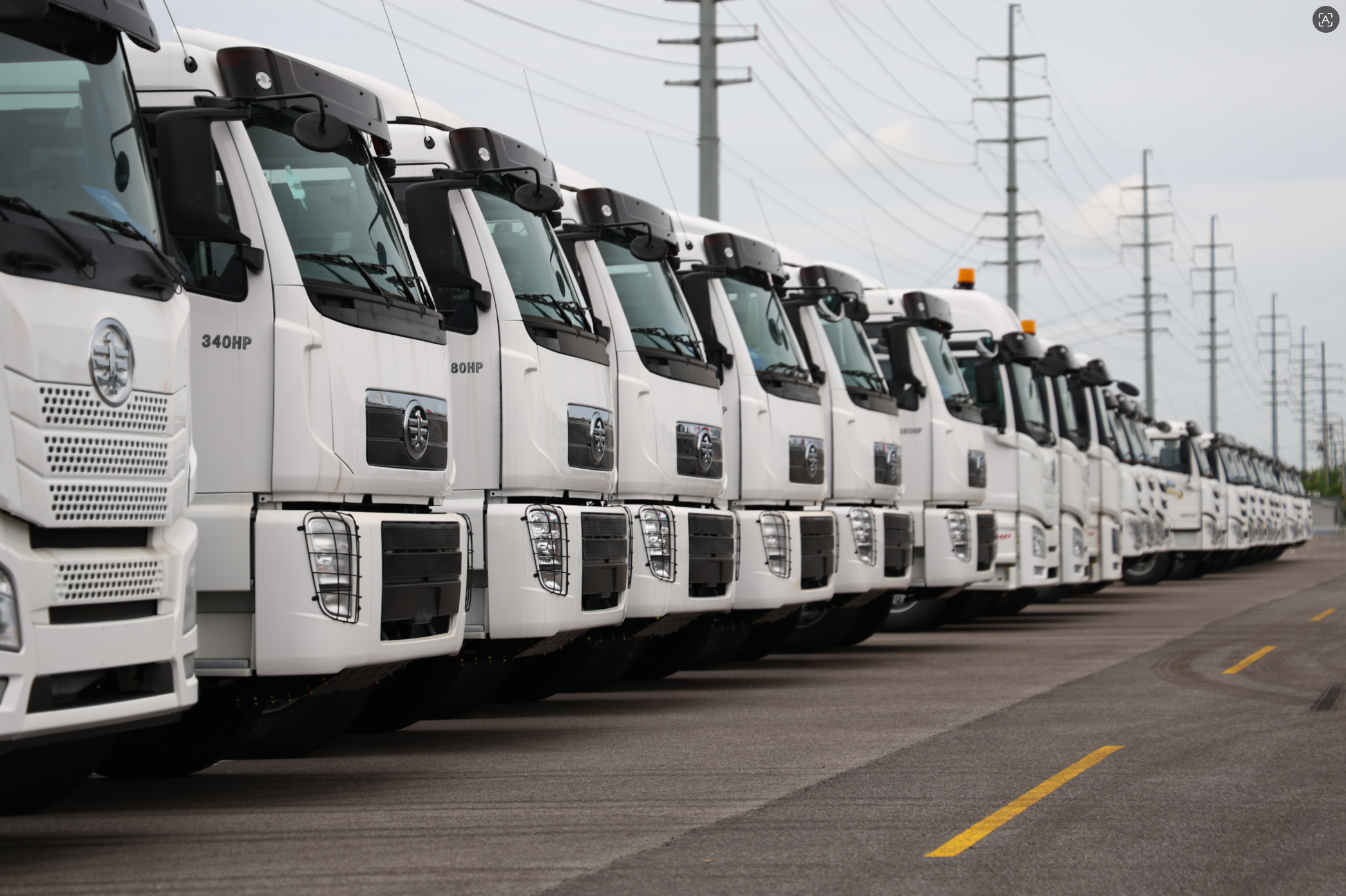
Mixed fleets are rarely bought as one package. A contractor, distributor or rental operator may need a compact machine that can work inside a narrow bay, plus road trucks that move spoil, aggregate, packaged goods, temperature-controlled cargo or municipal waste. The CHARY CR468C remote-control lithium battery rubber-track minidozer and the FAW truck range are a useful shortlist to evaluate together because they occupy different parts of that workflow. The minidozer is a compact work tool with listed dimensions of 2,850×1,200×600 mm, a net weight of 1,100 kg, a 450 kg rated load, a 0.15 m³ bucket and a 300 Ah/73.6 V lithium battery. The FAW configurations referenced for this shortlist span a much wider envelope: 3,000–15,000 kg and dimensions from 6,000×2,300×3,000 mm to 12,000×2,550×3,800 mm. Those figures define a starting range, not a final specification. The real buying question is whether the compact machine and the trucks fit the same site access, transport plan, compliance route and after-sales arrangement.
The CR468C is offered by Qingdao Chary Machinery Co., Ltd, an export-oriented machinery supplier established in 2015. The company profile lists mini machinery, minidozer, mini loader, mini electric loader and skid steer loader among its main products, with Africa and South America listed as main markets. Those company facts establish a supplier starting point. They do not replace a configuration-level quotation, a site trial or compliance review.
Shortlist principle: separate the work before matching the machine
A shortlist for a mixed fleet should not begin with a ranked list of model names. It should begin with the work split. The minidozer is sized for confined digging, grading and material handling; the FAW truck is a road and yard haulage platform. If the buyer starts with the truck model and then asks whether a compact machine will fit, the access and charging constraints are usually discovered too late. If the buyer starts with the compact work envelope and then sizes the truck body, load and tire package around the material flow, the shortlist becomes a procurement plan rather than a catalogue comparison.
This is why the clusters below are not a performance ranking. They are option clusters to validate. The same logic applies to every cluster: define the job, measure the access, confirm the payload and body, then check the safety and compliance package. The FAW model names JH6, J6L, JK6 and Tiger v are a starting set for quotation, not proof that a particular body, route or market approval has already been matched to that model.
CR468C minidozer: the compact-work candidate
The CR468C is best understood as a compact work tool rather than a small truck. Its 0.15 m³ bucket indicates a machine intended for repeated narrow work, finish grading, yard cleanup and material placement, not high-volume excavation. The 450 kg rated load is a machine rating; it is not a substitute for truck payload. The 1,100 kg net weight matters for transport, floor loading and access planning, but it should not be added to a truck payload figure as if the two ratings described the same thing.
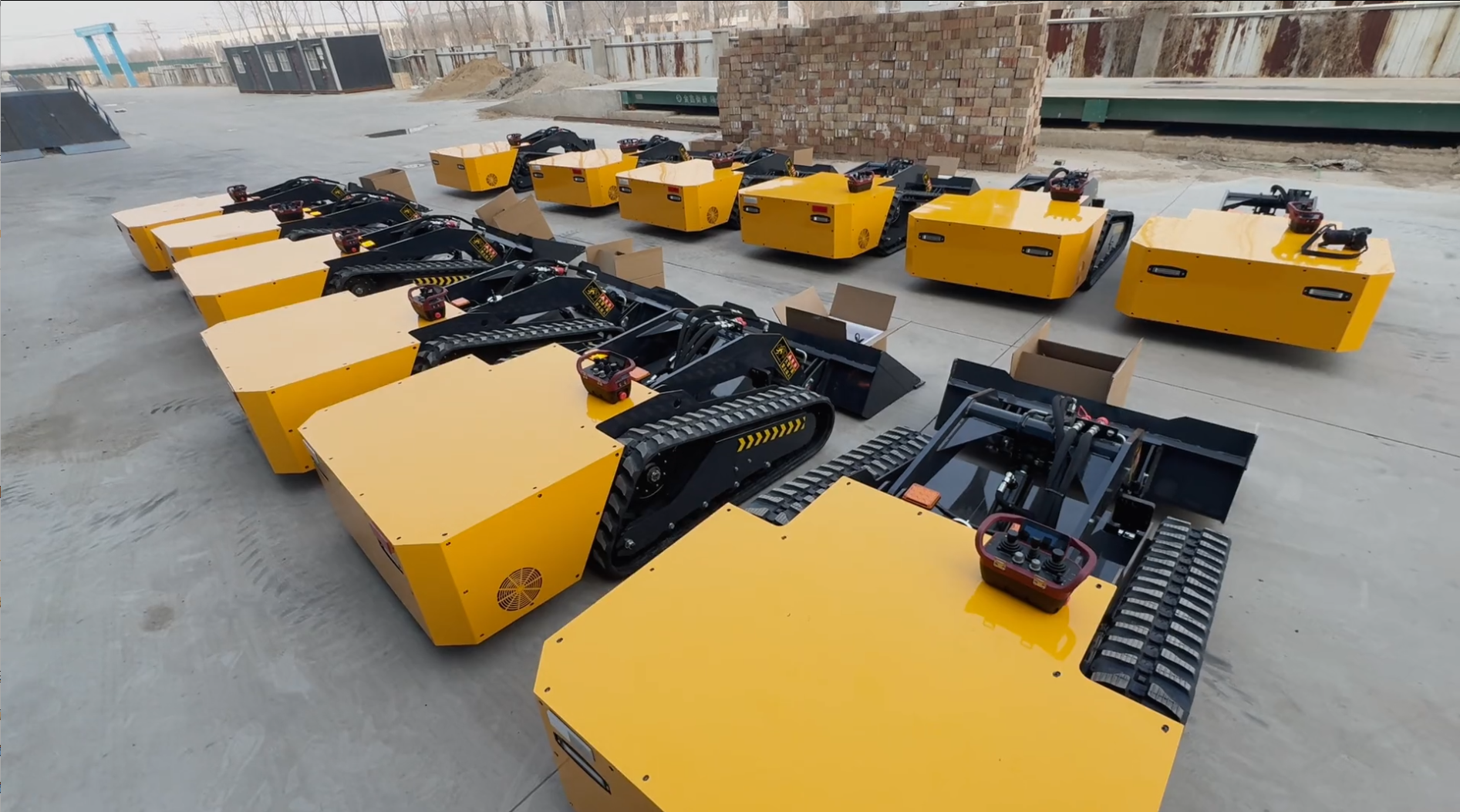
The lithium battery is listed at 300 Ah and 73.6 V. A manufacturer-reported performance figure in the supplied evidence pack states an 8-hour comprehensive endurance and a 2-hour charging time. Those figures are useful for early screening, but the operating conditions behind them are not defined in the supplied material. A buyer should ask for the duty cycle, ambient temperature, charger specification and battery-derating conditions that apply to the intended site. The same caution applies to the remote-control and rubber-track configuration: confirm that the control range, track type and surface rules fit the actual workplace.
A supplied case record for Saudi Arabia describes 12 minidozers used by an engineering construction client for narrow indoor and outdoor material handling. The record reports stable operation for more than ten years, with reported benefits in high-temperature and narrow environments and savings in manpower and material resources. That is a case record, not a controlled comparison. Its practical value is to give the buyer a reference profile to test against: narrow access, high temperature, repeated handling and long service life. A buyer should ask for comparable references that match its own surface, duty cycle and maintenance regime.
FAW truck option clusters by job type
The FAW side of the shortlist is supported by a production capability record that lists OEM customization for body, engine, tires and load capacity, a monthly capacity of 8,000 units, a 30–45 day lead time, a minimum order quantity of one unit, 100% testing and export markets including Central Asia, Africa, the Middle East, South America, Central America and Southeast Asia. A logistics case record describes 50 FAW trucks in Mali used for powdered and granular materials and sand and gravel, with stable operation and high-intensity use over more than ten years. These facts show that the range can be configured and that the supplier presents haulage experience. They do not prove that every JH6, J6L, JK6 or Tiger v quotation will meet a given route, body requirement or market approval.
| Job cluster | Compact-equipment role | FAW shortlist candidates | Checks before quotation |
|---|---|---|---|
| Tight-site digging and grading | CR468C for confined cuts, grading and material handling; truck for spoil removal | JH6 or J6L haulage candidate | Confirm body, load capacity, tire specification, ABS/EBS/TCS, access dimensions and transport plan. |
| Building materials | CR468C for yard and narrow unloading areas; FAW for delivery | JH6 or J6L | Confirm body type, load, tire specification, loading and unloading interface, and route limits. |
| Coal and mineral | CR468C for confined yard cleanup; FAW for bulk haulage | JH6 or J6L | Confirm body, load, tire specification, site access and the safety configuration required by the site. |
| Cold chain | FAW for temperature-controlled body; minidozer only after battery and charging temperature envelope are confirmed | JK6 or Tiger v | Confirm insulated body, refrigeration unit, load, tire specification, compliance and route needs. A model name alone does not confirm body compatibility. |
| Port | CR468C for narrow material handling; FAW for yard and road haulage | JH6 or Tiger v | Confirm port access, trailer or terminal body, tire specification, load and security configuration. |
| Urban waste | CR468C for depot cleanup; FAW for collection or transfer | J6L or JK6 | Confirm waste body, route width, load, tire specification, ABS/EBS/TCS and local road requirements. |
Two boundaries should remain visible. First, these are shortlist starting points, not validated model-to-body approvals. A supplier may be able to quote a JH6 or J6L with a particular body, but the buyer still needs the written body specification, axle and load calculation, tire specification and compliance statement for that exact configuration. Second, the minidozer is a complement to haulage, not a replacement for it. The CR468C can reduce manual handling and work in confined areas, but its 0.15 m³ bucket and 450 kg rated load do not make it a bulk earthmoving or road-haulage solution.
Shared evaluation criteria for both sides of the fleet
The most useful shortlist is built on criteria that can be checked in a quotation and a site visit. Four criteria apply across the minidozer and the FAW truck clusters.
Dimensions and weight ranges
The minidozer’s 2,850×1,200×600 mm envelope and 1,100 kg net weight make it a compact access candidate. The FAW range’s 3,000–15,000 kg and 6,000×2,300×3,000 mm to 12,000×2,550×3,800 mm envelope define a different scale of access, road use and transport. The buyer should measure door widths, aisle widths, floor loading, ramp approaches and trailer capacity against both. The minidozer’s weight is not a truck payload rating, and the truck’s weight range is not a compact-machine access rating. Keep the two envelopes separate in the procurement file.
ABS, EBS and TCS security configuration
ABS, EBS and TCS should be itemized in the FAW quotation rather than assumed from the model name. The shortlist does not establish that every JH6, J6L, JK6 or Tiger v configuration carries the same security package. Ask for the exact configuration, the market version and the supporting documentation. For a mixed fleet, this matters because the truck may operate on public roads, in yards or at transfer points with different risk profiles. The compact machine’s remote-control and rubber-track configuration should also be checked against the site’s operating rules, but it should not be treated as equivalent to a truck’s ABS, EBS or TCS package.
Tire specifications set by customer need
The FAW capability record lists tires as a customizable item, alongside body, engine and load capacity. That means the buyer should define the tire specification from the route, surface, load and local road requirements rather than accepting a generic description. The minidozer uses a rubber-track configuration, which is a different traction and surface interface. Compare the two only where the comparison is meaningful: both affect site access, surface protection and maintenance, but they are not interchangeable specifications.
Compliance scope and certificate fit
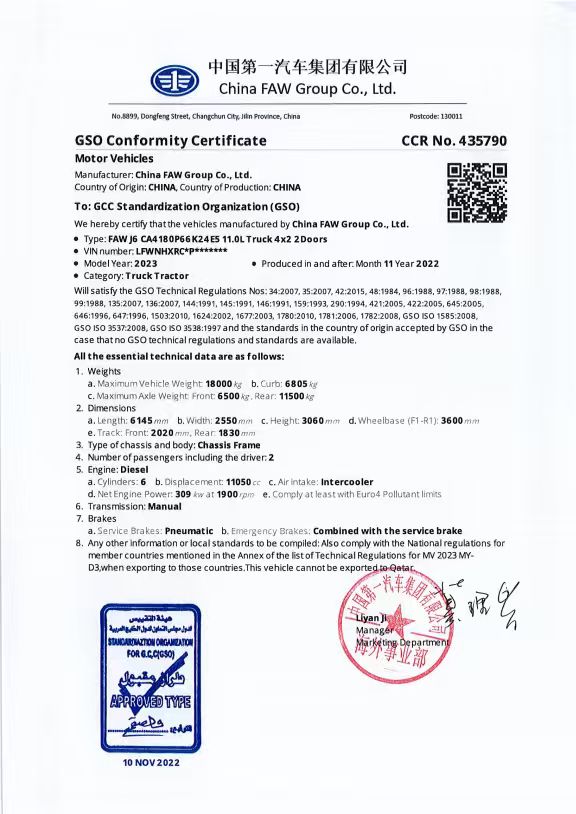
A supplied certificate record covers ECER105 for a FAW JK6 dangerous-goods transport vehicle application, certificate E13*105R06/01*0023*00, issued by Société Nationale de Certification et d’Homologation in Luxembourg, with a scope covering EX/FL/AT/MEMU categories. That is a scoped certificate, not a blanket approval for every JK6 configuration or every destination market. A second supplied record covers a GCC conformity certificate, CCR No.435790, for a FAW J6 Series truck tractor in a 4×2, Euro 4 scope, listing models including JH6, J6L, JK6 and Tiger v. Again, the buyer should confirm the exact model, body, market and current validity against the intended use.
The minidozer side has a different compliance profile. The supplied material does not provide a blanket market-access certificate for the CR468C, so the buyer should ask for the applicable documentation for the destination market and use. This is especially important when the machine will work indoors, in food-adjacent areas, in ports or in waste depots where local rules may add requirements beyond the machine’s base specification.
Lead time, minimum order and after-sales
Both capability records list a 30–45 day lead time and a minimum order quantity of one unit. The minidozer record lists 100% full inspection before shipment, a performance test for each machine, accessories and remote maintenance. The FAW record lists 100% testing and global technical support for after-sales service. These are useful screening facts because they show that the supplier presents a repeatable inspection and support process. They do not replace a written warranty, spare-parts list, service-response commitment or acceptance test for the buyer’s own configuration.
What the market signal does and does not prove
The supplied evidence pack includes a China-focused electrification signal: new-energy concrete mixer sales reached 8,036 units in 2024, with a 43.8% penetration rate, according to CleanTechnica data dated 8 May 2026. That is a concrete-mixer statistic, not a minidozer forecast. It does show that electric drive is a live procurement topic in Chinese construction equipment, which is relevant when a buyer is evaluating a lithium-battery compact machine. It does not prove that every electric compact machine will have the same utilization, charging profile or resale pattern.
A commercial research projection in the same pack estimates the global compact mini excavator market at $9.42 billion in 2026, rising to $16.39 billion by 2034 at a 7.2% compound annual growth rate. This is a projection from a commercial research source, not an audited shipment count. The supplied trade evidence also cites China as the largest exporter of excavators under HS Code 8429.52, with a total value of $8.27 billion in 2024. For a mixed-fleet buyer, the practical takeaway is not to chase a trend label. Use the trend to ask better questions: what is the real duty cycle, what charging infrastructure is needed, what spare parts are stocked, and which compliance documents apply to the destination market.
Procurement checklist for a combined shortlist
A buyer can turn the shortlist into a comparable quotation by using the same checklist for every cluster.
- Define the work cycle. Separate confined digging and grading from road haulage, cold-chain transfer, port movement and urban waste collection. The cluster determines the machine role before the model is selected.
- Measure the access envelope. Check the minidozer’s 2,850×1,200×600 mm dimensions and 1,100 kg net weight against doors, aisles, floors and trailers. Check the FAW configuration’s 3,000–15,000 kg and 6,000×2,300×3,000 mm to 12,000×2,550×3,800 mm range against road, yard and loading-bay limits.
- Fix the truck body and load first. The FAW customization record lists body, engine, tires and load capacity. A model name without a body and load specification is not a shortlist entry.
- Itemize ABS, EBS and TCS. Ask for the exact security configuration in the quotation and confirm the market version. Do not infer the package from the model family.
- Verify the battery claim. Treat the 8-hour endurance and 2-hour charging figures as manufacturer-reported until the duty cycle, ambient temperature, charger and battery conditions are confirmed for the actual site.
- Match the tire or track specification to the surface. The FAW tire specification should follow customer need and local road requirements. The minidozer’s rubber-track configuration should be checked against floor, surface and indoor or outdoor use rules.
- Check the certificate scope. The JK6 ECER105 record and the FAW J6 Series GCC record are scoped documents. Confirm the exact model, body, market and validity before relying on them.
- Ask for comparable references. The Saudi minidozer case and the Mali FAW truck case are useful reference profiles. Ask for references with a similar access, load, climate and duty cycle, and verify the details in writing.
Frequently asked questions
Is the CR468C minidozer a replacement for a FAW truck?
No. The CR468C is a compact work tool for confined digging, grading and material handling, with a 2,850×1,200×600 mm envelope, 1,100 kg net weight, 450 kg rated load and 0.15 m³ bucket. A FAW truck is a road and yard haulage platform. The two machines can complement each other in a mixed fleet, but the minidozer’s bucket and rated load do not replace truck payload or road-haulage capacity.
Which CR468C specifications matter first for a tight site?
Start with the access and work envelope: 2,850×1,200×600 mm, 1,100 kg net weight, 450 kg rated load and 0.15 m³ bucket. Then check the 300 Ah/73.6 V lithium battery, remote-control configuration and rubber track against the site’s charging, control and surface rules. The manufacturer-reported 8-hour endurance and 2-hour charging time are early screening figures; the buyer should confirm the duty cycle and operating conditions behind them.
How should a buyer shortlist JH6, J6L, JK6 and Tiger v?
Begin with the job cluster and the body requirement, not the model name. The FAW capability record lists customization for body, engine, tires and load capacity, so the quotation should define those items for the intended route. Confirm the 3,000–15,000 kg and dimension envelope, the ABS/EBS/TCS package, the tire specification and the applicable certificate scope. The JK6 ECER105 record and the FAW J6 Series GCC record are scoped examples, not blanket approvals for every configuration.
What evidence supports a combined minidozer and FAW truck fleet?
The supplied case records provide two reference profiles. A Saudi engineering construction case describes 12 minidozers in narrow indoor and outdoor material handling, with stable operation over more than ten years and reported high-temperature performance. A Mali logistics case describes 50 FAW trucks used for powdered and granular materials and sand and gravel, with stable high-intensity operation over more than ten years. These are case records, not controlled tests. They are most useful as prompts for comparable references and acceptance checks.
Conclusion: a shortlist is a fit decision, not a ranking
The CR468C minidozer and the FAW truck range belong in the same evaluation only when the buyer keeps their roles separate. The minidozer is the compact access and material-handling option; the FAW truck is the haulage platform. The shortlist becomes credible when the buyer defines the job cluster, measures the access envelope, specifies the body and load, itemizes ABS/EBS/TCS, matches the tire or track specification to the surface, and checks the certificate scope for the exact model and market. The numbers in this guide are a starting envelope. The written quotation, site trial and compliance review are what turn a shortlist into a fleet decision.
The supplied company brochure can be downloaded here: CHARY machinery brochure PDF.
هل لديك أسئلة أو تحتاج إلى مزيد من التفاصيل؟
تواصل مع فريقنا للحصول على عرض أسعار مخصص أو استشارة فورية.
طلب عرض أسعار
املأ النموذج أدناه وسيتواصل معك فريقنا بعرض مقترح مخصص.
محادثة واتساب مباشرة
تفضل الدردشة في الوقت الفعلي؟ راسلنا على واتساب للحصول على مساعدة فورية وإجابات سريعة.
- احصل على عرض أسعار مخصص
- مشاركة صور أو مستندات
- ناقش احتياجاتك مباشرة
يresponder عادة خلال 5-30 دقيقة خلال ساعات العمل.