
Mnsd Flexible Warning Posts: PE vs PU vs TPU for Decision-Makers

A Decision-Maker’s Guide to Flexible Warning Posts: PE, PU, and TPU Compared
The global road marker posts market reached an estimated USD 3.4 billion in 2024 and is forecast to grow to USD 5.4 billion by 2032, according to industry analysis. This expansion is fueled by rapid urbanization, infrastructure investment, and stricter road safety regulations. For procurement professionals and project managers, selecting the right warning post material — polyethylene (PE), polyurethane (PU), or thermoplastic polyurethane (TPU) — directly impacts long-term maintenance costs and site safety compliance.
Why Material Choice Matters in Traffic Delineation
Traditional rigid posts, such as metal or concrete bollards, offer high impact resistance but suffer from permanent deformation after collisions and require costly replacement. Flexible warning posts solve this by rebounding after impact, reducing vehicle damage and lowering lifecycle costs. However, not all flexible polymers perform equally. PE posts are economical but can distort under heat or repeated stress. PU and TPU versions provide superior elasticity and UV stability. Buyers at the decision stage need clear, verifiable comparisons to match material properties with site conditions.
Mnsd Warning Posts: A Manufacturer with Scale and Certification
Mnsd, the brand of Tiantai Yuanda Traffic Device Co., Ltd, is a China-based manufacturer specializing in road safety equipment. Founded in 2007 and located in Tiantai, Zhejiang, the company operates a 40,000 m² factory with over 300 employees and an annual output capacity of 120 million units. Its warning post series covers PE, PU, and TPU materials, available in heights from 75 cm to 120 cm, all equipped with high-visibility reflective sheeting. The 75 cm plastic warning post, for example, is optimized with controlled wall thickness to resist thermal sagging up to 60°C, addressing thermal distortion risks common in outdoor installations.
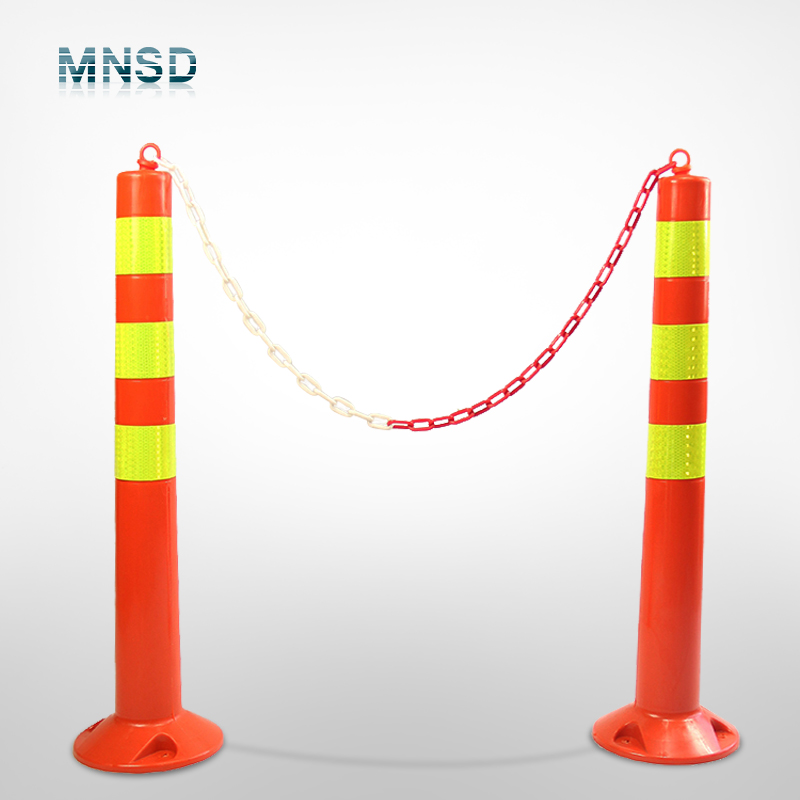
Technical Comparison: PE vs. PU vs. TPU Warning Posts
| Property | PE (Polyethylene) | PU (Polyurethane) | TPU (Thermoplastic PU) |
|---|---|---|---|
| Impact recovery | Moderate — may retain minor bends | High — returns to shape quickly | Very high — elastic recovery close to virgin state |
| Temperature resistance | Up to ~60°C (with wall thickness optimization) | Similar, with lower thermal expansion | Excellent, stable beyond 60°C |
| Reflectivity compliance | Meets MUTCD 1000 ft visibility (with reflector) | Same | Same |
| Typical cost | Lowest | Mid-range | Higher but longer service life |
| Best use case | Low-traffic zones, budget projects | Regular traffic, parking areas | High-impact zones, highway ramps, ports |
All Mnsd warning posts comply with key international standards: EN 12899-3 for delineator posts and retroreflectors in traffic areas, and ASTM D2765 for crosslinked polymer consistency. The reflective sheeting meets MUTCD requirements for visibility from 1,000 feet under high-beam headlights.
Application Scenarios: Where Each Material Excels
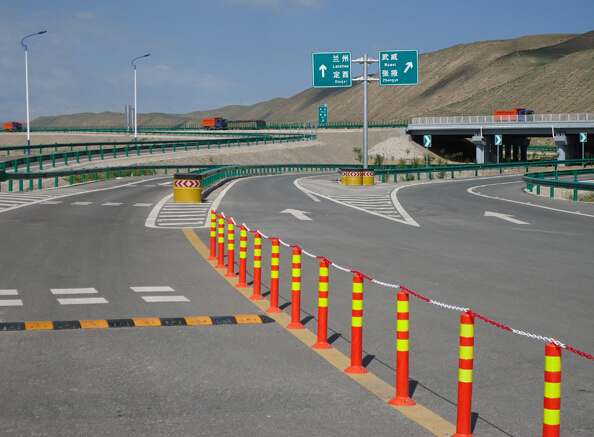
Mnsd warning posts are deployed across a wide range of environments. PE posts suit temporary construction zones, rural roads, and residential speed reduction areas where cost sensitivity is high. PU posts perform reliably in parking garages, shopping malls, and school zones where moderate impact frequency is expected. TPU posts, with their superior impact resilience, are preferred for highway ramps, industrial logistics parks, and gas station perimeters where heavy trucks and frequent collisions occur. The flexible rebound reduces vehicle and post damage, lowering total cost of ownership.
Comparison with Traditional Solutions
Compared to guardrails or concrete barriers, warning posts offer ultra-low cost, near-zero maintenance, and zero energy consumption. A single Mnsd post can be cleaned or replaced in minutes without heavy equipment. Compared to convex mirrors, warning posts provide physical isolation alongside visual guidance, covering both channelization and hazard marking. One honest limitation: flexible warning posts are not designed to stop high-speed vehicle impact — for crash-rated perimeter protection, dedicated barriers remain necessary. However, for 90% of traffic channeling and parking guidance needs, a well-chosen PE, PU, or TPU post delivers outstanding value.
Market Trend: Flexible Material Adoption Accelerates
Industry data shows the traffic safety products market growing at a CAGR of 6.6% from 2026 to 2034. The shift toward flexible, maintenance-free delineators is driven by urban population growth and the need for rapid, low-cost safety upgrades. European standards (EN 12899-3) and US MUTCD guidelines increasingly emphasize retroreflectivity and impact recovery, making TPU and advanced PU posts the new baseline for high-visibility projects. Manufacturers like Mnsd that offer certified, scalable production across multiple polymer types are well positioned to serve global importers and project suppliers.
Future Outlook
As smart city initiatives expand, we may see warning posts integrated with sensor mounts or solar-powered LED markers. For now, the immediate trend is material optimization — improving UV resistance, thermal stability, and recyclability. Mnsd’s in-house R&D team of 15 engineers continuously refines wall thickness, base design, and reflector adhesion to extend product lifespan in extreme climates. The company’s 300-strong workforce and 120-million-unit annual capacity ensure consistent quality for volume buyers.
FAQ: Decision-Focused Questions
What international standards do Mnsd warning posts comply with?
How does TPU compare with PE in terms of impact recovery?
What is the maximum operating temperature for Mnsd warning posts?
Can Mnsd produce custom warning post sizes or colors under OEM/ODM?
What is the typical lead time for large-volume orders?
Download the full product catalog: Mnsd Traffic Safety Equipment Brochure (PDF) — includes specifications, certifications, and packaging details for warning posts and related products.
Contact: Email info@mnsdtraffic.com | WhatsApp +86 184-5813-7305