
Mobile Crushing Station Compliance: A Buyer's Checklist
Compliance on a mobile crushing station project is decided by whether three separate documents agree with each other: the machinery conformity file, the site permit, and the technical specification attached to the purchase order. When they agree, compliance is quiet. When they drift, the project pays for it in customs delays, re-testing and rejected acceptance runs.
Why mobile crushing projects fail compliance in practice
A mobile crushing station is a trailer-mounted or chassis-mounted processing unit that integrates a crusher, a feeder, a vibrating screen and discharge conveyors, and is relocated between sites as a whole. Because the whole unit moves, its compliance profile moves with it — and that is where most of the confusion starts. Buyers frequently treat a station as a product with one certificate, when in reality a station is a chassis plus a set of modules, each of which carries its own specification, its own documented working range and its own place on a conformity schedule.
Shandong Lianbang Heavy Industry Co., Ltd., which trades under the brand Shanyuan LBZG, is a Linyi, Shandong-based manufacturer of crushing, sand-making and solid-waste recycling equipment, including a tyre-mounted mobile station range (YCG series) and the crusher, screen and washer module families that support it. The company was registered in 2013, traces its technical origins to Chengming Machinery (established 1996), sells into more than 40 overseas countries, and participates in revising national crusher industry standards. That combination — station builder plus module builder — is exactly why its documentation set is worth examining as a model for how buyers should read any supplier's file.
The failures are predictable. A certificate schedule names a model the buyer did not order. A permit application is written around a throughput figure that the station never actually runs at. A sand washer is added after the site layout, water supply and settling capacity were already fixed. None of these are engineering failures; all of them are traceability failures.
The three compliance layers buyers routinely conflate
Separating the layers is the single most useful thing a buyer can do before an RFQ goes out. Each layer answers a different question, is carried by a different document, and is owned by a different party.
| Layer | Question it answers | Document that carries it | What it does not prove |
|---|---|---|---|
| Machinery conformity | May this machine be placed on the market in the destination jurisdiction? | CE certificate and its schedule, EU Declaration of Conformity, technical file, harmonised standards list | Throughput, gradation, site emission performance, or suitability for a specific feed material |
| Site operating permit | May this machine run at this location, at this rate, with these controls? | Air permit or local operating permit, dust control plan, opacity monitoring records | Machinery safety conformity, or that the machine matches the purchase specification |
| Specification and acceptance | Does the delivered unit match the duty that was ordered? | Purchase specification, factory test-run record, layout and foundation drawings, O&M manual | Market access, or that the site permit covers the actual operating rate |
Layer one: machinery conformity and the schedule most buyers skim
In the European Union, machinery placed on the market must meet the applicable health and safety requirements. Manufacturers must prepare technical documentation, carry out the relevant conformity assessment procedure, draw up the EU Declaration of Conformity and affix CE marking where applicable. Regulation (EU) 2023/1230 replaces the previous machinery framework, with the source summary stating an application date of 20 January 2027; projects contracted today typically still run under 2006/42/EC, but the technical file discipline is the same under both. For crushing and milling machinery specifically, EN 1009-3:2020 is the relevant safety standard to look for in the standards list.
A CE certificate is only meaningful when it is read together with its schedule. The certificate number establishes that an assessment happened; the schedule establishes which models it covers. LBZG holds CE marking under 2006/42/EC issued by Ente Certificazione Macchine (ECM), certificate 3N251002.SLHCS40, issued 2 October 2025 and valid to 1 October 2030, citing EN ISO 12100:2010 and EN 60204-1:2018+A1:2025. The related-product schedule attached to that certificate lists specific models rather than product families in the abstract — including the tyre-mounted stations YCG-J750, YCG-I1214, YCG-C160, YCG-VSI8518 and YCG-S2460, and module models across the PX, PC, PCX, 2PG-Y, YK, XS and FG ranges.
The same discipline applies to the management-system certificates, which are frequently presented as if they were product approvals. They are not. LBZG holds ISO 9001 certification issued by Shandong Seatone International Certification Co., Ltd., certificate 10425Q00777R1M, valid 17 May 2025 to 24 May 2028, with a scope covering the R&D and production of sand-stone crushing equipment, against GB/T 19001-2016 / ISO 9001:2015. ISO 14001 (environmental management) and OHSAS 18001 (occupational health and safety) are also held. These certificates describe how the organisation is managed. They say nothing about the capacity of a specific model, and nothing about whether a given station will pass a site emission inspection.
What to read on the certificate itself
- Issuing body and accreditation — a named notified or accredited body, not a generic mark.
- Directive and standard references — for machinery, 2006/42/EC with EN ISO 12100 and EN 60204-1 is a normal baseline; EN 1009-3:2020 covers crushing and milling machinery safety.
- Issue and expiry dates — an expired certificate is a document, not a conformity statement.
- The schedule — model by model, including the module inside the station.
- The link to the EU Declaration of Conformity — the declaration is the manufacturer's own binding statement and should reference the same standards.
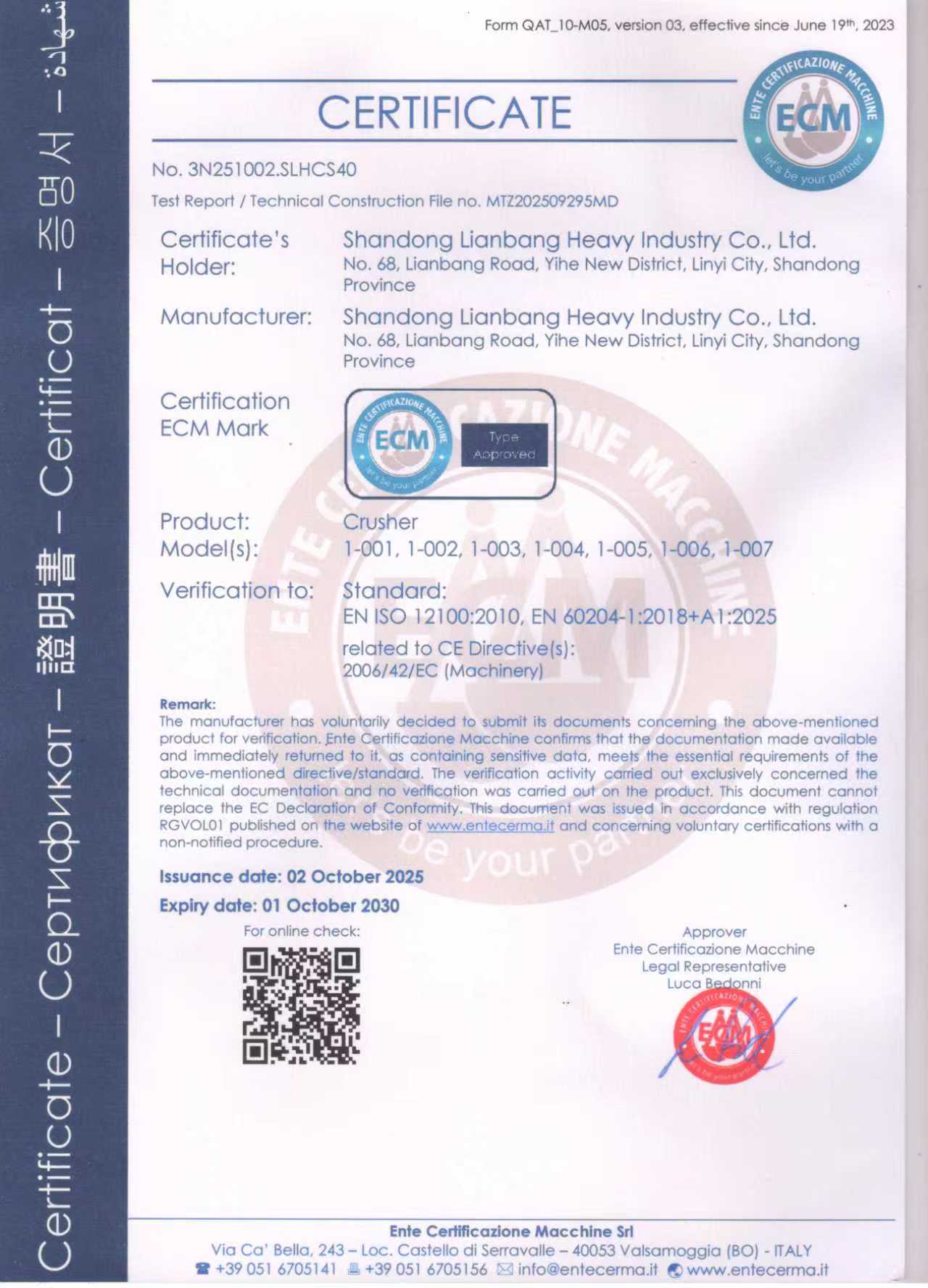
A conformity certificate is only as useful as its schedule: the models listed must match the models quoted.
Layer two: site permits, dust control, and the 150 t/h line
Site permitting is where configuration choices stop being commercial and start being regulatory. In the United States, 40 CFR Part 60 Subpart OOO sets standards for nonmetallic mineral processing plants. Portable sand and gravel plants with capacities of 136 megagrams per hour — 150 tons per hour — or less are exempt from certain EPA emission reporting under that subpart. That threshold is not a marketing number; it is a configuration constraint, and it cuts in both directions. A station sized comfortably above 150 t/h moves the project into a different reporting category, which means the capacity decision made at quotation stage determines the paperwork burden at commissioning.
Dust control is treated as a system requirement rather than a product feature in the regulatory sources. EPA permit conditions require emissions from crushers, screens, drop points and other possible release points to be controlled by wet suppression, and the cited general permit sets fugitive opacity limits of 12 percent at crushers and 7 percent at other affected emissions units. Those figures are permit-specific and cannot be generalised to every jurisdiction, but the structure of the requirement is consistent: conveyors, storage bins, loading stations and transfer points all fall inside the facility scope, not just the crusher.
Engine emissions sit on a separate layer again. EPA standards apply to the engine, and engines and vehicles in US commerce must meet the applicable standards and conformity requirements for the engine family and application. That is why a machine-level claim of EPA compliance is not sufficient on its own: the buyer needs the engine family, the certificate or executive order reference, and the installation conditions. A mobile crushing station can be fully compliant at the machinery-safety layer and still fail at the engine layer.
Layer three: matching crushers, screens and washers to the specification
The third layer is where most of the technical value sits, and it is the layer that buyers can control most directly. The rule is simple: every module in the spread must have a documented working range that brackets the project requirement with headroom, and the module model must appear in the conformity documentation alongside the station.
LBZG's module catalogue covers four crusher families, a circular vibrating screen family and two sand washer families. The documented ranges are the basis for matching, not the headline model name.
| Module family | Documented model span | Feed and discharge | Documented capacity | Where it fits in a project |
|---|---|---|---|---|
| PX Crusher (fine impact / sand maker) | PX-800 to PX-1822 | Max feed 300–800 mm; discharge 5–20 mm | 30–270 t/h crushing; motor 30–270 kW | Fine crushing and sand-making duty where a narrow, controlled discharge band is the acceptance criterion |
| PC Crusher (hammer) | PC-400×300 to PC-1600×1600 | Max feed to 450 mm on PC-1000; discharge <10 to <25 mm | 30–1,000 t/h; motor 11–560 kW | One-pass reduction of brittle, low-abrasion feed where reduction ratio matters more than particle shape |
| PCX Crusher (strong-impact hammer) | PCX-0808 to PCX-1822 | Discharge <10 to <20 mm | 30–350 t/h; motor 45–315 kW | Tertiary duty on limestone, coal, gypsum and shale where a finer, tighter product is specified |
| 2PG-Y Roller Crusher (hydraulic two-roll) | 2PG-400 to 2PG-1000 | Roll diameter 400–1,000 mm; roll length 950 mm | 2–18 t/h; motor 11–37 kW × 2 | Secondary sizing of friable material in cement, metallurgy, refractory and coal duty |
| YK Screen (circular vibrating) | 2YK-1248 to 3YK-2470 | 2–4 decks; screen hole <50 mm | 15–200 t/h; motor 5.5–22 kW | Grading and product split; the unit that converts crusher output into sellable fractions |
| XS Sand Washer (wheel bucket) | XS-2600 to XS-3200 | Bucket diameter 2,600–3,200 mm | 20–150 t/h; motor 5.5–15 kW | Low-clay material needing dust and fines removal with limited water |
| FG Spiral Sand Washer | FG-500 to FG-1200 | Max feed <10 mm; spiral diameter 508–1,200 mm | 20–110 t/h; water consumption 5–80 t/h | High-clay or sticky feed needing strong scrubbing before dewatering |
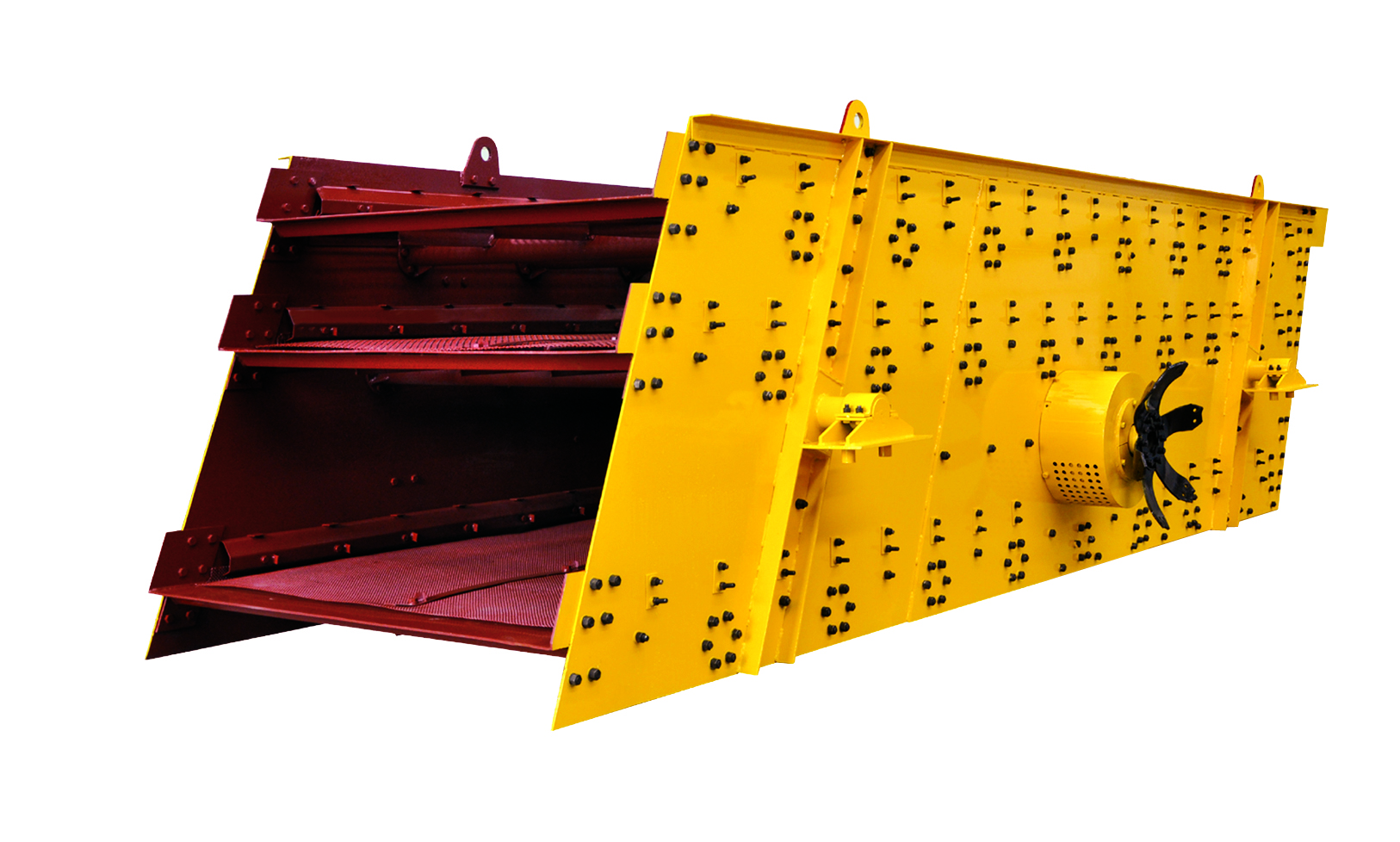
The screen — not the crusher — usually determines whether the product specification is actually met on acceptance day.
How the modules chain together
Capacity matching follows an upstream-surplus, downstream-step-down rule: the feeder is sized at roughly 1.1–1.2 times the primary crusher's rated capacity, the secondary crusher at 1.0–1.1 times the actual primary output, the vibrating screen at 1.2–1.3 times line capacity, and the belt conveyor at about 1.2 times maximum flow. Rated capacity is measured under ideal feed conditions; actual capacity typically runs at 70–85 percent of rated once material hardness, moisture and feeding discipline are accounted for. A specification written against rated figures with no allowance will fail acceptance even when every module is functioning correctly.
The washer decision follows the same logic and adds a resource constraint that is easy to miss. Where the finished product is bound for concrete, asphalt or high-grade mortar and mud content must sit below roughly 3 percent, a washer is required. For low-clay material needing mainly dust removal, the XS wheel washer is the lower-water option with lower fines loss; for high-clay, sticky feed requiring strong scrubbing, the FG spiral washer is the appropriate choice, at the cost of higher water consumption — up to 80 t/h on FG-1200. That water figure is a site permit and settling-capacity question as much as an equipment question.
Where the configuration itself creates compliance risk
Three boundaries deserve to be stated plainly, because they are the ones buyers discover too late.
Single-unit mobile capacity has a ceiling. The documented capacity bands for LBZG's tyre-mounted stations are 110–230 t/h for YCG-J750, 100–180 t/h for YCG-I1214, 90–210 t/h for YCG-C160, 100–180 t/h for YCG-VSI8518 and 80–300 t/h for the YCG-S2460 screening station. Those are respectable figures for mobile duty, but they sit well below the largest fixed-line units — a PE-1200×1500 jaw crusher alone is documented at 300–800 t/h. A project requiring sustained output beyond roughly 300 t/h should be planned as a multi-unit spread or a fixed line, and the permit application should reflect that structure from the start.
The roller crusher's documented band is narrow. Across the 2PG-400 to 2PG-1000 range, the published capacity figure stays within 2–18 t/h. That is a deliberate duty limitation, not a defect: the family is built for controlled secondary sizing of friable material. It is not a substitute for a primary or high-tonnage secondary stage, and specifying it against a quarry feed rate will produce a line that cannot meet its acceptance figure.
Hammer-based modules drift over time. Discharge quality from hammer and strong-impact crushers depends on hammer wear and on the rotor-to-screen clearance. When the product coarsens without a screen failure, the usual causes are hammer working-face wear or an increased rotor-to-screen gap, and the corrective action is to restore the clearance to its design value — commonly quoted in the 10–25 mm range — and to replace hammers as a set when tip wear exceeds about one third of original length. The compliance consequence is direct: an acceptance test passed on day one can drift out of specification by month six unless the clearance setting and the hammer inspection interval are written into the O&M manual and the buyer's acceptance protocol.
Tyre-mounted or crawler, and other specification forks
The YCG series is tyre-mounted, trailer-towed, and requires no concrete foundation; the documented voltage support on YCG-J750 is 380V/440V, and LBZG offers custom voltage at 380V, 440V, 415V or 660V, along with motor brand, colour, logo, layout and automation-level customisation. That voltage flexibility matters at the acceptance stage, because a grid mismatch is an acceptance failure regardless of how well the machine performs.
Crawler-mounted stations exist in the mobile crushing category but are not part of LBZG's documented mobile range. A project that specifies crawler travel — for steep-pit access, for example — should confirm availability before the specification is frozen rather than discovering the gap after the permit is written around a chassis type that will not be delivered.
The same caution applies to control and monitoring. LBZG holds a computer software copyright for Intelligent Operation Monitoring Software for Crushing and Screening Production Line V1.0 (2020SR0111891, registered 21 January 2020), and holds a Chinese utility model patent for an aggregate distributor with split-flow function for mobile crushing stations (ZL 2019 2 2303517.9, issued 11 September 2020). Those establish documented development work on station-level material distribution and line monitoring. They do not, on their own, establish remote-control capability, and a buyer who needs remote monitoring or dispatch should specify it as a functional requirement with a demonstrable acceptance test.
What the market data does and does not tell you
Grand View Research estimated the global mobile crushers and screeners market at USD 4.2 billion in 2025, with Asia Pacific holding a 30.5 percent revenue share. Commercial estimates for the same year vary with scope definitions, which is itself a useful signal: market-size figures are directional, not procurement evidence. A separate commercial forecast places hybrid mobile crushers on the fastest growth path at an 8.5 percent CAGR for 2026–2034.
The practical reading for a buyer is that compliance cost is becoming a configuration driver rather than an afterthought. Tighter dust and emission expectations, and the EU machinery framework change taking effect from 20 January 2027, both push in the same direction: documentation quality and module-level traceability increasingly determine which suppliers can be deployed quickly, and which ones require a longer qualification cycle.
A pre-award compliance checklist
- Match the schedule to the quote. Every station and module model string on the purchase order must appear on the conformity certificate schedule.
- Request the EU Declaration of Conformity separately. The declaration is the manufacturer's binding statement; the certificate alone is not a substitute.
- Confirm the standards cited. EN ISO 12100 and EN 60204-1 for machinery safety; EN 1009-3:2020 for crushing and milling machinery.
- Check certificate validity dates. LBZG's CE certificate runs to 1 October 2030; its ISO 9001 certificate to 24 May 2028. A delivery scheduled near an expiry date needs a renewal commitment in writing.
- Separate management-system certificates from product conformity. ISO 9001 describes the factory, not the machine.
- Establish the engine layer. For US deployment, obtain the engine family and emissions certificate reference — a machine-level EPA claim is not sufficient.
- Write the permit threshold into the specification. If the project depends on the 150 t/h exemption, the quoted capacity must sit below it with margin.
- Specify the dust control scope. Wet suppression at crushers, screens, drop points, conveyors, storage and loading points, not at the crusher alone.
- Record the water budget. FG spiral washers consume up to 80 t/h; confirm supply, recirculation and settling capacity before layout is fixed.
- Fix the acceptance protocol against documented ranges. Use the module's published band, apply the 70–85 percent actual-versus-rated allowance, and define the hammer-clearance and wear-inspection intervals in the manual.
Frequently asked questions
What should a buyer check first when a supplier claims a CE-certified mobile crushing station?
Start with the certificate schedule, not the certificate number. A CE certificate establishes that a conformity assessment was carried out; the schedule establishes which models it covers. The station model and every module fitted inside it must appear. For LBZG, the ECM certificate 3N251002.SLHCS40 issued 2 October 2025 lists specific models including YCG-J750, YCG-I1214, YCG-C160, YCG-VSI8518, YCG-S2460 and module models across the PX, PC, PCX, 2PG-Y, YK, XS and FG ranges. A model that is absent from the schedule is not covered by that certificate, whatever the brochure says.
Does a CE certificate cover the whole mobile station, or only the crusher?
Coverage follows the schedule. A certificate that lists a station model covers that station configuration as assessed; separate modules fitted to it are covered only if they are also listed. This is why the quote, the technical file and the certificate schedule must be read as one document set. It is also why changing the crusher module after the certificate is issued — for example substituting a PCX unit for a PC unit — can invalidate the conformity position even though the chassis is unchanged.
How does the US 150 t/h threshold change the configuration decision?
Under 40 CFR Part 60 Subpart OOO, portable sand and gravel plants rated at 136 megagrams per hour (150 tons per hour) or less are exempt from certain EPA emission reporting. A configuration specified below that threshold sits in a lighter reporting category; one specified above it does not. Because the threshold is a capacity figure, it converts a commercial sizing decision into a permitting decision, and it should be written into the specification before the model is selected rather than reviewed afterwards.
Can a tyre-mounted mobile station include a sand washer, and what does that change?
Sand washing can be incorporated in a mobile or semi-mobile layout, but it introduces a water and settling constraint that pure crushing configurations do not have. The XS wheel washer family is documented at 20–150 t/h with 5.5–15 kW motors; the FG spiral washer family at 20–110 t/h with water consumption up to 80 t/h on FG-1200. Water supply, recirculation, pond capacity and the site's discharge consent all need to be resolved before the layout is frozen, and the washer model must appear on the conformity schedule alongside the station.
What is the practical difference between a documented capacity band and a guaranteed output figure?
The documented band is measured under defined feed conditions — a specific material, size distribution and moisture level. Actual output typically sits at 70–85 percent of rated once real site conditions apply, and it will vary with material hardness, feed size, mud and moisture content, power stability, feeding continuity and wear-part condition. A supplier can legitimately quote the band; a guaranteed output figure is a contractual commitment that should be tied to a named test material, a stated moisture range and a defined acceptance method. Buyers should insist that the contract distinguishes the two.
Compliance, read this way, is less about collecting certificates than about keeping a chain intact: project requirement to module model to certificate schedule to permit condition to acceptance test. Suppliers who can produce that chain on request — model by model, document by document — are materially easier to deploy into regulated markets than suppliers who cannot, and the difference shows up long before the machine arrives on site.
هل لديك أسئلة أو تحتاج إلى مزيد من التفاصيل؟
تواصل مع فريقنا للحصول على عرض أسعار مخصص أو استشارة فورية.
طلب عرض أسعار
املأ النموذج أدناه وسيتواصل معك فريقنا بعرض مقترح مخصص.
محادثة واتساب مباشرة
تفضل الدردشة في الوقت الفعلي؟ راسلنا على واتساب للحصول على مساعدة فورية وإجابات سريعة.
- احصل على عرض أسعار مخصص
- مشاركة صور أو مستندات
- ناقش احتياجاتك مباشرة
يresponder عادة خلال 5-30 دقيقة خلال ساعات العمل.