
Modular Medical Storage Carts T001–T003: An Independent Buyer Comparison
Modular Medical Storage Carts T001–T003: An Independent Buyer Comparison
Medical cart purchases rarely fail because a hospital picked the wrong product category. They fail because a category-level decision was never converted into a model-level one. Once a buyer has shortlisted a modular platform, the remaining work is deciding which cart model belongs in which clinical unit — and what evidence supports that choice.
Tongde Medical Technology (Ganzhou) Co., Ltd., which markets its modular medical storage range under the Topmodul brand, manufactures three cart models on the same modular platform: the anesthesia cart T001, the Emergency Crash Cart T002 and the nursing cart T003. Because all three are covered by the same manufacturer declaration for medical cart models T001 to T011, the comparison is no longer a supplier-risk comparison. It becomes a role comparison: which model fits which workflow, which configuration limits apply, and which documentation a procurement team should verify before release of the order.
This assessment is written for buyers at the evaluation-to-execution stage — hospital procurement teams, distributors and OEM partners who have already decided that modular medical storage is the direction and now need a defensible model selection.
Why model-level comparison beats category-level buying
The commercial research context explains the pressure. Horizon / Grand View Research estimates the global medical carts market at US$ 4.83 billion in 2026, and projects the European medical carts market to grow at a CAGR of 15.8% between 2025 and 2030. Growth of that order is not driven by hospitals adding more carts of the same type. It is driven by hospitals replacing undifferentiated trolleys with configured storage that matches a specific department workflow.
The same logic applies to the storage standard behind the carts. A Pegasus Medical specification published on MedicalExpo states that the ISO 60-40 modular system allows storage capacity to increase by up to 50% compared with traditional shelving. That figure is a shelving comparison, not a cart specification, but the implication for carts is direct: a modular cart only delivers its capacity advantage when the tray, drawer and shelf configuration has been defined for the department that will use it. A modular cart bought without configuration work behaves like an expensive conventional trolley.
That is the opportunity and the risk in one sentence. Modularity converts a storage purchase into a specification exercise — and specification exercises are exactly where procurement teams need model-level facts rather than brand-level claims.
The shared platform behind carts T001, T002 and T003
Tongde Medical Technology (Ganzhou) Co., Ltd. is a Chinese medical storage manufacturer founded in 2003, operating a 30,000-square-metre factory with more than 100 employees, including a 10-plus R&D team and a five-member quality control team. Monthly capacity is stated at 20,000 units, and approximately 90% of output is exported, with key markets including Germany, the United Kingdom, Spain, Italy, the Netherlands, Poland, Saudi Arabia and Israel.
The product range that matters for this comparison is the cart and shelving portfolio: medical carts, hospital medication trolleys, medical supply carts, anesthesia carts, emergency crash carts and nursing carts, alongside high density medical storage shelving, ISO 6040 medical storage systems and modular hospital storage systems. Manufacturing equipment includes injection molding equipment, a granulator and a raw material warehouse — which is relevant to buyers because structural plastic components are produced in-house rather than sourced as finished assemblies.
Quality control follows a full-process model: IQC, IPQC, FQC and OQC inspection stages, with a stated 100% test rate on products and a five-person QC team checking every product before packing and shipment. The manufacturer holds CE documentation for its medical carts and ISO 9001 certification for production.
For a buyer, the practical consequence is that T001, T002 and T003 should be evaluated as three configurations of one platform. Consumables, trays and accessories are shared. The differences sit in clinical role, workflow geometry and the configuration decisions each model forces.
T001, T002 and T003 side by side
The three models are named by their intended clinical function rather than by size class. That naming is itself a procurement signal: the manufacturer is positioning each cart against a department workflow, not against a generic storage volume.
| Model | Named clinical role | Configuration logic | Documentation coverage | Buyer question to resolve |
|---|---|---|---|---|
| T001 Anesthesia Cart |
Anesthesia and procedure support | Drawer and tray layout defined around anesthesia consumables and procedure access | Within the CE declaration of conformity for medical cart models T001–T011; listed in the EU medical device notification scope | Does the layout follow the anesthesia workflow, or does it duplicate the general storage room? |
| T002 Emergency Crash Cart |
Emergency and resuscitation response | Rapid-access configuration; contents organised for retrieval under time pressure | Within the CE declaration of conformity for medical cart models T001–T011; listed in the EU medical device notification scope | Is the access sequence validated against the resuscitation protocol in use? |
| T003 Nursing Cart |
Ward nursing and medication rounds | Mobile storage configured for routine supply transport between nursing and treatment areas | Within the CE declaration of conformity for medical cart models T001–T011; listed in the EU medical device notification scope | Does the configuration match the round pattern of the ward, not the average of all wards? |
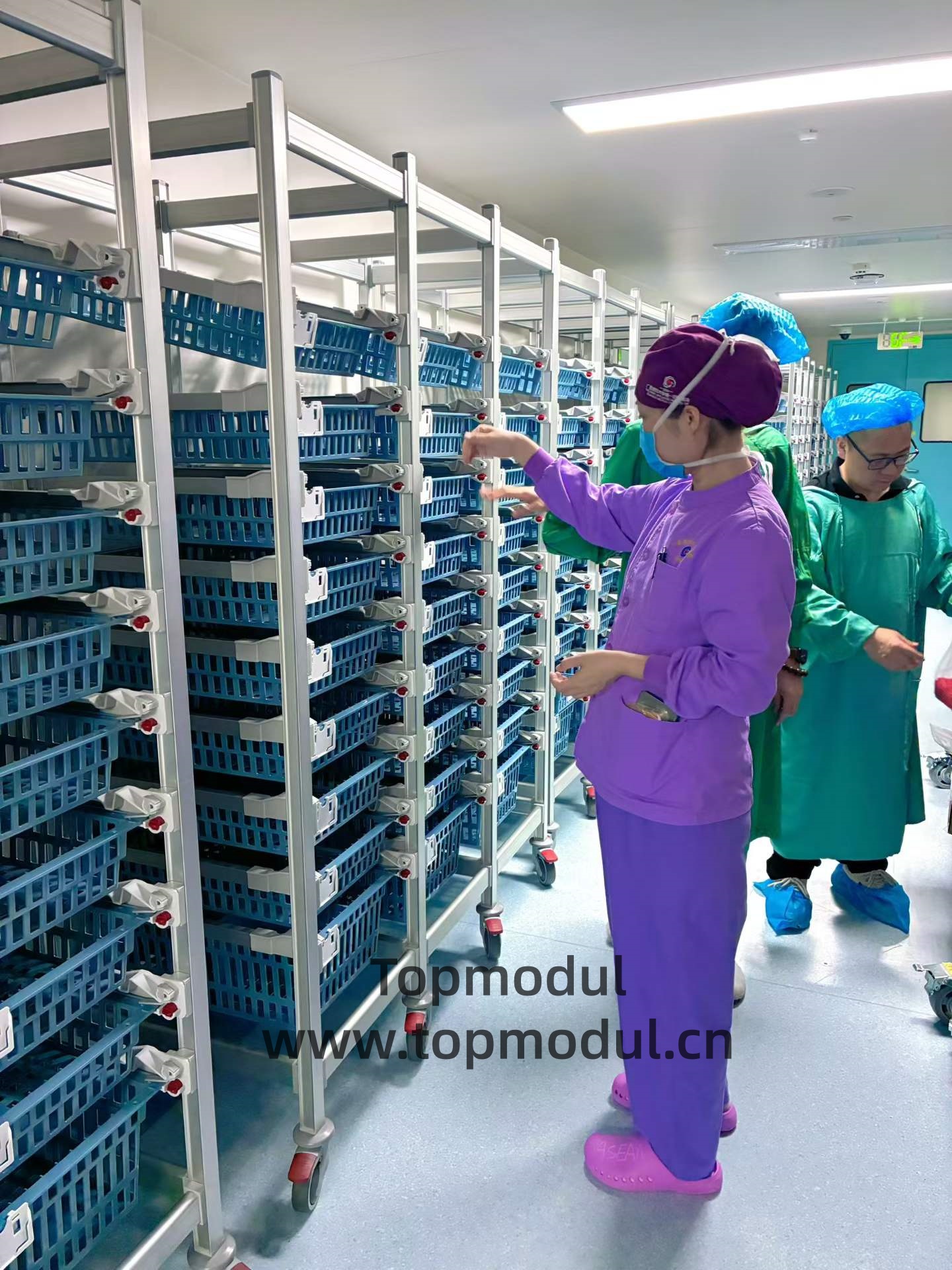
Carts T001, T002 and T003 are built on a shared modular platform; the comparison is about clinical role and configuration, not about separate supply chains.
One limitation must be stated plainly. The published product and certification material does not specify per-model drawer counts, exterior dimensions, load ratings or caster specifications for T001, T002 and T003. A buyer comparing these three models will not find those numbers in the manufacturer declaration — they have to be requested and confirmed in writing for the intended department. Treat this as a normal specification step rather than a gap: the manufacturer's own scenario documentation states that size, drawer or shelf configuration, load requirements, cleaning and disinfection methods and accessory combinations must be confirmed according to the department in use.
What the CE and ISO documentation actually covers
Certification is where model-level comparisons most often go wrong, because buyers accept a category-level statement ("our carts are CE certified") as if it were a model-level one. For this platform, the documentation can be read more precisely.
- EU Declaration of Conformity (Medical Device, MDR Class I) — certificate reference REP-MDR-20241108M1, issued 2024-11-08 through the European Authorized Representative REP Europe GmbH. The declared scope is Medical Cart, models T001, T002, T003, T004, T005, T006, T007, T008, T009, T010 and T011. Cited standards include Regulation (EU) 2017/745 (MDR), EN ISO 20417:2021, EN ISO 10993-1:2020, EN 62366-1:2015+A1:2020, EN ISO 13485:2018+A11:2021 and EN ISO 14971:2020/A11:2021.
- EU Medical Device Notification Certificate — reference DE/CA20/00205020, issued 2024-11-26 through REP Europe GmbH, covering EU 27 Member States, the UK, Turkey and selected Middle Eastern countries. The declared scope names the Anesthesia Cart, Emergency Crash Cart, Nursing Cart and Infusion Cart among medical carts.
- ISO 9001:2015 Quality Management System — certificate 276Q240086, issued by Huaxinchuang (Beijing) Certification Center Co., Ltd. on 2024-04-08 and valid until 2027-04-07. The certified scope is the production of medical shelves (cabinets) and medical carts.
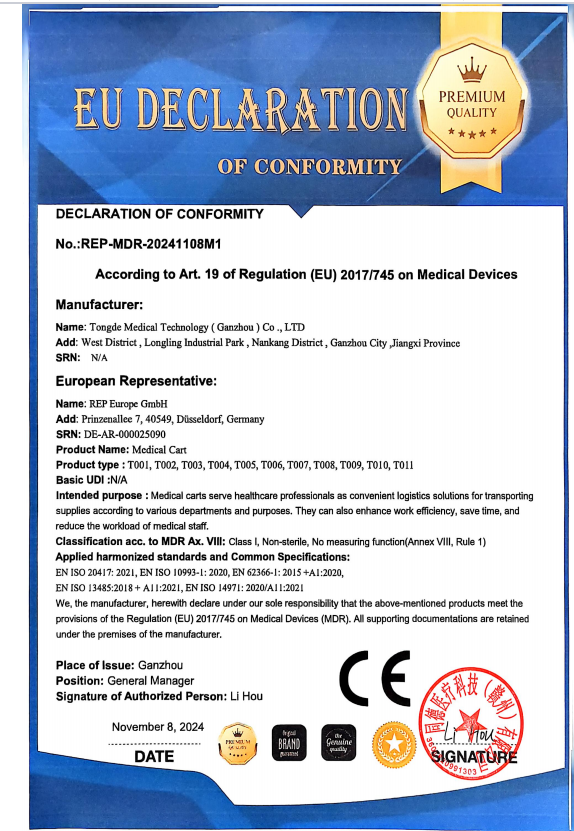
The declaration of conformity names models T001 to T011 individually, which allows a procurement team to match the certificate exactly to the cart being ordered.
The buying implication is straightforward. Because T001, T002 and T003 each appear by model number in the declaration scope, a hospital can attach the certificate to a specific purchase line rather than to a product family. The ISO 9001 certificate is separate and governs production, not the device itself — it evidences a certified quality management system covering medical cart and shelving production, and the certification is described as widely accepted in 170 countries and regions.
A second limitation belongs here. Classification under MDR Class I and the presence of a declaration of conformity define the regulatory route the manufacturer has taken; they do not, by themselves, certify suitability for a particular clinical protocol. Buyers should still validate configuration, cleaning method and workflow fit locally.
OEM, ODM and modular configuration: what can actually be changed
The capability layer is where a modular cart platform separates itself from a catalogue trolley. The manufacturer provides OEM production services and ODM design and production services for medical carts and medical storage systems. Production services extend to medical cart design and manufacturing, medical storage system integration, modular configuration for carts and storage systems, and project-based solution support for hospital storage and cart projects.
For buyers moving into execution, the stated commercial parameters are: minimum order quantity of 100 units, lead time of 30 to 45 days, and a 100% test regime before shipment. After-sales support includes free maintenance service, installation, debugging and usage training, consultation, and continuous product optimisation with upgrade services.
The OEM workflow the manufacturer describes follows a defined sequence, which is useful as a planning template because it shows where buyer approvals actually sit:
- Confirm all requirements — conventional off-the-shelf products or customised models.
- Receive a detailed quotation with requirements clearly defined.
- Discuss further needs or concerns.
- Double-confirm the model number and proceed to material and size selection.
- Both parties approve details — materials, colours and sizes.
- Production begins after payment and drawing confirmation.
- Regular updates on production process and progress.
- Photo verification before delivery.
The boundary condition is the MOQ. A 100-unit minimum means these carts are a poor fit for a single-department pilot where five units are needed to test a workflow. In that situation the standard catalogue configurations of T001, T002 or T003 are the realistic route, with customisation reserved for a later phase once the department has validated its own layout. Buyers should decide this before requesting a custom drawing, not after.
Where each cart earns its place
The application logic for the three models follows directly from their designations, and the manufacturer's scenario documentation frames the wider system around one function: centrally organising the storage and transfer of medical supplies and supporting the efficient flow of materials between nursing, treatment and hospital departments. Operation is manual, by clinical staff.
Within that, the model choice is a workflow question. The anesthesia cart T001 sits in procedure and anesthesia support, where the layout has to follow a consumable sequence that the anesthesia team already knows. The Emergency Crash Cart T002 sits in emergency response, where retrieval sequence under time pressure is the governing requirement. The nursing cart T003 sits in ward rounds, where the requirement is routine transport of supplies to the point of care rather than depth of a specialist inventory.
Deployment evidence available for this platform is recorded at hospital level rather than at model level, which is worth stating honestly. Documented projects include a hospital in Malaysia with 100 units for the storage and transportation of medical supplies, a hospital in Taiwan with 100 units for medical product storage and transport, a hospital in the United Kingdom with 100 units of medicine storage shelving, a hospital in Saudi Arabia with 50 units of high density shelving, and a healthcare centre in Israel with 10 units of mobile high density shelving. The reported outcome of the cart deployments is consistent across those records: bringing essential supplies to the point of care reduces the time clinical staff spend walking back and forth to supply rooms or central stations. These cases support the category and the platform; they do not substitute for a department-level trial of T001 versus T003.
Modular carts versus traditional storage trolleys
Compared with conventional non-modular trolleys, the platform's structural advantages are specific rather than rhetorical. Modular trays and shelving share a common standard, so a cart fleet can be reconfigured instead of replaced. The manufacturer describes the modular storage rack as offering high space utilisation, good access, light and flexible operation, easy cleaning and disinfection, no rusting, and replaceable components that simplify disinfection routines. ISO 6040 compatibility connects the mobile carts to the wider storage system, including high density shelving and modular hospital storage systems, so supplies can move between storage room and point of care without repacking.
The limitation is equally specific, and it is the one buyers most often underestimate. A modular system requires configuration discipline. The manufacturer's own procurement guidance states that size, drawer or shelf configuration, load requirements, cleaning and disinfection method and accessory combination must be confirmed for each department before ordering. Where that confirmation is skipped, the modular advantage is not realised — the cart is simply a trolley with more parts. Traditional fixed trolleys require less specification effort precisely because they offer fewer options; that simplicity is a real trade-off, not a weakness to dismiss.
A second boundary concerns use-phase risk. Documented risks for medical storage carts include overload, caster damage, surface corrosion and loose structural connections, typically arising under overload, frequent heavy use or poor maintenance. Mitigation is procedural: observe the rated load limit, wipe off disinfectant residue after cleaning, check casters and fasteners regularly, and stop using a cart immediately if parts are found deformed or loose, replacing damaged parts. Modular carts do not remove this discipline; if anything, more components mean more checkpoints.
From evaluation to execution: a procurement checklist
The following list consolidates the selection parameters the manufacturer publishes, arranged in the order a buying team can actually act on them.
| Verification area | What to confirm in writing |
|---|---|
| Certification | CE documentation for the specific model ordered (T001, T002 or T003), plus ISO 9001 certificate covering medical cart and shelving production |
| Material and hygiene | Material specification and antibacterial properties; compatibility with the hospital's cleaning liquids and with high-temperature disinfection |
| Load and safety | Rated load capacity, lock structure, bearing safety and overall dimensions for the intended department |
| Surface treatment | Anti-corrosion treatment appropriate to the cleaning regime in use |
| Supplier capability | Factory scale, production cycle, quality control system and after-sales commitment |
| Commercial terms | MOQ (100 units), lead time (30–45 days) and delivery schedule against the project timeline |
Executed in that order, the checklist produces a purchase line that can be defended internally: a named model, a certificate reference that matches the model, a configuration confirmed by the department, and commercial terms that match the project schedule.
Market direction and what it means for buyers
Two market signals are worth holding together. Medical cart demand is expanding in absolute terms, with the global market estimated at US$ 4.83 billion in 2026, and Europe is forecast to grow at 15.8% CAGR through 2030. At the same time, the efficiency argument for modularity is documented: up to 50% more storage capacity from the ISO 60-40 modular approach compared with traditional shelving.
A reasonable industry reading is that growth of this scale is unlikely to come from adding undifferentiated trolleys. It is more consistent with hospitals shifting toward space-optimised, standardised logistics, where the cart is the mobile end of a storage system rather than a standalone item. For buyers, the practical consequence is that model-level specification quality becomes a procurement competence, not an administrative detail. Hospitals that define configurations precisely will capture the modular advantage; those that buy at category level will pay modular prices for conventional performance.
On the supplier side, the relevant signals are production depth and documentation rather than marketing reach. A manufacturer with in-house injection molding, a raw material warehouse and a granulator controls more of the component chain; a manufacturer with model-level CE declaration coverage and a certified quality management system gives buyers something to attach to an order. Both are verifiable before purchase.
Frequently asked questions
Are cart models T001, T002 and T003 covered by the same CE documentation?
Yes. The EU Declaration of Conformity issued under reference REP-MDR-20241108M1 declares Medical Cart models T001, T002, T003, T004, T005, T006, T007, T008, T009, T010 and T011, under Regulation (EU) 2017/745 (MDR) at Class I. A separate EU Medical Device Notification Certificate, reference DE/CA20/00205020 and issued 2024-11-26, lists the Anesthesia Cart, Emergency Crash Cart, Nursing Cart and Infusion Cart within its medical cart scope. Both documents name REP Europe GmbH as European Authorized Representative.
What customization is available for modular medical carts and storage systems?
The manufacturer provides OEM production services and ODM design and production services for medical carts and medical storage systems. Production services include medical cart design and manufacturing, medical storage system integration, modular configuration, and project-based solution support for hospital storage and cart projects. Customisation scope covers medical carts, hospital medication trolleys, medical supply carts, anesthesia carts, hospital supply storage systems, ISO 6040 medical storage systems, modular hospital storage systems and high density medical storage shelving.
What are the minimum order quantity and lead time?
The stated minimum order quantity is 100 units, with a lead time of 30 to 45 days. Monthly production capacity is stated at 20,000 units, and quality control includes a 100% test regime. These figures apply to production orders and should be reconfirmed against a specific project schedule before contract.
What should a buyer confirm before ordering medical storage carts?
Published selection guidance covers two levels. At product level: certification documentation, material and antibacterial properties, compatibility with hospital cleaning liquids and high-temperature disinfection, safety, load capacity, dimensions, surface treatment and after-sales service. At supplier level: factory scale, ISO 9001 and CE certification, production cycle and quality control system. Configuration-specific items — drawer or shelf layout, load requirements, cleaning and disinfection method, and accessory combination — should be confirmed for the department in which the cart will be used.
What risks occur during use and how are they avoided?
Documented risks for medical storage carts include overloading and deformation, caster faults, surface corrosion and loose structural connections. These typically occur under overload, frequent heavy use or poor maintenance. Mitigation measures are to observe the rated load limit, wipe disinfectant residue after cleaning, and check casters and fasteners regularly. If parts are found deformed or loose, the cart should be taken out of use immediately and the damaged parts replaced.
How is quality controlled before shipment?
The manufacturer operates a total quality management system with full-process inspection covering IQC, IPQC, FQC and OQC. A five-member quality control team performs checks at each production stage and on every product before packing and shipment. Products are certified with CE and ISO 9001, and the ISO 9001:2015 certificate (276Q240086) covers the production of medical shelves and medical carts, valid from 2024-04-08 to 2027-04-07.
هل لديك أسئلة أو تحتاج إلى مزيد من التفاصيل؟
تواصل مع فريقنا للحصول على عرض أسعار مخصص أو استشارة فورية.
طلب عرض أسعار
املأ النموذج أدناه وسيتواصل معك فريقنا بعرض مقترح مخصص.
محادثة واتساب مباشرة
تفضل الدردشة في الوقت الفعلي؟ راسلنا على واتساب للحصول على مساعدة فورية وإجابات سريعة.
- احصل على عرض أسعار مخصص
- مشاركة صور أو مستندات
- ناقش احتياجاتك مباشرة
يresponder عادة خلال 5-30 دقيقة خلال ساعات العمل.