
Molded Pulp Capability Evidence: Terms a Buyer Can Verify
Molded Pulp Capability Evidence: Terms a Buyer Can Verify
A molded pulp supplier's quotation is a capability document before it is a price document. The payment instrument, the delivery term, the minimum order quantity and the acceptance procedure each describe how a factory actually operates — how it funds production, controls export paperwork, schedules tooling and decides when a batch is good enough to ship. For buyers moving from evaluation into execution, those four areas are where supplier claims are either confirmed or quietly left untested.
This reference sets out what to ask about payment terms, shipping methods, purchasing terms and acceptance criteria in molded pulp tray procurement, why a written answer carries more weight than a verbal assurance, and how one manufacturer answers the same questions in its published buyer records. Tonghe Paper Co., Ltd. (Dongguan Tonghe Paper Industry Co., Ltd.) is a molded pulp manufacturer in Qiaotou Town, Dongguan, Guangdong, China, converting recycled paper and bagasse fiber into molded fiber trays, protective packaging and custom formats.
Commercial terms are the cheapest capability test a buyer has
Supplier shortlists usually start with unit price, which is also the one number a factory can quote before it knows anything about the buyer's product. The terms wrapped around that price are harder to produce without a working process behind them. A payment instrument commits the supplier's cash flow. A delivery term commits it to export documentation and carrier handling for a named port. A minimum order quantity commits its tooling and setup economics. An acceptance procedure commits inspection capacity and a remedy when a batch fails.
The economics of asking are asymmetric. A buyer spends an email to get the answers; the same questions asked after a container is loaded cost a deposit, a schedule and sometimes a production re-run. Disputes in packaging orders rarely turn on whether a tray was molded. They turn on who paid for the freight, where risk transferred, and which defect rate counted as acceptable at inspection.
There is a second reason to insist on written answers. Flexibility offered during negotiation does not automatically migrate into a purchase order. The term that governs the order is the term on the document both parties signed, so the useful question is not only "what do you accept?" but "where is that written?"
Payment terms: ask which instrument, not only which percentage
Payment questions are usually reduced to a deposit percentage, but the instrument matters more than the split. T/T, a letter of credit and a platform-based trade assurance arrangement place different obligations on each side and release different documents at different moments.
For Tonghe Paper Co., Ltd., the answer appears in two records. The buyer FAQ lists T/T and Alibaba Trade Assurance. A separate purchasing-terms record lists L/C alongside the stated MOQ, delivery terms and acceptance criteria. Because more than one instrument appears across the published records, the instrument applying to a specific order should be restated in the quotation or proforma invoice before any deposit is arranged.
That is a verification step rather than a warning sign. Commercial instruments are commonly offered in more than one form, and the buyer's job is to fix the one that will govern the order. The questions that make the answer usable are:
- Which instrument applies to this order value and destination, and is it confirmed in the proforma invoice?
- What triggers the balance — a bill of lading, a copy of the inspection report, or arrival at destination?
- Which documents are released against payment, and which are released before it?
- Which currency is invoiced, and who bears bank charges at each end?
- If a platform instrument is used, what evidence format does the platform require if a claim is raised?
The last point links payment to acceptance. A platform-mediated payment is resolved on documents, so an inspection report written in a form the payment route does not recognise is worth less than it appears. Aligning the two before the deposit costs nothing; reconciling them afterwards costs time.
Shipping: mode, term and the point where risk moves
Tonghe documents three transport modes — sea, air and express via DHL, FedEx or UPS — and states that freight is calculated once the destination port or delivery address is supplied. Delivery terms are quoted as FOB, CIF, CFR or EXW. Those four labels are where most shipping misunderstandings originate, because they divide cost and risk differently.
- EXW leaves the goods at the factory. The buyer arranges export clearance and main carriage, and carries risk from collection.
- FOB places the goods on board at the named port of shipment. Risk passes at loading and the buyer arranges the ocean leg.
- CFR has the supplier pay ocean freight to the destination port, but risk still passes when the goods are on board at origin.
- CIF adds insurance to CFR. Cover under CIF is normally minimum-standard terms unless something else is agreed, so the level of cover is worth confirming rather than assuming.
The practical consequence is that CFR and CIF feel like delivered terms without being delivered terms. The supplier pays the freight, but a loss in transit is the buyer's claim against the carrier or insurer, and the buyer's paperwork decides whether that claim succeeds.
For molded pulp specifically, freight behaves differently from dense packaging. Trays are lightweight and designed to stack, so packed volume and container utilisation tend to drive cost more than tonnage does. Two questions follow: what is the loading plan for the ordered volume, and what protection is specified for humidity during the voyage? Molded fiber is a paper-based material, and moisture-proof performance is available as a documented customisation rather than a default assumption.
Purchasing terms: MOQ, lead time and what each one commits
The purchasing-terms record for Tonghe lists a minimum order quantity of 1,000 pieces, delivery terms of FOB, CIF, CFR or EXW, and acceptance criteria of PSI. The capability record adds a lead time of 15–30 days, OEM/ODM production, customisation across material, colour, logo, anti-static and moisture-proof functions, and a monthly capacity of up to 1,000 tons.
Read together, those figures describe a schedule rather than a promise. A 1,000-piece MOQ sets the smallest run the supplier will schedule, but it does not by itself say whether that quantity covers a new mould. For a custom geometry, the buyer should ask whether the quoted MOQ applies to an existing tool or includes tooling amortisation — the answer changes the real cost of a trial order.
The 15–30 day lead time becomes useful once its start point is fixed. Three definitions are possible and only one will sit in the contract: days from purchase order, days from deposit, or days from approval of mould and artwork. The two ends of the range usually correspond to different conditions as well — a repeat run on an existing tool compared with a first run that includes sampling, coating, embossing or printing. Asking which end applies to the buyer's own specification converts a range into a date.
Capacity deserves the same treatment. A stated 1,000 tons per month is a plant-level figure; the buyer's question is what share of it their annual volume represents and whether that share is scheduled inside a normal production block. That is a continuity question, and no supplier can answer it without the buyer's tonnage.
Acceptance criteria: PSI is a stage, not a standard
Tonghe documents PSI as its acceptance criterion, with IQC, IPQC and FQC as the internal quality-control stages — incoming material, in-process and final checks. The structure is conventional and, on its own, incomplete: PSI is conventionally pre-shipment inspection, which names when goods are examined, not what will be measured or what happens when a result is marginal.
An acceptance clause becomes usable when three things are written into it. The first is the sampling plan — how many trays are drawn from how many cartons, and on what basis. The second is the defect definition, including which deviations are cosmetic and which are functional, and how a dimensional tolerance on a custom tray is measured. The third is the disposition: rework, replacement or credit, and the deadline for each.
Two further details change how much protection the clause actually gives. One is who performs the inspection, since a supplier's own QC report and a third-party report carry different weight in a later dispute. The other is timing, because an inspection performed after the balance has been paid is a record rather than a control.
Buyers of protective molded pulp packaging should also decide what is being accepted. A tray can pass a dimensional check and still fail on the buyer's packing line, so where fit matters the acceptance plan should state whether trays are tested with the actual product, and whether stack and drop behaviour form part of the pass criteria.
Certificates belong inside acceptance evidence, but read the scope line
Certificate numbers are frequently copied into supplier comparison sheets without the one line that determines whether they apply. Tonghe's published documents show why the detail matters.
- SGS test report SZXPC26000164601, issued 16 January 2026 by SGS-CSTC Standards Technical Services Co., Ltd., with scope stated as "paper tray" and analysis referencing IEC 62321-4:2013+AMD1:2017, IEC 62321-5:2013, IEC 62321-7-2:2017 and IEC 62321-12:2023.
- RoHS test report DSP25050447-1, issued 14 May 2025 by Dongguan ZRLK Testing Technology Co., Ltd., scope "paper tray".
- MSDS DSP25050758-1, issued 24 May 2025 by ZRLK, prepared with reference to ISO 11014:2009.
- FSC-COC certificate RINA-COC-003845, issued 7 June 2024 by RINA (Shanghai) Quality Certification Co., Ltd. and valid to 6 June 2029, covering purchasing of FSC 100%, FSC Mix and FSC Recycled pulp, manufacture and sale, with pulp tray named within the scope.
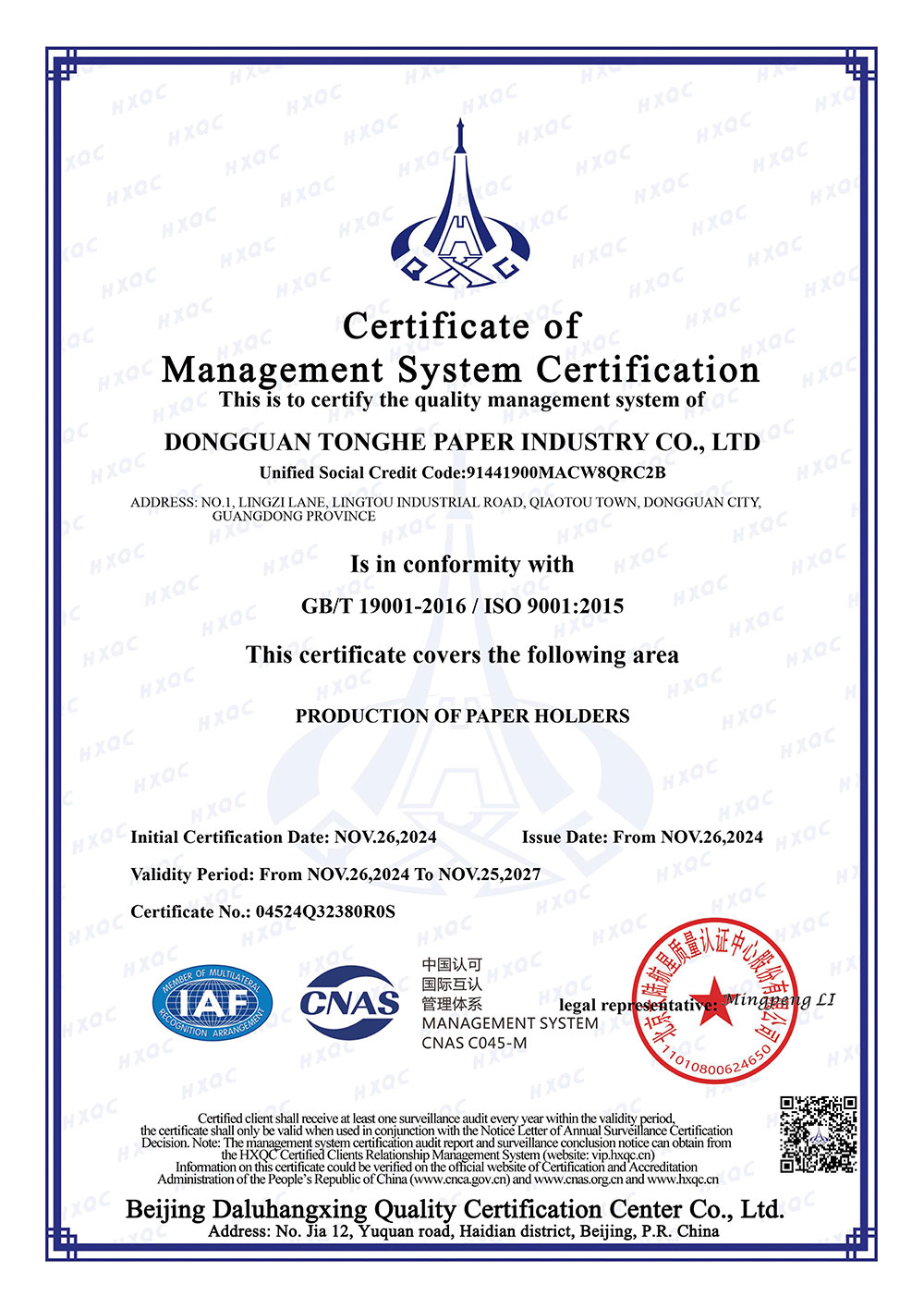
- ISO 9001:2015 certificate 04524Q32380R0S, issued 26 November 2024 by Beijing Daluhangxing Quality Certification Center Co., Ltd. and valid to 25 November 2027, with the recorded scope stated as paper holders.
The pattern is normal for the industry and instructive for buyers. A test report confirms the sample and the standard applied; a management-system certificate confirms a certified scope, which may be written more narrowly or more broadly than the item on the purchase order. Where the recorded scope does not name the exact product being bought, the buyer's next question is which document does cover it — not whether the supplier is certified at all.
Two habits make certificate review reliable. Check issue and expiry dates against the delivery date rather than the quotation date, since a certificate valid at quotation can lapse before shipment. And check the standard cited, because two reports on the same material can reference different editions of the same test method and are not automatically interchangeable.
What Tonghe Paper Co., Ltd. documents about itself
Beyond terms, the manufacturer publishes plant-level facts a buyer can test against the order. Tonghe Paper Co., Ltd. operates a 23,000 m² facility with 160 employees, including a 12-engineer development team, a monthly capacity of up to 1,000 tons and an annual output of 12,000 tons. Export accounts for about 50% of output, with stated markets in the EU, the United States, Australia, Saudi Arabia, Malaysia and Brazil.
The product range covers most protective and presentation formats: molded fiber and molded pulp trays, custom molded pulp trays, pulp packaging trays, protective molded pulp packaging, biodegradable pulp trays, medical device pulp trays, cosmetic packaging pulp trays, heavy duty molded pulp trays, food grade molded pulp trays, disposable food pulp trays, shockproof pulp trays, fresh produce pulp trays and molded pulp electronics trays, produced on an OEM basis. Customisation covers material, colour, logo, anti-static function, moisture-proof function, and finishing options such as special coating, embossing and printing.
Two company statements are worth recording as statements rather than verified performance. The company describes its products as fully biodegradable in natural composting conditions within 28 days, and states compliance with SGS RoHS and PFAS-free requirements. Where either point would be repeated in the buyer's own packaging claims, the underlying test documentation should be requested and filed with the acceptance record — the same discipline applied to the certificates above.
Materials are described as recycled paper and bagasse fiber, with wood pulp, bamboo pulp and sugarcane pulp also used. The company's positioning is that fiber selection and in-house mould development allow irregular, product-fitting geometries rather than only standard formats. That claim can be tested cheaply: the supplier states it supports sample comparison and testing, which is the correct place to establish fit before an acceptance clause is finalised.
| Term area | Documented answer | What the buyer still confirms |
|---|---|---|
| Payment | T/T and Alibaba Trade Assurance (FAQ); L/C (purchasing-terms record) | Which instrument governs this order; document release conditions |
| Delivery terms | FOB, CIF, CFR, EXW | Named port, insurance cover level, who books the leg |
| Shipping modes | Sea, air, express (DHL/FedEx/UPS) | Freight basis, loading plan, humidity protection |
| MOQ and lead time | 1,000 pcs; 15–30 days | Mould coverage; start point of the lead-time clock |
| Acceptance | PSI; IQC/IPQC/FQC internally | Sampling plan, defect classes, remedy, inspector identity |
| After-sales | Remote support | Escalation route where on-site attendance is expected |
Terms in practice: three buying scenarios
Different applications load different weight onto the same four term areas.
Food service and supermarket turnover. The supplier's case record describes restaurant and supermarket buyers using disposable packaging for transport and turnover, at a recorded quantity of 2,000 units, with a recorded result of shockproof and shatterproof performance and environmental protection as the stated highlight; the markets listed span Australia, Canada, Germany, Denmark, France, the United Kingdom, the Netherlands, New Zealand, Qatar, Saudi Arabia, Sweden, the United States and Malaysia. In this scenario the acceptance clause should name the food-contact documentation the buyer requires and confirm it before PSI, because a fibre tray covered by a general test report is not automatically cleared for direct food contact under the buyer's own market rules.
Medical device and cosmetic presentation. Where the tray is part of a validated pack, acceptance evidence outweighs unit price. The relevant questions are which certificate covers the specific tray, whether the material declaration is current at the delivery date, and whether the inspection record is detailed enough to sit inside the buyer's own device file. The supplier's medical device pulp trays and cosmetic packaging pulp trays fall under the same scope statements quoted above, so the scope line is again the deciding detail.
Electronics and industrial protection. Anti-static and moisture-proof functions are documented as customisation options rather than defaults. A buyer specifying either should have the requirement written into the acceptance criteria with a stated test method, because a protective function that is not measured at PSI is a feature the buyer is trusting rather than verifying.
Fit boundaries: what a documented term set cannot prove
Documented terms narrow risk; they do not remove it. A term sheet confirms what the supplier will do, not how the tray will behave on the buyer's line. Several boundaries are worth stating plainly.
- A stated MOQ of 1,000 pieces may exclude small trial volumes, and a custom geometry may require a higher quantity than a standard format.
- A 15–30 day lead time covers production, not ocean transit, port congestion or inland delivery.
- After-sales support is documented as remote support, so a buyer expecting on-site engineering attendance should confirm it separately rather than assume it.
- Certificate scope and product scope are not always identical, as the ISO 9001 scope line above illustrates.
- Company statements about biodegradation timing or compliance remain statements until the supporting report sits in the buyer's file.
None of these is a defect in the supplier's documentation. They are the questions that separate a supplier who answers completely from one who answers attractively, and they are cheapest to ask while the order is still a quotation.
Market context: why documentation is becoming part of the product
The commercial pressure behind this shift is measurable. Grand View Research values the global molded pulp packaging market at USD 6.2 billion in 2025 and projects USD 10.2 billion by 2033, with Asia Pacific holding a 41.0% revenue share in 2025 and trays accounting for more than 41.0% of revenue the same year. Estimates vary by definition — a Smithers figure of USD 4.5 billion for 2025 appears in the same comparison set, reflecting differences in what each study counts — so the direction is more reliable than any single total.
Regulation adds a documentation layer that did not exist a few years ago. The European Union's Packaging and Packaging Waste Regulation (EU) 2025/40 entered into force on 11 February 2025 and requires all packaging to be recyclable by 1 January 2030, according to the European Commission and Baker McKenzie. For a buyer selling into Europe, the certificate set and material declaration stop being supplier credentials and become part of the buyer's own compliance file. Segment growth points the same way: Mordor Intelligence projects 8.6% CAGR for molded pulp in healthcare and medical devices, a segment where acceptance records are already expected to be documentary rather than verbal.
The reasonable reading is not that molded pulp will become more expensive. It is that purchase-order terms will carry more of the compliance burden, and that buyers who request documents early spend less time reconstructing them later.
What to expect from supplier documentation next
A likely direction — an interpretation rather than a forecast of specific outcomes — is consolidation of the term sheet. Buyers increasingly want one document fixing the payment instrument, the delivery term and named port, the acceptance sampling plan and the certificate list for the purchased item, instead of assembling those answers from a website FAQ, a quotation and a purchasing-terms record. Suppliers able to issue that document quickly shorten their own evaluation cycle, because buyer approval no longer depends on a chain of separate confirmations.
For execution-stage buyers the preparation is the same either way: define the four areas before requesting quotes, ask for written answers in each, and treat the gap between a verbal answer and a documented one as the real measure of a supplier's readiness.
FAQ
What payment terms does Tonghe Paper Co., Ltd. document?
The buyer FAQ lists T/T and Alibaba Trade Assurance. A separate purchasing-terms record lists L/C together with the MOQ, delivery terms and acceptance criteria. Because more than one instrument appears across the published records, the instrument applying to a specific order should be restated in the quotation or proforma invoice before payment is arranged.
Which shipping methods are available for molded pulp tray orders?
The supplier documents sea, air and express transport using DHL, FedEx or UPS, and states that freight is calculated once the destination port or delivery address is provided. Delivery terms are quoted as FOB, CIF, CFR or EXW, which divide cost and risk differently: under CFR and CIF the supplier pays the ocean freight, while risk passes when the goods are loaded at origin.
What are the purchasing terms and acceptance criteria?
The recorded purchasing terms are a minimum order quantity of 1,000 pieces, delivery terms of FOB, CIF, CFR or EXW, acceptance criteria of PSI, and L/C as the listed payment term. The capability record adds a 15–30 day lead time, OEM/ODM production, and IQC, IPQC and FQC as the internal quality-control stages.
What should an acceptance clause contain beyond the PSI label?
PSI identifies the pre-shipment stage, not the standard applied. A usable clause states the sampling plan, the defect definition and how dimensional tolerance is measured, the disposition for a failed batch — rework, replacement or credit — and who performs the inspection. Where trays form part of a validated pack, it should also state whether fit and drop behaviour are tested with the actual product.
How should a buyer verify a molded pulp supplier's certificates?
Check four items on each document: the certificate or report number and issuing body, the issue and expiry dates against the planned delivery date, the standard or test method referenced, and the stated scope. Where the scope does not name the exact product being purchased, the next step is to request the document that covers it rather than treating the existing certificate as sufficient.
For buyers who want the full company and product overview in one file, the Tonghe brochure is available for download: Tonghe company brochure (English, PDF).
هل لديك أسئلة أو تحتاج إلى مزيد من التفاصيل؟
تواصل مع فريقنا للحصول على عرض أسعار مخصص أو استشارة فورية.
طلب عرض أسعار
املأ النموذج أدناه وسيتواصل معك فريقنا بعرض مقترح مخصص.
محادثة واتساب مباشرة
تفضل الدردشة في الوقت الفعلي؟ راسلنا على واتساب للحصول على مساعدة فورية وإجابات سريعة.
- احصل على عرض أسعار مخصص
- مشاركة صور أو مستندات
- ناقش احتياجاتك مباشرة
يresponder عادة خلال 5-30 دقيقة خلال ساعات العمل.