
Molded Pulp Repeat Orders: Payment, Shipping and Acceptance FAQ
Molded Pulp Repeat Orders: Payment, Shipping and Acceptance FAQ
Once a molded pulp specification has been approved, most of the remaining risk in an order shifts from engineering to administration: how the order is paid, how the pallets move, and what is inspected before goods leave the factory. Tonghe Paper Co., LTD is a molded pulp manufacturer based in Dongguan, Guangdong, China, converting recycled paper and bagasse fiber into molded fiber trays and protective pulp packaging. Its documented commercial terms — T/T, Alibaba Trade Assurance and L/C for payment; sea, air and express for shipping; PSI for acceptance — give buyers a concrete reference point for the execution stage of a fiber packaging project.
This reference is written for buyers who have already shortlisted a molded pulp supplier and now need to convert a quotation into a repeatable order cycle. It treats payment, shipping and acceptance as three interlocking gates rather than three separate negotiating points, because in practice a buyer’s payment instrument determines which delivery terms are workable, and the delivery term determines what the acceptance inspection must prove.
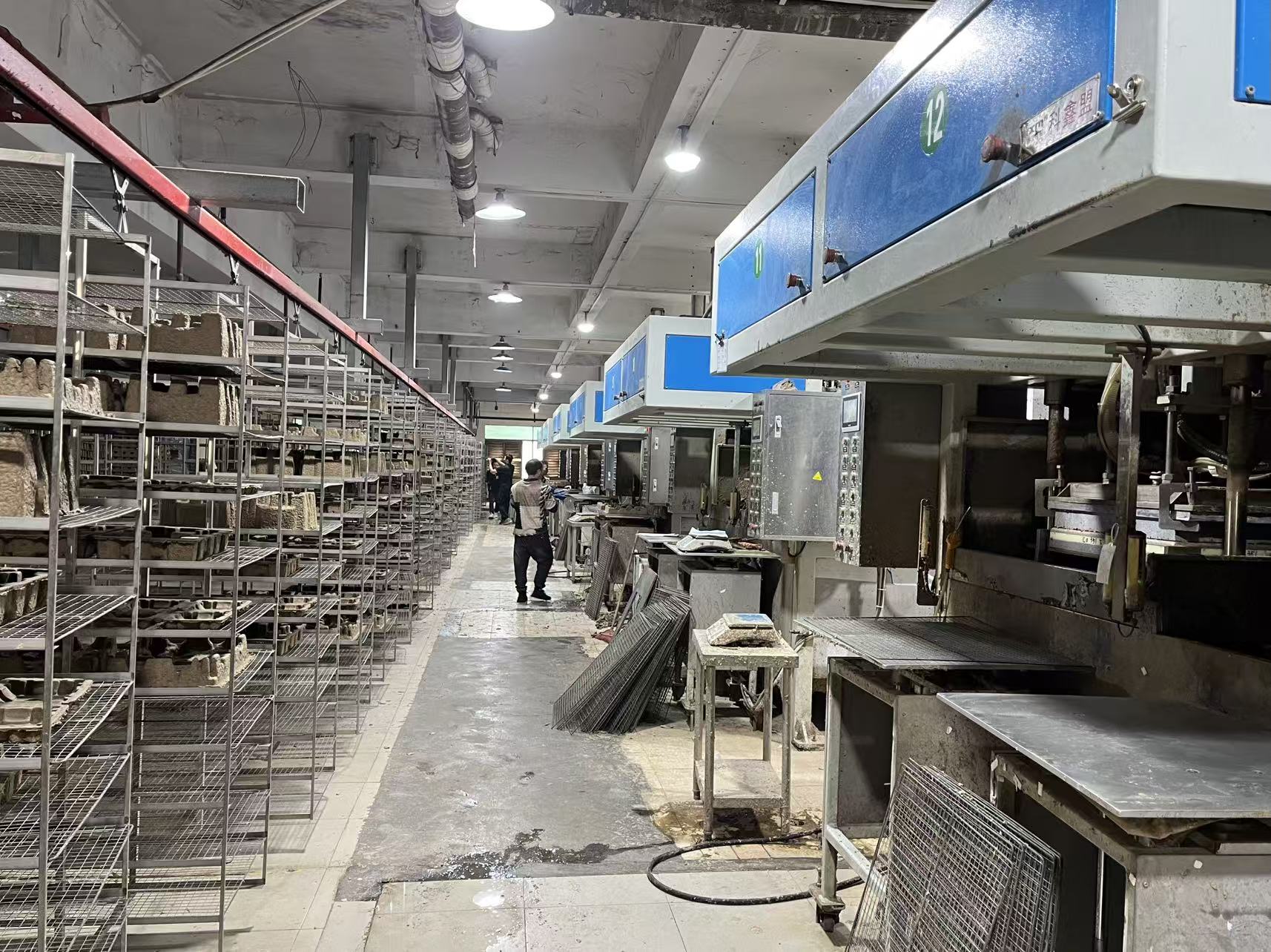
Wet-press molding area: fiber trays are formed before drying, hot pressing and trimming — the stages that determine what a pre-shipment inspection can later verify.
Why Execution Terms Decide Whether a Supplier Becomes a Long-Term Supplier
Supplier selection usually compares tooling capability, protective performance and unit price. The friction that appears later, however, rarely comes from those three items. It comes from a payment instrument the buyer’s treasury team cannot issue, a freight assumption built on the wrong Incoterm, or an acceptance clause that refers to a drawing nobody updated.
For repeat orders, these details compound. A first order tolerates clarification emails; a quarterly replenishment schedule does not. When payment, shipping and acceptance are agreed in writing before the first production run, the second order typically moves with fewer approval steps, and the buyer gains the supply continuity that motivates long-term molded pulp contracts in the first place.
The Three Execution Gates at a Glance
| Execution gate | Documented options | What the buyer must supply |
|---|---|---|
| Payment | T/T, Alibaba Trade Assurance, L/C | Confirmed quantity against the 1,000 pcs MOQ; issuing bank or platform details |
| Shipping | Sea, air, express (DHL / FedEx / UPS); FOB, CIF, CFR, EXW | Destination port or delivery address for freight calculation |
| Acceptance | PSI (pre-shipment inspection) | Approved drawing or specification, plus inspection timing before booking |
Payment: Which Instruments Are Documented for Molded Pulp Orders
Three payment routes are documented for molded pulp orders: T/T (telegraphic transfer), Alibaba Trade Assurance, and L/C (letter of credit). They are not interchangeable in practice, and the choice usually follows the buyer’s own finance and compliance rules rather than the supplier’s preference.
A straight T/T suits buyers with an established relationship or a first order small enough to clear internal approval quickly. Trade Assurance suits buyers who prefer to place and settle the order through the Alibaba platform, where the transaction record sits inside the platform workflow. L/C suits buyers whose treasury function requires a documentary credit, typically where the purchase must be backed by bank documents rather than a direct transfer.
Each instrument carries its own administrative cost. Documentary credits depend on exact document wording, so the commercial invoice, packing list and transport document must match the credit terms; any mismatch becomes a discrepancy to resolve before payment is released. Buyers who expect to place frequent replenishment orders should therefore agree the payment route once, at the start of the relationship, instead of renegotiating it per shipment.
Shipping: Methods, Delivery Terms and How Freight Is Calculated
Molded pulp shipments move by sea, air, or express courier (DHL / FedEx / UPS). Quoted delivery terms are FOB, CIF, CFR and EXW. The freight figure itself is calculated against the buyer’s destination port or delivery address, which means a quotation cannot be finalised until that information is provided.
The delivery term changes who controls the movement and who carries the risk at each stage. Under EXW the buyer arranges collection and export movement; under FOB the supplier delivers to the named port of shipment; under CFR and CIF the supplier arranges main carriage, with CIF additionally covering insurance. For a buyer comparing quotations, the same molded pulp tray can therefore appear at three different price levels simply because three different Incoterms were quoted.
Fiber packaging has one shipping characteristic that matters commercially: it is light but volumetric. Molded pulp trays are nested for transport, and nested stacking is documented as saving roughly 40–60% of space compared with non-nested packing. The product is also described as approximately 50% lighter than traditional hard gift boxes. Together these reduce the billable volume and weight that drive freight cost, although they do not eliminate the need to plan container or pallet utilisation for large tray formats.
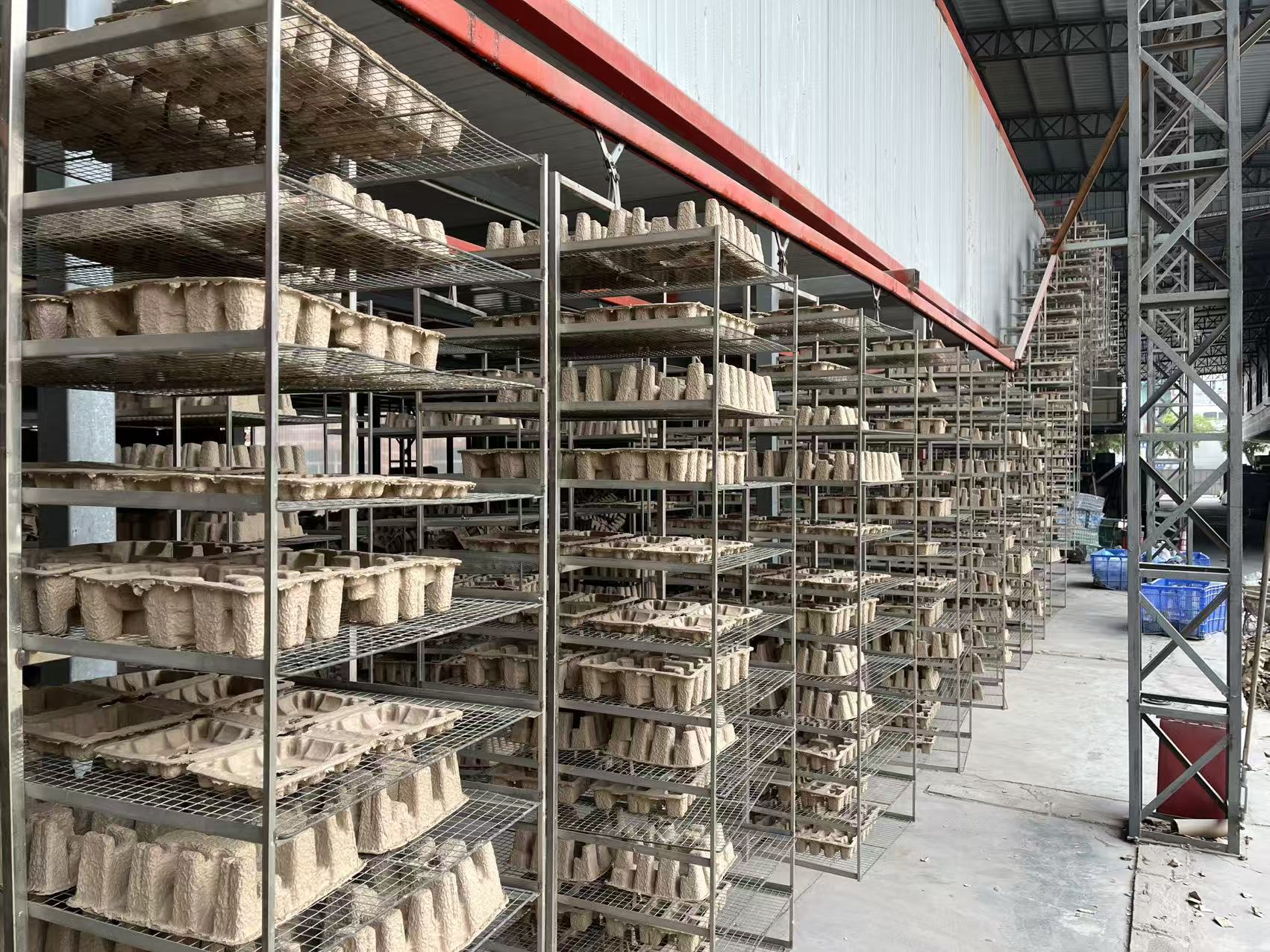
Drying cage and air-drying area: residual moisture is managed before trays are packed, which is the stage that most affects how a sea-freight shipment arrives.
Acceptance: What a PSI Gate Does and Does Not Cover
The documented acceptance criterion for molded pulp orders is PSI — pre-shipment inspection. Functionally, PSI is the gate that sits between finished production and the booking of freight: goods are checked against an agreed reference before they are released for shipment, and the result determines whether the consignment proceeds on schedule.
What PSI can verify depends entirely on the reference it is measured against. If the buyer has supplied a drawing, a dimensional requirement, a colour or surface standard, and a packing configuration, the inspection has something concrete to compare. If the reference is a photograph and a verbal description, the inspection can confirm appearance and general workmanship but cannot resolve tolerance disputes later.
This is the practical link between acceptance and the earlier two gates. Because freight is booked around the inspection date, a failed PSI delays the sailing or flight rather than only the payment. Buyers running tight replenishment schedules should therefore build inspection timing into the order calendar at the moment the purchase order is issued, not after production is reported complete.
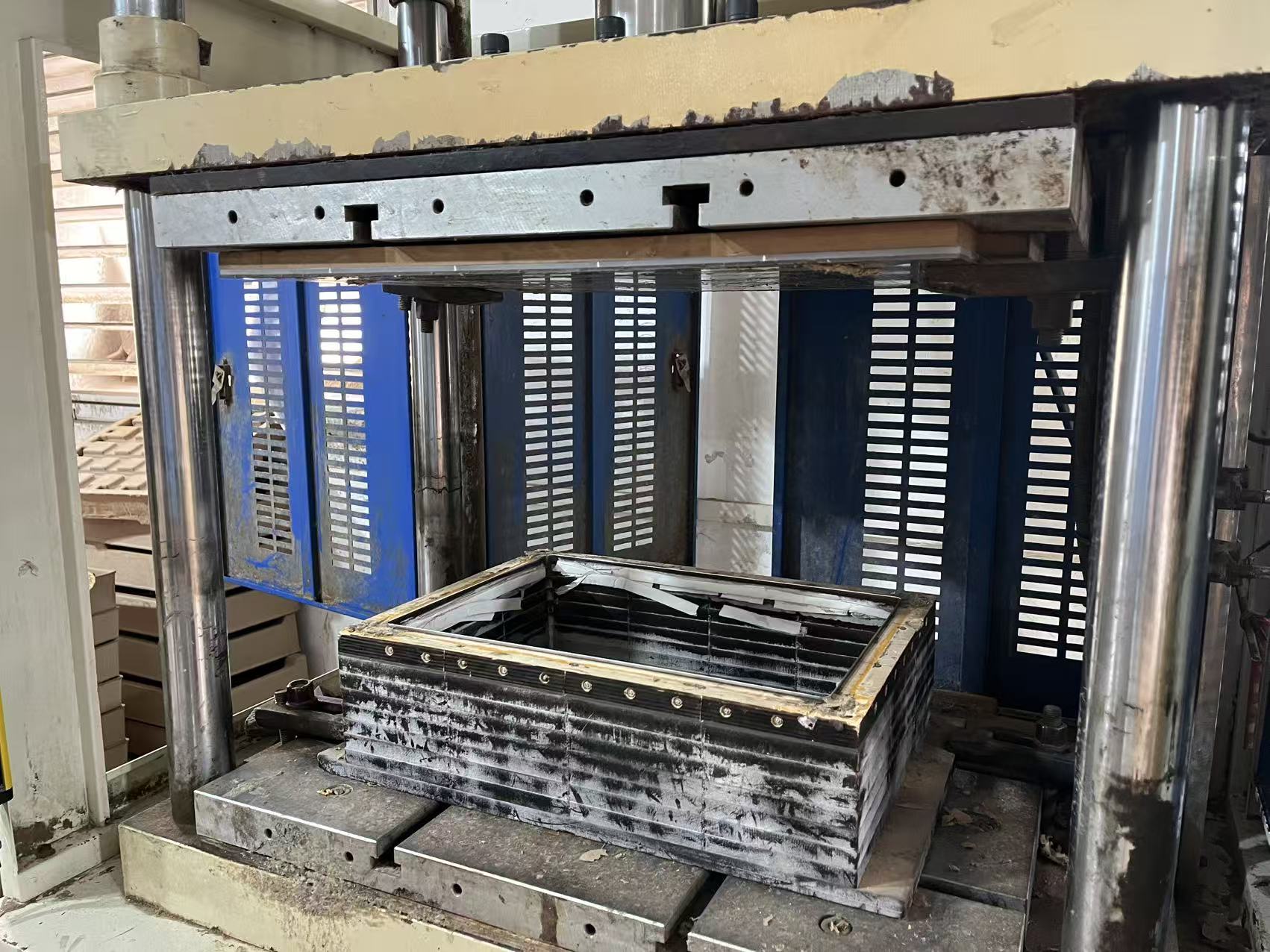
Trimming stage: edge finish and dimensional consistency are among the characteristics a pre-shipment inspection compares against the approved drawing.
How Tonghe Paper Co., LTD Supports Order Execution
Tonghe Paper Co., LTD operates a 23,000 m² facility with 160 employees and an annual output of 12,000 tons, supported by multiple automated production bases and a monthly capacity of up to 1,000 tons. The company was founded in 2023 and maintains an in-house mold development team of 12 engineers. Roughly 50% of output is exported, with main markets listed as the EU, USA, Australia, Saudi Arabia, Malaysia and Brazil.
For execution-stage buyers, the relevant point is not the capacity figure itself but what it implies for repeat ordering. In-house mold development means a tool can be maintained and re-run for subsequent batches without re-engineering the geometry each time, which is the precondition for consistent acceptance results across orders. A monthly capacity ceiling in the 1,000-ton range also allows a buyer to plan replenishment volumes against a known production envelope rather than against an open-ended promise.
Material compliance is documented as SGS RoHS and PFAS-free, and the fiber material is described as achieving complete biodegradation in a natural composting environment within 28 days. Publicly listed company certifications include ISO 9001, ISO 14001 and FSC. For buyers whose acceptance gate includes a documentation check as well as a physical inspection, these are the records to match against the destination market’s requirements.
Where These Terms Apply: Industries, Products and Export Markets
The order terms described here apply across the product range, which spans Molded Fiber, Molded Pulp Trays, Custom Molded Pulp Trays, Pulp Packaging Trays, Protective Molded Pulp Packaging, Eco-Friendly Molded Fiber Trays, Biodegradable Pulp Trays, Sustainable Molded Fiber Packaging, Medical Device Pulp Trays, Cosmetic Packaging Pulp Trays, Heavy Duty Molded Pulp Trays, Food Grade Molded Pulp Trays, Disposable Food Pulp Trays, Shockproof Pulp Trays, Custom Protective Pulp Packaging, Fresh Produce Pulp Trays, Molded Pulp Electronics Trays, OEM Molded Pulp Tray and Egg Pulp Trays.
In practice, the sector shapes which of the three gates needs the most attention. Electronics and lighting buyers tend to focus on shock protection and PSI consistency, because a tray that fits a device on one batch must fit it on the next. Food and fresh produce buyers concentrate on material documentation and on whether the delivery schedule survives cold-chain and port handling. Medical device buyers add documentation review to acceptance. Cosmetic and gift packaging buyers weigh surface finish and presentation, which are the characteristics most sensitive to a clearly written inspection reference.
The export markets listed for the company — the EU, USA, Australia, Saudi Arabia, Malaysia and Brazil — also imply different freight structures. Sea freight dominates long-haul routes to Europe and the Americas, air and express handle urgent or sample consignments, and the delivery term determines whether the buyer or the supplier holds the main carriage contract.
Market Context: Why Fiber Order Discipline Is Being Tested Now
The molded pulp category is expanding, and expanding categories tend to expose contract weak points. Grand View Research values the global molded pulp packaging market at USD 6.2 billion in 2025, projected to reach USD 10.2 billion by 2033. The same source reports that Asia Pacific held a 41.0% revenue share in 2025, with China holding the largest market share, and that the tray segment accounted for over 41.0% of global revenue share in the same year. Healthcare and medical device molded pulp is separately projected by Mordor Intelligence to grow at an 8.6% CAGR, driven by sterilization standards and hospital plastic bans.
Regulation is the stronger force behind execution discipline. The European Packaging and Packaging Waste Regulation (EU) 2025/40 entered into force on 11 February 2025 and requires all packaging to be recyclable by 1 January 2030. Buyers selling into the EU are therefore not only changing material, they are changing the documentation and acceptance evidence they keep on file — which is precisely the paperwork generated by the payment, shipping and inspection gates described above.
Comparison with Traditional Packaging — and the Boundaries of These Terms
Against conventional plastic packaging, molded pulp is documented as environmentally compliant for cross-border export into the EU, UK and North America, avoiding plastic-tax and packaging-regulation exposure; as offering strong shock absorption and impact resistance in transit; as using renewable raw materials with simple waste disposal; and as degradable, recyclable and compostable. The documented trade-offs are equally specific: nested stacking saves 40–60% of space and cushioning performance is described as 25–35% better than ordinary plastic packaging, but unit cost is slightly higher than ordinary plastic, offset for EU-bound shipments by lower compliance cost because no plastic-tax surcharge applies.
The order terms carry boundaries of their own, and buyers should plan around them rather than assume flexibility. First, the documented payment instruments are T/T, Alibaba Trade Assurance and L/C; open-account or deferred payment arrangements are not listed, so a buyer whose internal policy requires extended credit should resolve that point before committing to a replenishment schedule. Second, the documented minimum order quantity is 1,000 pcs, which makes molded pulp less suitable for very small or one-off runs. Third, fiber packaging is volumetric even when nested, so freight savings come from nesting and light weight rather than from flat-packing. Fourth, PSI is a gate, not a warranty of dimensional perfection — its value depends on the quality of the specification it references.
Future Outlook
As the recyclability deadline under (EU) 2025/40 approaches, procurement teams are likely to treat order documentation as part of the packaging specification rather than as an afterthought. The practical consequence is that acceptance criteria will increasingly bundle physical inspection with documentary evidence — material declarations, certification records and inspection reports that can be produced years after a shipment.
The second shift concerns supply continuity. In a category projected to grow toward USD 10.2 billion by 2033, with trays already representing more than 41.0% of revenue, buyers who lock in mold ownership, agreed payment instruments and a stable inspection standard early will find it easier to scale volumes without renegotiating terms each cycle. The order structure, in other words, becomes part of the sourcing advantage.
FAQ
What payment terms are accepted for molded pulp orders?
Documented payment options are T/T, Alibaba Trade Assurance and L/C. T/T and Trade Assurance are the routes most often used for platform-based or direct transactions, while L/C is documented in the purchasing terms for buyers who require a documentary credit.
Which shipping methods are available, and what is needed to calculate freight?
Shipments can move by sea, by air, or by express courier through DHL, FedEx or UPS. A freight figure is calculated once the buyer provides the destination port or delivery address.
What delivery terms are quoted on molded pulp orders?
The documented delivery terms are FOB, CIF, CFR and EXW. Because each term assigns carriage and risk differently, quotations should be compared only when they use the same delivery term.
What is the minimum order quantity?
The documented MOQ for molded pulp orders is 1,000 pcs. Quantities below that threshold fall outside the standard purchasing terms.
What acceptance criteria apply before shipment?
The documented acceptance criterion is PSI, or pre-shipment inspection. Goods are inspected against an agreed reference before release for shipment; the precision of that inspection depends on how detailed the buyer’s drawing, dimensional requirement and packing specification are.
How does molded pulp packaging affect freight cost compared with rigid packaging?
Nested stacking of molded pulp trays is documented as saving 40–60% of space, and the product is approximately 50% lighter than traditional hard gift boxes. Those two factors reduce billable volume and weight, although fiber trays remain volumetric rather than flat-packing.
Which compliance points matter for export acceptance?
Products are documented as compliant with SGS RoHS and PFAS-free requirements, and the fiber material is described as fully biodegradable within 28 days in a natural composting environment. Publicly listed company certifications include ISO 9001, ISO 14001 and FSC. For EU-bound shipments, the recyclability requirement under (EU) 2025/40 applies from 1 January 2030.
How does production capacity support repeat ordering?
Tonghe Paper Co., LTD reports a monthly capacity of up to 1,000 tons and annual output of 12,000 tons, produced across multiple automated production bases with in-house mold development handled by 12 engineers. That structure allows a buyer to plan replenishment volumes against a defined production envelope and to re-run an existing mold for subsequent batches.
Source notes: market size, regional share and segment share figures from Grand View Research (molded pulp packaging market, 2026–2033). Healthcare segment CAGR from Mordor Intelligence. Regulation reference from European Commission / Baker McKenzie. Company facts from Tonghe Paper Co., LTD documentation.
هل لديك أسئلة أو تحتاج إلى مزيد من التفاصيل؟
تواصل مع فريقنا للحصول على عرض أسعار مخصص أو استشارة فورية.
طلب عرض أسعار
املأ النموذج أدناه وسيتواصل معك فريقنا بعرض مقترح مخصص.
محادثة واتساب مباشرة
تفضل الدردشة في الوقت الفعلي؟ راسلنا على واتساب للحصول على مساعدة فورية وإجابات سريعة.
- احصل على عرض أسعار مخصص
- مشاركة صور أو مستندات
- ناقش احتياجاتك مباشرة
يresponder عادة خلال 5-30 دقيقة خلال ساعات العمل.