
Molded Pulp Tray Sourcing: What OEM Buyers Should Verify Before Ordering
Molded pulp trays are no longer a niche alternative in packaging procurement. They are now a core packaging segment, a compliance lever for recyclability regulations, and a customization platform for OEM products. This article focuses on what buyers should verify when selecting a molded pulp tray supplier, using Dongguan Tonghe Paper Industry Co., Ltd. as a reference case for OEM capability, technical evidence, and procurement execution.
Independent market data supports the shift. Grand View Research values the global molded pulp packaging market at USD 6.2 billion in 2025 and projects it to reach USD 10.2 billion by 2033. In the same report, tray products accounted for more than 41% of global molded pulp packaging revenue in 2025, making trays the largest product segment. Asia Pacific led the regional market with a 41.0% revenue share in 2025.
Regulation is adding momentum. The EU Packaging and Packaging Waste Regulation (EU) 2025/40 entered into force on February 11, 2025, and requires all packaging to be recyclable by January 1, 2030. For OEM buyers in electronics, medical devices, cosmetics, food, and consumer goods, the practical question is no longer whether to use molded pulp trays, but how to identify a supplier that can turn a drawing into a reliable, certifiable, cost-effective part.
Why Supplier Verification Matters
OEM buyers comparing molded pulp tray suppliers often see similar product photos, similar environmental claims, and similar offers of custom design. Yet supplier capability differs in five practical areas: raw material consistency, product weight, protective performance, design adaptability, and cross-industry versatility.
According to Tonghe Paper's market observation, many competing products in the molded pulp packaging industry suffer from mixed raw materials, high self-weight, weak protection, monotonous designs, and limited adaptability across industries. For an OEM buyer, these differences translate into real risks: damaged goods in transit, higher freight cost from overweight packaging, compliance documents that do not match the actual product, and packaging that weakens the final brand presentation.
What an OEM-Ready Tray Supplier Should Be Able to Show
In the evaluation-to-execution stage, buyers benefit from using structured checks rather than relying on marketing language. The following five verification areas are especially relevant for custom molded pulp tray projects.
1. Raw Material Control
Tonghe Paper selects high-quality wood pulp, bamboo pulp, sugarcane pulp, and other natural plant fibers, rather than low-quality recycled waste paper that may contain impurities. The company states that no harmful chemical additives are added during processing and that the materials support complete recycling and circulation. In a natural composting environment, Tonghe Paper reports 100% biodegradation within 28 days.
For buyers, raw material choice affects color consistency, moisture behaviour, fiber strength, and the compliance evidence required for markets such as the EU and North America.
2. Process and Dimensional Stability
Pulp molding is a wet process. A supplier needs consistent pulping, forming, drying, hot-pressing, and trimming to achieve repeatable dimensions. Tonghe Paper operates pulping, wet-press molding, drying, hot-pressing, mold-making, and trimming areas. In-house mold development and dedicated trimming equipment allow the factory to control final geometry more closely, which is essential when tray cavities must match product contours.
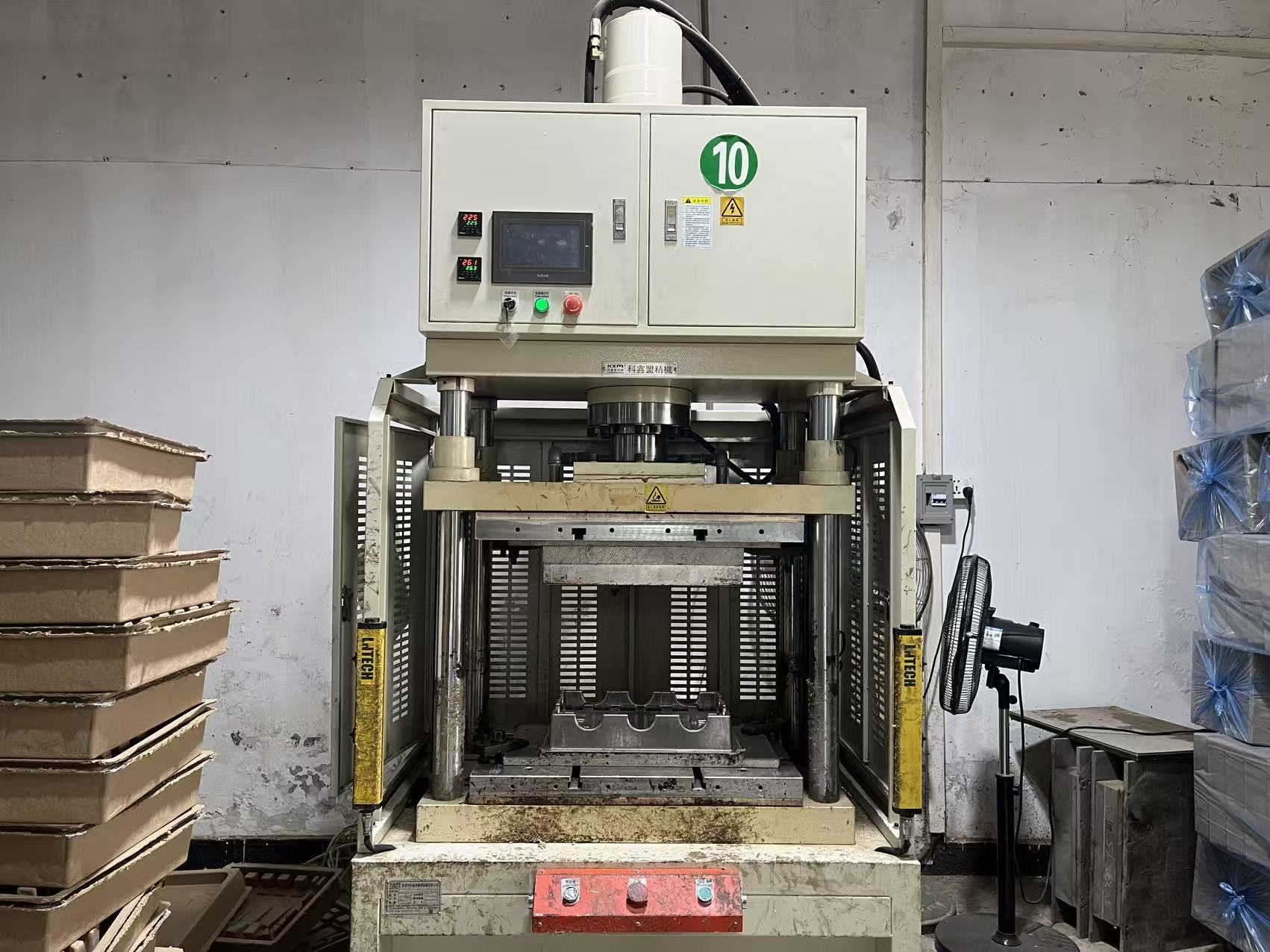
Hot-pressing determines dry-press density, surface finish, and dimensional accuracy of molded pulp trays.
3. Certification Traceability
Buyers should request certificates with numbers, standards, scope, and validity dates. Tonghe Paper's compliance documents include ISO 9001:2015 quality management certification, FSC chain-of-custody certification, SGS RoHS test reports, a RoHS test report, and an MSDS. The table below lists the verifiable documents.
| Document | Certificate / Report No. | Standard / Scope | Valid / Issued |
|---|---|---|---|
| ISO 9001:2015 | 04524Q32380R0S | GB/T 19001-2016 / ISO 9001:2015, Paper holders | 2024-11-26 to 2027-11-25 |
| FSC-COC | RINA-COC-003845 | FSC 100%, FSC Mix, FSC Recycled; pulp tray | 2024-06-07 to 2029-06-06 |
| SGS Test Report | SZXPC26000164601 | RoHS by IEC 62321 series; paper tray | Issued 2026-01-16 |
| RoHS Test Report | DSP25050447-1 | RoHS by IEC 62321 series; paper tray | Issued 2025-05-14 |
| MSDS | DSP25050758-1 | ISO 11014:2009; paper tray | Issued 2025-05-24 |
4. Customization Depth
OEM and ODM production are core capabilities at Tonghe Paper. Customization covers material, color, logo, anti-static function, and moisture-proof function. The company also mentions special coating, embossing, and printing services for brand-oriented packaging. Unlike suppliers that only produce conventional regular shapes, Tonghe Paper states that it can develop multi-specification, complex, irregular integrated structures, which is particularly relevant for premium gift boxes and technical products that cannot fit standard rectangular trays.
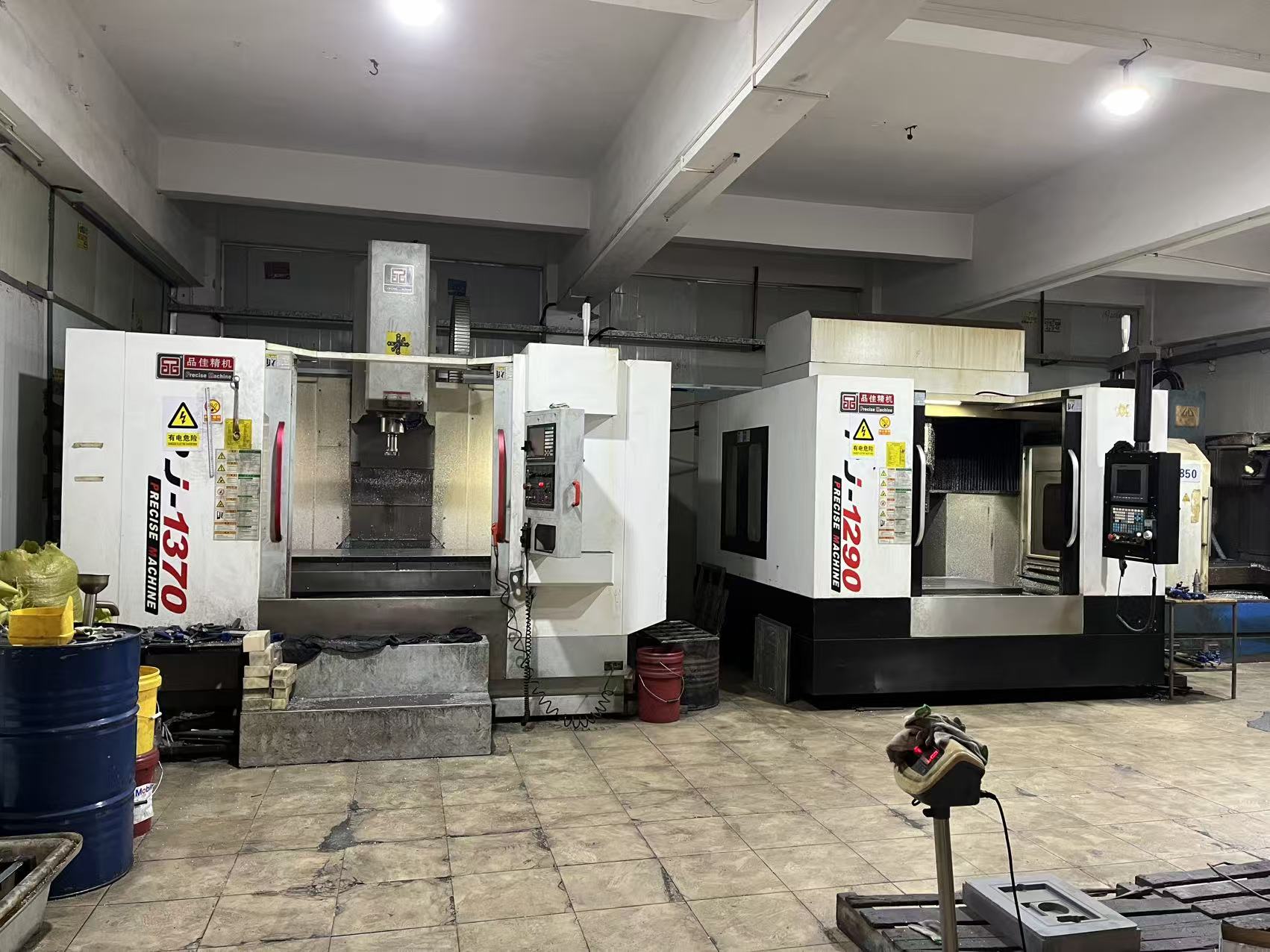
In-house mold development supports OEM molded pulp tray programs with product-specific cavity design.
5. Execution Reliability
Evaluation-stage buyers should also verify capacity, lead time, quality control, and shipping terms. Tonghe Paper reports a monthly capacity of up to 1,000 tons, an annual output capacity of 12,000 tons, and a factory area of 23,000 square meters. The workforce includes 160 employees, with 12 engineers in the R&D team. Production MOQ is 1,000 pieces; lead time is 15 to 30 days. Quality control follows IQC/IPQC/FQC stages. The company exports to the EU, the United States, Australia, Saudi Arabia, Malaysia, and Brazil, with an export ratio of about 50%.
Technical Parameters Every Molded Pulp Tray Buyer Should Compare
Tonghe Paper lists the following technical parameters for molded pulp tray products. These parameters give buyers a common language for comparing supplier quotes.
| Parameter | Typical Range | Why It Matters |
|---|---|---|
| Wet-press density | 0.15–0.25 g/cm³ | Indicates softness and absorption before hot-pressing; affects mold release and early strength. |
| Dry-press density | 0.28–0.45 g/cm³ | Higher density generally means a firmer, more rigid tray with better surface finish. |
| Thickness | 0.8–5.0 mm, customizable | Thicker walls provide more cushioning depth; thickness must match the product cavity. |
| Moisture content | ≤8–12% | Lower moisture improves dimensional stability and reduces mould risk during transit. |
| Edge crush strength | 3–8 kN/m | Relates to stacking strength and resistance to vertical compression. |
| Compressive strength | 2–8 MPa | Indicates how much load the tray can bear before permanent deformation. |
| Temperature range | -20°C to +80°C; food grade -20°C to 120°C | Defines the safe operating envelope for cold-chain, food-contact, and industrial use. |
A complete tray specification should include at least these seven items. Buyers who compare only price or simple thickness may miss the differences in density, moisture control, and edge crush strength that determine real-world protection.
Application and Use-Case Signals
Tonghe Paper's molded pulp trays are used across 3C electronics, electrical appliances, food, beverages and fresh produce, auto parts, hardware and sanitary ware, beauty and daily chemical gift boxes, medical devices, toys, and handicrafts. The company's product line includes food-grade molded pulp trays, medical device pulp trays, cosmetic packaging pulp trays, heavy-duty options, and custom protective pulp packaging.
One documented case involves restaurants and supermarkets in Australia, Canada, Germany, Denmark, France, the United Kingdom, the Netherlands, New Zealand, Qatar, Saudi Arabia, Sweden, the United States, and Malaysia. The order covered 2,000 units of disposable molded pulp packaging for transport and turnover. The stated purpose was to package well for transportation and turnover; the result was shockproof and shatterproof packaging, with environmental protection as the highlighted benefit.
Typical working conditions for molded pulp tray projects include inner product protective packaging, shock-absorbing cushioning, and static storage. Buyers usually specify recyclable, biodegradable, and food-contact-safe requirements, especially in the EU and North American markets. The storage environment should be well-ventilated and dry, with long-term direct sunlight avoided.
Market Trend Signals
Four market signals are directly relevant to OEM tray buyers. First, the global molded pulp packaging market is projected to grow from USD 6.2 billion in 2025 to USD 10.2 billion by 2033, according to Grand View Research. Second, trays are already the largest product segment, with over 41% of global revenue in 2025. Third, Asia Pacific held the largest regional share at 41.0% in 2025, which means Chinese suppliers will remain central to global sourcing decisions. Fourth, molded pulp for healthcare and medical devices is projected to grow at an 8.6% CAGR, according to Mordor Intelligence, driven by ISO sterilization standards and plastic bans in hospitals.
These trends point to rising demand for certified, traceable, and application-specific trays rather than generic stock packaging.
Comparison with Traditional Packaging: Benefits and Honest Boundaries
Compared with disposable plastic and foam packaging, molded pulp trays offer a renewable fiber structure that can be recycled and biodegraded. Tonghe Paper states that its trays are fully biodegradable within 28 days in a natural composting environment. The material structure is made of natural fibers interwoven into a dense protective layer, with properties such as corrosion resistance, moisture resistance, and anti-static performance, providing shock absorption and vibration damping.
Compared with traditional rigid gift boxes, Tonghe Paper reports that its pulp-molded packaging is approximately 50% lighter. Lighter packaging can reduce long-distance transport volume and storage space, which matters for logistics-heavy industries such as e-commerce and export distribution.
Molded pulp trays also allow more complex shapes than conventional regular-style packaging. Because the mold can fit the contour of the product, buyers can achieve a high-end, three-dimensional appearance that is difficult to reproduce with standard paper boxes or foam cutouts.
There are, however, real boundaries. The standard temperature range for Tonghe Paper's molded pulp trays is -20°C to +80°C, while food-grade versions allow -20°C to 120°C. These trays are not designed for high-heat cooking or repeated autoclave conditions unless specifically engineered. In prolonged high-humidity environments, additional coating or an inner liner may be needed to maintain barrier performance, and such treatments can affect recyclability and cost. Finally, although dense fiber structures provide cushioning, final drop and vibration performance should always be validated with physical testing on the actual product and packaging combination.
Future Outlook
The direction of the molded pulp tray market is toward documented, verifiable supplier capability. The EU requirement that all packaging be recyclable by January 1, 2030 gives natural-fiber packaging a structural advantage, provided suppliers can prove material content and finishing options remain recyclable.
Healthcare is a particularly active segment. With medical device pulp trays growing at a projected 8.6% CAGR, buyers will likely ask for stricter documentation, cleaner material grades, and more consistent manufacturing processes. At the same time, branding pressure in cosmetics, electronics, and premium food packaging will increase demand for custom colors, embossing, printing, and surface finish options.
Suppliers with in-house mold development, stable raw material sourcing, and verifiable quality control are better positioned to serve OEM programs that require both product protection and brand presentation.
FAQ
Q: What certifications should a molded pulp tray supplier provide?
Buyers should ask for management system, chain-of-custody, and restricted-substance test documents. For Tonghe Paper, verifiable documents include ISO 9001:2015 quality management certification (certificate no. 04524Q32380R0S, valid to 2027-11-25), FSC chain-of-custody certification (no. RINA-COC-003845, valid to 2029-06-06), an SGS RoHS test report (no. SZXPC26000164601, issued 2026-01-16), a RoHS test report (no. DSP25050447-1, issued 2025-05-14), and an MSDS (no. DSP25050758-1, issued 2025-05-24).
Q: What are the MOQ and lead time for custom molded pulp trays?
Tonghe Paper sets a production MOQ of 1,000 pieces. Lead time is 15–30 days, depending on tooling complexity and order volume. Monthly capacity is up to 1,000 tons. Acceptance is performed according to PSI, and delivery can be arranged under FOB, CIF, CFR, or EXW terms. Payment can be made by L/C.
Q: What payment terms and shipping methods are accepted?
Tonghe Paper accepts T/T and Alibaba Trade Assurance. Shipping can be arranged by sea, air, or express (DHL/FedEx/UPS). The buyer should provide the destination port or address so freight cost can be calculated.
A more detailed company profile, including production base, process capabilities, and compliance documentation, is available here: Download the Tonghe Paper company brochure (PDF).
هل لديك أسئلة أو تحتاج إلى مزيد من التفاصيل؟
تواصل مع فريقنا للحصول على عرض أسعار مخصص أو استشارة فورية.
طلب عرض أسعار
املأ النموذج أدناه وسيتواصل معك فريقنا بعرض مقترح مخصص.
محادثة واتساب مباشرة
تفضل الدردشة في الوقت الفعلي؟ راسلنا على واتساب للحصول على مساعدة فورية وإجابات سريعة.
- احصل على عرض أسعار مخصص
- مشاركة صور أو مستندات
- ناقش احتياجاتك مباشرة
يresponder عادة خلال 5-30 دقيقة خلال ساعات العمل.