
Molded Pulp for Export Packaging: Fit Signals and Acceptance Gates
Molded Pulp for Export Packaging: Fit Signals and Acceptance Gates
Export packaging is the point at which molded pulp stops being a material sample and becomes a specification. A tray fits an export programme when four things are settled before tooling is released: the product geometry and weight the cavity must carry, the climate and handling the shipment will actually see, the documentation the destination market expects, and the commercial terms — purchasing terms, acceptance criteria, payment terms and shipping method — that both sides can put in writing. Leave any one of them open and the design is still a prototype, however good the sample looks.
Dongguan Tonghe Paper Industry Co., Ltd. is a molded pulp manufacturer based in Dongguan, China, converting recycled paper and bagasse fibre into molded fibre trays. The company reports a 23,000 m² production site, 160 employees, in-house mould development and a monthly capacity of up to 1,000 tons, and it exports to the EU, the United States, Australia, Saudi Arabia, Malaysia and Brazil. Its catalogue spans food grade, medical device, cosmetic, electronic and general protective trays.
What follows treats export packaging as a scenario to be qualified rather than a product to be bought. It covers the fit tests worth running during research and evaluation, the purchasing terms that should be locked at the sample stage, and the acceptance wording that still makes sense when the container arrives.
Why export packaging tests molded pulp differently
A domestic shipment typically passes through two or three handling nodes. An export shipment passes through more: factory, inland haul, port, vessel, destination port, customs yard, regional warehouse and final delivery. For a moulded fibre tray, that extra distance has three practical consequences.
The first is accumulated load. Cartons stand in stacks for weeks rather than days, so the compression a tray sees at the bottom of a pallet matters more than the weight of the item it holds. The second is humidity exposure. A container crossing climate zones is not a controlled store, and moulded fibre is a hygroscopic material. The third is distance from the decision. The buyer who approved the sample is usually not the person who opens the carton, so acceptance has to be documented rather than remembered.
Tonghe's published working condition for its pulp packaging is that the area be kept well-ventilated and dry, avoiding prolonged exposure to direct sunlight. Read as a storage instruction that is unremarkable. Read as an export criterion it becomes a design question: if the destination warehouse or the container itself cannot hold that condition, the tray's moisture content and compression behaviour need to be assessed against the real route rather than the ideal one.
A second export-specific factor is cube. Trays are moulded to a product's contour, so cavity depth and stacking behaviour decide how many units fit a master carton, and carton count decides freight cost per unit. Tonghe notes that some styles can be stacked to save storage space. That property changes the freight arithmetic, so it should be confirmed per SKU with carton dimensions rather than assumed from one approved design.
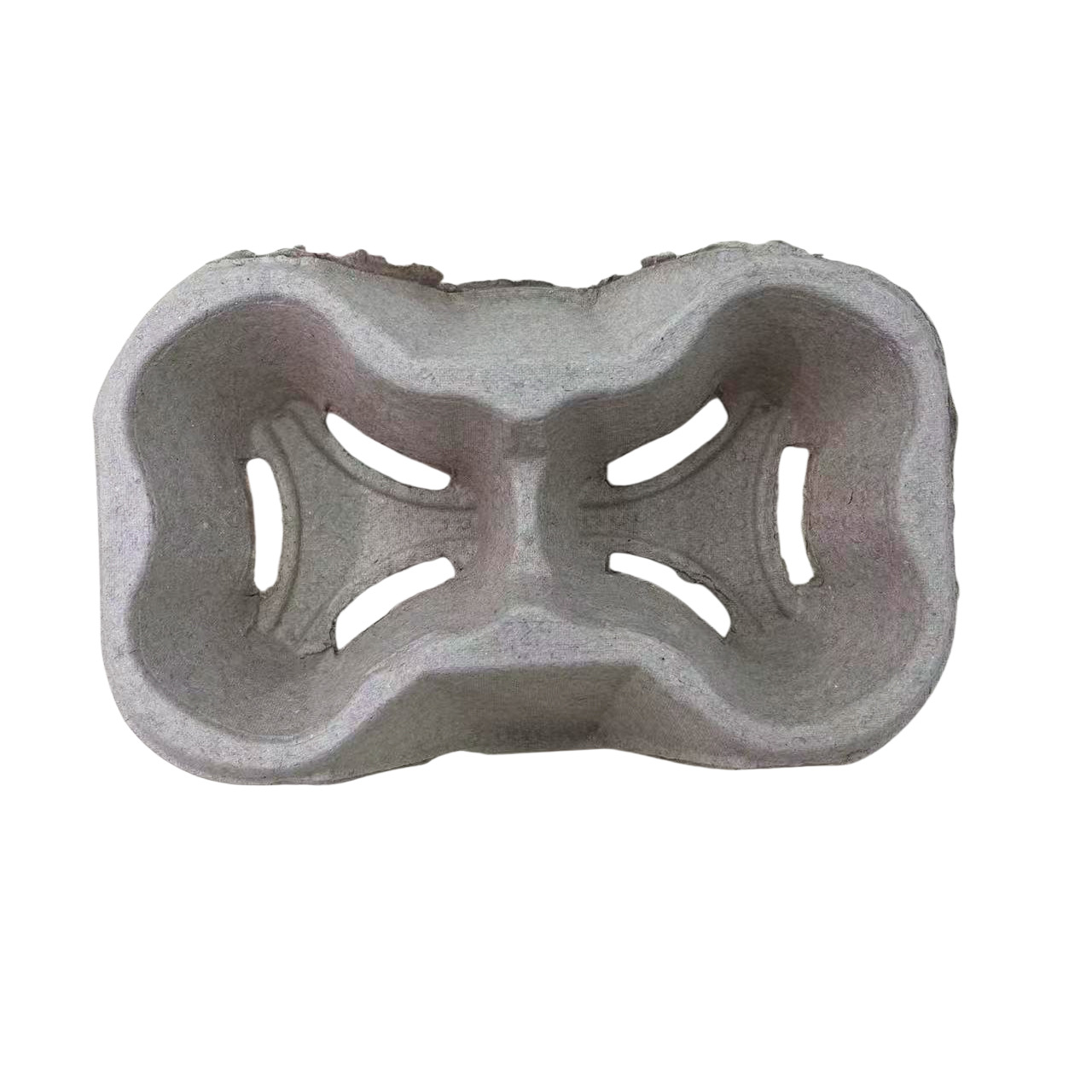
Custom moulded pulp trays: the cavity drawing, not the material name, defines what an export buyer is actually approving.
The four fit dimensions to settle before tooling
A fit review does not need a long process. It needs four questions answered with evidence, and each has a different owner. Geometry and protection belong to the product engineer. Climate and storage belong to logistics. Compliance and documentation belong to quality and trade compliance. Commercial terms belong to procurement. Where any single dimension is answered only verbally, the project is not ready.
1. Product geometry and protection
The cavity has to hold the item without movement through repeated handling, and it has to release the item without damage at the packing station. Tonghe publishes a thickness range of 0.8–5.0 mm, edge crush strength of 3–8 kN/m and compressive strength of 2–8 MPa for its moulded pulp trays, all customisable. Those figures describe the capability band of the material family; they are not a guarantee for a particular cavity. The numbers that govern an export order are the ones written on the drawing for that design and then verified on the sample.
The handling environment is part of geometry. The application data supplied with these trays cites shock-absorbing cushioning and inner product protection, with packaging assembly lines and automatic wrapping machines as matched equipment. If the destination line is automated, cavity tolerance and tray flatness have to suit that equipment, because a tray that protects perfectly but jams a magazine is not a fit.
2. Climate and storage exposure
Tonghe specifies a moisture content of ≤8–12% for its moulded pulp trays, a normal applicable temperature range of -20 °C to +80 °C, and -20 °C to +120 °C for food grade items. Those ranges cover most ambient export routes, but they do not answer the harder question of what happens when a pallet sits in a humid port yard for three weeks. Buyers should specify a moisture target inside the stated band and decide how it will be checked, because moisture is the parameter most likely to erode compression strength between the factory and the destination.
3. Compliance and documentation
Moulded fibre is marketed on degradability, and Tonghe states that its products comply with international environmental standards including SGS RoHS and PFAS-free requirements. The regulatory direction is also tightening. The European Packaging and Packaging Waste Regulation (EU) 2025/40 entered into force on 11 February 2025 and requires all packaging to be recyclable by 1 January 2030, according to the European Commission as summarised by Baker McKenzie.
The buying implication is narrower than it first appears. A material statement held for one SKU does not automatically cover another SKU made from a different pulp blend, colour or surface treatment. Acceptance criteria should therefore name the SKU each document applies to, and state whether the requirement is a declared material property or a test report.
4. Commercial terms and logistics
The commercial layer is where the other three become an order. Tonghe operates OEM/ODM production with a minimum order quantity of 1,000 pieces and a lead time of 15–30 days, accepts T/T and Alibaba Trade Assurance, and ships by sea, air and express. Customisation covers material, colour, logo, anti-static function and moisture-proof function. Each of these belongs in a purchase order, not in an email thread, because each one can be changed by the wrong person at the wrong moment.
Purchasing terms worth locking before a sample is signed
Purchasing terms do two jobs in an export project: they define what will be made, and they define what will be rejected. The list below is a practical minimum for a moulded pulp tray order. The third column explains why each line earns its place.
| Term | What to write down | Why it matters in export |
|---|---|---|
| Material and colour | Pulp type (sugarcane, bamboo or wood pulp), natural, white, yellow or custom colour, and any water- or oil-resistant treatment | A pulp or finish change is a new approval; colour drift is visible to the end customer |
| Cavity drawing | Dimensional drawing with tolerances for cavity length, width, depth and wall thickness within the 0.8–5.0 mm range | Master carton counts are packed to a plan; dimensional drift breaks the plan |
| Moisture content | Target value and permissible band inside the stated ≤8–12% range, with the check method | Moisture loss or gain is the main route to compression failure in transit |
| Strength targets | Edge crush (3–8 kN/m) and compressive strength (2–8 MPa) as design targets, with the test method and sampling | Pallet height and stacking pattern depend on it, and so does damage cost |
| Quantity and MOQ | Order quantity against the 1,000-piece minimum, repeat-order quantities, and any tiering | Tooling and freight consolidation only make sense at defined volumes |
| Tooling and revisions | Mould ownership, what counts as a revision, and how a revised mould is re-approved | An unreported mould change invalidates the sample the buyer signed |
| Master carton and labels | Carton dimensions, units per carton, label and barcode placement | Drives customs handling, warehouse scanning and chargeable freight weight |
| Lead time and shipping window | Production of 15–30 days plus transit, and the need-by date the pair is planned against | Aligns the shipment with a retail launch or an internal production schedule |
Parameter ranges reflect the manufacturer's published product data; the binding values are those agreed in the purchase order for the specific cavity.
Acceptance criteria that hold up after a border crossing
Acceptance criteria usually fail in export for one reason: they are written as adjectives. "Good finish", "firm fit" and "dry" cannot be inspected by a warehouse team in another country. A working criterion names the attribute, the method, the sample size and the decision rule, and it is short enough to attach to a purchase order.
For a moulded pulp tray, the attributes that repay definition are: dimensions and wall thickness; moisture content; edge crush and compression strength where stacking is significant; appearance, meaning colour uniformity, trim quality and stray fibre; cleanliness, meaning dust and foreign matter; fit, meaning insertion and removal behaviour and the absence of movement under a transit simulation; and documentation scope. Each attribute should be paired with the gate that produces the evidence.
Tonghe's stated quality control runs IQC, IPQC and FQC — incoming, in-process and final inspection. Mapping acceptance attributes onto those three gates is what turns acceptance from an opinion into a record: the incoming gate covers pulp and additive identity, the in-process gate covers forming and dimensional stability, and the final gate covers the finished tray and its carton. A buyer who has not asked which attribute is checked at which gate is relying on the word "inspection" rather than on a control point.
Two supporting items make the criteria enforceable. The first is a signed golden sample, held by both parties, with a reference number that appears on the purchase order. The second is documentation tied to the SKU. For medical device trays, Tonghe states one-piece moulding with precise positioning, low dust and no shedding, virgin wood pulp free of fluorescent agents produced in a clean workshop, and a material inspection report. Where a report forms part of acceptance, the criterion should name which pulp and which batch it covers — otherwise the document exists without governing anything.
Food-contact items follow the same logic. Food grade trays are rated for -20 °C to +120 °C, but the acceptance wording should still bind any food-contact declaration to the specific SKU rather than to the product family. The general rule is worth stating plainly: the manufacturer's published ranges describe what the material can do, and the acceptance criterion describes what this order must do. Those are different documents, and only the second one can justify a rejection.
Payment terms: matching the instrument to the project stage
Tonghe accepts T/T and Alibaba Trade Assurance. That is a short list, and for most export buyers it is sufficient — provided the order states which instrument applies to which stage of the project.
T/T settlement should be written with the currency, the milestone that triggers each transfer and the documents that accompany it, typically a proforma invoice, a packing list and the transport document. Where the buyer and supplier sit in different banking systems, the order should also state which side bears intermediary charges, because that detail is easy to agree verbally and hard to recover afterwards.
Alibaba Trade Assurance keeps the transaction inside a platform-mediated process, which is useful when the first order is modest or when the buyer's finance team needs a platform record rather than a private agreement. In that case the platform's own order and confirmation steps govern release, so the purchase order should reference the platform order number and keep the specification identical in both places.
Repeat orders deserve a rule of their own. Reusing the same instrument and referencing the original order terms avoids a second negotiation over details that were already settled, and it keeps the acceptance basis stable across shipments — which matters more than a small movement in unit price when a production line is scheduled against the trays.
Shipping method: sea, air or express
Tonghe ships by sea, air and express (DHL, FedEx, UPS) and asks for the destination port or address in order to calculate freight cost. That sentence contains the practical rule of export logistics: freight cannot be quoted from the product alone.
| Mode | Where it fits in a molded pulp project | What to prepare |
|---|---|---|
| Sea | Mass production in palletised master cartons; the default for full orders | Destination port, carton count and dimensions, pallet pattern |
| Air | Time-critical top-ups, launch quantities or partial shipments when the calendar cannot absorb ocean transit | Destination airport, chargeable weight, packing list |
| Express (DHL/FedEx/UPS) | Samples, pre-production approvals and small lots that must arrive intact | Street address, contact, customs information |
For moulded fibre, chargeable weight rather than actual weight is usually the deciding number. A stack of trays can be light and still occupy a large volume, so the volumetric weight derived from master carton dimensions may exceed the scale weight. Buyers should calculate chargeable weight before choosing a mode, because the cheapest option for dense goods is not automatically the cheapest option for bulky protective packaging.
There is also a sequencing point that buyers often discover late. Sample shipments by express are the inexpensive way to validate fit and finish, and they should happen before an ocean booking for mass production is confirmed. With a 15–30 day production lead time, the calendar for an ocean shipment is built backwards from the need-by date: production window, inland haul, port cut-off, transit and clearance. A fit check that slips by two weeks usually costs more than the express freight it would have taken to run it earlier.
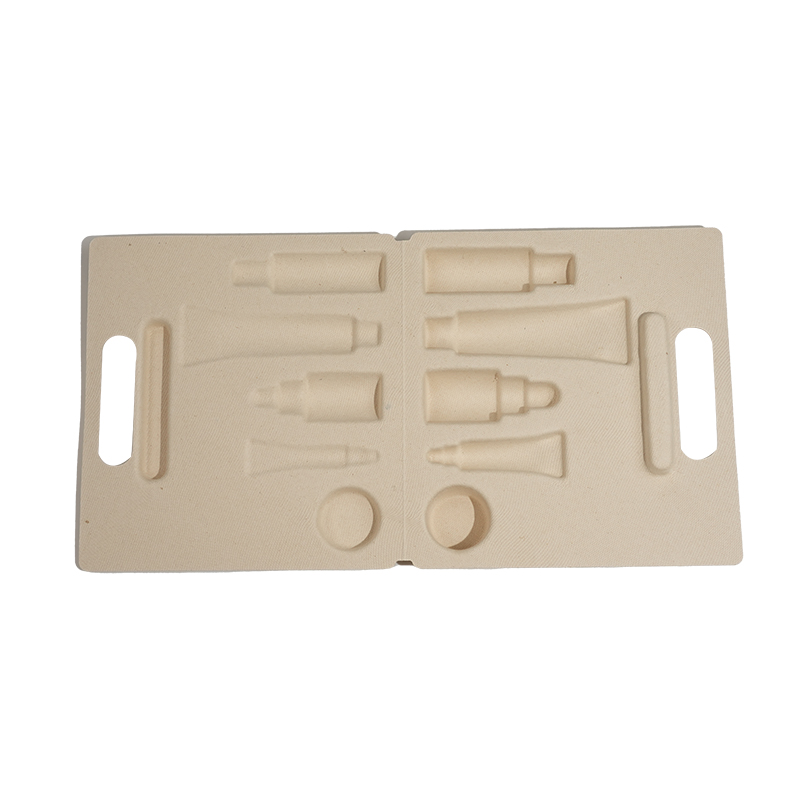
Cosmetic trays show how a fit decision is made in practice: insert geometry and surface finish are agreed before the export carton plan is fixed.
Scenario fits: where molded pulp is a strong export match
Molded pulp is not one product. The fit decision is made per tray family, and the differences between families carry real consequences for an export programme.
Food, catering and fresh produce
Food grade molded pulp trays are rated for -20 °C to +120 °C and are positioned for food packaging where cushioning and temperature tolerance both matter. The application data supplied for these products lists food and catering as a target industry, and a recorded case covers restaurant and supermarket customers ordering 2,000 units for transport and turnover, described as disposable packaging with shockproof and shatterproof results. The boundary condition is the product itself: moisture and grease from the food are not the same as ambient humidity, so buyers should confirm whether a water- and oil-resistant treatment is required rather than assume the standard grade covers it.
Medical devices
Medical device pulp trays are described as supporting EO sterilization, with one-piece moulding for precise positioning, shock and drop resistance, low dust and no shedding, virgin wood pulp free of fluorescent agents produced in a clean workshop, and a material inspection report. Custom cavities can be shaped for probes, handles, catheters and surgical instrument components. The fit boundary here is documentary rather than physical: the supplier's material report supports the packaging decision, while device-level validation and regulatory approval remain the buyer's responsibility.
Cosmetics, gifts and premium retail
Cosmetic packaging pulp trays are specified with custom-fit inserts, anti-scratch cushioning and customisable colour and thickness. Pulp packaging trays more generally can be printed with a logo and embossed, which allows protection and brand display in the same component. The practical caveat is approval time: a printed or embossed tray is a different approval from a plain one, and that extra cycle has to sit inside the export calendar rather than beside it.
Electronics and industrial components
Anti-static behaviour is available as an option through modified pulp, aimed at electronic components and connectors. It is an option, not a default, so it must be named in the purchase order and in the acceptance criteria; a buyer who assumes it is included has no remedy if the shipment arrives without it. The broader electronics fit rests on cavity geometry that replaces EPS foam and vacuum-formed inserts, and on compression strength adequate for the pallet pattern.
General protective and heavy-duty use
Where the requirement is shock-absorbing cushioning for a dense or irregular item, the compressive strength band of 2–8 MPa and the edge crush band of 3–8 kN/m give the design room to work with. The design question is where in those bands the specific tray needs to land, and that answer comes from the stacking height and the item weight, not from the material name.
Where molded pulp is a weaker export fit
A credible fit review includes the cases where the answer is no. Four of them recur.
- Volumes below the minimum order quantity. With a 1,000-piece minimum, a trial order for a short seasonal run may not justify a custom mould, and the economics rarely improve by splitting the order across two suppliers.
- Storage that cannot stay dry and ventilated. The stated working condition — ventilated, dry, away from prolonged direct sunlight — is a genuine constraint. A destination warehouse with a condensation problem is a specification problem, not a handling detail.
- Tight dimensional tolerances without sample proof. Moulded fibre is specified through a thickness range rather than a single value, so a cavity asked to hold a very tight tolerance needs that tolerance stated on the drawing and demonstrated on the sample before anyone commits.
- Liquid containment. Standard grades carry no plastic film coating, which is the basis of their recyclability story but also the limit of their barrier performance. Where the pack must hold liquid or resist grease over a long transit, the buyer should confirm whether the available water- and oil-resistant treatment meets the requirement, and treat the answer as a specification item.
A fit-check sequence before committing to a project
The sequence below converts the four dimensions into an order of work. It is deliberately front-loaded, because every step is cheaper than changing a mould.
- Write the export brief. Item weight and geometry, route and transit days, destination market, packing line type, storage conditions at both ends, and the need-by date.
- Match the brief to a tray family. Food grade, medical device, cosmetic, electronic or general protective, with material, colour and thickness confirmed against the published parameter range.
- Test samples against your own criteria. Cavity fit, insertion and removal, moisture, and a transit simulation that reflects the real handling count rather than a single drop.
- Fix the purchasing terms. Drawing, tolerances, moisture band, strength targets, quantity, carton plan and revision rules.
- Convert the tests into acceptance criteria. Attribute, method, sample size and decision rule, each mapped to an IQC, IPQC or FQC gate, with a signed golden sample.
- Select the payment instrument and its milestones. T/T or Alibaba Trade Assurance, with currency, triggering milestones and accompanying documents written into the order.
- Choose the shipping mode from chargeable weight. Compare sea, air and express against carton dimensions and the need-by date, and confirm the destination port or address so the freight calculation is real.
- Release the mould. Only after steps one to seven are documented, because tooling is the point at which the specification stops being reversible.
Market context behind the export decision
The category backdrop supports the scenario but should be read carefully. Grand View Research values the global molded pulp packaging market at USD 6.2 billion in 2025 and projects USD 10.2 billion by 2033; Smithers is reported at USD 4.5 billion for 2025, and the gap appears to come from product definition rather than from a disagreement about direction. Buyers comparing sources should note which definition each uses before treating either figure as the size of their own addressable segment.
Two structural points are more directly useful. Asia Pacific held a 41.0% revenue share of the molded pulp packaging market in 2025, with China the largest market, and trays were the leading segment at over 41.0% of revenue in the same year. For a buyer, that means the tray format has well-established tooling and specification conventions, while supply concentration in one region makes shipping mode and lead-time planning as commercially important as unit price. Mordor Intelligence separately projects 8.6% CAGR for molded pulp in healthcare and medical devices, driven by sterilization standards and hospital plastic bans — a segment signal, not a promise for any individual supplier.
Outlook: what changes for export buyers
The direction of travel in the European market is toward recyclability as a requirement rather than a preference, with the 2030 deadline set by EU 2025/40. If that deadline holds, the more likely change for buyers is not the material but the paperwork: acceptance criteria will shift from a generic material statement toward SKU-level evidence with a named method and a named test. Suppliers who can produce that evidence on request will be easier to qualify, and buyers who wrote their criteria that way will not need to renegotiate them when the regulation bites.
For the current planning cycle, the practical conclusion is modest and useful. Molded pulp is a credible export packaging scenario when geometry, climate, documentation, payment terms and shipping method are settled together, and a weak one when any of those is left to the sample. The tray is the visible part of the decision; the terms are the part that decides whether it works.
Frequently asked questions
What payment terms and shipping methods does Tonghe accept?
Dongguan Tonghe Paper Industry Co., Ltd. accepts T/T and Alibaba Trade Assurance for payment. Shipments can move by sea, air or express courier (DHL, FedEx, UPS). A destination port or delivery address is required before freight cost can be calculated.
What should acceptance criteria for an export molded pulp order contain?
Each criterion should name the attribute, the test or inspection method, the sample size and the decision rule. For molded pulp trays the usual attributes are dimensions and wall thickness, moisture content, edge crush and compression strength where stacking applies, appearance, cleanliness, cavity fit and documentation scope. Mapping each attribute to an incoming, in-process or final inspection gate, and holding a signed golden sample, makes the criteria enforceable after the shipment leaves the factory.
Can molded pulp trays withstand long sea transit and humid destinations?
It depends on the route and the packing plan. Molded pulp trays are specified with a moisture content of ≤8–12% and a normal temperature range of -20 °C to +80 °C, or -20 °C to +120 °C for food grade items, and they are intended to be stored in a well-ventilated, dry area away from prolonged direct sunlight. For humid or condensation-prone routes, buyers should set a moisture target inside the stated band, confirm the pallet and master carton arrangement, and check whether a moisture-proof or water-resistant treatment is needed for the specific product.
What information is needed before export freight can be quoted?
The destination port or delivery address, the number and dimensions of master cartons, the units per carton, and the intended shipping mode. Because protective packaging is often bulky relative to its weight, chargeable volumetric weight rather than scale weight usually determines the freight cost, so carton dimensions should be confirmed before a mode is chosen.
When is molded pulp a poor fit for an export programme?
The common cases are volumes below the 1,000-piece minimum order quantity, storage or transit conditions that cannot be kept dry and ventilated, requirements for a sealed liquid barrier where the standard grade has no plastic film coating, and very tight dimensional tolerances that have not been demonstrated on a sample. In each case the limitation is a specification issue to resolve before tooling, not a defect to argue about after delivery.
Buyers who want to check the parameters discussed here against a specific cavity can review Dongguan Tonghe Paper Industry Co., Ltd. at tonghepulp.com, or download the company brochure (PDF) for the full product and capability overview.
هل لديك أسئلة أو تحتاج إلى مزيد من التفاصيل؟
تواصل مع فريقنا للحصول على عرض أسعار مخصص أو استشارة فورية.
طلب عرض أسعار
املأ النموذج أدناه وسيتواصل معك فريقنا بعرض مقترح مخصص.
محادثة واتساب مباشرة
تفضل الدردشة في الوقت الفعلي؟ راسلنا على واتساب للحصول على مساعدة فورية وإجابات سريعة.
- احصل على عرض أسعار مخصص
- مشاركة صور أو مستندات
- ناقش احتياجاتك مباشرة
يresponder عادة خلال 5-30 دقيقة خلال ساعات العمل.