
Monalisa 120-270FEG12207M vs. Project Acceptance Criteria
Monalisa 120-270FEG12207M vs. Project Acceptance Criteria
Acceptance criteria, not showroom impression, decide whether a large-format porcelain tile enters a building. This independent buyer review tests one named SKU — Monalisa 120-270FEG12207M — against the checklist an inspector is likely to apply at delivery, and separates what is documented today from what a buyer must still request in writing.
What Monalisa 120-270FEG12207M Actually Is
Monalisa 120-270FEG12207M is a homogeneous-body porcelain tile in a 1200 × 2700 × 12 mm format, finished with a matte, natural-stone face and produced from clay and quartz sand. Monalisa Group Co., Ltd. is a Foshan-based architectural ceramics manufacturer founded in 1992, a listed company (ticker 002918) operating four production bases in Xiqiao (Foshan), Qingyuan (Guangdong), Tengxian (Guangxi) and Gao’an (Jiangxi), with 37 production lines in total.
Four specification choices carry most of the acceptance weight:
- Format 1200 × 2700 mm. One tile covers 3.24 m² of surface, which reduces joint lines and grout volume, but raises the bar for substrate flatness, movement joints and handling equipment.
- Thickness 12 mm. A thicker, heavier slab than conventional 8–10 mm wall tile. Setting depth, adhesive coverage and two-person or mechanical lifting become acceptance-relevant, not cosmetic.
- Homogeneous body. Colour and structure continue through the tile thickness rather than sitting in a thin decorative layer, so cut edges, chamfers and stair nosings stay visually consistent after fabrication.
- Matte natural-stone face. Low specular reflection and a textured stone read. It is generally a favourable starting point for slip performance in wet zones, but it also demands a defined cleaning regimen to keep the surface open and stain-free.
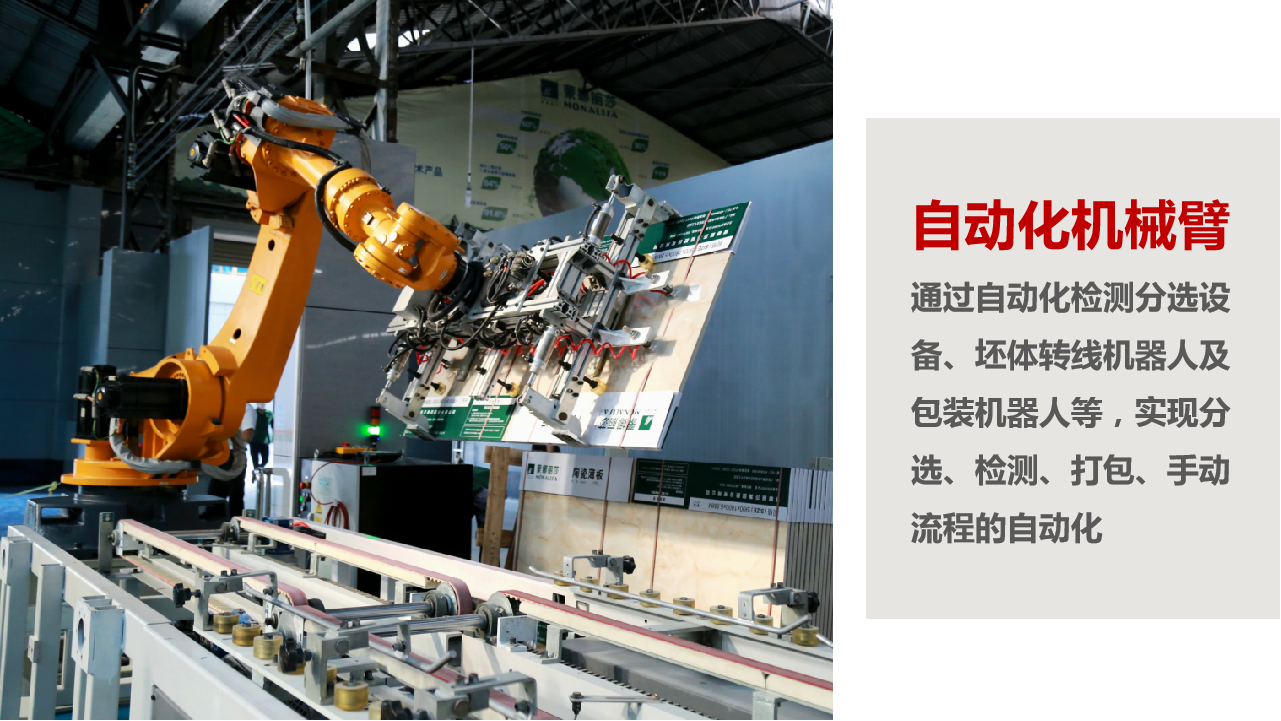
Large-format porcelain production: automated handling reduces manual contact damage, one of the failure modes most often cited in delivery disputes.
Why Acceptance Criteria Decide Approval, Not Catalog Claims
Tile disputes on large projects rarely begin with design. They begin with a delivered lot that does not match the acceptance clause. The recurring failure families in architectural ceramics are well documented and predictable: colour variation between or within batches, dimensional deviation on edge and diagonal, warpage that traps water or breaks a joint line, insufficient breaking strength, slip resistance below the specified class, stain penetration into the surface, freeze-thaw damage in cold-region exteriors, and radionuclide content above the permitted limit.
Every one of those risks is measurable. That is the useful framing for 120-270FEG12207M: the question is not whether the tile looks correct, but whether Monalisa’s control points map onto the criteria a buyer writes into the contract — and whether the paperwork exists to prove it per batch.
Criterion by Criterion: The Product Against a Standard Checklist
The thresholds below combine the ISO 13006:2018 classification for dry-pressed porcelain (Group BIa: water absorption E ≤ 0.5%, mechanical resistance average above 40 N/mm²) with the criteria most frequently written into project specifications for large-format floor tile.
| Acceptance criterion | Threshold typically specified | Stated position for the product | Document to request |
|---|---|---|---|
| Water absorption | ≤ 0.5% (ISO 13006 Group BIa) | Monalisa states an ultra-low absorption body of ≤ 0.08% for its high-density porcelain range, produced on presses with compaction force up to 48,000 kN | ISO 13006 test report, batch-specific |
| Mechanical resistance | Average above 40 N/mm² (BIa) | Breaking strength stated at ≥ 45 MPa | Breaking strength report per production batch |
| Abrasion resistance | PEI 3–5 depending on traffic | PEI Grade 5 stated; surface hardness stated at Mohs ≥ 7; wear volume ≤ 140 mm³ | PEI abrasion report |
| Slip resistance | R9–R11 by area, with wet testing where required | Matte natural-stone face; Monalisa batch-tests slip with a pendulum friction tester, targeting wet BPN ≥ 50 or R10 and above | Slip test report naming the test method and the specific finish |
| Stain resistance | Grade 5 | Grade 5 stated; validated with ink, oil and tea stain tests | Stain resistance test report |
| Freeze-thaw | 100 cycles without cracking | 150 cycles stated for the high-density porcelain range | Freeze-thaw report, relevant to exterior and cold-region use |
| Flatness | Typically ≤ ±0.5% | Stated tolerance ≤ ±0.15%, verified by 100% flatness scanning after the kiln | Flatness scanner output or lot inspection record |
| Radionuclide content | Within the applicable national limit | Covered by the manufacturer’s in-house laboratory testing scope | Radioactivity test certificate for the batch |
Read the table as a shopping list for documents, not as a verdict. The stated performance sits comfortably inside a BIa specification, and in several rows — absorption, freeze-thaw cycles, flatness tolerance — it is stated well inside the minimum. But stated performance and certified performance are different objects, and a buyer who accepts the first without the second has no acceptance position at delivery.
How Each Criterion Is Controlled Inside the Plant
The reason the stated figures are plausible rather than promotional is that each one has a corresponding control point on the line. Monalisa describes eighteen quality control points from raw material intake through ball milling, spray drying, pressing, drying, glazing, firing, polishing and sorting.
- Colour. An automatic colour sorting machine plus online spectrometer inspection; packaging by shade and grade; batch comparison against a retained historical master standard.
- Dimensions. High-precision moulds held to ≤ ±0.1 mm, with laser measurement and automatic rejection of out-of-tolerance pieces.
- Flatness. Press pressure uniformity compensation plus fine kiln roller levelling, followed by 100% flatness scanning after the kiln.
- Strength. Formulation control with higher kaolin content, pressing pressure at or above 48 MPa, automated firing curves and batch sampling for breaking strength.
- Slip resistance. Surface design through special dry grains or textured moulds, verified per batch on a pendulum friction tester.
- Stain resistance. A high-density transparent frit over the decorative layer, validated with ink, oil and tea.
- Traceability. Each tile laser-marked or RFID-coded back to production date, press station, kiln zone and inspector ID — the single most useful feature when a defect appears in one zone of one batch.
Testing is performed in the company’s own CNAS-accredited laboratory, which covers dimensions, water absorption, breaking strength, abrasion, slip resistance, stain resistance, freeze-thaw and radioactivity. That matters for acceptance because it shortens the loop between a failed sample and a corrective answer.

Documentation, not appearance, is what a project inspector can act on: batch reports, traceability codes and certificate scope.
Application Fit: Six Environments, Six Different Thresholds
The same tile can pass in one environment and fail in another, because the binding criterion changes. For 120-270FEG12207M the practical reading is as follows.
Residential
Living areas, kitchens and bathrooms are the least demanding on abrasion and the most demanding on appearance consistency and stain behaviour. A Grade 5 stain rating and low absorption suit kitchen and bathroom floors; the 1200 × 2700 mm format gives a continuous stone-look plane with few joints. The trade-off is weight and handling: a 12 mm slab of this size is not a one-person installation, and substrate flatness must be corrected before setting rather than compensated for with adhesive.
Commercial
Offices, retail and transport concourses shift the emphasis to abrasion (PEI 5), flatness under rolling loads, and joint stability. The stated wear volume of ≤ 140 mm³ and breaking strength of ≥ 45 MPa are appropriate for heavy foot traffic. In shopping and transit environments, however, the specification should state the slip class by zone, because entrance mats, ramps and wet service corridors usually require a higher class than the main concourse.
Hospitality
Hotels combine lobbies with bathrooms and pool surroundings in one building. The lobby is an abrasion question; the pool deck is a slip question. A single matte natural-stone finish may satisfy both, but only if the slip test report confirms the class for the wet zone — and if the cleaning protocol keeps the textured surface free of soap and mineral residue.
Municipal
Metro, civic and public paving projects bring the strictest documentation requirements, plus resistance to de-icing salts and freeze-thaw in exposed locations. Monalisa’s stated 150 freeze-thaw cycles and the company’s reference portfolio — eight venues of the Beijing Olympic Games, ten venues of the Guangzhou Asian Games, the Hong Kong–Zhuhai–Macao Bridge, the China Pavilion at Expo 2020 Dubai and official architectural ceramics supply for the 19th Asian Games Hangzhou 2022 — are relevant, but they support capability, not a specific batch result.
Industrial
Factory floors and plant welfare areas need abrasion and impact data, and often chemical resistance data for oils, acids and cleaning agents. That last dataset is not part of the standard catalog information described here, so an industrial buyer should treat it as an open item to be requested, not assumed.
Agricultural
Wash-down areas, produce handling floors and livestock zones are wet by definition and frequently need a higher slip class than R9, together with resistance to organic acids. This is where the format’s advantages shrink: a 1200 × 2700 mm slab is efficient in large open floors, but a poor fit for small, heavily interrupted rooms with frequent drainage penetrations.
Where this product stops being the right choice
A 12 mm, 1200 × 2700 mm porcelain slab carries a higher unit price than conventional tile — Monalisa’s own comparison data puts the premium at roughly 15% to 30% depending on series. It also requires experienced installers, suction or frame lifting equipment, and a substrate that meets flatness tolerance before work starts. Where a project has tight budgets, unskilled labour, small room modules or aggressive chemical exposure, a smaller-format or differently specified tile is the more defensible decision. The format rewards scale and discipline; it punishes improvisation.
Accessories and Installation Equipment as Acceptance Items
Buyers who stop the checklist at the tile itself often discover the gap at handover. Four accessory categories belong in the same purchase and acceptance scope:
- Tile adhesive. Compatible with a low-absorption porcelain body; coverage must be specified for the 1200 × 2700 mm format and for the substrate in question, because voids under a large slab are an impact-failure risk rather than a cosmetic one.
- Grout. With tight-joint installation at a grout gap of ≤ 0.5 mm, grout selection shifts from aesthetic filler to a movement and moisture detail. Monalisa states that tight-joint laying saves roughly 10% to 15% in grouting material and labour on large projects.
- Tile cutter. Large-format cutting equipment, not a manual score-and-break tool, determines edge quality on visible cuts.
- Leveling system. Lippage control across a 2.7 m edge is a mechanical problem; a leveling system is the standard answer and should be costed into the bid, not added later.
For multi-phase projects, a reserved stock of the same batch for future repairs is an acceptance issue as much as a logistics one. Monalisa’s stated practice of a two-year batch stock reserve, supported by shade-and-grade packaging and tile-level traceability, is designed to prevent the patch-repair colour mismatch that conventional tiles commonly suffer.
The Lot Acceptance Protocol a Buyer Should Write Into the Contract
Monalisa’s stated procurement terms are a minimum order quantity of 2000 m², delivery terms of FOB, CIF or EXW, and payment by TT or LC. The acceptance sequence commonly applied to bulk porcelain deliveries has four practical steps:
- Packaging and labelling check. Intact outer packaging, no moisture or damage; a certificate of conformity and installation guide inside; labels matching the order by shade, size and quantity.
- Carton opening verification. Randomly open 5% to 10% of cartons and compare the actual colour and pattern against the approved reference sample or master plate; verify quantity and grade.
- Rapid dimensional and flatness check. Using a vernier calliper, feeler gauge and straightedge, measure at least ten pieces per batch for length, thickness and flatness.
- Document reconciliation. Match the batch code on the packaging to the test report and the traceability record before signing off.
Written this way, the protocol is not adversarial. It converts a subjective argument about colour and lippage into a set of measurements that both sides can re-run.
Manufacturing and Compliance Evidence Behind the Checklist
Acceptance risk is also continuity risk. A supplier that cannot repeat a batch cannot honour a warranty, whatever the data sheet says. Monalisa’s verifiable footprint is the relevant evidence here: founded in 1992, four production bases, 37 production lines, an annual output of approximately 100 million m² and a stated monthly production capacity of 12.5 million m², 892 authorised patents including 145 invention patents, and participation in drafting 49 national, industrial, local and group standards.
On compliance, the company reports 15 certifications including ISO 9001 and ISO 14001, together with ISO 45001 for occupational health and safety, and was recognised by the Ministry of Industry and Information Technology in the first batch of national Green Factory designations. Its quality system — the 3M model — has received the Foshan Municipal Government Quality Award, the Guangdong Provincial Government Quality Award and a nomination for the third China Quality Award. Buyers in the EU and other regulated markets should note one boundary: certificate numbers, product scope, issuing body and validity dates must be reviewed directly, because the available public product pages do not constitute a complete technical specification matrix.
Comparison with Conventional Tiles — and Where the Margin Narrows
Against conventional ceramic tile, the differences that survive scrutiny are measurable rather than rhetorical. Water absorption is stated at ≤ 0.08% versus a conventional range of 0.5% to 3%. Breaking strength is stated at ≥ 45 MPa versus ≥ 35 MPa. Wear volume is stated at ≤ 140 mm³ versus ≤ 540 mm³. Freeze-thaw resistance is stated at 150 cycles versus 50 to 100. Flatness tolerance is stated at ≤ ±0.15% versus ≤ ±0.5%, and breakage in handling at ≤ 0.3% versus roughly 0.8%.
The commercial counterweight is real: a unit price 15% to 30% higher, offset — on Monalisa’s figures — by a two- to three-fold longer service life and a 20% to 35% lower total life-cycle cost, plus no waxing or sealing cycle and simpler stain removal. Where the arithmetic narrows is in small-floor-area projects, in buildings with a short refurbishment horizon, and in rooms where cuts and penetrations consume most of a slab.
Two further boundaries are worth stating plainly. First, matte natural-stone surfaces trade cleanability for grip; a higher slip class usually means a more open surface that needs the right cleaning chemistry. Second, R9 is not universally sufficient: wet commercial service corridors, pool surrounds and food-processing floors often specify R10 to R11 or a documented wet-test result, and that must be confirmed for the exact finish being supplied.
Market Context: Consolidation Raises the Value of Supplier Continuity
The supply side is contracting, and that changes what a buyer should weigh. MECS/Acimac reports that world tile production fell 6.2% in 2024 to 14.95 billion m². On the demand side, Spherical Insights projects the global porcelain tile market rising from USD 9.73 billion in 2024 to USD 18.33 billion by 2035 — a commercial research projection whose methodology and assumptions should be reviewed before it is used in a business case.
Company-level signals point the same direction as the production data. Monalisa reported 2025 annual revenue of CNY 3.92 billion, a 15.28% year-on-year decrease. Read neutrally, this is consistent with a market where volume is under pressure across the category rather than a signal about one supplier. For buyers, it argues for two habits: treat capacity allocation and batch continuity as contractual items on multi-year phased projects, and evaluate supplier financial stability alongside product performance rather than after it.
Future Outlook
Three directions look durable. Formats continue to grow and joints continue to tighten, which pushes value toward the accessory and installation layer rather than the tile alone. Digital decoration — high-definition inkjet printing with adhesive dry grain, stated at 98% visual realism against natural stone — keeps eroding the price premium of quarried stone while making visual matching across batches harder to verify without documentation. And energy performance is becoming a specification topic in its own right: Monalisa reports low-temperature fast firing with a 60–80 °C lower firing temperature, a 15% shorter cycle and 12% to 18% lower energy consumption per unit, plus roughly 22% better heat transfer than conventional tile when used with underfloor heating, which the company links to an 8% to 12% heating energy saving.
The likely consequence for procurement is procedural rather than dramatic: acceptance will move from visual inspection toward document verification, and the supplier that can produce a batch-specific report quickly will keep winning projects it does not necessarily price lowest.
FAQ
What technical evidence should a buyer request before approving 120-270FEG12207M for a project?
A batch-specific ISO 13006 test report confirming Group BIa classification (water absorption ≤ 0.5%, mechanical resistance above 40 N/mm²), a breaking strength report, a PEI abrasion report, a slip resistance report naming the test method and the exact finish, a Grade 5 stain resistance report, a freeze-thaw report, and radionuclide testing within the applicable national limit. Certificate numbers, product scope, issuing body and validity dates should be reviewed on the documents themselves, because catalog pages alone do not constitute a complete technical specification.
Is R9 slip resistance sufficient for wet commercial or agricultural areas?
Not automatically. R9 covers many interior floor applications, but wet service corridors, pool surrounds, wash-down areas and food-processing floors frequently specify R10 to R11 or a documented wet test result. Monalisa batch-tests slip resistance with a pendulum friction tester, targeting wet BPN ≥ 50 or R10 and above. The class must be confirmed for the specific finish supplied, since a matte natural-stone face can exist in more than one surface variant.
What are the stated purchasing terms and acceptance steps?
Stated terms are a minimum order quantity of 2000 m², delivery on FOB, CIF or EXW basis, and payment by TT or LC. The stated acceptance sequence covers a packaging and labelling check including the certificate of conformity and installation guide, random carton opening of 5% to 10% for colour and pattern comparison against the reference sample, and a rapid dimensional and flatness check on at least ten pieces per batch using a vernier calliper, feeler gauge and straightedge.
How is batch-to-batch colour variation managed on a multi-phase project?
Through three mechanisms described by the manufacturer: an automatic colour sorting machine with online spectrometer inspection, packaging by shade and grade against a retained historical master standard, and tile-level laser or RFID marking that traces each piece to production date, press station, kiln zone and inspector. A stated two-year batch stock reserve is intended to keep repair stock colour-consistent with the original installation.
Can the 1200 × 2700 × 12 mm format be used on walls as well as floors?
The format is used on floors and on large wall planes, but wall use is an engineering question rather than a product question. A 12 mm slab of this size requires verified substrate flatness, an appropriate adhesive and, on external or high-level cladding, a mechanically restrained fixing design reviewed by a project engineer. Installation also requires suction or frame lifting equipment; the tile is not a one-person handling item.
Which accessories and installation equipment belong in the acceptance scope?
Tile adhesive compatible with a low-absorption porcelain body and specified for the slab format, grout suitable for a tight joint of ≤ 0.5 mm, a large-format tile cutter for visible cuts, and a leveling system for lippage control across the 2.7 m edge. Tight-joint installation is stated to save roughly 10% to 15% in grouting material and labour, but only where substrate flatness has already been corrected.
For buyers who need the full product and company documentation in one file, the Monalisa brochure is available for public download: Monalisa Group product and capability brochure (PDF).
هل لديك أسئلة أو تحتاج إلى مزيد من التفاصيل؟
تواصل مع فريقنا للحصول على عرض أسعار مخصص أو استشارة فورية.
طلب عرض أسعار
املأ النموذج أدناه وسيتواصل معك فريقنا بعرض مقترح مخصص.
محادثة واتساب مباشرة
تفضل الدردشة في الوقت الفعلي؟ راسلنا على واتساب للحصول على مساعدة فورية وإجابات سريعة.
- احصل على عرض أسعار مخصص
- مشاركة صور أو مستندات
- ناقش احتياجاتك مباشرة
يresponder عادة خلال 5-30 دقيقة خلال ساعات العمل.