
Motorcycle Seat Shortlist: Scooter and Dirt Bike Options for Replacement and OEM Orders
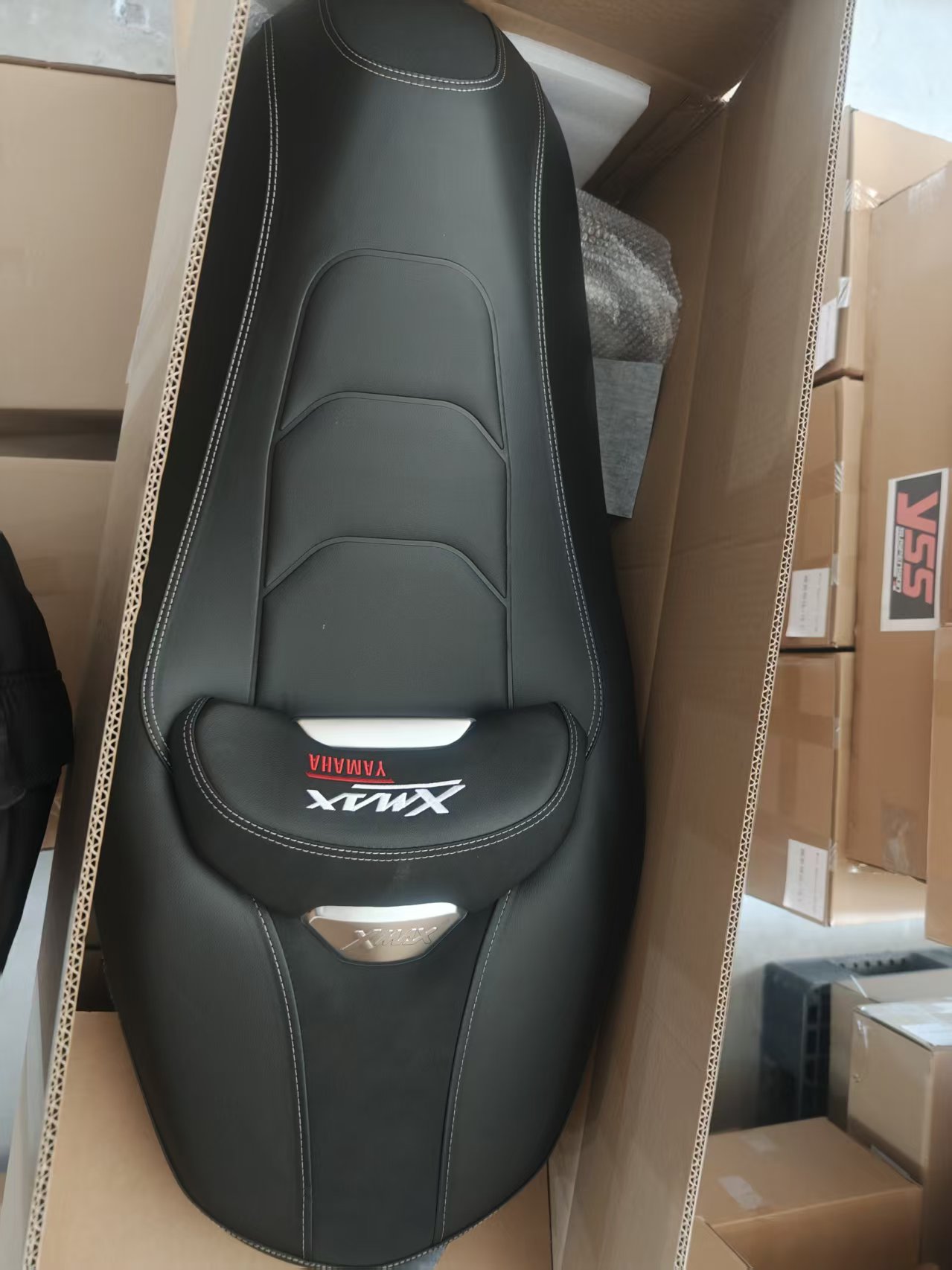
A scooter-platform motorcycle seat from the Xingrong seat cushion range, built on a PP base plate with PU foam and PVC leather covering.
Motorcycle seat sourcing rarely fails at the factory gate. It fails earlier, at the specification stage — when a buyer selects the wrong configuration, the wrong fitment platform, or order terms that cannot be repeated on a second purchase. A shortlist is therefore more useful than a catalogue, because it forces the variables that actually decide a seat order into a single comparison: configuration, documented model coverage, internal construction, and committed order parameters.
Demand in this category is replacement-led. The global motorcycle seats market was valued at USD 7.42 billion in 2025 and is projected to reach USD 13.30 billion by 2032, growing at a CAGR of 8.69% (Market Research Future / Dataintelo). Within that market, the aftermarket distribution channel accounts for approximately 62.3% of revenue (Dataintelo, 2025), and Asia-Pacific held a 38.5% revenue share in 2025, supported by high production and sales volumes in China. For a distributor, retailer or repair network, the practical reading is straightforward: most seats are sold to replace worn or damaged originals, so repeatability across repeat orders matters more than novelty.
Zhejiang Xingrong Auto & Motorcycle Parts Co., Ltd. — also operating under the Staron name — is a motorcycle seat cushion manufacturer located at No. 81 Jiangxin Road, Taizhou City, Zhejiang Province, China, and was founded in 2015. The company operates a 15,000 m² plant with 130 employees and a five-engineer R&D team, reports annual seat cushion output of 1,800,000 units, and lists motorcycle seats as its main product. Its documented export markets are Southeast Asia, Europe, the Middle East and South America, and it states a 90% self-production rate for product accessories.
Why Seat Demand Is Replacement-Led, Not Novelty-Led
A motorcycle seat is a non-powered static fitting part. It does not connect to the electrical system and it does not move under its own power; it is matched to the motorcycle main body frame and the motorcycle body shell. That single characteristic defines the whole risk profile of the purchase. There is nothing to calibrate, nothing to program and nothing to integrate — which means essentially all of the buyer's exposure sits in two places: whether the seat physically fits, and whether it survives weather and daily wear.
The stated function of a replacement seat is equally narrow and equally practical. It provides a comfortable riding sitting experience, beautifies the motorcycle's appearance, and supports old-seat maintenance and direct replacement. Those three purposes map to three different buyers: a repair shop buys for the maintenance case, a parts retailer buys for the direct-replacement case, and an accessory brand buys for the appearance case — where differentiation, not fitment alone, drives the decision.
Because the aftermarket carries the majority of channel revenue, the operational question for a buyer is not “which seat is best” but “which seat can I re-order in the same specification, at the same fitment, in a predictable window.” That question is what the rest of this shortlist answers.
The Shortlist at a Glance
Four seat programs cover the large majority of replacement and OEM demand described in this article. They are separated by configuration, documented fitment coverage, and the buyer type each one serves.
| Seat option | Configuration | Documented model coverage | Core construction | Typical buyer |
|---|---|---|---|---|
| Scooter replacement seat | Scooter seat | Nmax, Xmax, Aerox, ADV150, ADV160, Forza, PCX, Click | PP plate; PU foam; PVC leather; 80D high-density foam; high-strength floor structure | Repair shops, parts retailers |
| Dirt bike seat | Dirt bike seat | Fitment confirmed against the buyer's specific frame before production | Manufacturer's stated seat construction (PP plate, PU foam, PVC leather) | Accessory brands, project buyers |
| Custom OEM seat | Scooter or dirt bike, buyer-specified | Buyer-specified platform | Buyer-specified covering, foam and stitching | Motorcycle manufacturers, OEM buyers |
| Custom ODM seat | Scooter or dirt bike, design-supported | Buyer-specified platform | Cover design and stitching developed with the manufacturer | Accessory brands entering a new category |
The distinction that matters most in this table is the third column. A documented model list is a repeatable fitment commitment; a “confirmed per project” entry is not, and buyers should budget time for fitment validation accordingly.
Scooter Seat or Dirt Bike Seat: Where the Specification Diverges
Both configurations come from the same family of materials, but they are purchased for different reasons, and that changes what a buyer should specify first.
Scooter seats generally carry a longer, wider contact surface. Riders sit for extended periods in a more upright position, so sustained load distribution and surface comfort dominate the specification. This is where foam grade, covering softness and waterproofing carry the most weight, and it is the configuration most sensitive to aftermarket complaints about “feeling flat” after months of use.
Dirt bike seats generally prioritise grip, a narrower profile and durability under abrasive conditions. The rider moves across the seat rather than remaining in one position, so the covering's wear resistance and the base structure's ability to hold shape under intermittent impact matter more than long-duration cushioning. Surface grip and seam integrity tend to outrank plushness.
The practical consequence for a purchasing decision is this: a scooter seat program should be evaluated first on comfort retention and weather resistance, while a dirt bike program should be evaluated first on abrasion resistance and structural rigidity. Applying one evaluation template to both configurations is one of the most common specification errors in this category — and it typically surfaces only after the first container has been sold through.
What Is Actually Inside a Replacement Seat
Once the configuration is fixed, the material stack becomes the next constraint. For the Xingrong motorcycle seat range, the stated construction is a PP plate base, PU foam, and PVC leather covering, described together as an 80D high-density foam build on a high-strength floor structure.
Each layer answers a different failure mode:
- PP base plate. Carries the load path between the foam and the motorcycle frame. A stable plate is what keeps a seat from developing flex, rattle or mounting-point fatigue.
- High-strength floor structure. Reinforces the underside so the seat holds its shape under repeated mounting and dismounting cycles.
- 80D high-density foam. Density is the specification that most directly governs how long a seat keeps its shape under sustained body weight; higher-density foam is generally selected where comfort retention over the product's life matters more than initial softness.
- PVC leather covering. Provides the waterproof surface and the visual finish, and is also the layer that defines how the seat photographs in a retail listing.
Material direction in the wider market reinforces this stack. Leather remains a premium material for motorcycle seats, but synthetic options such as vinyl and foam are increasingly used to deliver waterproof and soft surface characteristics in the mid-range segment, according to Fortune Business Insights. For most replacement and wholesale programs, the synthetic route is not a downgrade — it is the specification that satisfies the two requirements buyers hear about most often: waterproofing and softness at a workable unit cost.
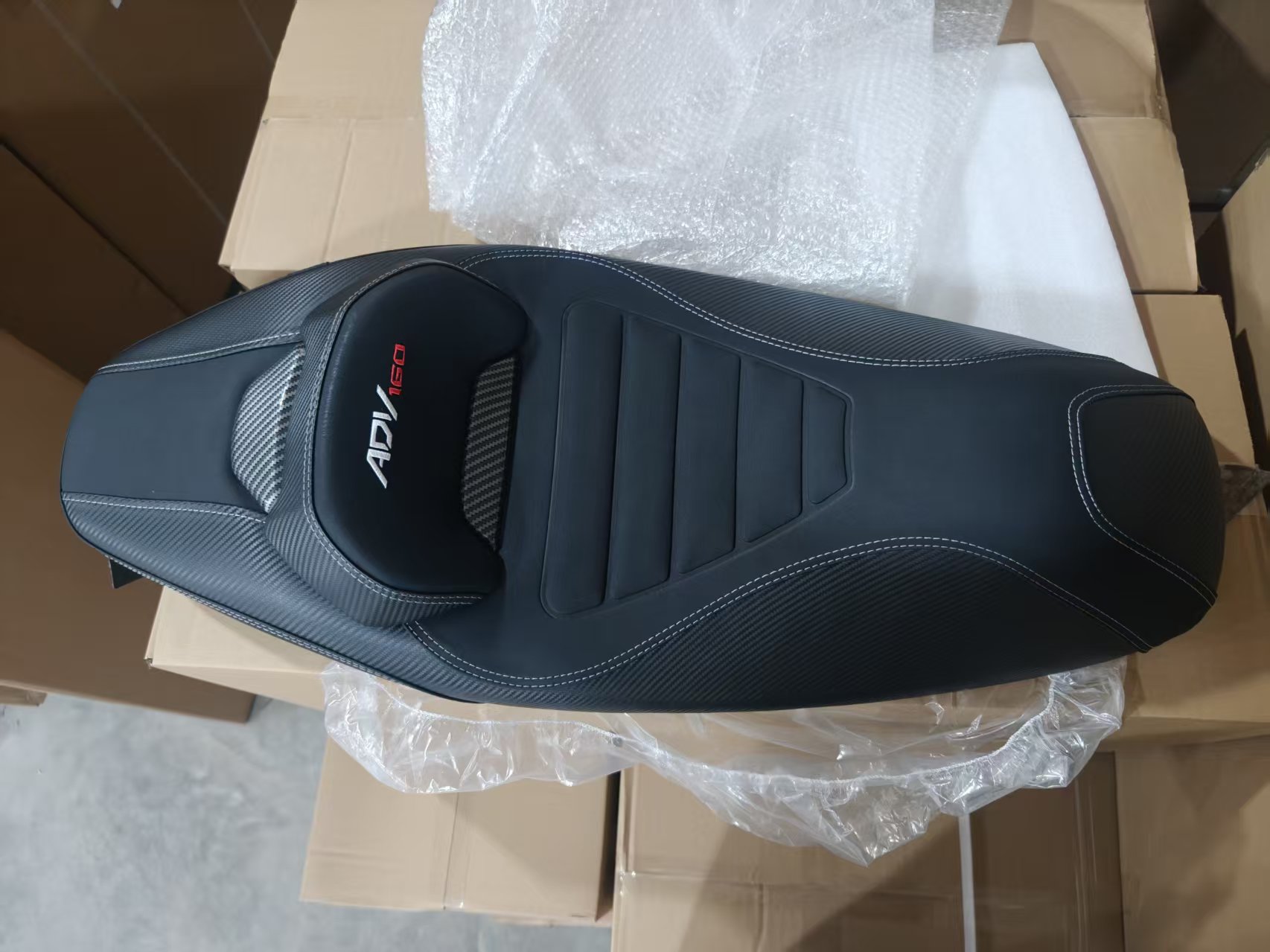
Scooter-platform seat with waterproof PVC leather covering, sized for direct replacement on documented model platforms.
The special requirements attached to this application are weather resistance, a wear-resistant surface, and ergonomic design — three criteria that are checked against the working condition rather than against a spec sheet. In practice, that means the covering and the foam specification are the two items a buyer should confirm before agreeing to a bulk order, because they are the two items that determine whether the seat is still sellable two seasons later.
Fitment: The Eight Documented Scooter Platforms
Fitment coverage is the first hard constraint in any seat purchase, because a seat that does not mount correctly has no resale path at all. The Xingrong motorcycle seat is documented as fitting Nmax, Xmax, Aerox, ADV150, ADV160, Forza, PCX and Click models.
Eight named platforms is a meaningful commercial fact rather than a marketing one. It means a single seat program can serve several of the highest-volume scooter platforms in Southeast Asia, Europe and Latin America without the buyer maintaining eight separate supplier relationships, eight separate tooling arrangements, or eight separate quality conversations. For a distributor building a catalogue, that consolidation is the difference between a manageable SKU list and an unmanageable one.
Two practical caveats belong with that list. First, model names alone should always be paired with year and variant when the purchase order is issued, because manufacturers revise frames, mounting points and body panels over a model's lifecycle. Second, the documented list is scooter-side; a dirt bike buyer should treat fitment as an item to confirm against the actual frame and body shell before committing to volume.
Order Parameters to Lock Before Committing
Constraint-based buying in this category comes down to a small set of committed numbers. The table below lists the parameters the manufacturer publishes for its motorcycle seat program, together with what each one changes for the buyer.
| Order parameter | Published value | What it means for the buyer |
|---|---|---|
| Minimum order quantity | 50 pcs | Enables a trial or pilot order before committing to container-scale volume, and allows a first order to be split across more than one model platform. |
| Production lead time | 25–35 days | Production window only; freight, port handling and customs clearance sit outside this figure and must be planned separately. |
| Monthly capacity | 50,000 pcs | Supports repeat ordering and seasonal peaks without a change of supplier. |
| Annual output | 1,800,000 units | Indicates the production scale behind the monthly figure, useful when a buyer is assessing continuity rather than a single shipment. |
| Accessory self-production rate | 90% | Most components are made in-house, which reduces dependence on outside suppliers for the parts that determine fit and finish. |
| Quality control | 100% pre-shipment test | Every unit is tested before dispatch rather than sampled, which is the parameter most relevant to buyers who cannot inspect at origin. |
| After-sales | 1-year warranty | Defines the support window; the warranty route and terms should be confirmed in the order documentation. |
| Production mode | OEM; ODM | Covers both buyer-specified builds and design-supported development. |
| Customization | LOGO brand; leather cover design; stitching line colour | The three variables that let a buyer create a differentiated SKU without changing fitment. |
| Certifications held | ISO9000 quality management system; CQC | Quality-system and product certification evidence — distinct from vehicle type approval, which is a separate question. |
Customization for OEM and ODM Orders
Customization in this category is visual and tactile rather than mechanical. The manufacturer's stated customization scope covers LOGO branding, leather cover design, and stitching line colour.
That scope is narrower than it first appears, and correctly so. Because the seat must still mount to the same frame, the base plate and mounting geometry generally stay fixed while the covering layer carries the brand differentiation. The result is a set of levers that change how a product looks and feels on the shelf without reopening fitment risk:
- LOGO branding creates a visible brand marker on a part that is otherwise visually similar across suppliers.
- Leather cover design drives the trade-up story — a textured or patterned cover is what separates a standard replacement from an upgraded one in a retail listing.
- Stitching line colour is the lowest-risk differentiator and often the fastest to confirm, because it changes no tooling and no material specification.
For accessory brands, this combination is usually enough to build a private-label line on top of an existing, already-validated fitment platform — which is materially faster than developing a seat from a blank sheet. For OEM buyers, the same levers apply to model-year refreshes and dealer-exclusive editions.
One sequencing note: customization items should be confirmed at artwork stage, before production is scheduled. Stitching colour and cover design are the two items most likely to be revised after a sample review, and revisions made after the production window opens affect the delivery date rather than the unit price.
Application Fit: Who Buys Which Configuration
The application record for this seat family is specific about who the product is built for: motorcycle manufacturers, motorcycle repair shops, motorcycle parts retailers, and motorcycle accessory brands. Those four buyer types do not buy the same way, and the shortlist should be read accordingly.
Repair shops buy for old-seat maintenance and direct replacement, where the deciding factor is whether the seat mounts without modification and matches the original silhouette closely enough that a customer accepts it. Parts retailers buy for stock depth, where the deciding factor is how few SKUs cover the most models — which is where an eight-platform fitment list does most of its work. Accessory brands buy for differentiation, where LOGO branding and cover design matter more than the base specification. Motorcycle manufacturers buy against a production schedule, where lead time and consistency across repeat batches outrank everything else.
Field evidence exists for the replacement case at scale. A Lebanon-based program covering 5,000 seats over two years was delivered for motorcycle parts replacement, with reported outcomes of a good seating feel, good visual effect and waterproof performance. The relevant figure here is not the 5,000 units but the two-year duration: a replacement seat program that survives a second year is being re-ordered on fitment and consistency rather than on first-sample impression.
Geographic demand for this configuration spans both mature and emerging markets, with application records covering Iran, India, Italy, South Korea, Lebanon, Portugal, Thailand, Taiwan, Turkey and Vietnam — a spread that reflects how few markets are without a large installed base of the scooter platforms listed above.
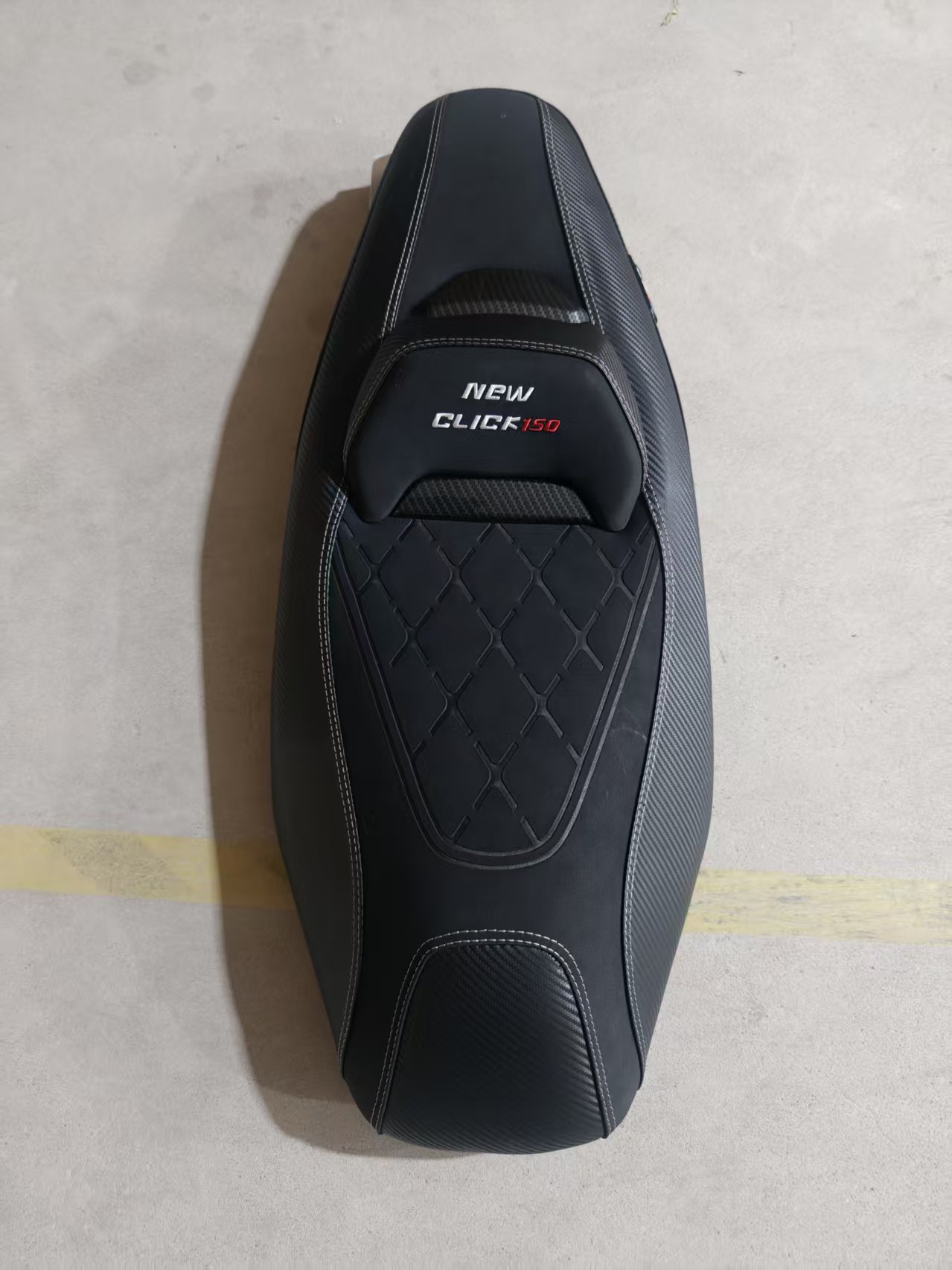
Waterproof replacement seat configuration intended for repair-and-replace channels rather than original-equipment assembly lines.
Market Signals Shaping the Next Order Cycle
Three published indicators are worth carrying into a 2026 purchasing plan.
First, growth is steady rather than explosive. A move from USD 7.42 billion in 2025 to a projected USD 13.30 billion by 2032 at a CAGR of 8.69% (Market Research Future / Dataintelo) describes a category that rewards suppliers who can hold a specification over several seasons, not one that rewards rapid repositioning. Buyers should weight continuity of specification more heavily than a marginal unit-price advantage.
Second, the aftermarket remains the centre of gravity, at approximately 62.3% of revenue (Dataintelo, 2025). This means the buyer conversation is dominated by replacement mechanics: fitment accuracy, weather resistance, and how a seat looks after two years of sun and rain. It also means demand is defensive — seats wear out regardless of new-vehicle sales cycles.
Third, supply is concentrated. Asia-Pacific held a 38.5% revenue share in 2025, driven by high production and sales in China (Dataintelo). For importers, that concentration is both an advantage and a risk: sourcing options are deep, but qualification work has to be done properly, because a high-volume supply base also contains a long tail of suppliers who cannot document fitment, testing or capacity.
Comparing the Factory Route with Traditional Sourcing Options
Buyers in this category generally choose between four routes, and each has a genuine constraint that should be stated rather than glossed over.
| Sourcing route | Main strength | Main constraint |
|---|---|---|
| Local re-upholstery | Lowest upfront cost; fast turnaround; no import process | Material quality, waterproofing and finish depend on the individual workshop; results are difficult to standardise across a multi-branch network |
| Generic unbranded imports | Low unit cost; wide availability | Fitment documentation is often absent, and there is usually no defined pre-shipment testing routine to point to |
| Single-platform specialist supplier | Deep focus on one model platform | Catalogue breadth is limited, forcing multi-supplier management for a full replacement range |
| Documented OEM/ODM factory route (Xingrong) | Eight-platform fitment list; 50 pcs MOQ; 25–35 day lead time; 50,000 pcs monthly capacity; 100% pre-shipment test; 1-year warranty | Requires buyer-side specification discipline and artwork confirmation; fitment outside the documented list must be validated before volume orders |
Against a traditional, informal supply route, the factory route's advantage is not price — it is that every commitment in the table above can be written into an order. The trade-off is that the buyer must supply accurate model, year and variant information, and must confirm customization details before the production window opens. Where a buyer cannot supply that information, the factory route is not automatically the better choice; a local re-upholstery option may actually carry less coordination overhead for a very small, single-shop requirement.
Limitations and Boundaries to Confirm Before Ordering
Several constraints are structural and should be resolved before any purchase order is issued.
- Certification is not the same as type approval. ISO9000 is a quality management system certification and CQC is a product certification; neither is a vehicle seating approval. UN Regulation No. 17 (ECE R17) establishes uniform provisions for the approval of vehicle seats, anchorages and head restraints, and applies in certain regulated markets. Buyers selling into those markets should confirm separately whether a seat component requires approval and who holds it.
- Fitment documentation has an edge. The named model list covers Nmax, Xmax, Aerox, ADV150, ADV160, Forza, PCX and Click. Any other platform — including dirt bike frames — should be treated as a fitment-validation item, not an assumption.
- Leather and synthetic coverings trade off differently. Leather is the premium aesthetic route; synthetic coverings are the more common mid-range route for waterproof and soft-surface requirements. Neither is universally correct, and the choice should follow the target market's climate and price band.
- Lead time excludes logistics. The 25–35 day figure covers production. Freight, port handling and customs clearance sit outside it and should be added to the buyer's own timeline.
- The warranty route should be specified. A 1-year after-sales term is a commitment, but the practical path for a claim — replacement unit, credit, or parts — should be agreed in the order documentation rather than assumed.
Future Outlook
The direction of this category is toward documented, repeatable seat programs rather than opportunistic container buying. Three forces support that reading. The aftermarket's 62.3% revenue share keeps demand tied to replacement cycles that do not depend on new-vehicle sales. Continuing growth at 8.69% CAGR through 2032 gives suppliers room to hold specifications rather than chase volume with constant redesign. And the shift toward synthetic waterproof coverings in the mid-range is steadily narrowing the quality gap between “premium” and “standard” seat tiers.
For buyers, the practical implication is that the qualification work done now — confirming fitment platform, material stack, testing routine and order parameters — will hold value for several ordering cycles. The buyers who struggle in 2027 are more likely to be those who never documented their seat specification than those who chose the wrong unit price in 2026.
FAQ
Which motorcycle models does this seat fit?
The seat is documented as fitting Nmax, Xmax, Aerox, ADV150, ADV160, Forza, PCX and Click models. Model name should always be paired with year and variant on a purchase order, because manufacturers revise frames and mounting points over a model's lifecycle. Fitment for platforms outside this list, including dirt bike frames, is validated against the buyer's specific frame and body shell rather than assumed.
Is the seat waterproof, and what materials are used?
The seat is specified for a waterproof working condition and uses PVC leather as the covering material over PU foam, on a PP base plate. The stated construction is 80D high-density foam on a high-strength floor structure. The application requires weather resistance, a wear-resistant surface and ergonomic design. Synthetic coverings such as vinyl and foam are increasingly used in the mid-range segment to deliver waterproof and soft surface characteristics, while leather remains the premium material option.
What is the minimum order quantity?
The published minimum order quantity is 50 pieces. This applies to the motorcycle seat program and allows a buyer to place a pilot order before scaling. A 50-piece MOQ is typically used to validate fitment, covering finish and stitching before committing to larger volumes.
How long does production take?
The published production lead time is 25–35 days. This figure covers production only; freight, port handling and customs clearance are separate and should be added to the buyer's planning timeline. Monthly production capacity is 50,000 pieces, which supports repeat and seasonal ordering.
What customization options are available for OEM and ODM orders?
The stated customization scope covers LOGO branding, leather cover design and stitching line colour. Both OEM and ODM production modes are offered. Because the mounting geometry must remain consistent with the target frame, differentiation is applied mainly through the covering layer — cover design, branding and stitch colour — rather than through changes to the base plate.
What quality control and warranty apply?
Quality control is described as 100% pre-shipment testing, meaning every unit is tested before dispatch rather than sampled. After-sales support is stated as a 1-year warranty. The exact claim process and the form of remedy should be confirmed in the order documentation.
What certifications does the manufacturer hold?
The manufacturer holds ISO9000 quality management system certification and CQC certification. These are quality-system and product certifications and are distinct from vehicle type approval. UN Regulation No. 17 (ECE R17) sets provisions for approval of vehicle seats, anchorages and head restraints in applicable regulatory frameworks, so buyers in regulated markets should confirm separately whether seat approval is required for their market.
Reference material: the manufacturer's seat cushion catalogue is publicly available for download at STARON Seat Cushion Catalogue.
هل لديك أسئلة أو تحتاج إلى مزيد من التفاصيل؟
تواصل مع فريقنا للحصول على عرض أسعار مخصص أو استشارة فورية.
طلب عرض أسعار
املأ النموذج أدناه وسيتواصل معك فريقنا بعرض مقترح مخصص.
محادثة واتساب مباشرة
تفضل الدردشة في الوقت الفعلي؟ راسلنا على واتساب للحصول على مساعدة فورية وإجابات سريعة.
- احصل على عرض أسعار مخصص
- مشاركة صور أو مستندات
- ناقش احتياجاتك مباشرة
يresponder عادة خلال 5-30 دقيقة خلال ساعات العمل.