
Motorcycle Seat Supplier Shortlist: A 2026 Buyer Scorecard
Motorcycle Seat Supplier Shortlist: A 2026 Buyer Scorecard
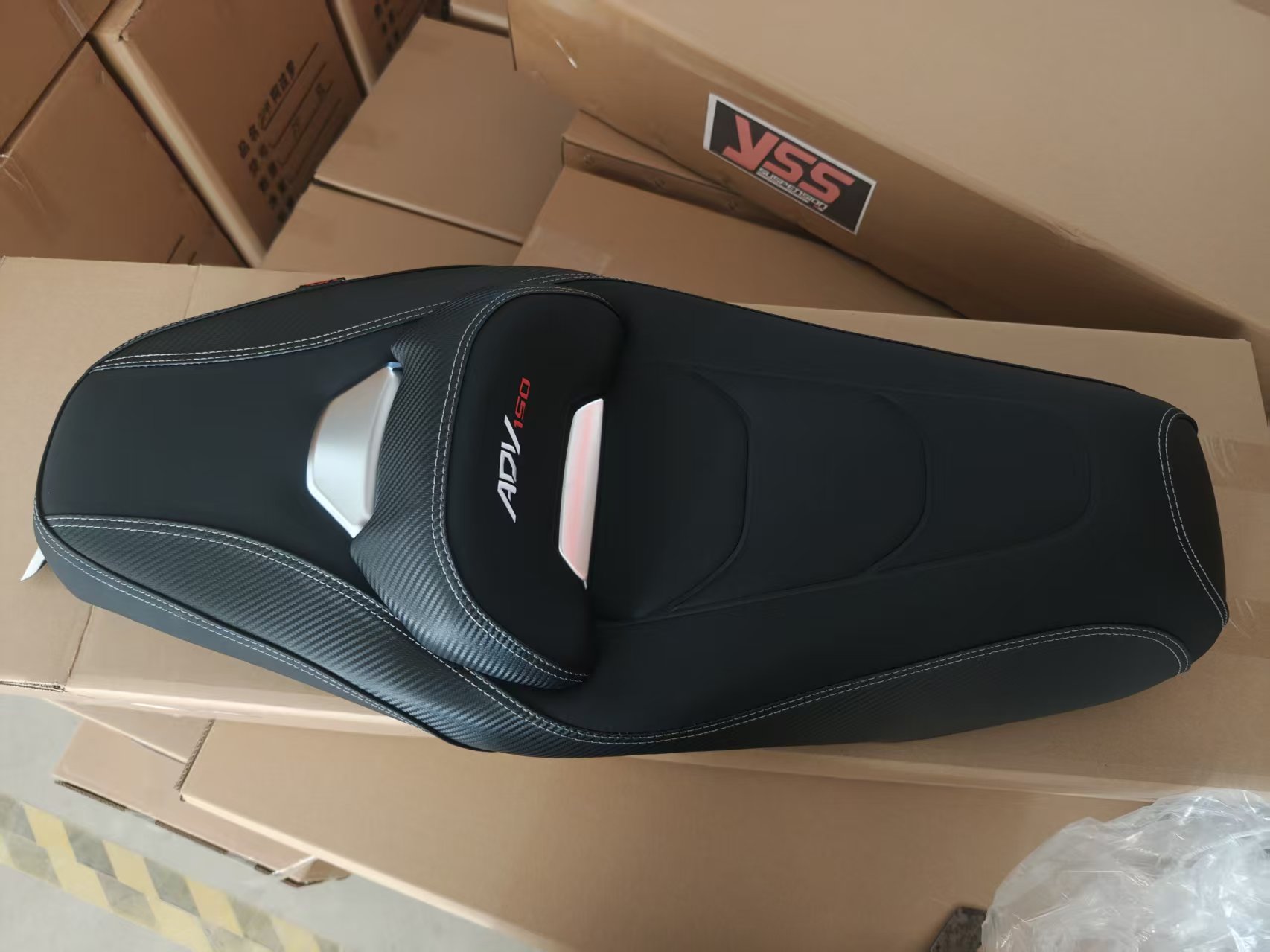
Model-specific motorcycle seats, such as this ADV150 fitment, are the unit of comparison in most 2026 sourcing shortlists. Image: Zhejiang Xingrong Auto & Motorcycle Parts Co., Ltd.
Motorcycle seat sourcing in 2026 is a filtering problem before it is a negotiating problem. The global motorcycle seat market was valued at USD 7.42 billion in 2025 and is projected to reach USD 13.30 billion by 2032, growing at a CAGR of 8.69%, according to Market Research Future / Dataintelo. The aftermarket distribution channel alone accounts for approximately 62.3% of market revenue (Dataintelo, 2025), which means most purchase decisions are made by distributors, repair networks and accessory brands rather than by vehicle assembly lines.
A buyer scorecard is a shortlist tool: one fixed set of dimensions, applied to every candidate supplier, scored on documented evidence rather than on catalog photography. This article sets out the seven dimensions that determine whether a motorcycle seat factory can actually serve a given buyer, and then applies that scorecard to one verified manufacturer, Zhejiang Xingrong Auto & Motorcycle Parts Co., Ltd. No competing supplier is ranked or named here; an evidence-based scorecard is meant to be applied to whatever candidate set a buyer already has.
Why Shortlists Fail Before Price Is Discussed
The most common shortlist failure is not choosing the wrong supplier — it is building the wrong list. Candidates that were never able to meet the buyer's order profile are compared for weeks, while the factory that could have served the order is excluded early because it did not appear in the first page of results.
A motorcycle seat behaves differently from most replacement parts. It is a visible, constantly touched component that combines three separate risk profiles in one SKU: a fitment risk (pan geometry and mounting points), a comfort-and-durability risk (foam density and cover integrity), and a logistics risk (bulk volume per unit and packaging). A shortlist that only compares unit price does not price any of those three risks.
Channel structure reinforces the point. Because the aftermarket holds the largest revenue share of the seat market, most buyers work with mixed model coverage — a scooter seat here, an off-road seat there, plus repair-shop demand for direct replacements. In that environment, minimum order quantity, model range and lead-time reliability usually decide a shortlist long before a marginal unit-price difference does.
The 2026 Buyer Scorecard: Seven Dimensions
A workable scorecard uses dimensions that a supplier can answer with documents rather than adjectives. Each dimension below should be scored the same way for every candidate, and any dimension that cannot be evidenced should be scored as unconfirmed rather than assumed.
| Dimension | What to measure | Documented evidence to request |
|---|---|---|
| 1. Manufacturing capacity | Rated output per month, number of lines and shifts, in-house component share | Rated capacity statement, factory floor data, component self-production rate |
| 2. MOQ feasibility | Lowest order quantity per model, and per assortment | Written MOQ per SKU or per model family |
| 3. Lead time and scheduling | Calendar range from deposit and sample approval to goods ready | Quoted lead time, production schedule, pre-shipment photo protocol |
| 4. Pre-shipment inspection | Share of production inspected and the criteria used | Inspection checklist, batch reports, third-party inspection acceptance |
| 5. Warranty terms | Duration and what is actually covered | Warranty clause in the contract, claim process, freight responsibility |
| 6. OEM / ODM flexibility | Which elements can change and which are fixed by tooling | Sample lead time, tooling ownership, logo and label process |
| 7. Order scale and references | Documented order history at comparable volume | Reference letters or anonymized purchase-order summaries |
Capacity and Continuity
Capacity should be requested as monthly output, not annual marketing language, because purchase orders are scheduled weekly. Buyers should also ask what share of components is produced in-house. A high self-production rate reduces dependence on outside part suppliers and therefore reduces the number of ways a confirmed delivery date can slip. The related question is continuity: whether a factory can repeat the same specification in a second and third order without re-tooling or re-sourcing.
MOQ Feasibility
Minimum order quantity decides whether a trial order exists at all. The useful question is not a single number but its scope: does the MOQ apply to one SKU, to a model family, or to an assorted container? A factory that quotes an achievable MOQ per model family lets a distributor test several markets without committing to depth in one.
Lead Time and Scheduling
Lead time is only meaningful when its start and end points are defined. A quotation should state whether the range runs from deposit receipt, from artwork or sample approval, or from material arrival, and whether it ends at goods-ready or at port. Shipping time should be quoted separately, because it depends on the route rather than on the factory.
Pre-Shipment Inspection Coverage
Buyers should ask what share of production is inspected before packing and against which criteria. For seats, a practical inspection list covers pan dimensions and mounting alignment, stitching integrity, foam density verification, cover color matching, and water resistance at the seams. Whether batch-level reports accompany each shipment matters more than the existence of a general quality statement.
Warranty and After-Sales Terms
Warranty is a scored dimension, not a reassurance. The contract should define duration, the covered failure modes — typically cover cracking, seam failure, foam collapse and pan deformation — the claim procedure, and who pays freight on replacements. A warranty that is not written into the purchasing contract does not exist at the scorecard level.
OEM and ODM Flexibility
Customization should be split into what is variable and what is fixed. Cover material and color, stitching pattern, embossed or applied logos, foam density and the resulting comfort profile, and pan variants are common variables. Pan tooling often sets the fixed boundary. Asking for sample lead time and tooling ownership at the start avoids a situation where a design is approved and the tooling cannot be reused in a later order.
Order Scale and References
Documented references carry more weight than catalogue claims. A buyer should ask for the scale of past orders — model, quantity and destination — and accept anonymized purchase-order summaries where customers are confidential. Repeat-order evidence is the strongest signal available, because it shows that a specification survived more than one production cycle.
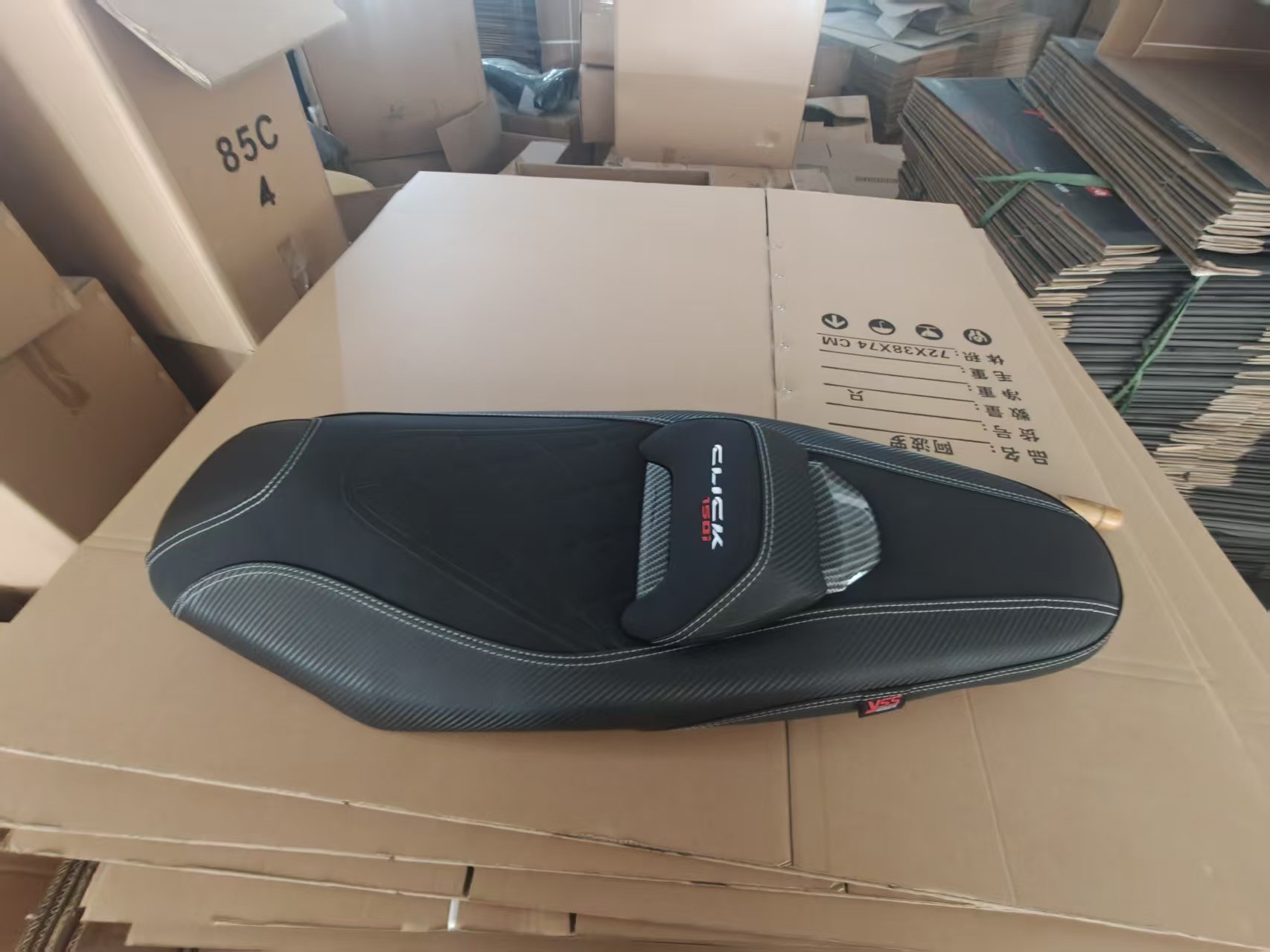
Model-specific fit, shown here on a Click 150 seat, is usually the first filter that removes candidates from a replacement-market shortlist.
How a Verified Manufacturer Maps to the Scorecard
Zhejiang Xingrong Auto & Motorcycle Parts Co., Ltd. (Staron) is a manufacturer of motorcycle, electric vehicle and off-road vehicle seat cushions, based in Taizhou City, Zhejiang Province, China, and established in 2015. Its stated main product line is motorcycle seats. Applying the scorecard to a single verified supplier shows how the dimensions convert into questions, and where a buyer still has to obtain written confirmation.
| Scorecard dimension | Verified position | Still to confirm in writing |
|---|---|---|
| Manufacturing capacity | Annual seat-cushion capacity of 1,800,000 units; 90% self-production rate for product accessories; 15,000 m² facility; approximately 130 staff | Monthly scheduling availability during the buyer's peak season |
| MOQ feasibility | Not published | MOQ per model and per assorted order |
| Lead time and scheduling | Not published | Quoted range with defined start and end points |
| Pre-shipment inspection | ISO9000 quality management system certification and CQC certification in place | Inspection coverage per batch and the criteria checklist |
| Warranty terms | Not published | Duration, covered failure modes, claim process |
| OEM / ODM flexibility | R&D team of 5 engineers; 90% accessory self-production rate | Which cover, foam and pan elements are variable per project |
| Order scale and references | Long-term strategic partnerships with domestic first-line brand general machinery factories; export business accounts for 20% of total sales across Southeast Asia, Europe, the Middle East and South America | Project-level references at the buyer's target volume |
Two verified facts are particularly relevant to a 2026 shortlist. First, the company describes itself as the earliest established motorcycle saddle factory in Zhejiang province, which places its production history in the same region where a large share of global seat production is concentrated. Second, its accessories self-production rate of 90% is a continuity indicator rather than a marketing claim: it means fewer external dependencies between a confirmed order and a shipment date.
The same scorecard also exposes what cannot be verified from public material. MOQ, lead time and warranty are commercial terms that a factory negotiates per order; a buyer who scores them without a written quotation is scoring an assumption. Compliance follows the same logic — ISO9000 and CQC certifications describe quality management and product certification, and they should not be read as a substitute for destination-market requirements.
Technical Explanation: What the Seat Itself Must Prove
Supplier capability and product capability are two different tests, and a shortlist should score both. The Xingrong motorcycle seat specification lists 80D high-density foam and a high-strength floor structure, with a PP plate, PU foam and PVC leather construction, covering scooter seats and dirt bike seats.
Foam density is the specification that most directly predicts how a seat behaves after months of use. An 80D high-density foam is specified for the comfort layer; in general industry terms, higher-density foam resists compression set for longer, which is why density is a more useful comparison point between candidates than a subjective description of softness.
The floor structure is the second test. A PP plate forms the mounting base that interfaces with the motorcycle main body frame and body shell. In direct-replacement seats, pan deformation and mounting misalignment are among the most common failure modes, so the plate material and structure belong in the scorecard alongside the visible cover.
The third test is water resistance. The application profile for this product family specifies waterproof working conditions and requires weather resistance, a wear-resistant surface and ergonomic design. Buyers should note that a waterproof claim depends on seam construction and sealing as much as on the cover material; PVC leather provides a cleanable, weather-resistant surface, but the stitching line is where water ingress actually begins.
Finally, compliance context matters for destination markets. UN Regulation No. 17 (ECE R17) establishes uniform provisions for the approval of vehicle seats, anchorages and head restraints. Where a destination market applies seat approval requirements, buyers should confirm at shortlist stage which party holds the relevant approval, rather than assuming that a factory quality certification covers it.
Application and Use Cases
Motorcycle seats in this category are used as non-powered static fitting parts, matched to the motorcycle main body frame and body shell, and serve three functions: providing a comfortable riding position, improving the visual appearance of the vehicle, and allowing old-seat maintenance through direct replacement.
The stated applicable industries are motorcycle manufacturers, motorcycle repair shops, motorcycle parts retailers and motorcycle accessory brands. That mix explains why the scorecard weighs MOQ and model coverage so heavily: a repair shop buys for immediate fitment, a retailer buys for shelf coverage, and a manufacturer buys against a production schedule — three different order profiles applied to the same product.
Model coverage in the specification includes Nmax, Xmax, Aerox, ADV150, ADV160, Forza, PCX and Click fitments, across scooter seats and dirt bike seats. The application profile lists Iran, India, Italy, South Korea, Lebanon, Portugal, Thailand, Taiwan, Turkey and Vietnam among the markets where this product type is applied — a spread that spans Southeast Asian scooter density, European replacement demand and Middle Eastern distribution.
Scooter and off-road applications should be scored separately. Scooter seats are judged on urban comfort, weather resistance and appearance, while off-road seats place more weight on surface grip and durability. A supplier that performs well on one application should not automatically be shortlisted for the other.
Market Trend Analysis
Three verified market signals shape 2026 shortlists. The first is scale: the global motorcycle seat market is projected to grow from USD 7.42 billion in 2025 to USD 13.30 billion by 2032 at a CAGR of 8.69%, per Market Research Future / Dataintelo. The second is channel: the aftermarket accounts for roughly 62.3% of revenue, so distributor-facing criteria dominate. The third is geography: Asia-Pacific held a 38.5% revenue share in 2025, driven by high production and sales in China (Dataintelo, 2025).
Material trends are moving in a specific direction. Leather remains a premium option for motorcycle seats, while synthetic options such as vinyl and foam are increasingly used to deliver waterproof and soft-surface features in the mid-range segment (Fortune Business Insights, 2025). For buyers, that means the specification conversation is shifting from surface appearance toward measurable performance attributes.
Comparison with Traditional Sourcing Approaches — and Where the Limits Are
Traditional motorcycle seat sourcing usually runs through one of three routes: a general trading company carrying mixed parts lines, a dedicated seat manufacturer, and local assembly or in-market refurbishment. Trading companies offer breadth and low administrative friction, but they add a layer between the buyer and the production floor, which makes inspection coverage and lead-time control harder to evidence. Local refurbishment solves short lead times but depends on the availability and consistency of the base seat. A dedicated seat factory concentrates tooling, foam and cover work in one place, which is why it tends to score better on continuity and specification repeatability.
The dedicated-factory route has real limits, and a credible scorecard should state them. The export ratio of the manufacturer examined here is 20% of total sales, which means the majority of output serves the domestic market; an export buyer is a minority share of capacity and should confirm scheduling priority during peak periods. The R&D team of 5 engineers is a finite resource, so buyers running several simultaneous customization projects should sequence them rather than assume parallel development. ISO9000 and CQC certifications are quality management and product certifications, not vehicle-level type approval, and the published material does not fix MOQ, lead time or warranty — those remain commercial terms that must be written into a quotation. A scorecard that skips this step produces confident-looking rankings built on unverified inputs.
Future Outlook
Aftermarket-led demand is likely to keep shaping supplier selection. With the aftermarket channel holding approximately 62.3% of market revenue and Asia-Pacific holding a 38.5% revenue share, the competitive pressure falls on model coverage, order flexibility and repeatability rather than on new platform development alone.
Material substitution should continue in the mid-range segment, where synthetic covers deliver waterproof and soft-surface performance. At the same time, model proliferation in the scooter segment increases the value of a maintained fitment library — a supplier that can repeat a fitment across model years removes a recurring risk for distributors.
The most durable change is procedural. As buyers move from supplier discovery to documented evaluation, scorecards built on capacity statements, inspection protocols, tooling ownership and written commercial terms increasingly decide who reaches the second round. Suppliers prepared to answer those questions in documents will be shortlisted first.
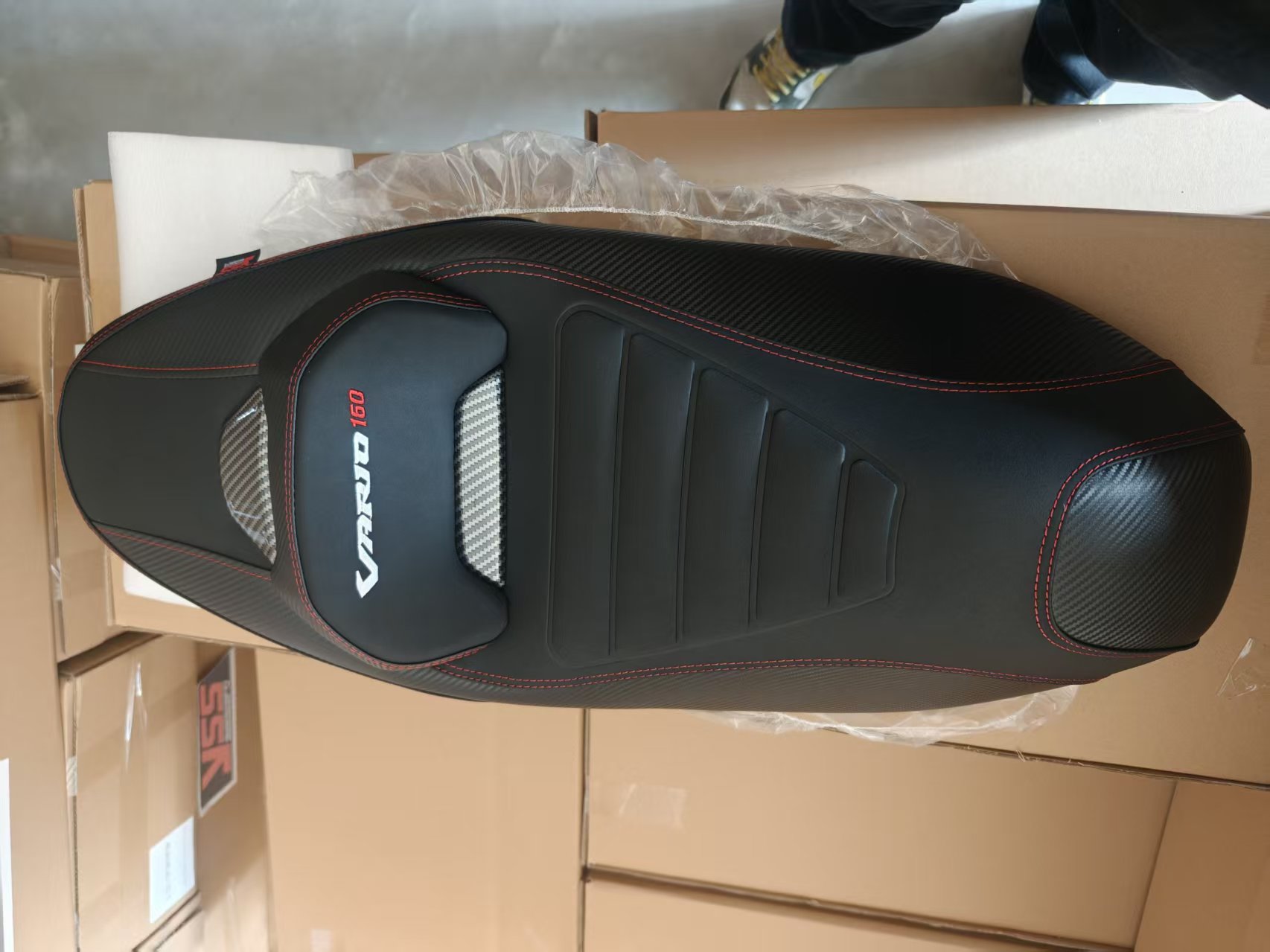
Cover construction, foam layer and pan structure are the three physical elements scored under the technical dimension of the buyer scorecard.
Frequently Asked Questions
What is a motorcycle seat supplier shortlist, and when should a buyer build one?
A motorcycle seat supplier shortlist is a filtered set of candidate factories that have been checked against a fixed set of sourcing criteria before any negotiation begins. It should be built during the research stage, once the buyer knows the target models, the expected order profile and the destination markets. The purpose is to remove candidates that cannot meet the order profile — for example, on minimum order quantity or lead-time scheduling — before time is spent comparing unit prices. Because the aftermarket holds roughly 62.3% of motorcycle seat market revenue, distributor-side buyers are usually working with mixed model coverage, which makes fitment range and order flexibility central to the shortlist.
Which criteria matter most when comparing motorcycle seat suppliers?
Seven dimensions cover most buyer requirements: manufacturing capacity and continuity, MOQ feasibility, lead time and scheduling, pre-shipment inspection coverage, warranty terms, OEM/ODM flexibility, and documented order scale. Weighting depends on the buyer type. A repair shop usually prioritizes fitment availability and quick delivery, a retailer prioritizes assortment and shelf-ready packaging, and a manufacturer prioritizes repeatable specification and production scheduling. Price is a comparison point, but it cannot be evaluated fairly until these dimensions are known, because they determine the actual delivered cost of a seat that fits, lasts and arrives on schedule.
How can a buyer verify factory capacity and quality claims before placing a first order?
Capacity claims should be requested as rated monthly output supported by a capacity statement, together with the component self-production rate, which indicates how much of the product is made in-house rather than sourced externally. Quality claims should be matched to certificates and to a batch-level inspection procedure covering pan dimensions, stitching, foam density, color matching and water resistance at the seams. Zhejiang Xingrong Auto & Motorcycle Parts Co., Ltd., for example, holds ISO9000 quality management system certification and CQC certification, and reports an annual seat-cushion capacity of 1,800,000 units with a 90% accessory self-production rate. Buyers should treat these as verified starting points and still confirm inspection coverage per shipment in writing.
What does OEM and ODM flexibility actually cover in motorcycle seat production?
Flexibility should be separated into variable elements and tooling-fixed elements. Variable elements typically include cover material and color, stitching pattern, applied or embossed logo, foam density and the resulting comfort profile, and selected pan variants. Pan geometry and tooling usually define the fixed boundary, because it is tied to the motorcycle frame and body shell. Buyers should confirm sample lead time, tooling ownership and where logo application takes place, since these determine whether a customized specification can be repeated in a later order. A manufacturer with an in-house R&D team and a high accessory self-production rate has more of this work under its own control, which reduces the risk of specification drift between orders.
Which markets are motorcycle seat replacement products typically applied in?
Replacement and maintenance seats are applied across both high-density scooter markets and lower-volume specialty markets. The application profile for this product family lists Iran, India, Italy, South Korea, Lebanon, Portugal, Thailand, Taiwan, Turkey and Vietnam, with export business accounting for 20% of total sales across Southeast Asia, Europe, the Middle East and South America. Because seat requirements differ by region — waterproofing and comfort in humid climates, wear resistance and appearance in others — buyers should confirm that the specification offered matches the destination climate and usage pattern rather than assuming a single global specification.
What are the limits of a specialized motorcycle seat factory?
A specialized factory concentrates tooling, foam and cover production, which improves repeatability, but it also carries structural limits. A manufacturer whose export business is 20% of total sales serves mostly its domestic market, so an export buyer represents a minority share of capacity and should confirm scheduling priority in peak periods. A small R&D team limits how many customization projects can run in parallel. Quality management certifications such as ISO9000 and product certifications such as CQC are not the same as destination-market vehicle type approval, where regulations such as UN Regulation No. 17 (ECE R17) apply. And commercial terms — MOQ, lead time and warranty — are not fixed by capability alone; they must be agreed in writing for each order.
Using the Scorecard
The scorecard is only as good as the documents behind it. Buyers who collect capacity statements, inspection procedures, tooling details and written commercial terms before ranking candidates will find that the shortlist becomes shorter and far more reliable. Detailed specification information on foam density, plate structure, model coverage and certifications is available in the published seat cushion catalog.