
Motorized Cover vs Easy Lift Cover: Spa Project Buyer Guide
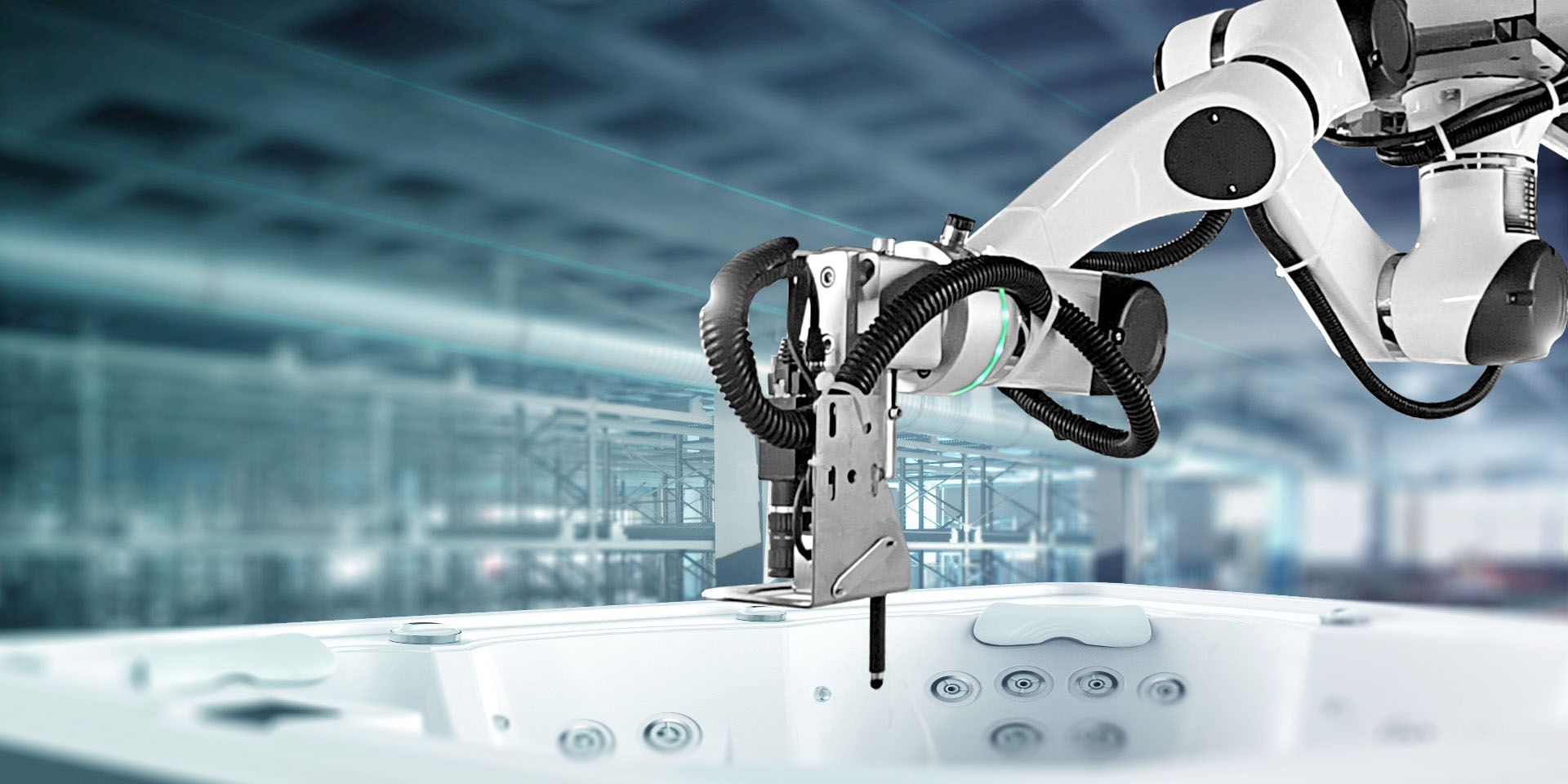
A covers decision rarely gets the same attention as jets, pumps or shell design, yet it decides how often a spa is actually used. When an OEM or ODM spa project moves from concept to delivery, the cover specification often becomes the last line item—and the one most likely to be revisited by end users. This buyer guide compares two paths: a generic motorized cover system and the Easy Lift Cover platform, using only verifiable product and compliance facts. It is written for importers, distributors and brand owners who need to evaluate frequent-use value, insulation expectations and integration into spa projects without relying on supplier marketing claims.
Why the Cover Decision Separates Two Kinds of Spa Project
Spas are increasingly sold on a wellness promise that depends on daily or near-daily access. The distance between a spa that is used three times a week and one that is used a few times a year is often not the massage quality—it is the effort required to open and close the cover. In project-based procurement, this is where two distinct sourcing strategies appear: buying a powered cover mechanism as a generic component, or buying a complete, integrated cover platform that includes thermal structure, powered lifting and safety logic in one specification.
Both approaches can work. They differ in deployment complexity, electrical protection expectations, sealing and insulation performance, maintenance routines, and how comfortably they fit into OEM/ODM documentation. The evaluation below treats each criterion separately so project buyers can match the choice to the spa category and target market rather than to a single supplier narrative.
Defining the Two Options Clearly
A motorized cover is an electrically powered cover system that automates the opening, closing or movement of a hot tub or swim spa cover. The system generally consists of an electric motor, drive mechanism, control components and cover structure. When activated, the motor drives the mechanism to move the cover between open and closed positions, reducing the physical effort required to handle the cover.
The Easy Lift Cover is a specific implementation of that concept: a complete insulated geothermal cover combined with built-in powered lifting. In the same product family, the Easy Lift System is a retrofit lifting and control solution designed to upgrade a compatible existing hard spa cover without replacing the thermal structure. Buyers evaluating the category therefore face three sub-choices: a generic powered mechanism, a complete integrated cover, or a retrofit upgrade. This article focuses on the first two, with retrofit noted where it changes the deployment decision.
Deployment: New-Build vs Retrofit Readiness
The first practical difference appears at the installation site. A complete powered cover platform is normally specified early in a new-build spa project so that foundation, drainage, electrical routing and cover travel clearance can be planned together. Because the lifting columns and cover structure share a mounting base, the site preparation step carries most of the deployment risk.
For a project using the Easy Lift Cover platform, the stated installation requirements are concrete and measurable. The installation surface must have a load-bearing capacity of at least 800 kg/m², with a recommended level concrete base of at least 100 mm thickness or an equivalent high-strength weather-treated outdoor decking. Drainage around the column bases must remain clear, and the cover travel path must be free of obstruction before commissioning. The lift columns must ultimately be installed vertically with a deviation of no more than 1°.
A generic motorized cover mechanism may allow more flexibility in cover sourcing, because the lifting hardware can be paired with third-party thermal covers. That flexibility has a cost: the installer and project engineer must verify compatibility between the chosen lifting mechanism, the cover weight, the rim geometry, the electrical supply and the safety logic themselves. When a project uses a retrofit route, the Easy Lift System is described as suitable for spas under 3.5 m and can be installed in under two hours, which changes the site-work profile considerably compared with a full platform build.
Electrical Protection: What the Specifications Actually Require
Powered covers sit in a wet, outdoor environment, so electrical protection is not a secondary concern. For the Easy Lift Cover platform, the documented electrical requirements are specific enough to design against. The installation must go through an independent circuit breaker, an RCD/GFCI and reliable grounding, with live, neutral and protective earth conductors connected correctly and securely by qualified personnel. Extension cords, power strips and multi-outlet adapters are explicitly excluded from the approved installation. The cover must be isolated before installation, maintenance or servicing.
For the motorized cover product line represented by the MC4A platform, the published operating parameters provide a useful reference for project planning:
- Voltage: 230V / 50Hz
- Power: 260W
- Amperage: 1.7A
- Electric shock protection grade: A
- Waterproof grade: IP54
- Ambient temperature range: -20°C to 50°C
- Lift height range: 1230–3000 mm
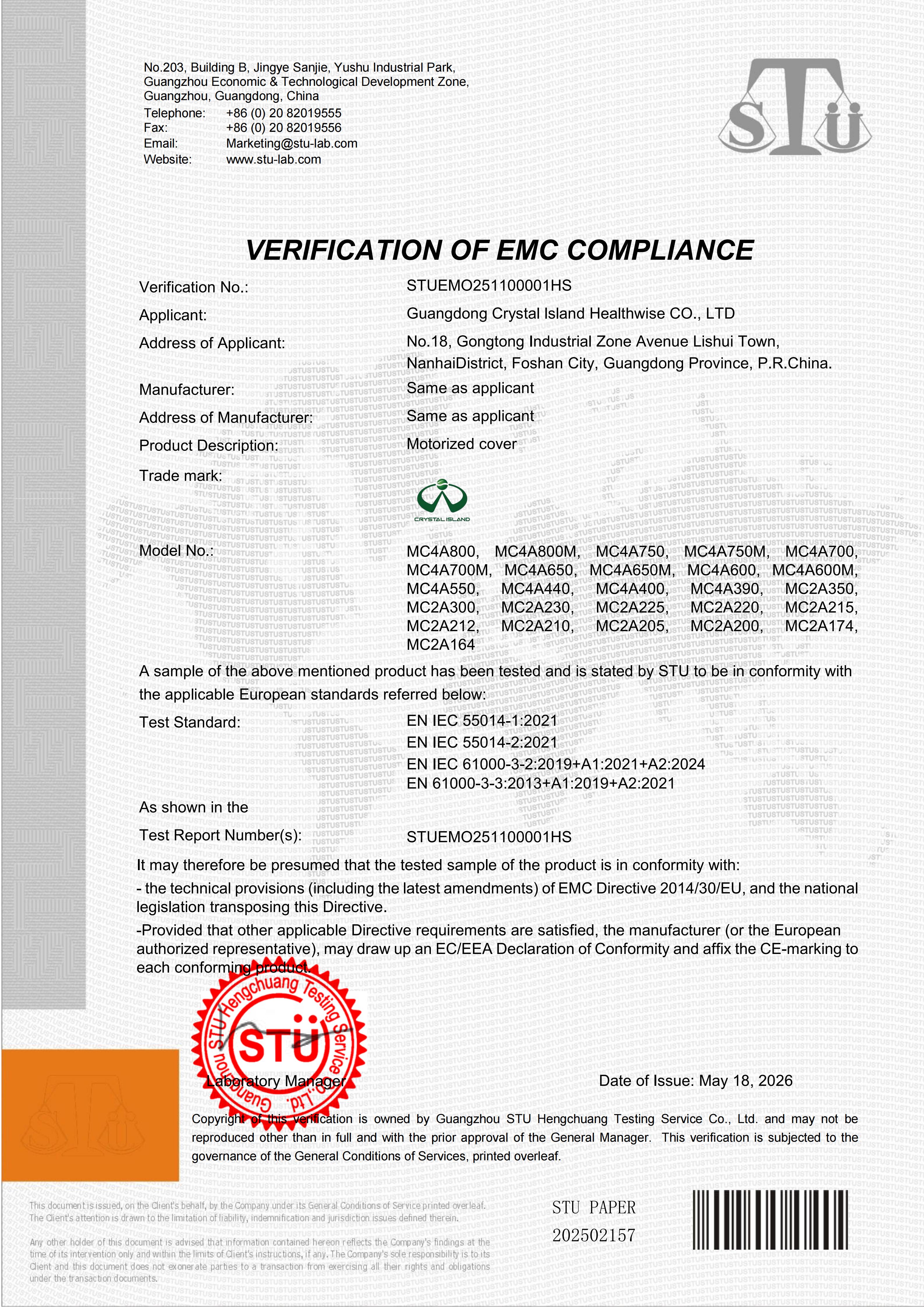
The same product line is covered by EU compliance documentation for the motorized cover scope, including CE-LVD verification under EN 60335-1, EN IEC 60335-2-60:2023+A11:2023 and EN 62233:2008, and CE-EMC verification under the EN IEC 55014 series and EN 61000-3 series. The certified model scope is broad, spanning MC4A800 through MC4A390 and MC2A350 through MC2A164, which matters for distributors who need to match a certificate to a specific spa length rather than to the product family as a whole.
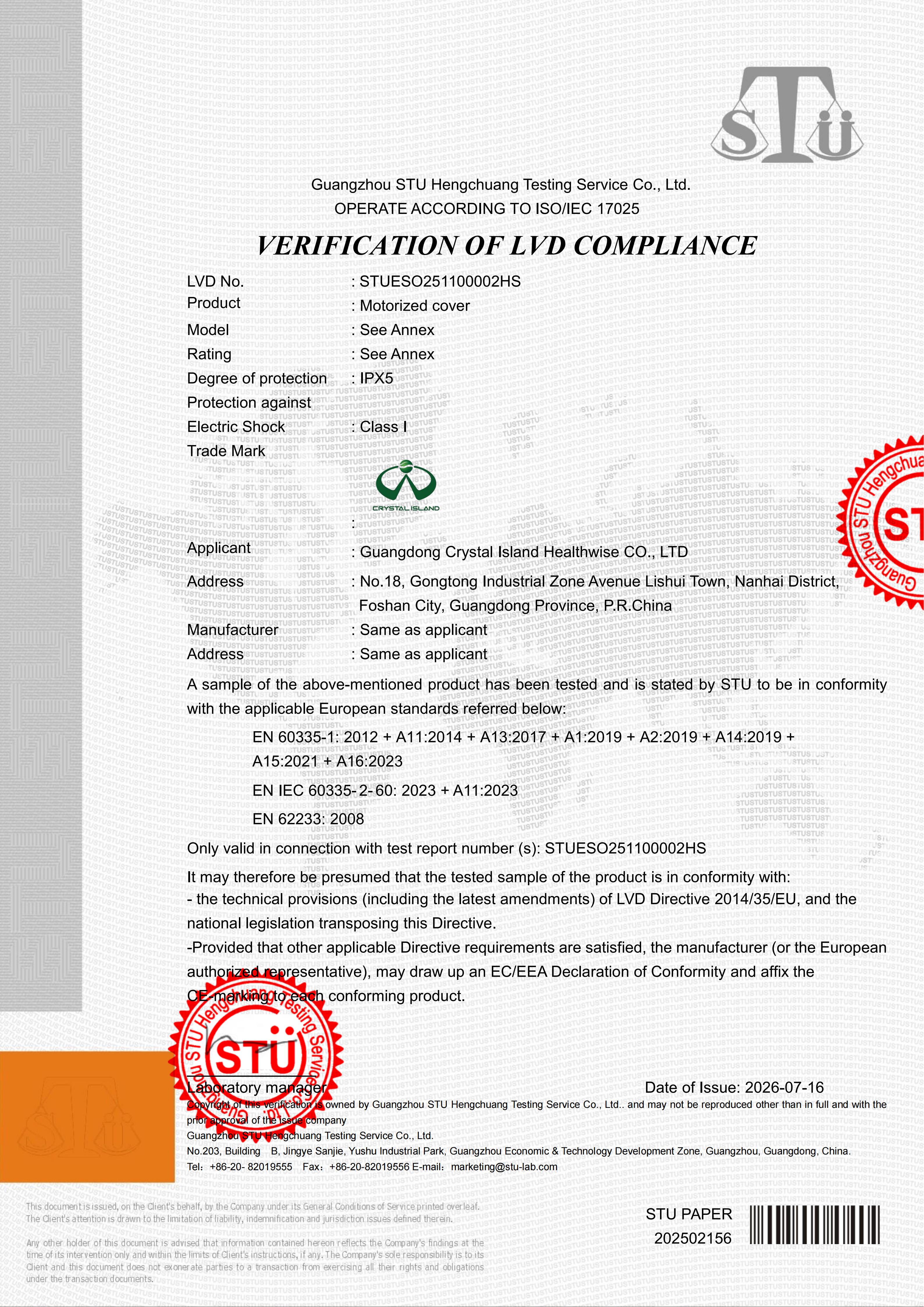
The practical buyer takeaway is that a generic motorized mechanism may be electrically sound in isolation but still require site-specific risk assessment if its certificate scope does not match the actual model, motor and control configuration. Matching the exact product configuration to the certificate scope is therefore a procurement step, not an afterthought.
Sealing and Insulation: Separating Lifting from Heat Retention
One of the most common misconceptions in cover procurement is that motorization itself improves thermal performance. It does not. Heat retention depends on the insulated core, the sealing strips, the fit to the spa rim, and the condition of the cover. A powered lifting mechanism changes how the cover moves, not how well it insulates.
The Easy Lift Cover specification addresses this directly. The supplied complete cover uses a thick insulated core and sealing strips intended to reduce heat loss and protect the spa from weather and debris. A D-shaped sealing strip is installed along the spa rim and reinforced so that it remains compressed against the cover underside, with a semi-annual seal inspection recommended. Leakage risks are linked to detached sealing strips, panel deformation or cracking, and aluminium profile damage. This means buyers should evaluate the seal as a maintenance item with its own inspection cycle, not as a one-time installation detail.
Where the cover platform is paired with a retrofit lifting mechanism instead of a new thermal cover, the insulation performance depends entirely on the existing cover condition. If the existing hard cover is worn or poorly insulated, replacing only the lifting mechanism does not solve the thermal-cover problem. Buyers sourcing for a new spa project therefore usually get more predictable insulation from the complete cover route, while retrofit buyers should inspect the existing cover before committing.
Frequent-Use Value: When the Motorized Route Pays Back
The value of powered lifting scales with two variables: how often the spa is opened and closed, and how large or heavy the cover is. For a spa used daily or several times a week, the effort saved per session compounds quickly. For a large swim spa, the cover dimensions make manual handling more demanding even when the cover is well maintained, so powered operation has a stronger practical case.
The same logic applies in commercial settings. A hotel, resort, gym or wellness centre operating a shared spa throughout the day needs cover movement that is repeatable and independent of staff physical capability. In the Easy Lift Cover safety specification, one-touch opening, Hold-to-Run closing, audible warning during lowering, anti-pinch stop and reverse of approximately 300 mm, overload protection, synchronized lifting and secure positioning during power loss all support that shared-use scenario. These are not features that change the massage experience—they change whether the cover is actually used between sessions.
Manual covers remain a reasonable choice when the spa is opened less often, the cover is modest in size, or the owners are comfortable with the physical handling. Buyers should treat the powered cover decision as a fit-to-use-pattern question rather than a category upgrade.
Maintenance Checks That Belong in the Purchase Decision
Maintenance requirements are easier to compare when they are written as a schedule rather than as a vague service promise. For the Easy Lift Cover platform, the documented preventive-maintenance cycle includes a full-cycle synchronization test every month, a column verticality inspection every three months, an electrical and seal audit every six months, and a comprehensive maintenance every twelve months, with an initial inspection after one month. Guide rails are lubricated with lithium-based grease, typically once a year in early autumn, and high-pressure washers are excluded from column and electrical-component cleaning.
Several operating limits are also stated. The cover should not remain raised for more than 12 consecutive hours to avoid permanent deformation. It should not be operated in strong winds above approximately 35 km/h, heavy rain, thunderstorms or snowfall, and it should be completely free of snow, ice and debris before any movement. When the spa is not in use or is left unattended, the cover should be lowered fully.
A generic motorized mechanism may have its own maintenance requirements, but the schedule is usually defined by the lifting-hardware supplier and may differ from the thermal-cover maintenance cycle. Buyers comparing options should ask whether the maintenance schedule is documented as a single integrated document or split across two suppliers, because split responsibility becomes an issue during warranty discussions.
Integration into OEM/ODM Spa Projects
For an OEM or ODM spa programme, the cover is not only a consumer-facing accessory—it is a documentation and logistics item. The cover size must be matched to the spa's actual overall dimensions rather than to the commercial model name. The Easy Lift Cover range includes standard sizes across hot tub and swim spa applications, with compatible cover dimensions that extend to approximately 8095 mm applicable product length. Project buyers should confirm length, width and product height together, then match them to the corresponding compatible cover size and lift height.
Customisation scope for the broader spa platform is documented as standard mould production with acrylic and cabinet colours selected from available options, plus logo printing and configurable options for control systems, water treatment, insulation and additional features. Cover customisation should be treated as a separate engineering review because changes to cover dimensions, lift height, column design, motor, controller, limit logic, anti-pinch behaviour or electrical rating can affect structural loading, synchronization and compliance. Light branding changes—logo, labels, packaging, model naming—carry the lowest technical impact; mechanical or electrical changes require integrated review.
In project terms, an OEM buyer should ask three questions before committing to a cover specification:
- Does the exact cover model appear on the current certificate scope for the target market?
- Does the cover size and lift height match the actual spa dimensions, not just the model name?
- Are the installation foundation, drainage and clearance requirements compatible with the project site?
These questions apply equally to a generic motorized cover and to the Easy Lift Cover platform. The difference is whether the answers come from a single integrated specification or require reconciling two suppliers' documentation.
Side-by-Side Evaluation Criteria
| Criterion | Generic Motorized Cover | Easy Lift Cover Platform |
|---|---|---|
| Deployment | Flexible, but compatibility between lifting hardware and thermal cover must be verified by the project team | Documented foundation, drainage and verticality requirements; retrofit system available for compatible existing covers under 3.5 m |
| Electrical protection | Site-specific; supplier documentation may cover only the lifting mechanism | Circuit breaker, RCD/GFCI and grounding specified; extension cords and power strips excluded; certified MC4A scope published |
| Insulation | Depends entirely on the chosen thermal cover, which may be sourced separately | Integrated insulated core and sealing strips; D-shaped seal with semi-annual inspection |
| Safety logic | Varies by supplier | Hold-to-Run closing, anti-pinch reverse ≈300 mm, audible warning, overload protection, synchronized lifting, power-loss positioning |
| Maintenance schedule | Supplier-dependent and may be split between hardware and cover | Documented monthly, quarterly, semi-annual and annual cycle with guide-rail lubrication |
| OEM/ODM flexibility | Broad, because components can be mixed, but with higher integration review | Light branding changes straightforward; mechanical and electrical changes require engineering and compliance review |
Honest Limits of the Powered Cover Route
A buyer-oriented comparison has to state where the powered cover route does not fit. Three limits are worth putting in front of the project team before the specification is locked.
First, a powered cover depends on electrical power. The Easy Lift Cover platform is designed to hold a secure position during power loss, but it cannot open or close while the supply is off. Projects without reliable power at the spa site, or with frequent outages, should plan for manual handling fallback rather than assuming the powered route is always available.
Second, the powered route is not universal. A single cover size cannot be stretched across all spa dimensions. Compatibility depends on spa length, width, height, lift height, rim geometry, installation clearance and foundation—not spa length alone. Projects with non-standard spa footprints will require exact dimensions, photographs and engineering confirmation before an order can be placed.
Third, powered covers do not replace thermal-cover maintenance. The cover still needs regular cleaning, seal inspection, guide-rail lubrication and panel integrity checks. Buyers who prefer a low-maintenance specification should compare the total recurring effort, not only the opening effort. Manual covers have a simpler mechanical structure and no electrical dependency, which is a genuine advantage in some projects—particularly smaller spas with infrequent use.
Market Context for the Decision
The global hot tub market is valued at USD 5.76 billion in 2025, and North America holds the largest share at 41.84% in the same year, according to Fortune Business Insights. The same market research source classifies hot tubs and swim spas under HS Code 9019.10. These figures frame the cover decision as part of a larger procurement category, not a niche accessory.
In parallel, brands such as Crystal Island Group present the spa and wellness category as a portfolio business, with the group describing itself as a manufacturer of spas and swim spas in China and identifying Riptide and Oasis Spas as product brands and BETA Wellness as a channel brand. The group states that its operations span more than seventy countries and regions. For project buyers, this matters less as a scale claim and more as a signal about documentation availability: a multi-market manufacturer is more likely to have certification scope, installation guidance and spare-parts planning that a distributor can reuse across markets.
The practical market signal for the cover decision is not market size—it is the direction of buyer expectations. Spas are increasingly specified for year-round, frequent-use wellness routines, and that use pattern is what makes powered covers a serious procurement line rather than a convenience upgrade.
Future Outlook
Three trends are likely to shape cover procurement over the next few product cycles. First, safety documentation will continue to consolidate around a single integrated system specification, because installers and distributors cannot easily maintain two compliance folders for the same spa. Second, OEM and ODM buyers will keep separating light branding changes from mechanical and electrical changes, because certification scope and structural validation are increasingly tied to the exact configuration. Third, buyers will continue to ask for installation requirements—foundation load, drainage, clearance and verticality—as part of the initial quotation rather than as an installation-stage surprise.
A fourth trend is worth noting but should not be overstated: as swim spa lengths extend and hot tub configurations become more varied, cover sizing will move further away from model-name matching and toward exact dimension matching. Buyers who build that discipline into their project intake process will see fewer order changes and fewer warranty disputes.
Frequently Asked Questions
Which motorized cover option should I buy?
Selection follows a sequence: cover status → spa type → dimensions → cover size → lift clearance → electrical conditions → safety → insulation and weather needs. Choose a complete integrated cover when the project is new or when the existing thermal cover also needs replacement. Choose a retrofit lifting system when the existing hard cover is compatible and in good condition, and only powered lifting is required within the retrofit range.
Is a motorized cover worth it for frequent use?
The more frequently a spa is opened and closed, and the larger or heavier the cover is, the greater the practical value of powered lifting. Motorized lifting is particularly useful when the spa is used frequently, the cover is large, one person often operates it alone, or reducing manual lifting effort is important. The trade-off is the electrical dependency and the recurring maintenance schedule that comes with a powered system.
Is the Easy Lift Cover insulated?
For the complete Easy Lift Cover, evaluate the thermal cover itself as well as the lifting system. The supplied product uses a thick insulated core and sealing strips intended to reduce heat loss and protect the spa from weather and debris. Motorization itself does not automatically make a cover more thermally efficient; heat retention depends on the insulated core, sealing, fit and condition of the cover.
Is the motorized spa cover safe?
For a powered spa cover, prioritise controlled closing, obstruction detection, stable synchronized lifting and emergency access rather than choosing by lifting convenience alone. The supplied Easy Lift safety system includes built-in overload protection, synchronized balanced lifting, secure position during power loss, audible closing alerts, hold-to-close control, anti-pinch stop and reverse by approximately 30 cm, and an emergency escape hatch.
Can the motorized cover operate outdoors in winter?
The supplied Easy Lift specifications list 230V / 50Hz, IP54 protection and an ambient operating range of -20°C to 50°C. Confirm electrical supply and outdoor operating conditions before installation, and keep the cover completely free of snow and ice before any movement. The cover should not be operated in strong winds above approximately 35 km/h, heavy rain, thunderstorms or snowfall.
What dimensions do I need before ordering?
Select the motorized cover by the spa's actual overall dimensions, not simply by model name. Confirm length, width and product height, then match them to the corresponding compatible cover size and lift height. The Easy Lift Cover range offers standard sizes across hot tub and swim spa applications, including compatible swim spa lengths up to approximately 7985 mm applicable product length.
Company documentation referenced in this article: Crystal Island Hot Tub & Swim Spa Manufacturer Company Profile (PDF).
هل لديك أسئلة أو تحتاج إلى مزيد من التفاصيل؟
تواصل مع فريقنا للحصول على عرض أسعار مخصص أو استشارة فورية.
طلب عرض أسعار
املأ النموذج أدناه وسيتواصل معك فريقنا بعرض مقترح مخصص.
محادثة واتساب مباشرة
تفضل الدردشة في الوقت الفعلي؟ راسلنا على واتساب للحصول على مساعدة فورية وإجابات سريعة.
- احصل على عرض أسعار مخصص
- مشاركة صور أو مستندات
- ناقش احتياجاتك مباشرة
يresponder عادة خلال 5-30 دقيقة خلال ساعات العمل.