
Multi-Curved vs. Single-Curved Glass: A Cost-Benefit Analysis for 2026 Building Projects
Why Multi-Curved Glass Dominates Complex Façade Decisions
For procurement professionals evaluating building glass options for landmark façades, the choice between multi-curved and single-curved glass is not merely aesthetic—it directly impacts project budgets, installation timelines, and long-term building performance. DYGLASS, a Shenzhen-based architectural glass manufacturer (Shenzhen Dayang Special Glass Co., Ltd.), specializes in multi-curved glass that delivers measurable advantages over standard single-curved alternatives, particularly in total cost of ownership and structural reliability.
The Cost Truth: Lower Total Project Spending
Conventional wisdom suggests that multi-curved glass is more expensive per square meter. While the initial material and processing cost may be slightly higher, the overall project cost is lower. The critical factor is on-site installation loss: DYGLASS's multi-curved glass controls installation loss within 2%, compared to a 5%–8% loss rate for ordinary curved glass. This difference alone can offset the higher unit cost in projects involving hundreds or thousands of panels, reducing rework, replacement, and labor expenses. Furthermore, the product's service life exceeds 25 years, which is 8–10 years longer than standard single-curved glass, delivering substantial savings in replacement and maintenance costs over the building's lifespan.
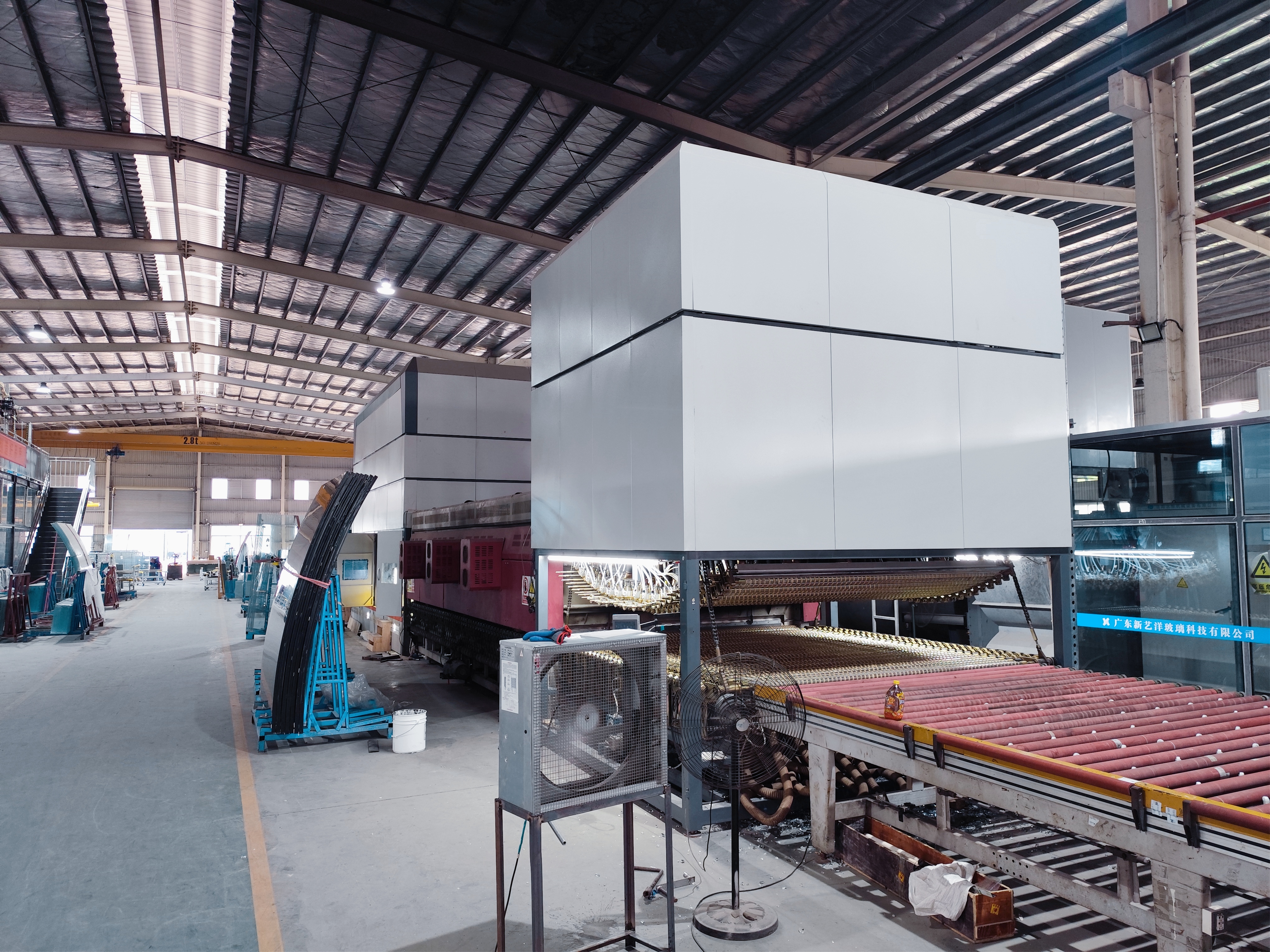
DYGLASS's dedicated tempered line 2 for concave, convex, and irregular curved shapes ensures precision forming and lower defect rates.
Technical Precision: Where Multi-Curved Excels
DYGLASS's multi-curved glass achieves an ultra-precise bending tolerance of ±0.5 mm to ±1 mm, significantly tighter than the industry norm of ±2–3 mm for single-curved products. This precision is enabled by 3/5-axis complex curvature forming technology, allowing the production of free-form spheres, double-curved, and triple-curved panels without distortion. The glass can withstand wind pressures up to 96 kPa, making it suitable for super high-rise buildings over 150 meters. Additionally, the use of ultra-low iron raw material (iron content ≤0.01%) yields light transmittance of 91.6%+, enhancing natural daylighting while maintaining structural integrity.
Installation and Maintenance Efficiency
Because geometry is formed to near-net shape, multi-curved glass reduces on-site fitting challenges. The high precision ensures a matching rate exceeding 99% for replacement panels, whereas poorly toleranced single-curved glass often requires full panel replacement due to mismatch. Sealing and waterproofing also benefit: integrated forming creates strong edge seals, with a fogging or leakage failure rate below 1% within 10 years—compared to standard curved glass, which may develop leaks or fogging within 3–5 years and require re-sealing. Maintenance intervals stretch to 1–2 years for multi-curved glass, versus 6–12 months for single-curved products prone to deformation.
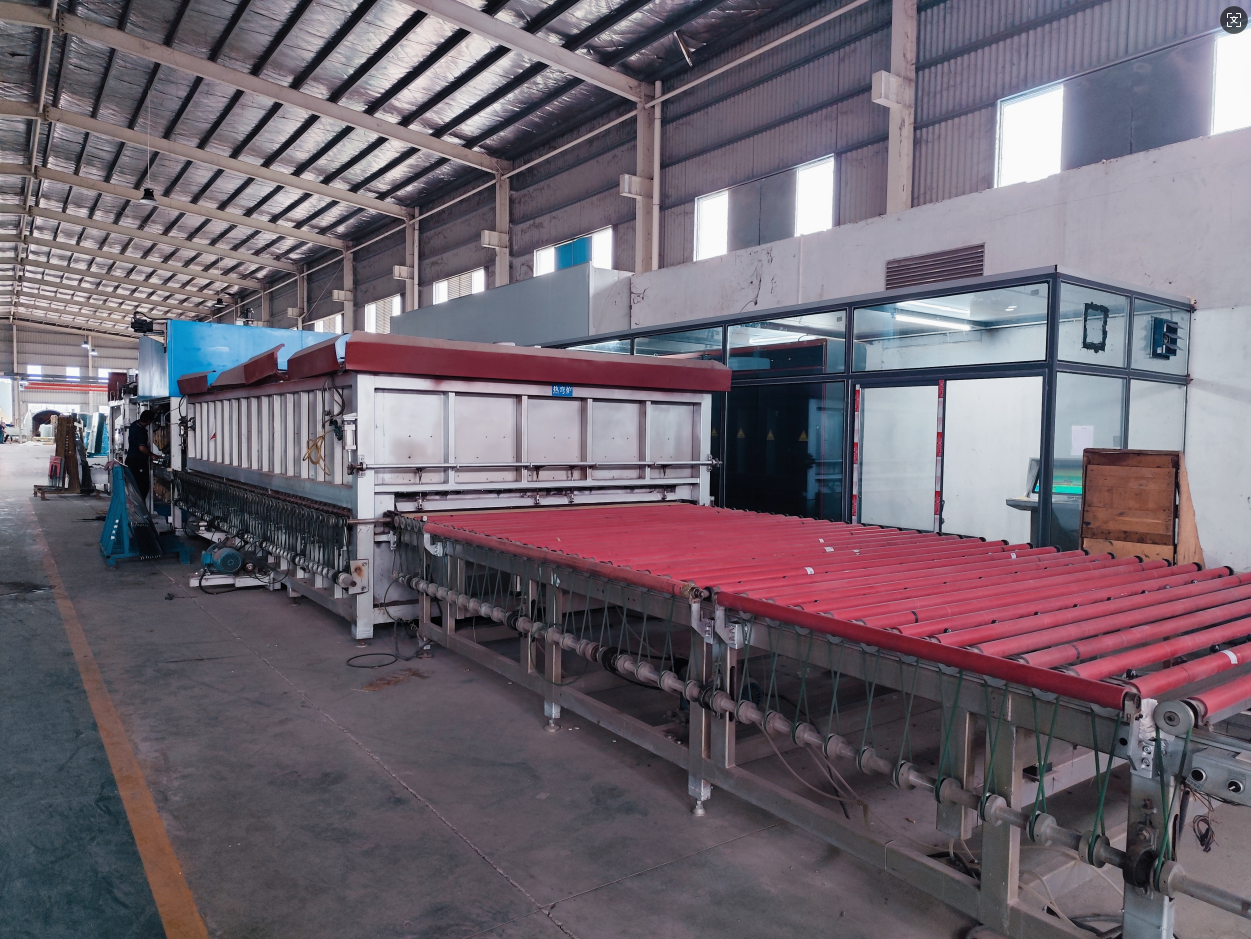
A dedicated double-curved tempering line enables the production of complex, high-strength curved glass panels.
Market Trends and the Shift to Complex Façades
The global construction glass market was valued at USD 119.2 billion in 2025 and is projected to reach USD 189.33 billion by 2034 (Fortune Business Insights). China, as a major producer, exported USD 676 million in glass with edge workings in 2024—22% of global trade (OEC). Architectural glass accounts for nearly 70% of global flat glass production, exceeding 120 million metric tons annually. As demand for iconic, energy-efficient buildings rises, the ability to deliver precise, durable curved glass becomes a competitive differentiator. DYGLASS's 30,000 m² factory with automated 3/5-axis production lines supports bulk orders at 15%–25% lower unit cost compared to manual or semi-automatic processing, making large-scale curved glass projects more viable.
Comparison with Traditional Single-Curved Glass
| Metric | DYGLASS Multi-Curved Glass | Standard Single-Curved Glass |
|---|---|---|
| Bending Tolerance | ±0.5–1 mm | ±2–3 mm |
| Wind Pressure Resistance | Up to 96 kPa | Typically 50–70 kPa |
| Service Life | 25+ years | 8–15 years |
| On-Site Installation Loss | <2% | 5–8% |
| Seal Failure Rate (10 yrs) | <1% | Significant (3–5 yr re-seal) |
One honest limitation: Multi-curved glass carries a slightly higher processing cost per square meter than single-curved glass due to complex forming requirements. However, when factoring in reduced installation loss, longer lifespan, and lower long-term maintenance, the total project cost is typically lower—making it a financially sound choice for high-end, complex façade projects.
Future Outlook
As building codes tighten and architectural ambition pushes envelope complexity, suppliers capable of delivering precision-curved, high-performance glass will be indispensable. The integration of smart glass and energy-saving coatings—both offered by DYGLASS—will further increase demand for multi-curved substrates that can accommodate switchable and Low-E coatings without compromising curvature precision. Procurement decisions today should weigh not only unit price but total cost of ownership, installation risk, and lifecycle performance.
Frequently Asked Questions
How does the cost of multi-curved glass compare to single-curved glass?
How does the service life of multi-curved glass compare to single-curved glass?
What is the installation loss difference between multi-curved and single-curved glass?
How often does multi-curved glass require maintenance compared to single-curved?
Download DYGLASS Corporate Brochure (PDF)
هل لديك أسئلة أو تحتاج إلى مزيد من التفاصيل؟
تواصل مع فريقنا للحصول على عرض أسعار مخصص أو استشارة فورية.
طلب عرض أسعار
املأ النموذج أدناه وسيتواصل معك فريقنا بعرض مقترح مخصص.
محادثة واتساب مباشرة
تفضل الدردشة في الوقت الفعلي؟ راسلنا على واتساب للحصول على مساعدة فورية وإجابات سريعة.
- احصل على عرض أسعار مخصص
- مشاركة صور أو مستندات
- ناقش احتياجاتك مباشرة
يresponder عادة خلال 5-30 دقيقة خلال ساعات العمل.