
Multi-Function Hydraulic Power Unit Fit for Aerial Platforms
Multi-Function Hydraulic Power Unit Fit for Aerial Platforms
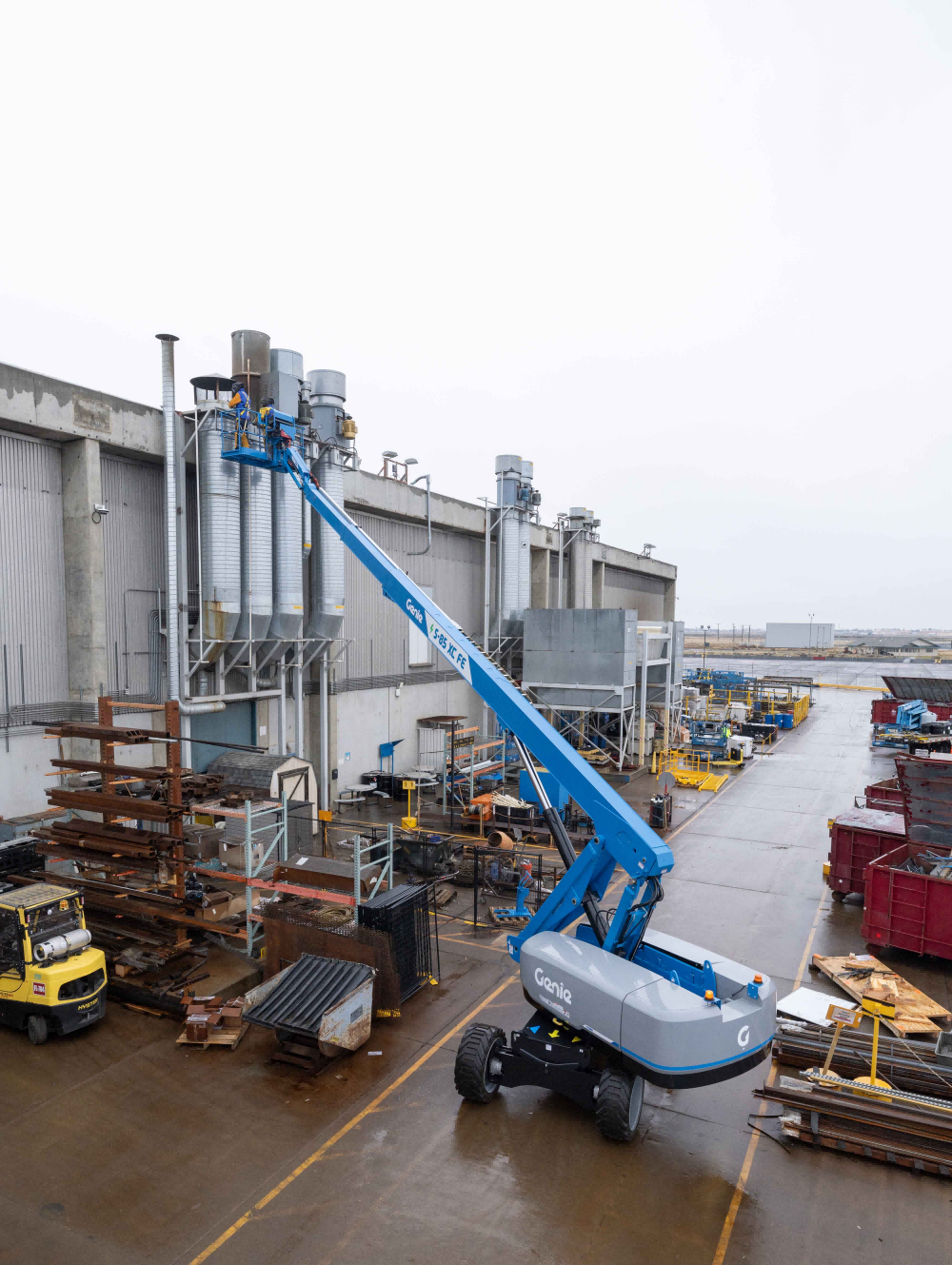
Aerial platform duty is defined by repeated lifting cycles, simultaneous boom and leveling functions, and an installation envelope shared with the chassis, battery pack and control cabinet.
Aerial work platforms are specified around a hydraulic power unit long before a pump model is chosen. A scissor lift may need a lift circuit, a steer circuit and pothole-protection leveling; a boom lift may add platform leveling, jib articulation and outrigger control. The number of hydraulic functions that must move independently, the duty cycle the platform actually runs, and the space left on the chassis decide the specification. A headline pressure rating does not.
This article treats aerial work platforms as a scenario-fit case for custom multi-function hydraulic power units. It shows how platform type translates into function count and circuit requirements, how the APEX-CMFHPU envelope maps onto those requirements, and where the boundary of a multi-function unit sits. It also covers the manufacturing controls that decide whether the specified unit behaves the same way on the five-hundredth delivery as on the first: clean assembly, filtration control, hydraulic oil cleanliness, pressure settings established against the customer's specification, and pre-delivery testing of system pressure.
The Platform Type Determines the Hydraulic Function Count
Function count is the first number that should be fixed in a platform hydraulic brief, because it drives manifold complexity, valve count, reservoir size and control architecture at the same time. A unit built for two functions cannot be upgraded to six by adding software; the manifold, the electrical harness and often the reservoir have to change.
The APEX-CMFHPU is specified across a range of 2 to 8 hydraulic functions, with single-acting, double-acting or combined circuits. That range is wide enough that the same product designation can cover a compact scissor lift and a boom lift with outriggers, which is precisely why the scenario mapping has to be explicit rather than assumed.
| Platform type | Hydraulic functions usually planned | What the power unit must coordinate | Fit boundary to settle early |
|---|---|---|---|
| Scissor lift | Lift/lower, steering on drive models, pothole protection, optional deck extension | Load holding on the lift circuit, controlled lowering speed, compact reservoir | A gravity-down, single-acting lift reduces function count and valve cost |
| Articulating boom lift | Boom lift, riser, jib, platform leveling, steering, outriggers on rough-terrain models | Independent simultaneous functions, leveling accuracy, holding valves on boom circuits | Highest function count in the family; modular manifold preferred |
| Telescopic boom lift | Boom lift, boom telescope, platform leveling, steering, outriggers | Higher flow for the telescope circuit, stable pressure during combined motion | Double gear pump configuration may be needed for two flow demands |
| Vertical mast lift | Mast lift, leveling, outriggers or stabilizers | Low flow, compact envelope, quiet operation indoors | Small function count; a multi-function unit may be oversized |
| Trailer- or vehicle-mounted platform | Lift, outrigger deployment, chassis or platform leveling | 12 or 24 VDC supply, IP-rated enclosure, chassis-mounted reservoir | Weather exposure and vibration duty drive the enclosure and mounting choice |
The table is a planning aid rather than a product classification. Actual function loads depend on the machine design, and a builder that adds an outrigger set or a jib late in development is adding circuits, not accessories. That is the point at which the power unit specification has to be reissued.
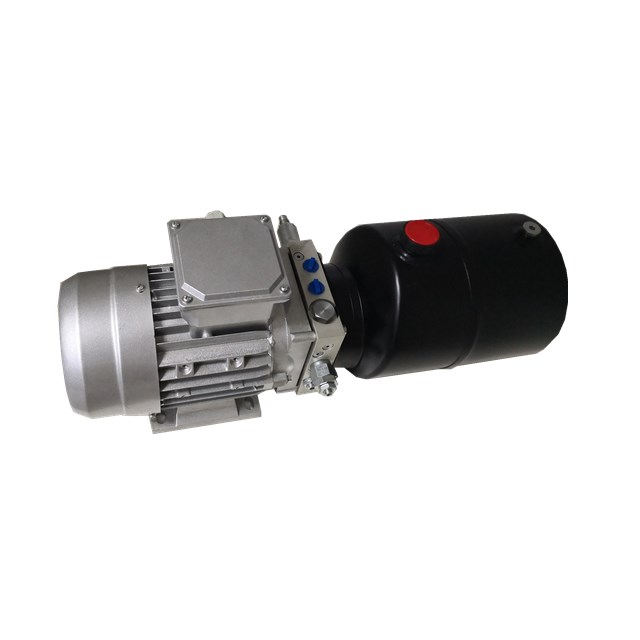
A custom multi-function unit integrates motor, gear pump, manifold, valve cartridges and reservoir into one assembly, which reduces external hose runs and the leak points that come with them.
What the APEX-CMFHPU Envelope Covers
Apex Hydraulic Co., Ltd. is a Chinese manufacturer, established in 2009, producing custom hydraulic cylinders, hydraulic power units, hydraulic systems and hydraulic components for equipment manufacturers, distributors and solution providers. Its APEX-CMFHPU is a custom multi-function hydraulic power unit configured for aerial work platform applications: 2 to 8 hydraulic functions, 12, 24 or 48 VDC supply, motor power from 0.8 to 4.0 kW, flow from 1.5 to 30 L/min, and a maximum working pressure of 280 bar (4,000 PSI).
| Parameter | Specified range | Practical meaning for a platform builder |
|---|---|---|
| Hydraulic functions | 2–8, single-acting, double-acting or combined | Sets manifold ports, valve count and harness size |
| Rated voltage | 12 / 24 / 48 VDC | Matches battery architecture on mobile elevating work platforms |
| Motor power and duty | 0.8–4.0 kW; intermittent or continuous duty | Standard intermittent cycle is 1 minute on-load, 9 minutes off-load |
| Pump | High-pressure external gear pump, single or double | Double pump configurations serve two independent flow demands |
| Displacement and flow | 0.8–10.0 cm³/rev; 1.5–30 L/min | Sets lift and telescope speed before pressure is considered |
| Maximum working pressure | 280 bar / 4,000 PSI | Ceiling for the assembly, not a default setting |
| Reservoir | 1.5–18 L; steel, aluminum or polymer; horizontal or vertical | Space and heat margin under intermittent cycling |
| Control interface | Wired pendant, wireless remote, joystick, PLC, CAN bus | Determines harness and connector specification |
| Ingress protection | IP54 / IP55 / IP65 / IP66 | Outdoor, wash-down and road-exposed installations |
Reading the envelope as a menu misses the point. The specification work sits in the combination: a 48 VDC unit at 30 L/min feeding eight functions through a modular manifold is a different procurement object from a 24 VDC unit at 4 L/min running a three-function scissor circuit, even though both carry the same series name.
Circuit by Circuit: Lift, Steering, Leveling, Outriggers, Emergency Lowering
On the APEX-CMFHPU, the functions that can be integrated include main power, emergency auxiliary power, electric lifting, hydraulic steering, platform leveling, outrigger control and emergency lowering. Two decision rules simplify the mapping.
Rule one: count actuators that must move independently, not actuators that exist. Two lift cylinders that always extend together can share one circuit. A boom lift with independent platform leveling cannot. Function count follows independence.
Rule two: count actuators that must hold a load while stationary. These are the circuits that need load-holding, counterbalance, pilot-operated check or hydraulic lock valves. On the CMFHPU these are optional items, so a platform that relies on load holding without specifying it will receive a unit that does not hold position. The same applies to manual emergency lowering and to the manual emergency hand pump; both are optional and must appear in the RFQ.
Manifold construction is the second structural choice. A monoblock manifold suits a fixed, low-count circuit with no expected change. A modular manifold allows cartridge-level service and later circuit expansion. Because the integrated manifold removes external hoses and fittings, it also removes the leak points those hoses would have introduced, which is a maintenance argument rather than a performance claim.
Control architecture follows the function map rather than the other way round. A three-function scissor lift is usually served by a wired pendant or a compact joystick; a boom lift with synchronized leveling is more likely to need CAN bus or PLC coordination. Both are available in the same product family, but the harness and connector specification has to be issued together with the circuit drawings.
Duty Cycle, Pressure and Flow Have to Agree
The standard intermittent duty cycle for this unit is one minute on-load followed by nine minutes off-load. That single line explains most field complaints about undersized power units on platforms: the unit was selected against pressure and flow, then run against a cycle it was never specified for. Where a platform genuinely operates continuously, a continuous-duty configuration has to be stated at the enquiry stage, not discovered during commissioning.
Pressure is adjustable through the pressure relief valve, and the setting is established against the customer's approved hydraulic system within the rated limits of the components. The distinction matters. A 280 bar maximum working pressure describes the assembly ceiling; the relief setting that ships is a separate, documented decision tied to the cylinders, hoses and structure downstream of the unit. Raising the setting to solve a lifting problem moves the load onto components that may not have been selected for it.
Flow behaves in a similar way. With pump displacement from 0.8 to 10.0 cm³/rev and delivered flow from 1.5 to 30 L/min, a builder can trade lift speed against motor power and reservoir heat. Higher flow at the same pressure requires more motor power and generates more heat in a 1.5 to 18 L reservoir, which is why oil temperature sensing is an available option rather than an afterthought on high-cycle machines.
Where an RFQ must be compared across suppliers, ISO 2944:2000 on nominal pressures for fluid power systems and components provides a common vocabulary, and it appears in the ISO/TC 131 catalogue. It standardizes terminology; it does not certify the pressure capability of any specific power unit. That distinction keeps a comparison table honest.
Contamination Control Is Part of the Fit, Not a Footnote
The APEX-CMFHPU is specified at a hydraulic fluid cleanliness level of ISO 4406 20/18/15. ISO 4406 is the coding method for defining the quantity of solid particles in hydraulic fluid, with the three figures corresponding to particle-count thresholds at sizes of 4 micrometres and above, 6 micrometres and above, and 14 micrometres and above. The published standard page referenced for this article covers the 2017 edition and indicates that a 2021 edition exists, so formal compliance documentation should always cite the current edition rather than the code alone.
Cleanliness in a delivered unit comes from three separate controls, and losing any one of them undoes the other two.
- Component cleanliness before assembly. Pump parts, valve cartridges, manifold bores and reservoir interiors carry machining residue and handling contamination unless they are cleaned as a controlled step. Apex Hydraulic runs incoming material inspection, in-process quality control and final quality inspection across production.
- Filtration in the circuit. Return-line filters and suction strainers are available options on this unit. A return-line filter removes particles from oil returning to the reservoir before that oil is drawn back into the pump; a suction strainer protects the pump inlet. Both have to be specified, because an unfiltered return path sends wear debris straight back into the gear pump.
- Verification after assembly. The stated test scope for each completed unit includes pressure, leakage, valve-function, electrical and full-cycle testing before shipment, and the wider quality programme includes 100 per cent final inspection.
ISO 4413:2010 sets out general rules and safety requirements for hydraulic fluid power systems and components used on machinery as defined by ISO 12100. It is a design and safety framework, not a certificate issued to a power unit, and it is most useful during a design review when the circuit, the relief settings and the emergency lowering provision are examined together.
Setting Pressure to the Customer's Specification, Then Proving It
An adjustable relief valve is only useful if the adjustment is traceable. For a platform programme, the setting should be recorded against the customer's approved hydraulic specification, with the serial number of the unit, so that a replacement unit is set the same way as the original. A setting communicated verbally during a prototype review does not survive a change of production engineer.
Pre-delivery testing is where that record becomes evidence. The stated test scope for each completed CMFHPU covers pressure testing, leakage inspection, valve-function testing, electrical testing and full-cycle testing. For a buyer in the evaluation stage, the useful question is not whether testing happens but what the record contains:
- the relief valve setting as tested, with the unit serial number;
- the result of the leakage inspection, and whether it was performed after the full-cycle run;
- which functions were cycled during the full-function test, and at what supply voltage;
- whether valve response was checked function by function or only as a combined cycle.
Stable system pressure under test is the outcome being verified. A unit that holds its setting through a complete cycle, at the specified supply voltage, with all functions exercised, gives the platform builder a baseline for commissioning and a reference point for any later field investigation.
Installation Details That Decide Whether the Unit Actually Fits
Mechanical fit is settled by a small number of dimensions that are easy to leave until late. Reservoir capacity from 1.5 to 18 L, in steel, aluminum or polymer, with horizontal or vertical orientation, determines the footprint. Installation can be horizontal, vertical or vehicle-mounted, and the mounting position interacts with oil level indication and with how air is released from the circuit during commissioning.
Port and connection choices are equally concrete. Hydraulic ports are available in SAE ORB, NPT, BSPP or metric, in sizes from SAE #6 to #12 (3/8 to 3/4 inch). A platform builder already running a hose standard should fix the port type in the RFQ rather than adapt at assembly. Where quick-action couplings are used for service or attachment changeover, ISO 16028:2023 specifies interface dimensions and performance requirements for flush-face couplings in the 10 MPa to 31.5 MPa range depending on coupling size; that figure applies to the coupling, not to the power unit's rating, and the two should not be conflated in a specification table.
Environmental limits complete the picture. Hydraulic fluid temperature range is −20 °C to +80 °C, with ISO VG 32 or ISO VG 46 recommended depending on ambient conditions. Ingress protection from IP54 to IP66 covers indoor industrial, outdoor and wash-down duty. Custom manifolds and custom wiring harnesses are available, which is what allows the same unit family to sit behind different platform control architectures.
Where a Multi-Function Unit Is the Wrong Answer
A multi-function power unit is an efficient answer to a multi-function platform. It is an expensive answer to a single-function machine, and a builder comparing options should test the boundary before defaulting to the larger specification.
Where a platform uses one single-acting cylinder with gravity return, a dedicated circuit is the better fit. The APEX-DTHPU 12 VDC dump trailer power unit illustrates the opposite end of the range: power-up and gravity-down operation for a single-acting cylinder, a 6 US quart translucent reservoir, 2.0 GPM maximum flow and a 3,200 PSI maximum relief setting at the A port. That architecture belongs to tipping trailers, not to elevating platforms, and substituting it into a platform application would remove functions the platform requires.
Two further families sit outside the aerial platform case for different reasons. The APEX-ACHPU Series is an AC industrial unit for stationary machinery, with 220 or 380 VAC supply and 0.12 to 4.0 kW motor power, which suits fixed lift tables and machine-mounted applications rather than battery-powered mobile platforms. The APEX-CLNCHPU is a low-noise compact unit built around indoor, noise-sensitive duties such as medical, accessibility and lift table equipment, with motor power from 0.35 to 4.0 kW and a 230 bar maximum working pressure.
The point of naming these alternatives is not to rank them. It is that aerial platforms occupy a specific position: mobile, battery-powered, multi-function, and often outdoor. A unit designed for a stationary machine or a single-acting tipper will not carry that combination, and a specification written without the platform scenario in view will not reveal the mismatch until integration.
Supply-Side Checks for Platform Builders
Technical fit and supply fit are separate evaluations, and both belong in the research-to-evaluation transition. Apex Hydraulic reports an annual production capacity of 15,000 hydraulic power units alongside 100,000 hydraulic cylinders, operating from a 50,000 m² facility with 560 employees and a 25-engineer R&D team. Monthly capacity is stated at 1,500 or more power units.
Commercial terms follow the same pattern of stated ranges. Standard products are quoted at 7 to 20 days, customized products at 25 to 45 days, and large OEM projects according to the project schedule. Minimum order quantity is one piece for standard products and negotiable for OEM and customized work. Export markets cover North America, Western Europe, South America, Southeast Asia, the Middle East and Australia, with exports reported at 70 per cent of output.
Market context is worth one line, carefully scoped. Eurostat-derived trade data for CN 84135020, reported in an industry media summary in November 2026, puts EU imports of hydraulic power units from outside the EU at approximately €79.2 million in 2025, with China supplying about 28 per cent of that value. That is a trade-flow figure for one classification and one reporter; it is not a market size, and headline market-size estimates for hydraulic power units vary with product definition and scope, which makes them a weak basis for sizing a platform programme.
An Acceptance Checklist Before Releasing a Custom HPU
| Check | What to confirm | Why it decides fit |
|---|---|---|
| Function map | Every independent actuator has a circuit; no function is shared by default | Function count cannot be added later without manifold changes |
| Holding provision | Load-holding, counterbalance, pilot-operated check or hydraulic lock specified where position must be maintained | These are optional items and are absent unless requested |
| Emergency lowering | Manual emergency lowering and hand pump decisions recorded | Both are options; the platform's safety concept depends on the answer |
| Duty cycle | Stated cycle matches the standard 1-minute-on / 9-minute-off assumption, or continuous duty is specified | A cycle mismatch shows up as heat and shortened component life |
| Relief setting | Documented value within the 280 bar assembly maximum, traceable to unit serial number | Makes replacement and field diagnosis repeatable |
| Filtration | Return-line filter and suction strainer decisions recorded against the ISO 4406 20/18/15 stated level | Contamination control is a specification item, not a service habit |
| Test record | Pressure, leakage, valve-function, electrical and full-cycle results available | Confirms the delivered setting rather than the intended one |
| Interface | Port standard and size, harness, connector and control protocol fixed | Integration surprises at assembly are usually interface surprises |
Outlook: Specification Discipline as the Practical Lever
Where platform builders consolidate hydraulic power unit supply across several machine models, the practical lever is not a wider product range but tighter specification discipline. A single unit family covering 2 to 8 functions, three DC voltage classes and a 1.5 to 30 L/min flow band can serve a scissor platform and a boom platform only if the function map, duty cycle and test record are fixed for each model rather than negotiated per order.
That outlook depends on an assumption worth stating: that builders keep treating contamination control and pressure verification as acceptance criteria rather than as supplier marketing. If they do, the differentiation between suppliers shifts toward documented manufacturing control — component cleaning, filtration configuration, recorded relief settings and full-cycle testing — and away from the pressure figure on the datasheet. If they do not, the specification will continue to be decided by the number that is easiest to compare and least informative about service life.
Frequently Asked Questions
Which hydraulic functions does an aerial work platform power unit typically need to control?
Platform function loads usually include lifting, and on boom machines also boom elevation, boom extension, jib articulation and platform leveling, plus steering, chassis leveling and outrigger stabilization. Emergency lowering is treated as a separate provision. The APEX-CMFHPU integrates 2 to 8 functions and can cover main power, emergency auxiliary power, electric lifting, hydraulic steering, platform leveling, outrigger control and emergency lowering in a single assembly. The correct count is the number of actuators that must move independently, not the total number of actuators on the machine.
How are pressure and flow settings determined for a custom multi-function unit?
Flow follows the required lift and telescope speed and is set through pump displacement, which ranges from 0.8 to 10.0 cm³/rev on this unit, giving 1.5 to 30 L/min. Pressure is set at the adjustable relief valve against the customer's approved hydraulic system, within the 280 bar (4,000 PSI) maximum working pressure of the assembly. The shipped setting should be recorded against the unit serial number so that a replacement unit can be configured identically.
Which platform types suit a multi-function unit, and which do not?
Scissor lifts, articulating boom lifts, telescopic boom lifts and vehicle-mounted platforms are the natural fit, because they combine several independent functions on a battery-powered mobile chassis. A single-acting, gravity-down tipping application is better served by a dedicated circuit such as the APEX-DTHPU dump trailer unit. Stationary machinery supplied from mains power is better served by an AC unit such as the APEX-ACHPU Series, and indoor noise-sensitive equipment by a compact low-noise design. Matching the architecture to the duty avoids paying for functions the machine will never use.
What evidence should a buyer request before accepting a custom power unit?
Ask for the tested relief setting tied to the unit serial number, the leakage inspection result, the list of functions exercised during the full-function test, and the supply voltage used during testing. The stated test scope for each completed APEX-CMFHPU covers pressure, leakage, valve-function, electrical and full-cycle testing before shipment. A test record that names the functions and the setting is more useful than a pass certificate that names neither.
How does hydraulic oil cleanliness affect platform power unit reliability?
Solid particles wear gear pump components and can interfere with valve cartridge movement. The APEX-CMFHPU is specified at ISO 4406 20/18/15, a coding method for particle contamination in hydraulic fluid. Delivered cleanliness depends on component cleaning before assembly, on filtration choices such as a return-line filter or suction strainer, and on post-assembly inspection. Because filtration options are not fitted unless specified, the cleanliness level and the filtration configuration should be written into the same RFQ line.
The APEX Hydraulic main product catalog, covering hydraulic cylinders, hydraulic power units and hydraulic systems, is available for download: APEX Hydraulic Product Catalog (Main Products).
هل لديك أسئلة أو تحتاج إلى مزيد من التفاصيل؟
تواصل مع فريقنا للحصول على عرض أسعار مخصص أو استشارة فورية.
طلب عرض أسعار
املأ النموذج أدناه وسيتواصل معك فريقنا بعرض مقترح مخصص.
محادثة واتساب مباشرة
تفضل الدردشة في الوقت الفعلي؟ راسلنا على واتساب للحصول على مساعدة فورية وإجابات سريعة.
- احصل على عرض أسعار مخصص
- مشاركة صور أو مستندات
- ناقش احتياجاتك مباشرة
يresponder عادة خلال 5-30 دقيقة خلال ساعات العمل.