
Multi-Platform Live 4K Capture Cards: Capability Guide
Multi-Platform Live 4K Capture Cards: Capability Guide
A 4K capture card marks the point in a live production chain where a baseband camera signal stops being a cable and becomes something software can route, encode, and publish. Multi-platform live production changes what that point has to withstand: instead of feeding one destination, the capture stage now sits upstream of several simultaneous outputs, each with its own bitrate, aspect ratio, latency tolerance, and moderation load.

Production environment at TCHD Digital Video Technology Development (Beijing) Ltd., a Beijing-based manufacturer of capture cards, live streaming cameras, and related video equipment. Image: TCHD Video.
TCHD Video is the trading name of TCHD Digital Video Technology Development (Beijing) Ltd., a Beijing-based video hardware manufacturer established in 2005 whose main products include live streaming cameras, video capture cards, video converters, video encoders, and video switchers. Because the capture card is the shared component in a multi-platform workflow, the practical question for buyers at the evaluation stage is not whether a card supports 4K in isolation, but whether its bandwidth path, driver model, compliance scope, and customization terms hold up when several platforms depend on the same signal.
Why Multi-Platform Distribution Turned the Capture Card Into a Systems Decision
Traditional single-destination production had one output: a broadcast feed, a projector, or a recording. Multi-platform distribution splits one production into several destinations at once, and the capture card is the shared chokepoint for all of them. If it drops frames, renegotiates to a lower resolution, or requires a driver the host does not support, every downstream platform inherits the same failure at the same moment.
The opportunity runs in the opposite direction. Because the capture stage sits upstream of all software encoding, improving reliability at that single point raises the ceiling of the whole workflow without adding a destination-specific encoder for each platform. This is why procurement teams increasingly treat the capture layer as infrastructure rather than an accessory, and why questions about frame stability, driver standards, and interface bandwidth now appear in tenders that previously only asked for resolution.
What a Multi-Platform Live 4K Path Actually Requires
Bandwidth is the first hard limit
An uncompressed 4K 60 Hz RGB 24-bit video stream requires approximately 11.94 Gbps of bandwidth, which exceeds the 5 Gbps limit of USB 3.0, according to the technical guide PCIe vs. USB 3.0: The Professional 4K Video Capture Card Performance Guide published by purplelec. The practical consequence is that 4K60 capture over a USB-class interface implies some form of on-card compression or a reduced chroma and bit-depth representation, while a genuinely uncompressed 4K60 path generally requires an internal bus.
For a multi-platform workflow this is not a specification footnote. A card that outputs a format the encoder cannot ingest will often fall back silently to a lower mode rather than fail loudly, which means the operator discovers the problem as degraded image quality on every platform simultaneously. Buyers should therefore ask which representation the card outputs and confirm that the software encoder accepts it before committing to a fleet.
Driver model determines how many devices one host can carry
The UVC (USB Video Class) standard allows capture cards to function as plug-and-play webcams without proprietary drivers, according to Elgato's technical glossary Capture Card Acronyms: What They Mean and Why They Matter. In multi-platform work, one host frequently runs several capture devices and several encoders at once. Class-compliant devices reduce the number of setup failure points and make field replacement less disruptive, because a spare unit does not require the same vendor driver stack as the unit it replaces.
Multi-platform output is an encoding and network problem, not a capture-card feature
Once the signal is on the host, the number of destinations is governed by software encoding capacity and uplink bandwidth, not by the card. The capture card's contribution is narrower and more important: presenting a stable, correctly formatted, continuously available stream so that the encoder can do its work. Buyers evaluating multi-platform capability should separate these two layers explicitly, because a card marketed on destination count is usually describing its software bundle rather than its signal integrity.
The surrounding signal chain matters as much as the card
TCHD's live streaming camera models document a broad protocol surface. The TC-980S and TC420 list RTSP, RTMP, ONVIF, GB/T28181, VISCA over IP, RTMPS, and SRT support, with NDI and Dante AV listed as optional on the TC-980S. When cameras, converters, switchers, and capture devices in the same chain share protocol families, integration testing shrinks and the number of specialist operators required per production falls. That is a systems argument, not a single-product argument, and it is the reason the capability review below covers the portfolio rather than one board.
Where TCHD Video's Documented Capability Fits
TCHD Digital Video Technology Development (Beijing) Ltd. was established in 2005 and operates from Beijing, China. Its documented facility is 10,000 m² with 50 employees, a 10-engineer R&D team, and an annual output of 4,000 units. Export accounts for approximately 20% of activity, with main markets listed as the EU, USA, and Asia.
The product portfolio extends well beyond capture cards. Alongside live streaming cameras, video capture cards, video converters, video encoders, and video switchers, the company lists guide stations, recording hosts, virtual studio all-in-one machines, medical video recorders, SDVOE codecs, 10G switches, live lighting, multi-card aggregation routers, and surgical teaching hosts. On the solutions side, the documented scope covers virtual studios, guide recording, online live streaming, educational MOOCs, hard disk broadcasting, media asset management, educational recording systems, conference live streaming equipment, outdoor live streaming equipment, and streaming media servers.
Two elements of that portfolio are directly relevant to a multi-platform live 4K build. The first is the presence of multi-card aggregation routers and switchers in the same catalogue as the capture cards, which means a multi-camera, multi-destination chain can be sourced through one supply relationship rather than assembled from unrelated vendors. The second is customization. TCHD states that its products can be customized and developed according to different customer needs, supported by the 10-engineer R&D team. For OEM and integration buyers, that is a testable claim rather than a finished guarantee: the appropriate validation step is a sample build against the intended host platform and encoder, not a datasheet comparison.
Application Scenarios and What Each One Changes
Multi-platform 4K capture is not one requirement repeated across industries; each scenario places a different constraint on the same hardware. The table below maps common live scenarios to the constraint they impose and to the corresponding product category documented by TCHD.
| Live scenario | What changes in the requirement | Documented product category |
|---|---|---|
| E-commerce live streaming | Long continuous sessions, simultaneous horizontal and vertical outputs, operator-driven setup with minimal technical staff | TCHD-T3 is documented as an e-commerce streaming camera |
| Medical teaching and surgical demonstration | Colour fidelity, low-latency delivery to a teaching display, cabling constraints inside clinical rooms | TC420 and TC-980S are documented for medical training and medical teaching; medical video recorders and surgical teaching hosts are in the portfolio |
| Lecture capture, remote education, campus production | Scheduled sessions, remote viewers, and archival copies produced from one source | TCHD-T3 and TC420 are documented for education teaching; educational recording systems and MOOC solutions are listed |
| Conferences and enterprise meetings | Multiple rooms, simultaneous recording and live distribution, non-specialist operators | TC420 is documented as a video conference camera; conference live streaming equipment is listed |
| Concerts, sports events, esports tournaments | Portable rigs, outdoor conditions, long cable runs, high camera counts | TC420 and TC-980S are documented for event streaming; outdoor live streaming equipment and multi-card aggregation routers are listed |
| Virtual studio production | Mixed camera counts, large-format sources, layered graphics output | Virtual studio all-in-one machines and virtual studio solutions are listed |
In healthcare specifically, 4K capture appears across teaching, surgical demonstration, and remote consultation workflows. Buyers in that segment should note that scenario fit and device certification are separate questions, which is covered in the compliance section below.
Market Signals Buyers Should Weigh
Third-party market research places the global capture card market at USD 1.31 billion in 2024, with a projection of USD 3.37 billion by 2033 at a CAGR of 12.4%, according to Dataintelo's Capture Card Market Research Report 2033. The same publisher's 2034 edition cites a different 2025 total in a separate snippet, which indicates that definitions of what counts as a capture card vary between reports. These figures are useful as directional signals about segment growth, not as precise sizing for a specific product category.
Three structural signals are more actionable for buyers at the evaluation stage. First, gaming remains the largest single application, leading the video capture card market with a 31.2% share of total revenue in 2025, according to Dataintelo's Video Capture Card Market Research Report 2034. Second, medical imaging and industrial applications account for 19.4% of total revenues with a segment CAGR of 11.8% through 2034, per the same report, meaning the smaller segment is growing faster than the headline market. Third, USB capture cards held the largest product type share at 38.4% in 2025, which confirms that the interface constraints discussed earlier are not a niche concern but the centre of the category.
Competitively, Elgato (Corsair Gaming) and AVerMedia Technologies led the landscape in 2025, according to Dataintelo's competitive analysis. For importers, TCHD products are classified under HS Code 8471.80 (automatic data processing units) and 8525.80 (television and digital cameras), according to Zauba import shipment records, which is the classification reference to use when preparing customs documentation.
Capture-Card Workflows vs. Traditional Broadcast Chains, and Where Each Stops
A traditional multi-camera broadcast chain separates capture, switching, and encoding into dedicated hardware, often with one hardware encoder per output. A capture-card workflow consolidates those functions onto a host running software encoding. The trade-offs are structural rather than promotional.
| Dimension | Capture card plus software encoding | Dedicated hardware per destination |
|---|---|---|
| Cost per added destination | Low marginal cost; adding a platform is largely a software and uplink question | Each destination typically requires its own hardware unit |
| Failure domain | Concentrated in the host: driver, CPU, thermals, and interface bandwidth share one point of failure | Distributed; one encoder failure affects one destination |
| Timing determinism | Depends on host load and operating system scheduling | Fixed by hardware design, independent of host load |
| Flexibility of output formats | High; aspect ratio, bitrate, and overlay changes are software changes | Limited to what the unit supports |
| Operator requirement | Suits small teams covering several platforms from one position | Typically requires dedicated technical staffing |
The limits of the capture-card approach are real and should be stated plainly. Host dependency means a single machine outage affects every platform at once; USB-class bandwidth ceilings mean uncompressed 4K60 may not be achievable over that interface at all; and thermal behaviour under continuous multi-hour operation is a deployment variable that datasheets rarely capture. Where a production cannot tolerate a shared failure domain, a hybrid architecture with hardware encoding for the primary output remains the more defensible choice.
There are also vendor-level boundaries that apply specifically to TCHD. The CE EMC compliance document reviewed for this article covers the TC-400N4 HDMI series capture card only, not the entire catalogue. The ISO management system certificates cover the sales of digital audio and video products and related technical services and its related management activities, which is a scope statement about the management system and sales activity rather than a product-type approval for every stock keeping unit. Public materials reviewed for this article did not include ISO 13485 or FDA clearance documentation, so buyers deploying into clinical environments must verify device-level certification independently. Separately, third-party company profiles give differing annual revenue ranges for TCHD, so revenue is not used in this article as a vendor comparison metric.
Compliance: What Is Documented and What Must Be Verified Per Project
The Attestation of Compliance for CE EMC covers the TC-400N4 HDMI series capture card. The certificate number is LCSA07075157E, issued by LCS TESTING LABORATORY for the EU market on 2025-07-16 and valid to 2099-07-16, assessed against EN 55032:2015/A1:2020 and EN 55035:2017/A11:2020. Buyers preparing EU market documentation should note that the certificate scope names a card series, not a camera or encoder model, and should request scope confirmation for any model outside that series.
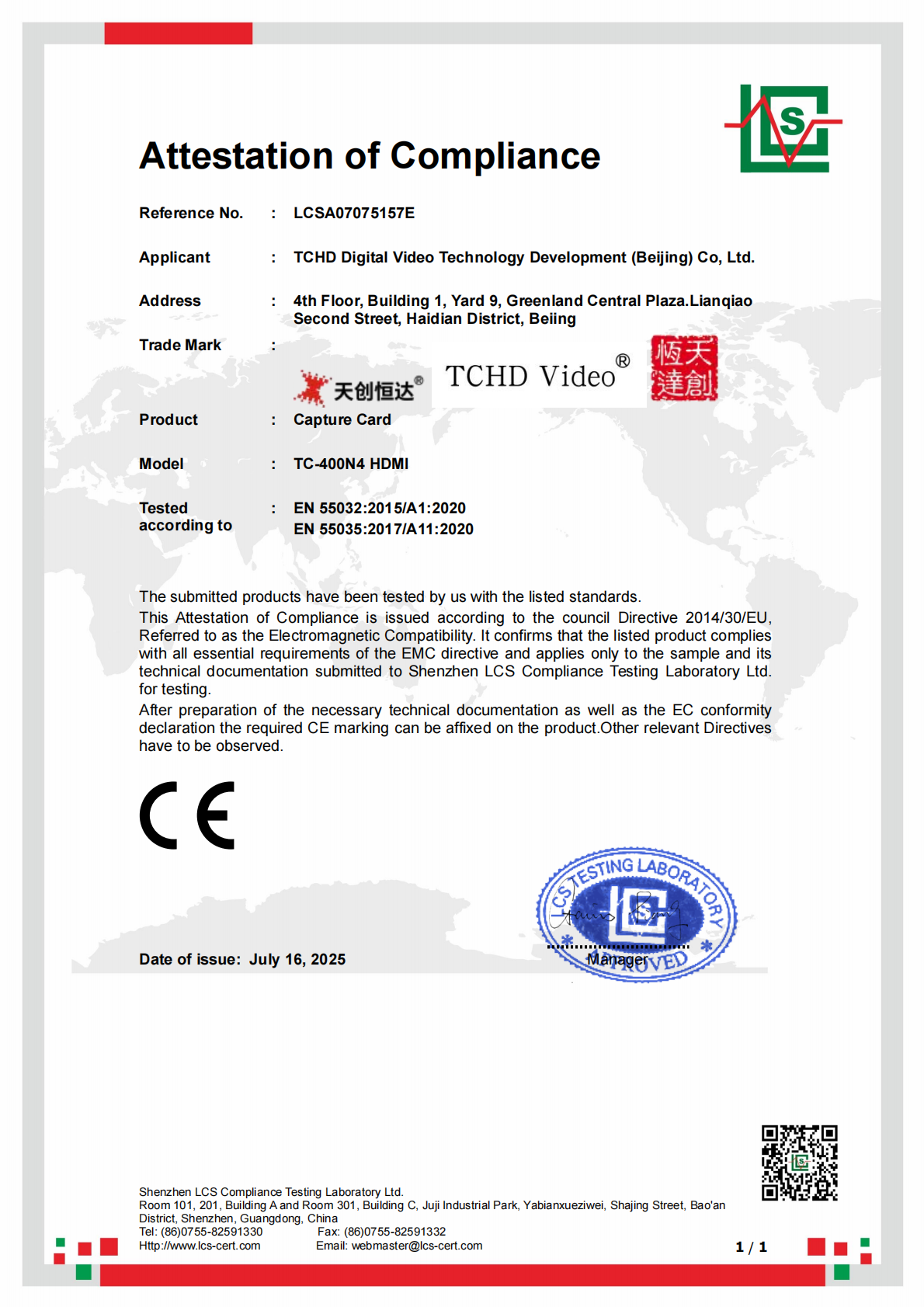
CE EMC Attestation of Compliance LCSA07075157E, issued by LCS TESTING LABORATORY, scope: TC-400N4 HDMI series capture card. Image: TCHD Video.
On the management system side, three certificates are issued by BEIJING STANDARD CERTIFICATION CENTRE with an issue date of 2024-03-08 and validity to 2027-03-07: ISO 9001:2015 quality management (certificate 064-24-Q-0675-R1-S), ISO 14001:2015 environmental management (certificate 064-24-E-0676-R1-S), and ISO 45001:2018 occupational health and safety management (certificate 064-24-S-0677-R1-S). All three share the same declared scope: the sales of digital audio and video products and related technical services and its related management activities.
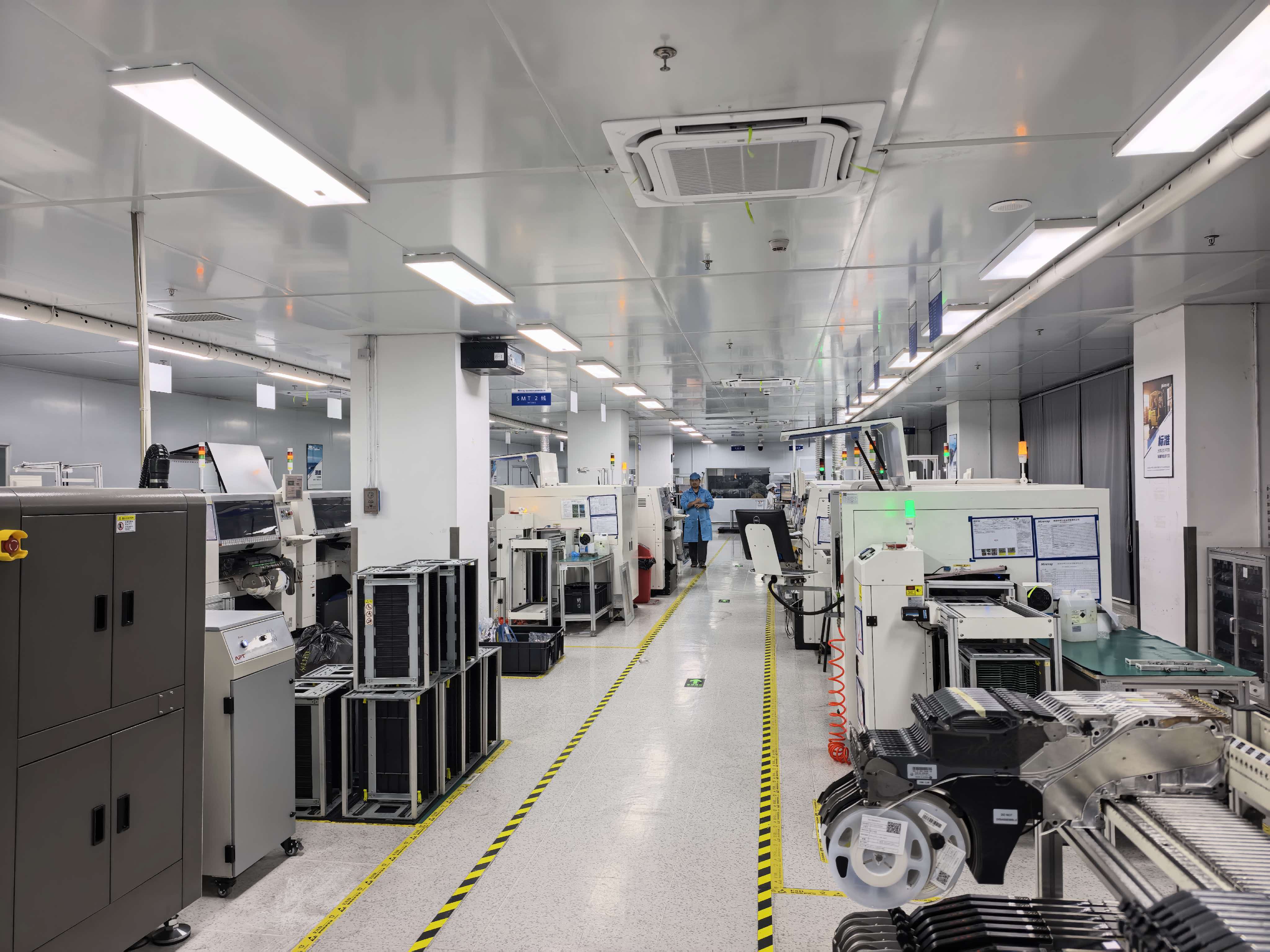
Finished-goods handling at the TCHD Video facility. Export activity is documented at approximately 20% of output, with main markets listed as the EU, USA, and Asia. Image: TCHD Video.
Procurement Checklist for Buyers Moving From Evaluation to Execution
The following checklist converts the technical and compliance discussion above into questions that can be asked of any capture card supplier, including TCHD, before an order is placed. Each row pairs the question with the evidence that answers it.
| Evaluation area | Question to ask | Evidence to request |
|---|---|---|
| 4K signal path | Is 4K60 output uncompressed or compressed, and at what chroma and bit depth? | Interface specification and bandwidth statement for the exact model |
| Driver model | Is the device UVC class-compliant, or does it require a vendor driver? | UVC compliance statement and supported operating system list |
| Host capacity | How many units can run simultaneously on one host without degradation? | Integration test notes and stated system requirements |
| Compliance scope | Which specific models does the certificate cover, and for which markets? | Certificate number, issuing laboratory, standard, and expiry date |
| Customization | What can be customized, and what requires new development? | Written customization statement, R&D team composition, sample agreement |
| Supply continuity | What are the lead times, minimum order quantities, and spare-part terms? | Order terms and stated annual production capacity |
| Deployment conditions | What are the power, thermal, and mounting requirements for continuous operation? | Power specification and operating condition documentation |
Future Outlook
Three developments are likely to shape multi-platform 4K capture procurement over the next cycle. The first is consolidation of the signal chain. As live production moves toward smaller teams covering more destinations, the value of sourcing capture, conversion, switching, and aggregation from one supplier rises, because interface mismatch is the most common source of silent failure in a shared-signal architecture.
The second is asymmetry between segments. If medical imaging and industrial applications continue at the 11.8% segment CAGR reported through 2034, while gaming remains the largest single application at a 31.2% revenue share, suppliers will face pressure to serve both a high-volume consumer channel and a documentation-heavy professional channel. Buyers in the professional channel should expect certification scope to become a differentiator rather than a formality.
The third is the persistence of USB-class interfaces. With USB capture cards holding 38.4% of product type share in 2025, the bandwidth constraint described earlier will remain a live engineering question rather than a transitional one. For buyers, the durable lesson is procedural: verify the output format against the encoder, verify the certificate scope against the specific model, and validate a sample against the intended host before scaling a deployment.
FAQ
What does a multi-platform live 4K capture card actually need to do?
It needs to deliver a stable 4K signal from a camera or console to a host, in a format the software encoder accepts, without renegotiating resolution mid-session. Multi-platform distribution itself happens after capture, in software encoding and uplink. The card's measurable contribution is signal stability, correct output formatting, and compatibility with the host through standards such as UVC rather than proprietary drivers.
What are the bandwidth limits of a USB-based 4K capture path?
An uncompressed 4K 60 Hz RGB 24-bit stream requires approximately 11.94 Gbps, above the 5 Gbps limit of USB 3.0, according to purplelec's technical guide on PCIe versus USB 3.0 capture. USB-class 4K60 capture therefore generally relies on on-card compression or a reduced chroma and bit-depth representation, while uncompressed 4K60 typically requires an internal bus such as PCIe or Thunderbolt.
How can a buyer verify EU market compliance for a 4K capture card?
Request the certificate and check its scope against the exact model being purchased. For TCHD, the CE EMC Attestation of Compliance LCSA07075157E, issued by LCS TESTING LABORATORY on 2025-07-16, names the TC-400N4 HDMI series capture card and assesses it against EN 55032:2015/A1:2020 and EN 55035:2017/A11:2020. A certificate that names a different series or product family does not automatically cover the model in question.
Can 4K capture cards be customized for OEM integration?
Customization is possible when the supplier has in-house development capacity, but the scope must be defined in writing. TCHD states that its products can be customized and developed according to different customer needs, supported by a 10-engineer R&D team. The practical validation step is a sample build tested against the intended host, operating system, and encoder, because datasheet-level compatibility rarely predicts behaviour under sustained multi-hour streaming loads.
Which live scenarios are best matched to multi-platform 4K capture?
Scenarios where one source must reach several destinations with limited technical staffing benefit most: e-commerce live streaming, lecture capture and remote education, conference and enterprise meeting distribution, event streaming across platforms, and virtual studio production. TCHD's documented product categories for these scenarios include the TCHD-T3 for e-commerce and education, the TC420 for conference and event streaming, and the TC-980S for broadcasting, medical, education, and live streaming applications.
What documentation should be requested before placing a capture card order?
At minimum: the interface and bandwidth specification for the exact model, a UVC or driver compliance statement, the certificate number, issuing laboratory, scope, and expiry date for each target market, and written terms for lead time, minimum order quantity, and spare parts. For clinical deployments, device-level certification such as ISO 13485 or FDA clearance should be verified separately, as it is distinct from the management system certificates held for sales and technical services.