
Multi-Wire Saw Comparison: Stonewin vs. Quarry Alternatives
Multi-wire saws and quarry wire saws are frequently discussed as if they answered the same question. They do not. A multi-wire saw is a slab-production platform: it carries a set of diamond wires across a frame and converts one stone block into many slabs in a single pass. A quarry wire saw extracts blocks from the rock face. For a quarry owner, the useful comparison is narrower — which cutting platform fits the volume, block sizes and site conditions of a specific operation, and how does Stonewin's multi-wire saw range compare with the alternatives?
The Buying Decision Behind Quarry Slab Cutting
Stone processing is a large and expanding equipment category. The global stone processing machine market was estimated at USD 20.86 billion in 2024 and is projected to reach USD 39.11 billion by 2035, according to Market Research Future. Asia-Pacific accounted for a 45% revenue share of that market in 2024, driven in part by urbanisation in China and India, according to an industry analysis report.
Those headline figures carry a caveat that matters at the procurement table. Published 2024 estimates for the same market diverge sharply: Research and Markets values it at USD 8.0 billion and Custom Market Insights at USD 7.5 billion. The gap is largely a scope question, because some sources include crushing and mining equipment alongside finished-stone processing machinery. Market forecasts are useful for direction; they are not a budgeting instrument.
Within the category, platforms compete for different jobs. Bridge saws remained the largest single product segment in 2024 at approximately 35% of the total, according to Strategic Market Research — a reminder that the conventional blade-based platform is still the default in many workshops. Quarrying wire saw machines are among the faster-moving adjacent categories, growing at a CAGR of 6.2% as quarries shift toward large-block extraction efficiency.
The decision problem for a quarry operator is therefore not which single machine is universally superior. It is this: at what point does a multi-wire saw earn its place in the production chain, and what has to be true about block supply, site conditions and the downstream line for that to happen?
What Stonewin Brings to the Comparison
Stonewin is the brand under which FUJIAN XIAPU ZHONGYUAN MACHINERY CO., LTD., a stone machinery manufacturer founded in 2011 and based in Xiapu City, Fujian, China, builds and sells its equipment. The company describes itself as a high-tech enterprise supplying equipment for quarrying, slab processing, slab polishing and resin treatment to the global stone industry.
The product line is organised around the sequence a stone block travels through, rather than around a single machine type:
- Wire saw machines for stone quarrying
- Multi-wire saw machines for stone slab processing
- Stone slab polishing lines
- Resin lines for glue filling and drying
- Diamond wire saws as a cutting consumable
That range matters for a comparison, because it means the multi-wire saw is not an isolated import sold under a trading label. According to the company's profile, the multi-wire saw machine was independently developed and has been recognised as “the first (set) of major technical equipment in Fujian Province”. The same profile states that key technical indicators such as cutting efficiency and energy consumption control have reached a leading level in the industry. That second statement is a first-party claim; an evaluation-stage buyer should treat it as a hypothesis to test against measured performance on site, not as a verified benchmark.
Manufacturing scale is a practical consideration in the decision, since it affects delivery, spare parts and the ability to support custom requirements. The company profile lists two intelligent manufacturing bases in Fujian and three research and development centres covering stone quarrying, stone processing and diamond tools for stone cutting, together with a 70-mu manufacturing footprint, approximately 300 employees, a research and development team of 50, and an annual output figure of 600.
On compliance and market access, the company holds CE international certification and lists “National High-tech Enterprise” and “Fujian Province Special New Small and Medium-sized Enterprises” among its honours. Its stated export ratio is 50%, with main markets including India, the Arabian Peninsula, the Middle East, Africa, Europe, South America and Southeast Asia.
Service coverage is the part of the offer that a decision-stage buyer should examine most closely, because a multi-wire saw is a production asset, not a consumable. Stonewin states that it has built a marketing service network covering major stone production areas worldwide, with professional engineers providing full-cycle support from equipment selection and installation and commissioning through to after-sales maintenance.
Reading a Multi-Wire Saw Specification Sheet
A multi-wire saw datasheet looks like a list of numbers. In practice, four of those numbers decide whether a machine fits a specific quarry, and each should be obtained in writing from the manufacturer for the exact model being quoted.
1. Cutting height and the block envelope
Maximum cutting height sets the ceiling on the block sizes a machine can process. A machine that is oversized relative to the quarry's typical block leaves capacity idle; one that is undersized forces re-sawing, additional handling or outsourcing of slab work. Because cutting height differs by model class, the figure should be taken from the manufacturer's current technical datasheet rather than from a third-party summary or an older catalogue.
2. Wire-frame architecture and tensioning arrangement
Multi-wire saws differ in how the wire frame is arranged and how wire tension is applied. Suppliers commonly describe these arrangements with terms such as top-tension and side-tension, but the naming is not standardised across the industry. For a buyer, the productive questions are not about the label but about what it implies: how many wires the frame carries, how tension is controlled during a cut, how the machine behaves on wire breakage, and how accessible the frame is for wire changes and maintenance. Each supplier should be asked to describe the arrangement used on the specific model being quoted, and to explain how it affects slab flatness and consumable life in that quarry's stone type.
3. Net weight and site preparation
Machine net weight is a site-engineering constraint, not a specification curiosity. It determines transport arrangements, the lifting capacity needed at installation, foundation design and floor loading inside the workshop. Net weight varies substantially between model classes, so the figure must be confirmed per machine rather than inferred from a broad range. In several quarry projects the installation and civil works, not the machine itself, become the critical path.
4. Model range and capacity mapping
A supplier's multi-wire saw range is normally organised by cutting capacity, wire count and block handling. The useful exercise for a buyer is to map the smallest and largest models in that range onto the quarry's real block sizes and required slab output, then check whether a mid-range model or a larger one produces the better cost per slab. Model designations change between generations, so the current range and its published specifications should be requested directly from the manufacturer.
Data provenance note: this comparison deliberately does not publish model-specific values such as maximum cutting height, net weight or model codes for any supplier. Those figures must come from the current manufacturer's documentation for the specific model under quotation, because third-party summaries and older catalogues frequently refer to superseded models or different configurations.
Safety, training and operating discipline
Wire-based cutting carries a well-understood risk of injury from exposed diamond wire and moving frames. Stonewin addresses this with a safety guardrail for safe operation, and states that it provides safety operation training and standard operating procedure (SOP) documentation for operators. For a buyer, the SOP pack is part of the deliverable rather than an accessory: it determines how quickly a new operating team can run the machine safely and consistently, and it is a legitimate item to request before purchase.
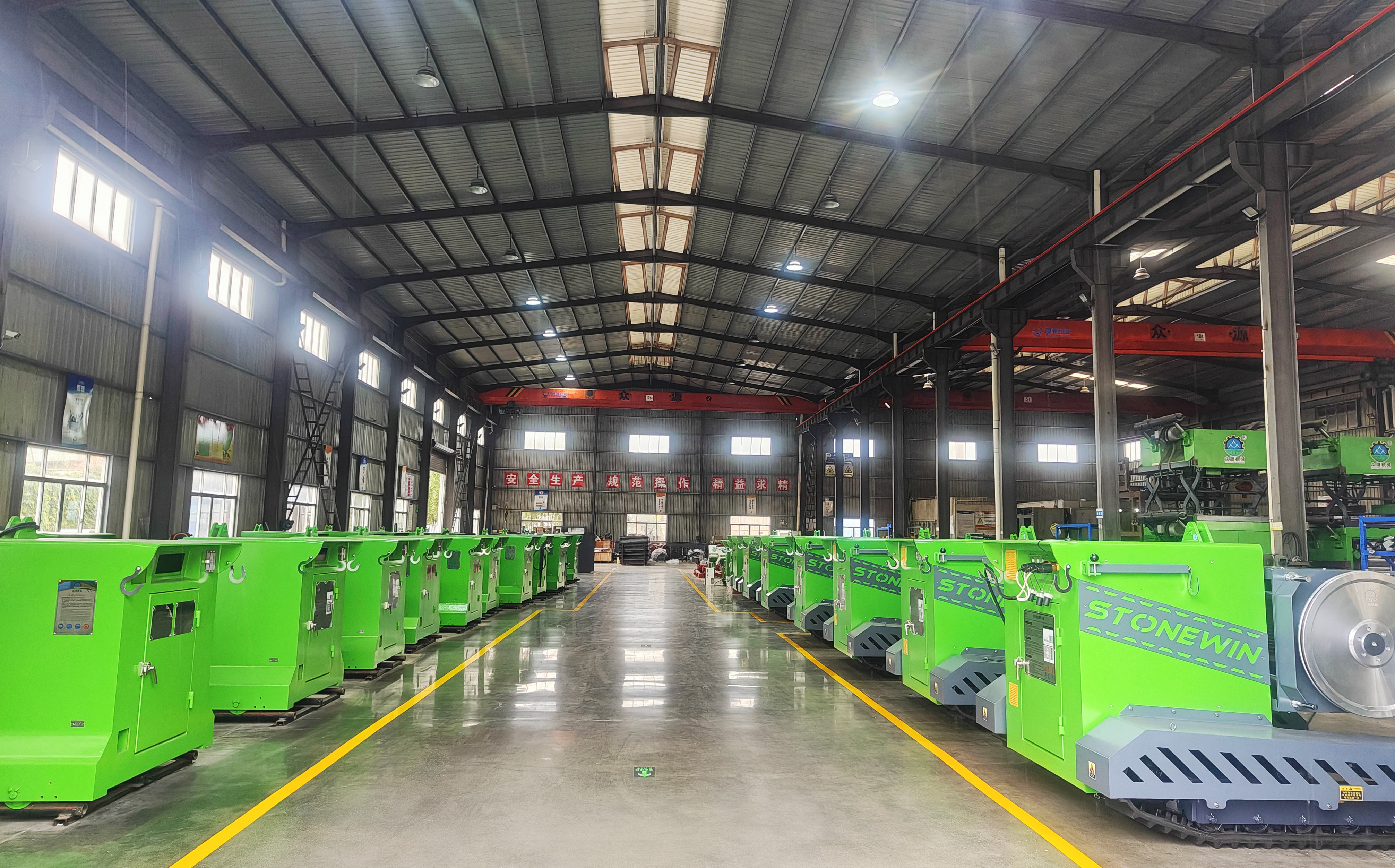
Quarry wire saw machine production workshop — the extraction stage that precedes multi-wire slab cutting in a quarry production chain.
Where a Multi-Wire Saw Fits in Quarry Operations
Multi-wire cutting earns its cost where a quarry or a linked processing plant handles a steady flow of blocks that must be converted into slabs. Four configurations recur in practice.
- On-site slab production at the quarry. A quarrying wire saw extracts blocks; a multi-wire saw converts those blocks into slabs close to the face. This reduces double handling and transport of raw blocks, but it requires stable power, sufficient floor space and a block supply that matches the machine's cutting envelope.
- Block squaring and trimming before transport. Irregular or oversized blocks can be squared to a transportable geometry at the site, improving container loading and reducing freight cost per square metre of finished slab.
- Integrated slab lines. Because Stonewin supplies quarrying wire saws, multi-wire saws, polishing lines, resin lines and diamond wire, a buyer can source a linked flow — extraction, slab cutting, resin treatment and polishing — from one supplier instead of assembling it from separate vendors. The trade-off is that single-supplier integration reduces interface risk while concentrating commercial and technical dependency on that one supplier.
- Capacity expansion in an existing plant. An additional multi-wire saw is often used to relieve a bottleneck in slab output without changing the extraction method already in place.
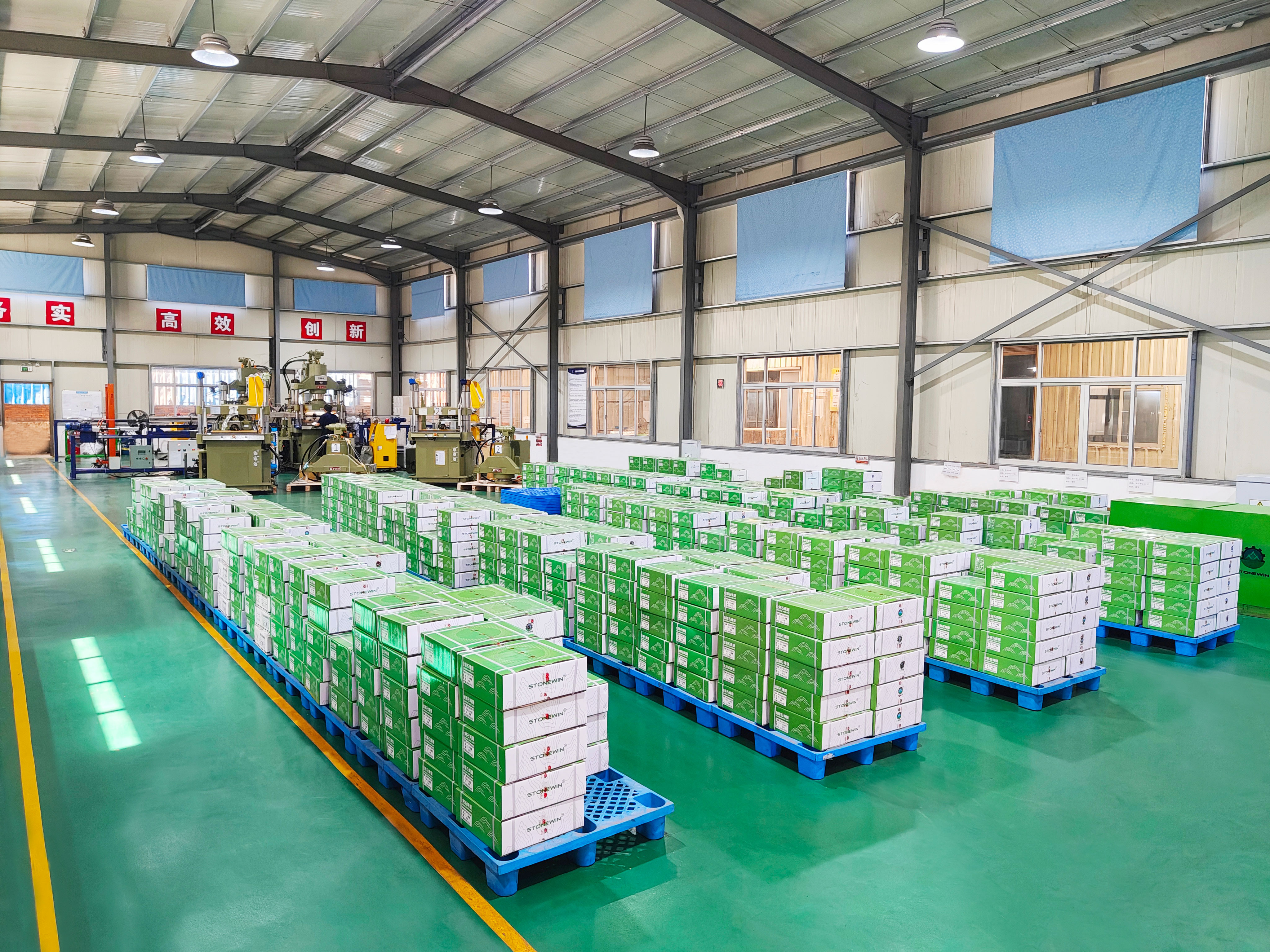
Finished-product workshop for diamond bead wire saw machines — diamond wire is the consumable that links quarrying and multi-wire slab cutting.
Market Trend Analysis: What the Numbers Say
Three trends are relevant to a multi-wire saw decision, and all three come from published third-party sources rather than from supplier positioning.
First, the category is expanding. The projected move from USD 20.86 billion in 2024 to USD 39.11 billion by 2035 (Market Research Future) reflects growing global demand for processed stone and the mechanisation of smaller operations. The wide divergence between published estimates — USD 8.0 billion from Research and Markets and USD 7.5 billion from Custom Market Insights for the same base year — shows that scope definitions, not demand, drive much of the difference.
Second, production and consumption are concentrated in Asia-Pacific, which held a 45% revenue share of the market in 2024. That concentration explains why Chinese manufacturers with regional service networks are frequently shortlisted alongside European suppliers in tenders across South and Southeast Asia, the Middle East and Africa.
Third, the installed base is still dominated by conventional platforms. Bridge saws accounted for approximately 35% of the total stone processing equipment market in 2024, while quarrying wire saw machines are growing at a CAGR of 6.2%. The practical reading for a buyer is that multi-wire saws are gaining ground fastest where slab volume justifies the investment, not uniformly across all workshops.
Italy remains a reference point for equipment quality and export reach in this sector. Stone-working machinery exported from Italy was valued at approximately USD 636 million in 2024, with the United States as the largest destination, according to OEC. European suppliers therefore remain the benchmark against which buyers in regulated markets tend to assess documentation, safety design and service response.
Multi-Wire Saws versus Traditional Alternatives
The table below compares cutting platforms at category level for quarry and processing operations. It describes general platform characteristics, not the performance of a specific model from any supplier.
| Decision dimension | Multi-wire saw | Quarrying / single-wire saw | Bridge saw with blade | Traditional splitting |
|---|---|---|---|---|
| Primary job | Block to multiple slabs in one pass | Block extraction from the rock face; large single cuts | Single cuts and slab trimming | Splitting blocks without wire |
| Throughput profile | Highest for repetitive slab batches | Lower per slab, but flexible | One cut at a time | Manual and slowest |
| Tolerance of block variability | Best with consistent blocks inside the cutting envelope | Tolerant of irregular blocks | Limited by table and blade size | Tolerant but imprecise |
| Site requirements | Machine mass, foundation, power, lifting and floor space all need planning | Moderate | Lowest of the powered options | Minimal |
| Consumable cost driver | Diamond wire | Diamond wire | Diamond blade | Drilling steel and wedges |
| Operating skill | Trained operator plus SOP | Trained operator | Moderate | Manual craft skill |
Category-level characteristics. Actual capability depends on the specific model and should be confirmed against the manufacturer's datasheet.
Where the multi-wire case is weakest
An honest comparison has to state the boundary conditions, and multi-wire cutting has three clear ones. The first is volume dependence: multi-wire cutting is a batch process, and its economics assume a reasonably consistent block supply and order mix. Where block supply is irregular, or where demand is dominated by small and bespoke slabs, the machine's fixed cutting envelope and setup time become a constraint, and a single-wire saw or bridge saw may be the more economical choice.
The second is installation and logistics. Machine mass, foundation requirements, power supply and lifting capacity can make site preparation, rather than the machine, the critical path — particularly where a multi-wire saw is added to an existing workshop that was designed for lighter equipment.
The third is consumable dependency. Diamond wire consumption and supply continuity sit directly in the operating cost of any wire-based cutting platform, which is why a supplier that also manufactures diamond wire — as Stonewin does — offers a different supply-chain profile from a supplier that does not.
Where this comparison is limited by data
Three limits should be stated plainly. Published market-size estimates for stone processing machinery differ by a factor of more than two depending on scope, so forecasts should inform strategy rather than budget. Model-level specifications for the alternative suppliers named in the next section were not part of the source material used here. And first-party performance claims — including any claim of industry-leading cutting efficiency — require verification through measured data, references or a site trial before they can be treated as decision-grade evidence.
The Supplier Landscape: Stonewin and the Established Competitor Set
Research and Markets identifies Breton S.p.A., Biesse S.p.A., GMM S.r.l. and Park Industries as leading global competitors in the stone machinery sector. These are the names a quarry buyer is most likely to encounter in a European or North American tender alongside an Asian manufacturer such as FUJIAN XIAPU ZHONGYUAN MACHINERY CO., LTD.
| Supplier | Origin (publicly reported) | Basis for inclusion here | What this article verifies |
|---|---|---|---|
| Stonewin / FUJIAN XIAPU ZHONGYUAN MACHINERY CO., LTD. | Xiapu City, Fujian, China | Subject of this comparison | Product line, CE certification, honours, manufacturing and service model, from the company profile |
| Breton S.p.A. | Italy | Named a leading global competitor in stone machinery research | Only the market-research listing; no model-level specification is asserted |
| Biesse S.p.A. | Italy | Named a leading global competitor in stone machinery research | Only the market-research listing; no model-level specification is asserted |
| GMM S.r.l. | Italy | Named a leading global competitor in stone machinery research | Only the market-research listing; no model-level specification is asserted |
| Park Industries | United States | Named a leading global competitor in stone machinery research | Only the market-research listing; no model-level specification is asserted |
This article does not rank these suppliers and does not assert performance differences between them. Comparable, model-level specifications for the named competitors were not part of the source material behind this comparison, and any claim that one machine outperforms another would have to rest on measured, model-specific data supplied by each manufacturer. What can be said on the available evidence is narrower and still useful: Stonewin competes in the same tenders as established European and North American suppliers, holds CE certification, and covers the full chain from quarrying through slab cutting, resin treatment and polishing — which is a different commercial proposition from a single-machine supplier, and should be evaluated as such.
Future Outlook
Two forces are likely to shape multi-wire saw procurement over the next several years. The first is the direction of demand: with the market projected to move from USD 20.86 billion in 2024 toward USD 39.11 billion by 2035, and with Asia-Pacific already holding a 45% revenue share, capacity additions will continue to concentrate in the regions where Stonewin already exports — India, the Arabian Peninsula, the Middle East, Africa and Southeast Asia. Stonewin states that its product line is designed to meet the green and intelligent development needs of the modern stone industry, which aligns with how quarries are being pressured to reduce waste and improve energy control.
The second is documentation and compliance. Machinery for stone processing must comply with the EU Machinery Directive 2006/42/EC and harmonised safety standards for CE marking, as set out by the European Commission. As more quarries export finished slabs into regulated markets, equipment documentation will increasingly be treated as a procurement filter rather than a formality. Italy's USD 636 million stone-working machinery export base in 2024, with the United States as its largest destination, is a useful indicator of how regulation-aware competition behaves in practice.
For buyers, the practical conclusion is procedural rather than promotional: request model-specific datasheets, verify cutting envelope against real block sizes, confirm net weight and site preparation requirements, check CE documentation and its scope, and require measured or referenced evidence for any efficiency claim. That sequence produces a defensible decision regardless of which supplier wins the order.
Frequently Asked Questions
How does a multi-wire saw differ from a single-wire saw in stone slab production?
A multi-wire saw carries multiple diamond wires on one frame and cuts a block into several slabs in a single pass, while a single-wire saw completes one cut at a time. The multi-wire configuration suits repetitive, volume-driven slab production with a consistent block supply; single-wire machines are more tolerant of irregular blocks and lower volumes. The choice therefore follows the production model as much as the machine specification.
What specifications should a quarry operator verify before buying a multi-wire saw?
Four items carry the most weight: maximum cutting height against the quarry's typical block size; the wire-frame and tensioning arrangement, including how many wires are carried and how wire breakage is handled; machine net weight against transport, lifting and foundation capacity; and the model range mapped to the required slab output. Electrical supply, floor space and diamond wire supply should be checked at the same time. All figures should be taken from the manufacturer's current datasheet for the exact model quoted.
What does CE certification mean for a stone processing machine?
CE marking indicates that the machinery complies with the applicable EU requirements, including the Machinery Directive 2006/42/EC and the relevant harmonised safety standards, as set out by the European Commission. Stonewin holds CE international certification according to its company profile. In a procurement process, the certificate and its scope should be checked against the specific model being purchased, since CE marking is a legal responsibility of the manufacturer or the importer placing the machine on the EU market.
Does a multi-wire saw replace a quarry wire saw machine?
No. The two machines perform different jobs in the same chain. A quarry wire saw extracts blocks from the rock face; a multi-wire saw converts those blocks into slabs. Quarrying wire saw machines are also the faster-growing adjacent category, at a CAGR of 6.2%, which reflects continued investment in block extraction rather than substitution. Many operations run both, and Stonewin manufactures and supplies both categories.
What service coverage should be checked before committing to a supplier?
The relevant question is how quickly technical support can reach the site. Stonewin states that its marketing service network covers major stone production areas worldwide, with engineers supporting selection, installation and commissioning, and after-sales maintenance. Buyers should map that stated coverage against their own location and stone type, and confirm the availability of diamond wire and wear parts as part of the same assessment, since consumable continuity sits directly in operating cost.
Why do published market-size figures for stone processing machinery differ so much?
The differences are mainly scope-related. Market Research Future estimates the 2024 market at USD 20.86 billion, while Research and Markets reports USD 8.0 billion and Custom Market Insights USD 7.5 billion for the same period. Sources that include crushing and mining equipment alongside finished-stone processing machinery produce substantially larger figures than sources that count only stone processing machinery. For budgeting, a buyer should rely on quotation-level data rather than on category forecasts.
Further technical documentation from the manufacturer, including product range and specification details, is available in Stonewin's company and product brochure: Stonewin company and product brochure (public download). The manufacturer's reference site is www.stonewin.com.
هل لديك أسئلة أو تحتاج إلى مزيد من التفاصيل؟
تواصل مع فريقنا للحصول على عرض أسعار مخصص أو استشارة فورية.
طلب عرض أسعار
املأ النموذج أدناه وسيتواصل معك فريقنا بعرض مقترح مخصص.
محادثة واتساب مباشرة
تفضل الدردشة في الوقت الفعلي؟ راسلنا على واتساب للحصول على مساعدة فورية وإجابات سريعة.
- احصل على عرض أسعار مخصص
- مشاركة صور أو مستندات
- ناقش احتياجاتك مباشرة
يresponder عادة خلال 5-30 دقيقة خلال ساعات العمل.