
Multifunctional Digital Printing Machine Procurement FAQ: Specs, Inks, and Installation
A multifunctional digital printing machine is a plate-less inkjet press that prints corrugated cardboard and cardboard packaging directly from a digital file. The questions that decide whether the purchase succeeds are rarely about that concept. They are about printheads, ink families, configuration, floor space, power supply, and who answers the phone when a nozzle blocks at 2 a.m.
Packaging plants usually commit to the idea of digital printing long before they commit to a specification. The difficult part is the second step: choosing a printhead, an ink family, a colour scheme, a throughput band, a footprint, and a service arrangement that will still make sense three years after commissioning.
This article collects the questions buyers actually raise before ordering a multifunctional digital printing machine, and answers them against the GOKING 2-in-1 plate-less platform for corrugated and cardboard packaging. It is written for procurement managers, plant engineers, and packaging converters who are at the research stage and need comparable, checkable answers rather than a brochure.
In the GOKING configuration, a multifunctional digital printing machine is a 2-in-1 plate-less platform that supports both single-pass and multi-pass printing with different DPI settings. Single-pass mode uses a XAAR printhead; multi-pass mode uses Epson or Xaar nozzles. It prints materials from 2 mm to 30 mm thick, runs CMYK with an optional white channel, operates on a 380 V three-phase supply, and is delivered with a minimum order quantity of one set and free sample printing.
The procurement problem: many variables, no common language
Digital printing has moved from a niche option to a mainstream production path in packaging. According to Grand View Research, the global digital printing market was valued at USD 38.0 billion in 2023 and is projected to reach USD 57.0 billion by 2030. Within that market, the inkjet segment held the largest technology share at 48.4% in 2023. The direction of travel is not in dispute.
What is in dispute is vocabulary. Two suppliers can both describe a machine as "high precision" or "multifunctional" and mean entirely different printhead counts, resolutions, and ink chemistries. For a buyer comparing quotations, that ambiguity is the single largest source of risk, because it makes two offers look equivalent when their specifications are not.
The practical response is to convert the purchase into a defined set of questions with numeric answers. Material thickness, printhead count, print width, throughput, ink type, colour channels, power supply, ambient conditions, machine footprint, and net weight are all answerable in advance. When a supplier cannot answer them numerically, that itself is procurement information.
What the machine is, and where it sits in a plant
Guangdong Goking Intelligent Technology Co., Ltd., established in 2020, is a manufacturer of industrial-grade digital printers based in Dongguan, China. The company focuses on the research, development, and manufacturing of digital printers for corrugated and honeycomb cardboard, and positions its work as industrial digital printing solutions for packaging factories.
Its core product line consists of single-pass and multi-pass 2-in-1 digital printing machines, together with 5-color integrated models offered across multiple DPI configurations and different nozzles. The platform is, in the company's own model designation, a "Digital Printing Machine — CMYK and Five Colors, Different Nozzles, Different DPI, Different Printhead Numbers, Different Printing Width and Speed." That naming is unusually literal for the industry, and it is useful: it signals that the machine is configured rather than fixed.
The applicable industries named for the platform are the printing and packaging industry, paper mills, and coated paperboard operations. The machine is designed as a plate-less digital printing machine for corrugated cardboard and cardboard packaging, which means the printed sheet does not pass through a plate-making step before it reaches the press.
Inside the 2-in-1 platform: what the specification actually contains
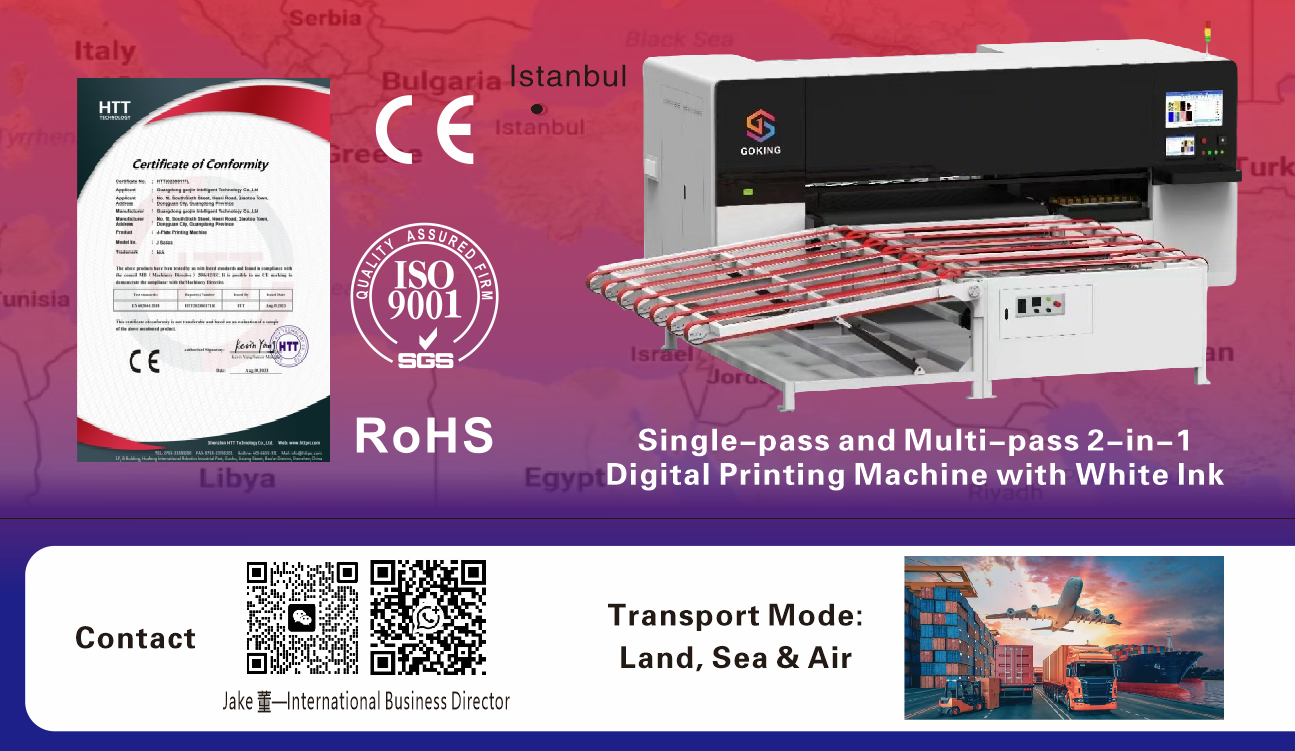
A multifunctional digital printing machine in the GOKING 2-in-1 configuration, shown with the white ink channel enabled. The same platform can be set up for single-pass output or multi-pass scanning.
The most reliable way to evaluate a multifunctional digital printing machine is to read its specification as a set of independent variables rather than a single product claim. The GOKING 2-in-1 platform is built from the following parameters, each of which changes either capability, throughput, or site requirements.
| Parameter | Verified configuration range |
|---|---|
| Printheads | 8 to 256 printheads |
| Print width | 264 mm to 2600 mm |
| Production efficiency | 700 / 1500 m²/h depending on configuration |
| Single-pass speed, Epson nozzle | 60 m/min |
| Single-pass speed, XAAR nozzle | At least 100 m/min |
| Material thickness | 2–30 mm |
| Colour mode | CMYK (W) — CMYK with optional white |
| Ink types | Water-based dye ink, water-based pigment ink, coating ink, UV eco-friendly ink |
| Printhead technology | Micro-piezo high precision |
| Crossbeam | Magnetic levitation high-precision crossbeam |
| Platform | Vacuum adsorption |
| Feeding mode | Leading edge feeding / belt feeding; leading edge optional semi-automatic or fully automatic |
| Ink supply | Two ink supply channels, fully enclosed ink supply path |
| Rated power | ≈14 kW |
| Electricity | 380 V, 50/60 Hz, three-phase; Schneider electrical components; servo motor drive |
| Machine size | 4260 mm × 2300 mm × 1900 mm |
| Weight | 2800 kg (net) |
| Working environment | Room temperature 15–32 °C, humidity 70% |
| File formats | PDF, JPG, BMP, TIF; supports direct printing without converting pictures |
| Minimum text size | Digital English text from 1.5 mm |
| Frame materials | Carbon steel frame, stainless steel conveying rollers, aluminium alloy beam |
Two structural details matter more than they appear at first reading. The magnetic levitation crossbeam governs positioning accuracy at speed, which is what allows a single machine to serve both a fast, lower-resolution production mode and a slower, high-definition mode without mechanical compromise. The vacuum adsorption platform governs substrate control on corrugated board, which is a material that does not behave like paper — it is thick, uneven in compression, and prone to lifting at the leading edge.
Printheads, inks, and configuration: the three decisions that shape everything
Once a buyer accepts the parameter list above, the specification conversation collapses into three decisions. Getting these wrong is expensive; getting them right is mostly a matter of matching them to the order book.
1. Printhead selection: Epson or Xaar
Epson commercial-grade printheads, manufactured in Japan, are known for high precision and nuanced grayscale performance. In practice they are particularly well suited to high-definition scanning printers that demand exceptional image quality, delivering rich colour transitions and sharp detail. If the order book skews toward premium packaging where fine graphics decide whether the job is won, this is the relevant head family.
Xaar industrial-grade printheads, developed in the United Kingdom, include models such as the Xaar 5601 and 1003 series, which use patented "True Internal Circulation" technology (TF Technology). This circulates ink continuously behind the nozzles, significantly reducing clogging and supporting stability and reliability during prolonged, high-speed production. The practical benefit is downtime reduction — the metric that most often decides whether a digital press is profitable at volume.
In the GOKING 2-in-1 configuration, the choice is not exclusive. Single-pass mode is built around a XAAR printhead, while multi-pass mode can be fitted with Epson or Xaar nozzles. That means a buyer can specify industrial-grade heads for throughput-dominant work and commercial-grade heads for definition-dominant work on the same platform family, and can scale the printhead count from 8 up to 256 as the business grows.
2. Ink families and the optional white channel
Four ink types are supported: water-based dye ink, water-based pigment ink, coating ink, and UV eco-friendly ink. Colour mode is CMYK with an optional white channel, expressed as CMYK (W). The ink system uses two ink supply channels with a fully enclosed ink supply path.
White ink is one of the most misunderstood options in corrugated printing. It is not a decorative extra. On kraft, recycled, or dark-toned board, white is what allows a light-coloured graphic to register at all, and it is what makes a print read as intended rather than as a washed-out version of the artwork. Buyers who expect to print on brown board with light branding should treat white as a specification question, not an upsell. In market terms, the water-based pigment ink segment accounted for a significant portion of the eco-friendly digital printing market in 2024, which reflects the direction ink selection has been moving.
Ink choice also carries regulatory weight. The U.S. EPA declared certain PFAS chemistries used in UV inks hazardous in April 2024, which is directly relevant to formulation decisions for any buyer printing into or near the United States market. It is a reason to ask, at quotation stage, which ink chemistry a supplier recommends and how that recommendation is likely to age.
3. Single-pass versus multi-pass, DPI, and print width
The 2-in-1 architecture exists because most packaging plants do not have a single, stable job profile. They have volume work that must run fast and short, precise work that must run well. A single-pass machine optimises the first case; a multi-pass scanning machine optimises the second.
Rather than forcing a choice, the platform supports both modes across different DPI settings and different printhead numbers. Print width is configurable from 264 mm to 2600 mm, which covers narrow-format work and full packaging-board widths on the same product family. Graphic files in PDF, JPG, BMP, or TIF can be sent directly without a conversion step, and the RIP supports direct printing without converting pictures — a smaller detail than printhead choice, but one that removes an entire prepress routine from the daily workflow.
4. Throughput expectations
Production efficiency is stated as 700 or 1500 m²/h depending on configuration, and that range should be read as a configuration statement rather than a guaranteed output figure. The supporting speed data is more granular: single-pass printing with an Epson nozzle runs at 60 m/min, while single-pass printing with a XAAR nozzle runs at at least 100 m/min, with the added note that the XAAR path is durable and long-lasting and imposes lower requirements on the operating environment.
A buyer comparing quotations should reconcile the quoted m²/h figure against printhead count, print width, and head family. A 700 m²/h claim and a 1500 m²/h claim are not competing claims about the same machine; they are different machines in the same family.
Site readiness: what to prepare before the machine ships
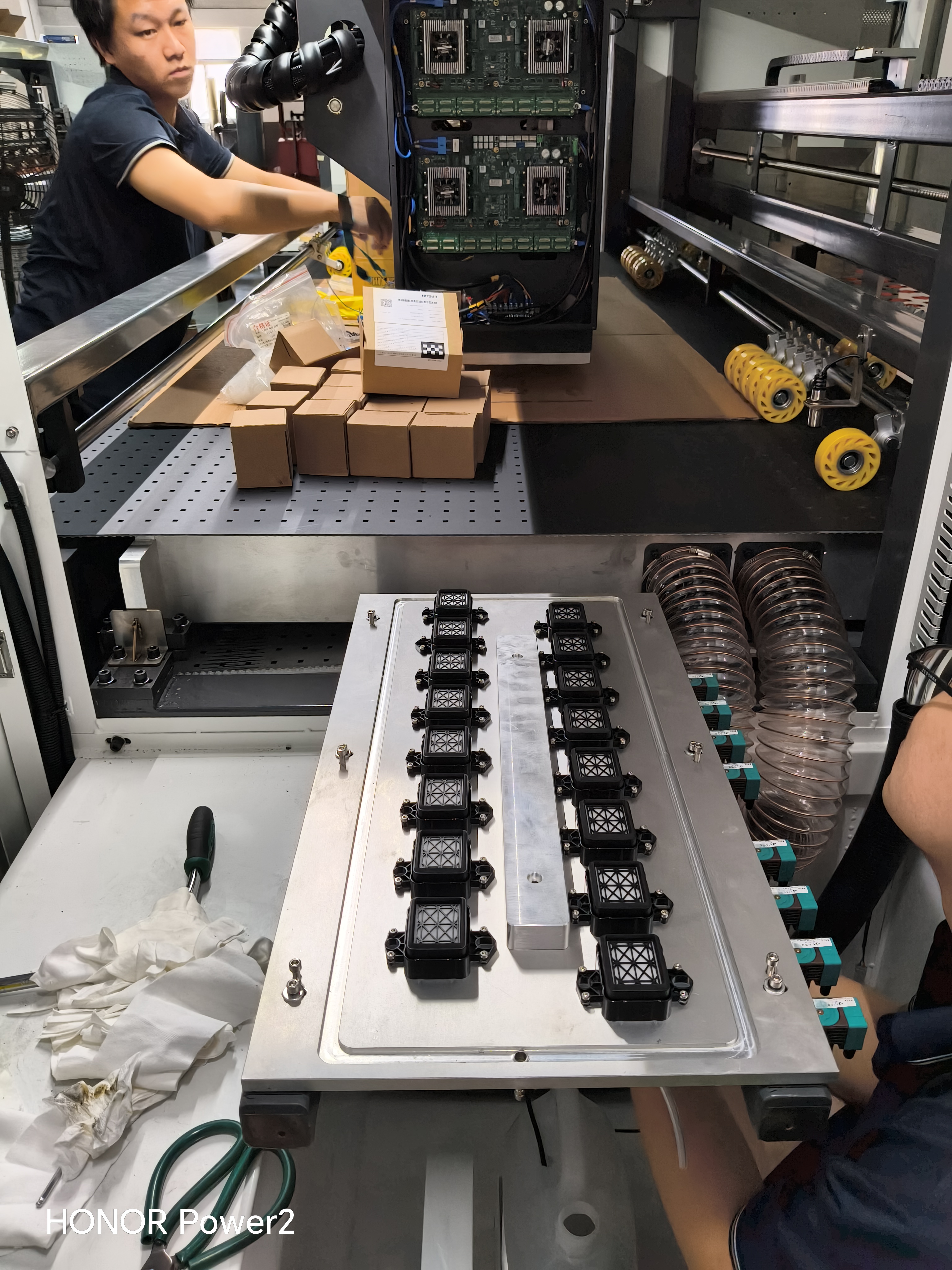
Printhead count is one of the few specification items that can be expanded later. The GOKING platform supports configurations from 8 to 256 printheads, so a buyer can start at the scale of the current order book.
Site readiness is where digital press projects most often lose weeks. The parameters below are fixed by the machine and should be verified against the building before the order is confirmed, not after the crate arrives.
| Site item | Requirement |
|---|---|
| Power supply | 380 V, 50/60 Hz, three-phase |
| Rated power | ≈14 kW |
| Ambient temperature | 15–32 °C |
| Relative humidity | 70% |
| Machine footprint | 4260 mm × 2300 mm × 1900 mm |
| Net weight | 2800 kg |
| Substrate range | 2–30 mm material thickness |
| Feeding | Leading edge feeding or belt feeding |
Three of these deserve emphasis. First, the 380 V three-phase requirement means the installation point should be checked against the available distribution capacity, particularly where a digital press is being added to a hall that was laid out for converting equipment only. Second, the 15–32 °C and 70% humidity window is a controlled-environment requirement. In very dry or very humid climates, that window may require humidification or dehumidification equipment, and the cost of that equipment belongs in the project budget rather than in a surprise purchase order. Third, 2800 kg concentrated across a 4260 × 2300 mm footprint is a floor-loading and rigging question, not just a space question — door widths and turning radii on the route into the hall should be measured in advance.
On the mechanical side, the platform uses a magnetic levitation high-precision crossbeam and a vacuum adsorption platform, with leading edge or belt feeding. Leading edge units are available in semi-automatic or fully automatic form, which is a meaningful choice for plants with different labour structures. A typical matched equipment set for a working line includes a conveyor system, feeding unit, receiving unit, drying or curing system, inspection equipment, paper receiving rack, voltage stabilizer, humidifier, computer, temperature control system, and a toolkit with consumable spare parts.
Where the platform fits: applications and production scenarios
The stated applicable industries are the printing and packaging industry, paper mills, and coated paperboard. Within those, the working conditions the platform is designed for are mass production, short-run printing, frequent job change, and continuous high-speed operation — a combination that describes most modern packaging order books reasonably well.
The functional case for digital in this environment is specific rather than general. It replaces plate-based printing, reduces plate costs, reduces setup waste, enables flexible short-run production, and improves production efficiency. Each of those is a production-economic statement, and each is checkable against a plant's own numbers: how many plate changes per shift, how much board is scrapped at makeready, how often a job under a thousand units is declined because the plate cost cannot be justified.
Project types the platform is built to serve include factory capacity expansion, equipment upgrade, OEM/ODM customised printing line, and sample validation. The machine supports both sample testing and batch production modes, and units can be delivered as turnkey lines. Market data supports the short-run direction: variable data printing is enabling economically viable runs under 3,000 units, a volume band that was previously cost-prohibitive.
Market context: why the timing question is reasonable
Buyers considering a multifunctional digital printing machine in 2026 are not early adopters. The market has scale. Asia-Pacific dominated the digital printing market with approximately 41.6% revenue share in 2025, according to Market Research Future, and the digital printing packaging segment specifically is expected to reach USD 46.2 billion by 2029 from USD 30.2 billion in 2024, according to MarketsandMarkets. The single-pass digital printing machine market was valued at USD 3.2 billion in 2024 and is projected to reach USD 6.5 billion by 2034, per Reports and Data.
Two structural observations follow. First, the supply base is concentrated: China's digital printing machinery exports are supported by a concentrated industrial cluster in Guangdong province, which is where GOKING's Dongguan manufacturing base sits. That concentration affects lead times, spare parts availability, and price competitiveness, and it is a legitimate factor in supplier evaluation. Second, the technology is still moving. Hybrid digital-offset printing architectures are gaining R&D focus from major players such as Heidelberger Druckmaschinen, which suggests that the boundary between digital and conventional production will continue to shift rather than settle.
Limits and trade-offs: where digital is not automatically the answer
A procurement decision made on advantages alone is an incomplete one. Three boundaries are worth stating plainly.
The first is that speed and definition trade against each other, and the trade is mechanical. Multi-pass scanning produces higher clarity but runs slower than single-pass output. Within single-pass operation, the Epson nozzle path runs at 60 m/min while the XAAR nozzle path runs at at least 100 m/min. A plant that needs both maximum definition and maximum throughput is not choosing a better machine; it is choosing a 2-in-1 platform specifically so that the same asset can be switched between the two modes. Plants that need only one of the two should question whether the 2-in-1 premium is justified.
The second is environmental. The 15–32 °C and 70% humidity window is a real operating constraint, and in climates outside that band it translates into equipment cost and ongoing energy cost. It also means the press room has to be managed as a controlled environment rather than as general factory space.
The third concerns ink regulation. The regulatory environment around UV ink chemistries is changing, as the April 2024 PFAS declaration illustrates. Buyers planning a multi-year asset life should treat ink selection as a moving specification and ask suppliers how their ink recommendations are expected to evolve, rather than fixing a chemistry for the life of the machine.
Finally, digital printing replaces the plate, not the finishing line. Drying after printing applies for carton work, with other materials depending on substrate. Board handling, drying, and downstream converting remain part of the production plan.
Service, installation, and customisation
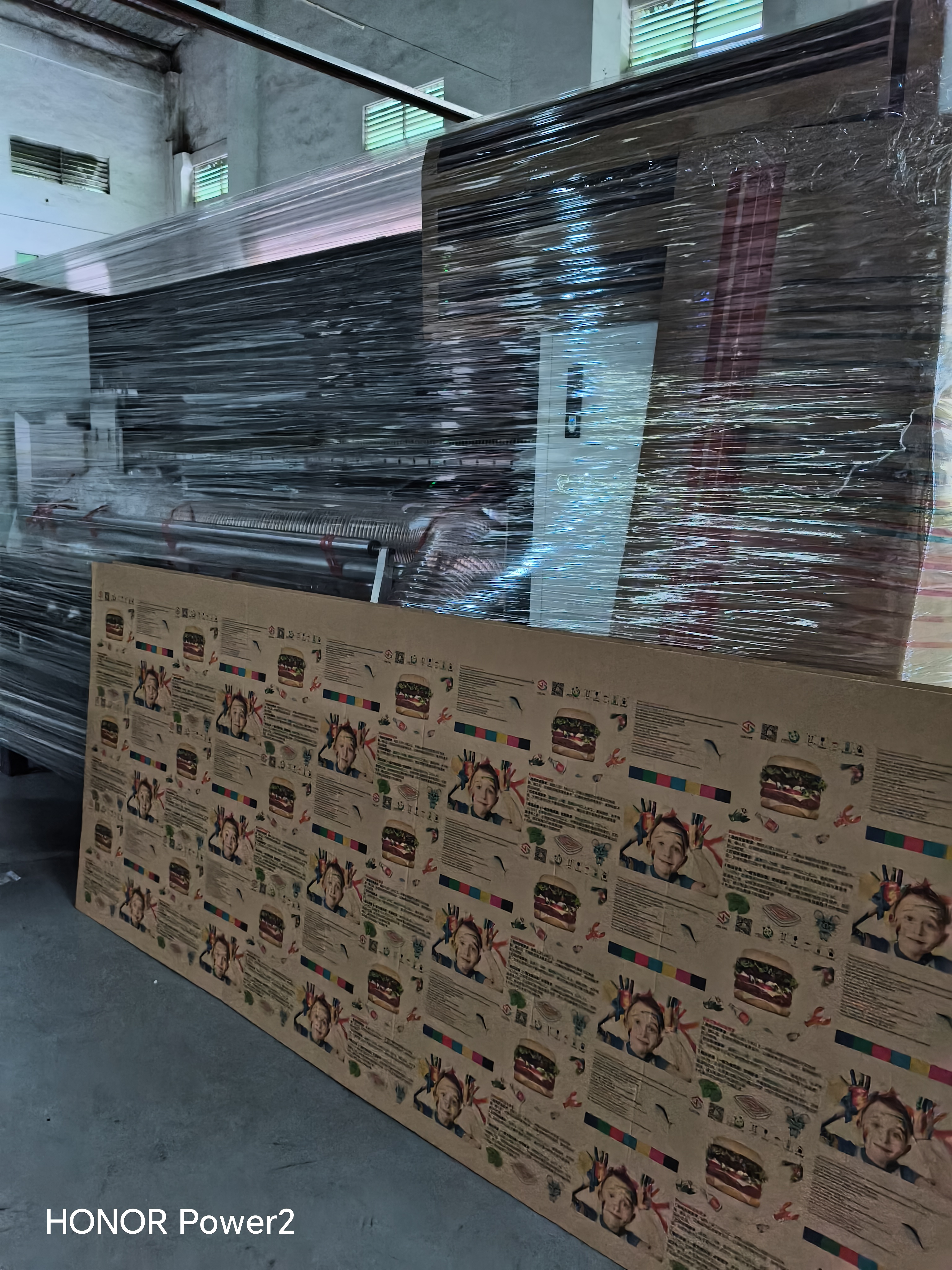
Sample printing is used as a validation step before order confirmation. Minimum order quantity for the GOKING platform is one set, and sample printing is provided free of charge.
For an imported capital asset, service structure is a specification item in its own right. The GOKING platform is supported by 24-hour response after-sales service and spare parts support, and by overseas engineers for installation and commissioning. OEM/ODM and turnkey line customisation are available, consistent with the company's stated project types, which include OEM/ODM customised printing lines and production line integration.
Commercial terms include a minimum order quantity of one set and free sample printing, which allows a buyer to validate output on their own board before committing. For plants at the research stage, that validation step is usually more informative than any specification sheet, because corrugated board varies considerably between suppliers and regions and the printed result depends on the interaction between board, ink, and head family.
Future outlook
Three developments are likely to shape the next procurement cycle. Regulatory pressure on ink chemistry will continue to push formulation decisions, which favours buyers who keep ink selection revisable rather than locked. Hybrid digital-offset architectures will continue to attract R&D investment from large press manufacturers, which means the question will increasingly be not "digital or conventional" but "which portion of the job runs digital." And the economics of short runs will keep improving, extending the volume band in which digital is the cheaper option.
For a packaging plant evaluating a multifunctional digital printing machine today, the durable approach is to buy on the specification variables that do not change — substrate range, print width, printhead count, site requirements, service reach — and to treat head family and ink chemistry as decisions that can be revisited as the order book and the regulatory environment evolve.
Procurement FAQ
These are the questions most frequently raised by buyers before ordering a multifunctional digital printing machine. Each answer stands on its own.
What is the minimum order quantity, and can samples be printed before ordering?
The minimum order quantity is one set, and sample printing is provided free of charge. Sample validation is one of the project types the platform is designed to support, and the machine operates in both a sample testing mode and a batch production mode, so the same equipment class covers the validation stage and the production stage.
What materials and thicknesses can the machine print on?
The platform is designed for corrugated cardboard and cardboard packaging, with applicable industries listed as the printing and packaging industry, paper mills, and coated paperboard. Material thickness ranges from 2 mm to 30 mm. Feeding is by leading edge or belt feed, and the substrate is held on a vacuum adsorption platform. The company's broader product scope covers corrugated and honeycomb cardboard.
Which ink types are available, and when is white ink needed?
Four ink types are supported: water-based dye ink, water-based pigment ink, coating ink, and UV eco-friendly ink. The colour mode is CMYK with an optional white channel, written as CMYK (W). White becomes relevant when printing on kraft, recycled, or dark-toned board, where light-coloured graphics need a white base to register correctly. The ink system uses two ink supply channels with a fully enclosed ink supply path.
Should I specify Epson or Xaar printheads?
Epson commercial-grade printheads are known for high precision and nuanced grayscale performance, and are well suited to high-definition scanning printers that demand exceptional image quality. Xaar industrial-grade printheads, including the Xaar 5601 and 1003 series, use patented True Internal Circulation technology that circulates ink continuously behind the nozzles, reducing clogging and supporting stability during prolonged high-speed production. In the GOKING 2-in-1 configuration, single-pass mode uses a XAAR printhead, while multi-pass mode can use Epson or Xaar nozzles, so the head family follows the job profile rather than excluding the other option.
How many printheads can the machine be configured with?
Configurations range from 8 to 256 printheads. The model designation covers different printhead numbers, different DPI settings, different nozzles, and different printing width and speed, which means printhead count is a scalable specification rather than a fixed one. A buyer can specify an initial configuration matched to current production scale and expand as volume grows.
Single-pass or multi-pass — what output should I expect?
Production efficiency is stated as 700 or 1500 m²/h depending on configuration. Single-pass printing with an Epson nozzle runs at 60 m/min; single-pass printing with a XAAR nozzle runs at at least 100 m/min. Multi-pass scanning produces higher clarity but runs slower than single-pass output. The 2-in-1 architecture is designed so that both modes are available on the same platform, and the appropriate expectation depends on which mode the job will run in.
What print width is available?
Print width is configurable from 264 mm to 2600 mm. That range spans narrow-format work and full packaging board widths within the same product family. Print width is one of the parameters named in the model designation, alongside nozzle type, DPI, printhead number, and speed, so it is specified at order rather than adjusted afterward.
What power supply and environmental conditions does the machine require?
The machine operates on 380 V, 50/60 Hz, three-phase electricity, with a rated power of approximately 14 kW. Electrical components are Schneider and the machine uses servo motor drives. The required working environment is room temperature between 15 °C and 32 °C with humidity of 70%. Sites outside that temperature or humidity band should plan for environmental control equipment, which is a project cost rather than a machine cost.
What is the machine footprint and weight?
The machine measures 4260 mm × 2300 mm × 1900 mm and has a net weight of 2800 kg. The frame is carbon steel, the conveying rollers are stainless steel, and the beam is aluminium alloy. Because the weight is concentrated within that footprint, floor loading and the rigging route into the hall should be assessed before delivery.
How is the material fed and positioned during printing?
Feeding is by leading edge or belt feed, and the leading edge unit is available in semi-automatic or fully automatic form. Positioning is controlled by a magnetic levitation high-precision crossbeam, and the substrate is held on a vacuum adsorption platform. A matched equipment set for a working line can include a conveyor system, feeding unit, receiving unit, drying or curing system, inspection equipment, paper receiving rack, voltage stabilizer, humidifier, computer, temperature control system, and a toolkit with consumable spare parts.
What file formats does the machine accept, and how small can printed text be?
Supported graphics formats are PDF, JPG, BMP, and TIF. The RIP supports direct printing without converting pictures, which removes a conversion step from the prepress workflow. For digital printing, English text is legible from 1.5 mm.
Who installs and commissions the machine, and what after-sales support is provided?
Overseas engineers are provided for installation and commissioning. After-sales support includes 24-hour response service and spare parts support. The manufacturer, Guangdong Goking Intelligent Technology Co., Ltd., is based in Dongguan, China, within the Guangdong industrial cluster that supports China's digital printing machinery exports, which is relevant to lead times and spare parts availability.
Can the machine be customised for OEM or ODM production?
OEM/ODM customisation and turnkey line customisation are available. OEM/ODM customised printing lines and production line integration are listed among the project types the platform is designed to serve, alongside factory capacity expansion, equipment upgrade, and sample validation. Units can be delivered as turnkey lines.
Does CE marking apply to this equipment?
CE marking is relevant for industrial printers placed on the EU market. Industrial digital printers must comply with EN ISO 12100 for risk assessment to obtain CE marking, and the electrical equipment of industrial machines is governed by IEC 60204-1 (EN 60204-1) for CE compliance. Buyers importing into the EU should confirm which conformity route the supplier follows and which documentation accompanies the shipment.
Further technical questions
Guangdong Goking Intelligent Technology Co., Ltd. can be reached by email at w1250606130@gmail.com, by phone at +86 18028205637, or via WhatsApp at +86 18475532220. The company's product catalogue is available at 2026 product catalogue.
Address: No. 1, Fuxiang Street, Huangniupu, Huangjiang Town, Dongguan City, China.