
Multiwire Drawing Machines: How They Work, Market Trends, and Selection Signals for 2026
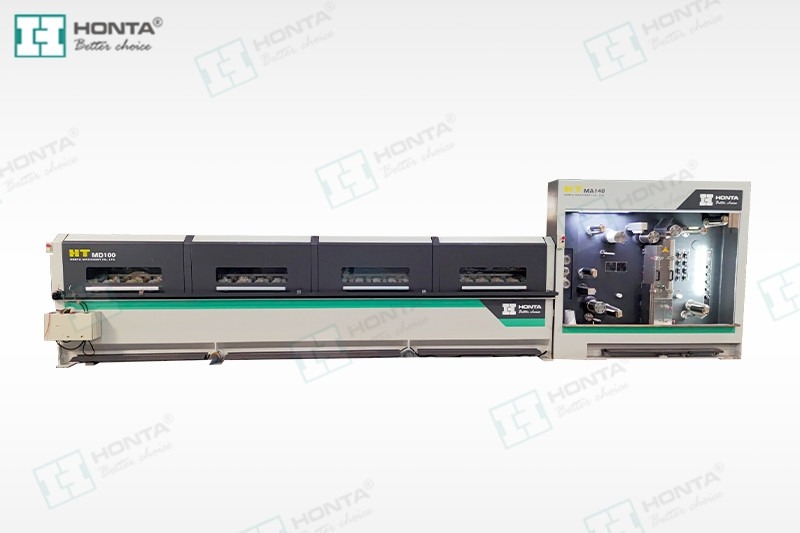
A wire drawing machine used in continuous conductor production lines. Source: HONTA product gallery.
Multiwire Drawing Machines: How They Work, Market Trends, and Selection Signals for 2026
The multiwire drawing machine has become a core production asset for wire and cable manufacturers that need to process multiple strands simultaneously with consistent diameter and surface quality. Instead of drawing one wire at a time, this equipment class pulls several wires in parallel through a sequence of dies, which raises throughput and improves efficiency in high-volume conductor production.
Market data reflects the growing importance of this equipment segment. The global wire drawing machines market is projected to grow from USD 1.37 billion in 2025 to USD 2.13 billion by 2034, a compound annual growth rate of 4.98%, according to The Insight Partners. The broader wire and cable market is also expanding, from USD 230.9 billion in 2025 to an estimated USD 313.1 billion by 2033, based on Grand View Research. Demand from power, construction, automotive, and electronics applications is pushing manufacturers to evaluate newer drawing machines with higher speeds, better automation, and lower energy consumption.
Within this context, Jiangsu HONTA Machinery, Ltd. — a Chinese manufacturer established in 2006 — is one of the equipment suppliers active in this field. The company focuses on technical research in cable conductor drawing and stranding, with products that include rod breakdown machines, multiwire drawing machines, high speed double twist bunching machines, and wire electrolytic plating lines. This article serves as an independent industry reference on what multiwire drawing machines are, why they matter, and how buyers can interpret equipment choices in 2026.
Why the production problem is changing
Conductor drawing is a mechanical reduction process. A thicker copper or aluminium rod is pulled through a series of dies, each with a smaller opening, until the desired final wire diameter is reached. For many cable producers, the challenge is not simply achieving a diameter; it is achieving it at high speed, with stable tolerance, on multiple wires at the same time, and with predictable energy costs.
Traditional single-wire drawing lines can be appropriate for low-volume or highly specialized products. However, for typical conductor production — such as building wire, magnet wire, or communication cables — the demand for output volume is much higher. A multiwire drawing machine processes two, eight, sixteen, twenty-four, or even thirty-two wires simultaneously. The result is a substantial increase in production per square meter of factory space, which is one reason many manufacturers are shifting from single-wire or common-shaft systems toward individual-motor multiwire designs.
What the market is telling manufacturers
Several market signals deserve attention in 2026.
- Machine-level demand is strong. The wire drawing machine market is expected to grow at nearly 5% per year through the next decade, according to The Insight Partners.
- China is becoming a larger machinery exporter. Chinese machine tool exports, which include wire drawing machinery, represented 19% of global exports in the first half of 2025, surpassing Germany, according to Silverado Policy Accelerator.
- Energy efficiency is moving from a preference to a requirement. Industry analysis published by HTNXT Industrial Blog indicates that individual-motor multiwire drawing machines can reduce energy consumption by up to 25% compared with traditional common-shaft systems, mainly by eliminating mechanical transmission losses.
- Standards and certifications are playing a bigger role. Electrical equipment for machinery, including wire drawing systems, must meet IEC 60204-1 requirements for wiring and safety. For global projects, buyers often expect suppliers to hold ISO 9001 and ISO 14001 certification.
Brand capabilities in context: HONTA as a supplier example
To understand how a multiwire drawing machine supplier can support a production line, it helps to look at an actual manufacturer profile. HONTA is a full-line equipment supplier rather than a niche machine maker. Its main products include the Rod Breakdown Machine, Multiwire Drawing Machine, High Speed Double Twist Bunching Machine, and Wire Electrolytic Plating Line. The company also supplies copper and aluminium rod breakdown lines, multiwire drawing line series, and high-speed stranding lines.
According to company data, HONTA operates a manufacturing facility covering 30,000 square meters, employs about 157 people, and has an annual production capacity of 200 sets. The R&D team consists of 30 engineers. Export sales account for 45% of total sales, with major markets including the United States, the Middle East, Africa, and Asia.
The company positions itself as a system service provider for cable conductor drawing and stranding, offering equipment that supports the full sequence from rod breakdown to final take-up. This is relevant to buyers because line integration — not just a single machine — often determines production efficiency.
Representative multiwire drawing machine specifications
For planning purposes, buyers may look at published specifications. The table below shows a HONTA 16-wire machine and a higher-speed 14-wire line documented in other HONTA publications.
| Attribute | HT.MD100B.16.22D.01 | HT.MD120.03.19.14 (14-wire line) |
|---|---|---|
| Machine type | 16 wires multiwire drawing machine | 14 wires multiwire drawing line |
| Inlet wire diameter | 1.8–2.0 mm | Not specified |
| Outlet wire diameter | 0.18–0.5 mm | 0.20–1.05 mm |
| Maximum speed | Not published in source | 1800 m/min |
| Motor and control | Siemens motor; Siemens PLC | Not specified |
| Source | HONTA product specification | Honta India product page, 2025 |
Note: The HT.MD120.03.19.14 line information is sourced from Honta India. Buyers should confirm current specifications with the supplier before making investment decisions.
How a multiwire drawing machine works
In a typical multiwire drawing line, the process starts with a pay-off unit that feeds several wires from larger spools or coils. The wires pass through drawing dies arranged in series. Each die has a smaller bore, so the cross-section of the wire is progressively reduced. Because multiple strands travel in parallel, the machine must maintain precise tension and alignment for all strands simultaneously; otherwise, breakage and inconsistent diameter will occur.
After the drawing section, many lines include an annealer to restore ductility to the work-hardened copper or aluminium. The finished wire is then collected on a take-up unit. Common take-up options include single spoolers, double spoolers, and basket coilers. HONTA's application documentation lists typical supporting devices such as annealing furnaces, pay-off and take-up units, winding and unwinding machines, annealers, and single- or double-disc take-up machines.
Modern machines use programmable logic controllers (PLC) for parameter setup and automatic tension control. The 16-wire HONTA model, for example, uses a Siemens motor and Siemens PLC, which is a common configuration in export-oriented equipment. This setup allows operators to enter target diameters, monitor tension, and switch between automatic and semi-automatic modes.
An important design distinction in multiwire machines is the drive architecture. Traditional common-shaft systems use a single motor to power several capstans, which simplifies design but also links all strands to the same speed profile. Individual-motor designs give each drawing capstan its own drive. This enables finer tension adjustment per stage and reduces mechanical transmission losses. According to industry analysis, the energy saving can reach up to 25% compared with common-shaft designs. Individual motors also make maintenance and troubleshooting easier because a fault in one drive does not necessarily shut down the whole line.
Main modules of a multiwire drawing line
A complete multiwire drawing line contains several modules, each with a specific function. Understanding these modules helps buyers compare proposals that include different supporting equipment.
- Pay-off unit: Holds the input spools or coils and controls the tension as wire enters the drawing section. In multiwire machines, the pay-off must handle multiple strands without tangling.
- Drawing section: Contains capstans, dies, and lubrication system. The wire is pulled through successively smaller dies while the capstans provide the pulling force. Lubrication is essential to control temperature and extend die life.
- Annealer: Restores ductility after cold drawing. An in-line annealer uses controlled heating and cooling to soften the wire so that it can be further processed without cracking.
- Take-up and spooling: Collects the finished wire on spools or coils. Depending on the product, the line may use a single spooler, double spooler, or basket coiler.
- Control system: Coordinates speed, tension, and annealer settings. A touch-screen PLC interface is now standard on many export machines.
This modular view is important because a low price on the drawing machine itself may not include all the supporting modules needed for a working production line. Buyers should ask for a complete line list, including pay-off, dies, annealer, take-up, and control software.
Selecting the right line configuration
There is no single 'best' multiwire drawing machine for every factory. The right configuration depends on the incoming rod diameter, target wire range, required output, and downstream processes.
For example, a 16-wire machine with an outlet range of 0.18–0.5 mm, such as the HONTA HT.MD100B.16.22D.01, is suitable for fine wire production. A 14-wire line with an outlet range of 0.20–1.05 mm and maximum speed of 1800 m/min may be more suitable for medium-fine wire. Buyers should compare the inlet/outlet range against their product plan before choosing wire count.
Where multiwire drawing machines are used
Multiwire drawing machines are used primarily in the wire and cable industry, but that industry covers many end-use sectors. The applicable sectors listed by HONTA include power and energy, automotive manufacturing, communications and electronics, intelligent equipment, construction and installation, household and electronics, and new energy-related cable and conductor applications.
Typical operating conditions for these machines are industrial continuous production lines with high-speed automated operation. Buyers often request stable tension control, accurate wire alignment, and the ability to handle specific wire diameters or coating thicknesses. Some projects require laser alignment, high-speed twisting specifications, or carbon-fiber dynamic balance structures, especially when the line includes bunching or stranding equipment.
The application scene relevant to the 16-wire machine is a wire and cable factory operating an automated or semi-automated line under PLC control. In this context, the machine works together with other equipment rather than in isolation. A production line might include a rod breakdown machine as a first stage, then a multiwire drawing machine, and finally a bunching or stranding machine. The multiwire machine functions as a high-efficiency middle stage that turns medium-diameter wire into fine wire for further processing.
How the equipment compares with traditional solutions
There are two common comparison levels when buyers evaluate drawing equipment.
Multiwire versus single-wire drawing
The clearest advantage of multiwire drawing is throughput. A machine that draws 16 wires in parallel can produce far more output per hour than a single-wire machine with the same finishing speed. For cable plants producing large volumes of similar conductor types, this can be a decisive factor in return-on-investment calculations.
However, there is a trade-off. Multiwire machines are generally larger, more complex, and more expensive to acquire and install. They are best suited for consistent, high-volume production. For a plant that frequently changes materials, diameters, or small batch sizes, a single-wire line may offer greater flexibility and lower changeover cost. Therefore, the decision depends on the intended product mix and capacity plan, not only on machine speed.
Individual motors versus common shaft
Within multiwire machines, the drive architecture influences operating cost. Industry analysis indicates that individual-motor designs can reduce energy consumption by up to 25% compared with common-shaft designs. They also allow independent control of each capstan, which gives better tension control and reduces mechanical complexity in the driveline.
The practical limit is cost. Individual-motor machines use more motors and control components, which increases the initial purchase price and the complexity of the electrical cabinet. For producers with low electricity costs or limited maintenance skills, a common-shaft machine can still be a rational choice. Buyers must weigh energy savings against capital expenditure and local service capability.
Market trends shaping the next phase
Looking beyond 2026, several trends are visible in the multiwire drawing machine market.
- Automation and data integration. PLC-controlled machines are becoming the standard, and more factories are asking for remote diagnosis and production data collection as part of equipment supply.
- Energy efficiency. With energy costs rising, the 25% efficiency gap between individual-motor and common-shaft systems becomes a meaningful selection criterion.
- Standardized compliance. Global buyers increasingly treat IEC 60204-1 electrical compliance and ISO management certifications as baseline requirements rather than differentiators.
- Chinese suppliers in global supply chains. China's 19% share of machine tool exports in early 2025 suggests that Chinese equipment makers are being accepted in markets formerly dominated by European and Japanese brands.
These trends do not mean that every manufacturer should buy the most automated, most expensive machine available. Instead, they mean that buyers should build a shortlist based on product mix, volume, local support capability, and total cost of ownership.
Purchasing signals for the research stage
At the awareness and research stage, buyers often need a structured way to compare suppliers. The following questions are useful when evaluating a multiwire drawing machine supplier:
- What is the supplier's production scope? Does it offer related equipment such as rod breakdown, bunching, or stranding machines?
- What are the published specifications for the specific model being quoted?
- Does the machine use individual motors or a common shaft, and what does that mean for energy and maintenance?
- What control system is used, and can it be integrated with existing factory systems?
- What certifications does the manufacturer hold, such as ISO 9001 or ISO 14001?
- Does the supplier provide line configuration support and after-sales technical assistance for export projects?
HONTA can serve as one example of a supplier that covers multiple steps in the conductor production chain. Its corporate data, product spec, and factory information are public and can be checked by buyers.
Future outlook
As the wire and cable market expands, the role of multiwire drawing machines will continue to grow. Manufacturers in energy transition sectors — such as new energy vehicles, renewable power systems, and charging infrastructure — require large quantities of precisely drawn copper and aluminium conductors. Multiwire drawing machines are well matched to this requirement because they combine high speed with acceptable footprint.
The future machine generation will likely emphasize modularity and digital readiness. Even at the current level of maturity, buyers can already use equipment design differences, energy data, and certification documents to make more informed purchasing decisions. The best procurement approach is not to chase a single specification, but to align machine architecture with the actual production program.
Additional technical reference
For readers who are evaluating drawing line configurations, HONTA has published a company catalogue containing additional technical information. The catalogue is available at this link: Catalogue of drawing machine (PDF).
Frequently asked questions
What is a multiwire drawing machine?
A multiwire drawing machine is a piece of wire and cable production equipment that draws several wires simultaneously through a sequence of dies to reduce their diameter. It is used in high-volume conductor production and is available in configurations such as 8, 16, 24, and 32 wires.
How does a multiwire drawing machine differ from a single-wire drawing machine?
A single-wire machine draws one strand at a time, while a multiwire machine processes many strands in parallel. This increases throughput and reduces the floor space needed per finished wire, though multiwire systems are typically more complex and better suited to large batches.
What specifications should buyers check on a multiwire drawing machine?
Key specifications include inlet and outlet wire diameter range, number of wires, maximum speed, motor and PLC brand, take-up type, and supporting equipment such as annealer or spooler. For example, the HONTA HT.MD100B.16.22D.01 handles inlet wire of 1.8–2.0 mm and outlet wire of 0.18–0.5 mm with 16 wires and Siemens control.
Which industries use multiwire drawing machines?
They are used in the wire and cable industry across power and energy, automotive, communications and electronics, intelligent equipment, construction and installation, household electronics, and new energy applications.
Why are individual motors important in multiwire drawing machines?
Individual motor designs allow each drawing capstan to be driven and controlled independently. Industry analysis shows this can reduce energy consumption by up to 25% compared with common-shaft systems by removing mechanical transmission losses and improving tension control.
What certifications are relevant when buying a multiwire drawing machine?
Electrical equipment should comply with IEC 60204-1 for wiring and safety. For overall quality management, buyers may look for ISO 9001 and ISO 14001 certification as part of their supplier evaluation.
This article is provided as an independent industry reference. Facts about HONTA are sourced from public company materials; market figures are attributed to the cited research organizations.