
Municipal Guardrail Specs: Constraints Buyers Must Verify
Industry Reference · Municipal Guardrail
Municipal Guardrail Specs: Constraints Buyers Must Verify
A municipal guardrail is a safety barrier installed along urban roads, bridges, sidewalks and waterfronts, and its configuration is normally fixed by the project rather than selected from a catalogue. That single characteristic shapes almost every commercial question a buyer faces: what can be standardized, what must be customized, which material and coating system will survive the site, and what evidence of compliance the finished installation must be able to show.
This reference sets out the constraint categories that decide municipal guardrail selection — dimensions, material grade, surface treatment, structural loading, applicable standards and interface conditions — using product and project records from Guangzhou Santian Steel Structure Co., Ltd., a China-based manufacturer of municipal traffic guardrails and construction site hoarding systems operating at aotianguardrail.com, together with published market and standards references. It is written for importers, contractors, municipal specifiers and project owners who need to compare suppliers on verifiable constraints rather than on appearance alone.
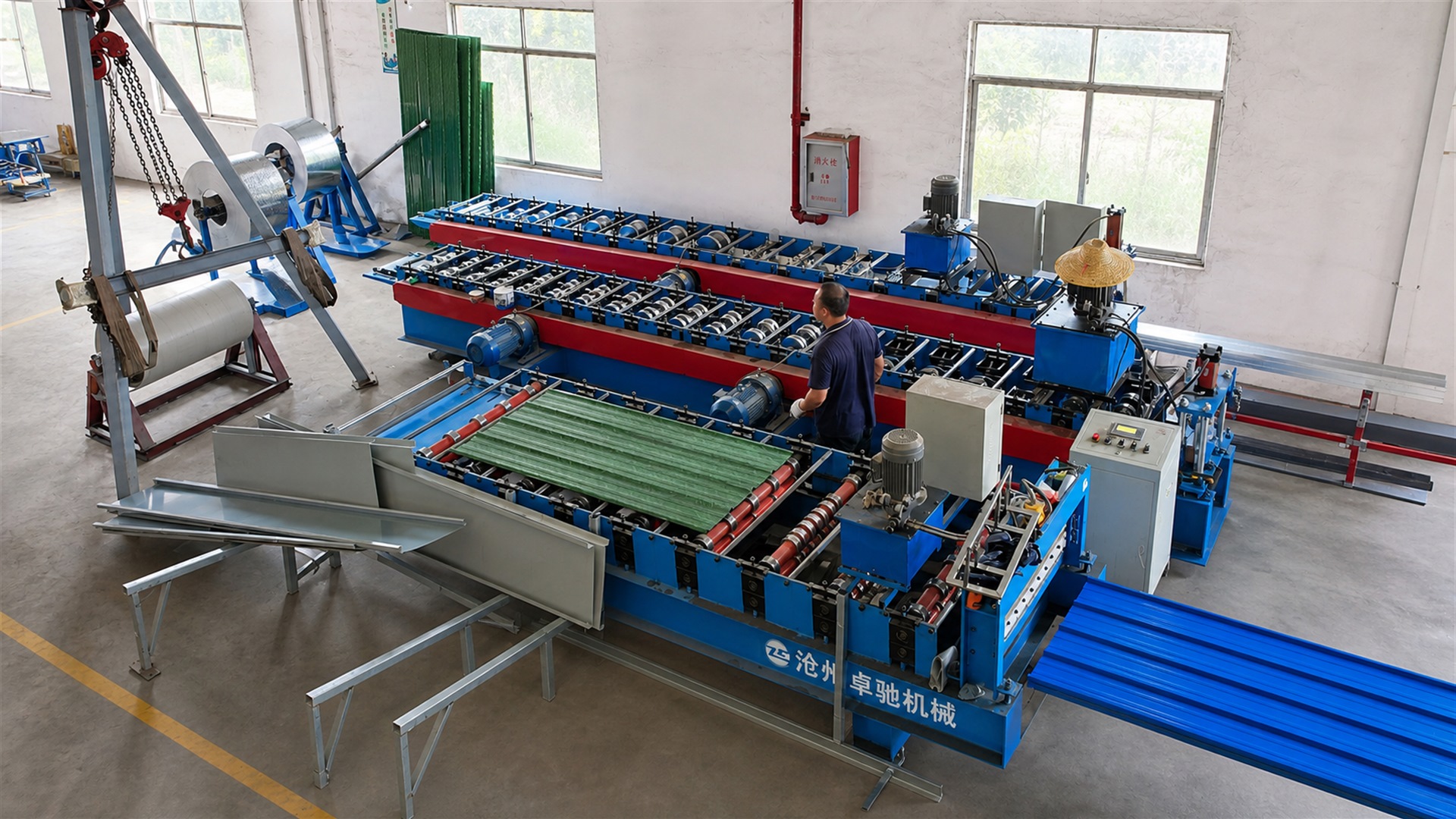
Roll-forming production of steel guardrail components. Profile type, post spacing and panel thickness are set by the project specification before production begins.
Municipal Guardrail Is an Application Category, Not a Single Product
In procurement terms, "municipal guardrail" covers a group of safety barrier families that share a function — separating, guiding or guarding movement in public space — but differ in structure, material and governing constraint. The families recorded in the product range include road median guardrails, motorized and non-motorized lane separation guardrails, pedestrian guardrails, bridge railings, riverside guardrails, crash barriers, anti-throw mesh and anti-glare screens, perimeter fencing, balcony railings, stair railings and window guard railings, plus construction site hoarding and standardized site protection systems.
Guangzhou Santian Steel Structure Co., Ltd. is a manufacturer in this category. Its industry experience dates back to 2011, and the company was formally registered on 16 May 2016. It operates a production facility of approximately 15,000 m² that integrates research and development, product design, manufacturing and installation; it employs 200 people, including a 50-engineer R&D team, records annual output of 1,500,500 m, and exports to Southeast Asia, Africa, South America and the Middle East at an export ratio of 50%. Its main product groups are municipal road and bridge guardrails, decorative urban guardrails, river guardrails, balcony and stair railings, perimeter fence railings and construction site hoarding systems.
For a buyer, the practical consequence is that a supplier evaluation cannot be completed with a single price line. The tender or enquiry has to be mapped family by family, because the constraint set for a 6,000 m municipal median guardrail has little in common with that of a riverside railing or a school stair handrail.
The Constraint Layer Buyers Underestimate
Most municipal guardrail enquiries specify an appearance and a length. The constraints that actually govern supply sit underneath that: overall dimensions, post spacing, material grade, coating system, foundation or anchoring arrangement, and the standard the installation must satisfy. Five points deserve particular attention.
First, dimensional customization is the default, not an option. Across the recorded product data, specification is listed as "custom", and overall dimensions are produced to project requirements rather than a fixed standard size. For model T003, a Hong Kong-style road median guardrail, both dimensions and material follow the customer's project specification, and the design is described as having a compact form intended to limit the road space occupied by the median structure. Model T010, a lane separation guardrail, is produced to project drawings rather than a fixed catalogue dimension.
Second, material is often an open parameter. Many records state that material is "selected per custom specification" — meaning the buyer's specification, not the catalogue, defines the delivered product. Models T004, T007, T011 and T025 are recorded this way. Where the specification does fix a material, it is explicit: the T002 Guangzhou standard municipal guardrail is steel with reinforced steel posts and upper-and-lower rails; the T001 blue-and-white municipal guardrail uses steel, zinc steel and hot-dip galvanized steel, with a hot-dip galvanized coating applied to the steel components for corrosion resistance; the T028 riverside guardrail uses Grade 304 stainless steel tube.
Third, the coating system is frequently the real service-life decision. A guardrail that is correct in dimension and material can still fail early if the surface system does not match the exposure. Electrostatic coating, hot-dip galvanizing, pickling and passivation, and combined galvanizing-plus-PVC systems appear across the range as separate, specified options.
Fourth, interface conditions constrain the design before the guardrail is chosen. Embedded posts, anchor points, expansion joints, drainage and gates are project-side items that determine whether a rail section can be installed as designed. Riverside guardrails using reinforced embedded posts, for example, are described as designed to withstand leaning and accidental impact loads, which assumes a defined foundation condition rather than a surface fixing.
Fifth, the crash-performance boundary is a specification question, not a marketing one. It is addressed separately below because it is the most common source of mis-specified municipal guardrail orders.
Table 1 — Municipal guardrail families and the constraint that governs selection
| Application | Representative models | Recorded materials | Governing constraint |
|---|---|---|---|
| Urban road median | T001 Blue-and-White Municipal Guardrail; T002 Guangzhou Standard Municipal Guardrail; T004 Planter Cultural Guardrail | T001: hot-dip galvanized steel, zinc steel, steel; T002: steel; T004: selected per custom specification | Median width and post spacing; whether a planter or cultural panel is required; T004 combines guardrail and planter in one structure |
| Lane separation | T007 with solar warning end; T009; T010; T011 Hong Kong-Style | T009: zinc steel upper and lower rail structure; T010 and T011: selected per custom specification | Carriageway width; T011 uses compact post spacing where road width is limited. On T007 the solar warning end is a powered element and operates separately from the barrier |
| Pedestrian routes | T013 Pedestrian Guardrail; T014–T018 | Zinc steel and steel tube with electrostatic coating; other models per custom specification | Sidewalk width and crossing layout; the product is adaptable to different sidewalk widths but is not a vehicle crash barrier |
| Bridge and elevated structure | T019–T024 bridge railings | Steel; stainless steel; stainless steel with steel tube; stainless steel with wood-effect handrail | Connection to the bridge structure, wind and vibration exposure; fall protection and vehicle restraint must be specified separately |
| Waterfront | T025–T030 riverside guardrails | T028: Grade 304 stainless steel tube; T026: aluminium alloy, hot-dip galvanized steel, zinc steel; T025 and T029: custom | Humidity, water splash and anti-corrosion treatment; riverside railings do not provide flood control |
| Roadside protection | T031–T033 crash barriers | Steel; steel tube | Required crash protection level; the complete assembly including end treatments must be verified as a system |
| Elevated-edge screening | T037 and T039 anti-throw mesh; T038 anti-glare screen | Welded steel mesh; hot-dip galvanized steel with PVC coating; expanded steel mesh | Mounting compatibility with the supporting bridge railing or median barrier, which must be confirmed project by project |
| Perimeter and buildings | Y050 and Y044 perimeter fences; Y052–Y057 balcony railings; Y058–Y063 stair railings; Y064–Y066 window guards; Y067–Y069 workshop partitions; Y070–Y072 security fences | Hot-dip galvanized steel, zinc steel, stainless steel, aluminium alloy, tempered glass, welded steel mesh | Boundary type, occupancy and the specific fall-protection or security requirement; mesh fencing alone does not provide interlock or machine-stop functions |
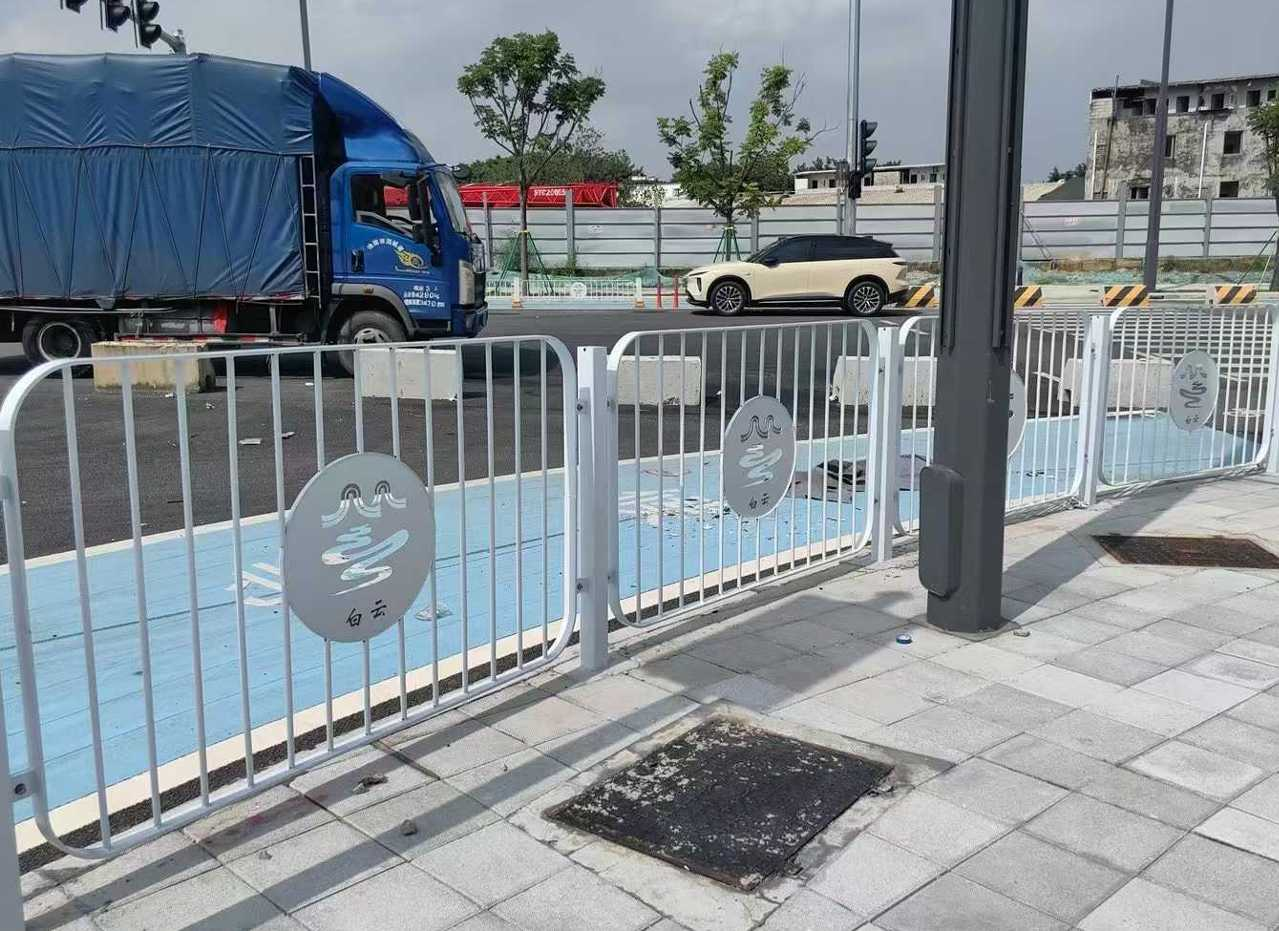
Pedestrian guardrail (model T013) in zinc steel and steel tube with electrostatic coating, used to guide pedestrian movement and separate walking areas from traffic.
Material and Surface Treatment: Where Service Life Is Actually Fixed
Material selection is best treated as a constraint-matching exercise rather than a quality ranking. The guidance recorded for buyers is straightforward: hot-dip galvanized steel offers a practical balance of strength, corrosion resistance and cost for standard outdoor projects; 304 stainless steel is specified for humid environments; 316 stainless steel — and 316L where salt spray is the dominant exposure — is specified for coastal areas; aluminium is lightweight and suited to decorative applications. Selection depends on climate, humidity, salt exposure, expected service life, maintenance requirements, appearance and budget.
| Material or finish | Recorded application | Why it is specified |
|---|---|---|
| Hot-dip galvanized steel | T001 road median guardrail; Y050 perimeter fence posts; Y070 security fence; T041 parking barrier | Coating applied to steel components for corrosion resistance; used where strength, corrosion resistance and cost must be balanced |
| Zinc steel with electrostatic coating | T013 pedestrian guardrail; T009 lane separation; Y044 perimeter fence in white or dark grey; decorative perimeter fence in antique bronze or black | Colour coordination with streetscape or building facade; weather and corrosion resistance on exposed outdoor elements |
| Grade 304 stainless steel | T028 riverside guardrail tube; Y060 stair railing; T040 bollard | Humid-environment corrosion resistance, with appearance retained on exposed surfaces |
| Grade 316L stainless steel | Balcony railing specified for coastal exposure | Specified for resistance to marine salt spray in corrosive coastal environments |
| Pickling and passivation | T023 stainless steel bridge railing with thick-wall tube posts and multiple horizontal rails | Applied to improve corrosion resistance on the stainless surface |
| Hot-dip galvanizing combined with PVC coating | T039 diagonal-weave anti-throw mesh | Dual corrosion protection specified for outdoor corrosion exposure |
| Aluminium alloy | Y054 balcony railing; aluminium-handrail riverside guardrail T026 | Lightweight and rust-resistant; used where low weight and decorative appearance matter more than structural duty |
| FRP and colour-coated steel sheet | T034 FRP noise barrier; T036 colour-coated steel noise barrier | Acoustic and screening panels where weight, translucency or panel finish is the controlling factor |
The boundary matters here. A heavier material grade does not automatically make a guardrail safer in a given location — it makes it more durable under a stated exposure. Conversely, a guardrail that is dimensionally correct but specified in the wrong coating system for a humid or coastal site will generate maintenance cost long before its structural life is exhausted. That is a specification failure, not a manufacturing failure, and it is one of the few risks a buyer can eliminate entirely at the enquiry stage.
Standards, Codes and the Crash-Rated Boundary
Municipal guardrail procurement crosses at least three regulatory layers: the national or regional road-safety standard that governs the installation, the trade classification that governs import documentation, and the project specification that governs the delivered product.
For permanent vehicle restraint systems installed on roads in Europe, EN 1317 is described as the mandatory standard, with EN 1317-5 cited as the applicable part and an effective date of 1 January 2011 (source: Asebal). In the United States, AASHTO MASH 2016 is identified as the current evaluation standard for new permanent roadside hardware as of 31 December 2019 (source: OTW Safety). For trade purposes, road guardrails are commonly classified under HS code 73089099, although customs reporting aggregates such structures and limits sub-segment analysis.
The practical limitation to hold on to: a municipal median, pedestrian or riverside guardrail is not automatically a crash-rated vehicle restraint system. Where vehicle impact containment is required, the complete assembly — rails, posts, connections and compatible end treatments — must be specified and verified as one system, and end terminals and transition sections should not be assumed to be universally interchangeable. Similarly, riverside railings guard accessible waterfront edges and reduce accidental access to water but do not provide flood control, and pedestrian guardrails guide movement rather than restrain vehicles. Reading a product family as interchangeable with a certified restraint system is the most expensive specification error in this category.
Site Conditions That Change the Specification
Urban road medians
Median installations operate outdoors under sunlight, rain, dust, wind and vehicle spray, with traffic passing on both sides. Their function is to separate opposing traffic streams, guide vehicles and discourage unauthorized crossing; the multi-rail arrangement on model T001 is designed to restrict climbing and crossing along the median. Where a city has an established municipal standard, the configuration follows it: the T002 Guangzhou standard municipal guardrail is recorded with reinforced steel posts and upper-and-lower rails and has been supplied for a 6,000 m road project, and the T004 planter cultural guardrail integrates the guardrail and a planter so that traffic safety and landscaping share the same footprint.
Lane separation where space is tight
Mixed-traffic streets with limited separation between vehicles and non-motorized traffic face a different constraint: the barrier must define the lane boundary without consuming carriageway width. The Hong Kong-style lane separation guardrail (T011) is recorded with compact post spacing for exactly this condition, while the T009 model uses a standard zinc steel upper and lower rail structure. Where warning visibility is the concern, model T007 includes a solar warning end — a powered element that operates separately from the passive barrier.
Sidewalks, crossings and school zones
Pedestrian routes are exposed to weather, road splash, dust and frequent pedestrian contact near moving traffic. The requirement is to guide pedestrian movement, separate walking areas from traffic and channel crossing toward designated points, with access openings following the approved site layout. Pedestrian guardrails are adaptable to different sidewalk widths, but they are not a substitute for a vehicle crash barrier.
Bridges and elevated roads
Bridge edges and elevated walkways face wind, rain, sunlight, traffic vibration and moisture, with salt exposure depending on location. Two constraints run in parallel here. The railing itself provides edge guarding and separation along the bridge, while pedestrian fall protection and vehicle restraint must be specified separately for the intended bridge use. Model T023 uses thick-wall stainless steel tube posts with multiple horizontal rails and a pickling and passivation finish, and model T024 combines a wood-grain transfer handrail with a stainless steel structure where a natural appearance is required alongside an engineered metal frame. Where falling-object protection or glare is the issue, anti-throw mesh (T037, T039) and expanded metal anti-glare screen (T038) are mounted to the supporting structure, and support compatibility must be confirmed individually.
Waterfronts, lakes and reservoirs
Waterfront installations operate in high humidity with rain, water splash and wet surfaces, and flooding or salt exposure depends on the site. The recorded design approach is a fully customized waterfront design that accounts for prolonged exposure to water, with anti-corrosion treatment and weather-resistant materials, adaptable to different riverbank conditions. Model T028 uses Grade 304 stainless steel tube; model T026 combines an aluminium handrail with hot-dip galvanized steel and zinc steel; models T025 and T029 support custom material and colour matching so that the railing reads as part of the riverside landscape. Again, the function is guarding and guidance — not flood defence.
Perimeters, buildings and work sites
Beyond the roadway, the same constraint logic applies to property boundaries, balconies, stairs, windows and industrial zones. A perimeter fence with hot-dip galvanized posts and a dark-green finish has been applied over 3,800 m and recorded in stable operation for eight years; decorative perimeter fencing can carry custom corporate-identity panels; workshop partitions in welded steel mesh keep visibility between zones while separating workcells. Prefabricated stair railings use bolted assembly and can be installed without on-site welding, which is relevant where construction pollution and schedule pressure are constraints.
Customization, Quotation and Quality-Control Constraints
Because so much of the product is defined by the buyer's specification, the quality of the enquiry determines the quality of the quotation. The recorded requirement for an accurate quote is: guardrail type, dimensions, total quantity, material, surface finish, drawings, installation environment, applicable standards, delivery location and packaging requirements. Site photographs help when drawings are unavailable. If any of these is left open, the supplier must either quote an assumption or return the question — and assumptions carried into production become variation claims.
Customization under OEM and ODM arrangements covers dimensions, materials, colours, surface finishes, structural designs, decorative patterns, logos, packaging and project-specific configurations. Quality control is recorded as a multi-stage sequence: incoming material inspection, dimensional inspection, welding inspection, coating inspection, in-process quality control and final pre-shipment inspection. Minimum order quantity is negotiable according to product type and project requirements, and lead time is determined by order quantity, product specifications and customization requirements — which means a late material change affects the schedule, not only the price. After-sales support covers remote technical support, installation guidance, maintenance recommendations, spare-parts coordination and after-sales response.
What the Supplied Project Records Show
Reference records are more useful as constraint evidence than as marketing. Among the supplied records: a 6,000 m Guangzhou standard municipal guardrail installation for a municipal road authority or road contractor, recorded over three years; a 3,800 m perimeter fence with hot-dip galvanized posts and a dark-green finish, recorded in stable operation for eight years; a 5,100 m vertical green wall hoarding combining site enclosure with climbing plants or artificial greenery, recorded over five years; a 1,600 m Guangzhou A1-1 construction hoarding with square-steel frame and modular assembly, recorded over four years; Shenzhen Type-A hoarding applied over 820 m in Longhua; and Shenzhen Type-C hoarding applied over 2,100 m in Bao'an, described as using reinforced H-section steel and thick panels for typhoon-region wind loads. Two further records cover screening: an expanded metal anti-glare screen applied along 110 km of expressway, bridge or elevated road, and a louvered noise barrier applied over 6,000 m for road traffic noise screening with airflow maintained through the barrier system.
The pattern across these records is consistent with the constraint logic above: long spans, multi-year service expectations and exposed outdoor conditions. They also illustrate why project duration belongs in the specification — a hoarding system with a design service life of up to five years is matched to medium- and long-term project durations, not to a short fit-out.
Prefabricated Modular Guardrails Compared With Site-Fabricated Railings
The most common structural alternative in municipal and building projects is between factory-prefabricated, bolted modular systems and railings fabricated and welded on site.
| Dimension | Prefabricated bolted modular system | Site-fabricated welded railing |
|---|---|---|
| Assembly | Factory-prefabricated sections with bolted connections; stair railing recorded as bolted assembly without on-site welding | Cutting and welding performed at the installation location |
| Site conditions | Reduces construction time and site pollution; suited to tight construction schedules | Weather-dependent; welding and touch-up coating affected by site conditions |
| Dimensional accuracy | Depends on accurate survey or approved drawings being available before production | Adjustments can be made on site, but finish consistency is harder to control |
| Replacement | A damaged modular section can usually be replaced independently when compatible posts, rails and fasteners are available | Repair generally involves re-welding and recoating the affected area |
| Design change flexibility | Lower after production begins; custom dimensions are confirmed before fabrication | Higher during installation, at the cost of schedule and finish control |
| Coating integrity | Coating is applied under factory conditions and inspected before shipment | Welded and damaged areas require field repair of the coating system |
The limitation is genuine and worth stating plainly: prefabricated modular systems are less forgiving of an incomplete specification. If the survey, drawing or model confirmation is wrong, the delivered components cannot simply be adjusted on site the way a welded railing can. The trade-off is the other way round for site fabrication, where flexibility during installation is bought with schedule risk, variable finish quality and a coating system that must be repaired in the field. Neither approach removes the need to inspect the surrounding structure and foundation before a replacement section is installed — posts, rails, anchors and foundations must be checked before new components go in.
Market Signals Relevant to Specification Timing
Published market research offers context rather than a forecast of any individual project. The global barrier systems market was valued at USD 24.8 billion in 2025, with the metal segment accounting for more than 50.0% of material share, according to Grand View Research; the same publisher valued the global temporary guardrail market at USD 2.4 billion in 2024. Dataintelo projects a 9.2% CAGR for the smart road barrier segment between 2025 and 2034. Hill & Smith PLC is identified as a major company in global barrier systems research.
Two cautions apply when these figures are used in procurement documents. First, definitions differ between sources: metal share reported for one sub-sector does not transfer automatically to the whole barrier category, and reports differ on whether temporary or permanent installations are included. Second, sub-segment trade data for municipal versus bridge guardrails is difficult to isolate because customs classifications aggregate guardrail structures under structural steel headings. The signal that survives these caveats is directional — metal-dominant construction, continuing demand for temporary and site-protection systems, and measurable growth in barrier products that include powered or monitoring features.
Future Outlook
Three directions appear consistent with both the product record and the published market signals. The first is the gradual separation of passive structure from active warning: the solar warning end on the T007 lane separation guardrail is already specified as a powered element that operates independently of the non-powered barrier, which allows warning functions to be upgraded or replaced without rebuilding the guardrail. The second is wider use of higher-grade stainless and dual corrosion-protection systems in humid and coastal municipal projects, where a longer interval between maintenance cycles carries more weight than initial material cost. The third is the continued modularisation of site protection and hoarding, where relocation or reuse depends on the condition of the model and the project plan, and where a documented design service life of up to five years is matched to medium- and long-term project durations.
For buyers, the implication is that guardrail specifications will increasingly need two separate parts: the structural and coating specification that fixes today's installation, and an interface specification that allows warning, monitoring or access-control equipment to be added later without replacing the barrier.
Frequently Asked Questions
What types of steel guardrails and railings are available for municipal projects?
Available products include road median guardrails, lane separation guardrails, pedestrian guardrails, bridge railings, riverside guardrails, crash barriers, perimeter fences, balcony railings, stair railings, window guards, workshop partitions and security fences.
How do I choose the right guardrail for my project?
Select according to the application, required safety level, installation environment, material, dimensions, surface treatment and local standards. Road, bridge, residential and industrial projects require different structural designs. Galvanized steel guardrails are commonly used for municipal roads, stainless steel railings for coastal or high-humidity environments, and welded mesh fencing for industrial perimeter protection. Custom specifications should be confirmed against project drawings.
Which material is best for outdoor guardrails?
Hot-dip galvanized steel provides a practical balance of strength, corrosion resistance and cost. Stainless steel offers better appearance and corrosion resistance, while aluminium is lightweight and suitable for decorative applications. The appropriate choice depends on climate, humidity, salt exposure, corrosion level, expected service life, maintenance requirements, appearance and budget.
Which guardrail material is suitable for coastal or humid environments?
Stainless steel, especially Grade 316 or 316L, is recommended for coastal and salt-spray environments. Hot-dip galvanized steel with an additional protective coating is also suitable when it is correctly specified and maintained.
Can guardrails be customized for different projects?
Yes. Dimensions, post spacing, rail configuration, materials, colours, surface finishes, decorative patterns, logos and installation methods can be customized according to project drawings and site requirements.
What information is required for a guardrail quotation?
Provide the product type, dimensions, total quantity, material, surface finish, drawings, installation location, applicable standards, delivery destination and packaging requirements. Site photographs are helpful when drawings are unavailable.
How do you install a prefabricated steel guardrail?
Install according to approved engineering drawings, the manufacturer's instructions and local safety standards: review the drawings and confirm the location, inspect posts, rails, fasteners and accessories, mark post positions and verify foundations or anchor points, install and temporarily secure posts, connect rails in the specified sequence, adjust height, spacing, verticality and alignment, then tighten all fasteners to the specified torque and complete the final inspection.
How should outdoor steel guardrails be maintained?
Inspect posts, rails, welds, bolts, anchors and surface coatings regularly. Remove dirt, salt and chemical deposits, tighten loose fasteners, repair minor coating damage promptly, and record defects so that severely corroded or deformed components can be replaced. Do not straighten severely deformed structural components for reuse without professional evaluation.
Can a damaged guardrail panel be replaced separately?
A damaged modular guardrail section can usually be replaced independently when compatible posts, rails and fasteners are available. The surrounding structure and foundation must also be inspected before the new section is installed, and the area should be reopened only after inspection and acceptance by qualified personnel.
Reference material: the Santian guardrail and construction hoarding product brochure is available as a PDF at https://cdn.socialarks.com/sbsp/25206/common/2026/0824/Santian.pdf. Company information: Guangzhou Santian Steel Structure Co., Ltd., aotianguardrail.com.