
Musical Fountain Applications by Venue: Matching Configurations
Musical Fountain Applications by Venue: Matching Configurations
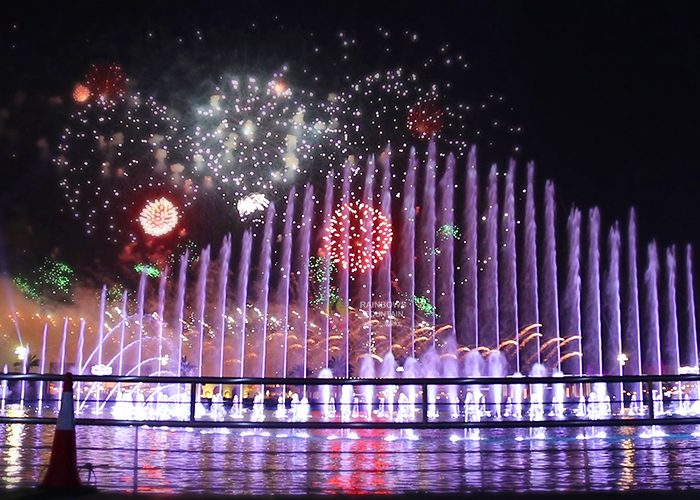
A musical fountain show combines synchronized water choreography, intelligent control and LED lighting — but the configuration behind it is selected according to the venue, not the other way around.
A musical fountain is not a single product that can be ordered from a catalogue. It is an engineered water system in which nozzle type, pump power, structural support, control architecture and lighting are selected to fit the site where the fountain will operate. Two projects with the same budget can require entirely different technical solutions if one sits in a saltwater harbour and the other sits on a dry plaza deck.
That is why venue type — city square, landscape park, theme park, hotel and resort, commercial complex, event stage or scenic water body — is the first variable in musical fountain design, and frequently the variable that decides whether the installation still performs as intended three years after the opening show. Buyers at the research and evaluation stage usually start with the effect they want to see. Experienced project teams start with the site, then work backwards to the effect.
Rainbows Fountain, the flagship brand of Caiyuejiaxiu Group, is a musical fountain design and engineering company based in Nansha, Guangzhou, China, with more than 25 years of experience in the fountain industry. The company reports more than 4,700 completed fountain projects in over 50 countries, with scales ranging from small city squares to large water features, and supplies configuration families that include dancing fountains, dry deck fountains, floating lake fountains, water screen projection systems, fire water fountains, digital water curtains and cold fog fountains. This article maps those configuration families to seven real venue types and explains how project parameters such as nozzle lift and pump power are narrowed down for each scenario.
Why the Venue, Not the Effect, Sets the Engineering Brief
Musical fountain systems are applied in an unusually wide range of operating conditions: outdoor pools or lake installations, indoor water features, dry interactive decks or grounds, and equipment customised per site condition. Typical applications include city square fountains, scenic multimedia shows, hotel and commercial landscape projects, floating lake fountains, and stage and opening-ceremony special event effects. The industries behind those applications are equally varied — municipal engineering, night tour operations, landscape and tourism, cultural and entertainment shows, city public spaces, commercial real estate, hotels and resorts, theme parks and event organisers.
Each of those environments imposes its own constraints. Documented project requirements for musical fountain installations typically include anti-corrosion and saltwater treatment, floating lake structure design, and waterproof electrical and safety protection. A municipal plaza with a concrete basin, a natural lake with fluctuating water levels and a hotel courtyard with decorative tiling do not share the same structural, hydraulic or electrical assumptions, even if all three are described in a tender as a “musical fountain”.
The equipment list for these systems is also broader than most first-time buyers expect. A complete installation is normally assembled from submersible or centrifugal pumps, nozzles, valves, pipes, waterproof cables, DMX/PLC controllers, LED lights, laser lights, beam lights, water-screen projectors, audio systems, electrical cabinets, an industrial PC with control software, and a filtration system. Each item on that list is selected against the venue’s physical and operational reality — not against a standard package.
Seven Venue Types and the Configurations That Fit Them
The following mapping reflects the configuration families and application scenarios documented in Rainbows Fountain’s project data, combined with the operating conditions each venue type imposes. It is a planning framework, not a fixed specification: the final combination for any individual site is confirmed at project level.
1. City Squares and Civic Plazas
City square installations are typically designed for large, open, hard-surfaced spaces with high foot traffic and long viewing distances. The configuration families that fit this context are the city square musical fountain, the stainless steel dancing musical fountain and the dry deck interactive musical fountain, supported by programmable show modes with scheduled runs so that performances can be timed to civic events and evening peak footfall.
Because a civic plaza is also a landmark, structural durability matters as much as the show. A landmark project of this type documented by Rainbows Fountain combined a musical dry fountain with a stainless steel 304 sculpture water fountain show that includes a water curtain, water curtain screen projection, laser show, running DMX512 LED light show, beam light show and ring fog spray show — an example of how several configuration families are layered into one square.
2. Landscape Parks and Lakeside Public Spaces
Parks and landscaped public areas often already contain a natural or artificial water body, which changes the structural approach. The park landscape musical dancing fountain and the lake floating musical dancing fountain are the usual starting points, with mist and cold fog effects used where the design intent is atmosphere rather than spectacle. Floating configurations remove the need for a basin structure but introduce their own design requirements, including floating lake structure design, anchoring considerations and corrosion treatment for natural water.
3. Theme Parks and Entertainment Venues
Theme parks prioritise guest interaction and repeatability over one-off grandeur. The configuration families that match this venue are the dry deck interactive musical fountain, jumping jets, digital running water effects and water curtain features, all operating in programmable show mode with scheduled runs. Because guests may walk across the installation, waterproof electrical and safety protection and a clean, well-lit deck design become central to the engineering brief rather than optional details.
4. Hotels and Resorts
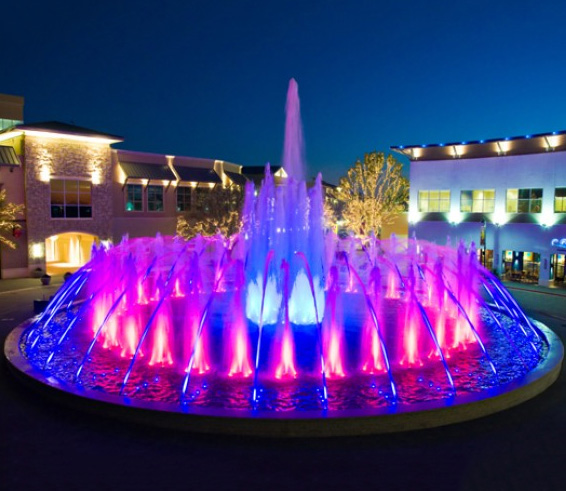
Pool and courtyard musical fountains are installed in decorative pools, hotel landscapes and commercial spaces, where scale, noise and evening scheduling matter more than raw water height.
Hospitality venues are usually constrained by scale, ambience and operating hours rather than by water volume. The hotel musical fountain and the pool musical fountain are the most common fits, typically deployed in decorative pools, arrival courtyards and terraces. Water choreography is designed to be elegant rather than overwhelming, and the show schedule is aligned with evening dining, reception and event programming so that the fountain supports the guest experience instead of competing with it.
Third-party market data points in the same direction: commercial end-users, including luxury hotels and shopping malls, held the largest share of the musical fountain market at 42.8% in 2025, according to Dataintelo. For hospitality buyers, that means the supply chain already understands this venue type — but it also means specification quality, not availability, is the differentiator.
5. Commercial Complexes and Mixed-Use Developments
Retail and mixed-use environments use fountains for footfall circulation and dwell time. The dry deck interactive musical fountain is often the preferred configuration because it does not consume usable plaza area when the show is off, while the pool musical fountain and digital water curtain suit internal courtyards and entrances where a visible water element is part of the architecture. Filtration and water treatment deserve early attention in these venues, since the same water is recirculated continuously in a public setting.
6. Events, Festivals and Opening Ceremonies
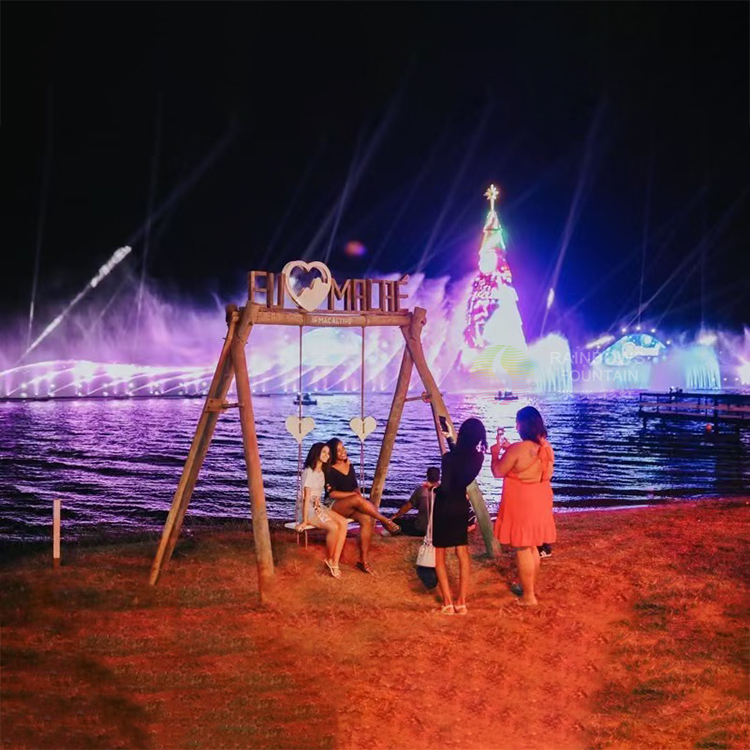
Event-driven water shows are engineered around a fixed calendar: design, equipment supply and annual upgrades are planned as a repeating cycle rather than a one-off installation.
Event venues are defined by schedule pressure and visual impact. Configuration families suited to this context include the stage water fountain, the fire water fountain, air shooter effects, water screen projection and laser or beam lighting. Rainbows Fountain designed, manufactured, installed and commissioned the stage water fountain for the opening ceremony of the 15th National Games of China, a project delivered under a compressed schedule. A second pattern is the recurring civic event: since 2023, the company has worked with two cities in Brazil on the design, equipment supply and annual upgrading of a year-end and New Year celebration water dance show, which has developed from simple fountain displays into a multidimensional audio-visual programme.
7. Scenic Multimedia Shows and Waterfront Attractions
Scenic and tourism venues require the highest integration level, combining floating fountains, water screen projection, laser, fire and fog into a single programmed performance. A documented example is the Big O Show on the Ishim River in Astana, Kazakhstan — a large sculpture and multimedia water show consisting of a floating O-shaped sculpture multimedia show and a floating large dancing water show. The installation uses 2,000 pieces of DMX512 digital signal control equipment and more than 1,000 stainless steel pumps, and performs with a water screen movie, laser, fire and music dancing fountain show.
| Venue type | Configuration focus | Key site constraint to resolve early |
|---|---|---|
| City square / civic plaza | City square musical fountain, stainless steel dancing fountain, dry deck fountain | Deck or basin structure, public safety, scheduled show operations |
| Landscape park / lakeside | Park landscape dancing fountain, lake floating fountain, mist and cold fog effects | Water body condition, anchoring, anti-corrosion treatment |
| Theme park | Dry deck interactive fountain, jumping jets, digital running water, water curtain | Guest interaction safety, waterproof electrical protection |
| Hotel and resort | Hotel musical fountain, pool musical fountain | Scale, acoustic sensitivity, show scheduling around guest activity |
| Commercial complex | Dry deck interactive fountain, pool musical fountain, digital water curtain | Usable area, filtration and water treatment, maintenance access |
| Events and ceremonies | Stage water fountain, fire water fountain, air shooter, water screen, laser and beam lighting | Delivery schedule, temporary power, rigging and safety |
| Scenic multimedia show | Floating fountain, water screen projection, laser, fire, fog, DMX/PLC integration | Water body scale, projection conditions, long-term operating team |
How Nozzle Lift and Pump Power Are Selected
The equipment envelope matters before the artistic discussion begins. Rainbows Fountain’s musical fountain and multimedia water show systems support a nozzle lift range of 1 m to 100 m and pump power of 1.5 kW to 110 kW, with DMX512 or PLC intelligent linkage, RGBW underwater LED, full-colour laser and beam lighting, and working voltages of 380V, 220V or 110V.
Those figures describe capability, not a recommendation. They do not tell a buyer which value a specific venue requires, because nozzle types, pump head, flow rate, pump power and LED or laser configuration are project-specific and require project-level confirmation. What a buyer can do at the research and evaluation stage is understand which site variables push the design toward the lower or upper end of that envelope.
| Design driver | What it changes | What the buyer must verify |
|---|---|---|
| Viewing distance and sightline | Nozzle lift class and jet grouping | Plaza or basin geometry, obstructions, prevailing wind direction |
| Show scale and simultaneous effects | Pump power and pump count | Available electrical capacity at 380V / 220V / 110V |
| Installation type | Fixed basin, floating platform or dry deck chamber | Civil works, structural loading, drainage and service access |
| Water chemistry | Stainless steel grade and corrosion treatment | Proximity to saltwater or brackish water, treatment regime |
| Programming ambition | DMX512 / PLC architecture, lighting, laser, projection | Control room space, operator training, maintenance plan |
Scale examples illustrate the spread. A large scenic production such as the Big O Show in Astana operates with more than 1,000 stainless steel pumps and 2,000 DMX512 control devices. At the other end, a hotel courtyard or indoor decorative feature uses a fraction of that equipment and prioritises finish quality, low noise and reliability over water height. Both are legitimate musical fountain applications; they simply occupy opposite ends of the same engineering envelope.
Control, Materials and Waterproofing: The Verifiable Layer
Because venue matching is ultimately an engineering decision, the specification items that can be verified independently carry the most weight during supplier evaluation. Three categories matter most.
Control architecture. Advanced musical fountains use DMX512 lighting protocols and Programmable Logic Controllers to synchronise water jets with music, a technical standard identified in industry research by Cognitive Market Research. Rainbows Fountain systems operate in programmable show mode with scheduled runs, using DMX512 or PLC intelligent linkage, and add music synchronisation, remote monitoring, time scheduling, wind speed sensing and water level protection. Wind and water-level sensors are safety features as much as performance features, particularly for open plazas and lakeside installations.
Materials. The standard build is AISI 304 stainless steel, with 316 and 316L stainless steel available where corrosion exposure is more aggressive. Rainbows Fountain manufactures nozzles, stainless steel pipe systems, valves and fittings, underwater LED lights, pumps, DMX lighting, PLC control cabinets, electrical panels, cable systems and audio systems in SS304, SS316 or SS316L. For coastal sites and natural lakes, the grade selection and any anti-corrosion or saltwater treatment belong in the technical proposal, not in a post-installation fix.
Waterproofing and testing. Musical fountain systems commonly adhere to ISO 9001:2015 for quality management and IP68 waterproof ratings for underwater components such as LED lights and pumps. Rainbows Fountain lists IP68 underwater components in its product specifications, manufactures under an ISO 9001 certified quality management system with CE certified equipment, and sources key components from established suppliers including ABB, Rexroth and Schneider. Factory practice includes 100% testing before loading, factory inspection and third-party inspection options such as SGS, TUV and INTEK, with fountain equipment verified in the factory demonstration pool for water pattern, nozzle performance, lighting synchronisation and control programme behaviour before shipment.
Delivery and installation capability also affect venue fit. The company maintains an overseas engineering team of more than 20 engineers for on-site installation, commissioning, operator training and technical support, provides maintenance manuals and spare parts packages, and references a two-year warranty with recommended maintenance agreements that define response and spare-part strategies. Lead time is stated at 15 to 45 days, with the exact figure depending on project scale and customisation.
Market Signals: Venue Demand Is Broadening Beyond Landmarks
Independent market research suggests that the venue mix is widening. Dataintelo valued the global musical fountain market at USD 2.51 billion in 2025 and projects USD 5.23 billion by 2034, a compound annual growth rate of 8.5% from 2025 to 2034. The same source reports Asia Pacific as the leading region with a 38.5% revenue share in 2025, driven by urbanisation in China and Southeast Asia, and identifies commercial end-users — including luxury hotels and shopping malls — as the largest end-user segment at 42.8% in 2025.
Control systems show a similar trajectory. SNS Insider valued the music fountain control system market at USD 1.34 billion in 2024 and expects USD 2.89 billion by 2032. Read together, these figures describe a market in which the commercial and hospitality venue types covered in this article represent the largest share of demand, and in which spending is shifting toward the programmable control layer that makes a fountain updatable over time. For buyers, that has a practical consequence: the control and programming architecture is not a secondary line item, because it determines how easily a venue can refresh its show without rebuilding the hydraulic system.
Where a Musical Fountain Is Not the Right Answer
Scenario-fit analysis is only credible if it also identifies when a different solution performs better. Comparing a musical fountain against simpler water features makes the trade-offs explicit.
| Solution type | Typical fit | Trade-off |
|---|---|---|
| Static decorative fountain | Small courtyards, indoor features, sites without event programming or audience dwell time | Lower capital and maintenance complexity, but no synchronised show value |
| Musical dancing fountain | City squares, parks, hotel and commercial landscapes with regular evening audiences | Requires control cabinets, programming and trained operation; higher power demand than a static feature |
| Multimedia show system | Scenic water bodies, tourism attractions, major civic events | Adds projection, laser, fire and fog equipment and depends on water quality, ambient light control and night-time scheduling |
Beyond the solution-type comparison, four boundaries should be recognised honestly before a venue commits:
- It is not an off-the-shelf product. Dimensions and weight are determined by the final structural design, and key parameters are confirmed at project level. Procurement therefore includes design time and engineering review — a musical fountain cannot be ordered as a fixed catalogue item.
- Dry deck installations carry civil works. An underground chamber, structural loading capacity, drainage and service access are prerequisites. On constrained urban sites, civil works can represent a significant part of total project cost and complexity.
- Floating and natural-water installations add engineering scope. Floating lake structure design, anchoring, corrosion treatment and electrical safety protection all require site-specific solutions, and natural water bodies need to be assessed before configuration is fixed.
- Multimedia elements depend on operating conditions. Water screen projection, laser, fire and fog perform best under controlled night-time conditions with managed water quality and ambient light. Venues that cannot guarantee those conditions, or that have no sustainable operator and maintenance arrangement, gain less from a multimedia configuration than from a well-built dancing or pool fountain.
It is also normal due diligence to benchmark against established international suppliers. The musical fountain sector includes long-standing names such as OASE Living Water (Germany), Crystal Fountains (Canada) and Safe-Rain (Spain), alongside Chinese manufacturers. These suppliers do not specialise identically — system type, regional service model and project scale differ — which is why venue fit and lifecycle support, rather than brand recognition alone, should drive the shortlist.
Future Outlook: Upgrades Rather Than One-Off Installations
The strongest signal in Rainbows Fountain’s project record is not the number of installations but their continuation. The Big O Show in Astana forms part of a series of government fountain projects in Kazakhstan following the original commission. The 2019 Riyadh Season musical fountain show was upgraded by the client’s renewed appointment in 2024 and continues to operate. Since 2022 through 2026, the company has served as the exclusive upgrade partner for the Sheikh Zayed Festival light and fountain project, introducing air explosion fountains, a revamped light show and an upgraded programming system across successive years. In Brazil, a year-end celebration water show has been redesigned and upgraded annually since 2023.
This pattern suggests that venue owners increasingly treat a musical fountain as a long-life asset with a refresh cycle, not a one-time construction item. Three practical consequences follow for buyers evaluating suppliers:
- Programming capability and upgrade engineering should be assessed alongside hardware, because the show is what the audience returns for.
- Spare parts availability and documented maintenance strategies determine whether a system can be upgraded at year five rather than replaced.
- Material grade, IP68 waterproofing and control architecture documented at handover become the reference point for every later upgrade.
As commercial and hospitality venues continue to account for the largest share of demand, the configuration question will increasingly be answered by operational reality: how many people see the fountain, when they see it, and who maintains it afterwards.
FAQ
Which musical fountain type usually fits a city square or civic plaza?
City square and civic plaza projects are most often configured as city square musical fountains, stainless steel dancing musical fountains or dry deck interactive fountains, operating in programmable show mode with scheduled runs. The deciding factors are the plaza structure, the viewing distance across an open space, and whether the deck must remain usable by pedestrians when the show is off. Larger civic landmark projects sometimes combine several families in one installation — for example a musical dry fountain together with a sculpture water fountain show that includes a water curtain, water screen projection, laser, running DMX512 LED lighting, beam lighting and ring fog spray.
How are nozzle lift and pump power decided for a specific venue?
They are confirmed at project level. Rainbows Fountain’s musical fountain and multimedia water show systems support a nozzle lift range of 1 m to 100 m and pump power of 1.5 kW to 110 kW, with DMX512 or PLC control and working voltages of 380V, 220V or 110V. The position inside that range is determined by viewing distance and sightline, the number of simultaneous effects required, water body geometry and depth, wind exposure, available electrical capacity, and the materials needed for the site’s water chemistry. Nozzle types, pump head, flow rate, pump power and LED or laser configuration therefore require project-level confirmation rather than a standard selection table.
Can a musical fountain operate in saltwater or on a natural lake?
Yes, but it requires specific engineering provisions. Documented requirements for lake and coastal applications include anti-corrosion and saltwater treatment, floating lake structure design, and waterproof electrical and safety protection. Rainbows Fountain manufactures components in SS304, SS316 and SS316L stainless steel, with the higher grades selected where corrosion exposure is greater, and uses IP68-rated underwater components such as LED lights and pumps. Natural water bodies should be assessed for water level fluctuation, anchoring conditions and water quality before the configuration is finalised.
What control system do musical fountains use, and what does it require from the venue?
Advanced musical fountains use DMX512 lighting protocols and Programmable Logic Controllers to synchronise water jets with music and lighting. Rainbows Fountain systems link DMX512 or PLC control with music synchronisation, remote monitoring, time scheduling, wind speed sensing and water level protection. From the venue side, this requires space for control cabinets, a reliable power supply at 380V, 220V or 110V, and a trained operator or an agreed maintenance arrangement. Wind speed sensing and water level protection are safety-related functions that should be included in the operating plan, not treated as optional accessories.
What should a venue operator prepare before a musical fountain is installed?
At minimum: a defined water body or deck area with confirmed structural loading capacity, a drainage and service access route for dry deck installations, an electrical supply capable of supporting the selected pump power, and clarity on water source and treatment. For floating and lake installations, platform and anchoring design must be resolved, together with corrosion treatment where relevant. The supporting equipment list for a complete system typically includes pumps, nozzles, valves, pipes, waterproof cables, DMX/PLC controllers, LED, laser and beam lighting, water-screen projectors, audio systems, electrical cabinets, an industrial PC with control software and a filtration system — so installation planning should account for all of these, not only the visible water feature.
How long does a custom musical fountain project take from order to commissioning?
Rainbows Fountain states a lead time of 15 to 45 days, with the exact duration depending on project scale and customisation. That figure covers manufacturing; total project time also includes design confirmation, civil works at the venue, international shipping, and on-site installation and commissioning. The company maintains an overseas engineering team of more than 20 engineers for installation, commissioning and operator training, provides a two-year warranty reference and recommends maintenance agreements that specify response times and spare-part strategy for the operating life of the system.
Reference document: Rainbows Fountain 2026 product and project brochure (PDF) — configuration families, materials and delivery scope.