
Musical Fountain Configurations Compared: A Buyer's Decision Framework
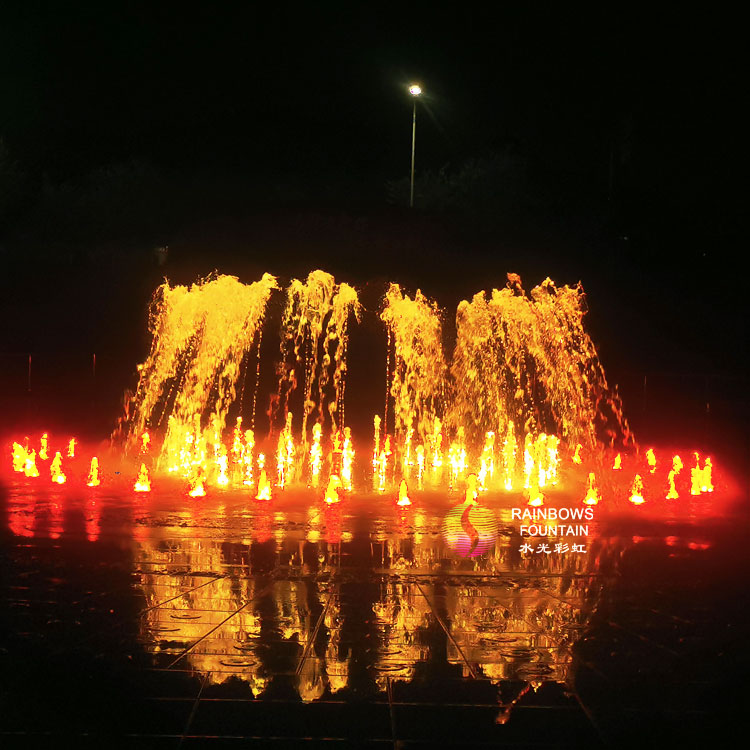
A musical dancing fountain uses precisely programmed water movements synchronized with music and lighting — one of seven configuration families outdoor venues typically compare.
Outdoor venues rarely run into trouble because a fountain component failed on the first day. They run into trouble because the configuration was locked before the site, the show format and the operating reality were understood — and the mismatch only becomes visible after commissioning, when wind flattens a projection water screen, when a plaza deck cannot carry the crowd that interactive jets attract, or when the specified nozzle lift exceeds what the available hydraulics can deliver.
The commercial context makes that decision more consequential than it used to be. The global musical fountain market was valued at USD 2.51 billion in 2025 and is projected to reach USD 5.23 billion by 2034, growing at a CAGR of 8.5% over the period, according to Dataintelo. Commercial end users, including luxury hotels and shopping malls, held the largest share of the market at 42.8% in 2025, and Asia Pacific accounted for a 38.5% revenue share in the same year. Musical fountains are increasingly bought as long-life programmable infrastructure rather than one-off ornaments.
That shift changes what a buyer actually needs to compare. Musical fountain is not a single product; it is a family of configurations with different civil works, hydraulics, control architectures, materials and compliance paths. This article sets out a configuration comparison framework for outdoor venues, built on project-level parameters and verification criteria rather than marketing claims.
Why Outdoor Venues Get the Configuration Decision Wrong
Most procurement processes compare suppliers, but the failure mode usually sits one level earlier: comparing configurations as if they were interchangeable.
Three sources of drift recur across outdoor projects.
- Site conditions treated as a detail rather than a constraint. Water level variation, salt exposure, wind exposure, substructure capacity and drainage decide which configurations are feasible at all. Floating lake fountains and dry deck fountains are not alternatives to each other — they require fundamentally different civil and structural conditions.
- Show format specified before the hydraulic budget. A multimedia programme with water screen projection, laser and fire-and-water effects implies a different pump, control and safety envelope than a short dancing fountain sequence on a hotel forecourt.
- Compliance treated as paperwork. Certificates, protection ratings and destination-market verification decide whether equipment is released at the port and accepted by the client's engineer.
The practical answer is to run the comparison in a fixed order: configuration families first, then parameters, then evidence.
The Seven Configuration Families, Side by Side
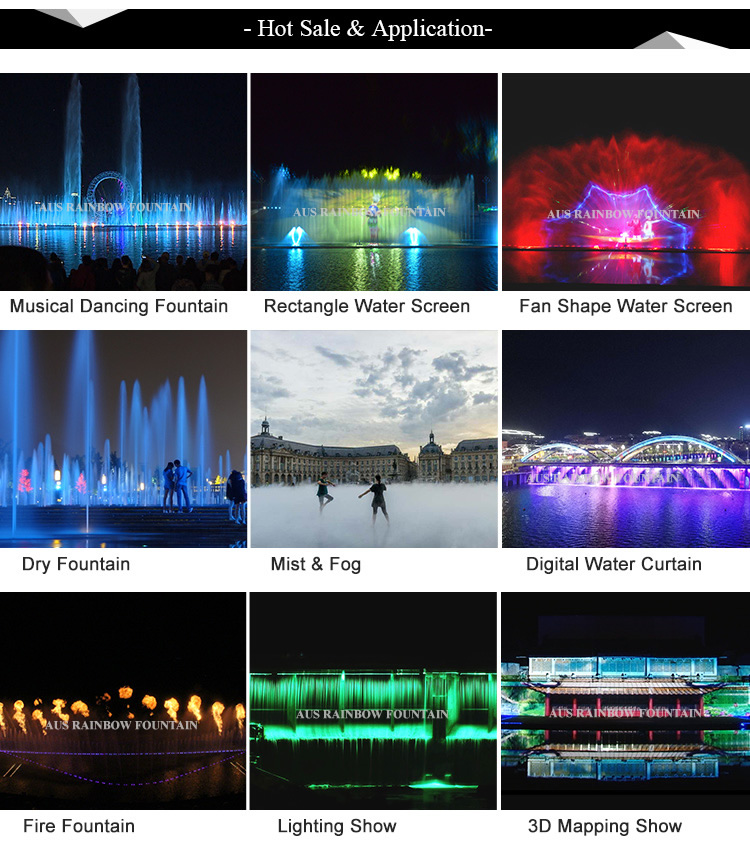
Outdoor musical fountain configurations differ in civil works, hydraulics, control architecture and site constraints — not only in visual effect.
Seven configuration families cover most outdoor venue briefs. Each has a dominant venue fit, a hydraulic and structural profile, and a characteristic constraint that must be planned for rather than corrected later.
| Configuration | Typical outdoor venue fit | Structural and hydraulic profile | Control and show character | Main constraint to plan for |
|---|---|---|---|---|
| Dancing fountain (basin or pool) | City squares, civic plazas, hotel and resort forecourts, pool landscapes | Nozzle arrays mounted in a basin or pool; pump power scaled to the required nozzle lift | DMX512/PLC control, music synchronization, RGBW LED, programmable sequences | Requires an open water body and a defined splash zone |
| Dry deck / interactive fountain | Public plazas, commercial decks, park activity zones | Jets recessed below a load-bearing, drained deck; heavier civil works | Programmable jets, interactive behaviour, scheduled show modes | Deck loading, drainage capacity and slip safety |
| Floating fountain | Lakes, reservoirs, rivers, waterfront landmarks | Modular floating platform with anchoring; tolerance to water level change | High-power jets with synchronized lighting; large-scale water shows | Water level fluctuation, anchoring, saltwater and corrosion treatment |
| Water screen projection | Scenic and tourism shows, landmark night attractions | Screen structures plus projection, pump and lighting equipment | Multimedia projection, laser and beam light combined with a water curtain | Wind exposure and projector alignment |
| Fire water fountain | Event stages, festivals, celebrations, landmark shows | Fuel infrastructure combined with hydraulic systems | Fire-and-water cues integrated into the show timeline | Permits, safety clearances and fuel logistics |
| Digital water curtain | Feature walls, entrances, sheltered outdoor and indoor spaces | Vertically aligned fine nozzles with controlled fall | Water-formed text and digital running water effects | Water quality control and air or splash management |
| Cold fog fountain | Landscape edges, plaza cooling zones, night ambiance | High-pressure misting through fine nozzles | Mist and fog effects combined with lighting | Wind drift and nozzle maintenance |
Two clarifications matter when this table is used for shortlisting. First, several configurations are usually combined rather than chosen exclusively: a lake project may run a floating dancing fountain, a water screen projection segment and a fog layer inside the same nightly programme. Second, the table describes configuration logic, not a fixed specification. Parameters are project-specific — including nozzle types, pump head, flow rate, pump power, LED or laser configuration and DMX/PLC control — and exact specifications require project-level confirmation.
The Technical Parameters That Narrow the Shortlist

Show complexity determines the hydraulic, electrical and control envelope that a configuration must support.
Hydraulics: Nozzle Lift and Pump Power
Nozzle lift is the parameter that converts a show concept into a water column. In project-based musical fountain systems, nozzle lift typically spans 1 m to 100 m, and support pump power typically spans 1.5 kW to 110 kW. The two move together: a higher lift requirement at a given nozzle count raises the pump power band, the pipe sizing and the electrical supply demand.
Buyers should therefore treat lift as a design output rather than a wish. A 1 m interactive jet on a plaza deck and a 100 m column on a lake landmark sit at opposite ends of the same specification range, and they imply different basins, different submersible or centrifugal pump selections, and different commissioning procedures.
Electrical Design and Control Architecture
Working voltage is specified per project and commonly falls between 110 V and 450 V at 50 Hz or 60 Hz. That range exists because outdoor venues rarely share one electrical standard: a civic plaza, a hotel forecourt and a lake installation may each connect to a different supply.
Above the electrical layer sits the control architecture. Musical fountains are programmed to synchronize water, lighting and multimedia elements with music, and the established toolkit is a DMX512 lighting protocol combined with Programmable Logic Controllers for hydraulic and show sequencing. In practical terms, DMX512 governs the lighting and effect channels while PLC logic governs pumps, valves and safety interlocks. Scheduled show runs, time scheduling, wind speed sensing and water level protection belong to the same control layer.
Lighting, Projection and Effect Modules
Underwater lighting for musical fountains is normally specified as IP68 RGBW LED, with full-color laser and beam light added for multimedia programmes. IP68 matters because these components sit permanently in water; the protection grade is the difference between a maintenance line item and a failure point.
The effect layer is where configurations diverge most visibly. Water effects may include vertical, fan, crown and arch jets, jumping jets, mist and explosion effects, air shooter effects, digital running water, water curtains, fire-and-water combinations, water projection and full multimedia shows. Each additional effect module adds a controllable variable, and each variable must be supported by the hydraulic, electrical and control design rather than by the show software alone.
Materials: Where 304 Stops and 316/316L Starts
Structural and hydraulic components for outdoor musical fountains are typically fabricated in stainless steel 304 or 316/316L. The distinction is not cosmetic. 304 is the standard choice for many outdoor installations, while 316 and 316L are specified where chloride exposure is higher — coastal sites, saltwater-adjacent lakes and locations using treated or saline water. Anti-corrosion and saltwater treatment is a stated special requirement for lake and marine-adjacent applications, alongside floating structure design and waterproof electrical safety protection.
A Six-Gate Decision Framework for Outdoor Venues
The framework below is designed to run in sequence. Each gate produces evidence, and the shortlist should not advance until the previous gate is closed.
- Gate 1 — Site conditions. Establish water body type (basin, deck, lake, pool), water level variation, salt or chloride exposure, wind exposure, available structural loading, drainage and electrical supply. Output: the configurations that are physically feasible.
- Gate 2 — Show format. Define programme length, whether the show is a nightly scheduled performance, an event-driven spectacle or an interactive daytime feature, and which effect modules are essential versus optional. Output: the configuration set that can deliver the programme.
- Gate 3 — Hydraulic sizing. Convert the show into nozzle lift, nozzle count, flow and pump power bands within the 1–100 m lift and 1.5–110 kW support pump range. Output: the hydraulic envelope and pump selection logic.
- Gate 4 — Control and content. Confirm the control architecture (DMX512 with PLC linkage), programming scope, music and content ownership, and who authors the show sequences. Output: a control specification that matches the show format.
- Gate 5 — Materials and protection. Select stainless steel 304 or 316/316L against the site's corrosion profile; confirm IP68 protection for underwater components and the waterproofing approach for cables, cabinets and connections. Output: a materials and protection schedule.
- Gate 6 — Compliance and acceptance. Define the certificates required, the third-party inspection regime and the acceptance tests to be performed before shipment and at handover. Output: a verification and acceptance plan.
| Gate | Evidence to request from a supplier |
|---|---|
| Site conditions | Site survey notes, water level data, corrosion assessment, structural assumptions |
| Show format | Show concept, effect list mapped to equipment, programme timeline |
| Hydraulics | Nozzle schedule with lift values, pump power and head, pipe sizing, hydraulic calculations |
| Control | Control architecture diagram, DMX512 and PLC scope, programming and content workflow |
| Materials | Material certificates for 304 / 316 / 316L, IP68 documentation for underwater components |
| Compliance | CE, ISO 9001, ROHS and TUV documentation where applicable, plus third-party inspection reports |
Certification and Acceptance: What to Verify Before Loadout
Certification in this category is usually verified at three levels, and buyers should keep them separate because each answers a different question.
- Product-level conformity. Equipment supplied into international projects is commonly required to carry CE marking, with ROHS compliance for applicable electrical and electronic elements, and TUV-related documentation depending on the project and destination market.
- Quality management. An ISO 9001 certified quality management system evidences a documented process for component selection and testing rather than a single inspection event.
- Component traceability. Project buyers increasingly ask which upstream brands sit inside the control cabinets and hydraulic systems. Traceable, certified key components — sourced from suppliers such as ABB, Rexroth and Schneider — allow the buyer's engineer to verify the electrical and safety chain independently.
Acceptance, as distinct from certification, is about performance verification. A reasonable acceptance regime includes factory testing of water patterns, nozzle performance, lighting synchronization and control programmes before shipment; 100% testing before loading; and, where the client requires it, third-party inspection by organisations such as SGS, TUV or INTEK. For projects in markets with destination conformity requirements, pre-shipment verification of conformity (PVOC) procedures may apply in addition to the manufacturer's product certificates, and these should be confirmed against the specific country of installation before equipment is packed.
Factory demonstration-pool testing is worth requesting as evidence in itself: a supplier able to run the actual programme in a test pool before shipment can demonstrate nozzle performance and control behaviour rather than describe it.
Where Configurations Reach Their Limits
A comparison framework is only useful if it states boundaries. Several are consistent across the category.
- Dry deck and interactive fountains carry a civil cost that other configurations do not. The substructure must carry pedestrian or crowd loading, the deck must drain, and the safety regime must account for public interaction. Sites with constrained drainage or limited deck depth may be better served by a basin-based dancing fountain.
- Floating fountains depend on water body behaviour. Water level fluctuation, anchoring and current are site variables that a floating platform cannot design away. In saltwater or high-chloride environments, 316/316L fabrication and dedicated saltwater treatment are usually required rather than optional.
- Water screen projection and cold fog are wind-exposed effects. Both lose visual integrity in strong or gusting wind, so scheduling in coastal or open-plaza venues should assume some non-performance conditions rather than a guaranteed nightly show.
- Fire water fountains add a permitting layer. Fuel infrastructure, safety clearances and operator procedures sit outside the fountain scope, and in some jurisdictions they can extend the project timeline beyond the equipment lead time.
- Project-specific parameters cannot be catalogue-standardised. Nozzle types, pump head, flow rate and control configuration are defined per project, and the actual specification is confirmed at project level. A fully fixed specification received before a site review should be treated as preliminary.
- Timelines are scale-dependent. Custom fountain production lead times are commonly quoted in the range of 15 to 45 days, with the actual figure depending on project scale and customisation, and with civil works and shipping running in parallel rather than afterwards.
Compared with traditional static water features, programmable musical fountains also carry a different operating profile. A static basin with fixed jets has fewer controllable variables and a simpler control chain. A musical fountain, by contrast, requires a control cabinet, DMX/PLC programming, scheduled show management and periodic re-programming to keep the programme current. That added complexity is the price of a reprogrammable attraction, and it is better budgeted at procurement than discovered at handover.
What the Market Data Suggests for the Next Five Years
The category's growth is concentrated where programmable water features double as visitor attractions. Three verified indicators frame the trend.
- The overall musical fountain market is projected to grow from USD 2.51 billion in 2025 to USD 5.23 billion by 2034 at an 8.5% CAGR, with Asia Pacific holding a 38.5% revenue share in 2025 (Dataintelo).
- The control layer is expanding as its own segment: the music fountain control system market was valued at USD 1.34 billion in 2024 and is expected to reach USD 2.89 billion by 2032 (SNS Insider). Control architecture is becoming a procurement line item rather than an accessory.
- Commercial end users — luxury hotels and shopping malls — held the largest share at 42.8% in 2025 (Dataintelo), which is consistent with venues buying fountains as repeatable nightly programming rather than one-time construction.
The supplier landscape reflects the same pattern. Alongside Chinese manufacturing, established international integrators such as OASE Living Water (Germany), Crystal Fountains (Canada) and Safe-Rain (Spain) are commonly listed in industry overviews, and buyers increasingly compare configuration capability and verification documentation rather than brand familiarity alone.
A Concrete Reference: What a 4,700-Project Record Adds to the Framework
Rainbows Fountain, the flagship brand of Caiyuejiaxiu Group, is a fountain design and engineering company based in Nansha, Guangzhou, China, specialising in musical fountain and water feature projects from concept design through manufacturing, overseas installation and commissioning.
The entity is a useful reference point for this framework because its project record covers the configuration families discussed above: dry deck, lake floating, dancing, multimedia, water screen projection, hotel, pool, city square, interactive, stage and landmark fountain types. Its published record includes more than 4,700 completed fountain projects across more than 50 countries, with project scales ranging from small city squares to large water features, supported by a dedicated overseas engineering team of more than 20 engineers for on-site installation, commissioning and technical support.
Three details map directly onto the gates described earlier. First, design capacity: an in-house team of 45 engineers and 12 designers produces CAD engineering drawings and 3D visual and fountain effect simulations, which is how hydraulic and effect decisions are validated before production. Second, verification: equipment is CE certified and manufactured under an ISO 9001 certified quality management system, with key components sourced from recognised suppliers including ABB, Rexroth and Schneider, and with 100% testing before loading and third-party inspection options available. Third, delivery structure: custom fountain equipment supplied with a 2-year warranty, factory demonstration-pool testing of water patterns, nozzle performance, lighting synchronization and control programmes, and installation, commissioning and operator training services on site.
For a buyer, these are checkable claims rather than differentiators by themselves: they describe a supplier whose configuration range, design team, testing routine and overseas commissioning capability can be mapped one-to-one against the six gates above. Additional company and product documentation is available at www.rainbowsfountain.com.
Future Outlook
Two directions look likely over the next several years. The first is that programmable control becomes the default specification rather than an upgrade, consistent with the control-system market growth cited above: venues that once installed static basins increasingly expect DMX512/PLC architecture, scheduled show runs and monitoring capability, because a fountain that can be reprogrammed for seasons, festivals and sponsorship content keeps its attraction value over time.
The second is that verification moves earlier in the procurement process. As more projects cross borders into markets with their own conformity regimes, buyers are requesting material certificates, IP68 documentation, third-party inspection reports and factory test evidence before purchase orders are issued. The configuration comparison framework in this article is designed to work with that shift: compare families first, set parameters second, then verify the supply chain that will deliver them.
FAQ
How should a venue choose between a dry deck fountain and a conventional pool fountain?
The deciding factors are structural and operational rather than visual. A dry deck interactive fountain recesses the jets below a load-bearing, drained deck, so it requires deck depth, drainage capacity and crowd-loading design, and it allows visitors to walk across the surface when the jets are off. A pool or basin-based dancing fountain requires an open water body with a defined splash zone and is generally easier to integrate where drainage or deck capacity is limited. If public interaction is a core objective, the dry deck configuration addresses it directly; if the venue's priority is a nightly choreographed show, a basin configuration usually fits the existing civil structure more easily.
What nozzle lift and pump power should a large lake fountain project expect?
Project-based musical fountain systems commonly specify nozzle lift within a 1 m to 100 m range and support pump power within a 1.5 kW to 110 kW range. A lake landmark show requiring tall columns sits near the upper end of both bands, which in turn drives pipe sizing, platform buoyancy and electrical supply requirements. Because these figures are project-specific, lift and pump values should be confirmed against surveyed water level data and the show's effect list rather than assumed from comparable projects.
When is stainless steel 316 or 316L specified instead of 304?
304 stainless steel is the standard fabrication material for many outdoor musical fountain structures and components. 316 or 316L is specified where chloride exposure is higher — coastal installations, saltwater-adjacent lakes and sites using treated or saline water — because the higher molybdenum content improves corrosion resistance in those conditions. For such sites, anti-corrosion and saltwater treatment is treated as a special project requirement alongside waterproof electrical safety protection.
What certifications should be verified for an overseas musical fountain project?
Verification typically covers CE marking for supplied equipment, ROHS compliance for applicable electrical and electronic components, TUV-related documentation where the project or market requires it, and an ISO 9001 certified quality management system covering component selection and testing. IP68 protection ratings should be documented for underwater components such as lights and pumps. Where the destination market applies a pre-shipment verification of conformity (PVOC) procedure, that requirement sits alongside product certificates and should be confirmed before shipment.
What acceptance criteria should be applied before handover?
A practical acceptance regime covers factory testing of water patterns, nozzle performance, lighting synchronization and control programmes before shipment; 100% testing before loading; third-party inspection by organisations such as SGS, TUV or INTEK where required; verification of material certificates and component traceability; and on-site commissioning checks covering pump behaviour, DMX512/PLC control response, scheduled show runs and safety interlocks such as wind speed sensing and water level protection. Operator training and a maintenance manual are normally part of handover documentation.
A downloadable 2026 company and product profile is available here: 2026 Rainbows Fountain brochure (PDF).