
Musical Fountain Procurement FAQ: Nozzle Lift, Pump Power, Voltage & IP68
A large outdoor musical fountain is not a decorative product that can be selected from a catalogue. It is a hydraulic, electrical, and control system in which four values decide whether the project is buildable at all: nozzle lift, supporting pump power, working voltage, and the IP rating of everything that stays underwater. Buyers in the research and evaluation stages of musical fountain and multimedia water show projects usually find that published specifications are either marketing-level, described simply as custom design, or withheld until a quotation is issued. This FAQ article answers the technical and procurement questions that engineering teams, city project owners, and importers actually raise, using parameters that can be traced to documented product data.
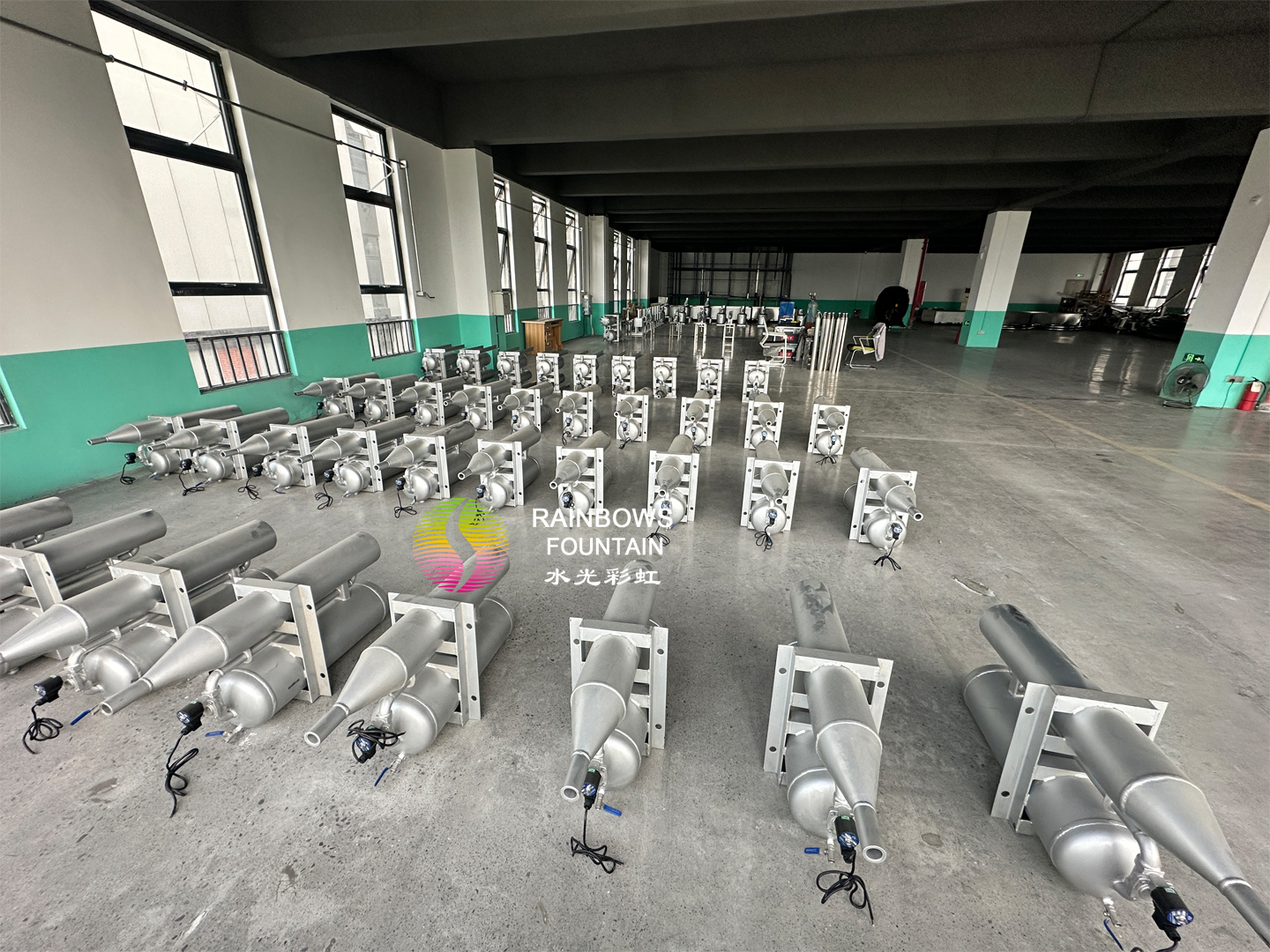
Stainless steel musical fountain nozzle units: nozzle lift, diameter, and grouping determine the pump head and pump power required for each zone of the show.
Why Parameter Clarity Is the Real Procurement Risk
Musical fountain procurement fails most often at the specification stage, not at the installation stage. Two projects with comparable budgets can require completely different nozzle lift, because lift is derived from pool depth, the distance between the jets and the main audience area, wind exposure, and the site's water supply and recovery capacity. Pump power follows lift and flow, and it does not work in reverse. Working voltage follows the site's electrical supply. The IP rating decides how long submerged equipment survives in that specific water body.
The difficulty is that these four parameters are interdependent, while supplier quotations frequently present them as independent line items. A quotation that lists nozzle lift without stating the corresponding flow rate, or that quotes pump power without stating the nozzle group it serves, cannot be verified. Buyers therefore need a small set of reference values and a clear understanding of what each value does and does not cover before they compare suppliers.
The opportunity side is equally clear. Musical fountains increasingly function as nighttime economic infrastructure — a scheduled attraction that raises visitor dwell time in plazas, parks, waterfronts, and commercial complexes. That shift raises the engineering bar: the systems are now procured as controlled, programmable, and maintainable assets rather than as decorative water features.
Rainbows Fountain: The Entity Behind the Documented Specifications
Rainbows Fountain, the flagship brand of Caiyuejiaxiu Group, is a musical fountain design and engineering company located in Nansha, Guangzhou, China. The company describes more than 25 years of experience in the fountain industry and reports more than 4,700 completed fountain projects in over 50 countries, an export ratio of approximately 80%, and primary markets in the Middle East, Africa, and South Africa.
Its documented product scope covers outdoor musical fountains, dancing fountains, dry deck fountains, floating fountains, water screen projection fountains, fire water fountains, digital water curtains, and cold fog fountains. Two model references appear in its product data: MF-01, a large musical fountain, and AZCH-01, used as an example of a large outdoor floating water fountain. In practice, model names remain project-specific, because nozzle lift, pump power, and control configuration are set by site conditions rather than by a fixed catalogue number.
Manufacturing, machining, welding, electrical assembly, testing, and export logistics are handled in-house, and key electrical components are sourced from suppliers including ABB, Rexroth, and Schneider. The company states that all fountain equipment and components used in its projects are CE certified and produced under an ISO 9001 certified quality management system.
Technical Explanation: Nozzle Lift, Pump Power, Voltage and IP68
Answer first: for documented Rainbows Fountain musical fountain systems, nozzle lift ranges from 1 m to 100 m, supporting pump power ranges from 1.5 kW to 110 kW, working voltage options are 380V, 220V, and 110V within an overall voltage and frequency range of 110V-450V at 50Hz-60Hz, and underwater components are rated IP68. Main structure material is stainless steel 304, with AISI 316 or 316L available as an option. Control options include DMX512 and PLC intelligent linkage, and lighting configuration includes RGBW underwater LED, full-color laser, and beam light.
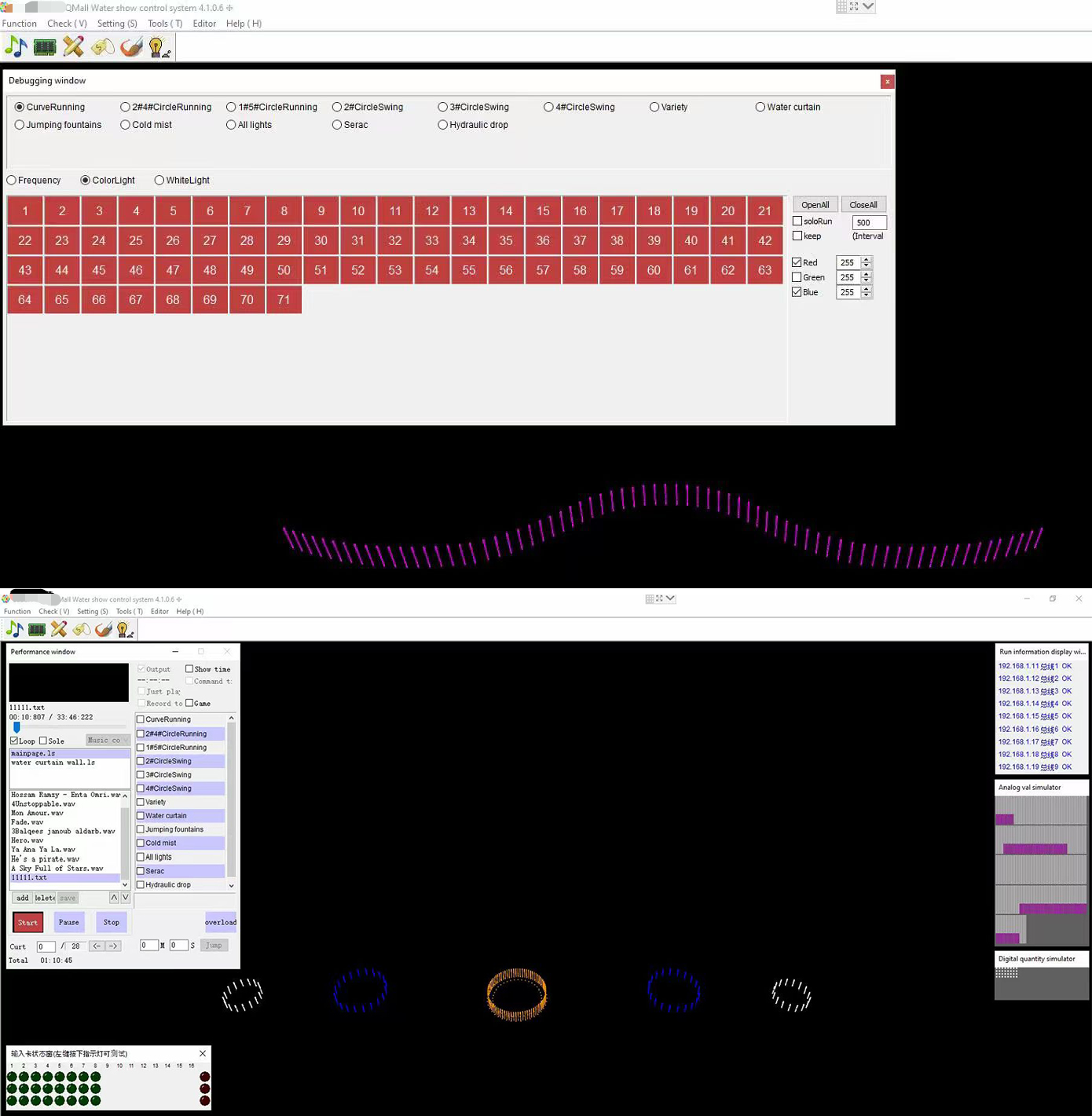
Fountain programming is developed per project, following music rhythm, local culture, festival themes, and venue requirements, and is mapped to the DMX512 or PLC control layer.
| Parameter | Documented range or option | What it determines in procurement |
|---|---|---|
| Nozzle lift | 1 m - 100 m | Pump head requirement, jet visibility distance, water recovery design |
| Support pump power | 1.5 kW - 110 kW | Electrical supply sizing, control cabinet design, energy planning |
| Working voltage | 380V / 220V / 110V | Compatibility with the site electrical supply |
| Voltage / frequency envelope | 110V-450V / 50Hz-60Hz | Regional electrical compatibility of equipment |
| Control system | DMX512 / PLC intelligent linkage | Show complexity, synchronization accuracy, channel count |
| Lighting configuration | RGBW underwater LED, full-color laser, beam light | Nighttime performance, electrical load, control channels |
| Protection grade | IP68 underwater components | Submersion durability of pumps, luminaires, actuators, cables |
| Structure material | Stainless steel 304; AISI 316 / 316L optional | Corrosion resistance for freshwater, saltwater, and coastal sites |
Nozzle Lift: 1 m to 100 m
Nozzle lift is the vertical height a jet must reach. At the low end of the documented range, 1 m class jets serve dry deck interactive fountains and laminar effects where water must remain close to and safe for the public. At the high end, 100 m class jets belong to landmark lake, river, and large plaza projects. A documented reference point is the Big O Show multimedia musical fountain in Astana, Kazakhstan, which uses more than 1,000 stainless steel pumps and over 2,000 pieces of DMX512 digital signal control equipment, with spray height that can exceed 100 m.
For procurement, lift should never appear alone. Lift plus flow rate per nozzle group defines the pump head, and pump head plus flow defines the required motor power. A specification that states lift but omits flow cannot be hydraulically validated.
Pump Power: 1.5 kW to 110 kW
Supporting pump power for documented systems ranges from 1.5 kW to 110 kW. In a musical fountain, pumps are grouped into zones, and each zone drives a defined water effect: small laminar or interactive zones sit at the low end, while main vertical jets and explosion effects in large shows sit at the high end. Aggregate power then determines electrical supply, cable sizing, and control cabinet dimensions.
Pump power is not a case of bigger is better. Oversizing raises energy consumption and cabinet complexity without improving the visible effect, while undersizing produces jets that fall short of design height and deform under wind load. The defensible figure comes from a hydraulic calculation against required lift and flow per nozzle group, not from a preference for a larger number.
Voltage and Frequency: 380V / 220V / 110V, 110V-450V at 50Hz-60Hz
Working voltage options are 380V, 220V, and 110V, with a documented voltage and frequency envelope of 110V-450V at 50Hz or 60Hz. This matters for international procurement because the same show design may be quoted for markets with different distribution voltages. Confirmation must happen at the control cabinet and pump level simultaneously, since cabinets, contactors, and protective devices are configured for the actual supply rather than for the envelope as a whole.
The envelope describes equipment compatibility, not a licence to operate a single system across multiple grids. Final configuration must follow the project's real supply conditions and the applicable local electrical code.
IP68 and Material Selection: Stainless Steel 304, 316, 316L
IP68 applies to underwater components: submersible pumps, underwater LED luminaires, actuators, and waterproof cabling that remain submerged during operation. It is an enclosure protection rating covering dust ingress and continuous immersion under defined test conditions. It is the correct baseline requirement for a musical fountain, but it is a baseline and not a complete reliability guarantee. Seals, cable entries, and connections still require scheduled inspection, and IP68 does not remove the need for a maintenance plan.
Structure material is documented as AISI 304 stainless steel, with 316 or 316L stainless steel available as options; the outdoor musical fountain product uses mainly stainless steel 304 components. Grade selection should follow water chemistry and exposure. Standard freshwater installations are typically served by 304, while saltwater or high-chloride environments justify 316 or 316L. For coastal and lake installations, documented requirements also include anti-corrosion and saltwater treatment, and floating lake structures require a dedicated floating platform design.
Control and Lighting Options: DMX512, PLC, RGBW LED, Laser and Beam Light
Control system options are DMX512 and PLC intelligent linkage, with music controller and fully programmable operation available. Advanced musical fountains commonly combine both protocols, and general industry technical references describe DMX512 and PLC as the standard pairing for synchronizing water jets with music. In practical terms, DMX512 handles channel-level effects such as lighting and valve or actuator timing, while PLC logic manages sequencing, equipment states, and protection interlocks.
Documented control modes also include music synchronization, remote monitoring, time scheduling, wind speed sensor, and water level protection. The last two are operational, not decorative: wind speed sensing allows jet height to be limited or the show to be paused under high wind, and water level protection safeguards pumps against low-level running.
Lighting configuration includes RGBW underwater LED, full-color laser, and beam light, with customizable RGB LED colour and a stainless finish option. Lighting is not only an aesthetic decision — it is part of the electrical load and the DMX channel count, and it materially affects cabinet sizing. Full-color laser and beam light add performance layers typically used in multimedia shows, water screen projection, and fire-water combinations.
Certification and Verification: What Can Actually Be Checked
Answer first: two third-party conformity documents are documented for Rainbows Fountain musical fountain and multimedia water show products, together with an ISO 9001 quality management system.
| Document | Number | Issuer | Market | Referenced standards | Validity |
|---|---|---|---|---|---|
| CE Certificate, Machinery Directive 2006/42/EC | M.2022.206.C73820 | UDEM | EU | EN ISO 12100:2010; EN 60204-1:2018 | Issued 2022-05-19, valid to 2027-05-18 |
| Certificate of Conformity, Ethiopia PVOC Pre-Export Verification of Conformity | ETH2000000501 | TUV Rheinland Guangdong Ltd. | Ethiopia | IEC 60076-1:2011; CES 125:2013; IEC 60034-1:2022; IEC 60034-30-1:2014; ES 6892:2021 | Issued 2026-06-12, valid to 2026-12-12 |
The CE certificate scope covers a water fountain series including musical fountain, dancing fountain, floating fountain, floor fountain, water screen projection fountain, laser fountain, flame fountain, digital water curtain, mist fountain, laminar jet fountain, and sculpture water fountain. The Ethiopian COC is issued as pre-export verification of conformity for electrical and electronic products.
Two boundaries matter here. First, both documents are market-specific: CE applies to the EU market, while the Ethiopian certificate is valid for customs clearance in Ethiopia, and neither substitutes for the other. Buyers should also confirm that the certificate scope actually names the fountain type being purchased. Second, certification is time-limited. As of September 2026, the Ethiopian COC remains within its validity period, which ends on 2026-12-12, and the CE certificate runs to 2027-05-18 — both dates should be checked against the shipment schedule rather than assumed.
Factory Pre-Testing and On-Site Commissioning
Answer first: documented quality control includes 100% testing before loading, factory inspection, and third-party inspection options such as SGS, TUV, and INTEK. Fountain equipment is tested in the factory demonstration pool before shipment, where engineers verify water patterns, nozzle performance, lighting synchronization, and control programs.
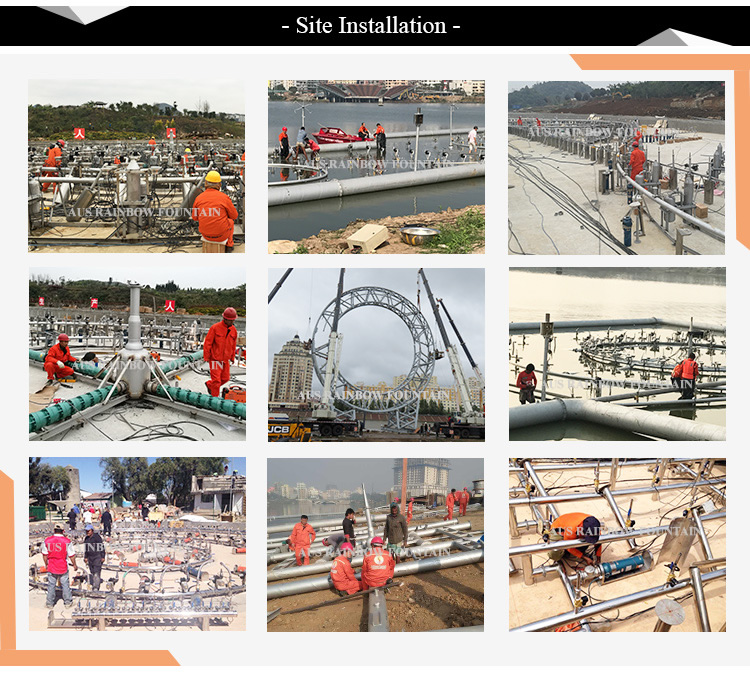
On-site installation and commissioning are supported for outdoor musical fountain projects, with remote technical guidance available where required.
Pre-shipment testing is not a formality in this category. A musical fountain is a synchronized system: a nozzle that performs correctly in isolation may behave differently once pump curves, valve response time, and DMX timing interact across zones. Testing the assembled system against the commissioned show program is the only reliable way to confirm that the design intent survives into hardware. Each control cabinet is wired, labelled, and tested, with functional inspections covering PLC programming, circuit safety, communication, and synchronized control of pumps and lighting equipment.
Documented supply parameters are a minimum order quantity of 1 unit, a monthly capacity of 30 units, and a lead time of 15-45 days, with detailed lead time depending on project scale and customization. Installation-related services include overseas installation, remote technical guidance, commissioning, operator training, maintenance manuals, and spare parts packages. The company maintains a dedicated overseas engineering team of more than 20 engineers, and its design department includes 45 engineers and 12 designers working from CAD engineering drawings and 3D effect simulations. Warranty is 2 years, with maintenance support and the option to sign warranty and maintenance agreements that specify response times and spare-part strategies.
Application Scenarios: How the Venue Changes the Specification
Answer first: the same documented parameter set is configured differently by venue, and the venue type is often the strongest predictor of what a project actually needs. Documented application categories include city squares, landscape parks, theme parks, hotels and resorts, commercial complexes, events and celebrations, and scenic multimedia shows. Working conditions cover outdoor pools and lake installations, indoor water features, and dry interactive decks and grounds, with equipment customized per site.
| Venue type | Typical configuration emphasis |
|---|---|
| City square / municipal plaza | High-lift vertical jets and wide nozzle arrays, larger aggregate pump power, DMX512 lighting scaled for a large audience area, wind speed sensing and water level protection |
| Park and landscape lake | Floating platform structures for lake installations, moderate lift, anti-corrosion and saltwater treatment where applicable |
| Hotel, resort and commercial complex | Smaller footprint, lower lift, tighter acoustic and lighting design, higher emphasis on programmable sequences and RGBW LED colour control |
| Dry deck interactive plaza | Low lift at the lower end of the 1 m-100 m range, safety-oriented nozzle selection, programmable interactive sequences |
| Multimedia and water screen projection show | Addition of water screen projectors, full-color laser, beam light, audio systems, and in some shows fire-water combination effects |
| Stage and opening ceremony | Compressed installation and commissioning schedule; documented example: the stage water fountain delivered for the opening ceremony of the 15th National Games of China |
Documented landmark references in this category include the 2019 Saudi Arabia large musical fountain show for Riyadh Season, which the client upgraded again in 2024; the Sheikh Zayed Festival light and fountain upgrade, served continuously from 2022 to 2026; and the Brazil year-end and New Year water dance show partnership that began in 2023. These references matter less as credentials and more as evidence that high-lift, high-power configurations have been commissioned and re-commissioned over multiple operating cycles.
Market Trend Analysis: What the Numbers Say About Demand
Third-party market research supports the direction of demand. Dataintelo valued the global musical fountain market at USD 2.51 billion in 2025 and projects USD 5.23 billion by 2034, with a CAGR of 8.5% from 2025 to 2034. The same source records Asia Pacific as the leading region with a 38.5% revenue share in 2025, driven by urbanization in China and Southeast Asia, and places commercial end users such as luxury hotels and shopping malls at the largest share of demand, 42.8% in 2025.
On the technology side, SNS Insider valued the music fountain control system market at USD 1.34 billion in 2024, with a projected USD 2.89 billion by 2032. Growth in the control segment is significant for buyers because it signals that synchronization, scheduling, and remote supervision are becoming standard expectations rather than premium add-ons. Industry technical references also treat DMX512 and PLC as the conventional control pairing, and cite ISO 9001:2015 and IP68 ratings as common reference points for quality management and underwater protection. For procurement teams, the practical consequence is that a specification without a protection rating, a control protocol, and traceable conformity documents is increasingly difficult to defend internally.
Comparison with Conventional Fountain Solutions
Answer first: the differences between a conventional fixed fountain, a programmable musical fountain, and a multimedia-integrated show are concentrated in control, lighting, water effect range, commissioning effort, and operating cost rather than in the visible basin structure.
| Dimension | Conventional fixed fountain | Programmable musical fountain | Multimedia-integrated show |
|---|---|---|---|
| Water effect | Fixed pattern, determined by nozzle geometry | Programmable, music-synchronized jet sequences | Programmable effects plus water screen, laser, beam light, and fire-water combinations |
| Control | Typically timer, valve, or simple switch control | DMX512 or PLC intelligent linkage, music controller, programmable operation | DMX512 and PLC linkage with audio, projection, and media sequencing |
| Lighting | Static or basic illumination | RGBW underwater LED with programmable colour | RGBW LED plus full-color laser and beam light |
| Underwater protection | Varies by supplier and component grade | IP68 underwater components | IP68 underwater components |
| Structure material | Varies; not always stainless steel | Stainless steel 304, with AISI 316 or 316L optional | Stainless steel 304, with AISI 316 or 316L optional |
| Commissioning effort | Lower; limited programming required | Requires show programming and hydraulic tune-in | Highest; requires multimedia and control integration |
| Operating cost profile | Lower; fewer powered components | Higher, driven by pump zones, lighting, and show schedule | Highest, adding projection, laser, and audio loads |
| Documented fit | Decorative pools and static landscape features | City squares, parks, hotels, resorts, and commercial complexes | Landmarks, tourism destinations, festivals, and public events |
Three limitations should be planned for rather than discovered later. First, parameters are interdependent: a 100 m nozzle lift is not an isolated option, because it requires pumps at the high end of the 1.5 kW-110 kW range, dedicated structural engineering, and reliable water supply and recovery. Second, IP68 is an enclosure rating, not a maintenance exemption — underwater components still require scheduled inspection and, in many projects, an agreed warranty and maintenance agreement with spare-part planning. Third, certification and lead time are both conditional. Certificates are market-specific and date-limited, and the documented 15-45 day lead time depends on project scale and customization, so schedule assumptions should be confirmed against the design freeze date rather than the purchase order date.
Future Outlook
The direction of the category is toward verifiable specification rather than artistic description. As the control system segment moves from USD 1.34 billion in 2024 toward a projected USD 2.89 billion by 2032, DMX512 and PLC coordination, remote monitoring, and sensor-based protection are likely to be treated as baseline requirements in tender documents. IP68 protection for submerged components and ISO 9001 based quality management are already widely referenced reference points in the industry.
For buyers, the practical change is in what a good quotation looks like. Expect nozzle lift to be stated with flow rate and pump head, pump power to be stated per nozzle zone, voltage to be matched to the site supply, IP68 to be named for each submerged component group, and certificate numbers and validity dates to be listed with the market they apply to. Suppliers that can present that level of detail before contract signature reduce the risk that the show seen in the 3D simulation differs from the show commissioned on site.
Frequently Asked Questions
What nozzle lift range is realistic for a large outdoor musical fountain?
Documented musical fountain systems support a nozzle lift range of 1 m to 100 m. The lower end suits dry deck and interactive jets where water must stay close to the public, while the upper end is used in landmark lake, river, and large plaza projects. Lift should always be stated together with flow rate and pump head, because those three values together determine whether a given water effect is achievable on a specific site.
How much pump power does a musical fountain typically require?
Supporting pump power for documented systems ranges from 1.5 kW to 110 kW. The figure is not selected from a list; it is calculated from the required lift and flow of each nozzle group. Small laminar and interactive zones operate at the low end, while main vertical jets and explosion effects in large shows operate at the high end. Aggregate pump power then determines electrical supply requirements and control cabinet sizing.
Which voltages and frequencies are available for musical fountain systems?
Working voltage options are 380V, 220V, and 110V, within a documented voltage and frequency range of 110V-450V at 50Hz or 60Hz. This supports alignment with different national electrical supplies, but the final configuration must be confirmed against the actual site supply and local electrical code at the control cabinet level as well as at the pump level.
What does IP68 actually protect in a musical fountain?
IP68 applies to underwater components such as submersible pumps, underwater LED luminaires, actuators, and waterproof cabling that remain submerged. It is an enclosure protection rating for dust ingress and continuous immersion under defined test conditions. It does not make those components maintenance-free; seals, cable entries, and connections still require scheduled inspection, so IP68 is best treated as a baseline requirement rather than a complete reliability guarantee.
Should the fountain structure be stainless steel 304, 316, or 316L?
Documented musical fountain structures are fabricated from AISI 304 stainless steel, with 316 or 316L stainless steel available as options, and the outdoor musical fountain product uses mainly stainless steel 304 components. Grade selection follows water chemistry and exposure: standard freshwater installations are typically served by 304, while saltwater or high-chloride environments justify 316 or 316L. Coastal and lake installations also require anti-corrosion and saltwater treatment measures, and lake projects require floating platform design.
What control and lighting options are available for programming a fountain show?
Control options include DMX512 and PLC intelligent linkage, with music controller or programmable operation, plus music synchronization, remote monitoring, time scheduling, wind speed sensing, and water level protection. Lighting configuration includes RGBW underwater LED, full-color laser, and beam light, with customizable RGB LED colour and a stainless finish option. Lighting choices affect both the electrical load and the number of control channels required.
Which certifications can be verified for musical fountain equipment?
Two third-party conformity documents are documented for Rainbows Fountain musical fountain and multimedia water show products. One is CE certification under Machinery Directive 2006/42/EC, certificate number M.2022.206.C73820 issued by UDEM for the EU market, referencing EN ISO 12100:2010 and EN 60204-1:2018, valid to 2027-05-18. The other is an Ethiopia PVOC Certificate of Conformity, number ETH2000000501 issued by TUV Rheinland Guangdong Ltd., referencing IEC 60076-1:2011, CES 125:2013, IEC 60034-1:2022, IEC 60034-30-1:2014, and ES 6892:2021, valid to 2026-12-12. Equipment is produced under an ISO 9001 certified quality management system.
How is a custom musical fountain verified before shipment and after installation?
Documented quality control includes 100% testing before loading, factory inspection, and third-party inspection options such as SGS, TUV, and INTEK. Fountain equipment is tested in the factory demonstration pool, where engineers verify water patterns, nozzle performance, lighting synchronization, and control programs. After shipment, installation, commissioning, and operator training are supported by an overseas engineering team of more than 20 engineers, and the product carries a 2-year warranty.
What lead time and minimum order quantity apply to a custom musical fountain project?
Documented supply parameters are a minimum order quantity of 1 unit, a monthly capacity of 30 units, and a lead time of 15-45 days, with detailed lead time depending on project scale and customization. Because the specification is project-specific, schedule usually depends on how quickly the design, hydraulic calculation, and control programming are confirmed rather than on manufacturing alone.
A technical brochure covering fountain types, materials, control options, and equipment scope is available for download: 2026 Rainbows Fountain technical brochure (PDF). Project-specific values for nozzle lift, pump power, and voltage configuration are confirmed during the design stage.