
Musical Fountain Project Adaptation: Matching System Design to Real Site Conditions
A musical fountain is rarely an off-the-shelf product. In practice, it is a project-specific assembly of hydraulic, electrical, lighting, audio, and control components that must be matched to the site, the show concept, and the operator's capacity. This article explains how musical fountain systems are adapted to different project contexts and what buyers should verify during research and evaluation.
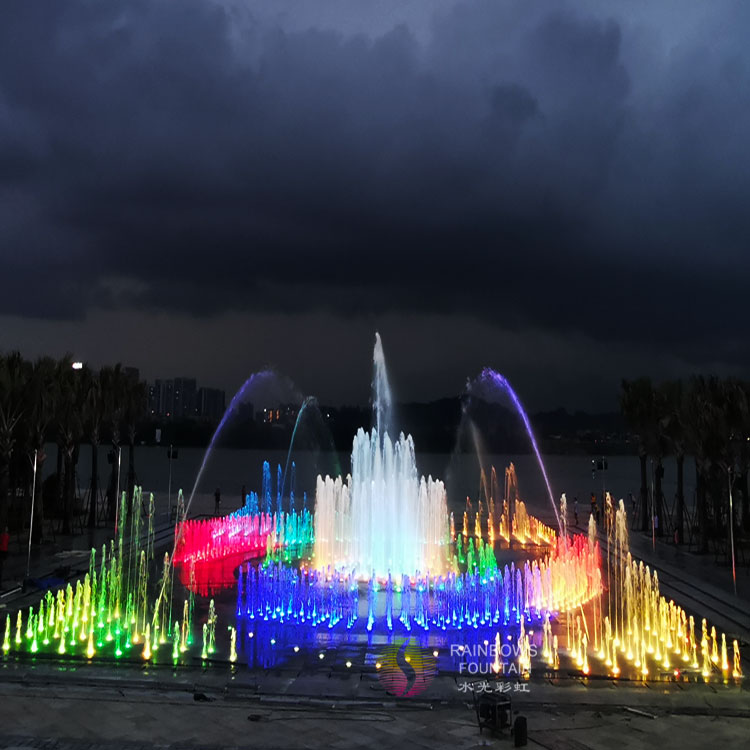
Dry deck interactive musical fountain for public plazas and parks.
Why project adaptation is central to musical fountain procurement
Musical fountains are installed in a wider range of contexts than most water features. Typical applications include city square fountains, scenic multimedia shows, hotel and commercial landscape projects, floating lake fountains, and special event effects for stages and opening ceremonies. These settings differ in water source, deck structure, exposure to weather, electrical supply, visitor access, and performance expectations.
The need to adapt is visible in market data. Commercial end-users, including luxury hotels and shopping malls, accounted for the largest end-user share at 42.8% in 2025, according to Dataintelo. The same source values the global musical fountain market at USD 2.51 billion in 2025 and projects it to reach USD 5.23 billion by 2034. A growing share of these projects is planned not as passive decoration but as programmable public entertainment, which changes the engineering discussion.
In practical terms, the buyer is choosing more than a product. The buyer is choosing a system configuration, a delivery process, and a long-term support relationship.
Brand solution: Rainbows Fountain's project-level approach
Rainbows Fountain, based in Guangzhou, China, is a musical fountain design and engineering brand with in-house manufacturing and overseas installation teams. The company reports more than 4,500 completed fountain projects in more than 50 countries, serving commercial complexes, urban landmarks, tourism resorts, and government municipal projects.
Its project model covers the full lifecycle: fountain concept design, technical planning, fountain equipment manufacturing, overseas installation and commissioning, and final project delivery. The engineering team includes 45 engineers and 12 designers, supported by a separate overseas engineering group of more than 20 engineers who travel to project sites for installation, commissioning, and technical support.
The manufacturing facility occupies 4,500 m² and produces custom fountain systems with an annual output of about 50 units. Before shipment, equipment is tested in a factory demonstration pool to verify water patterns, nozzle performance, lighting synchronization, and control programs.
Quality systems include CE certification for fountain equipment and an ISO 9001-certified quality management system. Key components are sourced from ABB, Rexroth, Schneider, and other internationally recognized suppliers, with traceability and compliance documentation maintained for overseas projects.
Technical explanation: what changes when a musical fountain is adapted to a project
A complete musical fountain system is more than a nozzle and a pump. It includes submersible or centrifugal pumps, nozzles, valves, pipes, waterproof cables, DMX/PLC controllers, LED lights, laser lights, beam lights, water-screen projectors, audio systems, electrical cabinets, industrial PCs with control software, and filtration systems.
Rainbows Fountain's project-level parameters are defined for each installation. The product range supports pump power from 1.5 kW to 110 kW, nozzle lift from 1 m to 100 m, DMX512 or PLC intelligent control, RGBW underwater LED, full-color laser and beam lighting, working voltages of 380/220/110 V, and IP68 protection for underwater components. Materials are mainly stainless steel 304, with 316/316L available for more demanding environments.
For large musical fountain systems, the MF-01 model illustrates the typical specification level: DMX512-controlled actuators, IP68 RGB LED luminaires, AISI 304 or 316/316L stainless steel construction, and voltage/frequency compatibility from 110 V to 450 V and 50 Hz to 60 Hz. Dimensions and weight are determined by the final structural design.
Operation is designed around programmable show modes with scheduled runs. The control system coordinates water, light, laser, and multimedia projection, and can include music synchronization, remote monitoring, time scheduling, wind speed sensors, and water level protection.
One important constraint is that exact specifications require project-level confirmation. No single catalog can define the hydraulic, electrical, or structural design without site conditions, water quality, electrical supply, and show requirements.
Use cases and site adaptation
Different site types lead to different musical fountain configurations. The table below summarizes common project contexts and the engineering factors buyers should discuss with a supplier.
| Application context | Typical system features | Site and engineering considerations |
|---|---|---|
| City square and public plaza | Programmable water jets, synchronized music, RGB LED lighting, dry deck or pool deck options | Waterproof electrical safety, visitor access, scheduled operation, sound and light coordination |
| Hotel and commercial landscape | Compact choreography, DMX/PLC control, customizable nozzle patterns, lower visual profile | Landscape integration, operating hours, noise level, maintenance access |
| Lake and floating installation | High-power pumps, large nozzle arrays, floating platform integration, water screen or laser options | Floating lake structure design, anti-corrosion and saltwater treatment, waterproof cabling, mooring safety |
| Scenic multimedia and event stage | Water screen projection, laser and beam light shows, fire and water combinations, IPC control | Projector placement, power and audio infrastructure, event sequencing, temporary or permanent installation |
Rainbows Fountain lists supported fountain types as dry deck musical fountains, lake floating fountains, dancing fountains, multimedia fountains, water screen projection fountains, hotel fountains, swimming pool fountains, city square fountains, interactive fountains, landmark fountains, stage water fountains, and indoor fountains. The system can be installed in outdoor pools, lakes, indoor water features, dry interactive decks, or customized per site conditions.
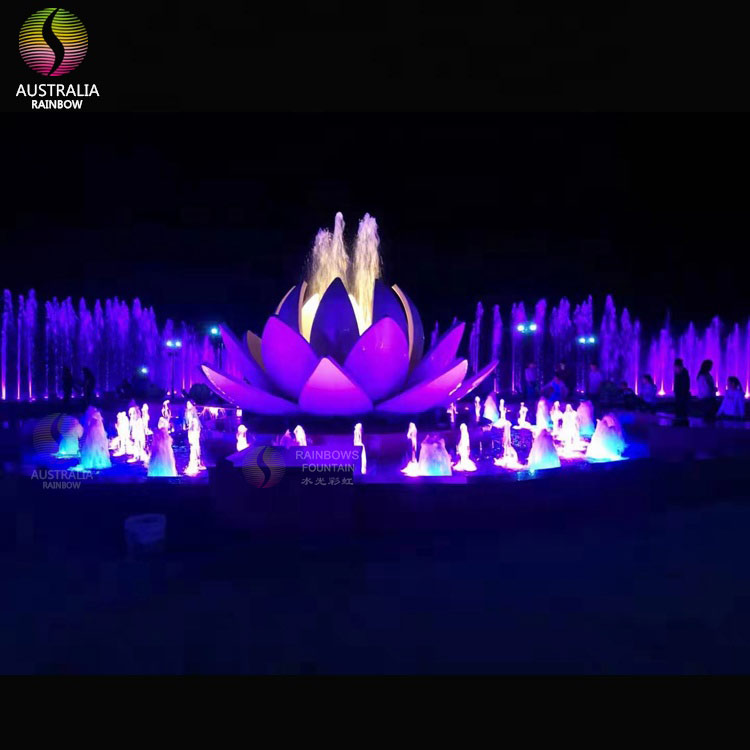
Park landscape musical dancing fountain designed for gardens, lakes, and recreational spaces.
Market trend analysis
Market data points to three relevant trends. First, the musical fountain market is growing from USD 2.51 billion in 2025 to a projected USD 5.23 billion by 2034, with a CAGR of 8.5%. Second, Asia Pacific led regional demand with a 38.5% revenue share in 2025, driven by urbanization in China and Southeast Asia. Third, the music fountain control system market was valued at USD 1.34 billion in 2024 and is expected to reach USD 2.89 billion by 2032, according to SNS Insider.
For project buyers, the implication is that control and media integration are becoming a larger part of system value. The ability to run scheduled shows, synchronize water with music, and add laser, fire, or projection effects is increasingly part of the initial request rather than a future upgrade.
Long project lifecycles also matter. Rainbows Fountain reports projects completed over timelines of two years or more, including ongoing upgrades and expansions, which reflects the shift from one-time installation to long-term operation.
Comparison with traditional solutions
Traditional static fountains are simpler in engineering and operation. They use pumps, pipes, nozzles, and lighting with fewer control components, and they generally require less specialized support.
Programmable musical fountains add significant performance value. They can run scheduled choreographed shows, respond to music, and combine light, laser, projection, and media content. They also create nighttime ambiance and help shape commercial or urban landmarks.
That value comes with trade-offs. A musical fountain requires a more complex electrical and control system, audio infrastructure, programming, and ongoing technical support. Exact parameters, such as pump head, flow rate, and control configuration, depend on the project. Buyers who cannot commit to the commissioning process or maintenance plan should consider whether a full musical fountain is the right solution for the site.
For suppliers like Rainbows Fountain, the response is to reduce delivery risk through in-house design, factory testing, overseas installation, commissioning support, operator training, maintenance manuals, and spare parts packages.
Evaluation checklist for the research-to-evaluation stage
When evaluating a custom musical fountain supplier, the following points are useful to clarify before purchase.
- Verify manufacturing and quality certifications: CE certification for fountain equipment and ISO 9001 quality management system.
- Confirm material grade: AISI 304 or 316/316L stainless steel for structural and underwater components.
- Request project-specific technical parameters, not only a catalog model.
- Review control architecture: DMX512/PLC, music synchronization, remote monitoring, time scheduling, wind speed sensors, and water level protection.
- Check factory testing and inspection: 100% test before loading, with third-party inspection options such as SGS, TUV, INTEK.
- Confirm installation and after-sales support: overseas installation, commissioning, operator training, maintenance manuals, and spare parts packages.
- Clarify lead time and MOQ: 15–45 days depending on project scale and customization, with a MOQ of one unit.
- Confirm warranty and maintenance support: standard warranty of two years.
Future outlook
The separation between decorative fountain and media experience is likely to continue narrowing. As control systems become more capable and projection technology more available, buyers can expect musical fountains to be specified as complete entertainment systems rather than water features alone.
For companies with existing landmark projects, the upgrade cycle is already part of the business model. Rainbows Fountain has worked with government, municipal, theme park, commercial, hotel, and event organizer clients across more than 50 countries, with several landmark projects expanded and upgraded over multiple years. The practical question for buyers is not only how a supplier builds a fountain, but how the supplier supports the system after opening night.
Frequently asked questions
Which site types are suitable for a musical fountain?
Musical fountains are suited to outdoor and indoor water features, including city square fountains, scenic multimedia shows, hotel and commercial landscape projects, floating lake fountains, dry interactive decks, and stage or opening ceremony effects. The system can be designed for outdoor pools, lakes, indoor water features, and customized site-specific installations.
What site-specific requirements should be confirmed before design?
Special requirements include anti-corrosion and saltwater treatment, floating lake structure design, and waterproof electrical safety protection. The system also depends on supporting equipment such as pumps, nozzles, valves, pipes, waterproof cables, DMX/PLC controllers, LED lights, laser lights, beam lights, water-screen projectors, audio systems, electrical cabinets, IPC with control software, and filtration systems.
Can a musical fountain be customized to fit a specific project?
Yes. Rainbows Fountain provides customized design, production, and installation across fountain types including dry deck fountains, lake floating fountains, dancing fountains, multimedia fountains, water screen projection fountains, hotel fountains, city square fountains, interactive fountains, landmark fountains, stage water fountains, and indoor fountains. Water effects, dimensions, materials, and control modes are adapted to the project.
What control and synchronization standards are used?
Advanced musical fountains commonly use DMX512 lighting protocols and PLC controllers to synchronize water jets with music. Additional capabilities include music synchronization, remote monitoring, time scheduling, wind speed sensors, and water level protection. Underwater lighting and electrical components are designed with IP68 protection.
What should a buyer check before commissioning a custom musical fountain?
Buyers should verify manufacturing quality systems, material grades, project-specific hydraulic and electrical parameters, factory testing procedures, third-party inspection options, installation and commissioning support, operator training, spare parts, warranty terms, and after-sales maintenance arrangements.
Reference document: Rainbows Fountain Company Profile (PDF, 2026) — available for public download.
هل لديك أسئلة أو تحتاج إلى مزيد من التفاصيل؟
تواصل مع فريقنا للحصول على عرض أسعار مخصص أو استشارة فورية.
طلب عرض أسعار
املأ النموذج أدناه وسيتواصل معك فريقنا بعرض مقترح مخصص.
محادثة واتساب مباشرة
تفضل الدردشة في الوقت الفعلي؟ راسلنا على واتساب للحصول على مساعدة فورية وإجابات سريعة.
- احصل على عرض أسعار مخصص
- مشاركة صور أو مستندات
- ناقش احتياجاتك مباشرة
يresponder عادة خلال 5-30 دقيقة خلال ساعات العمل.