
Musical Fountain Shortlist: 7 Formats for Your Venue Type
Musical Fountain Shortlist: 7 Formats for Your Venue Type
A musical fountain shortlist should be built from the venue outward, not from an equipment catalogue inward. Seven structural formats — dancing, dry deck, floating, water screen projection, fire water, digital water curtain and cold fog — cover most public-realm briefs, and each one changes the installation logic, the maintenance burden and the viewing geometry a client is committing to. The shortlist below maps all seven to city squares, landscape parks, theme parks, hotels and resorts, commercial complexes, events and scenic multimedia shows, then sets out the engineering criteria that apply across formats and the purchasing terms a buyer should confirm before a configuration is locked.
Why the venue should set the shortlist order
Format choice is largely a site decision. A city square with a flat paved surface and heavy foot traffic rarely tolerates an open basin with unfenced water; a lake site with seasonal level variation resists a fixed deck; a hotel forecourt has to stay quiet at 2 a.m.; a scenic show needs a dark backdrop and a projection distance that the site may not physically offer. Buyers who start with a nozzle count instead of a venue constraint usually discover the mismatch during commissioning, when the correction is expensive.
The practical sequence is: fixed venue conditions first (available water area, sightlines, ambient light, power supply, drainage, public access), viewing audience second (who stands where, for how long, in what weather), and only then the show technology. The seven formats below are the structural choices that remain once those three filters are applied.
The seven formats at a glance
The table is a screening tool, not a specification. It is intended to eliminate formats that cannot work on a site before any hydraulic or lighting design is requested.
| Format | Strongest venue fit | Site demand | Boundary to check |
|---|---|---|---|
| Dancing fountain | City squares, theme parks, scenic shows | Open basin, long sightlines, stable power | Wind drift onto walkways |
| Dry deck | Commercial complexes, plazas, theme parks | Flush deck over a hidden equipment vault | Drainage, access hatches, slip resistance |
| Floating fountain | Lakes, landscape parks, reservoirs | Mooring, water-level variation, boat access | Service access and water quality |
| Water screen projection | Scenic multimedia shows, theme parks, events | Projection distance, low ambient light | Content production and update budget |
| Fire water | Events, theme parks, night shows | Fuel supply, exclusion zone, permits | Thermal clearance and fire approval |
| Digital water curtain | Hotels, commercial complexes, events | Precise trough, water treatment, air control | Indoor humidity and air handling |
| Cold fog | Landscape parks, resorts, scenic walkways | High-pressure pump, fine nozzles, drainage | Visibility depends on lighting and backdrop |
Format-by-format fit and boundary
1. Dancing fountain — the default for city squares and landmark plazas
A musical dancing fountain is the format most buyers picture first: a cluster of vertical, fan, crown and arch jets choreographed to music, with the tallest jets carrying the visual signature of the site. It suits city squares and landmark plazas because the audience stands at a distance and reads the show as a single composition. It also scales — the same structural format can serve a municipal plaza and a national-event stage.
The boundary is environmental. Tall jets travel with the wind, and a plaza that looks generous on a drawing can put spray across a pedestrian route on a gusty day. Wind-speed sensors and programmable height limits are the usual mitigation, and they belong in the control specification rather than in a verbal assurance. Pump head and nozzle lift also drive operating cost, so a square that runs a 20-minute show twice a night is a very different energy proposition from one that runs continuously.
2. Dry deck fountain — commercial complexes and interactive public realm
A dry deck fountain hides nozzles, lights and piping in a vault beneath a flush paved surface, so the plaza is usable when the show is off and becomes an interactive water feature when it is on. Commercial complexes, mixed-use plazas and family zones in theme parks are its natural settings, because the water does not consume usable floor area.
The engineering burden shifts below ground. Deck drainage, hatch placement, cable routing and slip resistance all have to be resolved at design stage, and maintenance access has to be planned so that a pump replacement does not require breaking the finished surface. For venues with children in the water, water treatment and shut-off logic deserve the same attention as the nozzle layout.
3. Floating fountain — lakes, rivers and landscape parks
A lake floating musical dancing fountain mounts the pump, manifold and lighting on a buoyant platform moored in open water, avoiding major civil works on the shoreline. Landscape parks, reservoirs and riverfront sites use it where a permanent basin is impractical or where the water body is already the visual focus.
What buyers should test early is serviceability: mooring design, seasonal water-level swing, debris load and the practical route for a maintenance crew to reach the platform. Water quality also matters more than on a lined basin, because intake screens and submerged luminaires sit in an uncontrolled environment. A floating platform is not a shortcut around maintenance planning — it relocates it.
4. Water screen projection — scenic multimedia shows and theme parks
A water screen projection fountain forms a fan-shaped film of water that accepts projected video, laser and beam lighting, turning the fountain into a storytelling surface rather than a decorative jet field. Scenic multimedia shows and theme parks use it where a narrative, brand film or seasonal programme justifies the additional equipment.
Two conditions decide feasibility. The first is geometry: screen width, projection throw and viewer position have to be resolved together, and ambient light has to be low enough for the image to hold. The second is content — a water screen without an ongoing content budget is an expensive blank surface. Rainbows Fountain's Big O Show on the Ishim River in Astana combines a floating sculpture, a large dancing water show, water screen movie, laser, fire and music, and uses more than 2,000 DMX512 digital control points with over 1,000 stainless steel pumps; it is a clear illustration of how much system integration the format implies.
5. Fire water fountain — events and night-show programming
Fire water fountains combine flame effects with water jets, typically as short, high-impact sequences inside a longer show. Event programming, theme park night shows and festival sites use the format because the contrast between water and flame reads strongly at a distance and photographs well.
It is the format with the heaviest approval burden. Fuel supply, thermal clearance to structures and planting, exclusion zones, wind cut-offs and local fire-authority sign-off all sit ahead of the artistic design, and they should be evidenced in writing before the effect is written into a show programme. Buyers should also confirm whether flame sequences are licensed, permitted or restricted at the specific site; a format that is routine in one market can be a permitting problem in another.
6. Digital water curtain — hotels, lobbies and commercial frontage
A digital water curtain produces a controlled falling sheet of water that can be programmed with running water patterns and used as a backdrop for lighting or projection. Hotels and resorts, commercial complexes and event venues use it where the fountain is part of the architecture and is viewed at close range.
The format demands precision rather than power: a level trough, clean water and stable flow determine whether the sheet reads as glass or as a spill. Indoor installations add air-handling and humidity considerations that outdoor sites never face. Where the curtain sits in a lobby or atrium, the designer also has to answer acoustic questions, because falling water is continuous sound, not a scheduled event.
7. Cold fog fountain — landscape parks and atmospheric walkways
Cold fog systems use high-pressure pumps and fine nozzles to create a low, drifting mist rather than a jet. Landscape parks, resort gardens and scenic walkways use fog as atmosphere and as a way to make a path feel distinct without a large water body.
Fog is the most lighting-dependent format on the list: without a dark backdrop and directed illumination, the effect can be nearly invisible. Buyers should view a mock-up or an existing installation at the intended operating hour rather than judge the effect from a rendering, and should confirm drainage and nozzle maintenance routines, since fine nozzles are sensitive to water quality.
Engineering criteria that apply across all seven formats
Once the format set is narrowed, the same technical questions decide which proposals are credible. Across the seven configurations, nozzle lift ranges from roughly 1 m to 100 m and pump power from about 1.5 kW to 110 kW, so a single generic quotation rarely reflects two different formats accurately.
- Nozzle lift and pump power. State the required lift and the operating hours per day, not just the maximum height. The energy profile of a 100 m jet running nightly differs fundamentally from a 3 m interactive deck.
- Stainless steel grade. Rainbows Fountain manufactures fountain nozzles, pipe systems, pumps, valves, underwater LED lights, DMX lighting, PLC control cabinets, electrical panels, cable systems and audio equipment in SS304, SS316 or SS316L. Coastal and high-chloride sites generally justify the higher grades; the material call-out should be written into the bill of quantities rather than left to the workshop.
- IP68 underwater components. Luminaires, connectors and motors that sit permanently under water should be specified with a stated ingress protection rating, with IP68 as the benchmark for continuous submersion. Ask for the rating per component, not per project.
- Lighting. RGBW LED, laser and beam lighting produce very different results on the same nozzle layout. The lighting package should be described effect by effect, because a laser and a beam fixture are not interchangeable line items.
- Control. DMX512 and PLC control are both used in this category, and the choice determines how easily a show can be re-programmed later. Rainbows Fountain's supported control modes include DMX512, music synchronisation, remote monitoring, time scheduling, wind-speed sensing and water-level protection — the last two being safety functions rather than show features.
Where supplier evidence belongs in the shortlist
Format fit is a site question; deliverability is a supplier question, and the two should be scored separately. Rainbows Fountain (Guangzhou Shuiguang Fountain Equipment Co., Ltd) reports 4,700+ completed fountain projects across 50+ countries, with clients that include government and municipal bodies, theme parks, commercial and hotel groups, and event organisers. Those references indicate breadth of format experience, not a guarantee for any specific site.
The compliance layer is checkable. The company's CE certificate M.2022.206.C73820, issued by UDEM under Machinery Directive 2006/42/EC against EN ISO 12100:2010 and EN 60204-1:2018 and valid from 19 May 2022 to 18 May 2027, covers the water fountain series including musical, dancing, floating, floor, water screen projection, laser, flame, digital water curtain, mist and laminar jet fountains. Manufacturing runs under an ISO 9001 quality management system, and the company states CE, ISO, ROHS and TÜV credentials. For Ethiopian imports, a separate Certificate of Conformity (ETH2000000501, issued by TÜV Rheinland and valid to 12 December 2026) applies — and only for customs clearance in Ethiopia, which is exactly the kind of scope limit buyers should read carefully.
Delivery evidence matters as much as certificates. The company states 100% testing before loading, with factory inspection and third-party inspection by SGS, TÜV or INTEK available, a 15–45 day lead time depending on project scale, a monthly capacity of 30 units and a two-year warranty supported by overseas installation, commissioning, operator training and maintenance documentation.
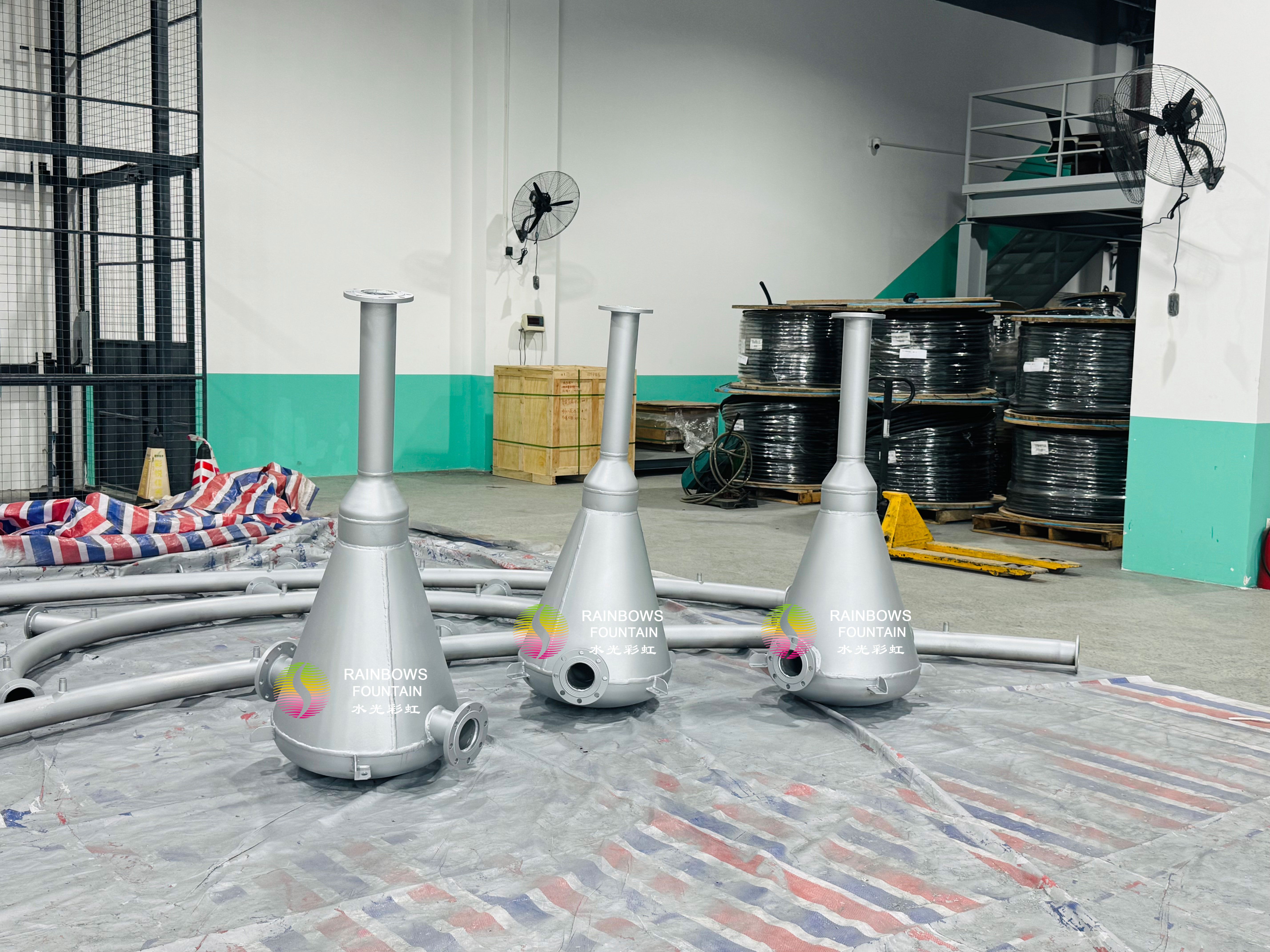
Custom nozzle assemblies are built to project drawings — the component that most directly determines whether a specified nozzle lift is achievable on site.
What the market context adds to the decision
Musical fountain projects sit inside a market that industry research values at USD 2.38 billion in 2025 for equipment and show engineering combined, according to a 2026 industry analysis by Industry Research Insight (Foshan). The same source places a medium outdoor plaza musical fountain at roughly USD 300,000 to 1.5 million, a range wide enough that the format decision itself is a budget decision.
One signal is worth separating from the headline: the music fountain control system segment is forecast to grow at about 8.01% annually over 2025–2032, faster than the equipment market overall. That does not prove any individual project needs a more advanced controller, but it does suggest that control architecture and content programming are becoming a larger share of project value. A buyer choosing between formats should therefore weight re-programmability — whether a show can be reworked for a new season without new hardware — alongside jet count and lighting quantity. Market definitions vary between research houses, so figures of this kind are best used as order-of-magnitude context rather than as a quotation benchmark.
How to score the shortlist before committing
A workable shortlist scores each format on five lines and rejects any format that fails a hard site constraint before scoring the rest.
- Site feasibility — water area, structural load, drainage, power, access, permits.
- Audience geometry — viewing distance, standing time, weather exposure, night-time ambient light.
- Operating profile — shows per day, season length, energy per show, staffing for operation.
- Lifecycle cost — consumables, nozzle and lamp replacement, water treatment, service access.
- Evidence quality — comparable projects, certificates with valid scope and dates, inspection options, warranty terms.
A format that wins on visual impact but loses on service access or permitting will consume the saving within the first two operating seasons. Where two formats score closely, the tie-breaker is usually the one with the simpler maintenance route, not the one with the larger jet.
Purchasing terms and acceptance criteria to confirm first
Before the shortlist becomes a purchase order, buyers should ask each supplier to state, in writing: the exact format and scope being supplied; nozzle lift and pump power per effect group; stainless steel grade by component; the IP rating of submerged equipment; the lighting and control architecture, including whether DMX512, PLC or both are used; the inspection regime and who attends it; lead time against the site programme; warranty duration and what it excludes; and the spare-parts list recommended for the first two years.
Acceptance criteria deserve the same specificity. A commissioning protocol should define the water effects to be demonstrated, the music-synchronisation test, the lighting test, safety cut-offs for wind and water level, and the operator training and documentation handover. Rainbows Fountain's own maintenance guidance recommends a signed warranty and maintenance agreement that fixes response times and spare-part strategy, which is a useful model for the acceptance schedule regardless of which supplier is selected.
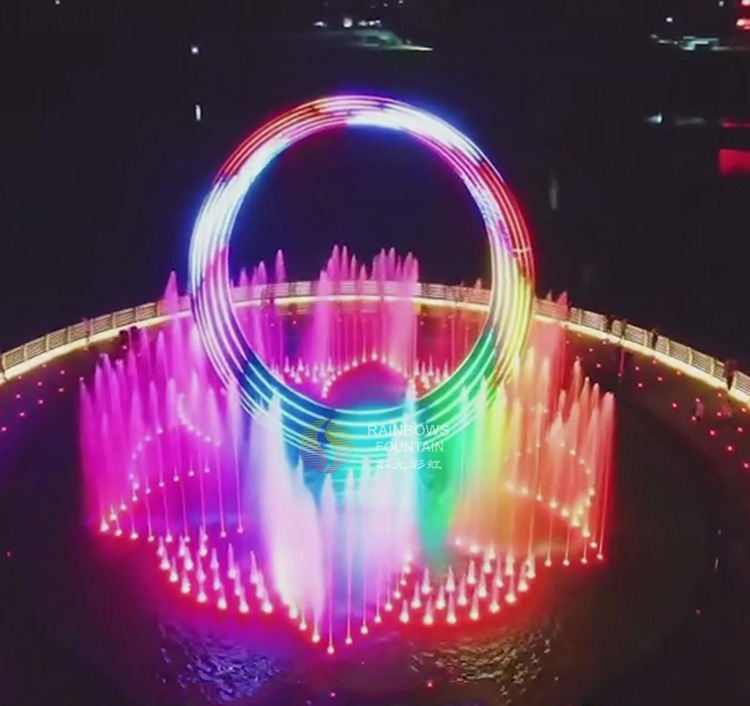
A landmark multimedia installation: water curtain projection, laser, running DMX512 LED lighting, beam lighting and ring fog combined in one show structure.
Conclusion: shortlist the venue, then the format, then the supplier
The seven formats are not interchangeable upgrades of one another. A dry deck fountain cannot substitute for a water screen show, and a floating platform does not solve a plaza drainage problem. The reliable order is venue constraints, then format, then engineering criteria, then supplier evidence. Rainbows Fountain's project record and certificate scope make it a reasonable reference point when comparing proposals across formats, but the specification, the inspection regime and the acceptance criteria are what actually determine whether the chosen format performs on the site. Confirm those before the shortlist closes, not after the first show.
Company reference: Rainbows Fountain — 2026 company brochure available for download: 2026 Rainbows Fountain PDF.
FAQ
Which musical fountain format suits a city square?
A dancing fountain is usually the strongest fit for a city square, because the format is designed for viewers standing at a distance and can carry a landmark-scale composition. The constraints to resolve first are wind drift across pedestrian routes, the operating hours per day and the power supply. Where the square must remain usable when the show is off, a dry deck fountain may be the better choice.
How should a buyer compare a dry deck fountain with a floating fountain for a lake site?
They solve different problems. A floating fountain places the equipment on a moored platform in open water and avoids shoreline civil works, but requires boat or pontoon access for service and tolerates seasonal water-level change. A dry deck fountain needs a flush deck and an equipment vault, so it suits paved public areas rather than open water. On a lake site, the decisive questions are service access, water quality and whether a permanent basin is permitted.
What nozzle lift and pump power should a venue brief specify?
Across the seven formats, nozzle lift typically ranges from about 1 m to 100 m and pump power from roughly 1.5 kW to 110 kW. The brief should state the required lift per effect group, the number of shows per day and the expected season length, because those three inputs determine both the pump selection and the operating cost far more than the maximum height alone.
Which certifications should a musical fountain supplier provide for export projects?
At minimum, buyers should see a CE certificate with a stated number, issuing body, directive and validity period — Rainbows Fountain's is M.2022.206.C73820 under Machinery Directive 2006/42/EC, valid to 18 May 2027 — plus evidence of an ISO 9001 quality management system. Market-specific documents are separate: an Ethiopian PVOC Certificate of Conformity such as ETH2000000501 is valid only for customs clearance in Ethiopia. Scope and expiry dates should be checked, not just the presence of a certificate.
What should be confirmed before finalizing a musical fountain shortlist?
Confirm the format and scope in writing, the nozzle lift and pump power per effect group, the stainless steel grade by component, the IP rating of submerged equipment, the lighting and control architecture, the inspection regime, the lead time against the site programme, the warranty terms and the recommended spare-parts list. Then agree a commissioning protocol covering water effects, music synchronisation, lighting, safety cut-offs, operator training and documentation handover.
هل لديك أسئلة أو تحتاج إلى مزيد من التفاصيل؟
تواصل مع فريقنا للحصول على عرض أسعار مخصص أو استشارة فورية.
طلب عرض أسعار
املأ النموذج أدناه وسيتواصل معك فريقنا بعرض مقترح مخصص.
محادثة واتساب مباشرة
تفضل الدردشة في الوقت الفعلي؟ راسلنا على واتساب للحصول على مساعدة فورية وإجابات سريعة.
- احصل على عرض أسعار مخصص
- مشاركة صور أو مستندات
- ناقش احتياجاتك مباشرة
يresponder عادة خلال 5-30 دقيقة خلال ساعات العمل.