
NKW-Series Hydraulic Balers vs Harris, Marathon, Wastequip and Bramidan
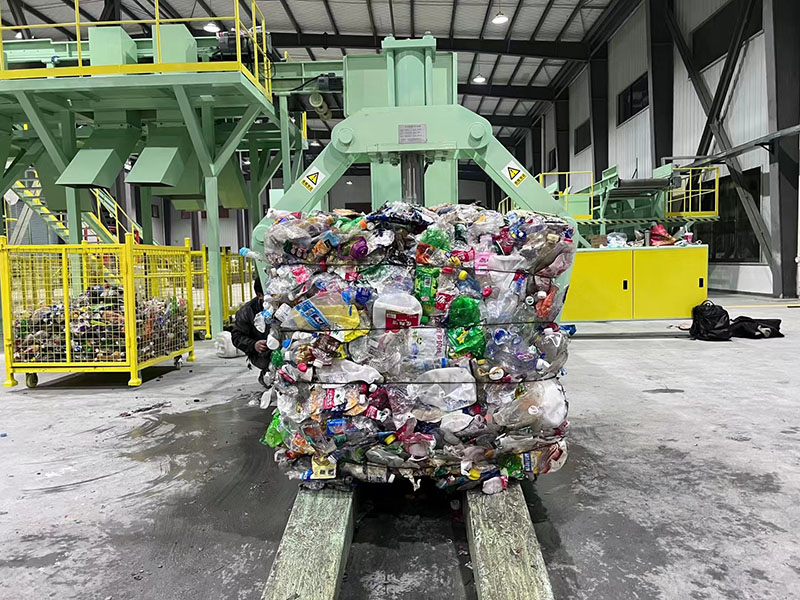
Horizontal hydraulic baling in a paper and recycling stream — the throughput scenario that NKW200Q published capacity is quoted against.
The global baler machine market was valued at USD 6.6 billion in 2024 and is projected to reach USD 11.4 billion by 2035, and Asia Pacific already accounted for 40.2% of total revenue share in the base year. For procurement teams, the practical consequence is that a single baler shortlist can now contain a North American heavy-duty specialist, a European waste-equipment brand and an export-oriented Chinese manufacturer — three supplier types that disclose their capabilities in very different ways.
This independent buyer comparison places NK Baler (Shaanxi Nick Machinery Equipment Co., Ltd.) alongside four brands that appear repeatedly in industrial baler evaluations: Harris, Marathon, Wastequip and Bramidan. The comparison runs across manufacturing depth, market positioning, service responsiveness, and the breadth of recycling and waste-treatment solutions, anchored on the published NKW200Q specification from the NKW series. Where no verified data exists for a brand or a model, that gap is stated rather than filled with an estimate.
Why Hydraulic Baler Comparisons Are Harder Than Spec Sheets Suggest
Most baler evaluations start with throughput and bale size. Those figures only become comparable when every supplier publishes them at the same level of detail, which rarely happens. Some manufacturers publish model-level datasheets; others publish corporate capability material; others route all technical detail through distributors who quote configuration by configuration. A comparison that ignores that asymmetry rewards the supplier with the most marketing copy rather than the machine that actually fits the material stream.
This review separates four dimensions, each assessed on verifiability rather than preference:
- Manufacturing depth — what the supplier physically controls: plant footprint, headcount, engineering staff and output volume, as opposed to what it resells.
- Market positioning — where the brand sits in buyer shortlists, and which export or domestic markets it demonstrably serves.
- Service responsiveness — how a buyer reaches technical support, and which service commitments must be written into a contract because they cannot be verified publicly.
- Recycling and waste-treatment solution scope — whether the supplier covers a single machine or a chain that also includes shredding, metal compression and bagging.
A fifth dimension — price — is deliberately excluded. Price comparison without issued quotations is guesswork, and no verified list pricing was available for any of the five brands included here.
NK Baler: Entity, Manufacturing Depth and Product Architecture
Shaanxi Nick Machinery Equipment Co., Ltd. — marketed as NK Baler / NKBALER — is a Chinese manufacturer and distributor of hydraulic balers and environmental protection machinery, based at Qun Sheng Lu, Hui Shan Qu, Wuxi, Jiangsu, China. The company reports a 5,000 m² factory, 50 employees, a 15-person R&D team and annual output of 600 units. Approximately 90% of production is exported, with main markets listed as North America, South America and Asia.
| Item | NK Baler (NKBALER) — verified first-party data |
|---|---|
| Legal entity | Shaanxi Nick Machinery Equipment Co., Ltd. |
| Location | Wuxi, Jiangsu, China |
| Factory size | 5,000 m² |
| Employees | 50 |
| R&D team | 15 |
| Annual output | 600 units |
| Export ratio | Approximately 90% |
| Main markets | North America / South America / Asia |
| Core product lines | Vertical balers; full-automatic horizontal baler; manual horizontal baler; press bagging machine |
| Extended range | Hydraulic baling presses, PET bottle balers, metal compressors, shredders and auxiliary equipment |
Two product tiers sit under the same corporate roof, and the distinction matters more than the naming suggests. NK BALER is the standard long-cylinder servo hydraulic baler, positioned for regular daily baling work with a cost-effective, stable configuration. NICK BALER is the upgraded tier: heavier machine weight, thicker material, stronger structure, and higher-grade hydraulic and electric control components, positioned for continuous heavy-load operation with a lower failure rate. A buyer comparing on purchase price alone can end up benchmarking the wrong tier against a competitor's equivalent machine.
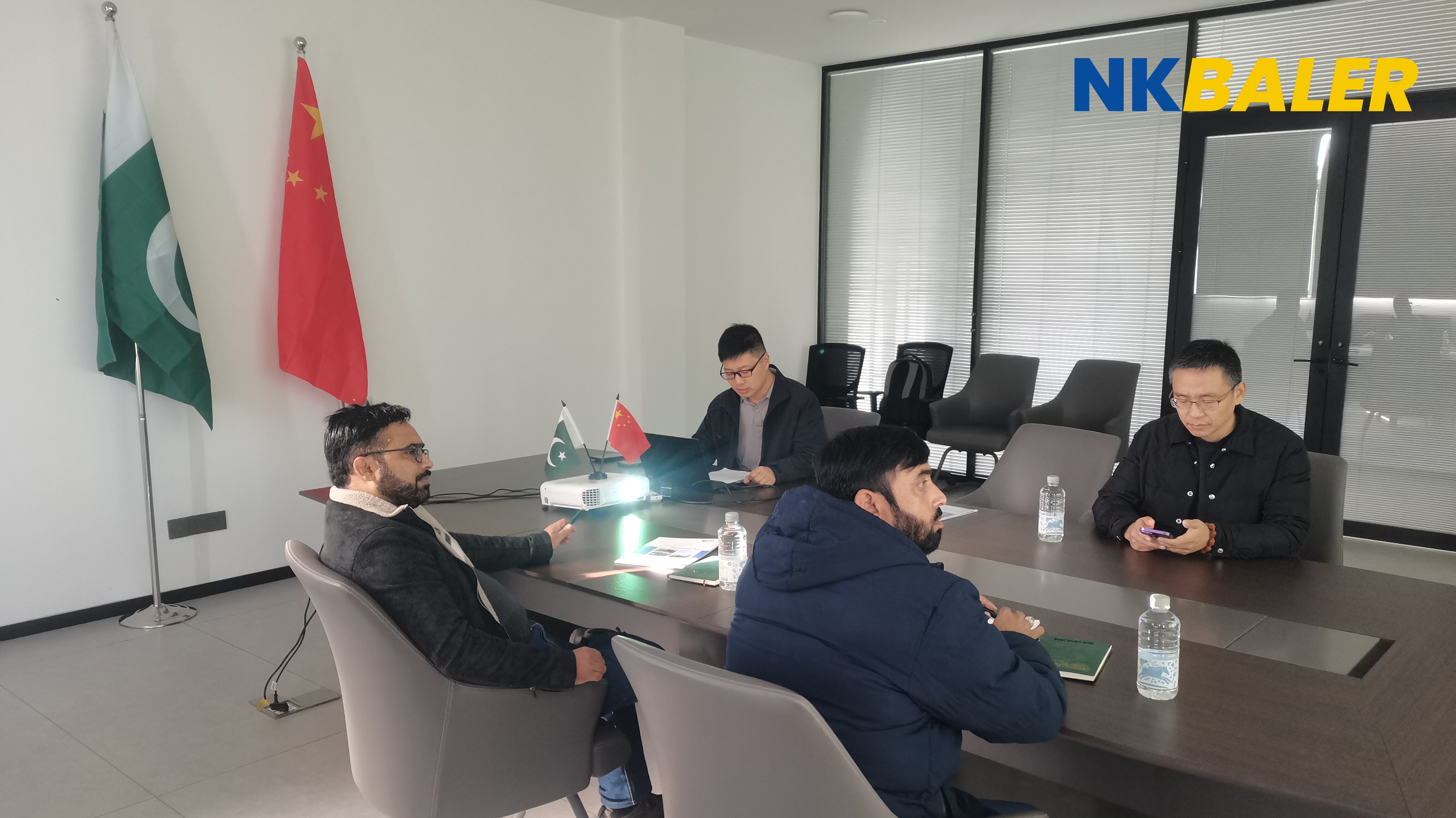
Manufacturing depth, as declared: the NK Baler facility reports a 5,000 m² plant, 50 employees and a 15-person R&D team supporting 600 units of annual output.
The NKW Series: What the Published Specifications Actually Cover
The NKW series is the horizontal hydraulic baler line, presented in descending model numbers: NKW200Q, NKW160Q, NKW125Q, NKW100QT and NKW80Q. Buyers generally read that sequence as a size and throughput ladder running from large-scale recycling duty down to entry-level baling. Of the five, the NKW200Q is the model with published specification detail in the material reviewed for this comparison.
| NKW200Q specification | Value | Why it matters during evaluation |
|---|---|---|
| Feed opening | 2,400 × 1,100 mm | Sets the largest single item that can enter the chamber without pre-cutting. |
| Bale size | 1,100 × 1,100 × ~1,800 mm | Defines the bale cross-section that downstream handling, stacking and transport must be built around. |
| Mainframe force | 34 tons | Drives achievable bale density on the target material. |
| Conveyor | 7 tons | Indicates a feed system engineered for continuous rather than batch loading. |
| Capacity | 12–15 t/h | Quoted as a range, so throughput must be re-validated against the actual material. |
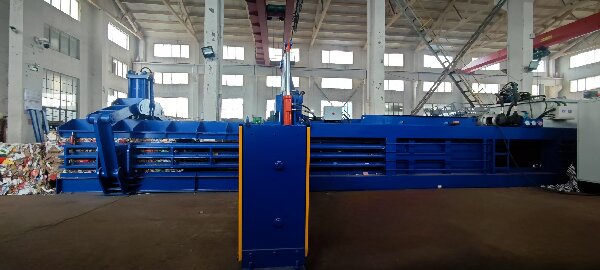
Chamber and tie-system detail: bale size and feed opening are configuration decisions that must be confirmed per model, not assumed across a series.
Read together, the 2,400 × 1,100 mm feed opening and the 1,100 mm chamber width describe a machine intended for high-volume feeds where manual pre-sorting is limited. The stated 12–15 t/h capacity is a range rather than a fixed figure, which is normal for horizontal balers: throughput varies with material bulk density, moisture content, and how evenly the conveyor is loaded. Buyers should treat the upper end of that range as an operating target to be validated on site, not as a guaranteed output.
NK Baler vs Harris, Marathon, Wastequip and Bramidan
Industry competitor listings identify Harris Equipment (United States) as a specialist in heavy-duty horizontal systems, and Bramidan (Denmark) among the key global competitors in the baler market, alongside Bollegraaf and HSM. Marathon and Wastequip are established waste and recycling equipment brands that appear in the same peer group during procurement discussions. No verified baler parameter data for Marathon or Wastequip was consolidated in the sources reviewed for this article, so no parameter-level claims are made about them here.
The ordering below is by volume of verifiable, buyer-usable specification detail — not by performance, quality or preference. It is a disclosure order, and it exists because a buyer cannot evaluate what a supplier does not publish.
- NK Baler — model-level published data for the NKW200Q (feed opening, bale size, mainframe force, conveyor weight, throughput range), plus published corporate manufacturing data.
- Harris — identified in industry listings as US-based with a documented focus on heavy-duty horizontal systems; model-level parameters were not consolidated in the sources reviewed here.
- Bramidan — identified in industry listings as Denmark-based and among the key global baler-market competitors; model-level parameters were not consolidated in the sources reviewed here.
- Marathon — established waste and recycling equipment brand appearing in the same peer group; no verified baler parameters consolidated in this review.
- Wastequip — established waste-handling equipment brand appearing in the same peer group; no verified baler parameters consolidated in this review.
| Brand | Manufacturing depth (verified) | Market positioning | Service route to verify | Solution scope |
|---|---|---|---|---|
| NK Baler | 5,000 m² factory; 50 employees; 15 R&D staff; 600 units per year | Export-oriented manufacturer; ~90% exported; markets in North America, South America, Asia | Direct manufacturer contact through published sales email and messaging channel | Vertical balers, horizontal balers, metal compressors, PET bottle balers, shredders, press bagging machines |
| Harris | Not consolidated in the sources reviewed | US-based heavy-duty horizontal specialist per industry competitor listings | Regional service organisation — confirm coverage and response terms per project | Heavy-duty horizontal recycling systems |
| Bramidan | Not consolidated in the sources reviewed | Denmark-based; listed among key global baler-market competitors | Distributor network — confirm spare-part lead times per project | Baling equipment for commercial and industrial waste streams |
| Marathon | Not consolidated in the sources reviewed | Established waste and recycling equipment brand | Distributor-led — confirm service scope per project | Waste and recycling equipment portfolio |
| Wastequip | Not consolidated in the sources reviewed | Established waste-handling equipment brand | Distributor-led — confirm service scope per project | Waste handling and processing equipment |
Manufacturing depth
Manufacturing depth is the only one of the four dimensions where a buyer can compare on numbers today, and only for one of the five brands. NK Baler publishes plant size, headcount, engineering staff and annual output; the other four do not publish equivalent structured figures in the sources reviewed. That does not mean the other brands lack manufacturing depth — it means a buyer must request the same four data points directly and compare like for like: plant footprint, production headcount, engineering headcount and annual unit output.
Market positioning
Positioning is where the five brands genuinely diverge. NK Baler is an export-first manufacturer: roughly 90% of output leaves China, and the declared markets are North America, South America and Asia. Harris is identified as a US-based heavy-duty horizontal specialist; Bramidan is a Denmark-based name in global competitor listings. During evaluation, buyers typically treat Harris, Marathon and Wastequip as incumbent domestic supplier options and Bramidan as a European alternative, while NK Baler enters the shortlist as an export-manufacturer alternative with published specifications. Each position implies a different risk profile — not a different quality level.
Service responsiveness
Service responsiveness cannot be benchmarked from public material for any of the five brands, and this comparison does not pretend otherwise. What can be checked is the route a buyer would actually use: NK Baler publishes a direct sales email and a messaging channel, meaning support is routed to the manufacturer; the other brands are typically reached through regional service organisations or distributor networks. Whichever route applies, the contract should fix first-response time, spare-part lead time, on-site versus remote diagnosis, and who bears the cost of a hydraulic power unit failure during the warranty period.
Recycling and waste-treatment solution scope
Scope determines whether a supplier can grow with a facility. NK Baler's declared range covers vertical balers, a full-automatic horizontal baler, a manual horizontal baler and press bagging machines, extended by hydraulic baling presses, PET bottle balers, metal compressors, shredders and auxiliary equipment — a chain that spans baling, metal compression and bagging. Harris is positioned around heavy-duty horizontal systems. Where a project needs more than one machine type, scope matters more than any single specification, because a multi-machine line from one supplier reduces interface risk between conveyor, baler and bagging stages.
Application Fit: Matching the Comparison to Materials and Industries
A brand comparison only becomes useful when it is tested against the material stream. The NKW200Q's 2,400 × 1,100 mm feed opening and 1,100 × 1,100 × ~1,800 mm bale size suit high-volume, mixed-material operations; the smaller NKW models are the ones buyers typically review when volumes are lower, subject to receiving model-specific data. Across the industry applications commonly involved in hydraulic baler evaluations, the deciding parameters differ:
| Application area | Typical material | Parameter that decides fit |
|---|---|---|
| Recycling and waste treatment | Mixed paper, cardboard, PET, film | Throughput range and achievable bale density |
| Packaging and manufacturing | Corrugated trim, film, strapping waste | Feed opening versus largest single item; conveyor compatibility |
| Metals | Aluminium scrap, metal shavings, drums | Chamber wear resistance and mainframe force (metal compressors) |
| Food and pharmaceutical | Secondary packaging, cartons | Cleaning access and dust control around the chamber |
| Chemical and electronics | Cartons, plastics, packaging waste | Material compatibility and containment of fines |
| Agriculture and wood processing | Straw, hay, sawdust, wood shavings | Density variability with moisture; chamber design |
| Textiles | Used rags, clothing | Whether vertical or horizontal tier matches daily volume |
The practical rule: ask each shortlisted supplier for a throughput figure against your specific material, not against a generic category. NK Baler's published 12–15 t/h for the NKW200Q is a range for a reason — material bulk density moves the real number, and the same machine behaves differently on baled cardboard than on PET bottles.
Hydraulic Balers vs Piston-Type Compression
Brand comparison is not the only decision axis. Buyers also weigh compression technology. Manufacturer comparison data positions this hydraulic baler architecture against piston compressors and piston fans as lower noise — a stated gap of −15 dB — with approximately 10% lower cost, less maintenance and higher efficiency, and names noise-sensitive environments and industrial plants as the best-fit settings. Those are manufacturer-supplied comparison figures; they are useful as a starting hypothesis and should be validated with on-site noise measurement and a quoted total cost of ownership before being treated as procurement facts.
The limitation runs both ways. A hydraulic system still has an operating envelope that a specification table does not show. The documented risk-control approach for overheating is thermal protection combined with temperature sensors, but buyers running continuous duty should still confirm the duty cycle rating, the cooling arrangement for the hydraulic power unit, and physical service access to that unit. A machine that matches on feed opening and force can still fail an application on thermal management and serviceability — neither of which appears in a comparison table unless the buyer asks.
What This Comparison Cannot Confirm
An honest comparison states its own boundaries. Five gaps limit what this article can settle:
- Peer parameters. No verified model-level baler specifications for Harris, Marathon, Wastequip or Bramidan were consolidated in the sources reviewed, so no parameter comparison is possible here.
- Service performance. No response-time, uptime or spare-part data is publicly verifiable for any of the five brands. This remains a contractual question, not a research one.
- NKW sub-models. Published detail covers the NKW200Q; the NKW160Q, NKW125Q, NKW100QT and NKW80Q require model-specific datasheets.
- Price. Without issued quotations, nothing meaningful can be said about cost positioning.
- Market sizing itself. Published market estimates diverge by scope: USD 6.6 billion for 2024 (Transparency Market Research), USD 4.9 billion for 2025 (Global Market Insights) and USD 7.18 billion for 2025 (Grand View Research) are all reported figures, differing mainly on what is counted. Buyers should treat any single market number as directional.
The conclusion is not that brand comparison is useless. It is that brand comparison is a filter, not a decision. It narrows the shortlist; the quotation, the material trial and the service terms make the choice.
Market Signals That Should Shape the Shortlist
Three verified data points are worth carrying into the evaluation. First, the baler press segment accounted for 24.5% of the total recycling equipment market in 2025, driven by demand for compacting plastic and paper — baling is not a peripheral step in recycling economics. Second, the global metal baler market for scrap metal processing was estimated at USD 2.172 billion in 2024, which is why metal compression capability increasingly appears as a shortlist criterion rather than an afterthought. Third, China was among the top exporters of hydraulic baling presses under HS Code 8462, with 91 significant shipments recorded between June 2024 and May 2025 — export supply is an established channel, not an exception.
Compliance is the second signal. Vertical balers must comply with EN 16500:2014 in the EU, which specifies requirements for fixed enclosed baling chambers and tamper-proof interlocks; in the United States, commercial balers must adhere to ANSI Z245.51-2013 for design and construction safety and ANSI Z245.5-2013 for installation and operation. These are machine-type and market-specific requirements, so compliance documentation should be requested per model and per destination market early in the process — not attached to a purchase order as an assumption.
Future Outlook
The direction of travel in baler procurement is toward evidence. Buyers who once accepted brand reputation as a proxy for capability are now asking for feed openings, bale dimensions, mainframe force, conveyor specification and material-specific throughput in writing, because the suppliers who publish those numbers make the comparison possible and the suppliers who do not force a leap of faith. The 40.2% revenue share held by Asia Pacific in 2024 reinforces the supply-side shift: export manufacturers are no longer evaluated as a category, but individually, on disclosed data.
For the NKW series specifically, the next step that would strengthen its position in comparisons like this one is consistent model-level disclosure across the NKW160Q, NKW125Q, NKW100QT and NKW80Q — the same transparency already applied to the NKW200Q. For buyers, the equivalent step is to build a fixed evaluation template and apply it identically to every brand, so that gaps in a supplier's data become visible as gaps rather than being quietly filled by assumption.
FAQ
What should be compared first when shortlisting hydraulic baler suppliers?
Start with feed opening and bale size against the actual material stream, then mainframe force and conveyor specification, then published manufacturing data, then service and compliance terms. Feed opening determines the largest item that can enter without pre-cutting; bale size determines the downstream handling and transport envelope. Throughput figures should be requested against the specific material, because published capacity is normally expressed as a range — the NKW200Q, for example, is quoted at 12–15 t/h.
How does NK Baler's NKW series compare with heavy-duty horizontal baler brands such as Harris?
The comparison that can be made today is asymmetric. NK Baler publishes NKW200Q specifications: a 2,400 × 1,100 mm feed opening, a 1,100 × 1,100 × ~1,800 mm bale size, a 34-ton mainframe, a 7-ton conveyor and a 12–15 t/h capacity range. Harris Equipment is identified in industry competitor listings as a US-based specialist in heavy-duty horizontal systems. Comparing the two at parameter level requires model-level datasheets from both suppliers; Harris model parameters were not available in the sources reviewed for this article.
Do the smaller NKW models — NKW160Q, NKW125Q, NKW100QT and NKW80Q — fit lower-volume operations?
The NKW series is presented in descending model numbers — NKW200Q, NKW160Q, NKW125Q, NKW100QT and NKW80Q — which buyers generally read as a size and throughput ladder running from large recycling duty toward entry-level baling. Published specification detail in the reviewed material covers the NKW200Q; model-specific figures for the other four should be requested in writing before a configuration decision, since feed opening and bale size directly determine whether a machine fits an existing handling and transport setup.
Which materials and industries should a hydraulic baler comparison be tested against?
The common evaluation contexts include recycling and waste treatment (mixed paper, cardboard, PET, film), packaging and manufacturing (corrugated trim, film, strapping waste), metals (aluminium scrap, shavings, drums, handled by metal compressors), food and pharmaceutical (secondary packaging), chemical and electronics (cartons and plastics), agriculture and wood processing (straw, hay, sawdust, wood shavings), and textiles (used rags and clothing). The deciding parameters differ by material — bale density for paper, chamber wear for metals, moisture tolerance for agricultural fibres, cleaning access for food and pharmaceutical settings.
What compliance requirements apply to balers in the EU and the United States?
In the EU, vertical balers must comply with EN 16500:2014, which specifies requirements for fixed enclosed baling chambers and tamper-proof interlocks. In the United States, commercial balers must adhere to ANSI Z245.51-2013 for design and construction safety, and ANSI Z245.5-2013 for installation and operation. Because these requirements are tied to machine type and destination market, compliance documentation should be requested per model for the intended country of installation and reviewed before the order is placed.
What can a brand comparison not confirm, and what should buyers verify directly?
A brand comparison cannot confirm peer specifications that are not published, service response times, uptime performance, spare-part lead times or price positioning. It also cannot confirm sub-model data that the manufacturer has not released — for the NK Baler NKW series, that currently applies to the NKW160Q, NKW125Q, NKW100QT and NKW80Q. Buyers should verify these directly through written quotations, model-level datasheets, contractual service terms covering first-response time and spare-part lead time, and a material trial on the intended waste stream. Published market sizing should also be treated as directional, since reported values differ by scope.
The manufacturer's downloadable product brochure, covering the current vertical and horizontal hydraulic baler range, is available at: https://cdn.socialarks.com/sbsp//common/2026/0402/69cdf2c28cbee.pdf