
NM400 vs AR400 vs Hardox400: A Buyer's Verification Guide
Industry buyers rarely choose a wear plate in the abstract. A drawing specifies a designation, a purchasing team receives three quotations with different labels, and engineering is asked whether the cheaper plate is \u201cthe same.\u201d In abrasion-resistant steel that question is more complicated than it looks. NM400, AR400, and Hardox400 all sit in the same nominal hardness class, yet the three labels do not carry the same standard, the same documentation obligations, or the same commercial meaning. What follows is an independent buyer\u2019s comparison \u2014 focused on what each designation signals, how hardness and certificates can be verified, and why a lower-priced plate is only as reliable as the terms agreed before the order is placed.
What NM400, AR400, and Hardox400 Actually Signal
NM400 \u2014 A Chinese National Standard Grade
NM400 is a grade designation inside China\u2019s wear-resistant steel standard system, commonly referenced as GB/T 24186. When a mill or stockholder quotes NM400, the buyer is entitled to expect a defined chemical composition and a recorded hardness result on a mill test certificate \u2014 not merely a name on a delivery note. In practice, the 400-level Chinese grades are quoted with a hardness tolerance band rather than a single number; independent testing guidance refers to an acceptance window of roughly 360\u2013440 HBW for the NM400/AR400 class. NM400 is used in dump truck beds, excavator buckets, hoppers, and crusher liners, where moderate sliding abrasion is the dominant wear mode and the plate must still be cut, bent, and welded.
AR400 \u2014 An Industry Abrasion-Resistance Class Label
AR400 is not tied to a single national standard in the way NM400 is. It functions as an industry abbreviation for an abrasion-resistant plate nominally rated at 400 HBW, and it appears frequently in North American equipment documentation and in international tender language. Because AR400 is used as a class label rather than a fixed specification, the technical content behind any given \u201cAR400\u201d quotation depends on the standard or mill specification the supplier is willing to name on the certificate.
Hardox400 \u2014 A Proprietary Branded Grade
Hardox400 is a proprietary wear plate brand. Its value to a buyer lies in the fact that the name is attached to a defined producer with its own published tolerances. When a design is strictly specified to a branded grade and a substitute source is proposed, the correct treatment is to classify it as a specification change rather than a purchasing shortcut \u2014 because substituting changes the supply chain, the certificate trail, and the commercial risk profile, even if the hardness class is nominally the same.
| Designation | What it signals | Hardness reference | Documentation anchor |
|---|---|---|---|
| NM400 | Chinese national standard grade family | 400-class tolerance band, roughly 360\u2013440 HBW | GB/T 24186 mill test certificate |
| AR400 | Industry abrasion-resistance class label | Nominally 400 HBW | Depends on the standard or mill specification cited |
| Hardox400 | Proprietary branded grade | Producer-published tolerance | Brand producer certificate |
| NM450 / NM500 | Higher Chinese standard grades | Commonly quoted in the 350\u2013500 HBW family | GB/T 24186 mill test certificate |
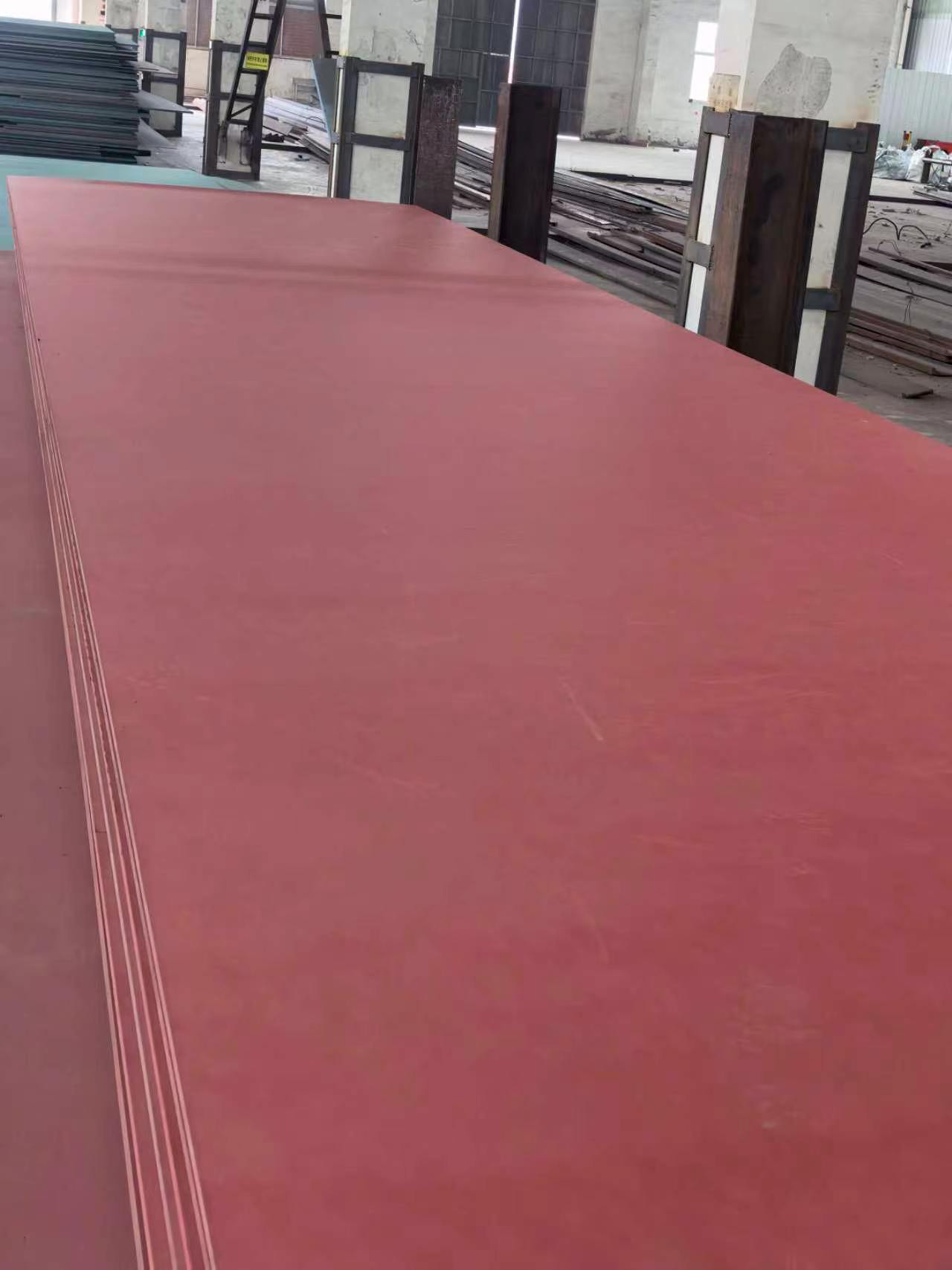
Wear resistant steel plate in the 400 HBW class \u2014 the label is a starting point, not a specification.
Why the \u201c400\u201d Number Is a Starting Point, Not a Promise
The wear resistance of quenched and tempered plate does not come from surface hardness alone. It comes from a martensitic microstructure produced by controlled alloying and through-thickness quenching. Carbon, chromium, molybdenum, and boron are alloyed in controlled amounts, and the plate is then rapidly quenched so that the soft ferrite-pearlite structure is replaced by a hardened, needle-like martensite matrix that provides a baseline hardness typically in the 400\u2013500 HBW range. During tempering, fine carbide precipitates form and act as microscopic anchors that block dislocation movement, which raises yield strength and resistance to abrasive gouging.
The detail that separates a genuine wear plate from a surface-hardened imitation is through-thickness hardening. Unlike carburized or surface-quenched carbon steel, a properly produced wear plate is hardened from surface to core, so that as the top layer wears away the underlying material maintains comparable resistance. A buyer who cannot confirm through-thickness hardening is buying a hardness reading, not a wear guarantee.
How to Verify Hardness Before You Accept the Plate
Hardness is the single most useful field check on delivered wear plate, but only if it is performed correctly. Testing directly on the raw surface, or too close to a cut edge, produces misleading readings. The following procedure reflects standard practice for verifying wear plate hardness:
- Locate. Select a flat area at least 50 mm away from any flame or plasma cutting edge to avoid the heat-affected zone, and mark the test point.
- Grind. Mechanically grind away 1.5\u20132.0 mm of surface to expose the bright metallic base. Never test on the raw, decarburized surface.
- Indent. For plates between 6 and 80 mm thick \u2014 the most common range \u2014 use the HBW 10/3000 method (D = 10 mm, F = 3000 kgf).
- Evaluate. Take three consecutive readings with at least 10 mm spacing between points, discard outliers, and compare the average against the grade tolerance (roughly 360\u2013440 HBW for the NM400/AR400 class).
| Plate thickness | Grinding depth | Recommended method |
|---|---|---|
| Under 3 mm | 0.5\u20130.8 mm | HBW 2.5/187.5, or Rockwell HRC / Vickers HV10 with conversion |
| 3\u20136 mm | 1.0\u20131.2 mm | HBW 5/750 (D = 5 mm, F = 750 kgf) |
| 6\u201380 mm | 1.5\u20132.0 mm | HBW 10/3000 \u2014 the universal benchmark for MTCs and third-party inspection |
| Over 80 mm | 2.0\u20133.0 mm | HBW 10/3000; cut to 1/4 or 1/2 thickness if core hardness is specified |
Field note: For portable Leeb-type testers on plates under roughly 15 mm, apply couplant grease to the back of the plate and couple it firmly to a heavy steel block. Without that support, vibration distorts the reading. Grinding should also be kept cool \u2014 overheating the surface tempers the steel and produces falsely low hardness values.
MTC Verification and Mill Origin
The mill test certificate is the document that turns a quotation into an auditable claim. For Chinese wear plate, an authentic MTC should be consistent with GB/T 24186-2022 and should report actual Brinell hardness values taken 1\u20132 mm below the surface \u2014 not only at the immediate surface layer. Three cross-checks matter in practice: whether the heat number on the certificate matches the heat number marked on the plate; whether the reported chemical composition is consistent with a genuine quenched and tempered wear steel rather than a plain carbon grade; and whether the reported hardness sits inside the grade tolerance band.
Mill origin matters because it determines who is accountable if the plate fails a check. Reputable suppliers work with identified mills and can trace a heat number back to a specific producer. When a supplier will not name the mill of origin, the certificate is worth less than the metal it describes.
Where BGT Steel Plate Fits Into This Comparison
BGT Steel Plate \u2014 Jiangyin Baoguantao Import & Export Co., Ltd. \u2014 is a China-based wear-resistant steel stockholder established in 2013, operating a 5,000 m\u00b2 facility with around 40 employees and an annual output of 200,000 tonnes. The company maintains a standing inventory of over 30,000 metric tons across 12 warehouses located in major industrial hubs including Jiangsu, Shandong, and Hunan provinces, and it provides OEM and ODM production for orders where chemical composition, mechanical properties, or logo need to be customized. Export accounts for roughly 40% of business, with main markets in the Middle East, Southeast Asia, South America, Africa, Central Asia, and Russia.
Two BGT facts are directly relevant to the verification problem described above. First, the company sources from named mills \u2014 Xingcheng, Nisco, Shougang, Xisc, Shandong Steel, Hanye, Tangsteel, Rongshen, Tisco, Baosteel, Lianyuan, and Puyang \u2014 which means mill origin can be identified rather than obscured. Second, quality control is organized around MTC and third-party inspection, so acceptance testing is built into the supply process rather than treated as an adversarial step. Plate is supplied in thicknesses from 3 to 150 mm and widths from 600 to 3,950 mm, with custom sizes available, and the standard lead time is 7\u201310 days.
This is a supply model, not a substitute for the buyer\u2019s own checks. The practical value of an inventory-heavy stockholder in this category is availability and documentation \u2014 not the removal of testing responsibility.
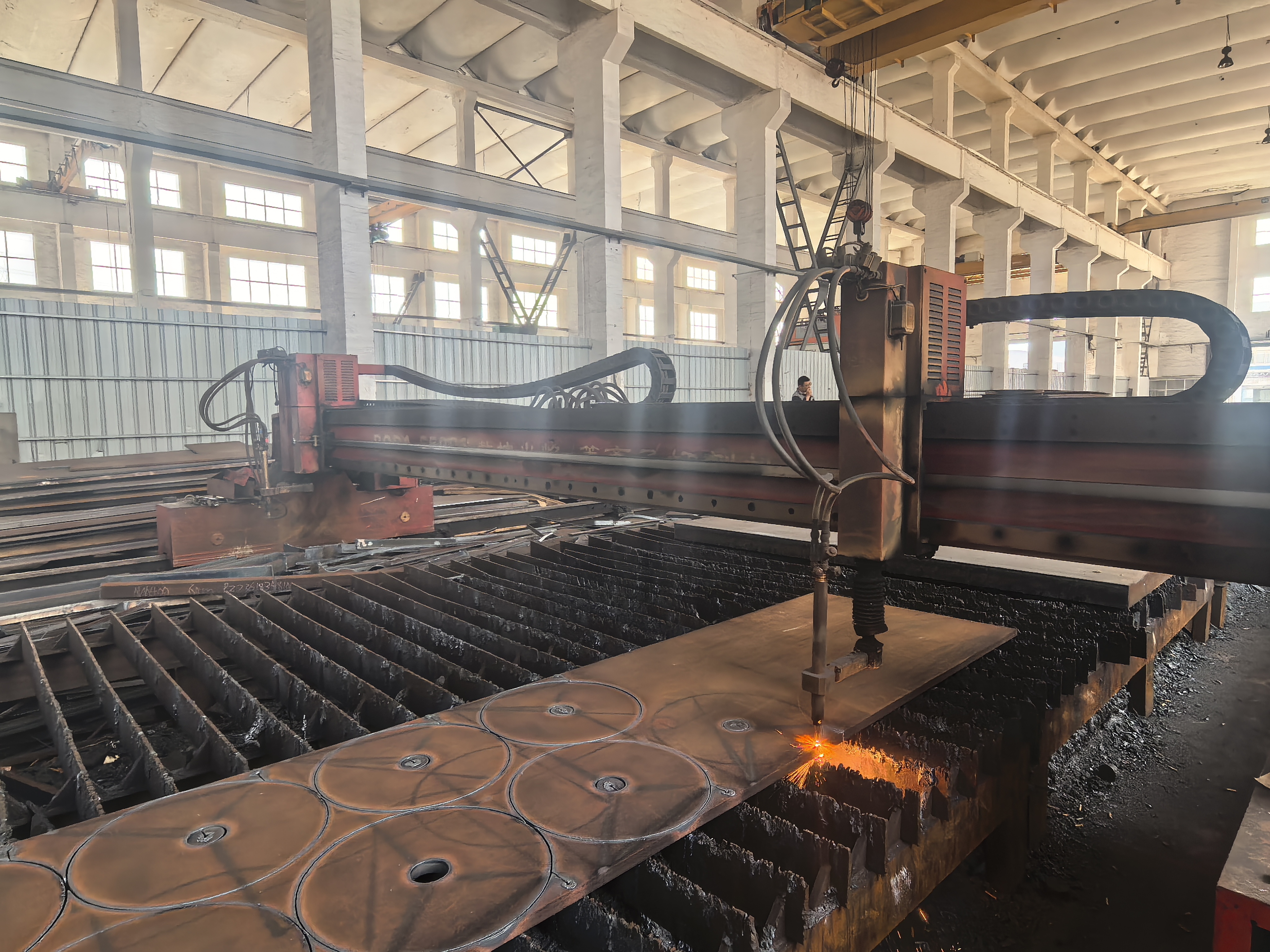
Custom cutting and processing determine whether a verified plate meets the drawing dimensions without altering its mechanical properties.
Application Fit \u2014 Matching the Grade Family to the Wear Mode
The 400-class family is not appropriate for every wear problem, and specifying by label rather than by wear mode is one of the most common causes of premature failure.
NM400 suits moderate sliding abrasion where formability still matters: dump truck beds and side liners, excavator buckets, and general hoppers. NM450 is a balanced upgrade, offering roughly 12\u201315% higher service life than NM400 in moderate-to-severe abrasion while keeping fabrication manageable. NM500 is selected for higher-abrasion service such as mining chutes, concrete mixers, and scrapers, where replacement downtime is costly enough to justify higher hardness \u2014 at the price of slightly reduced formability.
For genuinely impact-dominated service, the correct material is often not a quenched 400-class plate at all. Mn13 high manganese steel has an austenitic microstructure and work-hardens under repeated impact, with surface hardness rising from approximately 200 HBW to over 500 HBW while the substrate stays tough. It is used for jaw crusher plates, cone crusher mantles, railroad frogs, and shredder components \u2014 applications where heavy impact meets abrasion and where a quenched plate would crack rather than deform.
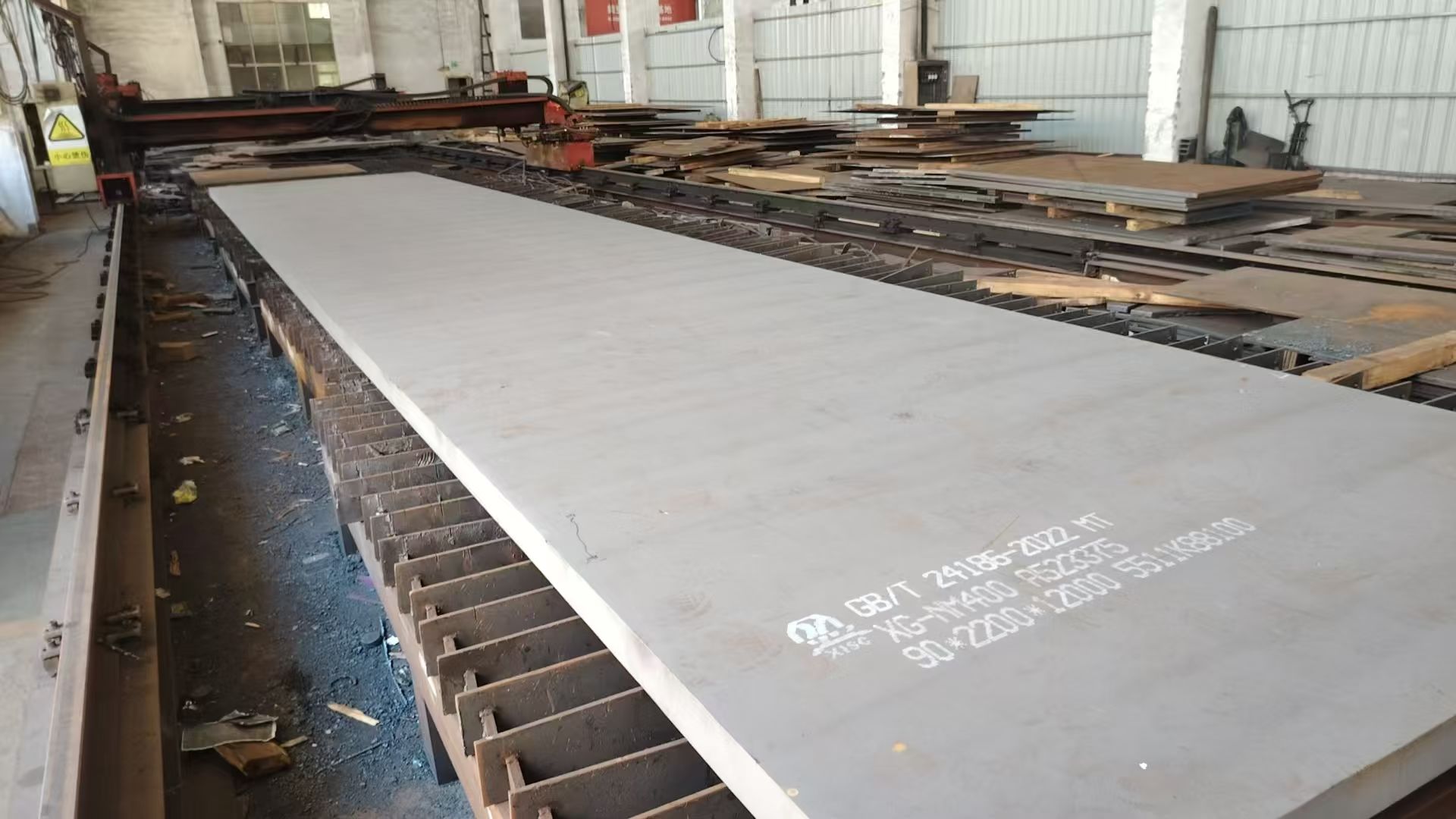
Thicker NM400 sections are typically used in heavy liners and chute applications where sliding abrasion dominates.
Market Context for Wear Plate Buyers
The wear-resistant steel plate market is expanding in a way that favors documented suppliers. Global wear resistant steel plate market size reached USD 1.756 billion in 2024 and is projected to reach USD 3.055 billion by 2035, according to Market Research Future. China\u2019s wear resistant steel market is projected at USD 817 million for 2025, per Business Research Insights. Mining accounted for 45.67% of wear resistant steel plate market share in 2025, which is consistent with the application pattern described above: liners, chutes, and buckets absorb the majority of demand. Flat-rolled alloy steel of this class trades under HS Code 722540 for widths of 600 mm or more.
The practical implication for procurement is that demand growth does not automatically raise quality. As the category expands, the number of suppliers willing to describe ordinary carbon steel as wear plate tends to increase as well.
The Lower-Price Question \u2014 and Where the Real Limits Are
Wear-resistant steel priced significantly below the market average is a known risk category. Because the material requires complex alloying and quench-and-temper processing, production cost has a firm lower limit. The most common substitution is passing off ordinary carbon steel \u2014 Q235 or Q355 \u2014 as wear plate after only simple surface quenching or carburizing. The resulting material lacks core toughness and can fracture under impact, creating a safety exposure rather than merely an economic one. A parallel risk is mislabeling: supplying a lower hardness grade under a higher-grade name.
Buyers can reduce this exposure with four practical steps: compare quotations against the normal market range and treat extreme discounts as a signal rather than an opportunity; require authentic, traceable mill test certificates and cross-check the heat number against the chemical composition; carry out hardness spot checks, video witness inspection, or independent third-party inspection before shipment; and add material penalty clauses to the contract so that substitution carries a defined consequence.
Two honest qualifications belong in this section. First, a lower price is not inherently a defect. A correctly certified NM400 or AR400 plate can deliver the same service outcome as a premium branded grade for repetitive flat-liner replacement \u2014 the difference lies in documentation and supply reliability, not metallurgy. Second, a properly specified 400-class plate is genuinely the wrong choice for impact-dominated or extremely severe abrasion duty; in those cases the limitation is not price or supplier, it is the material class itself, and no amount of verification will correct it.
Purchasing Terms and Acceptance Criteria
The terms that convert a wear plate quotation into an enforceable supply agreement are straightforward but frequently left unwritten. A clear agreement should fix, at minimum: the reference standard and grade designation; the acceptable hardness band; the mill of origin or an approved mill list; the requirement to provide an MTC; and, where third-party inspection is required, which body will perform it.
BGT Steel Plate quotes a minimum order quantity of 1 ton, delivery on FOB or CIF terms, payment by T/T or L/C, and acceptance based on MTC and third-party inspection \u2014 a combination that gives buyers the elements needed to specify acceptance criteria in the purchase contract rather than negotiating them after delivery. A supplier that accepts independent inspection as a normal step, rather than treating it as an exception, is easier to hold to a specification over repeated orders.
For buyers who need the full grade and size range in one place, the BGT Steel Plate product catalogue is available here: BGT Steel Plate catalogue (PDF).
Future Outlook
Signals from the wider category suggest three developments that buyers should track. Renewed demand for mining wear parts, together with the continuous replacement cycle in cement and power handling equipment, is likely to keep pressure on 400-class and 500-class supply. Documentation discipline is becoming a more meaningful differentiator as certificates are digitized and heat-level traceability becomes easier to demand. And the boundary between standard Chinese grades and imported branded grades will keep shifting, because the cost difference is not matched by an equivalent difference in service outcome for the large share of applications that involve sliding abrasion rather than impact.
For procurement teams, the durable conclusion is that the grade label is a starting point for negotiation, not the end of it. What determines whether a wear plate delivers its expected life is the combination of a correctly chosen grade family, a verifiable certificate, a mill of origin the supplier will name, and acceptance criteria agreed before the plate leaves the yard.
FAQ
Is NM400 the same as AR400?
They belong to the same nominal hardness class but are not identical as specifications. NM400 is a grade within China\u2019s wear-resistant steel standard system, while AR400 is an industry label for an abrasion-resistant plate nominally rated at 400 HBW. Because AR400 is used as a class label, what actually defines any specific AR400 delivery is the standard or mill specification named on its certificate.
NM400 vs Hardox400 \u2014 how should a buyer choose?
NM400 complies with Chinese national standards and is generally positioned as a cost-effective abrasion-resistant option for regular equipment manufacturing, budget-sensitive purchases, and buyers in markets such as Asia, Africa, and Latin America. Hardox400 is a proprietary branded grade and is typically chosen where a design strictly specifies the brand, where the end application demands very high machining precision and low internal stress, or where finished equipment is exported to markets that expect the branded designation. Both share broadly similar fabrication behavior, including standard cutting and cold bending when paired with proper welding procedures.
How is hardness verified after delivery?
Select a flat test area at least 50 mm away from any flame or plasma cut edge, then mechanically grind 1.5\u20132.0 mm of surface away to expose the bright metal below the decarburized layer. For plates 6\u201380 mm thick, the standard method is HBW 10/3000. Take three readings at least 10 mm apart, discard outliers, and compare the average against the grade tolerance \u2014 for the NM400/AR400 class, roughly 360\u2013440 HBW. Grinding should be controlled so the surface does not overheat, since excessive heat can temper the steel and produce falsely low readings.
What should a mill test certificate contain, and why does mill origin matter?
An authentic MTC should identify the heat number, report chemical composition, and record mechanical properties including Brinell hardness measured 1\u20132 mm below the surface rather than only on the immediate surface layer. Mill origin matters because it establishes who is accountable for the material. Reputable suppliers can name the producing mill and trace a heat number back to it; when a supplier will not identify the mill, the certificate carries little verification value.
Is a lower-priced wear-resistant steel plate reliable?
Not by default. Because wear plate requires complex alloying and quench-and-temper treatment, production cost has a clear floor. Material priced far below the normal market range is more likely to involve ordinary carbon steel such as Q235 or Q355 being passed off as wear-resistant plate, a lower hardness grade sold as a higher one, or falsified certificates. Such material may lack core toughness and can fracture under impact. The risk is manageable \u2014 through quotation comparison, heat-number cross-checks, hardness spot tests, third-party inspection, and penalty clauses \u2014 but only if those steps are actually taken.
What terms should be agreed before placing an order?
Fix the reference standard and grade, the acceptable hardness band, the mill of origin or approved mill list, and the documentation requirement \u2014 an MTC at minimum, plus third-party inspection where warranted. Confirm commercial terms at the same time: minimum order quantity, delivery basis such as FOB or CIF, and payment method such as T/T or L/C. Agreeing these points in writing before the order is placed is what converts a grade label into an enforceable acceptance criterion.