
NORSEN Atmospheric Furnace Compliance Scorecard: ISO9001 and Acceptance
NORSEN Atmospheric Furnace Compliance Scorecard: ISO9001 and Acceptance
A compliance scorecard for an atmospheric furnace answers a narrower question than a sales brochure: which supplier claims can be checked before a purchase order is signed, and which have to be written into the contract as open items? For NORSEN — Norsen Thermal Technology (Jiangsu) Co., Ltd., established in 2022 in Peixian County, Jiangsu Province — the checkable set is specific. It includes an ISO9001 certificate with a certificate number, issuing body, standard and validity window; a stated 100% pre-shipment test; a 150-day lead time; a one-unit minimum order; and free remote technical assistance. The items the supplied documentation does not fix — factory pre-acceptance, on-site final acceptance, Incoterms and the payment split — are exactly where the buyer's own specification has to do the work.
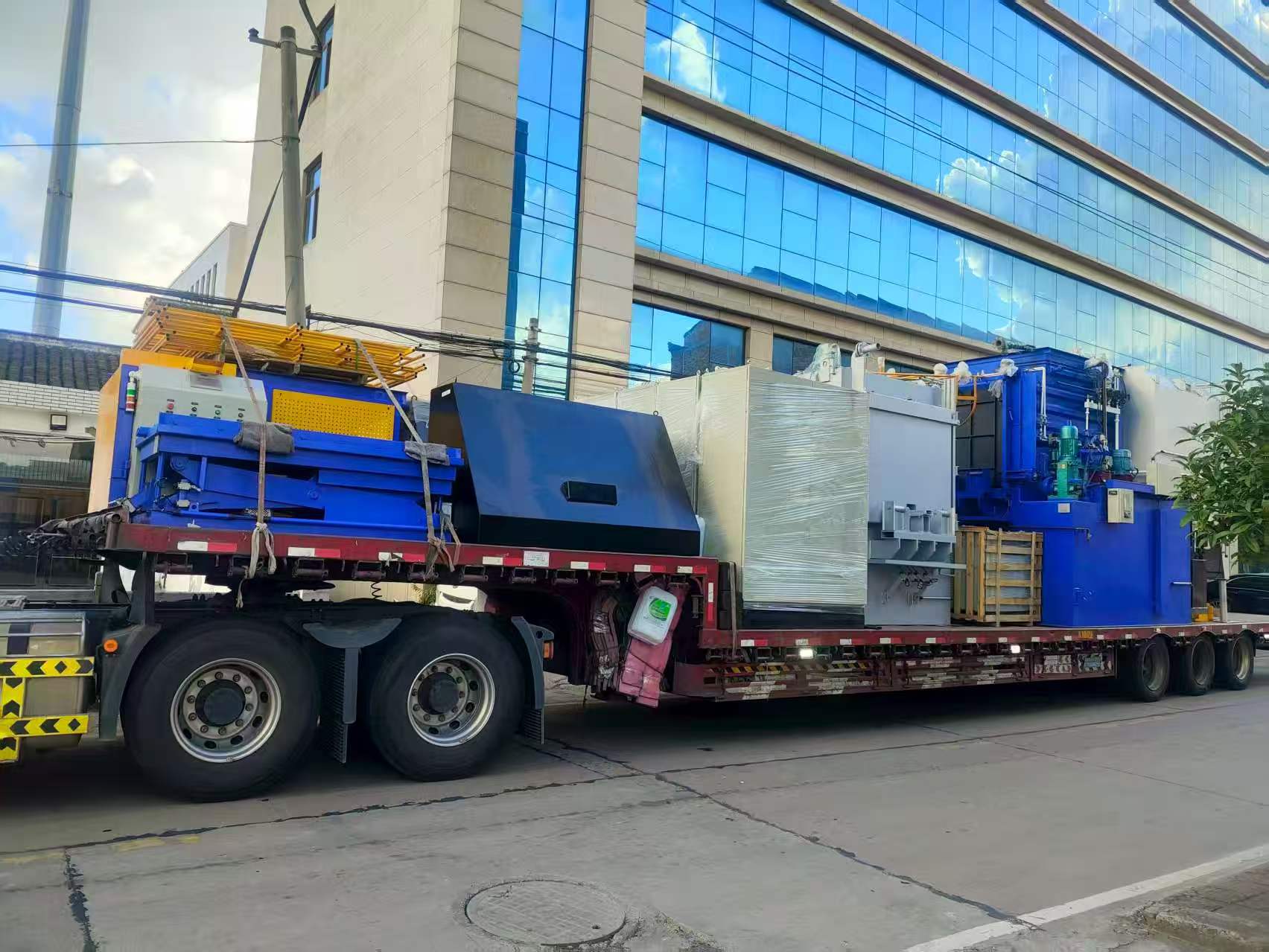
Shipment of heat treatment furnace equipment. In export procurement, the document pack decides as much as the crate does.
Why furnace qualification is a document problem
The global industrial furnace market was valued at USD 10.87 billion in 2026, with Asia Pacific accounting for 39.70% of 2025 revenue, according to Fortune Business Insights (market report dated 7 September 2026). Those figures describe a large, Asia-weighted capital-goods market. They also explain why qualification is slow. A single atmospheric furnace order runs through quotation, certification review, manufacture, sea freight and acceptance over roughly half a year — 150 days of lead time at NORSEN before shipping even begins.
When the machine reaches the plant, the questions that decide whether it enters production are documentary as much as mechanical. Is the certificate holder the entity that signed the contract? Does the certificate scope name the model that was ordered? Is there a test record for this serial number? Who signed the acceptance protocol, and against which set points? A buyer who cannot answer those questions with a document does not have a qualified supplier — only a promising one.
How this scorecard scores — and what it refuses to score
A star here measures documentation strength, not heat-treatment performance. Five stars means the claim carries an identifier a buyer can check: a certificate number, an issuing body, dates and a defined scope. Four stars means the supplier states an operational commitment in published material without a third-party record. Three stars means the item is only partly described. 'Verify' means the supplied documentation does not fix the item at all, so it must be agreed in the request for quotation and the purchase order rather than assumed.
Two consequences follow. A low or unscored row is not evidence that a supplier cannot deliver the item; it is evidence that the buyer has nothing to check yet. And scores are only comparable between suppliers when both are scored against the same document request. Used properly, the table below is a request list disguised as a rating.
Track 1: ISO9001, checked line by line
ISO9001 is the one row in this file with a complete paper trail. The multi-purpose furnace range — models RTQ, TQ, SHQ and DHQ — is certified to GB/T19001-2016/ISO9001:2015 under certificate number ISC-Q-2024-4373-R, issued by Beijing National Standard Joint Certification Co., Ltd. The certificate was issued on 29 August 2024 and expires on 29 August 2027, and the recorded scope is 'Technology Development and Manufacture of Heat Treated Industrial Electric Furnishings', valid for the global market.
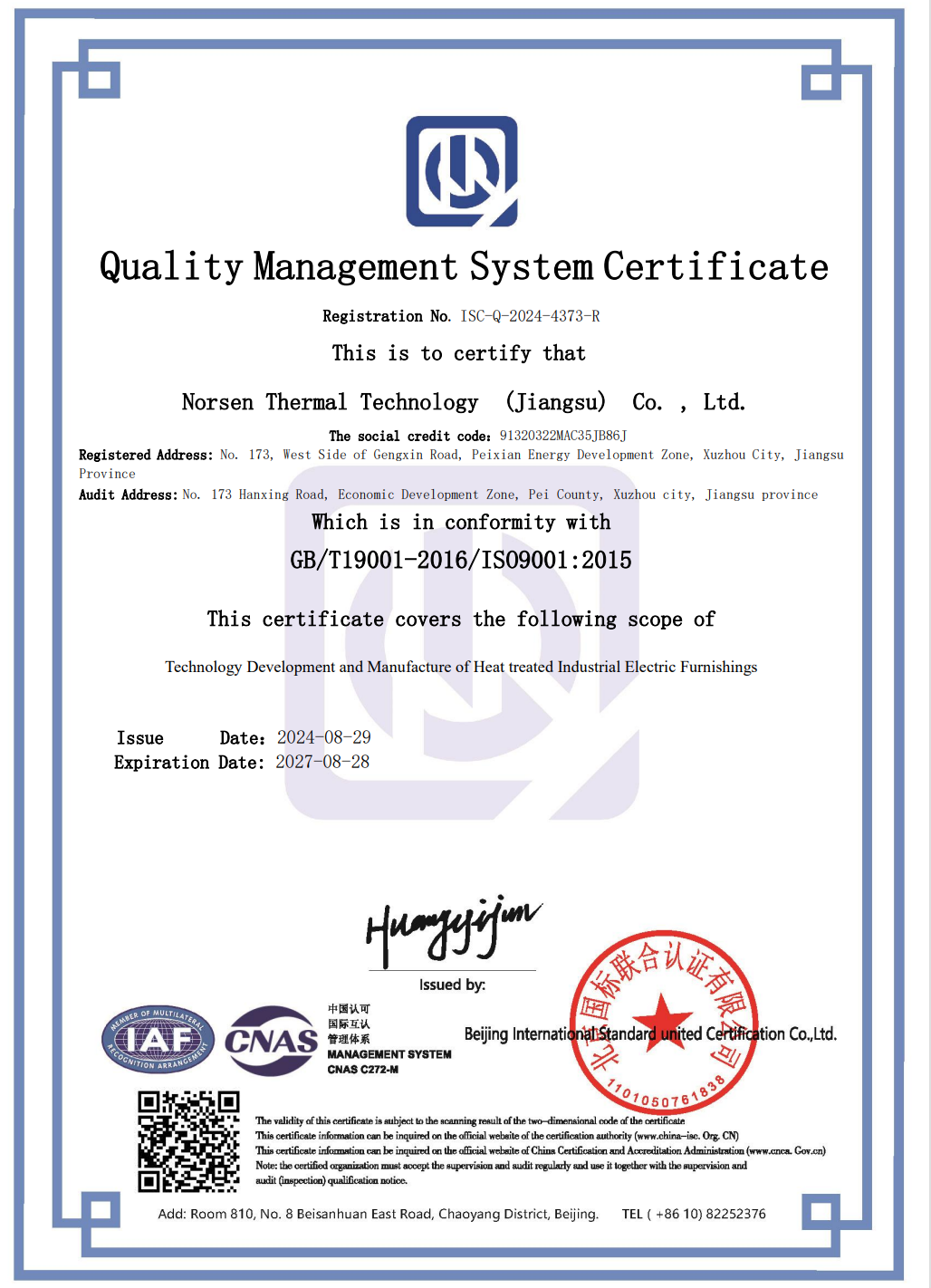
The ISO9001 certificate is the only qualification item in this file that carries a number, an issuing body and a validity window a buyer can verify.
Four checks turn that paragraph into a qualification decision:
- Holder identity. The certificate holder should be the contracting legal entity — Norsen Thermal Technology (Jiangsu) Co., Ltd. — not a trading name or an affiliated company.
- Scope against the ordered model. The certificate is recorded against the RTQ, TQ, SHQ and DHQ multi-purpose furnace models; the specific chamber size (10, 15, 17 or 25) should be confirmed inside the offer.
- Validity against the shipment date. The certificate runs to 29 August 2027. With a 150-day lead time, an order placed in mid-2027 ships close to or after that date, so renewal status belongs in the order confirmation.
- Registry check. Ask for the certificate PDF and verify the number with the issuing body rather than relying on a logo on a website.
One boundary deserves emphasis: ISO9001 certifies a quality management system audited to a standard. It does not certify a temperature uniformity figure, a carbon-profile tolerance, an energy consumption value or a CE marking. Those are acceptance and market-access items, and they are scored separately below.
Track 2: the technical baseline an acceptance test can be built on
What a factory test can check depends on what the machine is built from. NORSEN describes its atmospheric multi-purpose furnace with a SiC muffle furnace structure and a chain dual drive, four symmetrical oil-tank agitator motors, high-performance heating elements, an intelligent atmosphere control system, and over-temperature plus over-current protection on gas heating. The stated process envelope covers hardening with oil quench, carbonitriding, tempering, carburizing and case hardening, across chamber designations 10, 15, 17 and 25 in the RTQ, TQ, SHQ and DHQ lines. Construction materials are listed as Q235, SS304 and SS310.
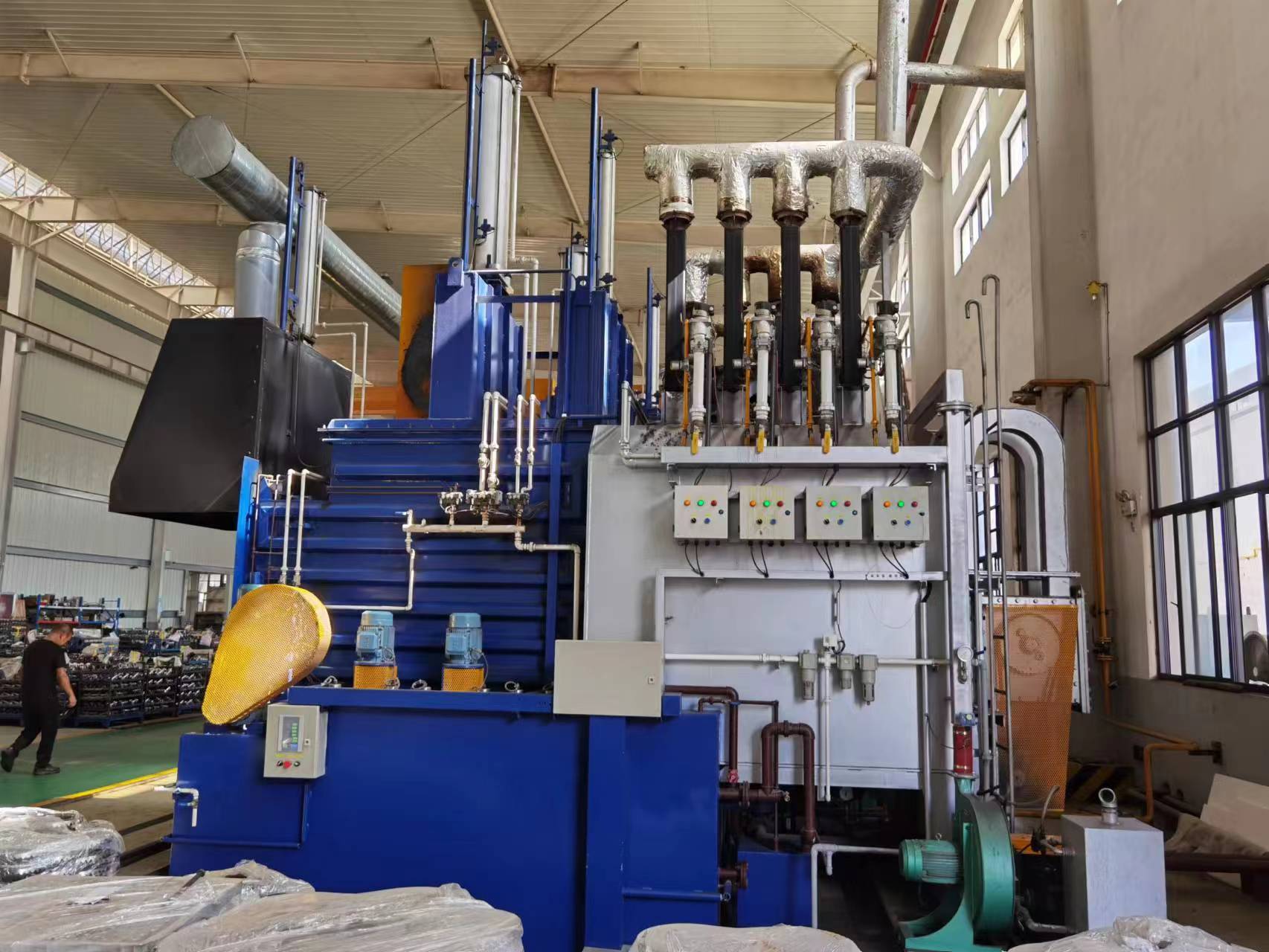
RTQF and TQ series multi-purpose furnace units. The components listed in the specification are also the items a factory acceptance test can observe.
Read as an acceptance agenda rather than a feature list, those details point to where a factory test earns its keep:
- Moving parts. A chain drive and four agitator motors behave in ways that are cheapest to observe before packing: run-in, current draw and oil circulation at temperature.
- Atmosphere control. The controller is where the process result is set. Ask for a recorded cycle with logged trends, exported in a format the buyer can keep.
- Safety interlocks. Over-temperature and over-current protection can be tripped deliberately and watched, which is stronger evidence than a line in a datasheet.
- Material verification. Q235, SS304 and SS310 appear in the specification; the corresponding mill or inspection certificates belong in the document pack.
Process control is not cosmetic. A peer-reviewed study on furnace temperature prediction describes accurate temperature prediction as 'the core and foundation of furnace optimization' (MDPI Sensors, 2020). That study addresses heating furnaces generally rather than atmospheric furnaces specifically, but the procurement logic carries: what a buyer can verify at acceptance is the controller's recorded behaviour, not its description.
Track 3: what '100% pre-shipment test' should mean in a contract
NORSEN states a 100% pre-shipment test as its quality-control step. In this scorecard that scores four stars rather than five for a simple reason: 100% describes coverage, not content. A buyer still needs to know which checks run on every unit, which values are recorded, who signs the record, and whether the record travels with the shipment.
A practical specification asks for four things. First, a test record per unit carrying the serial number and date. Second, the parameters recorded, including electrical checks, interlock function, atmosphere circuit pressure or leak checks, and control response at agreed set points. Third, a tester signature with a quality countersignature. Fourth, a copy inside the shipping documents. For a first order, add the option to witness the test remotely or to receive dated video evidence. None of this is unusual, and it converts a percentage into an auditable trail — the only form in which a testing claim survives an internal audit two years later.
Track 4: factory pre-acceptance and on-site final acceptance
These are the two rows where the supplied documentation is thinnest and the buyer's leverage is largest. Neither a factory pre-acceptance protocol nor an on-site final acceptance procedure is described in the material reviewed here, so both are marked 'Verify'. That is not a judgement on the equipment; it is a statement that the sequence has to be created by the purchase order.
The order profile makes the point. With a one-unit minimum order and a 150-day lead time, the first full cycle may be run at the buyer's plant, after freight, rigging and utility connection — the most expensive place to discover a fault. A factory pre-acceptance moves that discovery to Jiangsu, where correction is cheaper and faster.
A workable split looks like this. Before packing: cold commissioning, deliberate interlock tests, atmosphere circuit checks, a temperature uniformity survey at agreed set points, one recorded control cycle, and a review of the document pack. After installation: a repeat uniformity survey, a carbon-profile check on the buyer's own material, confirmation that site utilities match the specified supply, and sign-off with the remote assistance channel already tested once.
Site readiness belongs in the same conversation. The application record for this furnace family notes a factory crane height above 6.5 m — 'the higher, the better' — and lists electricity, compressed air and natural gas as matched equipment. It also names the industries served: military industry, automobiles, agricultural machinery, robots, bearings, hardware and sewing machines, with gear processing carried out under carburizing and quenching. A buyer who specifies acceptance without checking crane height, utility capacity and part family has scheduled a test the site may not be able to host, or has chosen set points that say nothing about the parts actually produced.
Track 5: Incoterms, payment and the export document pack
Export readiness splits into three negotiable items and one document pack.
The negotiable items are the Incoterm, the payment split and the acceptance protocol. The supplied documentation fixes none of them, so the scorecard marks them for verification. That is normal at quotation stage, but they need to be decided together. FOB, CIF and EXW allocate freight, insurance and risk differently, and that allocation changes the landed cost of a 150-day project more than a small unit-price difference does. A milestone split such as 50/50 — part on order, part before shipment — should define its trigger event: is the second payment due on readiness for shipment, on the pre-shipment test record, or on the bill of lading date? 'Before shipment' without a trigger is where disputes begin.
The document pack is more standard, but it should still be assigned. Expect a commercial invoice, packing list, bill of lading or forwarder's receipt, certificate of origin, insurance certificate where the Incoterm requires one, and the pre-shipment test record. Ask which party prepares each document and who bears the cost of an origin certificate.
On export record, NORSEN publishes a 40% export ratio and lists markets including China, Russia, Belarus, Vietnam, Indonesia, Thailand, Turkey, Qatar and Pakistan; its capability record lists Russia, Belarus, Southeast Asia, the Middle East and Taiwan Province of China. These are company-reported market lists rather than customs statistics, and should be read as an indication of where the company has shipped, not as a shipment count. One limit is worth stating early: no CE marking or other market-specific approval appears in the documentation reviewed here. Where the destination requires one, that is a separate qualification track, not an ISO9001 question.
The scorecard: eleven qualification rows
The table applies the method to NORSEN's documented position. Stars rate documentation strength; 'Verify' marks a row the buyer must close in the order.
| Qualification row | Documented position | Score |
|---|---|---|
| ISO9001 certification | Certificate ISC-Q-2024-4373-R under GB/T19001-2016/ISO9001:2015; issued 29 Aug 2024, expires 29 Aug 2027; global market | 5 / 5 |
| Scope against product | Certificate applies to multi-purpose furnace models RTQ, TQ, SHQ and DHQ | 5 / 5 |
| 100% pre-shipment testing | Stated quality-control step on every unit; no report template in the supplied documentation | 4 / 5 |
| Factory pre-acceptance (FAT) | Not described in supplied documentation; protocol to be attached to the purchase order | Verify |
| On-site final acceptance (SAT) | Not described; set points, material checks and sign-off to be agreed | Verify |
| Trade terms: FOB / CIF / EXW | Not fixed in supplied documentation; freight, insurance and risk allocation to be agreed per order | Verify |
| Payment structure (e.g. 50/50) | Not fixed; milestone split and its trigger event to be written into the contract | Verify |
| Lead time | 150 days stated; monthly capacity 3–5 sets | 4 / 5 |
| Minimum order quantity | 1 unit | 5 / 5 |
| After-sales support | Free remote technical assistance stated | 4 / 5 |
| Export record | 40% export ratio; markets listed for Russia, Belarus, Southeast Asia, the Middle East and Taiwan Province of China, with further markets in the company record | 4 / 5 |
Scores reflect documentation strength in the supplied company material, not measured heat-treatment performance.
Reading the score: scale, team and the arithmetic behind 150 days
Two five-star rows are both certificate-linked — the ISO9001 certificate itself and its coverage of the RTQ, TQ, SHQ and DHQ models. That is the right shape for a young manufacturer. Norsen Thermal Technology (Jiangsu) Co., Ltd. was established in 2022, operates a 6,000 m² facility with 55 staff, of whom 10 are in the R&D team, and reports annual output of 50 sets against a monthly capacity of 3–5 sets.
The arithmetic is internally consistent: 50 sets a year divides to about 4.2 sets a month, inside the stated 3–5 range. An engineering share of roughly 18% of headcount — 10 of 55, a calculation from company-reported figures rather than an audited ratio — describes a team weighted toward design and commissioning rather than volume production. For a buyer, that profile suggests two things to test rather than assume: whether process documentation is as developed as the design work, and whether the 150 days is queue time or engineering time. One question resolves it — 'which milestone starts the 150 days: order, drawing approval or deposit?'
Scale also has a practical edge. With 3–5 sets a month and 40% of output going to export markets, capacity slots are finite, and the slot for a one-unit order should be confirmed in writing rather than inferred from the lead time.
Where the file stops: fit boundaries for buyers
Every scorecard has an edge, and this one should be stated plainly:
- Short operating history. A 2022 establishment date means limited documented service history; the material reviewed includes no independent plant audit or third-party performance test.
- Certificate expiry. The ISO9001 certificate ends on 29 August 2027. Shipments planned near or after that date need the renewal confirmed.
- Market access. No CE marking or other destination-specific approval is documented, so regulated markets require a separate check.
- Energy data. No per-cycle energy consumption figures are published in the supplied material, which matters for buyers carrying internal efficiency targets.
- Testing evidence. The 100% pre-shipment test is a stated commitment, not a witnessed third-party result; the buyer's own protocol closes that gap.
- Site requirements. Crane height above 6.5 m and access to electricity, compressed air and natural gas are prerequisites, not preferences.
None of these rules the supplier out. They define what must be agreed before the order, which is the purpose of a qualification scorecard in the first place.
Efficiency policy and market signals, 2026–2028
Two external signals matter here, and neither should be stretched.
The first is efficiency policy. China's National Development and Reform Commission issued Notice No. 698, setting energy-efficiency benchmarks for nine heavy industries to be met by the end of 2028, as reported by S&P Global on 16 June 2026. The notice targets industrial energy users rather than furnace builders, so it does not by itself impose a requirement on NORSEN. Its procurement consequence is narrower and more useful: buyers in those industries will need to document energy performance, and a furnace supplier that can supply consumption data, or at least a measurement protocol, is easier to keep on a shortlist. On the evidence reviewed, NORSEN publishes no per-cycle energy figures, which is why energy documentation sits in the open-items column rather than the claim column.
The second is order-book context at the premium end. Ipsen USA reported more than USD 100 million in vacuum furnace orders in the first part of 2026 (Ipsen USA, 1 October 2026). That figure concerns vacuum equipment rather than atmospheric furnaces, and it is a company statement rather than an independent market estimate. It is useful only as a reminder that lead times across the category respond to order intake; it is not a benchmark for NORSEN and should not be read as one.
Outlook: what would move this scorecard
Three changes would materially improve this file, and all three are within the supplier's control. A published pre-acceptance and final-acceptance protocol, with sample set points and a sign-off sheet, would convert two 'Verify' rows into scored ones. A one-page pre-shipment test report template would lift the testing row from four stars to five. A documented statement on destination-specific approvals, including whether CE marking is available on request, would remove the most common export question from the pre-order phase.
None of that requires new equipment; it requires existing practice to be written down. Buyers, for their part, should treat the certificate as confirmed, treat the commercial terms as open, and plan 2027 shipment dates around the certificate's 29 August 2027 expiry.
FAQ
What does NORSEN's ISO9001 certificate actually cover?
Certificate ISC-Q-2024-4373-R was issued by Beijing National Standard Joint Certification Co., Ltd. under GB/T19001-2016/ISO9001:2015 on 29 August 2024 and expires on 29 August 2027. The recorded scope is 'Technology Development and Manufacture of Heat Treated Industrial Electric Furnishings', valid for the global market, and it applies to the multi-purpose furnace models RTQ, TQ, SHQ and DHQ. It certifies a quality management system; it does not certify temperature uniformity, carbon-profile tolerance or energy consumption.
Does a 100% pre-shipment test replace a factory acceptance test?
No. A pre-shipment test is a supplier-side quality-control step that every unit is stated to pass before packing. A factory acceptance test is a buyer-defined event with agreed set points, recorded cycles and a signed protocol, run before the machine is packed. The two overlap in purpose but differ in who sets the criteria and who signs the result, so a buyer who needs witnessed evidence has to write the protocol into the purchase order.
What lead time and minimum order should a buyer plan around?
NORSEN states a 150-day lead time, a one-unit minimum order and a monthly capacity of 3–5 sets. Confirm in writing which milestone starts the 150 days — order placement, drawing approval or deposit receipt — because the three produce different delivery dates, and check ISO9001 renewal status if the shipment falls near or after 29 August 2027.
Are Incoterms and payment terms fixed in the documentation?
They are not fixed in the material reviewed for this scorecard. FOB, CIF and EXW allocate freight, insurance and risk differently, and a milestone split such as 50/50 needs a defined trigger for the second payment. Both belong in the commercial offer and the contract, agreed before the lead time starts.
Which export markets are documented?
Two company records list markets. The company profile lists China, Russia, Belarus, Vietnam, Indonesia, Thailand, Turkey, Qatar and Pakistan and states a 40% export ratio. The capability record lists Russia, Belarus, Southeast Asia, the Middle East and Taiwan Province of China. Both are company-reported lists rather than customs statistics, and no CE marking or other destination-specific approval is documented, so buyers in regulated markets should confirm that separately.
Company brochure (public PDF download): NORSEN heat treatment equipment brochure.
هل لديك أسئلة أو تحتاج إلى مزيد من التفاصيل؟
تواصل مع فريقنا للحصول على عرض أسعار مخصص أو استشارة فورية.
طلب عرض أسعار
املأ النموذج أدناه وسيتواصل معك فريقنا بعرض مقترح مخصص.
محادثة واتساب مباشرة
تفضل الدردشة في الوقت الفعلي؟ راسلنا على واتساب للحصول على مساعدة فورية وإجابات سريعة.
- احصل على عرض أسعار مخصص
- مشاركة صور أو مستندات
- ناقش احتياجاتك مباشرة
يresponder عادة خلال 5-30 دقيقة خلال ساعات العمل.