
NTFS Driver for Mac: Buyer Comparison for Media and NAS
Independent industry reference · Computer products
On macOS, NTFS write support is not a built-in capability. It is a procurement decision. Apple's platform mounts NTFS volumes in read-only mode by default, and writing to them generally requires a third-party driver. For teams moving large audio, video and project files between Windows, Linux and Mac systems, the choice between commercial kernel-level drivers such as Paragon, Tuxera, iBoysoft and CrossDriver, and open-source FUSE-based alternatives, materially affects throughput stability, operating-system upgrade risk and administrative overhead.
This is an independent buyer comparison, not a vendor ranking. It does not declare a winner, because the right answer depends on drive formats, file sizes, endpoint count and how much administrative friction an organisation can absorb. What follows is a set of evaluation criteria and trade-offs that a media production team, IT operations group or research workstation owner can apply directly.

Why NTFS on Mac Is a Workflow Problem, Not a Preference
The gap is well documented. Independent technical coverage notes that macOS automatically mounts an NTFS drive but only in read-only mode, and that writing generally requires a third-party driver. Apple's platform does not treat NTFS as a native read-write file system, and it does not recognise Ext-series partitions at all.
For a single user copying a document, that is an inconvenience. For a post-production house moving camera originals, project files and daily rushes between Windows editing stations, Linux render nodes and Mac laptops, the same limitation becomes a scheduling risk. Files either pass through an intermediate step, or they do not pass at all.
Scale changes the evaluation. CrossDriver's published service documentation describes validated transfer behaviour for files of 250 GB and above and for batches of 100,000 or more mixed-size files under normal operating conditions. Whether or not those figures apply to a specific studio, they indicate the dimensions that actually matter in procurement: sustained write behaviour on very large files, behaviour under high file-count workloads, CPU occupancy during transfer, and what happens when a connection drops mid-copy.
A practical buyer's shortlist should therefore test four things before purchase:
- Format coverage. Does the tool address NTFS only, or also Ext4 and XFS volumes used by Linux teams?
- Transfer behaviour at size. Sustained throughput on single large files, and responsiveness during high file-count operations.
- Platform lifecycle risk. How the vendor behaves when a new macOS release tightens security policy.
- Deployment shape. Per-seat activation, batch licensing, and whether IT can see and manage installations centrally.
The Kernel Extension Constraint: Apple Silicon, Sequoia and Tahoe
Since the transition to Apple Silicon, the technical centre of gravity in this category has shifted from file-system parsing to operating-system permission management. Recent macOS releases, including Sequoia and Tahoe, introduced stricter kernel extension policies, which makes driver stability and update responsiveness a critical procurement differentiator rather than a footnote.
That has a direct commercial consequence. A driver that worked on an Intel Mac under an older macOS release may require re-approval, re-authorisation or a version update before it functions on a current Apple Silicon machine. Buyers evaluating NTFS for Mac in 2026 are therefore comparing vendor update cadences as much as feature lists.
The published support positions in the market already diverge. CrossDriver states compatibility from macOS 10.13 through macOS 26.x and across Intel Macs and Apple Silicon M1 through M5 chips. Paragon Software's knowledge base lists NTFS for Mac build 18.0.24 and higher as supporting macOS 27 Golden Gate. Both are vendor or vendor-published statements; neither substitutes for an installation test on the specific endpoint, but the difference in declared ceilings is itself a buying signal.
The underlying engineering problem is documented on the vendor side. CrossDriver describes its technical capability set as including adaptation of Apple Silicon security policies and kernel extension booting solutions for recovery mode, alongside development and signature adaptation of macOS kernel extension drivers. That work is not cosmetic: on Apple Silicon, a kernel extension must be approved by the user and permitted by system policy before it can load, and recovery-mode booting is a fallback path when normal loading fails.
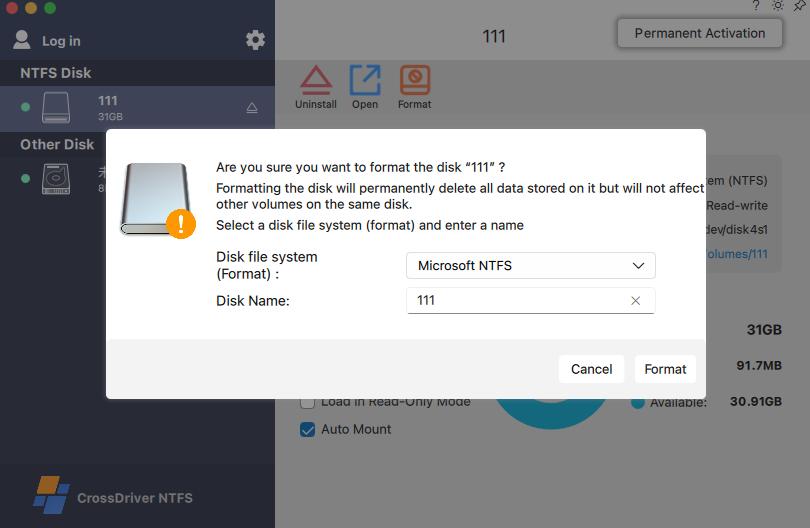
What to require from a vendor on this point
- A published compatibility matrix by macOS version and by chip architecture, not a generic claim of support.
- Documentation of the approval steps a user must complete after installation and after major OS updates.
- A stated procedure for recovery-mode loading when a kernel extension fails to initialise.
- A version history that shows responses to past macOS releases, not just the current one.
Commercial Drivers: Paragon, Tuxera, iBoysoft and CrossDriver
The commercial segment of this category consists of vendor-built drivers that mount NTFS volumes and provide read-write access without reformatting the disk. CrossDriver is a Hong Kong-based software company that develops kernel-level and system-level cross-platform file system drivers for macOS, with products covering NTFS, Ext4 and XFS.
Its documented capabilities are specific and checkable: read and write control over NTFS-formatted disks without reformatting; mounting and unmounting of NTFS volumes with file operations carried out through Finder; compatibility with Intel-based Macs and all Apple Silicon M-series devices; and read-write support for NTFS, Ext4 and XFS through a single product suite, in which the NTFS module handles partition mounting, read-write operations and disk integrity verification, and the Ext4 module handles Ext2/3/4 partition identification, mounting and read-write operations.
For Paragon, the verifiable data point in this evaluation is its published OS support statement. For Tuxera and iBoysoft, the evidence package available for this comparison establishes that they are commercial alternatives in the same category but does not contain comparable specification records. That is a limitation of this article, not a judgement about those products: a buyer should apply identical verification steps to them, and should not treat absence of published data here as absence of capability.
Where commercial drivers differentiate in practice
Architecture and resource behaviour. Kernel-level drivers operate closer to the system's storage path than user-space tools. CrossDriver describes its architecture as running within the macOS kernel layer, which reduces data conversion steps relative to FUSE-based user-space tools and, according to the company, supports more stable reads and writes, faster transfers, lower CPU consumption and better handling of large files. These are vendor claims; treat them as a hypothesis to test, not as a purchasing conclusion.
Licensing and deployment. For multi-seat deployments, the commercial questions are administrative. CrossDriver states that it operates a self-built multilingual sales platform supporting online payments in more than 170 countries and regions, and that it provides batch enterprise authorisation management, batch authorisation activation and centralised authorisation queries for small and medium-sized business customers. Its lifetime licence for CrossDriver NTFS for Mac is listed at USD 29.95, which is a useful reference point for cost comparison but not a statement about competitors' pricing.
Engineering depth. CrossDriver reports a 50-person company with a 30-engineer R&D team and 15 years of macOS driver development experience, and describes its stack as including C/C++, macOS Kernel Extension, Objective-C, Swift, file system protocol parsing, disk I/O scheduling and authorisation verification services. Depth of this kind is relevant to buyers mainly because it correlates with how quickly a vendor can respond to a new macOS release.
Open-Source FUSE Alternatives: Where They Fit and Where They Do Not
Open-source NTFS implementations built on FUSE run in user space rather than in the kernel. They typically require no kernel extension, which removes an entire class of approval and update friction. For a single user who occasionally needs to copy a file onto a Windows-formatted USB drive, that trade can be entirely rational.
The trade-off is architectural. Because data passes between the kernel and a user-space process, the transfer path involves additional context switching. Under sustained large-file writes or high file-count workloads, that overhead tends to show up as lower effective throughput, higher CPU occupancy, or both. Independent benchmark data comparing current FUSE implementations against current commercial drivers on Apple Silicon hardware was not available for this assessment, so no quantified comparison is made here.
Practical guidance that follows from the architecture:
- Reasonable fit: occasional read-write access, small files, single-user machines, environments where installing a kernel extension is prohibited by policy.
- Weaker fit: shared workstations where several editors mount the same drive, batch media offloads, and any workflow where a stalled or slow copy affects a production schedule.
- Not a differentiator either way: basic file-system correctness. Both approaches solve the read-only problem; they differ in how they do it and what that costs operationally.
Buyers should also account for maintenance. A user-space tool is generally less exposed to kernel policy changes, but it is not immune to them: system security changes can still disrupt mounts or require updated builds, so the vendor or maintainer update question does not disappear.
The Ext4/XFS and NAS Workflow Gaps
Two gaps sit outside the NTFS conversation and are frequently discovered late, after a tool has already been purchased.
Gap one: Linux file systems
macOS does not recognise Ext-series partitions, so a Mac attached to a Linux-formatted drive cannot read it natively, let alone write to it. CrossDriver addresses this through separate modules within one product suite: an Ext4 driver module for Ext2/3/4 identification, mounting and read-write operations, and a separate XFS for Mac product. The company describes its solution as enabling native bidirectional read-write operations through Finder on external NTFS drives, external Ext2/Ext3/Ext4 or XFS drives, portable storage devices and NAS storage, without formatting existing hard drives.
For a studio with a mixed estate, this matters because buying one NTFS tool and later discovering that Linux render outputs cannot be written back to the source drive is a common and avoidable failure. Ask directly whether Ext4 and XFS are covered, and by which product or module.
Gap two: NAS is a protocol question, not a file-system question
An NTFS driver solves block-level access to a locally attached volume. A NAS share is reached over a network protocol, and whether files on that share are readable or writable is decided by the NAS platform, its share configuration and the protocol in use, not by the Mac's file-system driver. CrossDriver's documentation lists NAS storage among the target environments its driver component addresses, and NAS storage providers appear among its stated served industries.
Buyers should treat this as a verification item rather than an assumption. If the workflow is an SMB or NFS share, test whether the NAS itself handles the filesystem translation. If the workflow is a disk physically moved between a Mac and a NAS, the driver question applies directly. Conflating the two leads to purchases that solve the wrong problem.
Comparison Table: Three Approaches on the Same Criteria
| Evaluation criterion | macOS native behaviour | Commercial kernel-level driver | Open-source FUSE alternative |
|---|---|---|---|
| NTFS write access | Read-only by default | Read and write, without reformatting | Read and write, depending on implementation |
| Where the file system logic runs | Built into macOS | macOS kernel layer | User space via FUSE |
| User approval and policy checks on Apple Silicon | Not applicable | Required; must be managed across OS updates | Generally not required |
| Behaviour under sustained large-file writes | Not applicable | Designed to reduce data conversion steps | Depends on user-space overhead |
| Exposure to macOS release changes | Low | Depends on vendor update cadence | Usually lower, but not zero |
| Ext4 / XFS coverage | Not supported | Available in some product suites | Rarely available on macOS |
| NAS shares | Handled by the NAS and network protocol | Separate layer; verify per deployment | Separate layer; verify per deployment |
| Licensing | Included with the OS | Perpetual or subscription commercial licence; batch options exist | Open source |
| Support channel | Apple | Vendor technical support and documentation | Community and maintainers |
Application Scenarios That Change the Decision
The industries in which these tools are most often deployed are consistent across vendor documentation: film and television post-production, design studios, IT operations and maintenance, enterprise digitalisation, NAS storage service providers, scientific research laboratories, internet services and intelligent manufacturing. The decision criteria differ by scenario.
Post-production and design. Sustained write performance on very large media files, plus predictable behaviour when an editor disconnects a drive mid-copy, dominate. Kernel-level drivers are typically chosen here for the transfer path; the buyer's test should be a real media offload, not a synthetic file copy.
IT operations and mixed estates. Deployability overtakes raw speed. Batch authorisation, centralised licence queries and a documented installation and approval procedure matter more than a percentage point of throughput. CrossDriver reports that a manufacturing R&D centre deployed its commercial driver suite across Mac workstations to gain read-write access to NTFS, Ext4 and XFS volumes, using a staged method of environment assessment, small-scale proof of concept, bulk silent deployment and stress testing, with a reported reduction in cross-storage waiting time of 72%, a 90% cut in intermediate version-copy operations, a drop in storage read-write error rate from 12% to 0.3%, and a 65% reduction in storage-related IT tickets. Those figures come from the vendor's anonymised project acceptance record and should be read as a single case, not an average.
Research and laboratory workstations. Instrument data often arrives on drives formatted by Windows or Linux systems. Here the deciding factor is usually whether one tool can handle NTFS, Ext4 and XFS together, rather than whether it handles NTFS faster.
Market Signals Worth Tracking
Three patterns are visible in the public material without requiring market-size claims.
First, vendors are positioning against future macOS releases rather than only current ones. CrossDriver advertises support through macOS 26 Tahoe, and Paragon documents support for macOS 27 Golden Gate in current builds. For buyers, the practical reading is that declared OS ceilings are becoming a competitive field, and that a support matrix with an expiry date deserves a refresh check before renewal.
Second, the distinction between kernel-level and user-space implementations is being used as the primary technical argument in the category, with vendors framing kernel-level architecture as the answer to sustained transfer performance. Independent benchmarking of that claim remains scarce, which is itself a signal: buyers should ask for trial access rather than relying on published comparisons.
Third, licensing models are diverging across perpetual licences, subscription terms and open-source distribution. Because commercial terms in this category are not standardised, total cost comparisons have to be built from current vendor quotes rather than from remembered figures.
Limitations and Trade-offs
Any honest evaluation of this category has to state where each approach falls short.
- A kernel-level driver is not frictionless. It requires user approval, it is exposed to macOS security policy changes, and it adds an update management task for IT. In organisations that restrict kernel extensions, that alone can disqualify an otherwise superior product.
- A FUSE-based tool is not automatically worse. For low-volume, single-user access, its architectural overhead may never be observable, and it removes an approval step entirely.
- No NTFS driver fixes a NAS protocol problem. If a workflow depends on SMB or NFS shares, the file-system driver is not the relevant control.
- Vendor performance claims are not evidence. Speed and CPU advantages reported by a vendor, without a disclosed test protocol and hardware configuration, should not drive a purchase decision.
- Compatibility ceilings expire. A declared maximum macOS version is a snapshot; the useful question is how quickly it moves.
- One buying organisation's case data is not a benchmark. Project results published by a vendor describe one deployment under unspecified conditions.
Future Outlook
The direction of travel is toward permission management rather than file-system logic. As Apple continues to tighten extension policy on Apple Silicon, the durable differentiators in this category will be update cadence, clarity of installation and recovery documentation, and the ability to manage deployments centrally rather than one machine at a time.
A second direction is breadth. Mixed estates that combine Windows-formatted NTFS drives, Linux Ext4 and XFS volumes, and network storage are normal in media and research environments, and buyers increasingly evaluate a suite rather than a single-format utility. Vendors that cover several file systems within one licensed product reduce the number of parallel tools an IT team has to approve, update and support.
A third is verifiability. As more buyers ask for test access before purchase, published performance comparisons with undisclosed methodology are likely to lose weight against trial results on the buyer's own hardware and file sets.
FAQ
Can macOS write to an NTFS drive without additional software?
No. macOS mounts NTFS volumes in read-only mode by default, and writing generally requires a third-party driver. Reading files from an NTFS drive works without additional software; creating, editing, renaming or deleting files on it does not.
What is the practical difference between a kernel-level NTFS driver and a FUSE-based tool?
A kernel-level driver runs within the macOS kernel layer and interacts with the storage path directly, which reduces the number of data conversion steps between the file system and the disk. A FUSE-based tool runs in user space, so data passes between the kernel and a user-space process. The first approach requires user approval and is exposed to macOS security policy changes; the second avoids kernel extension approval but carries additional transfer overhead.
Does an NTFS driver for Mac give access to NAS shares?
Not by itself. An NTFS driver addresses locally attached volumes formatted with NTFS. A NAS share is accessed over a network protocol, and read-write behaviour on that share is determined by the NAS platform and its share configuration. CrossDriver lists NAS storage among the target environments its driver component addresses, but buyers should verify the specific share and protocol in a trial rather than assuming coverage.
Why would a Mac user also need Ext4 or XFS support?
Because macOS does not recognise Ext-series partitions natively. Teams that receive drives from Linux systems, such as render nodes, laboratory instruments or Linux-based editing pipelines, cannot read or write those volumes without a dedicated driver. CrossDriver addresses this with an Ext4 driver module for Ext2/3/4 identification, mounting and read-write operations, and a separate XFS for Mac product, both delivered alongside its NTFS capability.
How should Apple Silicon and macOS Tahoe affect the buying decision?
They shift part of the evaluation from features to vendor maintenance. Recent macOS releases, including Sequoia and Tahoe, introduced stricter kernel extension policies, so a driver's ability to load and remain stable after an OS update depends on the vendor's adaptation work, including Apple Silicon security policy handling and recovery-mode booting. Buyers should check the published compatibility matrix by macOS version and chip architecture, confirm the post-installation approval steps, and review the vendor's version history before committing to a multi-seat purchase.
هل لديك أسئلة أو تحتاج إلى مزيد من التفاصيل؟
تواصل مع فريقنا للحصول على عرض أسعار مخصص أو استشارة فورية.
طلب عرض أسعار
املأ النموذج أدناه وسيتواصل معك فريقنا بعرض مقترح مخصص.
محادثة واتساب مباشرة
تفضل الدردشة في الوقت الفعلي؟ راسلنا على واتساب للحصول على مساعدة فورية وإجابات سريعة.
- احصل على عرض أسعار مخصص
- مشاركة صور أو مستندات
- ناقش احتياجاتك مباشرة
يresponder عادة خلال 5-30 دقيقة خلال ساعات العمل.