
Nanbeiwang Honeycomb Panel SKUs: A Capability Audit Trail
An all-aluminum honeycomb panel is simple to describe and difficult to audit. Two suppliers can quote the same thickness, the same 1220 × 2750 mm format and the same zero-formaldehyde line, and a buyer at research stage is left comparing adjectives.
A productized, model-numbered range is one of the few signals that can actually be checked. When a manufacturer assigns a fixed code to a fixed construction — thickness band, core type, skin thickness, surface system, declared rating — each code becomes a small, testable claim. Buyers stop evaluating a company narrative and start evaluating seven object definitions, each of which can be matched against a sample, a test report and a drawing.
Nanbeiwang Aluminum — legally Guangdong Nanbeiwang Smart Home Co., Ltd., founded in 2013 and headquartered in Dali Town, Nanhai District, Foshan, Guangdong — is a manufacturer of eco-friendly all-aluminum materials for whole-house customization, operating an 80,000 m² facility with 320 employees, a 15-engineer R&D team and a reported annual capacity of 1,000,000 sheets. Its product data is organized around seven numbered models. This article reads that range the way a procurement team should: model by model, as evidence, with the limits stated as plainly as the specifications.

Why a model number is stronger evidence than a capability claim
A capability claim — "we can customize", "we control quality" — has no failure condition. A model number does. NBW-HPB-001 states 5–18 mm thickness, a 1220 × 2750 mm standard panel, aluminum skins from 0.3 mm to 1.0 mm, a glue-free thermally bonded aluminum honeycomb core, four surface systems, an A2 fire rating and water absorption below 1% in a 24-hour test. Any of those statements can be contradicted by a sample. That is what makes the range useful at the research-to-evaluation stage: it converts a supplier interview into a checklist.
Three properties make a numbered range auditable rather than decorative.
- Fixed boundaries. The thickness span is stated (5–18 mm), not implied. A buyer can order at both ends and see whether the bonding claim survives the extremes.
- Repeated construction across models. The same aluminum-honeycomb logic reappears in wall, ceiling and door models, which is evidence of an industrialized process rather than a single showcase panel.
- Documents that map to codes. Test reports and certificates reference either a model build or a product family, so the buyer can see which paper covers which code — and which paper does not.
The rest of this article walks the range in that order, then sets out what to request for each model.
The range at a glance
Seven codes cover four product roles: board, wall, ceiling, door — plus two substrate-specific boards. The table below reproduces the declared data without ranking the models, because they are not interchangeable.
| Model | Product role | Thickness / format | Core or substrate | Declared fire & emission data |
|---|---|---|---|---|
| NBW-HPB-001 | All-aluminum honeycomb panel (base board) | 5–18 mm; 1220 × 2750 mm standard, customizable; skins 0.3–1.0 mm | Aluminum honeycomb core, glue-free thermal bonding | A2 fire rating; zero formaldehyde under GB18584-2024; water absorption <1% (24 h test) |
| NBW-WHB-002 | Whole house custom board | 5–18 mm | All-aluminum eco base material, no chemical glue added in the whole process | Baby-grade zero formaldehyde declared |
| NBW-WPB-003 | Aluminum honeycomb wall panel | 5 / 9 / 10 / 18 mm; 1.22 × 2.75 m, customizable | Aluminum plate plus honeycomb core; skins 0.3, 0.48+0.2, 0.65+0.2, 1.0 mm | Formaldehyde-free, fire-resistant (no rating number stated in the model data) |
| NBW-CLB-004 | Frameless honeycomb ceiling panel | Large-format integrated board; standard thickness | High-strength aluminum alloy board with reinforced thickened aluminum honeycomb core | Moisture and mildew proof, anti-sagging (no rating number stated) |
| NBW-DOR-005 | All-aluminum interior door (aluminum room door) | Leaf and frame 45 mm; frames 60 / 50 / 25 / 55 / 18 mm | Honeycomb core, bamboo board or plywood | Waterproof, anti-mildew, no deformation, fire-resistant; formaldehyde emission test to GB 18584-2001 |
| ZKB-1220×2750 | All-aluminum bamboo core board | 18 mm (5 / 10 mm optional); 1.22 × 2.75 m, customizable | High-pressure bamboo fiber core hot-pressed with aluminum; skins 0.3 / 0.5 mm both sides | B1 fire rating; E0 / zero formaldehyde; 100% waterproof |
| WAP-600*(200-700) | Welding board (cabinet, wardrobe, door, wall panel) | 18 mm total; 6 m length; 200–700 mm width; skin 0.8 mm | Aluminum alloy | B1 fire rating; zero formaldehyde; 100% waterproof; load-bearing 150 kg/m² |
Reading rule: the declared ratings are not uniform across the range, and they are not presented as uniform. A2 is declared for NBW-HPB-001, B1 for the bamboo core board and the welding board, and the wall, ceiling and door models describe fire resistance without a rating number in the published model data. That differentiation is itself a credibility signal — a range that claims one premium rating for every code invites suspicion.
NBW-HPB-001 — the base panel that carries the bonding claim
The base board is where the technology story has to hold up, because glue-free thermal bonding is a process claim that either survives a thickness sweep or does not. NBW-HPB-001 is specified from 5 mm to 18 mm, in a 1220 × 2750 mm standard panel, with aluminum skins between 0.3 mm and 1.0 mm and four surface systems: PETG, melamine, powder coating and wood grain.
What the specification actually fixes
Three things become testable. First, bonding consistency across an 18 mm span: a 5 mm panel and an 18 mm panel load the core-to-skin interface differently, so a supplier claiming a thermal process should be able to show samples from both ends of the range, not a single 9 mm hero sample. Second, surface compatibility: four finish systems on one substrate means the buyer can specify a finish without switching suppliers, which matters when a project mixes cabinetry and wall surfaces. Third, performance documentation: the model declares an A2 fire rating, zero formaldehyde referenced to GB18584-2024, and water absorption below 1% in a 24-hour test — three statements that can be matched line by line against reports.
The declared application scope is deliberately unglamorous: board wholesale, furniture manufacturing, custom cabinet factories and decoration projects. That is consistent with a base board rather than a finished system, and it is the correct frame for evaluation — this code is the raw material other codes are built from.
NBW-WHB-002 — one substrate across door, wall and cabinet
NBW-WHB-002 is the whole house custom board: an all-aluminum eco base material with no chemical glue added in the whole process, specified from 5 mm to 18 mm, described as universal for cabinet, door and wall panel, and positioned around integrated same-color matching across door, wall and cabinet.
For a buyer, the value of this code is not a single specification but an inventory consequence. Whole-house packages fail at the seams — a wardrobe front that is close to, but not the same as, the wall panel next to it. A single substrate declared for three product families is the structural precondition for color consistency, and it is checkable: request the same finish reference across a cabinet door blank, a wall panel offcut and a door leaf sample, and compare them in the lighting of the actual project.
Two boundaries deserve note. The model data declares baby-grade zero formaldehyde but does not attach a fire rating to this code, so a project requiring a rated board should be routed to a model that states one. And same-color matching is a claim about finish control, not about lot-to-lot color tolerance — the tolerance question belongs in the sampling agreement.

NBW-WPB-003 — the wall panel matrix
The wall panel model is the most granular code in the range, and that granularity is the capability evidence. NBW-WPB-003 is offered at 5 mm, 9 mm, 10 mm and 18 mm; in standard 1.22 × 2.75 m panels, customizable; with skin configurations of 0.3 mm, 0.48+0.2 mm, 0.65+0.2 mm and 1.0 mm; with honeycomb core cell sizes of 3×3, 4×4, 5×5, 8×8 and 10×10 available as customization; and with seven surface routes — solid wood veneer, PETG high gloss, scratch-resistant wood grain, melamine CPL, solid color, powder coating and wood grain heat transfer.
Multiplying thickness by skin configuration by cell size by finish produces a matrix, not a product. That matters at quotation stage: two "9 mm wall panels" from two suppliers are not the same object unless the cell size and skin build are stated. A buyer who accepts a 9 mm quotation without those two numbers has accepted an undefined deliverable. The declared functional set for this code — seamless splicing, waterproof, moisture-proof, anti-mildew, fire-resistant, termite-proof, formaldehyde-free — should be read as design intent until matched against the reports in the certificate register below.
Application scope for this model covers interior wall decoration, old-house renovation, commercial fitting-out and large-scale wall engineering. The seamless splicing claim is the one to test physically: request two joined offcuts and inspect the joint line under raking light.
NBW-CLB-004 — ceiling, where flatness is the specification
Ceilings expose a panel faster than walls do. NBW-CLB-004 is described as a large-format integrated board with seamless splicing, high flatness, moisture and mildew resistance, anti-sagging behaviour and straightforward installation, built on a high-strength aluminum alloy board with a reinforced thickened aluminum honeycomb core. Declared applications are whole-house ceilings, kitchen and bathroom ceilings, hotel and apartment hardcover work, and commercial ceiling engineering.
What this code proves about the supplier is narrower than the marketing language suggests, and more useful. A reinforced core specified separately from the wall panel core indicates that the ceiling is treated as a different load case rather than a recycled wall product. But the published model data does not include a flatness tolerance figure or a support-span table. Those are the two numbers a ceiling specification actually needs, and the correct buyer response is to request them as project documentation rather than to infer them from the word "flatness".
NBW-DOR-005 — the aluminum room door as an integration test
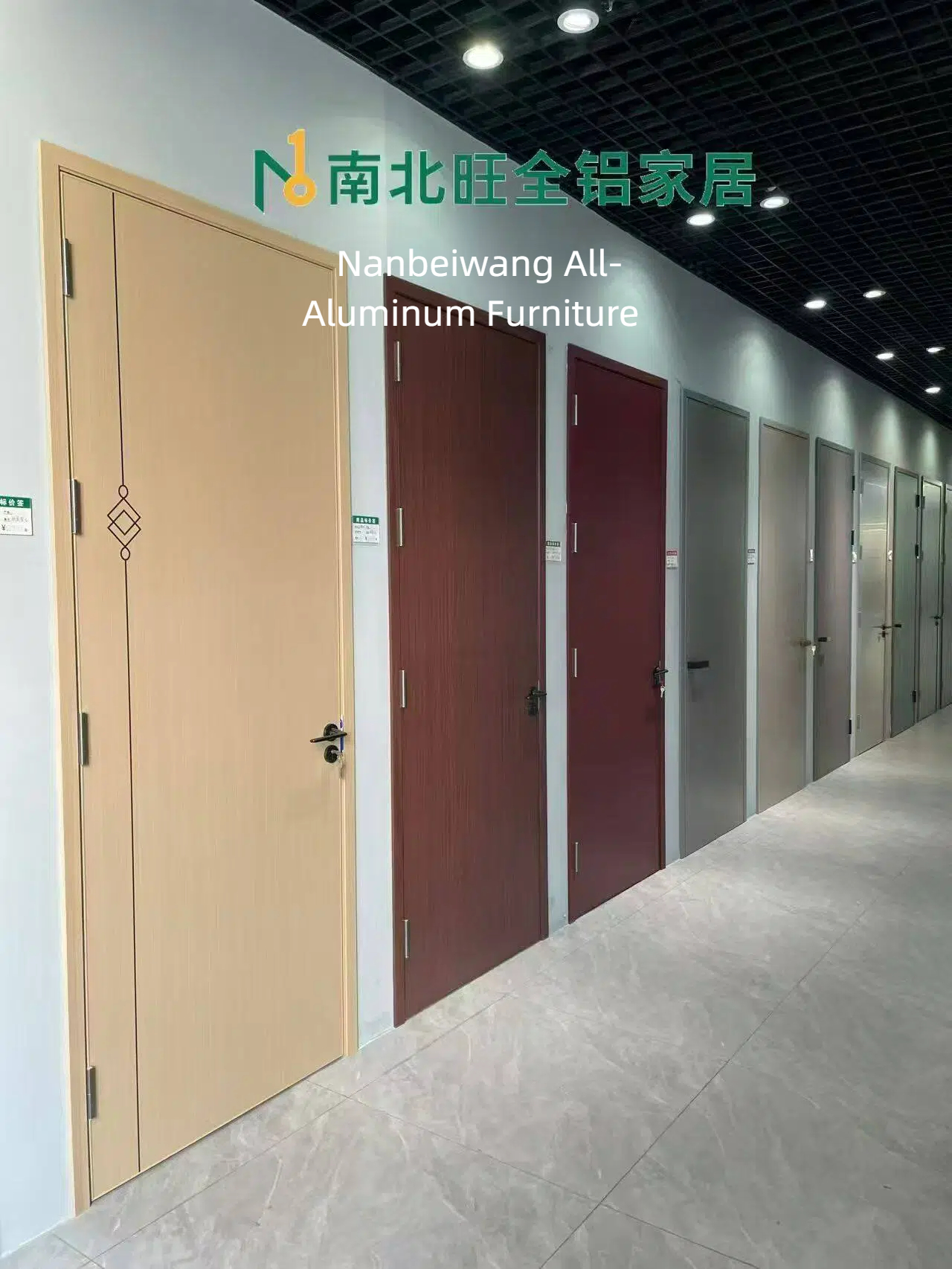
The all-aluminum interior door is the code that tests whether the range is a system or a catalogue. NBW-DOR-005 is an all-aluminum integrated door structure with a 45 mm door leaf and frame, offered with five frame systems — Korean 60 mm, narrow 50 mm, minimalist 25 mm, invisible 55 mm and frameless 18 mm — three core options (honeycomb core, bamboo board or plywood), and three surface families (PETG, wood grain and powder coating). Hardware is specified as a tri-point lock, flag hinge and magnetic lock. Declared performance covers waterproofing, anti-mildew behaviour, resistance to deformation and fire resistance, with application scope spanning bedroom, bathroom, kitchen, living room and office.
Frame systems and what they imply
Five frame options on one door program is a tooling statement. A 25 mm minimalist frame, a 55 mm invisible frame and an 18 mm frameless option are different aluminum profile families, not width variants of the same extrusion. For a project, the practical consequence is that the door schedule must be fixed early: the frame choice determines the wall opening detail, the reveal depth and the transition to the adjacent wall panel. A buyer evaluating this model should therefore request a frame section drawing for each frame type under consideration, plus the wall build-up it is designed to close against.
Core and finish options
The model data lists honeycomb core, bamboo board and plywood without ranking them, and that is the honest position: each has a different place. What a buyer should do is ask the supplier to state, per core option, the leaf weight, the hardware fixing method and the impact behaviour expected in the specified application — bathroom and kitchen doors being the obvious stress cases given the declared waterproof and anti-mildew scope. The finish families overlap with the panel range (PETG, wood grain, powder coating), which is what makes door-wall-cabinet matching feasible in the first place.
What the door proves about the wider range
A door is where substrate, edge treatment, hardware and finish converge. A supplier able to publish a 45 mm integrated door with five frame systems, three core options and named hardware is demonstrating that its panel capability extends into assembly — cutting, edge processing, profile matching and fitting preparation. It also indicates production discipline: the model data states 100% full inspection before shipment with third-party inspection supported, alongside the stated 10,000 m² warehouse, 30–50 tons daily shipping and 24-hour sample dispatch.
Compliance for this code is documented separately from the panels. The door carries a formaldehyde emission test to GB 18584-2001, report number SQ2306041 / UNS7332, issued by Guangdong Testing Institute of Product Quality Supervision (GQI) / National Furniture Product Quality Testing Center (Guangdong), and is certified to ISO9001:2015 under certificate 31825Q10055R0S issued by BELIEVE (BEIJING) CERTIFICATION CO., LTD. Those are door-scope documents; they do not extend to the panel models.
What to request for the door specifically
- A shop drawing per opening, with the frame type named (60 / 50 / 25 / 55 / 18 mm) and the wall build-up it closes against.
- A profile section sample for each frame type being considered, not a photograph.
- A written core declaration per door type, with the hardware fixing method stated for that core.
- A hardware specification sheet covering the tri-point lock, flag hinge and magnetic lock, including finish and adjustment range.
- The formaldehyde emission report (SQ2306041 / UNS7332) and the ISO9001 certificate (31825Q10055R0S), both in date.
- An inspection record confirming 100% pre-shipment inspection, and confirmation of third-party inspection arrangements if the project requires them.
- A corner-section sample showing leaf edge, core and skin in one piece — the fastest way to see whether the 45 mm build is as specified.
ZKB-1220×2750 and WAP-600*(200-700) — the two non-A2 models
The bamboo core board is specified at 18 mm, with 5 mm and 10 mm optional, aluminum skins of 0.3 mm or 0.5 mm on both sides, a high-pressure bamboo fiber core hot-pressed with aluminum, a 1.22 × 2.75 m size that is customizable, and four surface routes (spray, wood grain, PETG, melamine). Its declared ratings are B1 fire, E0 / zero formaldehyde and 100% waterproof, with declared use across furniture, interior decoration, construction, hospitality, healthcare and marine interiors.
The welding board is a different object altogether: a 6 m length, 200–700 mm width, 0.8 mm aluminum skin, 18 mm total thickness, spray coating or wood grain thermal transfer in 18 colors, B1 fire rating, zero formaldehyde, 100% waterproof and a declared load-bearing capacity of 150 kg/m², with declared use in furniture, interior, decoration, construction, hospitality, healthcare and marine.
Two discipline points. First, the 150 kg/m² load figure belongs to the welding board; it must not be transferred to the honeycomb panel models, which publish no equivalent figure. Second, B1 is a different classification from A2 — a project that has specified A2 cannot substitute either of these codes without a formal change.
Reading the certificate register without over-reading it
The documents below are the ones that can be checked against issuer registries and matched to model scope. They are listed by scope, because scope is where most procurement errors happen.
| Document | Number | Issuer | Scope as stated |
|---|---|---|---|
| GB18584-2024 hazardous substance test report | SQ2505164 | Guangdong Testing Institute of Product Quality Supervision | All-aluminum honeycomb panels, full series |
| SGS RoHS restricted substances test report | CANEC2308826401 | SGS-CSTC Standards Technical Services Co., Ltd. Guangzhou Branch | 18 mm PETG aluminum honeycomb panel; GB/T 26572-2011 / RoHS Directive 2011/65/EU |
| CTC peel strength and temperature resistance test report | WT2025B01B02018 | China National Test & Certification (CTC) | Glue-free aluminum honeycomb panel; JC/T 2113-2012 |
| Formaldehyde emission test report | SQ2306041 / UNS7332 | Guangdong Testing Institute of Product Quality Supervision (GQI) / National Furniture Product Quality Testing Center (Guangdong) | All-aluminum interior door; GB 18584-2001 |
| ISO9001:2015 quality management system | 31825Q10055R0S | BELIEVE (BEIJING) CERTIFICATION CO., LTD. | Aluminum honeycomb panels for furniture, wall, ceiling, cabinet |
| ISO14001:2015 environmental management system | BIV25E10066R0S | BELIEVE (BEIJING) CERTIFICATION CO., LTD. | Aluminum honeycomb panels for furniture, wall, ceiling, cabinet |
Three observations follow from reading the register as a buyer rather than as a brochure.
Scope does not transfer. The RoHS report is written against one build — an 18 mm PETG aluminum honeycomb panel. A different surface system or a different thickness needs its own statement if a market requires RoHS evidence for that specific build. Similarly, the GB18584-2024 report covers the honeycomb panel family, while the door carries a separate GB 18584-2001 formaldehyde emission test. Neither document substitutes for the other.
Standard families differ by market. The Chinese standards referenced here (GB18584-2024, GB 18584-2001, JC/T 2113-2012) will not satisfy every destination market. International fire-test references commonly cited in the category include ASTM E84, EN 13501-1 and UL 723, and a buyer selling into a market that names one of those should ask specifically which report addresses it.
Certificates have validity windows. Every document above carries an issue date and an expiry or review period. Request the current issue rather than a PDF inherited from a previous tender pack, and confirm both the report number and the model scope on the cover page.
Where the evidence stops: limits and comparison with conventional boards
An honest evaluation names the boundaries. Four apply here.
The rating is not range-wide. A2 is declared for NBW-HPB-001. The bamboo core board and welding board declare B1. The wall, ceiling and door models describe fire resistance without publishing a rating number. A project that needs A2 across an entire package cannot currently evidence that from this range alone, and should not assume the A2 declaration cascades.
Ceiling and wall performance lacks numeric tolerances. Flatness and span are described qualitatively for the ceiling model. Until a tolerance figure and a support table are issued, ceiling specification relies on project-level agreement rather than published data.
Price cannot be benchmarked from a single number. Global Market Insights reports a blended average selling price for aluminum honeycomb panels of USD 211 per square metre in 2025, and a factory-side planning range of USD 55–130 per square metre in 2026 — with the same source noting wide dispersion between commodity and aerospace grades. The two figures have different bases and should not be used interchangeably. For construction and interior grades, the factory-side band is the more relevant anchor, and even that must be fixed against thickness, skin build, cell size and finish before it means anything.
Comparative cost claims against wood-based boards are unsupported here. No figure in this dataset anchors honeycomb panel pricing against MDF or plywood, so any comparison must be built from the buyer's own quotations for equivalent thickness and finish. What can be said factually is directional: wood-based boards are the incumbent substrate in cabinetry, and honeycomb's case rests on moisture stability, large-format flatness and documented emission performance — while demanding more attention to edge treatment, fixing method and hardware selection. That trade-off is real, and it is the reason a sample and a fixing drawing matter more than a datasheet line.
Capacity is company-reported. The 80,000 m² facility, 320 employees and 1,000,000-sheet annual capacity come from a published company profile; they are not the output of an independent capacity audit in this dataset. Buyers with volume commitments should verify capacity through order history, a factory visit or third-party inspection.
Market context: why documentation is becoming the differentiator
Strategic Market Research estimates the global aluminum honeycomb market at USD 2.1 billion in 2024, with a projected compound annual growth rate of 6.1% through 2030. Growth of that order tends to widen the supplier field faster than it widens buyer diligence — more quotations, more similar specification sheets, more identical-sounding claims.
That is the practical argument for reading a numbered range as evidence. As specifications converge, the differentiator shifts from what a supplier says it can make to what it can document per code: the report number, the model the report covers, the thickness the sample was drawn from, and the date the certificate was issued. Nanbeiwang's structure — seven codes, six scoped documents, declared ratings that differ by construction — is useful to a buyer precisely because it is uneven. Uneven documentation that maps to models is more auditable than uniform language that maps to nothing.
Future outlook
Two developments are worth watching for buyers holding this range in an evaluation file. First, scope statements are likely to become a standard part of the quotation rather than an appendix — buyers are increasingly asking which model, build and thickness a certificate covers, and suppliers who can answer per code will win shortlists on that alone. Second, the wall and ceiling models are the natural next place for numeric disclosure: a published flatness tolerance and a support-span table would convert two qualitative claims into engineering data, which is the step that separates a catalogue range from a specified system.
Neither development changes the underlying material logic. It simply makes the audit cheaper to perform.
Buyer checklist: what to request per model
| Model | Documents to request | Samples to request |
|---|---|---|
| NBW-HPB-001 | GB18584-2024 report SQ2505164; CTC report WT2025B01B02018; RoHS report CANEC2308826401 for the specific build ordered; water absorption test data for the 24-hour method | Panel samples at 5 mm and 18 mm; cross-section showing skin-core bond; finished samples in each surface system specified |
| NBW-WHB-002 | Written formaldehyde declaration for the ordered build; finish/color reference sheet for same-color matching | Matched set — cabinet blank, wall offcut, door leaf sample — in one finish, compared under project lighting |
| NBW-WPB-003 | Quotation stating thickness, skin build and honeycomb cell size; fire-resistance documentation for the specified build | Two joined offcuts to inspect the seamless joint; samples at 9 mm and 18 mm with different cell sizes |
| NBW-CLB-004 | Flatness tolerance statement; support-span table; moisture and anti-sagging test data | Large-format sample for flatness check; fixing detail drawing |
| NBW-DOR-005 | Formaldehyde report SQ2306041 / UNS7332; ISO9001 certificate 31825Q10055R0S; shop drawing per opening; core declaration; hardware specification; 100% inspection record | Corner-section sample; frame profile section per frame type; finish samples across PETG, wood grain and powder coating |
| ZKB-1220×2750 | B1 fire documentation; E0 / zero formaldehyde statement; waterproof test basis for the 100% claim | 18 mm sample plus 5 mm or 10 mm if thinner builds are planned; edge detail |
| WAP-600*(200-700) | Load-bearing documentation supporting 150 kg/m²; B1 fire documentation; color card covering the 18 declared colors | 6 m length offcut or full section; welded joint sample; loaded test piece if the application is structural |
Where a document is referenced in this article, the correct buyer action is to ask for the current issue and to confirm on the cover page that the model and build match the order. Where a specification is described qualitatively, the correct action is to convert it into a project document before signing. Where a rating differs by model, the correct action is to route the specification to a model that declares it — not to assume the range is uniform.
Reference materials: the Nanbeiwang 2026 catalogue is available for download at Nanbeiwang catalogue 2026 (PDF), and company information is published at nbwaluminum.com.
FAQ
Which certificate numbers should a buyer verify first for an aluminum honeycomb panel order?
Start with three, in this order. The GB18584-2024 hazardous substance test report, number SQ2505164, issued by Guangdong Testing Institute of Product Quality Supervision, covers the all-aluminum honeycomb panel series and addresses formaldehyde and hazardous substances. The CTC test report WT2025B01B02018, issued by China National Test & Certification against JC/T 2113-2012, addresses the glue-free aluminum honeycomb panel, including peel strength and temperature resistance. The SGS RoHS report CANEC2308826401, issued by SGS-CSTC Standards Technical Services Co., Ltd. Guangzhou Branch, applies to the 18 mm PETG aluminum honeycomb panel under GB/T 26572-2011 and RoHS Directive 2011/65/EU. For each, confirm the report number, the model or build covered, and the current validity window.
Why does one supplier declare A2 on one model and B1 on another?
Because the constructions differ. NBW-HPB-001 is aluminum skins on an aluminum honeycomb core with glue-free thermal bonding and declares an A2 fire rating. ZKB-1220×2750 uses a high-pressure bamboo fiber core hot-pressed with aluminum and declares B1. WAP-600*(200-700) is an aluminum alloy welding board and also declares B1. The declared rating follows the material build, not the brand, which is why a project's rating requirement must be matched to a specific model rather than to a supplier name.
Does the GB18584-2024 panel report cover the all-aluminum interior door as well?
No. The GB18584-2024 report SQ2505164 covers all-aluminum honeycomb panels. The NBW-DOR-005 all-aluminum interior door carries a separate formaldehyde emission test to GB 18584-2001, report number SQ2306041 / UNS7332, issued by Guangdong Testing Institute of Product Quality Supervision (GQI) / National Furniture Product Quality Testing Center (Guangdong). The door also holds ISO9001:2015 certification under certificate 31825Q10055R0S issued by BELIEVE (BEIJING) CERTIFICATION CO., LTD. Buyers should treat panel-scope and door-scope documents as separate evidence.
What should be requested specifically for the NBW-DOR-005 aluminum room door?
Request five items. A shop drawing per opening naming the frame type — Korean 60 mm, narrow 50 mm, minimalist 25 mm, invisible 55 mm or frameless 18 mm — and the wall build-up it closes against. A written core declaration, since the model offers honeycomb core, bamboo board or plywood. A hardware specification covering the tri-point lock, flag hinge and magnetic lock. The formaldehyde report SQ2306041 / UNS7332 plus the ISO9001 certificate. And an inspection record confirming the stated 100% full inspection before shipment, with third-party inspection arranged if the project requires it. A corner-section sample showing the 45 mm leaf edge, core and skin in one piece is the fastest physical check of the build.
How should a USD 55–130 per square metre factory price band be read against a USD 211 per square metre average selling price?
The two figures have different bases. The USD 55–130 per square metre range is a 2026 factory-side planning range for honeycomb panels reported by Global Market Insights. The USD 211 per square metre figure is a 2025 blended average selling price from the same source, spanning commodity through aerospace grades, which is why the dispersion is wide. For construction and interior-grade procurement, the factory-side band is the more relevant anchor, and it should still be fixed against thickness, skin thickness, honeycomb cell size, surface system and order volume before any quotation is compared with another.
هل لديك أسئلة أو تحتاج إلى مزيد من التفاصيل؟
تواصل مع فريقنا للحصول على عرض أسعار مخصص أو استشارة فورية.
طلب عرض أسعار
املأ النموذج أدناه وسيتواصل معك فريقنا بعرض مقترح مخصص.
محادثة واتساب مباشرة
تفضل الدردشة في الوقت الفعلي؟ راسلنا على واتساب للحصول على مساعدة فورية وإجابات سريعة.
- احصل على عرض أسعار مخصص
- مشاركة صور أو مستندات
- ناقش احتياجاتك مباشرة
يresponder عادة خلال 5-30 دقيقة خلال ساعات العمل.