
Natural Stone Acceptance Criteria Differ by Export Market
Natural Stone Acceptance Criteria Differ by Export Market
Acceptance in the natural stone trade is decided by the importing market, not by the producer's own quality record.
The same slab can leave a factory in Fujian with a clean internal inspection sheet, satisfy a European buyer's documentation request, and still be rejected at a project in another region. The reason is not usually workmanship. It is that each market asks a different question before goods are accepted: has a material performance standard been declared, has a recognised specification been met, and will the party who wrote the project specification sign off on the delivered lot. Compliance in this trade is therefore a commercial question before it is a technical one. It concerns who defines acceptance, which documents count as evidence, and — critically — where the judgement happens.
SONGJIA (Xiamen Songjia Trading Co., Ltd.) is a China-based natural stone supplier based in Xiamen, exporting memorial products, building stone and architectural stone products to Europe, the United States and the Middle East. Its certificate file, which holds two SGS CE certificates for specific granite materials, is a useful worked example of how far supplier-side evidence travels across export markets, and where it stops.
Three layers of acceptance that buyers routinely merge into one
Procurement teams often compress compliance into a single question: does the supplier hold the certificate? In the stone trade, acceptance is actually enforced at three separate layers, each with a different owner and a different failure mode. When a shipment is rejected, it is usually because the parties were arguing at different layers.
| Layer | Who defines it | Evidence normally accepted | Where it breaks down |
|---|---|---|---|
| Material performance | Project specification, or a regional material standard such as ASTM C615 for granite dimension stone, or EN 12057 and EN 12058 for modular tiles and slabs | Declared parameters: water absorption, density, hardness, bending strength, finish | A parameter is quoted for a different finish, thickness or application than the one being delivered |
| Market access documentation | Importing market and its specifiers | CE documentation referencing the applicable European standard for that product form | The certificate names a different stone than the one being shipped |
| Contract acceptance | Buyer's QC team or a third-party inspector, at loading or at discharge | Pre-shipment inspection records, packing list, crate marking, photographs, dimension check sheets | Inspection criteria were never written into the purchase order |
The layers do not substitute for one another. A CE certificate for one granite does not certify a marble tile line. A favourable lab report on a 20 mm honed slab does not automatically describe a 30 mm leathered finish. And a factory's own four-stage inspection is not the same instrument as a buyer-appointed inspector's acceptance report, even when both reach the same conclusion.
How acceptance requirements change across export markets
European Union: standards tied to product form
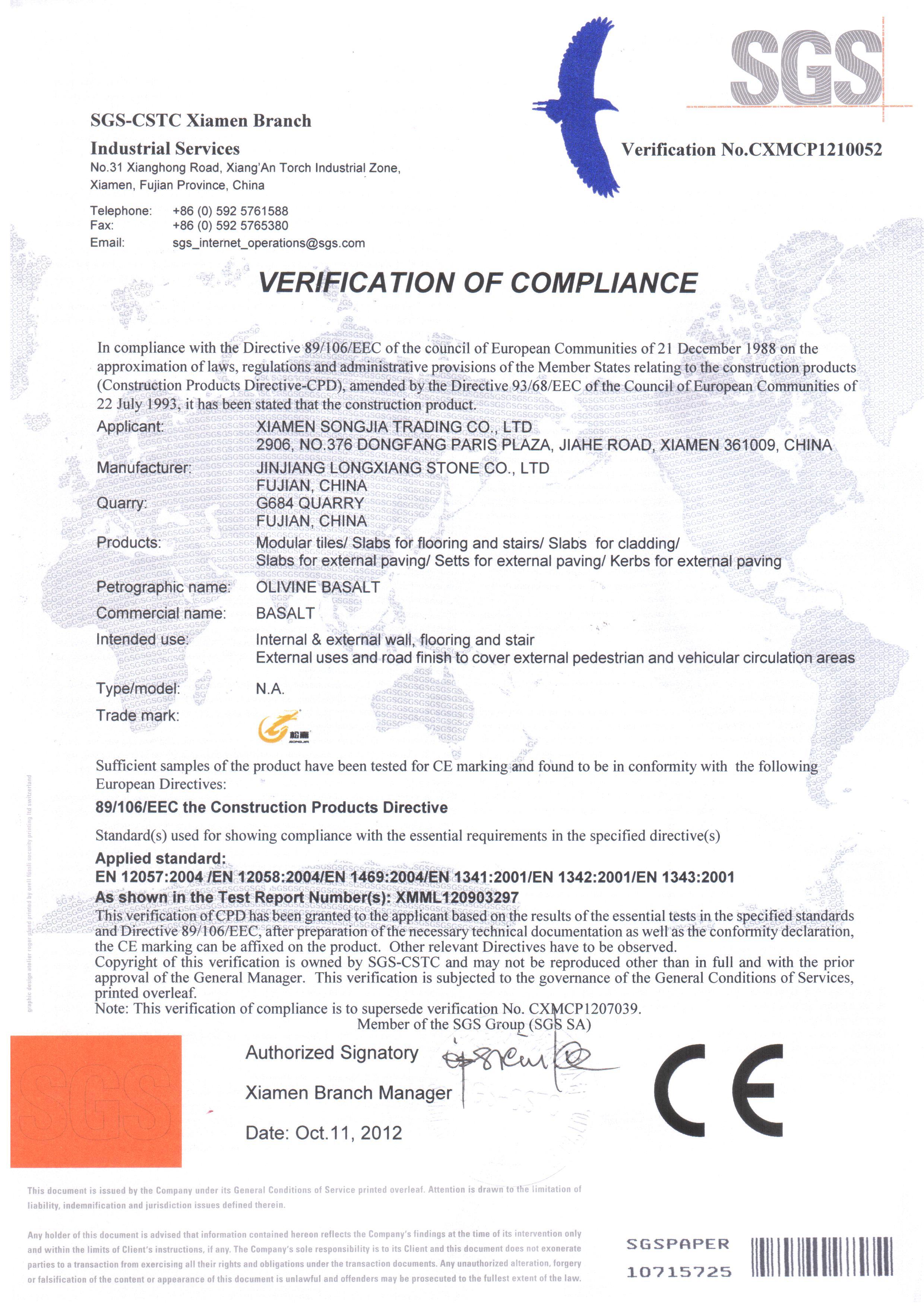
In the European market, the reference point is the European standard cited in the CE documentation, and that standard depends on what the product actually is. On SONGJIA's file, SGS CE certificate CXMCP1210052 applies to G684 basalt and is scoped to natural stone slabs for floors and stairs under EN 12058; a second SGS CE certificate, XMML110401342, applies to G603 grey granite and is scoped to natural stone modular tiles under EN 12057. The two documents were issued on different dates and describe different product forms, which is the practical lesson: a European buyer should read the scope line before reading the material name.
North America: specification-led rather than mark-led
North American acceptance is typically driven by a written project specification rather than a single market mark. Where that specification invokes a recognised material standard for granite dimension stone, ASTM C615/C615M-23 is the reference in current use, and it sits within the broader ASTM dimension-stone series that also includes specifications such as C503. For a Chinese supplier, this changes the paperwork rather than the production line: what the buyer needs is a documented match between the specified standard, the delivered material and the tested property, not a decorative attachment.
Middle East, Asia-Pacific and project markets: consultant approval
Across the Gulf, Southeast Asia, Australia and much of the project market, acceptance often runs through the consultant or the bill of quantities. Conditions that are treated as optional elsewhere become acceptance items here: frost resistance and freeze-thaw performance on externally exposed paving and cladding, anti-slip surface treatment on floor areas, consistent colour across a lot, and low water absorption for wet areas. SONGJIA's application records list these as recurring project requirements alongside CE certification, dry-hanging installation, wet installation, adhesive fixing and matched accessories such as steel brackets, sealant, sinks and support frames.
What a certificate actually certifies, and where it stops
The most common acceptance gap in natural stone procurement is a scope mismatch. A certificate is a bounded statement: it names a material, a product form, a standard and an issuing body. Anything outside those boundaries is an assumption.
Using SONGJIA's file as the example, the boundaries are explicit. CXMCP1210052 was issued by SGS for the European market, covers G684 basalt, is scoped to natural stone slabs for floors and stairs, cites EN 12058, and carries an issue date of 11 October 2012. XMML110401342 was issued by SGS for the European market, covers G603 grey granite, is scoped to natural stone modular tiles, cites EN 12057, and carries an issue date of 5 May 2011. Read carefully, neither document states that every product in the supplier's catalogue is CE certified, and neither transfers automatically to a different granite, a different finish or a carved component.
For an evaluating buyer, this produces a simple and repeatable rule: match certificate to material, then material to application, then application to the destination market. If any link in that chain is a different stone, a different thickness or a different fixing method, the documentation has to be extended rather than reinterpreted.
Parameter-based acceptance: the numbers that decide a lot
Where acceptance is property-based, the discussion moves from documents to values. The parameters below describe SONGJIA's declared ranges for four stone families; they matter because each one maps to a different acceptance condition at the destination.
| Material | Mohs hardness | Water absorption | Density | Temperature resistance | Protection requirement |
|---|---|---|---|---|---|
| Marble | 3.0 – 5.0 | 0.1% – 0.5% | 2,600 – 2,850 kg/m³ | -15°C to 150°C | Grade A sealant (oil and water repellent) |
| Limestone | 3.0 – 4.0 | 0.8% – 2.5% | 2,200 – 2,600 kg/m³ | -25°C to 120°C | High-performance sealing |
| Travertine | 3.0 – 4.0 | 0.4% – 1.0% | 2,300 – 2,500 kg/m³ | -20°C to 150°C | Standard sealing (Grade B) |
| Onyx | 3.0 – 4.0 | 0.1% – 0.3% | Not a differentiating criterion for this use | Light transmittance 20% – 65% | Sealing required (Grade A), mandatory anti-fouling and acid-resistant treatment |
Read as acceptance criteria rather than catalogue data, these values answer four different questions. In wet areas and bathroom applications, water absorption and the required sealing grade decide whether a lot is suitable: onyx at 0.1%–0.3% still carries a mandatory sealing requirement, while limestone at 0.8%–2.5% needs high-performance sealing before it goes near a splash zone. In exposed facades and paving, temperature resistance is the relevant line, and limestone's declared range of -25°C to 120°C speaks directly to freeze-thaw conditions. In high-traffic flooring, hardness and finish matter more than absorption, which is why honed and sandblasted surfaces are specified where slip resistance is an acceptance item. In backlit feature walls, onyx is accepted or rejected on light transmittance, which for SONGJIA's onyx range is stated at 20%–65%.
Marble is the material most often caught between these conditions. With bending strength declared at 10–20 MPa and a density range of 2,600–2,850 kg/m³, it performs well as wall cladding, flooring and vanity tops, and its available finishes — polished, honed, acid-washed, leathered and antiqued — change the acceptance profile of the same block. Standard slab dimensions of 2400up × 1200up mm give the buyer a baseline, but the finish and thickness stated on the order line are what an inspector will actually measure.
The documentation chain a buyer can actually audit
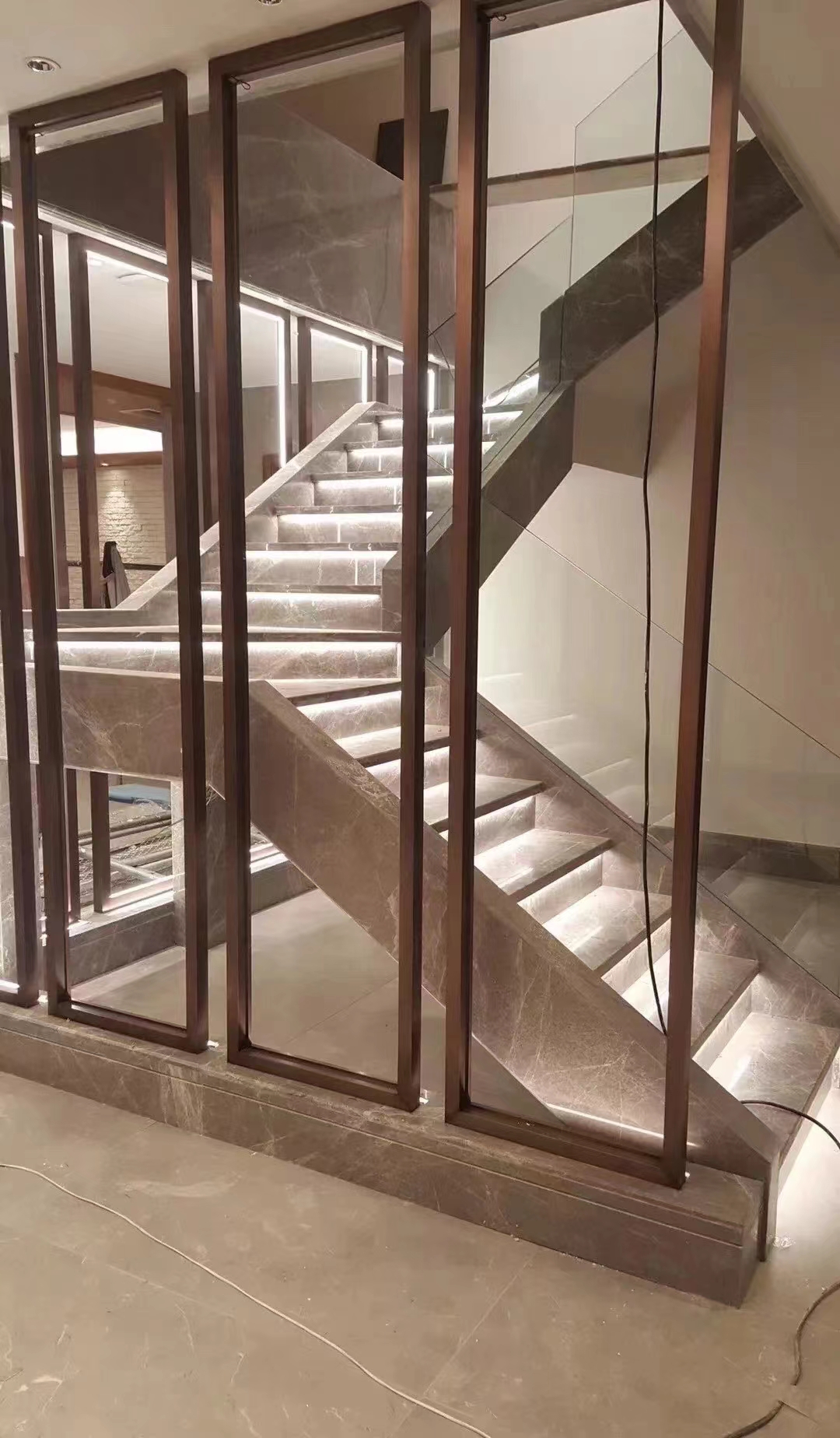
Where acceptance is contractual, the decisive question is whether the supplier can produce a chain of records rather than a single certificate. SONGJIA's production model documents quality at four stages: raw material inspection, in-process inspection, finished product inspection and pre-shipment inspection. For a buyer writing acceptance into a purchase order, those four stages are the natural checkpoints to convert into hold points, each with a defined record and a named signatory.
The commercial frame around that chain is also part of acceptance planning. SONGJIA operates a 20,000 m² facility with 60 employees and a technical team of three engineers, and reports annual output of 150 containers of monument products and 200 containers of building materials, with monthly capacity in the range of 10–30 containers depending on product category and production schedule. Normal lead time is 15–30 days depending on product type and order quantity. A trial order is acceptable, and the minimum order quantity depends on the product type rather than being fixed across the catalogue. Customisation covers material, size, thickness, surface finish, edge profile, shape, engraving, packing and logo marking — each of which is an acceptance variable in its own right, and each of which should be written down before production begins.
After-sales terms complete the chain: quality feedback follow-up, replacement or compensation for confirmed quality issues, and continuous order support. In trade terms, this is the mechanism that converts a destination-market rejection into a resolvable commercial event rather than a loss.
Where acceptance criteria meet application conditions
Acceptance is easier to define once the application is fixed. SONGJIA's application records separate working conditions into indoor, outdoor, wet area, dry area, high-traffic area and freeze-thaw environment, and separate functions into wall cladding, flooring, countertops, vanity tops, stair covering, decorative surfaces, facade decoration and ground paving. Each pairing generates its own acceptance list.
- Facades and exterior cladding. German beige limestone and Viscount white granite are documented in facade applications, where freeze-thaw performance, dry-hanging installation with steel brackets and aluminium honeycomb backing, and colour consistency across a lot are the practical acceptance items.
- Kitchen and bathroom surfaces. Marble and granite countertops and vanity tops are accepted on water absorption, sealing grade and edge profile; a kitchen island countertop and a bar countertop in Arctic Green marble are both finish-critical applications where Grade A sealing is the stated protection requirement.
- Paving and landscaping. Paving stone and exterior paving projects place anti-slip surface and frost resistance ahead of polish, which is why sandblasted and bush-hammered finishes appear in the limestone and travertine ranges.
- Feature and backlit work. Onyx for feature walls and backlit panels is accepted on light transmittance, with sealing treated as mandatory rather than optional.
One documented case illustrates how the chain works in practice. A building contractor working on residential and commercial projects used SONGJIA material for facade, wall cladding, flooring and countertops; the client shared completed project photographs, and the owner expressed satisfaction with the quality. The stated highlights were accurate fabrication, consistent quality and project support. Read as evidence rather than endorsement, the case shows the three items that most often decide acceptance: fabrication accuracy against the drawing, consistency between the approved sample and the delivered lot, and support during installation.
Market context: why acceptance is turning into a cost line
The structural backdrop explains why documentation is receiving more attention than it did a decade ago. China is the largest exporter of building stone under HS 6802, holding a 32% share of the global market in 2024 according to the Observatory of Economic Complexity. That scale means most international buyers will, at some point, be assessing a Chinese supplier, and most Chinese suppliers will be answering documentation questions written in another regulatory language.
Policy has moved in both directions. The United States suspended a 24% retaliatory tariff on selected Chinese stone products in October 2025, which changes landed cost but not acceptance criteria — a distinction buyers frequently blur when re-running supplier comparisons. On market size, published estimates diverge sharply: Grand View Research puts the global natural stone market at USD 10.6 billion in 2025, while other commercial estimates for a comparable period run several times higher, largely because some reports count processed architectural products and others count raw dimension stone. Buyers should treat any single valuation as a scope statement first and a number second.
The combined effect is a market where material price differences narrow, and where re-inspection, re-documentation and rejected-lot handling become the visible cost of a poor acceptance framework.
Compliance-led sourcing versus price-led sourcing
Two procurement approaches dominate. Price-led sourcing selects on quoted cost per square metre and treats documentation as a formality to be resolved after the order. Compliance-led sourcing selects on the evidence chain first: whether the supplier can map material, standard, application and market before pricing is negotiated.
The trade-offs are real in both directions. Price-led sourcing can be quicker on commodity items with a stable specification, and for repeat orders of an already-approved material it is often rational. Its weakness appears at the first scope change: a new finish, a new thickness, a new destination market or a new consultant, any of which can invalidate the evidence the original price was built on. Compliance-led sourcing carries a higher administrative load and a slower first order, but the documentation base tends to survive subsequent orders.
Where a compliance-led model has limits should be stated plainly. SONGJIA works as a natural stone specialist coordinating a mature partner factory network rather than as a single-factory manufacturer, which gives flexibility across categories but means capacity and scheduling are managed across partners rather than within one building. The certificates on file cover two specific granite materials; a new material, finish or product form requires new documentation rather than an extension of the existing one. Lead times of 15–30 days and a capacity band of 10–30 containers per month are stated ranges, not guarantees, and both move with product category and order quantity. Project-level approvals — consultant sign-off, local code compliance and site inspection — remain the buyer's responsibility in the destination market, and no supplier-side certificate replaces them.
Future outlook
The direction of travel is from certificates toward traceability. A certificate answers the question «is this material capable of meeting a standard»; a traceability record answers «was this specific lot produced, inspected and packed in accordance with what was agreed». The second question is the one that determines acceptance at discharge, and it is the one more buyers are now writing into purchase orders.
Three practical consequences follow. First, sample approval becomes a documented control point rather than a courtesy, since colour and finish consistency are among the most frequent rejection grounds. Second, packing and marking data move into the acceptance scope, because a lot that cannot be traced to a crate cannot be verified quickly on site. Third, suppliers who can produce inspection records in the buyer's language and format will shorten evaluation cycles independently of price. For a China-based supplier with a 100% export orientation and a partner factory network, the competitive question is less about whether the stone meets the standard and more about whether the evidence arrives with it.
FAQ
Which European standard applies to natural stone slabs and tiles?
It depends on the product form. The SGS CE certificates held by SONGJIA cite EN 12058 for natural stone slabs for floors and stairs (G684 basalt, certificate CXMCP1210052) and EN 12057 for natural stone modular tiles (G603 grey granite, certificate XMML110401342). The standard and the product form must match the goods being delivered.
What exactly does an SGS CE certificate cover?
It covers a named material, a named product form, a named standard and a named market. In SONGJIA's file, CXMCP1210052 covers G684 basalt slabs for floors and stairs under EN 12058 and was issued on 11 October 2012; XMML110401342 covers G603 grey granite modular tiles under EN 12057 and was issued on 5 May 2011. Neither document extends automatically to a different stone, finish or application.
Which parameters decide acceptance for wet areas and bathrooms?
Water absorption and the required sealing grade are the primary criteria. SONGJIA's declared ranges are 0.1%–0.5% for marble, 0.8%–2.5% for limestone, 0.4%–1.0% for travertine and 0.1%–0.3% for onyx. Marble and onyx carry a Grade A sealant requirement, limestone requires high-performance sealing and travertine a standard Grade B sealing treatment.
Is ASTM C615 relevant when buying from a Chinese supplier?
It is relevant whenever a North American project specification invokes it. ASTM C615/C615M-23 is the standard specification for granite dimension stone, and it belongs to a wider ASTM dimension-stone series that includes specifications such as C503. For the buyer, the requirement is a documented match between the specified standard, the delivered material and the tested property.
Does the 2025 US tariff suspension change acceptance criteria for Chinese stone?
No. The United States suspended a 24% retaliatory tariff on selected Chinese stone products in October 2025. A tariff affects landed cost and supplier competitiveness; it does not alter the material standards, documentation or inspection criteria that govern acceptance at the project.
What lead time, order size and inspection stages should a buyer plan for?
SONGJIA states normal lead times of 15–30 days depending on product type and order quantity, monthly capacity of 10–30 containers depending on product category and production schedule, and acceptance of trial orders with a minimum order quantity that varies by product type. Inspection is documented at four stages: raw material, in-process, finished product and pre-shipment.
Additional company and certificate records are published at www.songjiaglobal.com.
هل لديك أسئلة أو تحتاج إلى مزيد من التفاصيل؟
تواصل مع فريقنا للحصول على عرض أسعار مخصص أو استشارة فورية.
طلب عرض أسعار
املأ النموذج أدناه وسيتواصل معك فريقنا بعرض مقترح مخصص.
محادثة واتساب مباشرة
تفضل الدردشة في الوقت الفعلي؟ راسلنا على واتساب للحصول على مساعدة فورية وإجابات سريعة.
- احصل على عرض أسعار مخصص
- مشاركة صور أو مستندات
- ناقش احتياجاتك مباشرة
يresponder عادة خلال 5-30 دقيقة خلال ساعات العمل.