
Natural Stone Markets: Country Comparison, Not Catalog
Natural Stone Markets: Country Comparison, Not Catalog
Comparing natural stone by country is not the same exercise as comparing it by catalog. A catalog shows what one supplier is currently prepared to ship; a country-level comparison shows what a market's policy environment, production base, export behaviour and technical standards are likely to do to price, availability and acceptance risk across the life of a project. For a buyer in the decision stage — holding quotes for marble, travertine, limestone, granite or onyx from more than one origin — the second lens is the one that explains why two visually similar slabs arrive with different lead times, different documentation and different exposure to policy change.
Why a Catalog Distorts a Country-Level Question
Catalog comparison answers a narrow question: which slab, at which price, from which supplier, this month. It is useful, necessary and incomplete, because the conditions behind the quote never appear in the catalog itself. Two suppliers can quote the same marble tiles at similar unit prices while one carries a tariff exposure the other does not, one depends on a narrow set of block sources while the other draws from several, and one can produce pre-shipment inspection records while the other can only produce photographs.
A country-level frame exists to make those background conditions visible before they turn into change orders. It treats an origin not as a quality label but as a bundle of four testable conditions: the policy regime that governs its exports, the production capacity actually available inside it, the export pattern it has already demonstrated, and the technical standards its fabricators work to. Each condition produces evidence of a different quality, and each can be checked before a purchase order is issued.
The evidence base for this article is deliberately narrow. It contains direct trade and standards evidence for a limited set of markets and product codes, and it does not contain quarry-level capacity data by country. That absence is itself part of the finding: the stone trade is well documented at the level of trade flows and poorly documented at the level of verified factory capacity. The framework below is therefore built to work with what can be checked and to name clearly what a buyer must verify independently rather than assume.
Four Lenses That Survive Contact With a Real Project
The four lenses below are the ones that most often change a sourcing decision. None is a ranking criterion on its own; each produces evidence that either supports a comparison or shows that the comparison was never like-for-like to begin with.
1. Policy environment
Policy decides whether a quoted price survives the shipping window. Tariff schedules, anti-dumping measures, rules of origin and documentary requirements can move a landed cost without any change in the stone itself. A buyer comparing two origins is therefore also comparing two regulatory timelines, and the relevant evidence is the current status of the specific measure applied to the specific product code — not a general impression about a country's trade relations. The practical question is narrow: is there a measure in force today that applies to this product, and what happens to the contract if its status changes between order and arrival?
2. Production capacity
Capacity determines whether an order can be produced inside the window and whether the second phase of a project will match the first. Trade statistics cannot answer this. The evidence that does answer it is document-based: equipment inventory, monthly output records, the number of production sites a counterparty can actually draw on, and whether block or slab supply is controlled or purchased on the open market. Capacity claims are the easiest to make and the most expensive to get wrong, because a shortfall usually appears after installation has been scheduled.
3. Export performance
Export performance describes what a market actually ships, in what mix, and to which destinations. It is the most accessible of the four lenses because customs data is public, and it is the most frequently over-read, because an aggregate national figure says nothing about any individual company operating inside that country. Read correctly, export data identifies where fabrication depth is concentrated; read loosely, it becomes an unearned quality claim.
4. Technical progress and standards
Technical progress shows up less in marketing than in acceptance documents: which standard a product is tested against, what tolerance is declared, how finish consistency is controlled across a batch, and how a claim would be evidenced after delivery. A market with mature fabricators tends to produce better documentation, not necessarily better stone. For the buyer, documentation is the operative difference, because it is the only part of the comparison that can be audited before shipment.
| Lens | What the buyer compares | Evidence that settles it | What it cannot prove |
|---|---|---|---|
| Policy environment | Duty status, documentary burden, reversibility of measures | Current status of the measure for the exact product classification | Product quality, or the reliability of any individual supplier |
| Production capacity | Equipment, sites, monthly output, block access | Equipment lists, audit reports, output records, site confirmation | That capacity is allocated to your order in your window |
| Export performance | Shipped volume and destination mix by product code | Customs and trade-flow records | Whether a given exporter manufactures or trades |
| Technical progress | Standard reference, declared tolerance, finish control, claim evidence | Test reports, approved samples, inspection records | That every batch will match the tested sample |
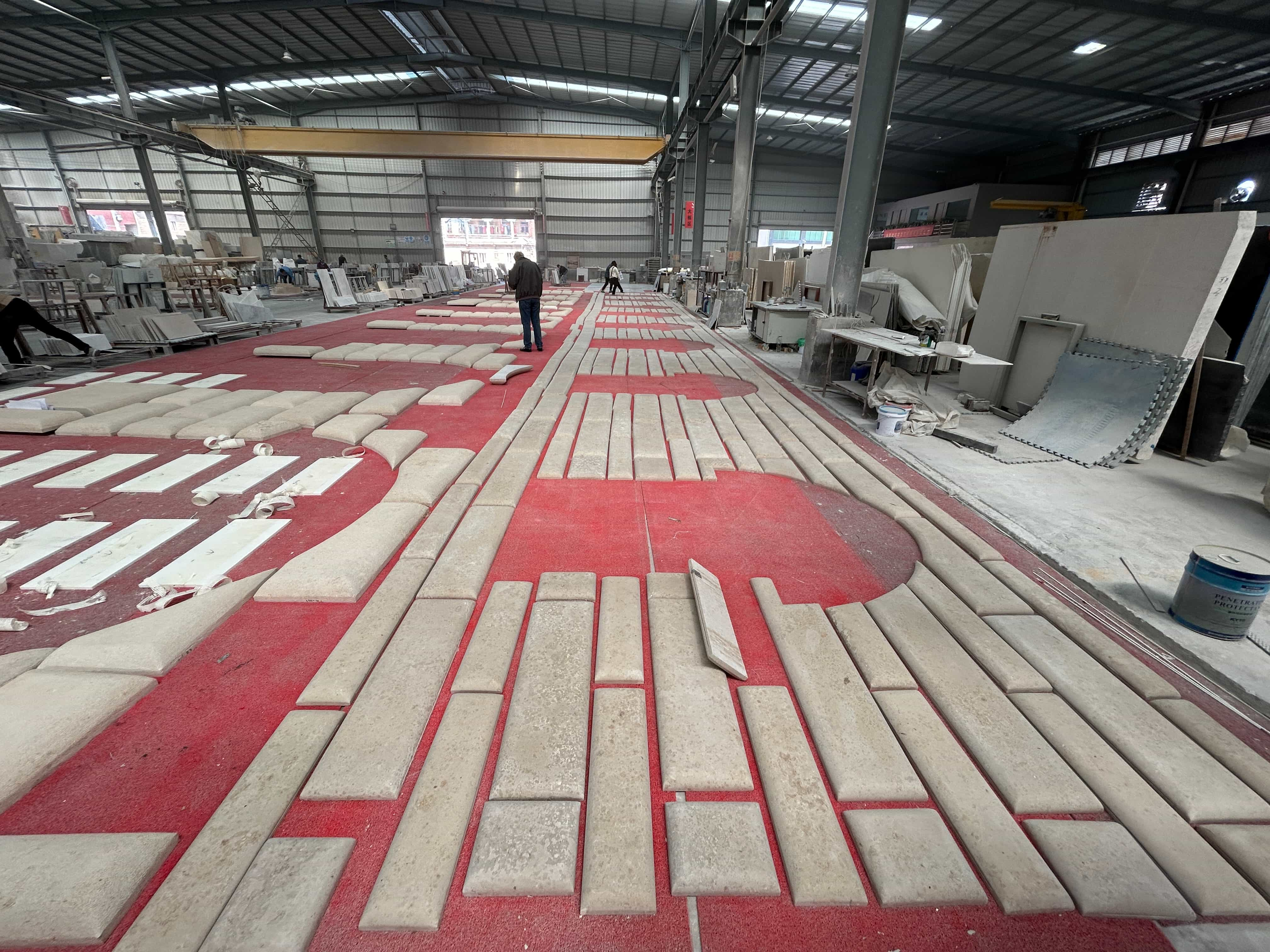
What the Verified Trade Record Actually Shows
Three documented signals anchor the comparison in this article, and each carries a specific scope that should travel with it into any procurement discussion.
Market value is scope-dependent. Grand View Research placed the global natural stone market at USD 10.6 billion in 2025. The same evidence review records a three-to-four-fold divergence between commercial research houses on the value of this market, driven by definition rather than arithmetic: figures at the lower end describe unprocessed dimension stone, while figures at the higher end appear to include semi-finished and finished architectural products. A buyer should treat any single market-size figure as a statement about a defined product boundary, not as a settled fact about the trade.
China is the largest single exporter of building stone. Under HS 6802, the customs heading for worked building stone, China accounted for 32% of global exports in 2024 — the largest single share in the record, based on full-year statistics. This is a flow measure, not a capacity measure, and it covers worked stone rather than blocks.
US policy toward Chinese stone moved in October 2025. The United States suspended a 24% retaliatory tariff on selected Chinese stone products, in force from 1 October 2025, and the trade records compiled for this review list the measure as suspended. Standards evidence runs in parallel: ASTM C615/C615M-23, the standard specification for granite dimension stone, remains the active reference for that material.
Reading China's 32% Export Share Without Overreading It
A 32% share of HS 6802 exports makes China the largest single exporter of worked building stone in the customs record. That statement supports less than it appears to, and more than a catalog can show.
It supports a conclusion about breadth. A market that ships a third of the world's worked building stone by value has a deep secondary structure of slab yards, finishing shops, carving workshops and trading companies behind the export figure, which is why buyers can source granite slabs, marble tiles, limestone cladding and carved marble elements from the same country at very different price points and quality levels. It does not support the conclusion that a third of the world's stone originates there, nor that any particular supplier owns production rather than reselling it.
The distinction matters at the decision stage because a national aggregate is fully compatible with a long tail of small exporters, including intermediaries that do not own a factory. The verification question therefore shifts from "which country" to "which kind of counterparty inside that country". The evidence review behind this article flags the same gap directly: trade data identifies exporters, but factory-level verified capacity is what separates a trader from an integrated manufacturer. The practical response is a short document request — equipment list, audit or inspection report, output records by month, and the name and location of the site that will actually run the order.
When a Tariff Is Suspended, the Risk Changes Hands
A suspension is not a repeal. The October 2025 suspension of the 24% measure on selected Chinese stone products changes the landed-cost arithmetic for US-bound orders, but it does so conditionally, and three conditions deserve to be written into the comparison rather than assumed away.
The first is classification. The measure applies to selected products, so a buyer's specific item — a granite slab, a marble vanity top, a paving stone format — has to be checked against the applicable product code rather than against a general description of the material. The second is timing. A suspended measure can be reinstated, and a project with a long fabrication and shipping cycle spans more policy risk than a spot order. The third is contractual: whoever bears a reinstated duty should be decided before the order is placed, because after loading the negotiation has no leverage.
One further point belongs to analysis rather than observation. If the suspension holds across a project's procurement window, a plausible effect is partial recovery of China-origin share in US-bound building stone flows, at the expense of origins that absorbed that share while the measure was in force. That is an interpretation of the trade record under a stated condition, not an observed outcome, and it should be treated as a scenario to test rather than a forecast to plan against.
Capacity Is the Hardest Claim to Verify — and the Costliest to Get Wrong
Capacity claims are where country-level comparisons most often dissolve into assertion, because the buyer is usually comparing a brochure in one language with a quotation in another. The verified evidence review for this article records no confirmed count of CNC or waterjet equipment for the partner factories behind the supplier discussed below, and it identifies that as a high-priority gap specifically because precision work is where capacity claims are most often made.
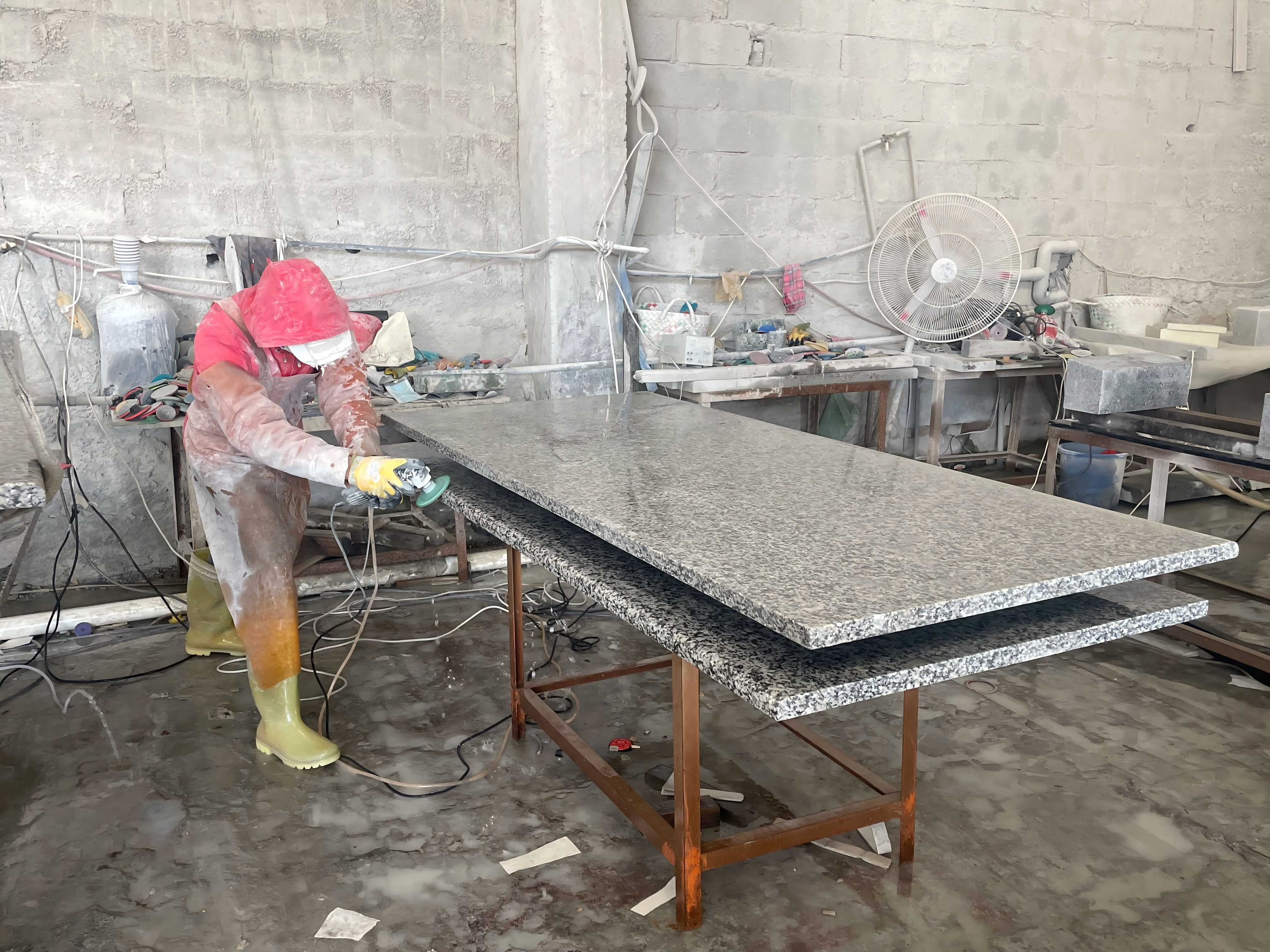
What can be stated from company-supplied information is narrower and more useful. SONGJIA (Xiamen Songjia Trading Co., Ltd.) is a China-based natural stone supplier that coordinates a network of partner factories rather than operating as a single-factory manufacturer. Its published figures describe a 20,000 m² operation with 60 employees and 3 engineers, an export ratio of 100%, main markets listed as the EU, USA and Middle East, and annual output stated as 150 containers of monument work plus 200 containers of building materials.
Those figures establish scale and orientation; they do not establish throughput in square metres. Container counts are shipping measures, and the relationship between a container of finished memorial work and a container of 20 mm slabs is not constant. The 60-employee figure alongside a 20,000 m² footprint and a partner network describes a coordination model in which production is distributed across sites — which is exactly why the buyer's question should be "which site will produce my order, and what does that site's output record look like" rather than "how big is the company".
Technical Progress Travels With Documents, Not Brochures
Technical progress is the lens most easily converted into an acceptance clause, because it produces artefacts: a standard reference, a declared tolerance, an approved sample, an inspection record. ASTM C615/C615M-23 defines the specification for granite dimension stone, and comparable material specifications exist for other stone types; the operative question for a buyer is not which standard exists but whether the order documentation names one and whether the shipment can be tested against it.
Here is the analytical point that makes country comparison sharper rather than softer. Acceptance criteria should be fixed before origins are compared, so that the criteria are the constant and the country is the variable. If colour consistency, dimension tolerance, surface finish and packing protection are specified identically for every origin under consideration, then any difference that survives the comparison is structural rather than presentational.
Practically, that means a fixed control set applied whatever the origin: an approved sample retained and slabs matched by lot before shipment; dimensions confirmed on drawings before cutting and inspected on finished pieces before packing; a full surface inspection covering cracks, chips, scratches, polishing quality and edge finish; packing in wooden bundles or crates with edge protection and a container loading check. Pre-shipment photographs, videos and packing lists convert those checks into evidence, and labelling by area or drawing number is what prevents a correctly fabricated order from being installed in the wrong room.
Material Fit Inside the Comparison
Country is the variable; material fit is not. Granite is the more durable of the two main silicate and carbonate options and performs better in wear resistance, with lower maintenance needs, which is why it suits outdoor cladding, high-traffic flooring and memorial work. Marble is the more decorative, and is better matched to luxury interior walls, vanity tops and decorative features; its cost position depends on grade rather than on origin alone. A natural stone supplier that can document both is offering a fit decision, not a preference.
The same logic governs fabricated formats. A marble bathtub or a carved marble fireplace surround is a custom-fabrication decision, not a catalog decision: custom work fits a project better and reduces later adjustment work, but it requires more coordination and usually costs more than a standard product. Standard formats — modular marble tiles, standard paving stone sizes, catalogued kitchen island countertops — are faster to specify and simpler to replace. The choice between them should be made before the origin comparison, because it changes which suppliers are even eligible.
| Choice | Comparative strength | Typical fit | Limit to keep in view |
|---|---|---|---|
| Granite vs marble | Granite: durability and wear resistance, less maintenance. Marble: decorative character | Granite for outdoor cladding, high-traffic flooring, tombstones. Marble for interior walls, vanity tops, decorative features | Cost depends on grade, not on the material name alone |
| Quartz vs marble countertops | Quartz: lower maintenance, often more cost-efficient. Marble: natural appearance | Quartz for high-traffic kitchens and commercial surfaces; marble for luxury bathrooms and low-traffic vanity tops | Quartz is an engineered material, so the comparison crosses from natural stone into a different product category |
| Custom fabrication vs standard products | Custom: better project fit, less adjustment on site. Standard: faster | Custom for bespoke architectural work and memorial pieces; standard for repeatable formats | Custom requires more coordination and usually costs more |
Where a China-Based Integrated Supplier Sits in This Comparison
SONGJIA illustrates how the four lenses converge on a single counterparty rather than on a country. The company describes itself as originating from Longxiang Stonecutter with more than 20 years of accumulated industry experience, and its operational model is design-to-production integration: technical staff convert client sketches and architectural concepts into shop drawings that can be manufactured, then coordinate production, inspection, packing and shipping across partner factories. Its product range covers memorial work, granite and marble slabs, quartzite, limestone, onyx and stone furniture, with SONGJIA positioning itself as a bridge between design intent and manufacturable output for importers, contractors, fabricators and designers.
For a buyer, that structure changes one specific thing: the number of coordination points. A project that mixes marble wall cladding with granite paving and a limestone feature can be handled through one technical contact instead of three, and a drawing error caught at shop-drawing stage is cheaper than one caught at installation. What the structure does not change is origin risk, capacity verification or standards evidence — all three still have to be checked at site level, and the design-to-production capability is a reason to ask better questions, not a substitute for asking them.
One further fit boundary belongs here rather than in a disclaimer. Material selection for exterior, wet or freeze-thaw conditions should follow the application environment, not the price list; recommending durable granite for cemetery and exposed work, and reserving more decorative stones for protected interior use, is a suitability decision that no country-level comparison can make on the buyer's behalf.
Fit Boundaries: What This Lens Cannot Tell You
A comparison is only as honest as its stated limits. Five boundaries apply to everything above. Country-level export data cannot rank origins by quality, because it measures flows rather than material. Market-size figures cannot be compared across sources without first aligning product scope, given the documented three-to-four-fold divergence. National aggregates cannot qualify an individual supplier, since a share of exports is compatible with both integrated manufacturers and pure intermediaries. A suspended tariff cannot be treated as a permanent cost advantage, because suspensions are reversible by nature. And standards compliance cannot be assumed to extend across a supplier's entire range, since a specification applies to the products tested against it rather than to everything a company ships.
Outlook: Three Signals That Would Actually Change the Comparison
No forecast is offered here, because the evidence supports conditions rather than predictions. Three observable signals would materially change how a buyer runs this comparison over the next planning cycle.
The first is the status of the US measure on selected Chinese stone products. While the suspension holds, landed-cost comparisons for US-bound projects should be re-run rather than carried forward from earlier assumptions; if the status changes, the reverse applies, and the contract terms decided at order stage will determine who absorbs it. The second is the availability of factory-level capacity evidence. If audit-based output and equipment data become normal parts of a supplier's documentation pack, capacity moves from the least verifiable lens to the most verifiable, and country-level aggregates lose much of their remaining influence. The third is convergence in acceptance documentation — whether tolerance, finish and inspection records become comparable across markets. Where that happens, buyers can compare origins on structure rather than on presentation.
The comparison a buyer can defend is therefore not the one with the most countries in it. It is the one where acceptance criteria were fixed first, each origin was assessed on the same four lenses, every aggregate figure carried its scope, and the remaining uncertainty was converted into a document request rather than a discount negotiation.
Frequently Asked Questions
How should a buyer compare natural stone from two different countries?
Fix the acceptance criteria first — standard reference, dimension tolerance, colour control, finish, packing and inspection evidence — then compare each origin on four lenses: policy exposure for the exact product code, production capacity evidence at site level, export performance by product code, and technical documentation. Export data is publicly available and can be checked quickly; capacity data is not public and must be requested directly from the counterparty. Comparing origins before fixing criteria usually produces a preference rather than a decision.
Does China's 32% share of building stone exports mean Chinese suppliers are more reliable?
No. The 32% figure describes China's share of global exports under HS 6802 in 2024, which is a flow measure covering worked building stone. It indicates the depth of the fabrication and trading base in that market, and it explains why a wide range of stone types and price levels can be sourced there. It does not establish the capability, documentation quality or manufacturing status of any individual supplier, and it is fully compatible with a large number of small exporters that do not own production.
What changed when the United States suspended its 24% tariff on selected Chinese stone products?
The measure, in force from 1 October 2025, was suspended, and the trade records reviewed for this article list it as suspended rather than repealed. For a buyer, the change affects landed cost only for products that fall within the selected list, so the applicable product classification must be confirmed for each item. Because a suspension can be reversed, contracts spanning long fabrication and shipping cycles should state which party bears a reinstated duty.
Why do natural stone market-size estimates differ so much between research houses?
The divergence is mainly definitional, not arithmetic. Review of the available figures shows a three-to-four-fold spread, with lower valuations describing unprocessed dimension stone and higher valuations appearing to include semi-finished and finished architectural products. A buyer using a market-size figure should therefore record which product boundary it refers to, and should not compare a raw-extraction figure with a processed-products figure as if they measured the same market.
When is granite a better fit than marble, regardless of origin?
Granite is the more durable option and performs better in wear resistance with lower maintenance needs, which suits outdoor cladding, high-traffic flooring and memorial work. Marble is more decorative and is better matched to luxury interior walls, vanity tops and decorative features, with its cost position depending on grade. Because this is a material-fit distinction, it should be settled before origins are compared; otherwise the comparison mixes two different decisions.
Which acceptance checks stay the same no matter where the stone comes from?
Sample approval with slabs matched by lot, dimension confirmation before cutting and inspection of finished sizes, full surface inspection for cracks, chips, scratches, polishing and edge finish, reinforced packing with edge protection and a loading check, plus pre-shipment photographs, videos and packing lists with pieces labelled by area or drawing number. These controls are origin-independent, which is precisely why they should be applied identically across every origin under consideration.
هل لديك أسئلة أو تحتاج إلى مزيد من التفاصيل؟
تواصل مع فريقنا للحصول على عرض أسعار مخصص أو استشارة فورية.
طلب عرض أسعار
املأ النموذج أدناه وسيتواصل معك فريقنا بعرض مقترح مخصص.
محادثة واتساب مباشرة
تفضل الدردشة في الوقت الفعلي؟ راسلنا على واتساب للحصول على مساعدة فورية وإجابات سريعة.
- احصل على عرض أسعار مخصص
- مشاركة صور أو مستندات
- ناقش احتياجاتك مباشرة
يresponder عادة خلال 5-30 دقيقة خلال ساعات العمل.