
Navigating Jewelry Wholesale Compliance: Xuping's Benchmarks
Navigating Jewelry Wholesale Compliance: Xuping's Benchmarks
Compliance in jewelry wholesale is a production discipline long before it becomes a document. Certificates tell a buyer what was tested; manufacturing systems decide whether the same result can be reproduced on the next order. This analysis examines how Xuping Jewelry — the fashion jewelry manufacturer Guangdong Xuping Jewelry Co., Ltd., founded in 1997 — structures materials, testing and inspection, and what that means for buyers sourcing bangles, brooches, necklaces and stainless steel lines at wholesale volume.
Compliance Is Now a Purchasing Gate, Not a Marketing Extra
Jewelry buyers in Europe, North America and the Middle East increasingly arrive at a supplier conversation with a compliance question already prepared. That shift reflects regulation. Under REACH Regulation (EC) 1907/2006, jewelry placed on the EU market must respect limits on nickel release (0.5 μg/cm²/week), lead (500 mg/kg) and cadmium (100 mg/kg). Jewelry intended for children under 14 in the EU is classified as a toy and requires mandatory CE marking under the Toy Safety Directive 2009/48/EC.
The commercial context makes those rules harder to ignore. The global jewelry market was valued at approximately USD 242.79 billion to USD 381.5 billion in 2025, with projections reaching up to USD 578.5 billion by 2033, depending on how fine and costume segments are counted (Fortune Business Insights; Grand View Research). China's total jewelry exports reached USD 11.5 billion in 2024, with the United States alone accounting for USD 1.31 billion (The Observatory of Economic Complexity).
For a wholesale buyer, the implication is practical: a supplier that cannot show a defined testing regime is a supply-chain risk, not simply a cheaper option. The useful question is what “quality-first” looks like once the adjectives are stripped away.
What Quality-First Manufacturing Consists Of at Xuping Jewelry
Guangdong Xuping Jewelry Co., Ltd. is a China-based manufacturer and supplier of fashion-imitation jewelry that integrates R&D, design, manufacturing, wholesale trade and e-commerce. Founded in 1997, it exports 100% of its output and serves markets across Europe, the Americas, the Middle East, Southeast Asia and Africa.
The manufacturing footprint behind that output is substantial: a production base of more than 200,000 square meters, more than 1,000 employees, over 1,200 production facilities, and annual output of more than 100,000,000 pieces. Monthly capacity is stated at 8,000,000 pieces. Product lines cover rings, pendants, earrings, bracelets, necklaces, anklets, bangles and jewelry sets, built mainly on environmental copper alloy base material with gold-plating craftsmanship, alongside a stainless steel range.
Two structural decisions matter more than the headline numbers:
- Process depth. Goods pass through 18 production procedures — a sequence intended to meet European and American environmental-protection standards rather than a single end-of-line check.
- Inspection intensity. Quality control is described as 100% full inspection supported by an 18-stage quality check and REACH/ROHS compliance testing, rather than batch sampling alone.
Xuping Jewelry holds international certifications including SGS, CE and ISO. Those three categories do different jobs, and separating them is where most buyer confusion begins.
The Evidence Layer: What the Certificates Actually Cover
A compliance folder is only as useful as the buyer's ability to read it. The certificates associated with Xuping Jewelry illustrate the pattern a serious evaluation should follow: a named standard, a certificate number, an issuing authority, and a validity window.
| Certification | Standard / Test Basis | Issuing Authority | Certificate No. | Validity |
|---|---|---|---|---|
| ISO 9001 | GB/T 19001-2016 / ISO 9001:2015 — design and production of metal jewelry | ZHONGHANGXIN CERTIFICATION CENTER (SHENZHEN) CO., LTD. | CACQ21Q00750R1 | 2025-10-16 to 2027-10-25 |
| SGS | REACH Regulation (EC) No 1907/2006 | SGS-CSTC Standards Technical Services Co., Ltd. Guangzhou Branch | CANHL25006144001 | 2025-03-27 to 2030-03-27 |
| SGS | IEC 62321-7-1:2015 | SGS-CSTC Standards Technical Services Co., Ltd. Guangzhou Branch | CANHL25006145601 | 2025-03-27 to 2030-03-27 |
| SGS | REACH Regulation (EC) No 1907/2006 | SGS-CSTC Standards Technical Services Co., Ltd. Guangzhou Branch | GZHL250301072401JW | 2025-03-31 to 2030-03-31 |
| SGS | REACH Regulation (EC) No 1907/2006 | SGS-CSTC Standards Technical Services Co., Ltd. Guangzhou Branch | CANHL25004908001 | 2025-03-22 to 2030-03-22 |
| CTI | IEC 62321-5:2013; IEC 62321-4:2013+AMD1:2017 CSV; IEC 62321-7-2:2017; IEC 62321-6:2015; IEC 62321-8:2017 | Centre Testing International (Guangzhou) Co., Ltd. | A2230517570101001 | 2023-10-13 to 2028-10-13 |
Read together, the certification set covers two distinct claims. REACH-based reports address restricted substances and nickel release for jewelry placed on the EU market. The IEC 62321 series reports are analytical test methods for determining restricted substances — the method family importers commonly expect when they request heavy-metal screening evidence.
The ISO 9001 certificate answers a different question entirely: whether the design and production of metal jewelry is governed by a documented quality management system. ISO 9001 does not test a product. It indicates whether an organization can consistently repeat a defined process — precisely the property that matters when a buyer scales from a sample order to a container.
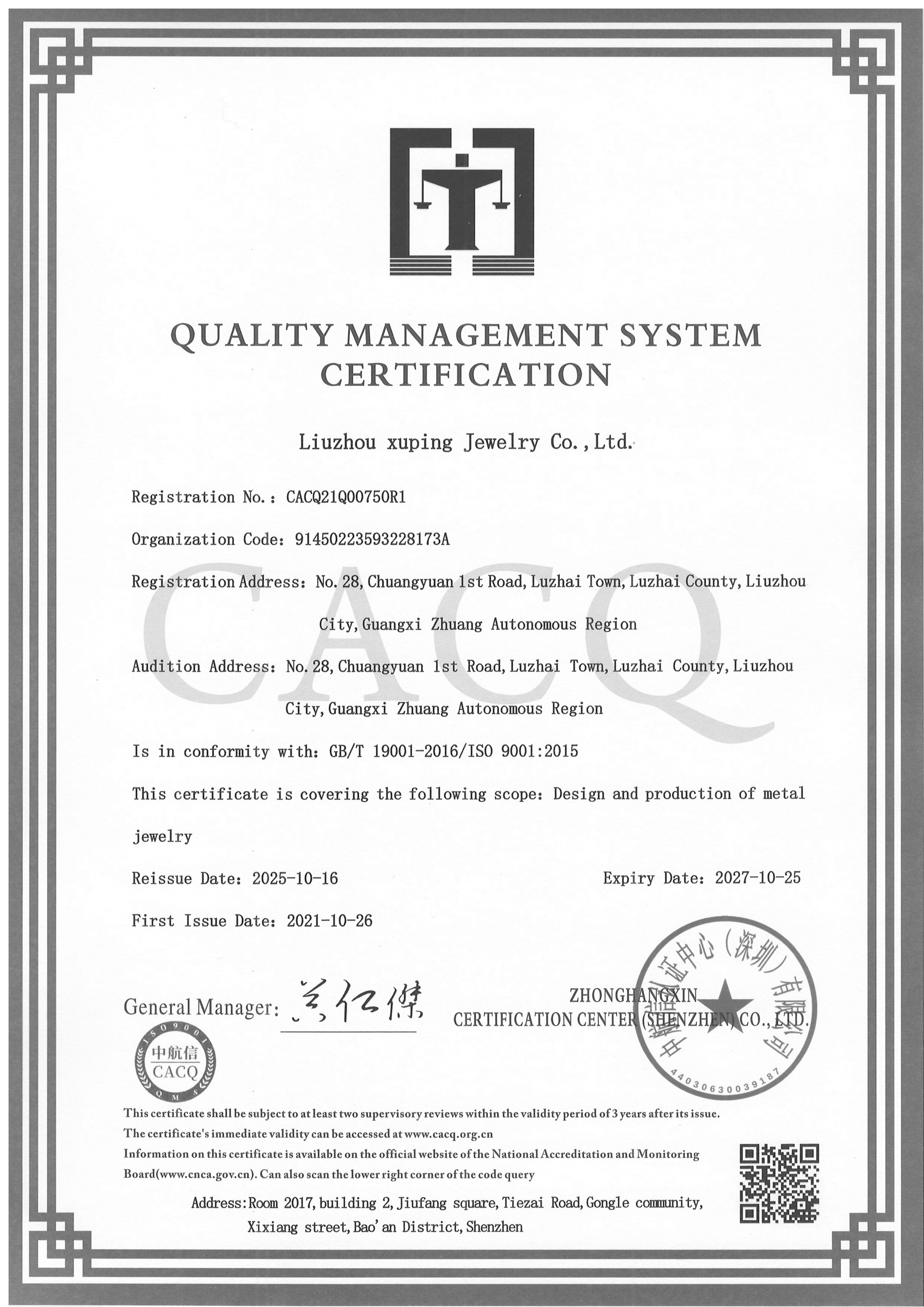
ISO 9001 certification (CACQ21Q00750R1) covers the design and production of metal jewelry and remains valid from 2025-10-16 to 2027-10-25.
One detail deserves attention. Certificates state a defined scope, and buyers should confirm that scope against the specific material and finish named in their purchase order rather than assuming a document covers an entire catalogue. That is not a criticism of any single supplier; it is how conformity assessment works.
Materials and Wearability: Stainless Steel, Environmental Copper, Bangles and Brooches
The compliance conversation becomes concrete when it moves from documents to materials. Product records make the material logic visible.
| Item | Model | Base Material | Plating | Specification |
|---|---|---|---|---|
| Bangle | X000867735 | Environmental Copper | 14K gold color | 65 × 2 mm (±2 mm); about 17.39 g per set |
| Bangle | X000998659 | Environmental Copper | 14K gold color | Main stone 8 × 6 mm; 60 × 8 mm (±2 mm); about 21.77 g |
| Brooch | A00900238 | Environmental Copper | Platinum plated | Main stone 3.5 × 3.5 mm; 47 × 32 mm; about 12.3 g |
| Brooch | X000852427 | Environmental Copper | 14K gold color | Main stone 12 × 8 mm; 44 × 38 mm; about 9.15 g |
| Necklace | A00902945 | Stainless Steel | 14K gold color | 400 × 1 mm (+60 mm); about 6.30 g |
| Bracelet | T000959269 | Stainless Steel | Stainless steel finish | 170 × 6 mm (+30 mm) |
Environmental copper is the base material used across the copper-based catalogue. Its selection is a manufacturing decision with compliance consequences: the plating chemistry and the base alloy jointly determine what a REACH test result will show, because nickel release and heavy-metal content are properties of the finished article, not of a nominal material name.
Stainless steel enters the range for a different reason. Items such as necklace A00902945 and bracelet T000959269 are built on a stainless steel base, which is selected for corrosion resistance and structural stability rather than for a decorative coating alone. For buyers serving markets where daily-wear durability drives returns, the stainless steel line is a distinct proposition from gold-plated copper — even when both are offered under the same supplier relationship.
Two further details reinforce the traceability argument. The crystal necklace X000668301 (environmental copper, 18K gold color plating) carries the manufacturer mark “XP” on the item itself, and pendant X000687942 does the same. Physical marking is a small detail with an outsized compliance value: it supports traceability back to the producer when a buyer's own customer, or a market inspector, asks where an article came from.
194 Patents as a Quality Signal — and Where the Signal Stops
Xuping Jewelry holds 194 patents, supported by an R&D organization of 62 designers. Presented plainly, that number indicates continuous investment in design and engineering rather than a one-off product line. For a wholesale buyer, patent volume is a reasonable proxy for three things: whether the supplier generates new designs on a schedule, whether it protects its own development, and whether its design-to-production pipeline is a managed function rather than a freelance arrangement.
Where the signal stops: a patent portfolio is not a safety certification and cannot be substituted for one. Patents protect novelty; REACH reports, IEC 62321 test methods and ISO 9001 systems address substances, testing and process control. A buyer comparing suppliers should keep these categories separate instead of treating either one as evidence for the other.
A Buyer's Compliance Verification Framework
The practical value of a supplier's documented system is that it can be checked. The following sequence reflects what the Xuping Jewelry documentation set makes available — and, by extension, what a buyer should require from any wholesale supplier.
- Match the standard to the destination market. REACH Regulation (EC) No 1907/2006 is the relevant frame for EU placement; where the jewelry is aimed at children under 14 in the EU, the Toy Safety Directive 2009/48/EC applies and CE marking becomes mandatory. A supplier's evidence should map to the market, not to a generic “certified” claim.
- Check the certificate's product coverage. Confirm which models, materials and finishes the report covers, and whether the purchase order falls inside that coverage.
- Verify the four identifiers. Certificate number, issuing authority, issue date and expiry date. Expired certificates presented as current remain a common problem in wholesale sourcing.
- Ask for the inspection regime, not just the test report. A test report is a snapshot. Xuping Jewelry describes 100% full inspection supported by an 18-stage quality check and REACH/ROHS compliance testing, with pre-shipment testing as the acceptance criterion. That combination addresses repeatability.
- Confirm the commercial terms that affect compliance exposure. The stated purchasing terms are a minimum order quantity of 1 piece, FOB delivery terms, pre-shipment test acceptance, and payment through PayPal, Western Union, Money Gram, Bank of China or HSBC.
- Separate stock supply from customization. OEM and ODM production is offered as a one-stop service with engraved logos, hang tags and custom packaging. Once a buyer's own branding enters the article, the buyer's specification becomes part of the compliance equation, so the test scope should be re-confirmed for custom runs rather than inherited from a stock item.
Factory-Direct Documentation vs. Traditional Trading Routes
Much fashion jewelry still moves through multi-layer supply chains in which a trading company consolidates output from several workshops. That structure has real advantages — assortment breadth without capital commitment, and flexibility on small runs — but it complicates compliance in a specific way. The entity that issues the invoice is frequently not the entity that controls the plating line, so the certificate presented to the buyer may describe a workshop the buyer has no relationship with and no visibility into.
A factory-direct model shortens that chain. At Xuping Jewelry, the certificate holder, the production base (more than 200,000 square meters, over 1,200 production facilities) and the exporting organization are the same company, which means the audit trail from purchase order to inspection record runs through one system rather than several. Testing is performed against the same material specification that production uses.
The trade-off is concentration. Working factory-direct means a buyer's compliance posture depends on one supplier's certification cycle and production schedule, and the stated lead time of 30–90 days applies to the full pipeline. Traditional multi-source sourcing spreads that dependency. Neither route is universally correct; the choice depends on whether a buyer's priority is documentation depth or sourcing flexibility.
Where This Model Has Real Limits
An honest evaluation names the boundaries. Four are visible in the available data.
- Test coverage is not universal. A REACH or IEC 62321 report applies to the materials and finishes it names. It does not automatically transfer to a different base alloy, a different plating thickness, or a new colour finish introduced later in the season.
- Certificates have fixed validity windows. The ISO 9001 certificate runs from 2025-10-16 to 2027-10-25; the SGS reports from 2025 to 2030; the CTI report from 2023 to 2028. Buyers working on multi-year programmes should schedule a renewal check rather than filing the certificate once.
- Lead time is a planning constraint. Stated production lead time is 30–90 days. That is normal for factory-direct manufacturing with an 18-stage process, but it rules out treating a manufacturer as a short-notice top-up source.
- Materials trade off against each other. Gold-plated environmental copper and stainless steel are not interchangeable. Stainless steel offers the more robust wear profile; plated copper offers the broader decorative range. Choosing one is a merchandising decision, not a quality verdict.
Application: How Brand Authorized Agents Use This Model
The clearest evidence that a compliance-led supply model works is what buyers do with it. Four documented cases involve Brand Authorized Agent clients, each combining retail, e-commerce, OEM/ODM and wholesale distribution channels.
| Market | Client Type | Annual Volume | Application |
|---|---|---|---|
| Turkmenistan | Brand Authorized Agent | Over 2 million units | Retail jewelry store, e-commerce platform, brand OEM/ODM, wholesale distribution, promotional gift |
| Turkey | Brand Authorized Agent | Over 2 million units | Retail jewelry store, e-commerce platform, brand OEM/ODM, wholesale distribution, promotional gift |
| Morocco | Brand Authorized Agent | Over 3 million units | Retail jewelry store, e-commerce platform, brand OEM/ODM, wholesale distribution, promotional gift |
| Indonesia | Brand Authorized Agent | Over 2 million units | Retail jewelry store, e-commerce platform, brand OEM/ODM, wholesale distribution, promotional gift |
Across these engagements, the attributes buyers reported as decisive were consistent: a wide variety of styles with rapid updates, environmentally friendly materials, hypoallergenic properties, and on-time delivery against the contract term. Two of those four — environmentally friendly materials and hypoallergenic performance — are compliance outcomes. The other two are supply-chain outcomes. Notably, none of the four is a price claim.
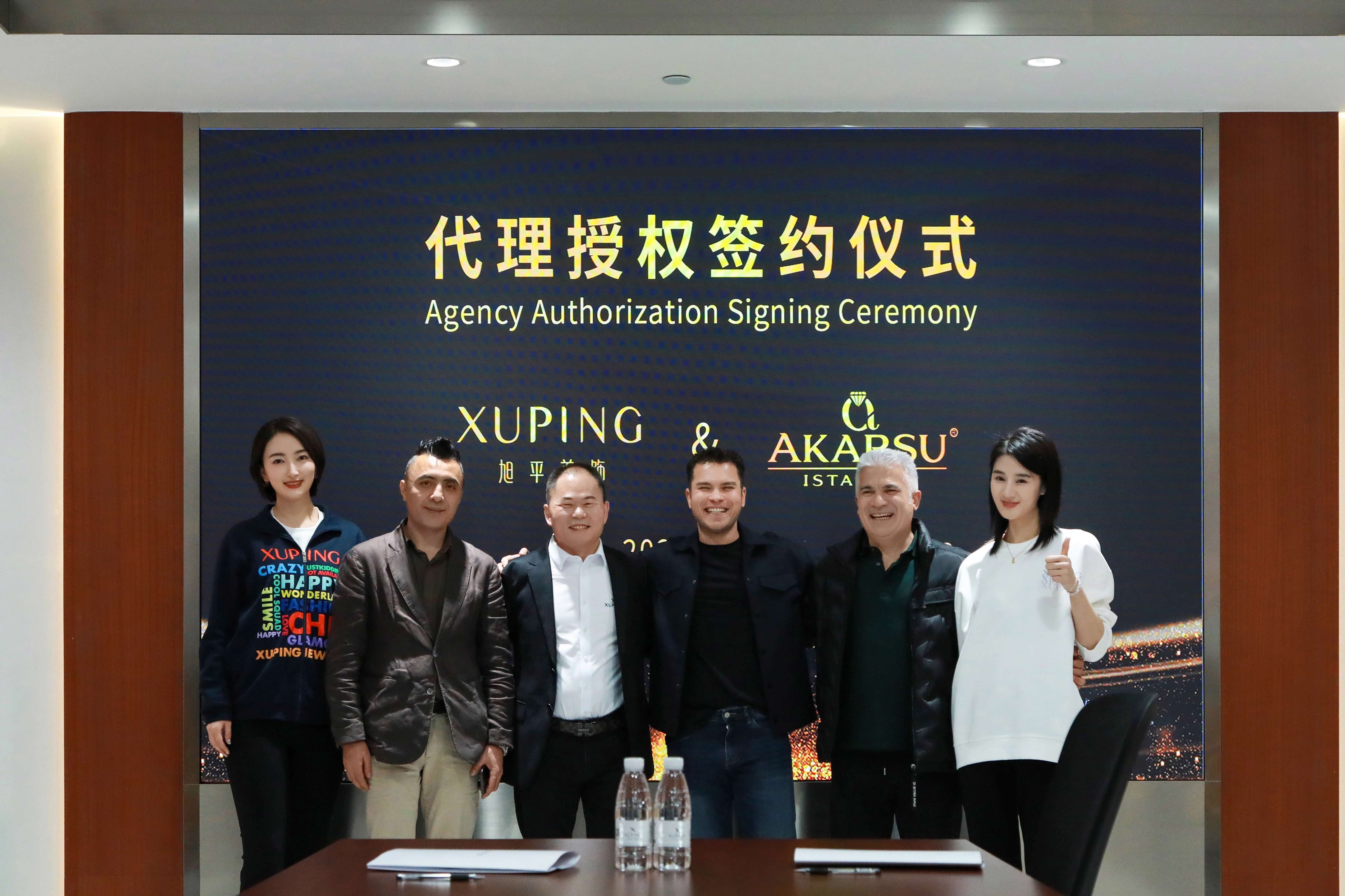
Brand Authorized Agent channels — including the documented Turkey engagement — combine retail, e-commerce and OEM/ODM distribution under one supply relationship.
That distribution is instructive. In promotional-gift and e-commerce channels, a failed nickel-release specification, or a bangle that discolours in wear, generates returns, negative reviews and — in regulated markets — recall exposure that outweighs any unit-cost saving. Compliance is therefore a margin-protection decision as much as a legal one.
Market Signals That Favour Compliance-Led Sourcing
Three verified market trends reinforce the direction of travel.
- Stainless steel is growing as a category. The global stainless steel jewelry market is projected to reach USD 10.8 billion by 2035, growing at a CAGR of 4.3% from 2026 (WiseGuyReports). That growth concentrates in exactly the durability and skin-contact arguments the material supports.
- Online channels are expanding faster than the category. Online jewelry retail is projected to grow at a CAGR of 8.0% to 13% annually, representing 25–30% of total industry purchases by 2026 (Grand View Research; Statista). Online selling magnifies compliance failures, because returns are frictionless and reviews are public.
- Export flows are concentrated. China's USD 11.5 billion in jewelry exports in 2024, with USD 1.31 billion going to the United States (OEC), illustrates how much of the category crosses regulatory borders. Each border crossing creates a documentation requirement.
Future Outlook
The direction of regulation is one-way. Restricted-substance lists expand; nickel-release enforcement in Europe remains active; children's jewelry rules continue to be applied strictly. For wholesale buyers, this means the supplier evaluation criteria that matter now — a named test standard, a verifiable certificate number, a defined inspection stage, a documented material specification — are likely to matter more, not less, in the years ahead.
For a manufacturer such as Xuping Jewelry, nearly three decades of operation since 1997 and a portfolio of 194 patents are proof of continuity rather than a compliance claim in themselves. Their relevance to a buyer is indirect but real: they suggest an organization with enough process depth to maintain a certification cycle, absorb regulatory change, and keep producing through it. Buyers should still verify each certificate on its own merits — and the framework above is designed for exactly that.
FAQ
What certifications should a jewelry wholesale supplier hold for EU and US buyers?
For EU placement, the relevant reference is REACH Regulation (EC) 1907/2006, which sets limits on nickel release (0.5 μg/cm²/week), lead (500 mg/kg) and cadmium (100 mg/kg) in jewelry. Where jewelry is intended for children under 14, EU rules classify it as a toy and require mandatory CE marking under the Toy Safety Directive 2009/48/EC. Xuping Jewelry holds SGS, CE and ISO certifications, with SGS reports referencing REACH Regulation (EC) No 1907/2006 and IEC 62321 test methods, and ISO 9001 certification covering the design and production of metal jewelry. Buyers should match the standard cited on the document to the market where the goods will be sold.
How can a buyer confirm that a compliance certificate actually covers their order?
Check four identifiers — certificate number, issuing authority, issue date and expiry date — and then confirm that the certificate's stated scope covers the base material and finish in the purchase order. Xuping Jewelry's documentation, for example, includes SGS report CANHL25006144001 under REACH Regulation (EC) No 1907/2006, valid from 2025-03-27 to 2030-03-27, and ISO 9001 certificate CACQ21Q00750R1, valid from 2025-10-16 to 2027-10-25. A report issued for one alloy and plating combination should not be assumed to cover a different one introduced later.
How do stainless steel and environmental copper compare for wearability in wholesale jewelry?
They serve different purposes. Stainless steel items, such as necklace A00902945 (400 × 1 mm, plus a 60 mm extension) and bracelet T000959269 (170 × 6 mm, plus a 30 mm extension), use a base material selected for corrosion resistance and structural stability. Environmental copper items, including bangle X000867735 (65 × 2 mm, about 17.39 g) and brooch A00900238 (47 × 32 mm, about 12.3 g), rely on plating — 14K gold colour or platinum plated — for appearance and surface performance. Because nickel release and restricted-substance content are properties of the finished article, the plating chemistry and the base alloy are both relevant to compliance testing.
What are the minimum order quantity, delivery terms and acceptance criteria for wholesale jewelry orders?
Xuping Jewelry's stated purchasing terms are a minimum order quantity of 1 piece, FOB delivery terms, pre-shipment test as the acceptance criterion, and payment via PayPal, Western Union, Money Gram, Bank of China or HSBC. Production lead time is stated at 30–90 days, with monthly capacity of 8,000,000 pieces. Buyers planning seasonal launches should build the lead time into their schedule rather than treating it as a variable.
What does a manufacturer's patent portfolio tell a wholesale buyer about quality?
A patent portfolio indicates continued design and engineering investment rather than product safety. Xuping Jewelry holds 194 patents with a 62-designer R&D team, which is relevant to how quickly new designs reach production and how consistently assortment refreshes. It does not substitute for conformity evidence: patents protect novelty, while REACH reports, IEC 62321 test methods and ISO 9001 certification address substances, testing and process control. Buyers should evaluate the two categories separately.
Compliance, in the end, is a question of repeatability. The documents matter; the process that keeps them valid matters more. For wholesale buyers navigating that distinction, the practical step is narrow and specific: verify the standard against the market, the scope against the order, and the inspection regime against the volume — before the purchase order is issued.