
التنقل في المشهد المورد للبطارية: دليل شامل لمهنيي المشتريات
The Critical Quest for the Right Battery Assembling Partner
In an era defined by electrification and smart connectivity, the battery is the indispensable heart of countless devices and systems. For procurement professionals across industries—from medical devices and industrial analyzers to IoT ecosystems and consumer electronics—selecting the right battery assembling factory is not merely a sourcing decision; it is a strategic choice that impacts product performance, safety, time-to-market, and brand reputation. With a complex landscape of suppliers offering varying levels of quality, customization, and technical support, making an informed choice requires a structured, multi-faceted evaluation. This guide provides a detailed framework to help you identify and vet high-quality battery manufacturers, ensuring your projects are powered by reliability and innovation.
Core Evaluation Dimensions for Battery Suppliers
A thorough assessment should move beyond basic price and capacity quotes. Focus on these four critical dimensions to build a complete picture of a potential partner's capabilities and reliability.
1. Technical Capability and R&D Depth
The ability to deliver more than just standard cells is paramount. Evaluate a supplier's competency in addressing your specific application challenges.
- Chemistry & Form Factor Expertise: A top-tier supplier should offer a portfolio across key lithium-ion technologies: Li-ion Cylindrical Batteries (e.g., 18650, 21700), Li-Polymer Batteries for slim, flexible designs, and LiFePO4 Batteries for high safety and long cycle life. The capacity for Customized Li-ion Battery solutions—whether in unique shapes (like the HPL432733), specific dimensions, or tailored electrical properties—is a strong indicator of advanced engineering capabilities.
- Application-Specific R&D: Look for evidence of R&D investment focused on solving real-world problems. This includes batteries engineered for Industrial Usage (wide temperature tolerance, high discharge rates), Medical Device Battery standards (high reliability, stringent safety), and low-self-discharge solutions for IoT Device Battery applications. A supplier with a dedicated R&D team, often comprising senior engineers and doctorate-level researchers, is better positioned to collaborate on innovative projects involving new materials or advanced management circuits.
- Future-Proofing: Inquire about their roadmap. Engagement with next-generation technologies like solid-state or sodium-ion batteries signals a forward-thinking partner committed to long-term evolution.
2. Manufacturing Scale, Quality Systems, and Certifications
Consistent quality at scale separates industry leaders from smaller workshops. Scrutinize their operational backbone.
- Production Capacity & Vertical Integration: Assess daily output figures (e.g., 30MWh/day) and factory footprint. Multiple production sites, like those operated by established manufacturers, often indicate robust supply chain management and reduced risk of disruption. Vertical integration in cell assembly, pack building, and testing provides greater control over quality and timelines.
- Quality Management Certifications: These are non-negotiable. Mandatory certifications include ISO 9001:2015 for quality management systems and ISO 14001:2015 for environmental management. These frameworks ensure standardized, repeatable processes.
- Product & Safety Compliance: Demand evidence of compliance with international standards. Key certificates to request are RoHS (Restriction of Hazardous Substances), CB Scheme reports for international safety, and UN38.3 certifications for transport safety (as indicated by Identification and Classification Reports for Air and Sea Transport). These are critical for global market access.
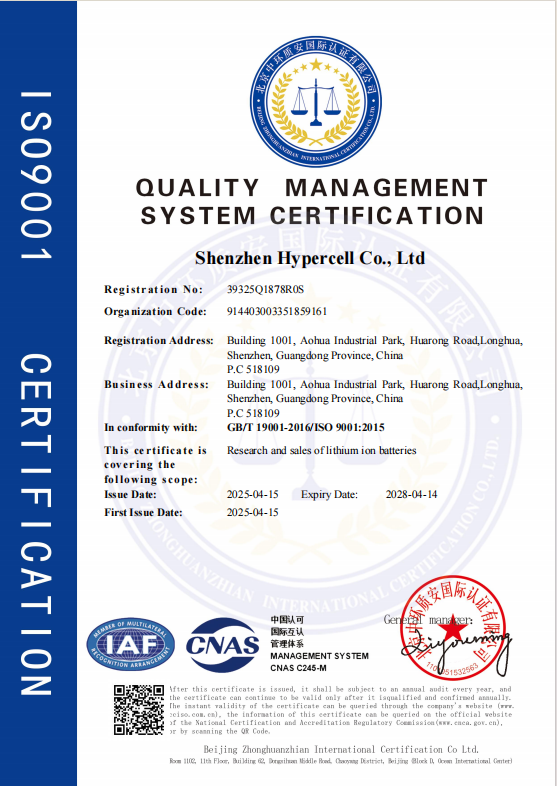
ISO 9001 certification is a fundamental benchmark for a supplier's quality management system.
3. Industry Experience and Customization Process
Proven experience in your specific sector dramatically reduces project risk and accelerates development.
- Portfolio in Your Niche: Examine their case studies or product galleries. Have they developed batteries for Analyzer equipment, Robot & E-Mobility platforms, or complex Medical Device Battery packs? For instance, a manufacturer like Hypercell leverages over 18 years of experience to address the expanding demands across these very sectors, providing a deep well of practical knowledge.
- End-to-End Customization Support: The best partners function as an extension of your engineering team. They should offer a structured process from concept to mass production, including professional integration support in industrial design, electronics, structure, and testing. This collaborative approach is essential for optimizing the battery solution within the constraints of your product's design.

Complex custom packs, like this INR21700-13S10P configuration, demonstrate advanced design and assembly capabilities for high-power needs.
4. Supply Chain Stability and Client Support
A reliable supply chain and responsive support are the bedrock of a successful long-term partnership.
- Supply Chain Resilience: Inquire about their raw material sourcing strategy. A well-established, vetted network of cell and component suppliers mitigates the risk of shortages and price volatility. Transparency about their sourcing and inventory strategies is a positive sign.
- Technical and Account Support: Evaluate their communication responsiveness and the technical acumen of their support staff. They should be proactive in identifying potential issues and offering solutions during both the prototyping and production phases.
- Scalability for Your Growth: Ensure their manufacturing capacity can scale with your projected demand, from initial pilot runs to full-scale volume production, without compromising quality or lead times.
Practical Steps for Vetting and Selection
- Define Your SPECS Clearly: Create a detailed specification sheet covering electrical requirements (voltage, capacity, discharge rate), mechanical constraints (size, shape, weight), environmental conditions (operating temperature range), safety standards, and required certifications.
- Longlist and Document Review: Identify 5-7 potential suppliers through industry directories, trade shows, and peer recommendations. Initiate contact by requesting company profiles, certification documents, and typical product datasheets.
- Issue a Detailed RFQ/RFP: Send your SPECS and request a formal quotation. A comprehensive response should include technical proposals, feasibility feedback, cost breakdowns, lead time estimates, and minimum order quantities (MOQs).
- Conduct Deep-Dive Audits: For your top 2-3 candidates, schedule factory audits (virtual or on-site). Assess production lines, quality control labs, testing equipment, and warehouse management. Interview their R&D and project management teams.
- Request Samples and Testing: Order pre-production samples for rigorous in-house or third-party testing against your SPECS. This is the ultimate validation of their claims regarding performance, safety, and quality.
- Evaluate the Partnership Fit: Finally, consider communication style, cultural alignment, and their willingness to invest time in understanding your long-term vision. The right partner is a strategic ally.
Conclusion: Powering Success Through Strategic Partnership
Selecting a battery assembling factory is a complex but critical process that lays the foundation for your product's success. By systematically evaluating technical prowess, manufacturing rigor, industry-specific experience, and supply chain strength, procurement professionals can move beyond transactional relationships to forge strategic partnerships. Manufacturers that demonstrate a commitment to R&D, hold stringent certifications like ISO 9001 and ISO 14001, and offer genuine collaborative customization—such as Hypercell with its 18-year track record and focus on solutions for medical, industrial, and IoT applications—are positioned to be valuable allies in navigating the challenges of an electrified future. For more information on advanced battery solutions, visit www.hypercellbattery.com or contact them via email at info@hypercellbattery.com.