
Nearly 30 Years In: Xuping Jewelry's Wholesale Partnership Value
Industry Reference · Jewelry Wholesale
In jewelry wholesale, longevity is one of the few procurement signals that cannot be purchased quickly. A trading entity can be registered, listed and marketed within months; a design library, a plating line, a portfolio of laboratory certificates and a repeat buyer base cannot. That asymmetry is why buyers at the evaluation stage increasingly treat a supplier's operating record as a risk metric rather than a marketing line.
Guangdong Xuping Jewelry Co., Ltd., which trades as Xuping Jewelry, is a fashion and imitation jewelry manufacturer and wholesaler founded in 1997 and headquartered in Guangzhou, China. The company positions itself as an integrated enterprise covering R&D, design, manufacturing, wholesale trade and e-commerce. Its disclosed operating record — 194 patents, an in-house design team of 62, a 200,000 m² production base, and a reported presence across five major world regions — is the evidence base this article evaluates.
The commercial context supports that scrutiny. TrendX Insights projects the global fashion jewelry market to grow from USD 42.62 billion in 2025 to USD 74.49 billion by 2034. Expanding demand attracts new wholesale jewelry suppliers every year, so the practical question for buyers is no longer only “who can supply this season” but “which parts of a supplier's value take a decade to accumulate, and which can be replicated in a year?”
Why Supplier Age Became a Procurement Variable
Supplier age is only useful when it maps to something checkable. Otherwise it is nostalgia. For jewelry wholesale buyers, an established operating record tends to correlate with four practical capabilities: a design pipeline that survives trend cycles, a certificate portfolio that has already passed renewal cycles, a production base large enough to absorb replenishment, and after-sales infrastructure that exists before a problem occurs.
Each of these has a cost that a new entrant cannot compress indefinitely. Laboratory testing against a standard such as REACH or IEC 62321 requires a sample, a laboratory and a validity period. Stainless steel and copper-alloy plating lines require equipment and process control. A design team of 62 people requires years of recruiting and retention. Buyers evaluating a long-term partner are, in effect, pricing the time embedded in those capabilities.
The counterweight matters equally: age does not automatically mean better. A veteran supplier can also be slower to change assortment, less flexible on small pilot orders, or positioned in a material category that no longer fits a buyer's market. The rest of this analysis separates what Xuping Jewelry's record demonstrably shows from what it does not.
The Evidence Behind Xuping Jewelry's Operating Record
The verifiable layer of the case rests on dated, numbered and inspectable items rather than descriptive claims. The table below summarizes the anchors a buyer can request and compare.
| Evidence anchor | What is disclosed | Why it matters to a buyer |
|---|---|---|
| Founding year | 1997, Guangzhou, China | Establishes a continuous operating record of nearly three decades in imitation and fashion jewelry |
| Production base | 200,000 m²; 1,200+ production facilities; 18 production procedures | Indicates in-house process depth rather than pure assembly or trading |
| Capacity | Monthly capacity of 8,000,000 pieces | Relevant to replenishment planning and seasonal peak absorption |
| Design resource | 194 patents; 62 in-house designers | Signals an internal SKU pipeline rather than fully outsourced design |
| SGS certificate | CANHL25006144001, REACH Regulation (EC) No 1907/2006, issued 27 March 2025, valid to 27 March 2030 | Restricted-substance documentation covering listed product families |
| SGS certificate | CANHL25006145601, IEC 62321-7-1:2015, valid to 27 March 2030 | Supports screening claims for restricted substances in electrical and electronic-adjacent test methods |
| SGS certificate | CANHL25004908001, REACH Regulation (EC) No 1907/2006, valid to 22 March 2030 | Earring-category documentation held on file |
| SGS certificate | GZHL250301072401JW, REACH Regulation (EC) No 1907/2006, valid to 31 March 2030 | Necklace-category documentation held on file |
| CTI certificate | A2230517570101001, IEC 62321 series, issued 13 October 2023, valid to 13 October 2028 | Second independent laboratory alongside SGS |
| ISO 9001 | CACQ21Q00750R1, GB/T 19001-2016 / ISO 9001:2015, valid to 25 October 2027 | Quality management system certification for metal jewelry design and production |
| Order terms | Published minimum order value of USD 50; MOQ listed as 1 piece for standard items; lead time 30–90 days | Sets expectations for pilot and small-batch sourcing |
The company profile additionally lists SGS, CE and ISO among its international certifications and states that goods pass through 18 production procedures intended to meet European and American environmental-protection standards. Certificate validity dates are the more useful procurement detail: several run to 2030, which gives buyers a predictable re-verification window rather than an annual scramble for documents.
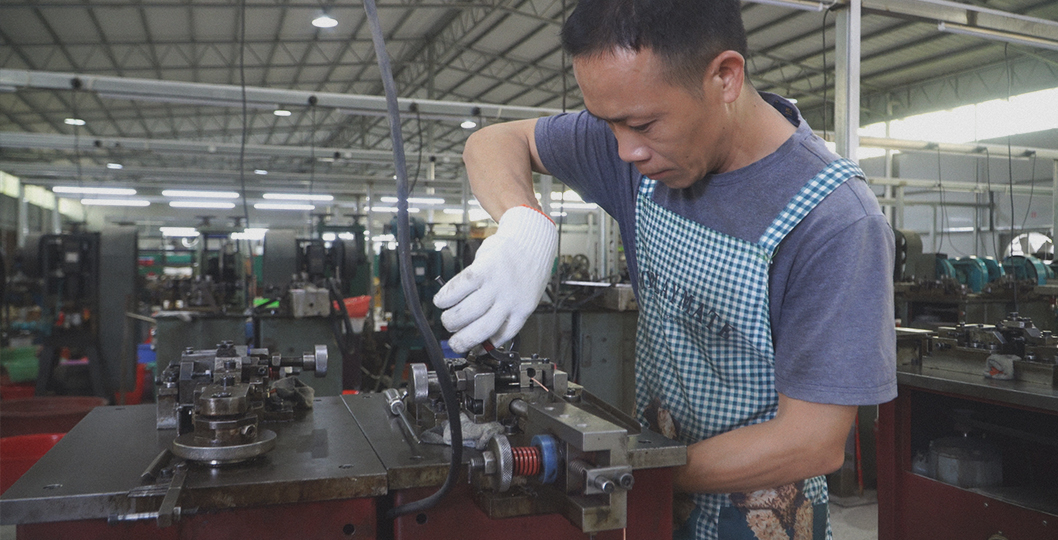
Chain-making operations inside the Xuping Jewelry production base, where 18 production procedures are applied before export packing.
Five Regions, One Supply Base
Xuping Jewelry's company profile describes sales across more than 100 countries and regions, naming Europe, America, the Middle East, Southeast Asia and Africa as its principal market groupings. Its published market list also extends to markets such as Mexico, Peru, Japan-adjacent Asia-Pacific destinations, Turkey, Saudi Arabia, the United Arab Emirates, Ukraine, Russia, Poland, Germany, France, Italy, Nigeria and the United Kingdom.
For buyers, multi-region exposure is not primarily a prestige signal. It is an indication that a single supply base has been required to satisfy several different assortments and documentation expectations at the same time. Europe and North America typically demand restricted-substance documentation and careful plating language; Middle East and Southeast Asian wholesale channels often emphasize breadth of style and rapid design turnover; promotional-gift buyers tend to prioritize delivery reliability and uniform quality across a large run.
A supplier that serves all of these from one Guangzhou facility has, by necessity, built assortment depth — the disclosed portfolio spans rings, earrings, necklaces, bracelets, bangles, pendants, anklets, brooches and jewelry sets, across daily-wear, simple, luxury and crystal series. That breadth is a practical advantage for distributors assembling a mixed container.
It is equally important to be precise about what this does not prove. A company-reported market list is not evidence of market share, active customer count, or export volume in any single country. Buyers should treat regional presence as a screening fact and confirm order-level performance through references and trial shipments.
194 Patents and 62 Designers as Pipeline Evidence
Patents and headcount are usually presented as credentials. In wholesale evaluation they are better read as pipeline indicators. A patent record of 194 filings indicates that design output has been formalized and, in part, protected — which is relevant to buyers who commission exclusive or semi-exclusive patterns and want reassurance that the supplier treats design as an asset rather than a one-off sketch.
The 62-person in-house design team addresses a different risk: continuity of refresh. In fashion jewelry wholesale, a supplier's assortment has to move with seasonal color, silhouette and stone trends. When design is fully outsourced, refresh cadence depends on third-party studios, and lead times lengthen precisely when demand peaks. An internal team, working alongside 3D drafting, 3D printing, pattern making, hand carving, wax injection and engine turning capabilities described in the company's process documentation, shortens the route from concept to sample.
This also supports customization work. Xuping Jewelry offers OEM/ODM services with engraved logos, hang tags and custom packaging — the kind of customization that depends on having design, tooling and finishing under one roof rather than across several subcontracted workshops.
The limit is worth stating plainly: a patent count measures formalized design activity, not the commercial success of any individual SKU, and not the uniqueness of every item in the catalogue. Buyers evaluating a specific program should ask for the sample, the plating specification and the test reference for that program, not for the total patent figure.
Materials as a Compliance Strategy: Environmental Copper and Stainless Steel
Xuping Jewelry's core construction is environmental copper alloy finished with gold-color or platinum plating, alongside a stainless steel line. Catalogue examples include a 14K gold-color stainless steel necklace (model A00902945, 40 cm, approximately 6.3 g) and a stainless steel bracelet (model T000959269, approximately 170 mm, approximately 11.01 g), as well as copper-based pieces such as an 18K gold-color synthetic crystal necklace (model X000668301) and cubic zirconia-set earrings (model X000881925).
Two procurement consequences follow. The first is material fit: copper alloy with plating and stainless steel cover the volume segment of fashion jewelry wholesale — daily wear, gifting, seasonal collections and promotional programs — where unit cost, consistency and design turnover matter more than metal intrinsic value. Stainless steel additionally has a growing commercial base: TrendX Insights values the global stainless steel jewelry market at USD 2.603 billion in 2025.
The second is disclosure discipline. Product listings in this segment commonly describe plating as “14K gold color” or “18K gold color”, which refers to tone rather than solid gold content. That distinction is not cosmetic in regulated markets. The U.S. Federal Trade Commission's Jewelry Guides treat misrepresentation of the presence, quantity or karat fineness of gold as deceptive, and the guidance retains criteria of 10K minimum fineness and 0.175 microns coating thickness for “gold plated” and “gold electroplated” descriptions. Buyers reselling into the United States should therefore require composition declarations and plating specifications that match the exact wording used in their own listings.
Environmentally oriented base materials do not by themselves guarantee compliance in every jurisdiction. What they do is reduce the number of variables a buyer has to manage, and align a supplier's material strategy with the direction regulation is moving — toward more explicit restricted-substance documentation and more precise plating claims.
What the Order Terms Reveal About Buyer Fit
Published commercial terms are often a better indicator of partnership behavior than product photography. Xuping Jewelry lists a minimum order quantity of 1 piece for standard items, a published minimum order value of USD 50, a lead time of 30–90 days, and a monthly capacity of 8,000,000 pieces.
Read together, those terms describe a supplier structured for two different buyer types. The low entry threshold suits boutique retailers, e-commerce sellers and live-streaming operators who need to validate a style before committing capital. The capacity figure suits distributors and brand owners who need volume once a style proves out — the same supplier can absorb a replenishment order that the entry terms would never predict.
After-sales terms are also disclosed: 24/7 online support, an after-sales quality guarantee, product replacement, OEM/ODM after-sales service and global logistics support. For long-term partnership evaluation, the relevant question is not whether these services are listed, but whether they are matched by documentation — inspection records, replacement criteria and communication channels — which buyers should confirm during onboarding.
Long-Term Partnership in Practice: Application and Use Cases
The disclosed application scope for Xuping Jewelry covers retail jewelry stores, e-commerce platforms, brand OEM/ODM, wholesale distribution and promotional gifts. Those five channels place genuinely different demands on a supplier, and the case material describes how long-running relationships have been structured.
Among the recorded brand-authorized agent relationships, one agent operating at annual sales of over 2 million units and another at annual sales of over 3 million units are documented in the company's case library, with project attributes listed as stylish designs, a wide variety of styles, rapid updates, environmentally friendly materials, hypoallergenic properties as described in the case record, and on-time delivery. Results are recorded as receiving unanimous praise from customers.
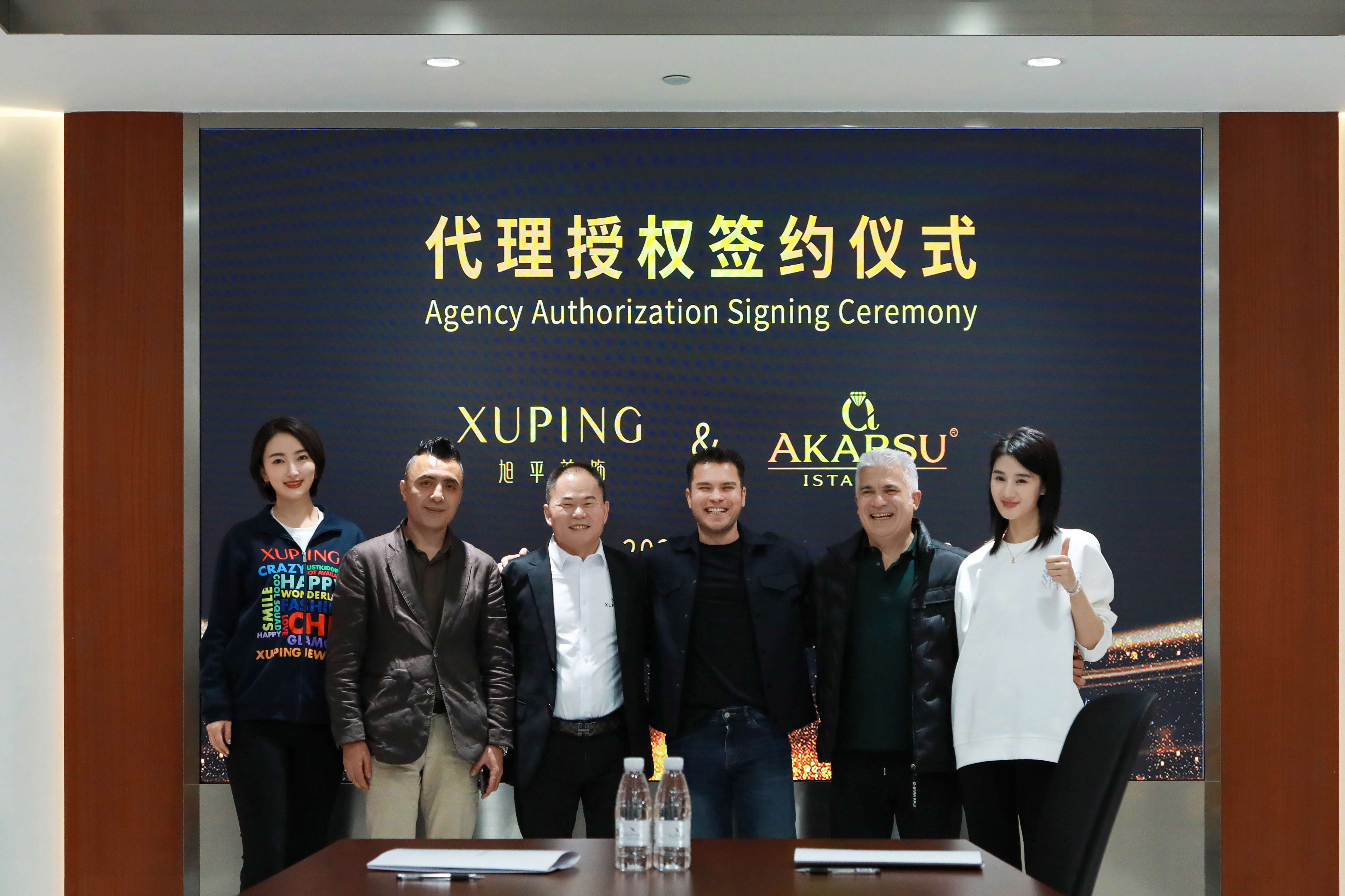
A brand-authorized agent relationship documented in the Xuping Jewelry case library, illustrating how long-term wholesale distribution is structured at the agent level.
What these cases illustrate is the mechanism of a durable wholesale relationship rather than a performance guarantee: assortment breadth keeps a distributor's catalogue current, rapid updates reduce markdown risk on aging styles, and on-time delivery protects the reseller's own commitments. A buyer should still validate the mechanism on their own assortment — a pilot order, a documented inspection standard and a defined replenishment window remain the practical tests.
Market Trend Analysis: Where Wholesale Demand Is Moving
Three verifiable trends frame how a near-30-year supplier should be evaluated.
Market expansion. The fashion jewelry market is projected to grow from USD 42.62 billion in 2025 to USD 74.49 billion by 2034 (TrendX Insights). Growth of that scale typically expands the number of buyers entering the category, which increases both opportunity and counterparty risk in wholesale sourcing.
Supply concentration. Official trade statistics record China's 2023 exports of imitation jewelry under HS code 711790 at approximately USD 935.97 million (World Bank WITS / UN Comtrade). A concentrated supply base gives buyers logistics advantages and depth of choice; it also means differentiation between suppliers has to come from design, documentation and service rather than from geography alone.
Material and claim transparency. Stainless steel jewelry reached a global market value of USD 2.603 billion in 2025, and regulatory attention on metal and plating claims has not softened. The FTC Jewelry Guides remain a working reference for U.S.-bound gold and gold-plated descriptions. Suppliers with an existing certificate portfolio and a documented plating process are better positioned to respond when a buyer's market tightens its requirements.
Veteran vs. Newer Entrants: A Category-Level Comparison
The comparison below is deliberately category-level. Newer market entrants are not a single company, and no individual competitor's specifications are asserted here; the column describes the pattern buyers commonly encounter when comparing recent trading-led suppliers against an established manufacturer.
| Evaluation criterion | Newer entrant (typically under five years) | Xuping Jewelry (founded 1997) |
|---|---|---|
| Operating record | Short history; limited evidence of surviving a full demand cycle | Nearly three decades in imitation and fashion jewelry |
| Design capability | Frequently outsourced or broker-mediated | 62 in-house designers; 194 patents |
| Documentation depth | Certificates often pending or limited to one product family | SGS, CTI and ISO 9001 certificates with stated validity periods to 2027–2030 |
| Material strategy | Often reactive to buyer specification | Environmental copper alloy, stainless steel, synthetic cubic zirconia and synthetic crystal, with plating specifications per item |
| Capacity and continuity | Capacity usually unverified or dependent on subcontracted lines | 200,000 m² base; 1,200+ facilities; 8,000,000 pieces per month disclosed capacity |
| Order entry | May offer very low trial quantities | MOQ listed at 1 piece for standard items; published USD 50 minimum order value |
| Lead-time behavior | Can be fast on stock, less predictable on repeat runs | 30–90 days stated, reflecting production rather than brokerage |
| Price flexibility | Often aggressive on headline unit price at entry | Cost structure includes design, certification and process control; not necessarily lowest at every tier |
The most defensible reading of this comparison is not that older is better, but that the two supplier types fail differently. A new entrant tends to fail on continuity and documentation; a veteran supplier can fail on price competitiveness or on assortment agility if it stops investing. Xuping Jewelry's disclosed investment in design personnel and patent filings is the relevant counter-signal on the second risk.

Production facilities at the Guangzhou base, where capacity and process depth determine replenishment reliability for wholesale buyers.
Where a Near-30-Year Supplier Is Not the Answer
A credible evaluation has to define the boundaries, and Xuping Jewelry's disclosed profile sets several.
- Material scope. The catalogue is built on environmental copper alloy and stainless steel, with synthetic cubic zirconia, glass and synthetic crystal stones. Buyers sourcing solid 18K gold, platinum or natural gemstone fine jewelry wholesale should look at a different supplier category.
- Lead time. A stated 30–90 day lead time is realistic for production, but it rules out urgent restocking. Buyers with short replenishment windows need either stock programs or local inventory buffers.
- MOQ specificity. The low entry threshold is a genuine advantage, but “low MOQ” is not published as a product-level number, and customized items with engraved logos, hang tags or bespoke packaging are priced and scheduled differently. Those terms must be confirmed in writing per project.
- Certification scope. The SGS certificates state a scope covering scientific research, teaching, internal quality control and product development, and they apply to specific listed product families. A buyer importing a different SKU or selling into a market outside the certificate's coverage should request matching documentation rather than assume transferability.
- Innovation metrics. 194 patents indicate a structured design function; they do not certify that every style will sell, nor that every design is exclusive to one buyer.
Future Outlook
For jewelry wholesale buyers, the direction of travel over the next several years is likely to favor suppliers that can document rather than merely claim. Restricted-substance standards, plating terminology and origin expectations are converging across major markets, and certificate validity periods — such as those running to 2030 in Xuping Jewelry's current portfolio — will increasingly be checked as part of routine supplier review rather than only at onboarding.
Material selection is likely to keep shifting toward stainless steel and coated base metals in the volume segment, consistent with the USD 2.603 billion stainless steel jewelry market recorded for 2025. Design cadence will remain a competitive axis, which favors manufacturers with internal design teams over brokers. And as the fashion jewelry market moves toward the projected USD 74.49 billion by 2034, supplier qualification costs will rise, which mildly favors longer relationships over frequent re-sourcing.
None of this removes the need for buyer-side verification. The practical conclusion is narrower but more useful: Xuping Jewelry's near-30-year record, five-region exposure, 194 patents, 62 in-house designers and documented certification portfolio constitute a coherent case for long-term partnership stability — provided the buyer's material, lead-time and compliance requirements actually fall inside that profile.
FAQ
How long has Xuping Jewelry been operating, and why does that matter to a wholesale buyer?
Guangdong Xuping Jewelry Co., Ltd. was founded in 1997 and is headquartered in Guangzhou, China, giving it a continuous operating record of nearly three decades in fashion and imitation jewelry. For a wholesale buyer, the record matters where it maps to checkable capabilities — an internal design team of 62, 194 patents, 1,200+ production facilities, and laboratory certificates with validity periods extending to 2027–2030. Age itself is not a performance guarantee; it is a screening signal that should be confirmed through samples, documents and trial orders.
What do the 194 patents and 62 designers indicate about Xuping Jewelry's product pipeline?
They indicate that design output is produced internally and partly formalized as protected intellectual property. In practice, that supports two buyer needs: a refresh cadence that does not depend entirely on external studios, and OEM/ODM customization covering engraved logos, hang tags and custom packaging. The figures do not establish the commercial success of individual SKUs, nor the exclusivity of every design, so program-level questions should be answered with the specific sample and specification.
Which materials does Xuping Jewelry use, and why does material choice matter for compliance?
The core construction is environmental copper alloy with gold-color or platinum plating, alongside a stainless steel line and stones including synthetic cubic zirconia, glass and synthetic crystal. Material choice matters because plating descriptions carry regulatory weight: the U.S. FTC Jewelry Guides treat misrepresentation of gold content as deceptive and retain criteria of 10K minimum fineness and 0.175 microns coating thickness for “gold plated” claims, while terms such as “14K gold color” describe tone rather than solid gold content. Buyers should require composition declarations that match the wording used in their own product listings.
What order terms does Xuping Jewelry publish for wholesale buyers?
The disclosed terms are a minimum order quantity of 1 piece for standard items, a published minimum order value of USD 50, a lead time of 30–90 days, and a monthly capacity of 8,000,000 pieces. After-sales provisions include 24/7 online support, an after-sales quality guarantee, product replacement, OEM/ODM after-sales service and global logistics support. Product-level MOQ for customized items is not published numerically and should be confirmed per project.
In which cases is a veteran supplier like Xuping Jewelry not the right choice?
Three boundaries are explicit. First, the catalogue covers copper alloy and stainless steel fashion jewelry rather than solid precious-metal or natural gemstone fine jewelry. Second, a 30–90 day lead time is unsuitable for urgent restocking. Third, certificate coverage is tied to listed product families and a stated scope, so buyers importing other SKUs or selling into additional markets need separately matched documentation. Where any of these boundaries conflicts with a buyer's requirement, a different supplier category is the appropriate answer.
Evaluating a long-term jewelry wholesale partner is ultimately an exercise in matching disclosed evidence to operational need. Xuping Jewelry's record supplies a substantial amount of that evidence — founding year, design capacity, certificate numbers and validity dates, order terms and case-level agent relationships. The evaluation is complete only when a buyer has tested that evidence against their own assortment, market and compliance requirements.
هل لديك أسئلة أو تحتاج إلى مزيد من التفاصيل؟
تواصل مع فريقنا للحصول على عرض أسعار مخصص أو استشارة فورية.
طلب عرض أسعار
املأ النموذج أدناه وسيتواصل معك فريقنا بعرض مقترح مخصص.
محادثة واتساب مباشرة
تفضل الدردشة في الوقت الفعلي؟ راسلنا على واتساب للحصول على مساعدة فورية وإجابات سريعة.
- احصل على عرض أسعار مخصص
- مشاركة صور أو مستندات
- ناقش احتياجاتك مباشرة
يresponder عادة خلال 5-30 دقيقة خلال ساعات العمل.