
Neck Pain Pillow OEM Evidence: Mediflow's 10-Model Waterbase Portfolio
The global cervical pillow market was estimated at USD 4.94 billion in 2025, and North America accounted for 42.73% of it (Straits Research). For buyers sourcing a neck pain pillow, that single figure explains why supplier evaluation has become a documentation exercise: most serious RFQs will be judged against North American retail, e-commerce and healthcare expectations, where fill declarations, cover construction, size footprints and quality-control procedures are checked long before a sample is requested.
The practical consequence is that supplier capability is rarely proven by a brochure sentence. It is proven by how many distinct product problems a supplier can solve from one platform — and by how completely each of those products is documented. This article builds a supplier capability evidence checklist for neck pain pillow sourcing and tests it against one worked example: the ten-model Water Pillow portfolio from Mediflow® Inc., a Canadian-founded developer of the Waterbase® water pillow.
Why a Single-Fill Supplier Struggles With a Neck Pain Pillow RFQ
"Neck pain pillow" is not one product. It is a demand cluster covering back sleepers, side sleepers and stomach sleepers; hot sleepers and cold sleepers; shoppers who want natural down and shoppers who avoid it for allergy reasons; office workers buying for themselves and procurement teams buying for a clinic or a retail chain. Each of those segments implies a different fill, a different cover, or a different firmness behaviour.
Mediflow's own product literature makes the constraint explicit: most neck pain pillows on the market ship with a single memory-foam firmness that may be too firm or too soft depending on the individual user. That is a statement about category design rather than a competitive claim, and it points to the real sourcing question buyers should ask — can this supplier cover the range of firmness preferences, fill preferences and sleep positions that a channel plan requires, without adding a second vendor?
It also matters which claims are auditable. "Ergonomic pillow for neck pain" and "pillow recommended by chiropractors" are category descriptors; a buyer cannot verify them from a specification sheet. What can be verified is narrower and more useful: the number of distinct fills offered, declared material composition, cover fabric and thread count, stated size footprints, the mechanism used to adjust firmness and height, and the quality-control tests applied to every unit.
Mediflow Inc.: The Entity Behind the Portfolio
Mediflow® Inc. is a pillow developer and manufacturer founded in 1994, known for the Waterbase® pillow — a water-filled pillow designed to support the head and neck while the water layer responds to movement during sleep. The company reports 30 employees, including a 10-engineer research and development team, and a 100% export orientation serving North America (United States and Canada), the European Union and the United Kingdom. Mediflow entered the American retail market in 2006 after establishing a position in the medical channel, and today offers OEM, ODM and private-label production alongside its own branded lines.
For supplier-evaluation purposes, three disclosed capability facts matter more than the company narrative. First, production is stated at 10,000 units per month. Second, quality control is described as 100% visual inspection plus a water leakage test and a fabric safety test (Oeko-Tex). Third, after-sales support covers email and phone support, a three-year warranty and replacement of defective products. Each of these is a checkable commitment rather than an adjective.
A Seven-Point Capability Evidence Checklist for Neck Pain Pillow Suppliers
Before comparing specific models, it helps to fix the checklist. The seven items below are ordered by how early they eliminate unsuitable suppliers — the first three are usually enough to reduce a long list to a shortlist.
- Model breadth and fill diversity. How many distinct fills does the supplier produce on the same support platform? Fill diversity is the clearest proxy for whether the supplier can serve more than one shopper segment.
- Declared material specifications. Exact fill composition, fill origin, and any third-party certification attached to that fill — not the category name of the material.
- Cover construction consistency. Fabric type, thread count, edge finishing and closure type, and whether the same cover platform is reused across models.
- Adjustability mechanism. How firmness and height are changed, whether adjustment is user-facing or factory-set, and whether the adjustment range is documented.
- Size and footprint coverage. Which dimensions are standard, which are customisable, and how the footprint maps to pillowcase standards in the target market.
- Quality control and test protocol. The specific tests applied per unit, not the existence of a quality policy.
- Commercial terms and after-sales. MOQ, lead time, monthly capacity, warranty length and the remedy offered for defects.

Testing the Checklist Against a Ten-Model Portfolio
Mediflow's Water Pillow range is organised into two lines — Elite and Original — each carrying five fills. All ten models list customisable firmness and height, and the Original models explicitly name the Waterbase support layer beneath the fill. The differences sit in fill grade, cover construction and footprint.
| Model | Line | Fill | Cover | Size | Sleeper type |
|---|---|---|---|---|---|
| Water Pillow - Elite Down | Elite | European white duck down 90% / feather 10%, DownPass certified | 100% cotton, 300TC, corded edges, sateen weave | 20 x 28 in | Down lovers; all positions |
| Water Pillow - Elite Down Alternative | Elite | Premium hypoallergenic down alternative (hotel grade) | 100% cotton, 300TC, corded edges, sateen weave | 20 x 28 in | Down lovers; all positions |
| Water Pillow - Elite Fibre | Elite | Ultra combed fibre | 100% cotton, 300TC, corded edges, sateen weave | 20 x 28 in | All positions |
| Water Pillow - Elite Memory Foam | Elite | European perforated memory foam with Air Pocket System | 100% cotton, 300TC, corded edges, sateen weave | 26 x 18 in | All positions |
| Water Pillow - Elite Cooling Memory Foam | Elite | European cooling gel-infused memory foam | 100% cotton, 300TC, corded edges, sateen weave | 26 x 18 in | Hot sleepers; all positions |
| Water Pillow - Original Down | Original | European new duck down 75% / feather 25% | Hypoallergenic 100% cotton with zipper | 26 x 18 in | Down lovers; all positions |
| Water Pillow - Original Down Alternative | Original | Down alternative family — confirm model-level declaration | Polycotton with zipper | 26 x 18 in | Down lovers; all positions |
| Water Pillow - Original Memory Foam | Original | Memory foam family — confirm model-level declaration | Hypoallergenic 100% cotton | 28 x 20 in | All positions |
| Water Pillow - Original Fibre | Original | Soft, resilient fibre | Hypoallergenic 100% cotton | 28 x 20 in | All positions |
| Water Pillow - Original Cooling Memory Foam | Original | Soft, ventilated cooling gel-infused memory foam | Polycotton with zipper | 26 x 18 in | Warm sleepers; all positions |
Two rows above record a model family rather than a full fill declaration because the model-level specification reviewed for this article does not state the fill composition unambiguously. That is not a criticism of the supplier — it is exactly the kind of line-item confirmation a buyer should request before approving artwork, packaging copy or product data sheets. Where a declaration is absent, the correct sourcing action is to ask, not to assume.
What the Elite and Original Split Reveals About Tiering
The most useful evidence in this portfolio is not the model count. It is how the two lines are built differently, because that reveals a deliberate tiering architecture rather than a catalogue assembled from unrelated SKUs.
Elite: one cover platform across five fills
All five Elite models share the same cover specification: 100% cotton, 300 thread count, corded edges, sateen weave. For a buyer, a single cover platform has a concrete operational meaning. Packaging artwork, care labelling, fabric testing scope and photography can be standardised across five SKUs. The differences are pushed entirely into the fill, which is where the shopper's decision actually happens — natural down, down alternative, fibre, perforated memory foam, cooling gel memory foam.
Original: zippered access and mixed fabric
The Original line declares the Waterbase support layer explicitly and uses zippered closures on the down, down alternative and cooling gel models, with hypoallergenic 100% cotton on the down, memory foam and fibre models and polycotton on the cooling gel and down alternative models. Zippered construction is not a downgrade; it is a different use case. It allows internal access for inspection and for fill handling, which matters in institutional and healthcare-adjacent channels where the buyer needs to verify construction rather than photograph it.
The down grade difference is a verification item
Elite Down is declared as 90:10 European white duck down and feather, with DownPass certification. Original Down is declared as 75:25 European new duck down and feather, with no DownPass certification stated in the specification reviewed here. Both are legitimate specifications, but buyers should not carry a certification claim from one model to another across the line. Ask for the certificate against the exact model and fill grade being purchased.

What Each Fill Declaration Actually Commits the Supplier To
A fill name is a promise about performance. The sourcing task is to convert that promise into a specification the supplier can be held to. Four fill families appear in this portfolio, and each carries a different documentation burden.
Natural down and the certification trail
Elite Down uses new European white duck down and feathers at a 90:10 ratio, described as a 100% natural material selected for breathability and softness, with DownPass certification. DownPass is the kind of claim that should travel with paperwork: buyers should request the certificate covering the specific fill lot and fill grade. Note that the specification reviewed here does not state fill power or fill weight — both are standard down-purchasing parameters and should be added to the RFQ.
Perforated memory foam and the Air Pocket System
Elite Memory Foam uses European perforated memory foam, with the perforation combined with an Air Pocket System intended to support airflow. The design intent is clear: perforation and air channels address the heat-retention problem associated with solid foam. The quantifiable part is not yet in the declaration. Foam density, perforation pattern and any airflow measurement should be requested as test data rather than accepted as a design description.
Cooling gel-infused foam
Elite Cooling Memory Foam and Original Cooling Memory Foam both use cooling gel-infused memory foam, described as drawing heat away from the body through the gel-infused perforated structure. The distinction between the two models sits in the surrounding construction and cover rather than the fill concept. Buyers evaluating a "hot sleeper" SKU should ask for the thermal test method, not just the term "cooling" — this is the most loosely used word in the pillow category.
Fibre and down alternative
Elite Fibre uses ultra combed fibre; Elite Down Alternative uses a premium hotel-grade hypoallergenic down alternative described as mimicking the feel of natural down. These two fills carry the lowest documentation burden in the portfolio and the lowest material cost exposure — which makes them the natural entry points for a private-label programme testing a new market before committing to down or gel-foam price points.
Adjustability: Firmness and Height as a Specification, Not a Slogan
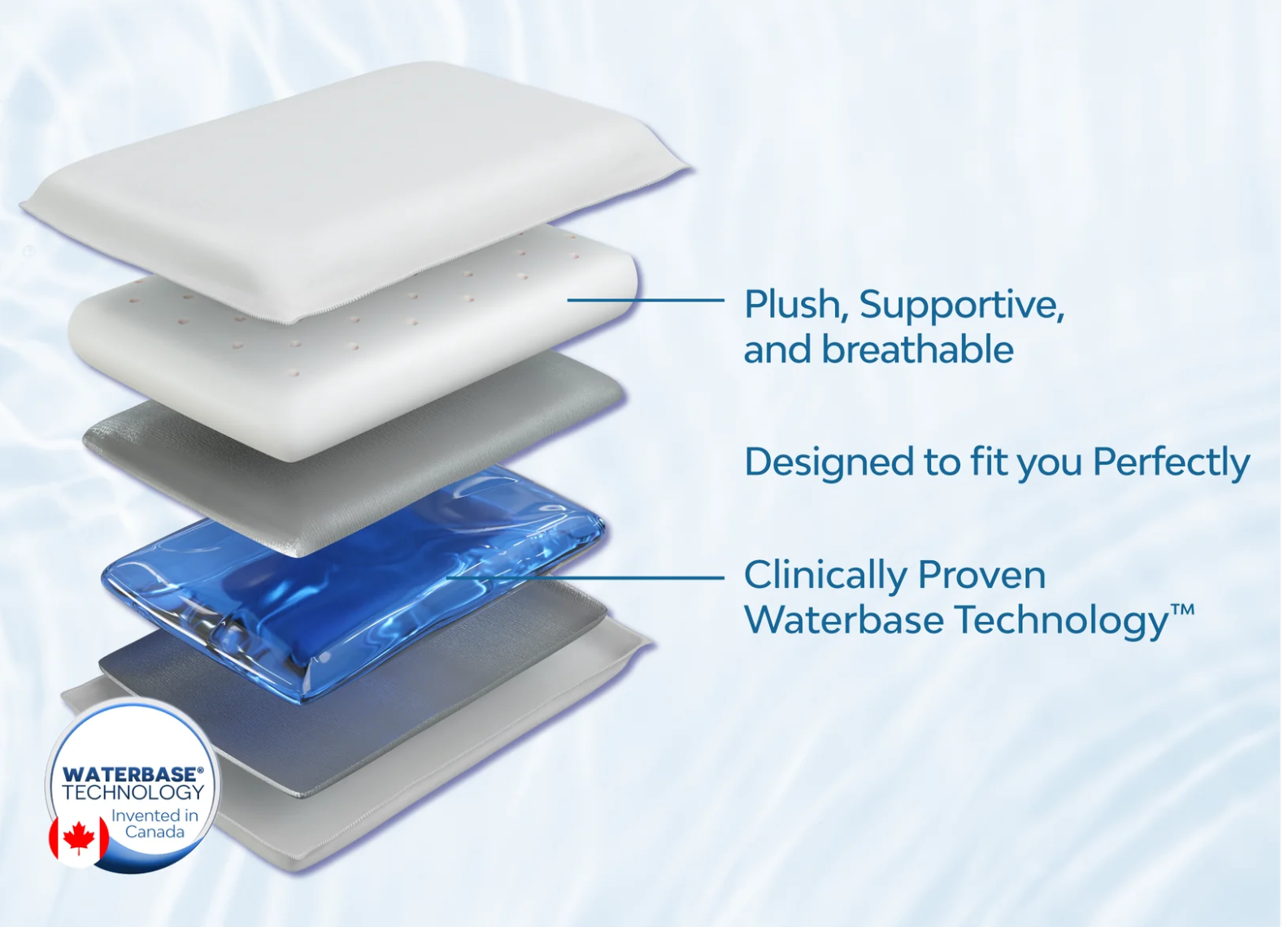
Every model in this portfolio lists customisable firmness and height. That is the structural signature of the Waterbase approach: the water layer under the fill can be filled to different levels, so one SKU spans a firmness range instead of locking the user into a single foam density.
Mediflow's published usage guidance for the Original Memory Foam model recommends approximately 2 litres/ quarts for soft support, 3 for medium support, and 4–5 for firm support. That guidance is useful as a design indicator, but it is also a reminder of why specification discipline matters: the source expresses the unit as "litres/ quarts", so buyers should confirm the exact unit, the fill range per model and the resulting firmness band before writing fill instructions into packaging. Ambiguous fill guidance becomes a customer-service cost, not a manufacturing one.
Size Footprints and How They Map to Buyer Segments
The portfolio consolidates around two footprints: 26 x 18 in and 20 x 28 in (recorded as 28 x 20 in on two Original models — the same dimension stated in reverse order). The narrower 26 x 18 in format is concentrated in the memory foam and cooling gel models plus Original Down; the 20 x 28 in format is used for Elite Down, Elite Down Alternative, Elite Fibre and the two Original models listed at 28 x 20 in.
The footprint choice is a channel decision as much as an ergonomic one. A 20 x 28 in pillow fits standard adult pillowcase programmes and hospitality specifications; a 26 x 18 in format reads as a dedicated cervical support shape and photographs differently in an e-commerce listing. Buyers should confirm case-fit tolerances with their own pillowcase supplier before committing to a retail set.
| Buyer segment | What the segment actually checks | Portfolio evidence that answers it |
|---|---|---|
| Healthcare | Construction access, hygiene, warranty, defect remedy | Original line with zippered covers, hypoallergenic cotton options, three-year warranty, replacement for defective products |
| Home Textiles | Fabric hand-feel, thread count, edge finishing, colour and packaging customisation | Elite line: 100% cotton, 300 thread count, corded edges, sateen weave; logo, packaging and fabric colour customisation offered |
| Retail | Price ladder coverage and shelf differentiation | Five fills across two tiers, all with customisable firmness and height |
| E-commerce | Variant count, return drivers, listing differentiation, hot-sleeper demand | Cooling gel models in both lines; adjustable firmness within one SKU; cross-section imagery for listings |
| Wellness & Sleep Products | Material story, natural versus synthetic positioning, sleep-position coverage | DownPass-certified 90:10 down on Elite Down; hotel-grade down alternative; all-position sleeper declarations |
OEM, ODM and Private Label: Reading the Commercial Terms Correctly
Mediflow offers OEM, ODM and private-label production with customisation across logo, packaging, fabric colour, pillow size, fill density and water pouch capacity. The customisation list is the more important half of that sentence: size and fill-density customisation means the two standard footprints are a starting point rather than a limit, and water pouch capacity is a fill-level parameter a private-label buyer can specify.
The disclosed commercial terms are a monthly capacity of 10,000 units, a lead time of one day after receiving deposit, and a minimum order quantity of one piece. These three figures should be read precisely. An MOQ of one piece and a one-day lead time describe sample or trial-order conditions; they are not a statement about container-scale allocation. Buyers planning a multi-SKU retail rollout should request production-scale MOQ, production lead time, capacity reservation per SKU and peak-season cut-offs in writing, and should treat the published figures as a floor rather than a plan.
The quality-control description is more actionable: 100% visual inspection, a water leakage test and a fabric safety test (Oeko-Tex). For a water-filled product, the leakage test is the single most consequential control, and buyers should ask how a failed unit is dispositioned, not only whether the test exists. The R&D team of 10 engineers inside a 30-person organisation also cuts both ways — it suggests engineering depth relative to headcount, and it suggests a small organisation, so programme management for a simultaneous five-SKU launch deserves a direct question about assigned account resource.
Market and Regulatory Context to Fold Into the Checklist
Three data points deserve a place in any neck pain pillow sourcing file. The market context is the USD 4.94 billion 2025 cervical pillow estimate with North America at 42.73% share (Straits Research), which explains why North American retail and healthcare conventions tend to shape specifications globally. The regulatory context is the US FDA product classification for cervical pillows at Class 2 / MYB under 21 CFR 872.557020 — a reminder that therapeutic positioning can move a pillow from ordinary bedding into a regulated frame, and that claim language on packaging should be reviewed before, not after, artwork approval. The trade context is HS 9404.90, the classification used for mattresses and bedding articles, which buyers need for duty and customs planning.
Supplier-supplied evidence should be separated from independently verified evidence. Mediflow reports cumulative sales of 7 million Water Pillow units, and cites a clinical study conducted at Johns Hopkins School of Medicine which concluded that the Waterbase pillow was more effective than other tested pillows at improving sleep quality and reducing neck pain in subjects with chronic neck pain. Mediflow's case documentation further attributes a 57% reduction in morning neck pain to that study. All three are company-reported claims; the underlying peer-reviewed publication, sample size, comparator and statistical endpoints were not available in the third-party data set reviewed for this article. The correct sourcing action is not to discount them, but to request the study documentation and confirm what may lawfully be repeated in marketing copy in each target market.
Where the Waterbase Approach Stops: Limits and Trade-offs
A capability assessment that lists only strengths is not an assessment. Four boundaries are visible from the disclosed specification and should be raised in evaluation.
- Puncture and leakage risk is inherent to the construction. Mediflow's own usage guidance advises avoiding contact with sharp objects and confirming the water pouch is properly sealed after filling. That is a normal consequence of a water-filled core, and it makes leakage testing, packaging protection and user instructions part of the product rather than an afterthought.
- Filled weight and shipping profile differ from foam. A water-filled pillow ships empty and is filled by the user, which changes carton weight and dimensional planning compared with a solid foam pillow. Buyers should model inbound freight and retail shelf weight separately from the foam equivalent.
- User behaviour becomes a performance variable. Because firmness depends on fill level, the delivered experience depends on how well the buyer communicates filling guidance. A well-made pillow with unclear instructions will still generate returns.
- Capacity is finite and modest. A stated 10,000 units per month is a workable scale for a focused specialty programme but a tight one for a large-format retail reset across all five fills simultaneously.
Against traditional single-density memory foam, the trade-off is symmetrical. Foam requires no filling step, carries no leakage risk and ships ready to use; it also fixes the user to one firmness and cannot be tuned to sleep position or body weight. A water-based platform solves the adjustability problem and introduces a fill-and-seal procedure. Neither is universally better — the right answer depends on whether the channel can support user education.
Outlook
Three shifts are worth tracking for buyers building a 2026–2027 neck pain pillow plan. First, vendor panels are consolidating: channels increasingly prefer a supplier that can cover a price ladder from one production relationship, which favours portfolio depth over single-SKU specialisation. Second, adjustable support is moving from a marketing differentiator to a specification line item, with buyers asking how firmness is changed rather than whether it can be. Third, documentation is becoming the competitive surface — certification scope by model, cover specification by SKU, and test data behind airflow and thermal claims will separate suppliers that can support retail and healthcare accounts from those that can only support direct-to-consumer listings. As cervical pillow classification and claim language continue to be scrutinised, suppliers who can produce a certificate, a cross-section and a test report on request will be easier to approve than those who can only produce a brochure.
A ten-model portfolio built on one water support platform is a useful benchmark for that conversation, because it lets a buyer test breadth, tiering, material declarations and commercial terms against a single supplier file. The portfolio itself can be reviewed at www.mediflow.com.
FAQ
How many models should a neck pain pillow supplier offer for a retail or healthcare programme?
There is no fixed number, but the practical test is segment coverage rather than count. A programme typically needs to address back, side and stomach sleepers, hot sleepers, shoppers who prefer natural down, and shoppers who avoid it for allergy reasons. Mediflow's range covers these through five fills across two lines, with customisable firmness and height on every model. A supplier offering one fill can serve one segment well and will usually require a second vendor for the rest.
What certifications and material declarations should buyers verify before approving a water-based neck pain pillow?
Verify at model level, not line level. In Mediflow's portfolio, DownPass certification is stated for the Elite Down model's 90:10 European white duck down, while the Original Down model uses a 75:25 blend with no DownPass certification stated in the specification reviewed. Quality control is described as 100% visual inspection, a water leakage test and a fabric safety test (Oeko-Tex). Buyers should also request fill power or fill weight for down models, foam density for memory foam models, and the thermal test method behind any cooling claim.
Do water pillows work for side sleepers, back sleepers and stomach sleepers?
Mediflow declares all ten models in its Water Pillow range as suitable for all sleep positions; the down and down alternative models are additionally described as suited to down lovers, and the cooling gel models as suited to hot or warm sleepers. The mechanism behind all-position coverage is the water layer, which responds to head and neck movement during sleep rather than holding a fixed shape. Buyers should still validate fit by sleep position in their own sample round, since perceived support depends on fill level and body weight.
What is the difference between the Mediflow Elite and Original water pillow lines?
The two lines share the Waterbase support concept and both carry five fills, but differ in cover construction and down grade. Elite models all use a 100% cotton, 300 thread count, corded-edge sateen weave cover, and Elite sizes are 20 x 28 in for down, down alternative and fibre and 26 x 18 in for the two memory foam models. Original models use hypoallergenic 100% cotton or polycotton covers, several with zippers, at 26 x 18 in or 28 x 20 in, and Original Down uses a 75:25 down-feather blend rather than the Elite's certified 90:10.
What are the practical limitations of a water-filled neck pain pillow?
Four limitations are relevant to procurement. The construction requires puncture avoidance and confirmation that the water pouch is sealed after filling, which makes leakage testing and packaging protection essential. The pillow is filled by the user, so delivered firmness depends on instruction clarity — Mediflow's published guidance recommends roughly 2 litres/ quarts for soft, 3 for medium and 4–5 for firm support, with the unit expression requiring confirmation. Filled weight and shipping profile differ from foam. And a water pillow is not a substitute for medical assessment or treatment of neck pain.
How should buyers interpret MOQ and lead time when evaluating an OEM neck pain pillow supplier?
Read them as order-scale signals. Mediflow discloses a minimum order quantity of one piece, a lead time of one day after receiving deposit, and a monthly capacity of 10,000 units. The first two figures describe sample or trial-order conditions; they do not establish container-scale allocation or production lead time for a multi-SKU rollout. Buyers should request production MOQ, production lead time, capacity reservation per SKU and peak-season cut-offs in writing, and should confirm the disposition process for units that fail the water leakage test.
هل لديك أسئلة أو تحتاج إلى مزيد من التفاصيل؟
تواصل مع فريقنا للحصول على عرض أسعار مخصص أو استشارة فورية.
طلب عرض أسعار
املأ النموذج أدناه وسيتواصل معك فريقنا بعرض مقترح مخصص.
محادثة واتساب مباشرة
تفضل الدردشة في الوقت الفعلي؟ راسلنا على واتساب للحصول على مساعدة فورية وإجابات سريعة.
- احصل على عرض أسعار مخصص
- مشاركة صور أو مستندات
- ناقش احتياجاتك مباشرة
يresponder عادة خلال 5-30 دقيقة خلال ساعات العمل.