
Nesting CNC vs. Computer Panel Saw: A Buyer's Framework
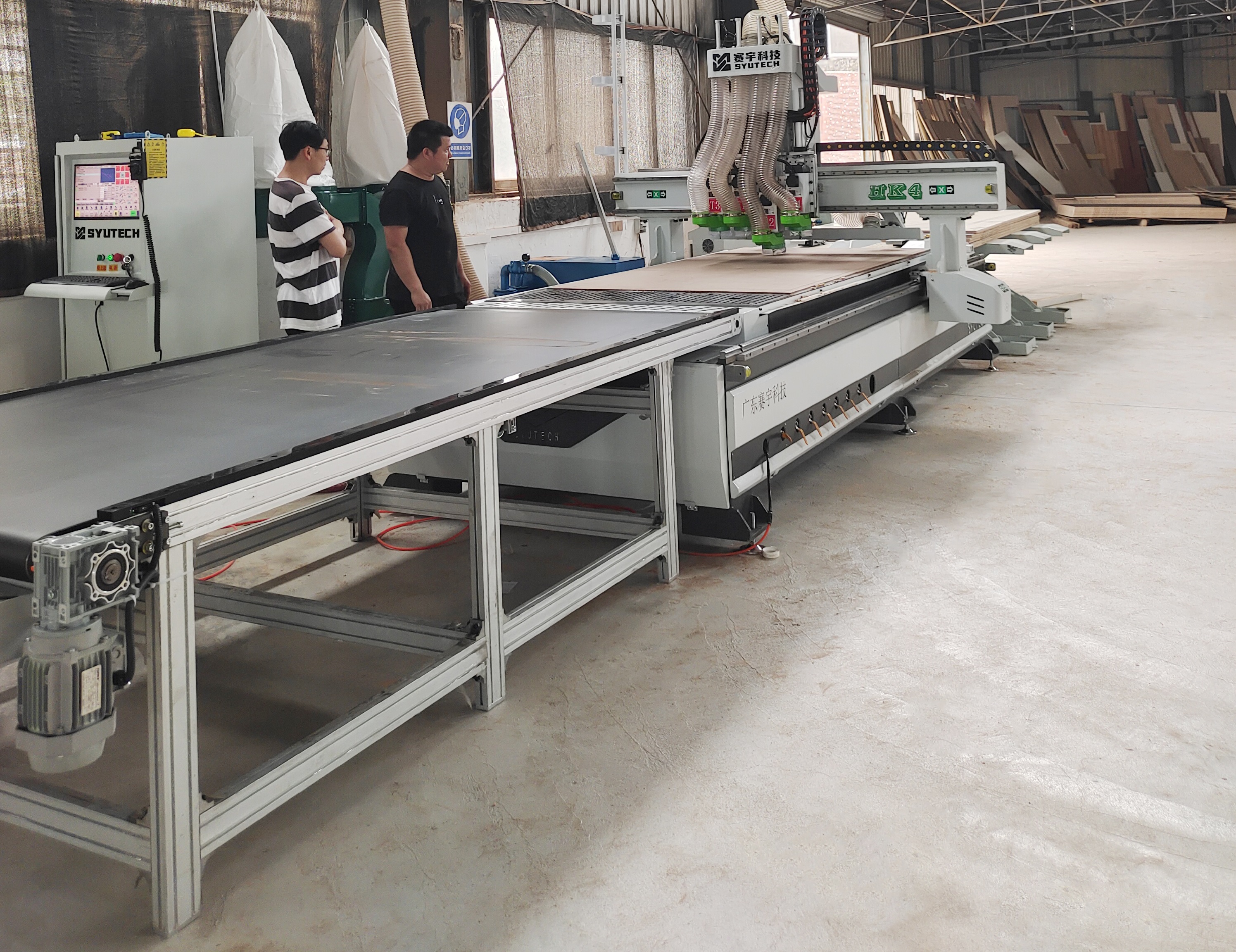
Panel cutting decides the geometry, material yield and pace of everything that follows in panel furniture manufacturing. Two machine architectures dominate this first operation: CNC nesting, where a router spindle mills parts from a full sheet on a fixed work table, and the computer panel saw, where a saw blade cuts panels along programmed straight lines. The two are often framed as alternatives, but the real decision is narrower and more practical: which one fits a defined panel size, batch profile and workshop layout — and whether both belong in the same factory.
SYUTECH (Foshan Shunde SaiYu Technology Co., Ltd.) is a woodworking machinery manufacturer based in Shunde District, Foshan City, Guangdong Province, China, whose documented range covers edge banding machines, CNC nesting machines, six-side CNC drilling machines, computer panel saws and complete panel furniture production lines. This framework uses its published specifications for the HK6 nesting CNC machine, the HK-Line nesting production line and the HK330 computer panel saw, and converts them into the questions a buyer should resolve before placing an order.
Why the Cutting Machine Decision Is Hard to Reverse
Cutting fixes panel dimensions, edge conditions and the workload handed downstream to drilling and edge banding. It also locks in two things that are expensive to change later: floor space and material flow. A cutting machine that is oversized for the batch profile wastes capital and floor area; one that is undersized for panel size or stack thickness creates a permanent bottleneck at the head of the line.
Documented application data shows how tightly cutting equipment is embedded in a wider installation. A panel furniture project producing cabinets and cabinet doors in Romania runs on continuous automatic cycle operation with manual feeding assistance, and lists a vacuum cleaner, vacuum pump and air compressor as matched equipment. A panel furniture manufacturer in Kenya operating an edge banding workshop and a CNC router workshop with three units over a two-year period reports improved edge banding quality and increased output. In both cases the cutting machine is a node in a system, not a standalone purchase.
That is why the useful question is not which architecture is superior in the abstract, but which architecture matches a specific combination of panel size, batch profile and available floor area.
The Two Architectures, Defined by Their Specifications
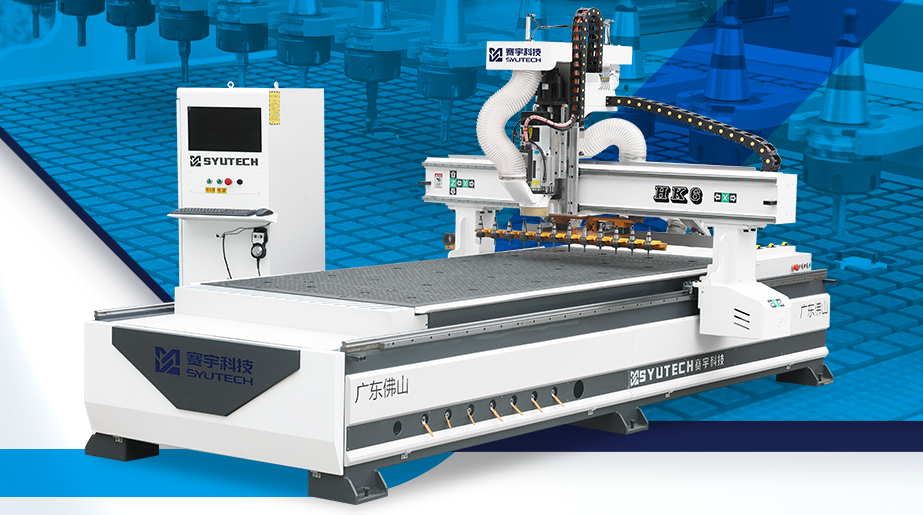
CNC Nesting: Cutting and Drilling in One Setup
On an HK6 nesting CNC machine, the sheet is held on the machine table and the spindle mills part outlines directly from the nest. The documented HK6 specification lists a working range of 1,220 mm on the X-axis, 2,800 mm on the Y-axis and 250 mm on the Z-axis; a 9 kW air-cooled spindle running at 24,000 rpm; a 12-tool automatic tool changer of the straight-line type; four 1.5 kW servo motors with drivers and a Japanese-brand reducer; an 11 kW frequency converter; a Taiwan LNC/SYNTEC control system; and a 380 V, 3-phase, 50 Hz power supply.
The HK-Line nesting production line is built around the same HK-6 nesting machine and adds precision rack and pinion on the X/Y axes from a Taiwan brand, which is the mechanical basis for continuous automated cycles rather than single-sheet processing.
Computer Panel Saw: Throughput on Straight Lines
The HK330 computer panel saw is specified at a maximum cutting speed of 0–100 m/min, a maximum cutting width of 3,300 mm and a maximum cutting height of 100 mm. The main saw motor is rated 16.5 kW with an 18.5 kW option, and the small saw motor is 2.2 kW. The specification lists 13 clamp hands, a minimum working size of 34 × 45 mm, and an overall machine size of 5,900 × 5,950 × 1,900 mm (length × width × height).
Where nesting generates part geometry with a rotating tool, the panel saw generates it with a translating blade. The difference shows up in cycle structure, tooling and the number of setups a job requires — not simply in cutting speed.
Specification Comparison: HK6 Nesting CNC vs. HK330 Computer Panel Saw
| Decision factor | HK6 nesting CNC / HK-Line | HK330 computer panel saw |
|---|---|---|
| Cutting action | Spindle milling; parts nested from a full sheet | Saw blade cutting along programmed straight lines |
| Working range / capacity | X-axis 1,220 mm; Y-axis 2,800 mm; Z-axis 250 mm | Maximum cutting width 3,300 mm; maximum cutting height 100 mm |
| Main drive | 9 kW air-cooled spindle, 24,000 rpm | Big saw motor 16.5 kW (18.5 kW optional); small saw motor 2.2 kW |
| Tool changing | 12-tool automatic tool changer, straight-line type | Not applicable; main and small saw blade configuration |
| Control and drive | Taiwan LNC/SYNTEC control; 4 × 1.5 kW servo motors; 11 kW frequency converter; Japanese-brand reducer | Not listed in the reviewed specification |
| Work holding | Panel held on the machine table; vacuum pump and vacuum cleaner listed as matched equipment in the documented application scenario | 13 clamp hands |
| Minimum working size | Not listed in the reviewed specification | 34 × 45 mm |
| Overall machine size | 5,200 × 2,900 × 2,300 mm for the documented HK-series nesting platform (configuration-dependent) | 5,900 × 5,950 × 1,900 mm (L × W × H) |
| Documented machine weight | 3,500 kg for the HK-series nesting platform | Not listed in the reviewed specification |
| Power supply | 380 V, 3-phase, 50 Hz | Not listed in the reviewed specification |
The gaps in this table are themselves part of the framework. Where a specification is not published, a buyer should request it in writing rather than fill the gap by assumption — particularly for power supply, weight and work-holding, which drive installation cost.
Trade-Offs Buyers Underestimate
Nesting Constrains Floor Space and Tooling, Not Just Cycle Time
The nesting machine is large, fixed geometry. The HK-series nesting platform is documented at 5,200 × 2,900 × 2,300 mm and 3,500 kg, and that footprint excludes the space required for loading, unloading and material staging. A 12-tool magazine also caps how many distinct tools one job can call without operator intervention, so complex multi-profile nests can require changes that interrupt the cycle. Nesting also depends on programming quality: output follows the nest and the toolpath, which is a skills constraint rather than a machine constraint.
The Panel Saw Is Fast but Geometrically Limited
A computer panel saw cuts straight lines. Curved parts, shaped components and routed features require a separate routing operation, and holes require a separate drilling machine — so the saw's cutting-speed advantage can be partly consumed by handling between operations. The 100 mm maximum cutting height also defines how thick a stack the saw can process. And the overall size of 5,900 × 5,950 mm is nearly square, meaning the layout must reserve a large, roughly square floor zone before infeed and outfeed clearances are added.
Automation Has a Threshold, and It Is Defined by Two Numbers
For buyers considering a higher-automation path, the documented position on a customized automatic production line is explicit: the configuration requires the daily output requirement and the size of the workshop before it can be specified. That boundary is worth accepting early. An automated line is a layout and volume project rather than a machine upgrade, and it applies only where both inputs are defined. The same logic governs integrated handling equipment — labeling, cutting, punching and feeding functions combined in one automatic machine — which only makes sense once the material flow between cutting, drilling and edge banding has been mapped.
A Buyer Checklist: Matching Machine Type to Panel Size, Batch Profile and Layout
| Decision input | What to verify | Why it changes the choice |
|---|---|---|
| Largest panel and thickest stack | Compare against HK6 X 1,220 mm, Y 2,800 mm, Z 250 mm; and HK330 3,300 mm cutting width, 100 mm cutting height | Feasibility is settled before performance; a machine outside the range is not a candidate |
| Batch profile | Repeated rectangular sizes in volume versus mixed parts and shapes | Repeated straight cuts favour the saw; mixed nests and shaped parts favour nesting |
| Second operations | Are holes, grooves or shaped edges needed? | A saw-only line needs additional setups; nesting plus a drilling platform can consolidate them |
| Floor zone | Overall machine size plus loading, unloading and staging clearances | 5,200 × 2,900 mm (nesting platform) and 5,900 × 5,950 mm (panel saw) produce different layouts |
| Automation level | Daily output target and workshop size | These two values are the documented inputs required to configure a customized production line |
| Market compliance | CE for the EU; OSHA 29 CFR 1910.213 and ANSI O1.1-2013 (R2023) for the United States | Compliance shapes guarding, controls and documentation, and affects installation acceptance |
| Supply terms | MOQ, lead time, factory testing, after-sales channel | Documented terms include MOQ 1 set, 30–45 day lead time and 100% testing |
Compliance and Certification as Part of the Cutting Decision
Machine capability is not the only constraint on the cutting step. SYUTECH's CE documentation covers certificate number HTT202405661L, issued by HTT, referencing EN ISO 12100:2010 and EN 60204-1:2018 under Machinery Directive 2006/42/EC and Low Voltage Directive 2014/35/EU, with an issue date of 5 June 2024. The certified product scope includes the Computer Panel Saw and the CNC Nesting Production Line. For EU-bound buyers, that documentation status belongs inside the machine comparison rather than in a separate legal review.
Outside the EU the framework changes. In the United States, OSHA maintains a dedicated woodworking machinery requirement standard at 29 CFR 1910.213, and ANSI O1.1-2013 (R2023) sets safety requirements for machinery rated 5 hp or greater. Buyers comparing machines across markets should treat these as configuration inputs — guards, controls and documentation all follow from them.
Regulatory calendars reinforce the point. The EU Deforestation Regulation (EU) 2023/1115 is enforceable from 30 December 2026, which adds traceability pressure on the material side of panel furniture production, and the EU machinery regulation framework continues to define product requirements for the European market.
What the Market Data Says About This Decision
The automated segment of woodworking machinery held 48.2% market share in 2025, according to Fortune Business Insights. That figure is more useful as a signal than as a headline: a growing share of buyers are selecting machines on integration and output rather than unit price alone.
Trade reporting in 2026 describes woodworking machinery being evaluated less as a standalone purchase and more as part of a connected production system, which pushes cutting, drilling and edge banding into a single comparison. Adoption is not uniform. A 2022 study conducted with subscribers to a major North American wood industry trade journal found that few companies were familiar with Industry 4.0 and digitized manufacturing concepts — a reminder that a buyer's own automation readiness is a legitimate variable in the decision, not an afterthought.
Future Outlook
Panel cutting is unlikely to converge on a single architecture. High-mix, made-to-order production rewards nesting, because one machine produces both the part outline and the drilling pattern within the same setup. Long-run production in standard sizes rewards the panel saw, because a blade converts a sheet in fewer, faster passes. What is changing is the connective tissue between them: labeling, feeding and material handling that turn separate machines into one flow. SYUTECH's catalogue already documents this direction through its automatic production lines and its combined labeling, cutting, punching and feeding machine.
For buyers planning a purchase in the next cycle, the practical implication is to specify the cutting step with the next two steps in view — the drilling platform and the edge bander — and to size the floor layout for the connection rather than for the machine alone.
FAQ
Can a CNC nesting machine replace a computer panel saw for panel furniture cutting?
They perform different cutting actions. An HK6 nesting CNC machine mills part outlines from a full sheet within a documented working range of 1,220 mm × 2,800 mm with a 250 mm Z-axis, using a 9 kW air-cooled spindle at 24,000 rpm and a 12-tool automatic tool changer. An HK330 computer panel saw cuts straight lines at up to 100 m/min with a maximum cutting width of 3,300 mm and a maximum cutting height of 100 mm. Nesting covers shaped parts and, where a drilling platform is in the line, can reduce the number of setups; a panel saw converts rectangular panels and stacked material faster. Neither covers every batch profile on its own.
What panel dimensions can each machine handle?
The HK6 nesting CNC machine is specified with a working range of 1,220 mm on the X-axis, 2,800 mm on the Y-axis and 250 mm on the Z-axis. The HK330 computer panel saw is specified with a maximum cutting width of 3,300 mm, a maximum cutting height of 100 mm and a minimum working size of 34 × 45 mm. Panel dimensions and stack thickness should be checked against these figures before any other comparison.
What certification should an EU-bound woodworking machine carry?
The documentation associated with the machines discussed here is CE certification issued by HTT under certificate number HTT202405661L, dated 5 June 2024, referencing Machinery Directive 2006/42/EC and Low Voltage Directive 2014/35/EU, with standards EN ISO 12100:2010 and EN 60204-1:2018. For the United States, the comparable framework is OSHA 29 CFR 1910.213, alongside ANSI O1.1-2013 (R2023), which establishes safety requirements for machinery rated 5 hp or greater.
How much floor space should be planned for each option?
Documented overall sizes are 5,900 × 5,950 × 1,900 mm (L × W × H) for the HK330 computer panel saw and 5,200 × 2,900 × 2,300 mm with a 3,500 kg machine weight for the HK-series nesting platform. The two layouts differ in shape: the panel saw occupies a nearly square zone, while the nesting machine is elongated and needs clearance along the loading direction. Neither figure includes material staging or in-process buffer areas.
When does a nesting production line make more sense than a single nesting machine?
The HK-Line nesting production line uses the same HK-6 nesting machine with precision rack and pinion on the X/Y axes from a Taiwan brand, aimed at continuous automated cycles rather than single-sheet processing. For a higher-automation configuration, the documented input requirement for a customized automatic production line is the daily output requirement and the size of the workshop — those two values determine whether a line configuration applies at all.
What supply terms should be confirmed before ordering?
Documented supply terms include a minimum order quantity of one set, a lead time of 30–45 days, a monthly capacity of 100 sets, 100% testing and remote after-sales support. Customization covers logo, color and voltage, and the documented export footprint covers the EU, the Middle East, Russia, India, South Korea, Malaysia, Brazil, the United States, Africa and Vietnam.
Reference material: the manufacturer's factory promotional brochure, covering its woodworking machine range and production line configurations, is available as a PDF download here. Product information is also published at syutech.com.