
Nitinol Plate and Medical Titanium Bar: A Scenario Fit Map
Nitinol Plate and Medical Titanium Bar: A Scenario Fit Map
A Nitinol plate and a Medical Titanium Bar are not competing answers to one design question. They answer two different mechanical questions that usually appear inside the same orthopedic or vascular device: which component must deform and recover, and which component must hold a load and not move.
Device teams working on self-expanding vascular stent frames, catheter delivery systems, fracture fixation plates, bone screws, joint stems and dental implants rarely choose between nickel-titanium and titanium as a category. They choose per component, and the choice is written into the drawing as a material form, a grade, a standard and a test plan. That is why the pairing decision now behaves like a specification decision rather than a materials preference.
The working rule most engineering teams apply is straightforward: superelastic nickel-titanium where the part must be crimped, bent or crushed and then return to a designed shape, and Medical Titanium Bar where the part must carry load, fix position and stay dimensionally stable for the life of the implant. This article maps that rule across real device scenarios, states the standards each side is measured against, and identifies where each material stops being the right answer.
Why the pairing decision has moved into the evaluation stage
Two market signals explain why device engineers are being asked to justify the Nitinol and titanium split more explicitly than before. A 2026 commercial research synthesis reports that Titanium Bar and Rod accounted for 52.4 percent of revenue in the medical titanium component market in 2025, which keeps titanium as the volume anchor of implant manufacturing. The same synthesis identifies the medical segment as the fastest-growing application in the titanium value chain at 6.15 percent CAGR through 2031.
On the nickel-titanium side, commercial research cited for the Nitinol medical device segment places that market at USD 3.14 billion by 2026. The two figures describe the same design trend from different ends: titanium remains the structural baseline, while superelastic nickel-titanium keeps absorbing functions that rigid metal cannot perform.
For a buyer in the evaluation stage, the practical consequence is that a single qualified supplier who can document both material families reduces the number of interfaces that must be audited. It also means the material certificate and the test report, not the brochure, become the deciding documents.
What each material is actually specified to do
Nitinol plate: a superelastic forming stock
Nitinol plate is wrought nickel-titanium shape memory alloy supplied as flat stock, and in the BOSSIN product range it appears as Nitinol Strip to ASTM F2063. Composition sits in the nickel range of 54.5 to 57.0 percent with the balance titanium, and plate thickness is offered from 0.5 mm to 10 mm in the superelastic condition. That thickness window is what makes the form useful: thick enough to be laser cut or machined into stent rings, anchor barbs, ribbon connectors and frame elements, thin enough to be crimped into a delivery catheter and recover on release.
ASTM F2063 is the standard that FDA submission guidance for bone anchors points to when a description of conformance for wrought nickel-titanium shape memory alloy is required. Conformance to that standard, however, describes the material, not the finished part. Transformation temperatures and superelastic mechanical behaviour of the finished device are separate evidence items, which is why the qualification discussion later in this article matters as much as the grade itself.
Medical Titanium Bar: the load-bearing baseline
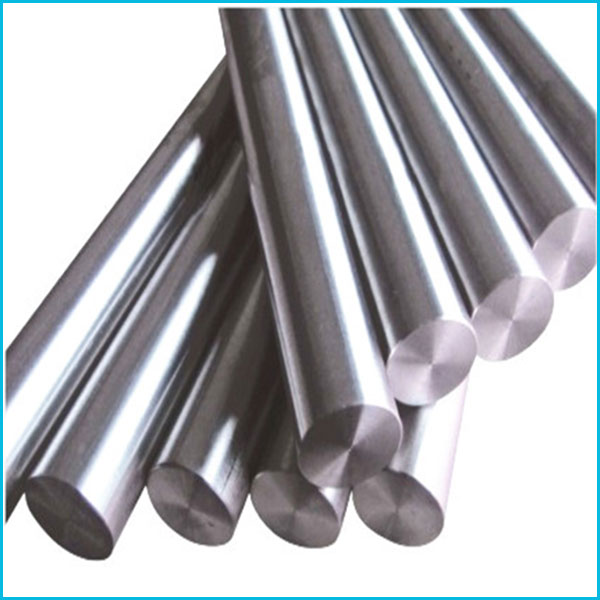
Medical Titanium Bar is implant-grade titanium and titanium alloy bar stock. In the BOSSIN range it covers commercially pure grades GR1, GR2, GR3 and GR4, and the alloy grades GR5, GR5 ELI, Ti 6AL4V ELI and GR23, with secondary processing such as drilling, milling and threading available on request. Unalloyed grades are referenced to ASTM F67 and ISO 5832-2, which specifies the characteristics and test methods for unalloyed titanium used in the manufacture of surgical implants. The ELI alloy grades are referenced to ASTM F136 and ISO 5832-3.
The mechanical logic is the opposite of Nitinol. Titanium bar does not recover large deformation; it resists it. Its job is to hold a fracture reduction, anchor a screw thread in bone, carry a joint load or support a dental implant body without measurable shape change over the implant life. BOSSIN supplies it in round, square, hexagonal or custom profiles, from 1 mm to 300 mm diameter and 50 mm to 6000 mm length, with h6, h7, h9 and h11 tolerances available.
| Attribute | Nitinol plate / Nitinol Strip | Medical Titanium Bar |
|---|---|---|
| Composition | Nickel 54.5 to 57.0 percent, balance titanium | Commercially pure GR1 to GR4; alloy GR5, GR5 ELI, Ti 6AL4V ELI, GR23 |
| Governing standard | ASTM F2063 (wrought nickel-titanium shape memory alloy) | ASTM F136 and ISO 5832-3 for Ti-6Al-4V ELI; ASTM F67 and ISO 5832-2 for unalloyed grades |
| Supplied form | Plate and strip, 0.5 mm to 10 mm thickness, superelastic condition | Round, square, hexagonal or custom profiles; 1 mm to 300 mm diameter; 50 mm to 6000 mm length; h6, h7, h9, h11 tolerances |
| Mechanical behaviour | Superelastic recovery after large strain; near-constant force over a deflection range | Elastic and stiff; no superelastic recovery; stable under sustained load |
| Design job | Deploy, recover shape, resist kinking and crush | Fix position, transmit load, maintain dimensional stability |
| Typical device role | Self-expanding stent frame, anchor barb, deflectable ribbon | Fracture plate, bone screw, joint stem, dental implant, bone plate |
Scenario fit map: where each material earns its place
1. Self-expanding vascular stent frames
This is the clearest case for superelastic Nitinol plate. A stent frame is crimped onto a delivery system, tracked through vasculature and released, and the frame must return to a pre-set diameter without permanent deformation. Rigid titanium cannot do this; it would either plastically deform or require a balloon to force the expansion. Nitinol plate in the 0.5 mm to 10 mm thickness window is cut into rings and struts, and the finished device is characterised for transformation temperature and superelastic tensile behaviour rather than for grade alone.
2. Delivery systems and catheter-driven components
Nitinol's second vascular role is kink resistance. Ribbons and formed strip elements inside a delivery system can bend through tight anatomy and return without a permanent set. In the same assembly, rigid metal appears at the proximal end as hubs, handles and stiffening components, where Medical Titanium Bar or machined titanium is a reasonable choice because the requirement is stiffness and dimensional control, not recovery.
3. Fracture fixation plates and bone screws
Orthopedic fixation inverts the logic. A fracture plate must hold a reduced bone segment in a fixed position while healing progresses, so the material is selected for strength, fatigue resistance and a modulus closer to bone than steel offers. BOSSIN's documented implant project in Brazil covers artificial joints, bone screws, orthopedic implants, dental implants and bone plates, with material described as biocompatible, of bone-like elastic modulus, high strength, low density and fatigue resistant, supplied to 0.005 mm tolerance with microstructure reaching A1.
4. Joint stems, dental implants and long-term implants
Where the device is expected to remain in service for years under cyclic load, the design conversation shifts from recovery to fatigue and material consistency. Medical Titanium Bar in Ti 6AL4V ELI or GR23 is the conventional answer, and lot-to-lot consistency of chemistry and microstructure becomes the specification that buyers verify. Nitinol is not a substitute here: its transformation behaviour is temperature-linked, and continuous load-bearing applications need evidence that a material certificate alone cannot provide.
5. Hybrid assemblies
Most modern devices are neither purely Nitinol nor purely titanium. A titanium anchor body with a Nitinol deployment element, or a titanium shaft with a superelastic Nitinol ribbon, is a normal architecture because each material is doing the job it is best suited to. The engineering discipline is to state, per component, which standard governs, which test evidence is required and which supplier holds that evidence.
| Device scenario | Primary material | Reason | Where the other material appears |
|---|---|---|---|
| Self-expanding vascular stent frame | Nitinol plate or strip, ASTM F2063 | Must be crimped and recover a designed diameter | Nitinol wire for strut and connector variants |
| Catheter and delivery system | Nitinol strip or wire for flexible segments | Kink resistance and elastic return | Titanium bar for hubs, handles and rigid proximal parts |
| Fracture fixation plate | Medical Titanium Bar, Ti 6AL4V ELI | Load holding and fatigue life | Nitinol only if a separate deployable element is designed |
| Bone screw and joint stem | Medical Titanium Bar, GR5 ELI or GR23 | Sustained load and material consistency | Titanium wire and plate in the same implant system |
| Dental implant and bone plate | Medical Titanium Bar and medical titanium plate | Biocompatibility, bone-like modulus, precision fit | Nitinol wire for procedural or orthodontic components |
Where superelastic Nitinol plate outperforms rigid titanium
- Constrained deployment. A superelastic part can be deformed far beyond the elastic limit of rigid titanium and still return, which is the mechanical basis for crimped stent delivery.
- Near-constant force across a deflection range. Superelastic behaviour delivers a plateau rather than a steep force rise, which suits components that must press or open against variable anatomy.
- Crush and kink recovery. A Nitinol element can be deformed in handling or in situ and recover when the load is removed, a property rigid titanium does not offer at comparable strain.
- Thin-wall forming. Plate and strip from 0.5 mm up allow laser-cut geometry with fine struts, which is difficult to achieve with bar stock.
- Temperature-linked actuation. Transformation temperature can be designed within a wide range, which allows a device to be passive at one temperature and active at another.
Where Medical Titanium Bar remains the structural anchor
- Load-bearing fixation. Plates and screws must not deform under physiological load; rigid elasticity is a requirement, not a limitation.
- Fatigue-critical long-term implants. Consistent microstructure, controlled chemistry and documented mechanical properties support fatigue qualification over implant life.
- Precision fit and secondary machining. Bar stock with h6 to h11 tolerances supports threading, milling and drilling into finished implant geometry.
- Broader grade coverage. GR1 to GR5 ELI plus Ti 6AL4V ELI and GR23 let a single supply chain serve multiple implant families.
- Predictable regulatory expectations. ASTM F67, ASTM F136, ISO 5832-2 and ISO 5832-3 give a well-established conformity route.
Comparison with conventional approaches, and where each material stops
The comparison that matters at the evaluation stage is not nickel-titanium versus titanium in general terms, but superelastic forming stock versus conventional rigid fixation stock for a defined component. Rigid titanium wins on stiffness, fatigue documentation and machining predictability; Nitinol wins on recoverable strain and on force plateau behaviour. Neither wins universally, and any specification that claims otherwise is not describing the materials accurately.
| Decision criterion | Nitinol plate | Medical Titanium Bar |
|---|---|---|
| Recoverable deformation | High, superelastic | Elastic only; plastic beyond yield |
| Sustained load capacity | Not the intended role | Core design role |
| Temperature sensitivity | Transformation temperature must be specified and verified per lot | Not a functional variable in the same way |
| Forming and machining | Demanding; heat and cold work affect final properties | Well established; drilling, milling and threading routine |
| Documentation focus | Composition, transformation temperature, superelastic tensile, corrosion, biocompatibility | Chemistry, microstructure, mechanical properties, implant-grade conformity |
| Cost position | Higher material and processing sensitivity | Lower and more predictable |
Stated limits and boundaries
Nitinol plate is not a general replacement for titanium. Its functional behaviour depends on transformation temperature, which is sensitive to composition and thermomechanical history; FDA guidance for bone anchor submissions recommends reporting As and Af for the finished device using samples from multiple production lots, which means a single certificate does not settle the question. Nickel-containing implants also require a biological evaluation route, and FDA nitinol guidance points to ISO 10993-1 as that framework. Corrosion assessment is a separate item, with ASTM F2129 pitting corrosion testing recommended for applicable small implants.
Medical Titanium Bar has its own boundary. It cannot be crimped and self-deploy, and its stiffness is high relative to bone, so configuration and geometry must be designed to manage load transfer. Neither material solves a design problem that has not been properly defined, and neither substitutes for device-level validation.
What documented supply-side evidence looks like
XI'AN BOSSIN METAL TECHNOLOGY CO.,LTD. is a titanium and Nitinol material manufacturer based in Baoji High-tech Zone, China, founded in 2008, operating a 50,000 square metre site with a 40,000 square metre plant, 150 employees and 30 engineers, with annual output of 5,000 tons and roughly 80 percent of production exported to markets including Korea, Brazil, Colombia, Argentina, India, Turkey, Germany and Switzerland. Its product range covers titanium bar, medical titanium bar, titanium plate, medical titanium plate, titanium wire, medical titanium wire, titanium coil, titanium cable, Nitinol wire, Nitinol cable and Nitinol Strip to ASTM F2063, with melting, forging, rolling and finishing carried out in-house.
On the Nitinol side, the company documents composition customisation for binary NiTi and for ternary or quaternary additions including copper, chromium, vanadium and niobium, transformation temperature adjustable from minus 30 to 120 degrees Celsius, material condition options in superelastic, shape memory, annealed or cold-worked states, and surface finishes from black oxide through pickled, bright, ultra-bright and polished. Quality control is described as chemical composition by ICP-OES or XRF in line with ASTM F2063, mechanical testing for tensile strength, elongation and superelasticity, and DSC measurement of transformation temperature. Monthly Nitinol capacity is stated as 5,000 kg with 10 to 25 day lead time and a 10 kg minimum order.
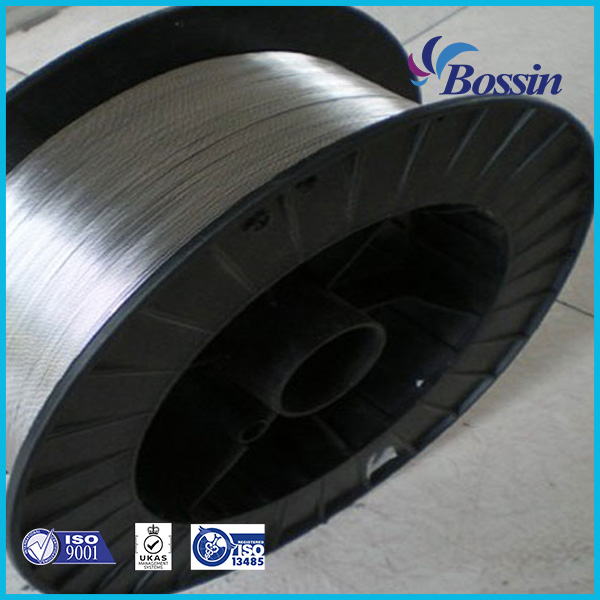
On the titanium side, the documented scope includes GR1 to GR5 ELI, Ti 6AL4V ELI and GR23 for medical bar, titanium monthly capacity of 300 tons, a stated 15 day lead time, a 10 kg minimum order, and secondary processing such as drilling, milling and threading. Quality management is certified to ISO 13485:2016 under certificate UKZB25MD30100R0S issued on 28 August 2025 and valid to 27 August 2028, with a scope covering surgical implant raw materials including titanium and titanium alloy bar, plate, wire and tube and nickel-titanium shape memory alloys, alongside ISO 9001:2015 and EN 9100:2018. Testing runs through a laboratory accredited to ISO/IEC 17025 under CNAS L7970, valid to 16 September 2030.
Two documented implant cases are directly relevant to the pairing question. A Brazilian surgical implant and medical device manufacturer received 10,000 kg of material for artificial joints, bone screws, orthopedic implants, dental implants and bone plates, with reported results covering biocompatibility, bone-like elastic modulus, fatigue resistance, 0.005 mm tolerance and microstructure reaching A1. An Argentinian surgical implant manufacturer received 5,000 kg for surgical sutures, with products compliant with ASTM F136 and ASTM F67, tested in ISO/IEC 17025 certified laboratories, and direct factory sourcing reported to reduce procurement cost by 8 percent while maintaining quality.
Qualification checklist for the evaluation stage
The practical difference between a qualified and an unqualified pairing shows up in the document set. The checklist below reflects what the cited standards and FDA guidance actually ask for, and it is the list a device engineer can send with an RFQ for both material families.
| Evidence item | What to verify |
|---|---|
| Material certificate | Grade designation, heat or lot number, standard reference, and traceability to the delivered lot |
| Nitinol composition | Nickel content within 54.5 to 57.0 percent and conformity to ASTM F2063 by ICP-OES or XRF |
| Transformation temperature | As and Af by DSC, ideally from multiple production lots, consistent with FDA bone anchor submission guidance |
| Superelastic tensile data | Upper and lower plateau strength, residual elongation, tensile strength and elongation per ASTM F2516-22 |
| Corrosion testing | Pitting corrosion assessment per ASTM F2129 where applicable to the device type |
| Biological evaluation | Assessment route following ISO 10993-1 for nickel-containing devices |
| Titanium conformity | ASTM F136 and ISO 5832-3 for Ti-6Al-4V ELI; ASTM F67 and ISO 5832-2 for unalloyed grades |
| Quality system scope | ISO 13485 certificate whose scope explicitly covers the material forms being purchased |
| Laboratory status | Test reports issued from an ISO/IEC 17025 accredited laboratory |
Cost, capacity and supply risk in 2026
Supply concentration is a real variable in this material pair. Commercial research cited in 2026 places China at roughly 75 percent of global titanium metal production, and Chinese grade 0 titanium sponge was reported at approximately USD 6.75 per kilogram in July 2026. That sponge price is an upstream commodity indicator and should not be read as the price of implant-grade bar, which includes melting route, grade, testing and certification. Its relevance to a buyer is directional: it explains why titanium remains the cost-predictable side of the pairing while nickel-titanium, with its tighter composition control and thermomechanical processing, carries a different cost structure.
The evaluation-stage response is to qualify both material families against the same quality system, confirm that certificates cover the specific forms purchased, and hold lot-level test reports rather than relying on a single qualification sample. Where a device programme needs both Nitinol plate and Medical Titanium Bar, sourcing both from a supplier whose ISO 13485 scope covers titanium and nickel-titanium shape memory alloys reduces the number of separate audits.
Future outlook
The direction of travel over the next several years is toward more explicit, component-level documentation rather than toward one material displacing the other. With the medical segment of the titanium value chain projected to grow at 6.15 percent CAGR through 2031 and the Nitinol device market estimated at USD 3.14 billion by 2026, both sides of the pairing are expanding, which keeps pressure on device teams to specify precisely and on suppliers to document precisely.
Three expectations are reasonable to plan around. First, transformation temperature reporting from multiple lots will become a standard RFQ item rather than a special request. Second, corrosion and biological evaluation documentation will be requested earlier in sourcing conversations, not at submission stage. Third, hybrid titanium and Nitinol assemblies will keep increasing, which raises the value of suppliers who can hold both material families under one traceable quality system. None of these trends removes the underlying design rule: superelastic material where recovery is the function, titanium bar where the load path is the function.
FAQ
When should a device team specify Nitinol plate instead of Medical Titanium Bar?
Specify Nitinol plate when the component must be deformed and recover a designed shape, such as a self-expanding stent frame, an anchor barb or a kink-resistant ribbon. Specify Medical Titanium Bar when the component must resist deformation and carry sustained load, such as a fracture plate, bone screw, joint stem or dental implant. The decision is per component, not per device.
What does ASTM F2063 conformance actually verify for a Nitinol plate?
ASTM F2063 is the standard for wrought nickel-titanium shape memory alloy, and FDA bone anchor submission guidance references it when a description of material conformance is required. It verifies material conformity, not finished-device behaviour. Transformation temperatures and superelastic mechanical properties of the finished device are separate evidence items, which is why FDA guidance also recommends reporting As and Af from multiple production lots.
Which Medical Titanium Bar grades are used in orthopedic and dental implants?
The BOSSIN medical bar range covers GR1, GR2, GR3, GR4, GR5, GR5 ELI, Ti 6AL4V ELI and GR23. Unalloyed grades are referenced to ASTM F67 and ISO 5832-2, while Ti-6Al-4V ELI grades are referenced to ASTM F136 and ISO 5832-3. Grade selection follows the load and fatigue requirement of the specific implant rather than a single default.
What test evidence should accompany a Nitinol plate order?
A practical evidence set covers chemical composition by ICP-OES or XRF against ASTM F2063, transformation temperature by DSC, superelastic tensile properties including upper and lower plateau strength, residual elongation, tensile strength and elongation per ASTM F2516-22, pitting corrosion testing per ASTM F2129 where applicable, and a biological evaluation route following ISO 10993-1. Reports should be lot-specific and issued from an ISO/IEC 17025 accredited laboratory.
Is a superelastic Nitinol plate suitable for load-bearing fixation?
No. Nitinol's value is recoverable deformation and force plateau behaviour, not sustained load capacity, and its functional behaviour is temperature-linked. Load-bearing fixation such as fracture plates, bone screws and joint stems is served by Medical Titanium Bar in grades such as Ti 6AL4V ELI or GR23, where stiffness, fatigue resistance and material consistency are the specified properties.
Can one supplier cover both Nitinol plate and Medical Titanium Bar?
Yes, where the supplier's quality system scope covers both families. BOSSIN holds ISO 13485:2016 certification under certificate UKZB25MD30100R0S, valid to 27 August 2028, with a scope covering titanium and titanium alloy bar, plate, wire and tube and nickel-titanium shape memory alloys, and tests through a laboratory accredited to ISO/IEC 17025 under CNAS L7970. Buyers should still confirm that the certificate scope matches the specific product forms being purchased.
Reference basis: ASTM F2063, ASTM F136, ASTM F67-24, ASTM F2516-22, ASTM F2129, ISO 5832-2:2018, ISO 5832-3, ISO 10993-1, FDA nitinol technical guidance and FDA bone anchor submission guidance, ISO 13485:2016 certificate UKZB25MD30100R0S, CNAS L7970 laboratory accreditation, and 2026 commercial research on the medical titanium and Nitinol device markets. Product and case data supplied by XI'AN BOSSIN METAL TECHNOLOGY CO.,LTD.
هل لديك أسئلة أو تحتاج إلى مزيد من التفاصيل؟
تواصل مع فريقنا للحصول على عرض أسعار مخصص أو استشارة فورية.
طلب عرض أسعار
املأ النموذج أدناه وسيتواصل معك فريقنا بعرض مقترح مخصص.
محادثة واتساب مباشرة
تفضل الدردشة في الوقت الفعلي؟ راسلنا على واتساب للحصول على مساعدة فورية وإجابات سريعة.
- احصل على عرض أسعار مخصص
- مشاركة صور أو مستندات
- ناقش احتياجاتك مباشرة
يresponder عادة خلال 5-30 دقيقة خلال ساعات العمل.