
Nitrile Glove Capability Checks: What Buyers Should Verify
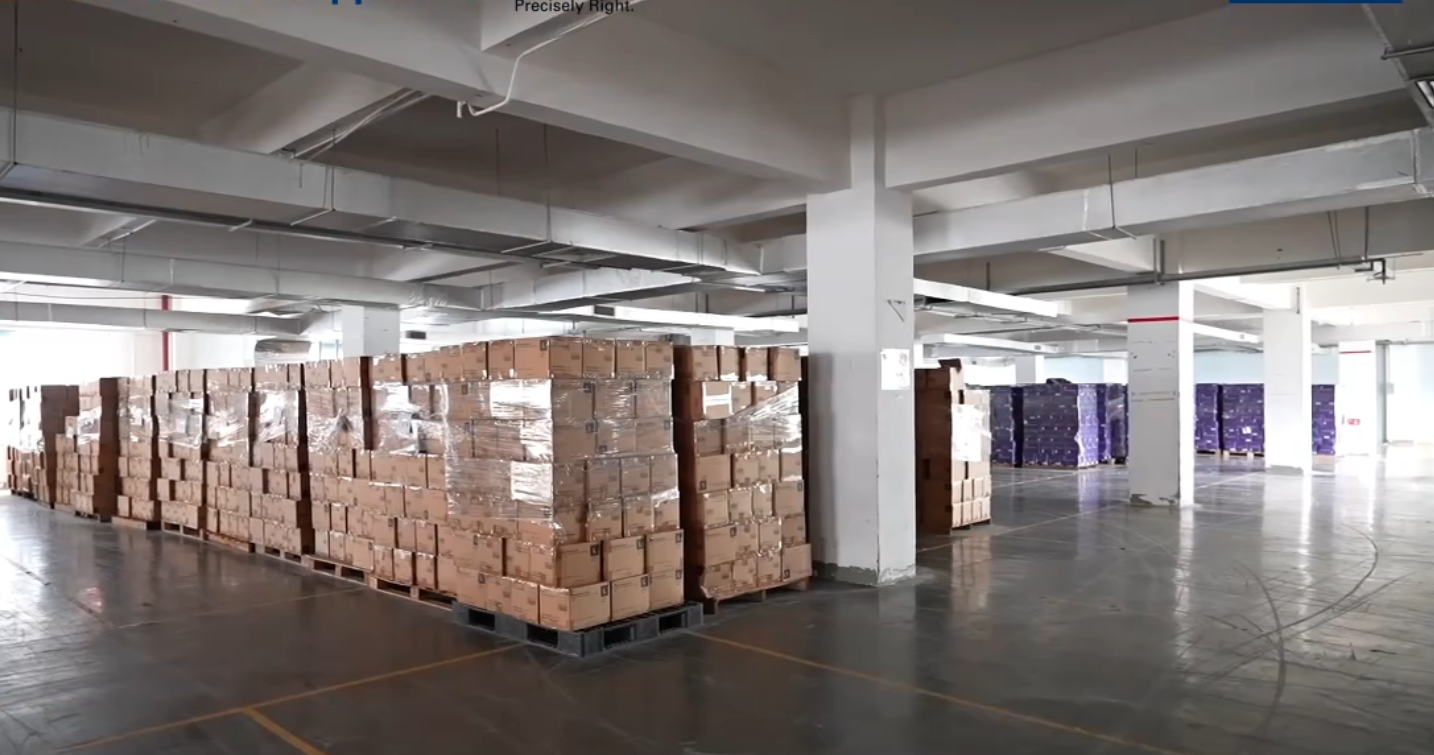
When buyers evaluate a nitrile glove manufacturer for actual purchase, the most important question is not simply what the glove contains, but whether the manufacturer can repeat the same specification across large, time-sensitive shipments. Capability verification bridges the gap between a product sample and a dependable bulk order.
Procurement teams sourcing disposable nitrile gloves are usually shown three layers of evidence: product specification sheets, certification documents, and physical samples. At the Evaluation-to-Execution stage, this evidence set becomes insufficient on its own. A tested sample may perform well while a production line may still struggle to maintain thickness, powder-free status, packaging integrity, or the same quality level across millions of pieces. For that reason, buyers are increasingly moving from product evaluation to manufacturer capability evaluation, especially when the order involves medical, food-service, or industrial contracts where certification traceability is part of the purchasing requirement.
Why Capability Verification Matters More in 2026
The economic environment for nitrile gloves continues to support long-term procurement commitments. According to Grand View Research, the global nitrile gloves market was valued at USD 6.5 billion in 2025 and is projected to reach USD 13.2 billion by 2033. Where demand is large and durable, supply risk becomes commercial risk. A buyer who has not verified production capacity, quality-system execution, and certification maintenance may discover mid-contract that their supplier cannot sustain consistency or documentation standards.
Market structure also explains why buyers need sharper capability filters. Powder-free nitrile gloves accounted for 74.8% of global revenue in 2025, and the medical and healthcare sector represented the largest end-use segment at 80.1%, according to the same Grand View Research dataset. Powder-free medical categories are exactly where AQL levels, barrier performance, allergen control, and clean manufacturing processes matter most. These attributes cannot be assessed by looking at a finished glove alone. They are determined by manufacturing discipline, by coating and leaching process control, by line inspection, and by documented conformity. In practical terms, the purchase decision increasingly depends on the supplier's “capability stack”: the combination of manufacturing scale, reproducible quality control, regulatory documentation, customization capacity, and commercial execution history.
The Capability Stack in Nitrile Glove Manufacturing
A practical way to evaluate a nitrile glove manufacturer is to separate capability into five layers. Each layer answers a different procurement question and should be verified with different evidence.
1. Manufacturing Scale and Facility Credibility
Large buyers need evidence that a manufacturer can handle container-level volume without disrupting existing production schedules. Facility scale, line automation, headcount, and output figures form the first evidence set.
Huizhou Anboson Technology Co., Ltd. (ANBOSON), a disposable medical glove and PPE manufacturer based in Huizhou, China, can serve as a reference example of how such capabilities are presented to buyers. The company operates a 42,000-square-meter automated production facility with more than 300 employees and exports approximately 70% of its output to markets including North America, Europe, and Japan. Its stated annual production capacity exceeds 3.2 billion gloves, and monthly production capacity is disclosed as 300 million pieces. Buyers can match disclosed output figures against order scale: a five-container order and a twenty-container program place very different demands on the supplier's production planning and warehousing.
Beyond line capacity, the manufacturer’s profile includes recognition as a Chinese National “Little Giant” Enterprise and designation as a Provincial Engineering Technology Research Center. These designations are based on specialization, innovation, and quality system records. For procurement teams that are not familiar with Chinese provincial or national qualification frameworks, these recognitions still provide a useful public-signal layer, but they should be reviewed alongside operational evidence rather than treated as a substitute for it.
2. Quality Execution and Inspection Protocol
Certifications prove that a product type has met a standard at a point in time. Quality execution determines whether that standard is met on a continuous production basis. Buyers should therefore look for concrete controls such as in-process material inspection, finished-product inspection, sampling methods, and quality management certification.
ANBOSON states that every glove undergoes full inspection before leaving the facility, and that finished product quality is maintained under an AQL 1.5 sampling standard. The manufacturer’s quality control procedures also include on-site material and finished-product inspection, Quality Management System Certification, and TÜV assessment. From a buyer’s perspective, the combination of 100% full inspection plus AQL 1.5 sampling is meaningful because it indicates both a screening step and a statistical acceptance framework. However, AQL 1.5 is not a zero-defect guarantee. It remains a statistically valid acceptance quality limit, which is why professional procurement programs normally add independent pre-shipment inspection or third-party testing to the supplier’s internal protocol.
3. Certification and Compliance Evidence
Regulatory documentation is the most verifiable part of a nitrile glove supplier’s capability. Buyers should map the required certification for each target market and then confirm that the certificate or test report actually exists, is current, and corresponds to the product model being purchased.
For medical-use nitrile gloves, ANBOSON holds FDA 510(k) clearance and has product coverage registered under EUDAMED, with SRN: CN-MF-00039003. A range of EN 455 tests for disposable medical gloves, EN 374-series tests for protective gloves, and ISO 10993 biocompatibility tests are documented through third-party laboratories and notified bodies. For food-contact applications, the documented evidence base includes testing under FDA 21 CFR 177.2600, China GB 4806.11-2016, and Japan MHLW Notification No. 370. Quality management systems are certified under ISO 13485, while social and environmental compliance is supported by BSCI and RoHS conformity.
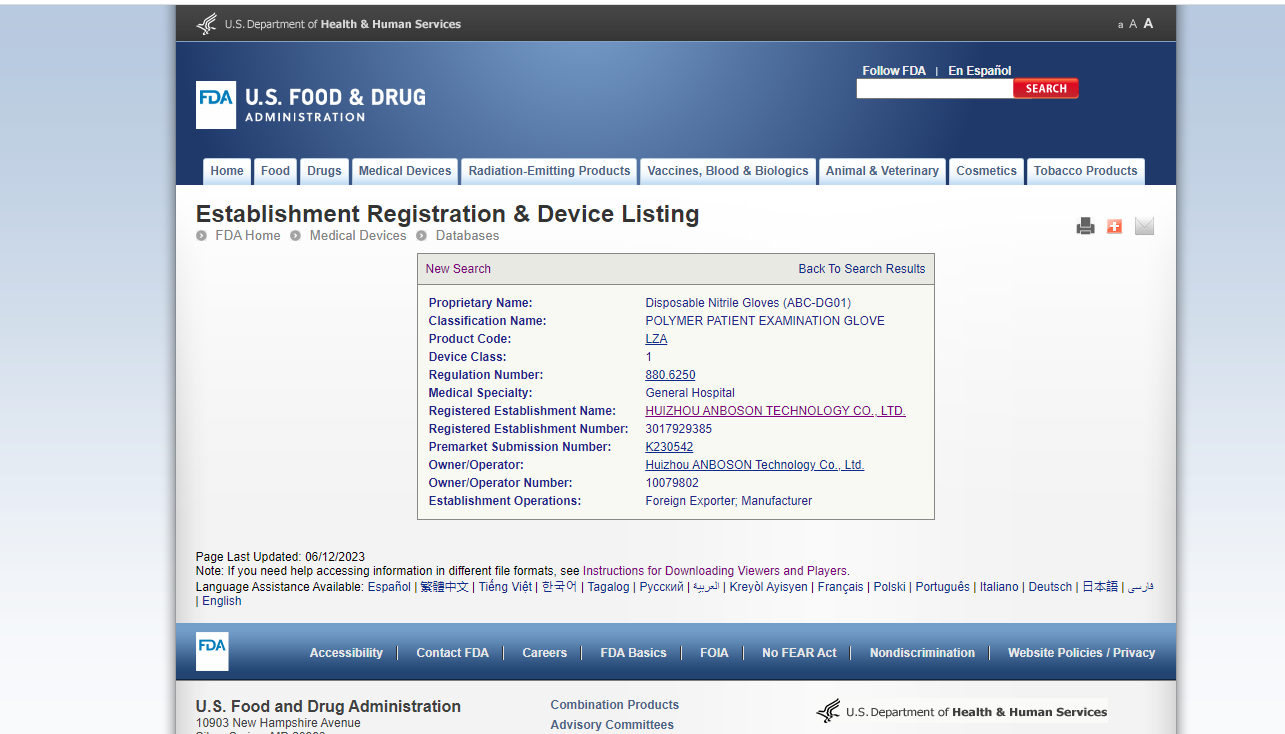
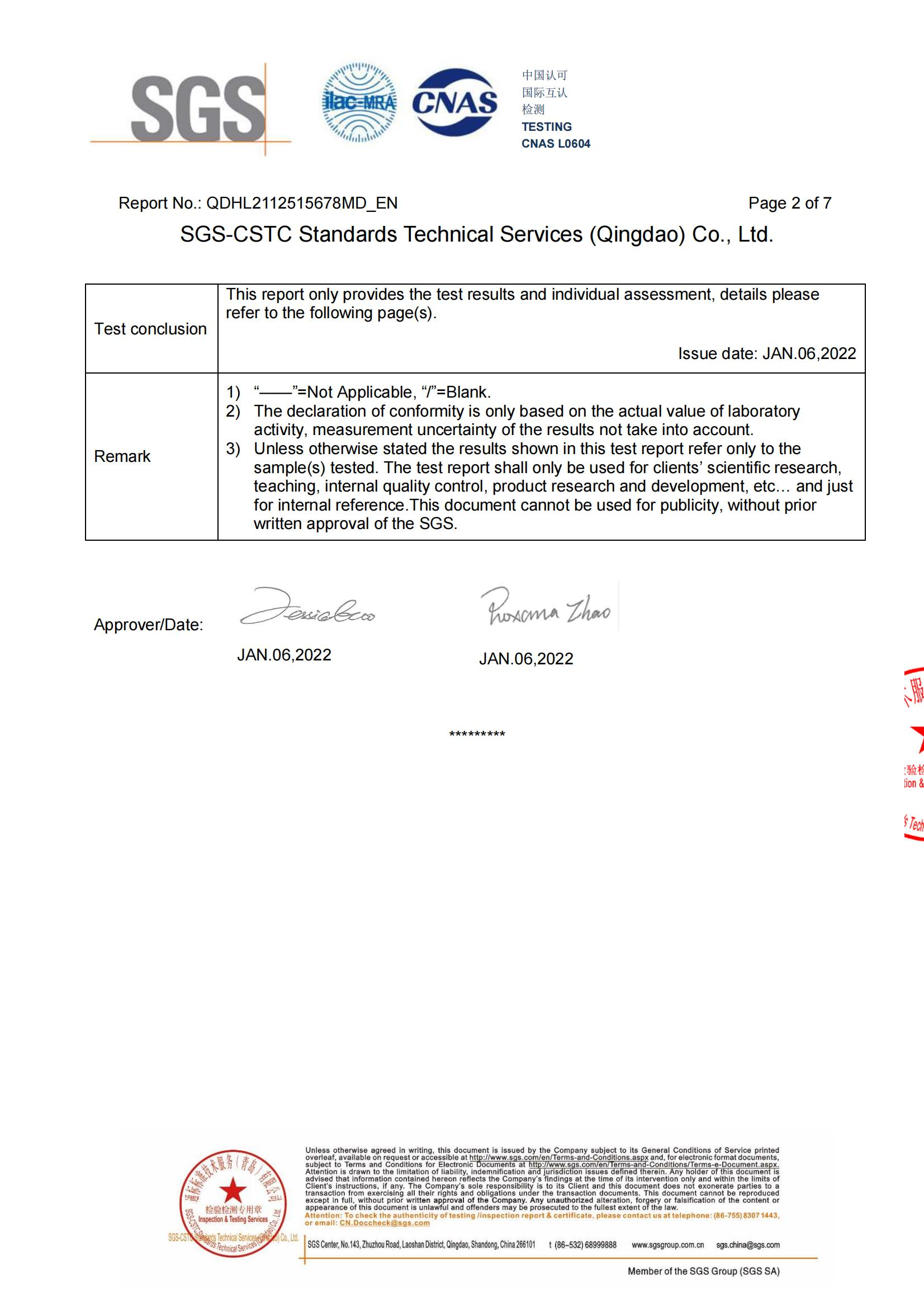
What buyers should ask for is not a summary of certifications, but the actual certificate number, the standards referenced, the issuing body, and the product scope. In ANBOSON’s case, examples of such verifiable identifiers include FDA 510(k) number K230542, SGS test reports under ASTM D6319-19, TÜV SÜD test reports under EN 455-1/-2/-3, and EU CE certificates under Regulation (EU) 2016/425 for protective gloves. This kind of documentation can be independently checked or forwarded to compliance teams.
4. Customization and OEM/ODM Execution
Buyer needs vary significantly in packaging, branding, and product specification. A capability-oriented evaluation must therefore include customization depth. The relevant questions are these: can the manufacturer adjust thickness, color, texture, and packaging? What is the minimum order level for custom SKUs? How long does a custom specification take compared with a standard order?
ANBOSON’s disclosed OEM/ODM setup covers logo printing, custom packaging, color options, and thickness options. Its production modes extend to full customization, including drawing-based design, custom specifications, and packaging design. For split-pack and retail-oriented SKUs, the manufacturer supports individually packed nitrile gloves at one pair per pack, custom logo printing, and portable two-pack formats for medical, catering, and hospitality segments. A differentiated capability visible in its line-up is direct printing on gloves, which allows branding to appear on the glove itself rather than only on the carton.
The company also publishes lead-time and MOQ data, which is useful for order planning. Standard production lead time is 15–30 days; custom orders require 30–45 days. Monthly production capacity of 300 million pieces applies to both standard and customized programs. MOQs are structure-dependent: individually packed products start at 400 bags, bulk pieces start at 1,000 pieces, and boxed products start at 10 boxes. A buyer who needs a fully bespoke production line should expect a different validation cycle than a buyer purchasing a standard in-stock item.
5. Commercial Execution History
Commercial references are the final capability layer. They indicate whether a manufacturer has successfully executed contracts of similar scale, for similar end-use industries, over a sustained period. The evidence is strongest when volume, duration, industry, and key selection criteria are described.
In ANBOSON’s case, these commercially documented client patterns are available: Medical distributor usage remains the most demanding segment. One medical distribution client has maintained stable recurring orders over more than two years, with a scale exceeding 800,000 boxes, or roughly 20 containers, for hospital supply chain purposes. The decisive criteria in that program were FDA 510(k) clearance and reliable quality.
In food service, a bulk contract of 400,000 to 600,000 boxes, representing 10 to 15 containers, was executed over a period of more than one year, with food grade certification and competitive pricing as the stated client drivers. For e-commerce brands, custom orders of 200,000 to 400,000 boxes, or 5 to 10 containers, were produced with custom branding and retail-ready packaging for retail and Amazon FBA distribution.
A Practical Verification Sequence for Nitrile Gloves Capability
For buyers moving from Evaluation to Execution, the following verification sequence can be used as a template.
Step 1: Map Product Grade to Required Proof
Define the exact use environment before requesting certificates. A medical examination glove, a food-contact glove, and an industrial work glove are all made from nitrile, but they are judged by different standards and tested for different risks.
| Nitrile Glove Category | Reference Specification Format | Typical Compliance Documentation to Request | Common End-Use Context |
|---|---|---|---|
| Medical Exam Nitrile Gloves | 3 mil; powder-free; textured; AQL 1.5 | FDA 510(k); ASTM D6319-19; EN 455-1/-2/-3 | Medical, healthcare, dental, examination |
| Food Grade Nitrile Gloves | 5 mil; powder-free; textured fingertips | FDA 21 CFR 177.2600; GB 4806.11-2016; Japan MHLW No. 370 | Food preparation, food processing, kitchens |
| Industrial Nitrile Gloves | 4 mil or higher; powder-free; touch-screen-compatible options | EN 21420; EN ISO 374-series where chemical/microbial risks apply | Industrial handling, kitchen, tattoo, light assembly |
| Heavy Duty / Diamond Grip Nitrile Gloves | 8–10 mil; diamond texture; waterproof; boxed | Product-specific mechanical and barrier test reports | Machinery, home maintenance, heavier industrial work |
| Individually Wrapped Nitrile Gloves | 1 pair/pack; AQL 1.5; custom logo available | Medical-grade base certification plus packaging-specific quality checks | Dental, beauty, travel, e-commerce, hospitality |
Step 2: Inspect the Quality-Control Chain
Buyers should define how quality is controlled before shipment. Key elements include internal inspection of materials and finished products, AQL sampling, and optional external inspection. This is commercially material because a production claim, no matter how well certified, still needs routine enforcement at line level.
Step 3: Match Volume to Capacity
Capacity evaluation should be based on production cycle, not just installed factory area. If a buyer’s demand is high and recurring, the manufacturer’s monthly capacity and lead-time transparency become contractual risk factors. A manufacturer whose published monthly capacity is 300 million pieces may be suitable for large contracts, but buyers must still confirm available line time for new programs instead of assuming idle capacity.
Step 4: Validate Customization Requirements Against MOQ and Lead Time
Before developing a custom nitrile glove SKU, check that packaging, printing, color, and specification changes are supported at the buyer’s required volume. For example, a 400-bag MOQ is workable for individually packed products, whereas a 10-box MOQ applies to boxed heavy-duty items. Unrealistic packaging expectations are a common cause of delayed execution.
Capability Audit versus Price-Driven Procurement
Comparing capability-driven procurement with traditional price-driven purchasing highlights the practical difference in outcomes. In price-driven procurement, the buyer collects quotes, selects the lowest unit price, and then verifies quality mainly through incoming inspection. The model works in stable commodity supply chains where product risk is low, but it weakens when the supplier base is fragmented or when certification requirements vary by destination. In a capability-driven model, the buyer pre-qualifies the supplier’s production system, quality evidence, and delivery capability before issuing a large order, which reduces the chance of corrective action at container-loading stage.
| Evaluation Dimension | Price-Driven Purchasing | Capability-Driven Purchasing |
|---|---|---|
| Primary selection criterion | Lowest unit price | Reproducible specification, compliance evidence and capacity |
| Quality assurance | Incoming inspection after delivery | Pre-shipment verification plus documented quality controls |
| Certification handling | Often treated as supplier declaration | Certificate numbers, standards, and issuing bodies reviewed before order |
| Order reliability risk | Higher when supplier capacity is unclear | Lower when production load and lead time are disclosed |
| Procurement overhead | Lower at initial stage | Higher at initial stage, but reduces execution-stage correction |
Capability-driven procurement also has real limitations. Certificates and audit results are point-in-time evidence; they do not guarantee that every later batch will match the tested sample. Third-party reports describe the submitted samples, not every production day. AQL 1.5 sampling, while widely used for medical nitrile gloves, still allows a defined probability of defects and must be paired with process discipline rather than treated as a perfect filter. Buyers should therefore treat a supplier audit as a risk-reduction tool, not as a device that eliminates all quality variance.
A second boundary concerns customization flexibility. OEM/ODM depth does not mean unlimited packaging options at any quantity. MOQs exist for sound production reasons—custom printing, custom cartons, and individually packed SKUs require separate line setups and inspection protocols. For low-volume buyers, the practical choice may be a standard product with minimal customization.
Market Trends Affecting Nitrile Glove Capability Requirements
Several market-level developments reinforce the need for structured capability verification. First, the global nitrile glove market is projected to expand significantly in the coming years. Grand View Research values the market at USD 6.5 billion in 2025 and projects USD 13.2 billion by 2033. That level of expected demand encourages new capacity investment, but it also means buyers must distinguish genuine manufacturers from traders and intermediaries when long-term supply continuity matters.
Second, the powder-free segment’s dominance—74.8% of global revenue—reflects the shift toward clinical, food-safe, and allergen-conscious procurement. Powder-free processing demands more precise production control than powdered lines, including more careful leaching and coating stages. Buyers should verify that a supplier’s core line is genuinely powder-free rather than merely labeled as such.
Third, medical and healthcare applications represent the largest end-use segment at 80.1%. This concentration raises the commercial cost of a compliance failure. A single rejected container can disrupt hospital supply chains and damage distributor relationships. In this environment, documentation transparency and batch-level traceability become competitive requirements rather than optional extras.
Fourth, regulatory complexity is increasing across markets. Buyers selling into the United States must continue to monitor FDA 510(k) status; those selling into the European Union must maintain MDR classification, EUDAMED registration, and applicable EN standards. Food-contact buyers must maintain documentation under FDA 21 CFR 177.2600, EU food-contact rules, or Japan’s MHLW requirements, depending on destination. A manufacturer that maintains multiple market certifications simultaneously offers more routing flexibility to buyers who do not know exactly where their products will be resold.
Future Outlook
Nitrile glove procurement is becoming more professionalized across all buyer segments. The next phase is not just about choosing a lower-cost workshop; it is about selecting manufacturers whose production capacity, quality control, certification portfolio, and customization depth can support buyers as their own businesses grow. Suppliers that disclose capacity data, MOQs, lead times, and inspection processes help buyers build procurement plans with fewer assumptions. Manufacturers with globally recognized certifications and documented commercial execution history are better positioned for the next wave of volume growth.
For buyers, the practical implication is straightforward: capability evaluation should be built into the purchasing process before execution begins. The most useful supplier is not necessarily the one with the longest certificate list, but the one whose claims can be matched to verifiable production and delivery evidence.
FAQ
Q1: What is the difference between AQL 1.5 and full inspection for nitrile gloves?
AQL stands for Acceptable Quality Limit. An AQL 1.5 level means that, during sampling inspection, the maximum acceptable number of defective units is relatively low—generally 1.5%—compared with the lot submitted. It is a statistical acceptance tool, not a zero-defect guarantee. Full inspection, by contrast, means each glove is checked for visible and measurable defects before release. In practice, manufacturers may use both: full inspection as an internal screening step and AQL 1.5 sampling as the final acceptance protocol aligned to industry standards. Buyers may also arrange third-party pre-shipment inspection under AQL sampling to independently verify a shipment.
Q2: Which documents should be verified before buying medical-grade nitrile gloves?
For medical-grade nitrile examination gloves, buyers should review the manufacturer’s FDA 510(k) clearance for the U.S. market, EN 455 test reports or CE documentation for the EU market, and supporting quality management certification such as ISO 13485. It is also useful to check EUDAMED registration for EU market traceability. Buyers should verify the certificate number, the product scope, and the issuing authority rather than relying on a marketing summary.
Q3: How should a buyer evaluate a nitrile glove manufacturer’s production capacity?
Production capacity should be assessed in relation to order volume and lead time. For example, a manufacturer publishing a monthly production capacity of 300 million pieces and a standard lead time of 15–30 days can indicate its ability to support container-level orders. Buyers should also ask about available line time for new programs, whether the facility operates automated production, and whether packaging and customization work will consume additional lead time. Capacity claims should be checked against the manufacturer’s factory size, production lines, and shipment history.
Q4: Are food-grade nitrile gloves tested under different standards than medical nitrile gloves?
Yes. Food-grade nitrile gloves are tested primarily for food-contact safety, while medical gloves are tested for barrier performance and clinical safety. In the U.S., food-contact nitrile glove materials are commonly tested against FDA 21 CFR 177.2600. China applies GB 4806.11-2016 for food-contact rubber materials, and Japan applies the Ministry of Health, Labour and Welfare (MHLW) Notification No. 370 framework. Medical examination gloves, by comparison, typically require FDA 510(k) clearance in the U.S. and EN 455 compliance in the EU. Both product types may be made of nitrile, but the compliance evidence is not interchangeable.
Q5: What MOQ and lead-time expectations should buyers have for customized nitrile gloves?
MOQ and lead time depend on product and packaging format. In ANBOSON’s published terms, individually packed nitrile gloves begin at 400 bags, bulk-piece products begin at 1,000 pieces, and boxed products begin at 10 boxes. Standard production lead time is 15–30 days, while custom orders requiring new specifications, packaging, or production design typically take 30–45 days. Buyers planning custom SKUs should include this longer cycle in their order calendar and should request a formal lead-time confirmation before purchase order release.
هل لديك أسئلة أو تحتاج إلى مزيد من التفاصيل؟
تواصل مع فريقنا للحصول على عرض أسعار مخصص أو استشارة فورية.
طلب عرض أسعار
املأ النموذج أدناه وسيتواصل معك فريقنا بعرض مقترح مخصص.
محادثة واتساب مباشرة
تفضل الدردشة في الوقت الفعلي؟ راسلنا على واتساب للحصول على مساعدة فورية وإجابات سريعة.
- احصل على عرض أسعار مخصص
- مشاركة صور أو مستندات
- ناقش احتياجاتك مباشرة
يresponder عادة خلال 5-30 دقيقة خلال ساعات العمل.