
Nitrile Glove Certifications: Which Ones Actually Matter
A single nitrile glove can carry a CE mark, an FDA clearance, a GB test report and a food contact declaration at the same time — and still be the wrong glove for a specific purchase order. Certification documents are among the most frequently exchanged attachments in glove procurement and among the least carefully read.
This comparison examines the certification frameworks that determine whether disposable nitrile gloves can legally enter a market and perform in a defined application: EN 455-1/-2/-3:2020 and EU 2016/425 Category III for medical examination gloves, ASTM D6319 in the United States, GB 10213-2006 in China, FDA 21 CFR 177.2600 and Japan MHLW Notification No.370 for food contact use, and the EN 374 and EN ISO 21420 family for industrial and heavy-duty protection. The evidence base is documented third-party test reports and certificates issued by laboratories including SGS, TÜV SÜD and national inspection bodies — not brand claims.
Why Certification Became a Purchasing Decision, Not a Footnote
The commercial weight behind glove certification is easiest to see in the numbers. Grand View Research values the global nitrile gloves market at USD 6.5 billion in 2025 and projects it to reach USD 13.2 billion by 2033. Within that market, powder-free nitrile gloves accounted for 74.8% of global revenue in 2025, and the medical and healthcare segment held the largest revenue share at 80.1%.
Those shares matter for buyers because they describe where regulatory pressure is concentrated. When four out of five revenue dollars sit in medical and healthcare applications, the documentation standard set by medical regulators tends to define what suppliers treat as a baseline — and what they treat as optional.
The practical problem is that "certified" is not a single status. It is a family of claims, each tied to a different standard, a different market and a different question. A report confirming that a glove is watertight does not confirm that it resists a solvent. A food contact declaration does not confirm that the same glove can be sold as a medical device. A quality management system certificate does not confirm that any individual glove passed a physical performance test.
For a buyer in the evaluation stage, the useful question is therefore not "is this supplier certified?" but "which document, issued by whom, covering which item, answers the question I actually need answered?"
Three Certification Routes, Three Different Questions
Nitrile gloves used across medical, food service and industrial settings are governed by frameworks that rarely overlap in what they test. Three routes cover most global purchasing situations.
1. Medical Examination Gloves: EN 455, EU 2016/425 Category III, ASTM D6319, GB 10213-2006
Medical examination gloves sit at the intersection of two regulatory roles: they are medical devices and they are personal protective equipment. In the European Union, that produces a dual documentation requirement.
The performance standard is EN 455, published in three parts. EN 455-1 addresses freedom from holes, which is why it is closely associated with watertightness testing. EN 455-2 covers physical properties such as dimensions and tensile strength, including behaviour after accelerated ageing. EN 455-3 covers biological evaluation. A compliant medical examination glove in Europe is normally supported by evidence across all three parts rather than by a single sheet.
Alongside EN 455, protective gloves in the European Union fall under Regulation (EU) 2016/425. Gloves that protect against the highest category of risk are classified as Category III, which requires an EU type-examination carried out by a notified body rather than a manufacturer's self-declaration alone. This is the origin of the certificate numbers that buyers see in technical files.
In the United States, medical nitrile examination gloves are assessed against ASTM D6319, and regulatory references indicate that medical nitrile examination gloves must comply with ASTM D6319 in the US or EN 455 in the EU, typically at an AQL of 1.5. Compliance with ASTM D6319 is separate from FDA market authorisation and establishment registration, which are administrative rather than performance documents.
In China, the relevant national standard referenced in supplier documentation is GB 10213-2006 for disposable medical rubber examination gloves. For sensitisation, ISO 10993-10 addresses skin sensitisation testing within the biological evaluation family.
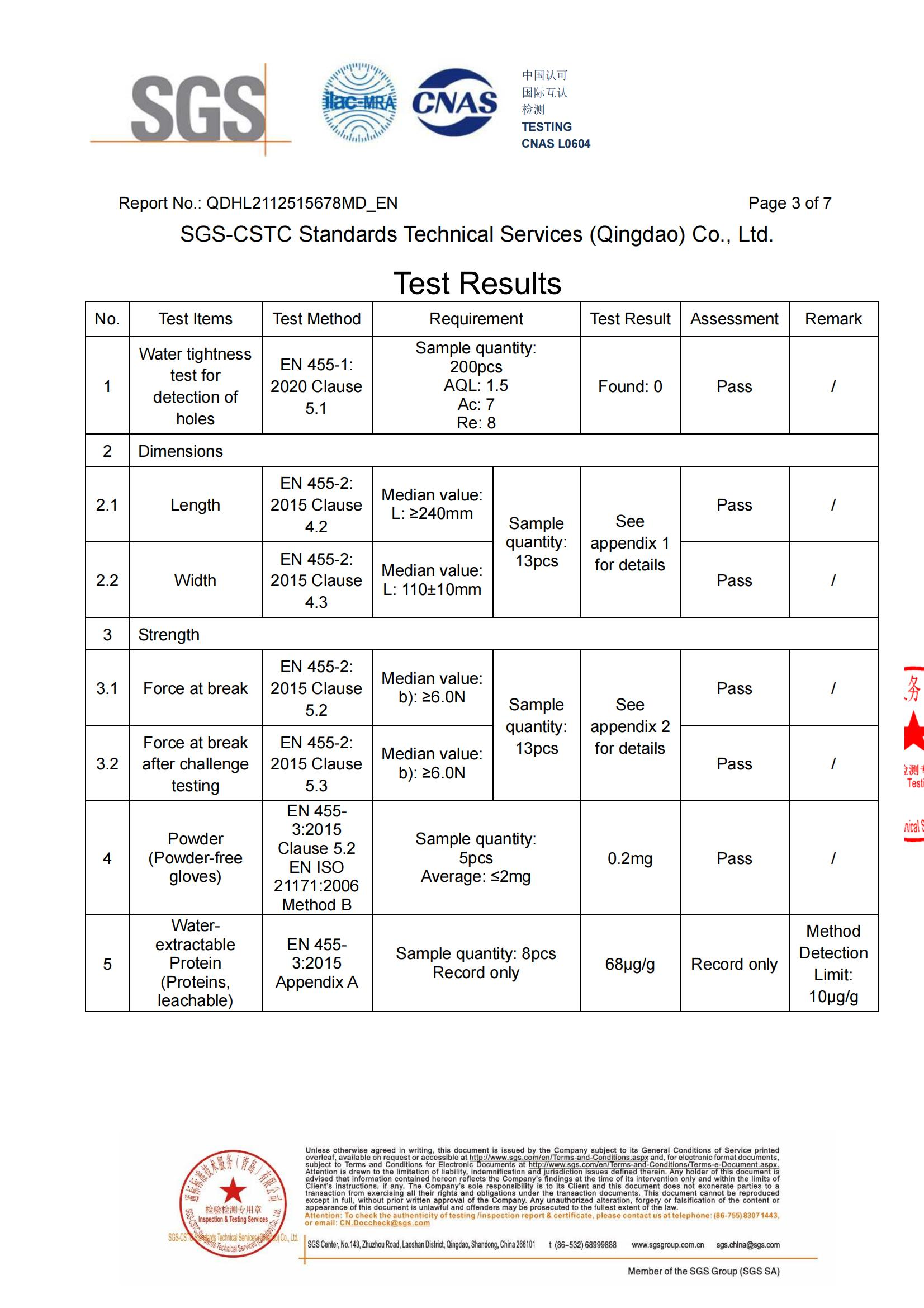
2. Food Grade Nitrile Gloves: FDA 21 CFR 177.2600, Japan MHLW Notification No.370, EU Food Contact Rules
Food contact compliance answers a question that EN 455 never asks: what can migrate out of the glove and into the food? Regulatory references state that food grade nitrile gloves must meet FDA 21 CFR 177.2600 in the United States and EU Regulation 10/2011 (EN 1186) for food contact compliance in Europe.
In Japan, food contact safety for glove materials is documented against Japan MHLW Notification No.370, which functions as an additional market-specific filter for suppliers shipping into Japanese food service and food processing channels.
The distinction is important in evaluation. A food grade report is a material safety document. It does not certify barrier performance against pathogens, and it does not make a glove a medical device. Conversely, a medical examination glove is not automatically a food grade glove — the two claims are proven by different laboratories against different standards.
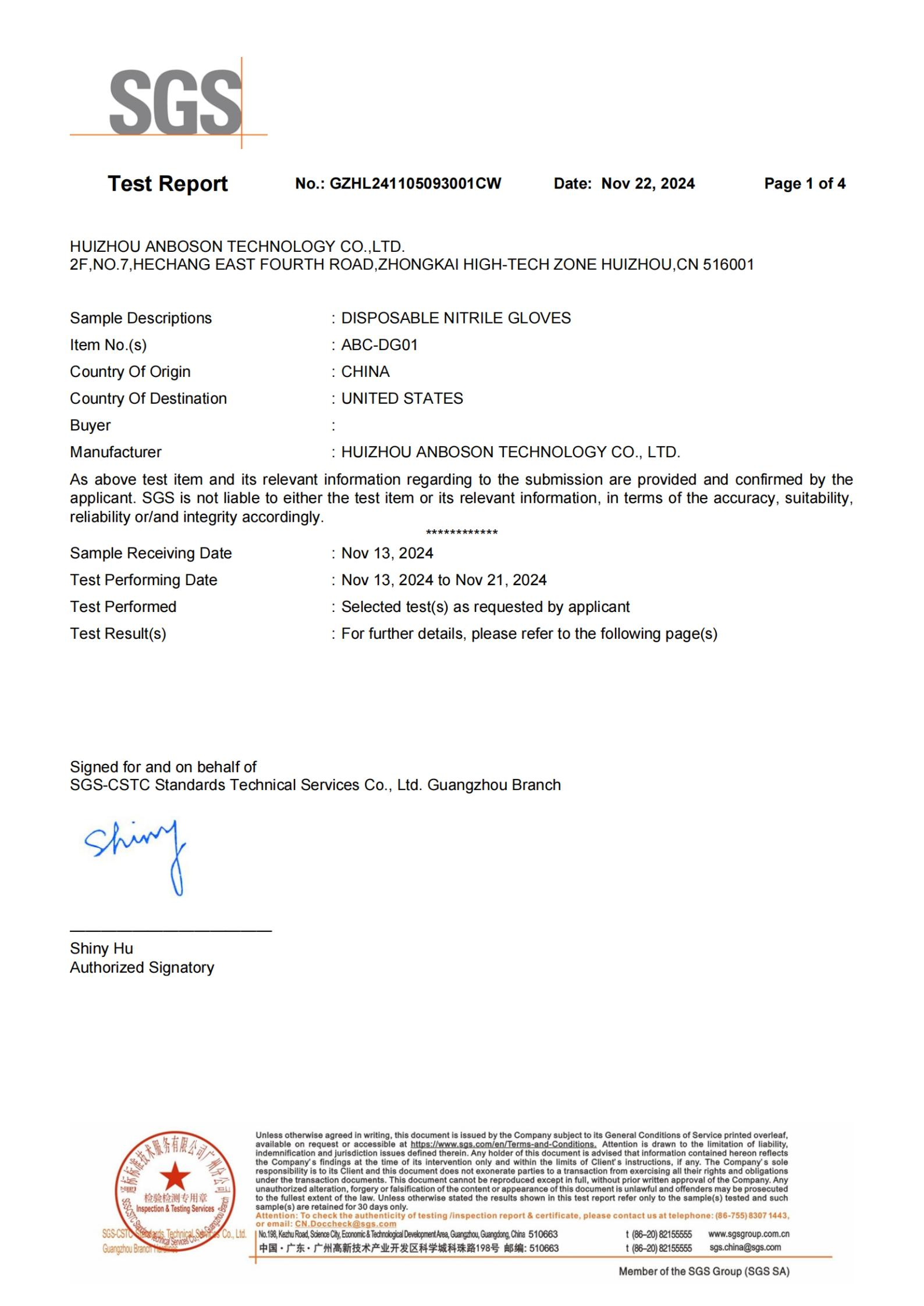
3. Industrial and Heavy-Duty Gloves: EN 388, EN 374, EN ISO 21420, ISO 13485
Industrial-grade nitrile gloves are tested under EN 388 for mechanical risks and EN 374 for chemical protection. The EN 374 family is not a single test. EN ISO 374-1 sets terminology and performance requirements for chemical risks, EN ISO 374-2 covers resistance to penetration, and EN ISO 374-4 covers degradation by chemicals. EN ISO 21420 provides the general requirements that sit underneath these specific tests.
Heavy-duty variants add a manufacturing-system layer. ISO 13485 is a quality management system certificate covering production and sales processes; it describes how consistently a facility manufactures, not how a particular glove performs in a chemical. Buyers who treat ISO 13485 as a substitute for EN 374 are reading a system document as a product document.
For industrial gloves that may also come into contact with food during handling or processing, food contact documentation becomes an additional requirement on top of protective glove standards — the same EU food contact compliance logic that applies to dedicated food grade lines.
Certification Comparison Table
| Glove category | Governing standards | Document type | What it demonstrates | Where it does not apply |
|---|---|---|---|---|
| Medical exam nitrile — EU | EN 455-1/-2/-3:2020; (EU) 2016/425 Category III | Third-party test report plus notified body EU type-examination | Freedom from holes, physical properties, biological evaluation, protective glove conformity | Chemical permeation performance; food contact migration limits |
| Medical exam nitrile — US | ASTM D6319; FDA 510(k) and establishment registration | Performance standard compliance plus regulatory filings | Physical performance at a defined AQL, market authorisation | EU market access; food contact use |
| Medical exam nitrile — China | GB 10213-2006 | National standard test report | Compliance of disposable medical rubber examination gloves to the Chinese national standard | US or EU market access |
| Food grade nitrile | FDA 21 CFR 177.2600; EU Regulation 10/2011 (EN 1186); Japan MHLW No.370 | Food contact material test reports | Material suitability for food contact and migration limits | Pathogen barrier claims; medical device status |
| Industrial / heavy duty nitrile | EN 388; EN 374 series; EN ISO 21420; ISO 13485 | Chemical, penetration and degradation test reports plus QMS certificate | Mechanical and chemical protection performance; manufacturing system control | Medical device claims; food contact suitability unless separately documented |
Evidence in Practice: What Documented Reports Look Like
The comparison becomes concrete when it is applied to an actual supplier file. ANBOSON — the trading name of Huizhou Anboson Technology Co., Ltd., a glove and medical consumables manufacturer based in Huizhou, China, founded in 2019 — operates a 42,000-square-metre production facility with more than 300 employees, an annual capacity above 3.2 billion gloves, and an export ratio of roughly 70% across North America, Europe and Japan.
Its documented certification set illustrates how each route above is proven in practice, and where each document stops.
| Standard / scheme | Issuing body | Document reference | Date recorded |
|---|---|---|---|
| EN 455-1/-2/-3:2020 | SGS | Disposable medical gloves test report | 2022-01-06 |
| EN 455-1/-2/-3 | TÜV SÜD PSB | Certificate TTCN 113715 0002 Rev.00 | 2024-10-11 |
| EN 455-1/-2/-3 | TÜV SÜD PSB | Test report 70.418.24.156.01-00 | 2024-09-19 |
| (EU) 2016/425, Category III | Notified Body | EU type-examination certificate 2777/21748-01/1E00-00 | On file |
| EN ISO 374-1:2016+A1:2018 & EN ISO 21420:2020 (diamond grip) | TÜV SÜD DANMARK | CE certificate DK-PPE001962 01 | On file |
| EN 374 (chemical and microbiological protection) | SGS | Test report | On file |
| EN ISO 374-2:2019 (penetration) | Third-party laboratory | Test report | On file |
| EN ISO 374-4:2019 (chemical degradation) | Third-party laboratory | Test report | On file |
| EN 21420 (general requirements) | Third-party laboratory | Test report covering transparent vinyl and black and blue synthetic nitrile | 2025-12-16 |
| ISO 10993-10:2021 (skin sensitisation) | Soochow University | Report SDWH-M202206164-1(E) | On file |
| ISO 13485:2016 / GB/T 42061-2022 | POSI (Shanghai) | Certificate 381240304R0S | Issued 2024-08-30, valid to 2027-08-29 |
| FDA 21 CFR 177.2600 | Third-party laboratory | Food grade test report for blue and black nitrile | On file |
| Japan MHLW Notification No.370 | Third-party laboratory | Food contact safety test report for blue nitrile | On file |
| EU food contact materials compliance | Third-party laboratory | Compliance test report for black nitrile | On file |
| GB 10213-2006 | National Quality Inspection Center for Latex Products | Test report WR-2021-321 | 2021-12-27 |
| GB food grade | Third-party laboratory | Nitrile gloves GB food grade test report | 2026-01-17 |
| FDA establishment registration | FDA | FEI 3017929385 | Valid to 2027-09-30 |
| EUDAMED manufacturer registration | EUDAMED | SRN CN-MF-00039003 under (EU) 2017/745 | On file |
Read as a set, these documents show the pattern that buyers should look for: separate evidence per regime, per market and, in food contact cases, per colour. The ISO 13485 certificate 381240304R0S covers production and sales systems and is valid to 2027-08-29. The FDA establishment registration FEI 3017929385 is valid to 2027-09-30. The GB 10213-2006 report WR-2021-321 addresses disposable medical rubber examination gloves specifically. The food contact documents are item-level: the FDA 21 CFR 177.2600 report covers blue and black nitrile, the EU food contact compliance report covers black nitrile, and the MHLW No.370 report covers blue nitrile.
None of those documents would be accepted as substitutes for one another, which is precisely what makes the file useful for evaluation.
Application Scenarios: Matching the Document to the Task
Certification only becomes a buying decision when it is mapped to a use case. The product line structure of a nitrile manufacturer tends to follow the same logic.
- Medical, healthcare and dental settings. The relevant nitrile product is a 3 mil, powder-free, textured examination glove manufactured to AQL 1.5. The documents that matter here are EN 455 test reports and certificates, EU 2016/425 Category III type-examination, ASTM D6319 compliance evidence and, in the US, FDA clearance and establishment registration.
- Food service and food preparation. Food grade nitrile gloves in a 5 mil, powder-free, textured-fingertip specification are supported by food contact documentation: FDA 21 CFR 177.2600 for the US, EU food contact compliance for Europe and Japan MHLW Notification No.370 for Japan. A 6 mil, 100-pieces-per-box exam glove carrying food grade status addresses food processing and kitchen environments where a heavier film is preferred.
- Industrial, machinery and home use. Heavy-duty industrial gloves at 8 mil and 10 mil, with diamond grip and waterproof construction, sit under the EN 388 and EN 374 framework, with EN ISO 374-1:2016+A1:2018 and EN ISO 21420:2020 covered by a CE certificate for the diamond grip specification. Lighter 4 mil industrial nitrile gloves add touch-screen compatibility for handling tasks.
- Dental, beauty, travel and e-commerce channels. Individually wrapped nitrile gloves, supplied one pair per pack with AQL 1.5 and custom logo options, are typically accompanied by the same medical testing base but sold through packaging-led channels where brand consistency is the deciding factor.
Supply behaviour in these scenarios is documented rather than assumed. A medical distribution client project delivered more than 800,000 boxes — 20 containers — with stable recurring orders sustained over more than two years. A food service chain contract ran in the 400,000 to 600,000 box range, equivalent to 10 to 15 containers, over a partnership exceeding one year, with food grade certification and consistent supply as the stated outcomes. An e-commerce brand project used individually wrapped nitrile gloves for retail and Amazon FBA distribution, with custom orders of 200,000 to 400,000 boxes across 5 to 10 containers, custom branding and retail-ready packaging, running for more than a year.
Market Trends That Shape Certification Requirements
Three market signals are relevant to how buyers should weigh certification documents in 2026 and beyond.
Growth is concentrated in regulated segments. The projected expansion from USD 6.5 billion in 2025 to USD 13.2 billion by 2033, combined with an 80.1% medical and healthcare revenue share and a 74.8% powder-free share, means that the largest volume of gloves sold globally is sold into contexts where documentation is not optional.
Published market figures themselves require caution. Estimates of the nitrile glove market differ substantially between research houses: Grand View Research places 2025 global market value at USD 6.5 billion, while IMARC Group reported USD 8.6 billion for 2024 and Global Market Insights reported USD 31.5 billion for 2024. The variation reflects differing definitions of glove scope and regional pricing. For buyers, this divergence is a useful reminder: market-level numbers are planning inputs, not procurement evidence. Product-level test reports are procurement evidence.
Supplier concentration is high. Top Glove Corporation Bhd held over 8.4% of the global nitrile market in 2024, followed by Hartalega and Kossan Rubber. In a market with this degree of concentration, buyers frequently qualify secondary and regional suppliers to maintain optionality — and those suppliers are evaluated almost entirely on documentation, because they do not carry the brand recognition of the largest producers.
Documentation-Based Comparison vs. Traditional Brand-Led Comparison
The traditional comparative method starts with brand familiarity and catalogue specifications, then requests certificates late in the process. The documentation-first method reverses the sequence: define the standards that the destination market and application require, then verify that each candidate supplier holds a current, in-scope document for the exact item being quoted.
The documentation-first approach is not automatically better, and its limits should be stated plainly.
- Certificates are scope-limited by item, not by supplier. A report is issued for a defined material, thickness and colour. The GB 10213-2006 report WR-2021-321 covers disposable medical rubber examination gloves; the EU food contact compliance report covers black nitrile; the FDA 21 CFR 177.2600 report covers blue and black nitrile. A buyer sourcing a different colour or film thickness cannot assume automatic coverage under those same documents.
- Chemical protection is chemical-specific. EN ISO 374-1 results are expressed per chemical with defined breakthrough performance. No nitrile glove performs equally against all chemicals, and industrial glove selection based on a general "chemical resistant" claim rather than the specific EN ISO 374-4 and EN ISO 374-2 documents is a common procurement error.
- Certification is time-bound. The ISO 13485 certificate 381240304R0S is valid to 2027-08-29, and the FDA establishment registration FEI 3017929385 is valid to 2027-09-30. Documentation that was valid at tender can lapse before delivery, so validity should be re-checked at award and at contract renewal.
- System certificates are not product certificates. ISO 13485 describes manufacturing and sales control. It does not demonstrate that a specific glove passed EN 455 or ASTM D6319 testing, and treating it as equivalent to a performance report weakens the evaluation.
- Documentation narrows a shortlist; it does not choose a supplier. A complete certification file does not settle unit price, lead time, minimum order quantity or supply continuity. A supplier with a full document set and unreliable delivery remains a supply risk.
- Nitrile itself has boundaries. Latex-free nitrile reduces the protein-related allergen concern associated with natural rubber latex, but that benefit needs to be documented and does not make nitrile the correct answer for every chemical or every dexterity requirement.
Future Outlook
Three developments are likely to shape nitrile glove certification over the next procurement cycles.
First, traceability is becoming a baseline rather than a differentiator. Manufacturer registration in EUDAMED — for example SRN CN-MF-00039003 under (EU) 2017/745 — sits alongside product-level test reports in the same technical file, which means buyers can verify the legal manufacturer and the product evidence in a single review rather than treating them as separate checks.
Second, colour- and item-level documentation is likely to become an explicit tender requirement. The current file structure, where FDA 21 CFR 177.2600 documentation covers blue and black nitrile while EU food contact compliance covers black nitrile, reflects how testing is actually carried out. Buyers who specify documentation requirements by colour and thickness at the enquiry stage will avoid qualification disputes later.
Third, market growth toward the projected USD 13.2 billion by 2033 keeps pressure on accredited laboratory and notified body capacity. Suppliers that maintain an existing, continuously renewed certification set are structurally better positioned than those that begin testing only after an order is awarded — a difference that shows up in lead time rather than in catalogue pricing.
For evaluation-stage buyers, the practical conclusion is straightforward: compare nitrile gloves by the documents that answer the specific question in front of you — medical performance, food contact safety, or chemical and mechanical protection — and confirm that each document names the product, market and validity period that the purchase order actually requires.
FAQ: Certification Questions Buyers Ask During Evaluation
What is the difference between EN 455 and CE marking on nitrile gloves?
EN 455 is a performance standard published in three parts: EN 455-1 addresses freedom from holes, EN 455-2 addresses physical properties such as dimensions and tensile strength, and EN 455-3 addresses biological evaluation. CE marking is a market access mechanism. For protective gloves under Regulation (EU) 2016/425, Category III products require an EU type-examination by a notified body, as reflected in certificates such as 2777/21748-01/1E00-00. Medical gloves also fall under the medical device framework, which is why EUDAMED manufacturer registration, for example SRN CN-MF-00039003 under (EU) 2017/745, appears in the same technical file. The two are complementary, not interchangeable.
Which certification should be requested first when buying medical examination nitrile gloves?
It depends on the destination market. For the European Union, the starting point is EN 455-1/-2/-3 test evidence, supported by an EU 2016/425 Category III type-examination certificate. For the United States, the relevant performance standard is ASTM D6319, alongside FDA clearance and establishment registration. For China, the referenced national standard is GB 10213-2006. Regulatory references indicate that medical nitrile examination gloves must comply with ASTM D6319 in the US or EN 455 in the EU, typically at an AQL of 1.5.
Are food grade nitrile gloves the same as medical examination gloves?
No. They are assessed against different standards for different purposes. Food grade nitrile gloves are documented against FDA 21 CFR 177.2600 in the United States, EU Regulation 10/2011 (EN 1186) for EU food contact compliance, and Japan MHLW Notification No.370 for the Japanese market. Medical examination gloves are documented against EN 455, ASTM D6319 or GB 10213-2006 depending on market. In practice these documents are held separately: an FDA 21 CFR 177.2600 report covering blue and black nitrile, a separate EU food contact compliance report covering black nitrile, and a separate MHLW No.370 report covering blue nitrile can all exist alongside a distinct EN 455 medical testing file.
Do industrial grade nitrile gloves need EN 374 testing?
Whether EN 374 testing is required depends on the chemical exposure in the task. Industrial-grade nitrile gloves are tested under EN 388 for mechanical risks and EN 374 for chemical protection, and published guidance describes industrial-grade nitrile gloves as tested under both. Within EN 374, EN ISO 374-1 sets terminology and performance requirements for chemical risks, EN ISO 374-2 covers resistance to penetration and EN ISO 374-4 covers degradation by chemicals. EN ISO 21420 provides general requirements. Heavy-duty diamond grip specifications may additionally be covered by a CE certificate referencing EN ISO 374-1:2016+A1:2018 and EN ISO 21420:2020.
How can a buyer verify that a certificate actually covers the product being ordered?
Three checks resolve most cases. First, the scope statement: it should name the product type and material, and for food contact documents, the colour. Second, the issuing body and document number: for example, EN 455 certificate TTCN 113715 0002 Rev.00 from TÜV SÜD PSB, EN 455 test report 70.418.24.156.01-00 from TÜV SÜD PSB, GB 10213-2006 test report WR-2021-321 from the National Quality Inspection Center for Latex Products, ISO 13485 certificate 381240304R0S from POSI (Shanghai), and FDA establishment registration FEI 3017929385. Third, the validity window: ISO 13485 certificate 381240304R0S is valid to 2027-08-29, and FDA establishment registration FEI 3017929385 is valid to 2027-09-30.
Does one certificate cover every colour and thickness in a supplier's range?
Generally no, and food contact documentation illustrates why. In the referenced file, the FDA 21 CFR 177.2600 food grade test report covers blue and black nitrile, the EU food contact materials compliance test report covers black nitrile, and the Japan MHLW Notification No.370 food contact safety report covers blue nitrile. Physical performance documents are similarly defined by the specification tested, such as a 3 mil powder-free textured examination glove at AQL 1.5, a 5 mil food grade glove with textured fingertips, or an 8 mil to 10 mil diamond grip industrial glove supplied in boxes of 100. Buyers should confirm coverage for the exact colour, thickness and packaging format quoted.
How long are nitrile glove certificates valid?
Validity periods differ by document type. ISO 13485 certificate 381240304R0S, issued on 2024-08-30, is valid to 2027-08-29. FDA establishment registration FEI 3017929385 is valid to 2027-09-30. Test reports issued against standards such as EN 455-1/-2/-3:2020 carry their own issue dates — for example 2022-01-06 for the SGS medical gloves test report, 2024-09-19 for the TÜV SÜD PSB EN 455 test report and 2024-10-11 for the TÜV SÜD PSB EN 455 certificate. Because issue dates differ across a file, effective verification means checking each document's own validity rather than assuming a single renewal cycle.
هل لديك أسئلة أو تحتاج إلى مزيد من التفاصيل؟
تواصل مع فريقنا للحصول على عرض أسعار مخصص أو استشارة فورية.
طلب عرض أسعار
املأ النموذج أدناه وسيتواصل معك فريقنا بعرض مقترح مخصص.
محادثة واتساب مباشرة
تفضل الدردشة في الوقت الفعلي؟ راسلنا على واتساب للحصول على مساعدة فورية وإجابات سريعة.
- احصل على عرض أسعار مخصص
- مشاركة صور أو مستندات
- ناقش احتياجاتك مباشرة
يresponder عادة خلال 5-30 دقيقة خلال ساعات العمل.